Balancing the risks and benefits of environmental initiatives
Draft Energy Plan Comments Made by Richard Ellenbogen and David Dibbell
The New York Draft State Energy Plan prepared by the New York State Energy Research & Development Authority (NYSERDA) is currently out for comments. I have been describing my comments in a series of articles. This post describes comments submitted by Richard Ellenbogen and David Dibbell.
Ellenbogen Comments
Richard Ellenbogen provided the following biography for his comments.
I am a Former Bell Labs Engineer that has done work on the utility system with NYSERDA and Con Ed. Starting in 1999 I decarbonized my factory and set up monitoring system to track power use. Those measurements resulted in the Public Service Commissions Case 08-E-0751 to reduce power line losses. I was an invited speaker to a PSC Utility Conference in 2008 for that line loss reduction case initiated by Steven Keller based upon my work at the factory. I authored a paper written at the request of Con Ed after a factory visit. I was the Keynote Speaker at the 2023 Business Council of NY Renewable Energy Conference and an invited speaker at the Dutchess County Chamber of Commerce meeting on Energy. I was an early adopter of renewable technologies going back to the 1990’s and decarbonized both my home and my business two decades ago. Between 2006 and mid-2023, the business recycled or repurposed 100% of its waste and sent nothing to a landfill. Over the past 20 years, the factory has generated between 60% and 85% of its electrical energy onsite with a carbon footprint approximately 30% lower than the Con Ed System, even prior to the closing of Indian Point.
Here are the comments submitted by Ellenbogen:
I have been making arguments to Albany for years that touch tangentially on Climate Change but are more centered around what is economically possible based upon the structure of the grid and societal issues. This makes my work directly applicable to the Draft Energy Plan and the Climate Leadership & Community Protection Act (CLCPA). As both an engineer and a business owner, I am very cognizant of the technical issues, but I also have to pay attention to economics if I expect to stay in business. Both issues have been lost in the Energy Plan discussion. In addition, the technical issues are not understood by most policy makers that I have spoken with over the past seven years and costs don’t seem to matter. However, even if New York were to eliminate 100% of statewide GHG emissions, global temperatures would drop by 0.0004 degrees-Celsius but New York State’s expenditures will be into the trillions of dollars. Based on the 35-year experience of Germany the New York attempt to eliminate GHG emissions will fail magnificently. We do not have the solar resource climate of California, the Iberian Peninsula, or Australia.
I have written several papers for the Public Service Commission (PSC) that explain why the current plan will not work. In a 2023 response to 14 questions posed by the PSC I described five issues and offered a viable alternative. In and additionally, the final document explains a plan that will work with presently existing technology. In early 2024 I filed comments I raised additional issues and argued that installing Combined Cycle Natural Gas Generation now and phasing to nuclear over time is a far more cost effective and secure way to power the state than what the CLCPA is mandating. Earlier this year I submitted a viable plan for the decarbonization of the downstate system, starting with Long Island along with justifications for the technologies and relative prices compared to other solutions planned for, tried, or implemented by the state. It will result in a 50% reduction in natural gas usage, a 90% reduction in emissions at the location of every generating plant, and a 76% reduction in emissions across the power sector of NY State. Further, it is not weather dependent and can provide very low carbon dispatchable generation that will support the system. The price tag for Long Island would be in the range of $20 billion, however that is a drop in the bucket compared to the trillions of dollars that the CLCPA will cost.
One of my primary concerns is the premature conversion of all homes to electric heat. Many of the issues mentioned in the following paragraphs would be rectified by the $20 billion plan I previously mentioned but it is way too early to start converting locations to electric heat until cleaner fossil-fired units are in place that will ensure a reduction in GHG emissions.
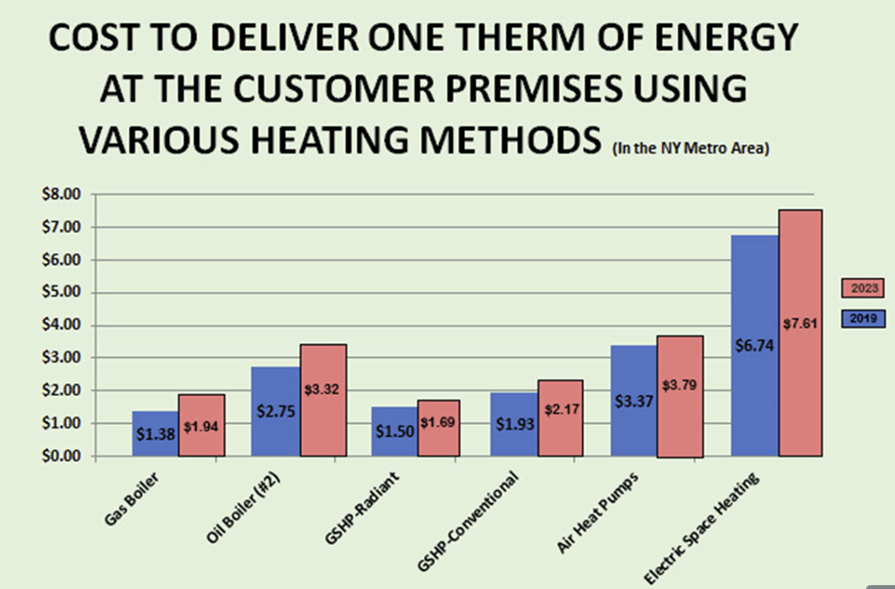
To provide a pictorial view of the issues, below is a graph that I generated for a discussion with NYSERDA (NY State Energy Research and Development Authority) in 2019 that shows the relative costs of various types of heating solutions in the downstate region. NYSERDA confirmed that the numbers matched their analysis. I updated it in 2023 for another presentation. Gas heat was at $1.94 per therm (100,000 BTU) including efficiency losses. An air source heat pump costs $3.79 per therm because of the high cost of downstate electricity relative to gas. One of the reasons that our electricity costs so much is that 90% of the fossil fuel plants in the downstate region are from the 1960’s and 1970’s and are very inefficient. As a result, even if a heat pump has a 300% efficiency but it gets its electricity from a power plant that is 30% efficient, that is only 90% efficient in the best-case scenario. In cold weather, the heat pump efficiencies can drop below 200% and even as low as 100%, so the system wide efficiency can drop to 66% efficient or 33% efficient while a new gas furnace can operate with efficiencies of 90% – 95%. That is why I said that heat pumps can reduce holistic efficiency. Local Law 97 using false metrics to support the plan is dangerous and will likely end up with NY City subject to a class action lawsuit for all the penalty revenue that they collect under the Law.
The solutions that the state is taking to make heat pumps affordable is to provide early adopters with a special utility rate, but that money has to come from somewhere and it is in other ratepayers higher bills. So, if we are talking about affordability, it not only will raise the actual costs for the adopters, but it will raise the bills for the other ratepayers, as well. The utility costs are the tip of the iceberg.
Beyond those are the costs of the conversions. An article in The City about a Brooklyn Co-op that converted to heat pumps illustrates those costs. Tenants had been previously using oil for heat so their operating costs went down, however if they had been using gas, their operating costs would have doubled. Heat pumps for locations with oil make sense but not for locations with gas. The conversion cost mentioned in the article was $50,000 per unit, $40,000 after rebate, but the state will run out of money for rebates in a large program and again, those rebate costs are shouldered by the ratepayers and taxpayers as a fee on their bills, the System Benefits Charge or SBC. At a 6% interest rate over 30 years, that will add $300 per month to the carrying cost of every unit. In a city where 25% – 33% of the residents already pay 50% of their annual income for rent, how is that sustainable? I have been asking that question and no one will answer me. There is also an exhibit in a filing that I co-filed that shows how the number of Con Ed customers in arrears is up 59% since 2019 when the CLCPA was passed. That is going to get far worse as this process proceeds because the state is only at the beginning of its journey and the obstacles here are far larger than they were in Germany.
Despite claims that affordability has been considered in the Draft Energy Plan there are no defined triggers for acceptable cost limits. In the Ontario “Green Transition” lip service to costs caused problems because public support can turn in an instant when they can no longer afford food and rent. The article should be a warning to every politician that is supporting this process. As difficult as that may be to believe, NY State will turn Purple at a minimum and more likely will turn Pink when everyone realizes that they have astronomical utility bills, no environmental benefits to show for it with multiple blackouts and battery fires proliferating in their neighborhoods.
As I tried to explain to the NY State Energy and Telecommunications committee when I addressed them in March, you can’t legislate physics and math and they are trying to do that. It is an unmovable object and trying to move it in any direction will not go well raising costs exponentially. This is supported by the NYISO’s Power Trends 2025 report. Page 9 has the downstate generation pie chart and pages 22 – 25 show the reliability issues. Everything below the black line at “0” is a blackout and they will be extremely likely within a few years. Keep in mind that generating plants take years to build and intermittent renewables will not support the system, especially with the local pushback on siting and moratoriums against them.
The fundamental problem is that the CLCPA is based upon “bad” science that has been disproven. The CLCPA was passed based upon the writings of Bob Howarth who sat on the CLCPA and said that the rise in atmospheric methane emissions was caused by fossil fuel extraction and leaking pipelines. Some experimental scientists scooped methane out of the atmosphere and found that the atmospheric methane is coming primarily from organic decomposition and that the fossil fuel industry is not the primary culprit. The atmospheric carbon has the wrong carbon isotope. They contradict Howarth’s work by name on page 11 of the document.
I agree with Roger Caiazza that even though the Draft Energy Plan messaging claims that stakeholder input will be considered there is no evidence supporting that claim. As a result, even though I could elaborate in far more detail, I am only going to submit this summary of the issues.
Dibbell Comments
David Dibbell is an engineer and project manager, now retired, with a background in facilities engineering, capital projects, energy management, and technical compliance systems in the pharmaceutical and food industries. I am active on the X platform and on WattsUpWithThat.com to communicate science-based material from which one can see that the claims of the climate movement are fundamentally unsound.
The following lists the comments made by Dibbell. I added the figure referenced.
I refer to Figure 48 in Volume II, 16. Pathways Analysis.
This figure depicts the year 2040 outcome of benefits vs. costs for the four scenarios, Current Policies; Additional Action; Net Zero Scenario A; Net Zero Scenario B.
The Costs (blue column) must be incurred for each of these scenarios as expenditures for hard-money assets require. But the speculative Health Benefits and Avoided GHG Benefits (composite column) do not produce a hard money stream of receipts to justify the expenditures for assets to be created to begin with. This is fundamentally imprudent, especially in a multi-faceted energy system on which the State relies for its social and economic well-being.
For the projected Health Benefits, largely relying on PM2.5 reductions, I simply note that the regional trends are such that there will be no conceivable way to confirm a cause-and-effect relationship for whatever health outcomes emerge in the State. There could be improvement unrelated to NY energy systems evolution, or there could be degradation for reasons unrelated to energy systems even if one of the scenarios occurs physically as projected. No one will know. This problem of confounding factors is apparent from the graphs at this EPA website, as air quality data varies within a generally improving trend since 2010.
For the projected Avoided GHG Benefits, a more definite case is made here that there is no perceptible risk from GHG emissions at all, and no attributable harm in the form of storms, floods, extreme conditions, and the like. This implies that the Social Costs per metric ton of CO2 and other GHGs assumed in the analysis are highly exaggerated. See the Social Cost of GHG Mitigation tab in the Pathways Analysis Technical Supplement: Inputs and Assumptions spreadsheet (Annex 1). Any value higher than zero is based on the speculation that climate trends and impacts are driven by these emissions. The analysis in this Draft Plan relies on these Social Cost values as though they were real. This is a fatal error in any serious planning exercise which purports to show costs and benefits with a net benefit to justify the costs.
The scientific material from which it is concluded that there is no risk from GHG emissions is given here in a recent formal comment submitted to the EPA concerning the 2009 Endangerment Finding. Within this comment is a link to a Google Drive folder containing plots, histograms, and a Readme document.
In short, it is demonstrated from the ERA5 reanalysis that the minor increment in the atmosphere’s radiative absorbing power is massively overwhelmed by energy conversion within the general circulation.
Please take this seriously within the NYSERDA, NYPA, and DPS organizations. You have experienced resources on staff that surely know better than to continue on the current path which promotes non-emitting but intermittent wind and solar sources with massive battery support. The NY State administration and legislature should repeal the CLCPA and rescind or avoid any related mandates for vehicles. Start over. Drop the unwarranted concern over “climate” trends and GHGs. Prioritize affordability, reliability, and an ample supply of electricity and fuels for industrial development, transportation, and for the general well-being and safety of the citizens of our State.
Thank you for inviting comments on the Draft 2025 Energy Plan.
Conclusion
I like both sets of comments. Although it is the last minute I encourage readers to submit your own.
I am a meteorologist (BS and MS degrees), was certified as a consulting meteorologist and have worked in the air quality industry for over 40 years. I author two blogs. Environmental staff in any industry have to be pragmatic balancing risks and benefits and (https://pragmaticenvironmentalistofnewyork.blog/) reflects that outlook. The second blog addresses the New York State Reforming the Energy Vision initiative (https://reformingtheenergyvisioninconvenienttruths.wordpress.com). Any of my comments on the web or posts on my blogs are my opinion only. In no way do they reflect the position of any of my past employers or any company I was associated with.
View all posts by rogercaiazza




 Pragmatic Environmentalist of New York