

The New York Independent System Operator (NYISO) has released its 2025-2044 System & Resource Outlook (Outlook). It’s a long-term planning assessment that finds New York will need “substantial new investment in reliable generation and transmission infrastructure to serve growing electricity demand and state policy targets.” The report supports my contention that the rapid electric system transition to a zero‑emissions grid mandated by New York politicians is technically and institutionally constrained, and that reliability can be put at risk if policy timelines outrun feasible infrastructure and resource development.
I am convinced that implementation of the Climate Leadership & Community Protection Act (Climate Act) net-zero mandates will do more harm than good if the future electric system relies only on wind, solar, and energy storage because of reliability risks, unacceptable costs, and adverse environmental impacts. I have followed the Climate Act since it was first proposed, submitted comments on the Climate Act implementation plan, and have written over 650 articles about New York’s net-zero transition. The opinions expressed in this article do not reflect the position of any of my previous employers or any other organization I have been associated with, these comments are mine alone. I acknowledge the use of Perplexity AI to generate summaries and references included in this document.
Background
The NYISO is responsible for electric resource planning for New York State. The Comprehensive System Planning Process (CSPP) consists of four components: the Local Transmission Planning Process (LTPP), the Reliability Planning Process (RPP), the Economic Planning Process, and the Public Policy Transmission Planning Process. My particular interest is the RPP.
Last December a NYISO update on the CSPP described the Reliability Planning Process. It is a two‑year process that starts in even years and has two components. The Reliability Needs Assessment (RNA) “evaluates the adequacy and security of the Bulk Power Transmission Facilities (BPTF)
over a seven-year Study Period (years four through ten of the next ten years) and identifies Reliability Needs defined as violations of Reliability Criteria” established by regulatory authorities. The second component is the System & Resource Outlook that is developed in the years between RNA.s It includes the following:
- 20-year study of system and congestion
- Identifies, ranks, and groups congested elements
- Assesses the potential benefits of addressing the identified congestion
- Provides information to developers and marketplace regarding future challenges in the New York power system
The current analysis covers 2025 to 2044, so it must consider the transition requirements of the Climate Act. NYISO’s long‑term scenarios show that reaching very high levels of zero‑emissions generation is a serious challenge. This post is an overview of the Outlook emphasizing key insights and recommendations.
NYISO Summary and Key Findings
The press release provides a good overview of the Outlook.
The Outlook is a scenario-based planning study intended to help policymakers, regulators, market participants, and developers understand how different policy choices can shape New York’s future resource mix, transmission needs, system costs, and reliability risks over the next 20 years.
Key findings from the Outlook include:
- New York’s electricity demand is expected to grow over the next two decades, driven by electrification and emerging large loads that increase total energy needs and reshape when and where demand occurs.
- All scenarios require significant new generation, and policy-driven scenarios require far more installed capacity than exists today to reliably meet demand.
- Transmission capability is increasingly central to system performance, public policy achievement, congestion reduction, and the ability of new resources to serve consumers.
- The Outlook also shows that the final increments of emissions reductions carry the greatest infrastructure challenges. Scenarios that move from 95 percent to 100 percent emissions-free electricity require substantially more investment in replacement resources and anticipate technologies not yet available at commercial scale. By comparison, other scenarios that also lower emissions significantly do so with much lesser investment in generation and transmission.
These analyses compare alternate projections of policy mandates against a business as usual or base case. NYISO describes the modeling scenarios:
The Outlook is structured around three groups of scenarios that represent the various futures evaluated in the Outlook. The Base Case is a reference future that aligns with the NYISO’s Reliability Planning Process assumptions1 to define the load, generation, and transmission assumptions. The Contract Case builds on the Base Case by adding generation projects with financial commitments (e.g., NYSERDA and offshore wind REC contracts) and approved transmission projects, as well as incorporating projected fossil retirements, to evaluate near-term system conditions as renewables come online and aging thermal units exit. The Policy Case, which includes eighteen scenarios, reflects relevant state policy targets by modeling pathways to meet (existing or delayed) targets like 70% renewables and 100% zero-emissions electricity and evaluates alternative resource mixes—including potential new nuclear and/or fossil—to assess progress toward policy achievement and resulting system conditions.
The Outlook selects two core policy scenarios for detailed production‑cost analysis: one “Higher” pathway that reaches a fully zero‑emissions grid by 2044 and one “Baseline/Policy‑limited” pathway that only achieves roughly mid‑90s percent zero‑emissions by 2044.
Resource Planning
My primary Climate Act implementation concern is the disconnect between the naïve presumption of Climate Act authors that the zero emissions electric system transition was only a matter of political will because the technical, logistical, and economic challenges were small and the reality that those challenges are enormous. I do concede that at the time the Climate Act was written there was no expectation of significant load growth but that is only one aspect of the problem The Outlook outlines the real challenges and the approach:
Meeting New York’s future electricity needs will require a significant transformation of the generation fleet, driven by rising demand, evolving policy requirements, and the retirement of existing fossil generation. As conditions evolve, ensuring that sufficient energy and capacity resources are available to serve load becomes increasingly complex. In particular, tradeoffs emerge between the pace, scale, and timing of new resource development, the types of resources available, and the ability of those resources to meet both energy needs and firm capacity requirements across the system.
To explore these dynamics, the Outlook evaluates a range of potential resource pathways that reflect differing assumptions about policy achievement, development pace, and system conditions. These scenarios are not intended to predict a single outcome but rather to illustrate how different combinations of demand, policy, and resource availability can produce materially different system outcomes—and to highlight the implications of those differences for future grid planning.
NYISO explicitly uses alternative futures (including “Higher Demand” and scenarios with advanced nuclear) to highlight that different combinations of resources can hit similar CO₂ outcomes but with very different reliability and feasibility profiles. That is an important distinction. The statute and agency rhetoric treat “100% zero emissions” as a single, deterministic path in their plans. In practice resource mix and infrastructure choices matter enormously.
Resource adequacy and reliability risk
The Outlook focuses heavily on resource adequacy through 2044 and shows that preserving reliability under Climate Act‑consistent trajectories depends on how quickly firm capacity is replaced as fossil units retire. NYISO’s analysis indicates that without sufficient dispatchable zero‑emissions resources and/or substantial new nuclear or long‑duration storage, the system faces tighter margins and greater risk, especially under higher load or stressed conditions.
NYISO also examines scenarios where demand is higher and weather or electrification trends deviate from planning baselines, and under those cases the resource and infrastructure requirements to keep reliability within criteria become much more challenging. A long‑standing theme of this blog is that “electrify everything” plus aggressive fossil retirements is a reliability problem, not merely an emissions accounting problem. Electric systems must be built around reliability during peak demand. One of my primary concerns with the Climate Act renewable energy mandates is weather variability because the conditions that characterize the highest loads also have the weakest expected wind resource availability. The Hochul Administration’s planning has emphasized central forecasts and has yet to grapple with the specific challenges associated with extreme cases.
Limits of “100% zero emissions” portfolios
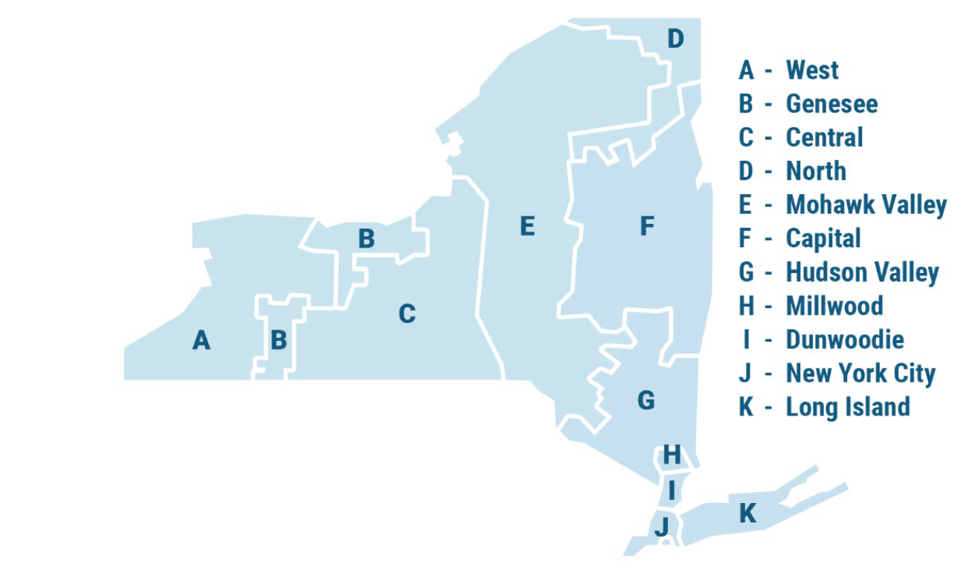
The document notes that alternate scenarios can achieve CO₂ reductions comparable to “100% zero emissions” portfolios while using different mixes of nuclear, storage, and renewables. NYISO explicitly discusses an “Alternate” path and advanced nuclear build‑out with up to 5 GW, limited to Zones A, B, C, and E (Figure 1) as ways to provide firm, clean capacity that ease system stress compared to strictly constrained portfolios.
Figure 1: NYISO New York Control Area Load Zones
Source: NYISO 2025-2044 System & Resource Outlook
Those scenario results essentially validate my arguments that insisting on specific technologies (or excluding others) is a policy choice layered on top of the emissions objective, and that some technology‑constrained paths are significantly more brittle from a reliability and cost perspective. The Outlook’s willingness to model advanced nuclear as a serious resource option contrasts with the Climate Act mandate and lends technical credibility to my arguments about the need for firm zero‑emissions capacity beyond intermittent renewables.
The Outlook finds that “policy design significantly impacts the scale of new resource development”. For example. “Outlook scenarios without clean energy targets require approximately ~10–35 GW, scenarios with relaxed or partial zero-emissions scenarios require ~30–60 GW, and scenarios targeting a fully zero-emissions system require substantially higher additions— approaching ~105 GW of new resources by 2044 under higher demand conditions. The difference in costs for all the new resources necessary for zero emissions versus costs for the relaxed emission scenarios relative to the differences in emissions should be an energy policy discussion point. Furthermore, relaxed emission scenarios eliminate the need for developing hydrogen-fueled generation capacity and infrastructure development that the Outlook estimates at upwards of 30 GW.
Infrastructure, siting, and transmission constraints
NYISO’s long‑range analysis implicitly underscores how much new transmission and bulk infrastructure is required to move large quantities of upstate renewable and nuclear output to downstate loads, and to integrate storage at scale. The scenarios with substantial new nuclear and renewables in upstate zones make clear that geography, siting limits, and zonal restrictions are binding constraints, not footnotes.
By identifying zonal limits NYISO is effectively quantifying some of the siting and societal impacts that disproportionately impact Upstate New York. The Outlook notes:
Downstate capacity requirements continue to shape where firm resources are needed. Because the highest and most constrained load centers remain in downstate New York, locational capacity requirements continue to drive firm and dispatchable resources near those areas. Even in futures with substantial upstate renewable development, additional firm capacity is often needed closer to load centers to satisfy capacity requirements that cannot be met through statewide totals alone.
Resource availability assumptions create a persistent tension between where clean energy is most developable and where it is most needed. Land-based wind and utility-scale solar are more available in upstate zones, while demand remains concentrated downstate. This creates a recurring planning challenge. The system may have strong opportunities to add clean energy where development potential is greatest, but it still requires transmission capability and additional downstate resources to ensure that energy and capacity can serve load.
This supports my concerns that Climate Act implementation treats land use, transmission corridors, and community opposition as solvable details, whereas the system modeling shows they materially shape feasible resource portfolios.
Recommendations
NYISO finds that growing demand and planned fossil retirements mean the system needs “substantial new investment in reliable generation and transmission infrastructure” across all futures. They recommend prioritizing timely development of new resources, especially in policy driven scenarios that require much more installed capacity than exists today.
A central recommendation is to “establish a viable path for the development of resources capable of providing firm capacity and operational flexibility as the generation mix evolves,” explicitly recognizing the need for dispatchable, firm resources even in highly decarbonized futures. NYISO also calls for coordinating the timing of resource additions, repowering, and retirements to reduce transition risk and avoid tightening system conditions during the Climate Act transition.
On the transmission side, the Outlook urges targeted enhancements to increase transfer capability across the Central East interface (e.g., dynamic voltage support) and bulk transmission upgrades to support zero emissions generation development in Northern New York. These are framed as necessary to reduce congestion, improve deliverability, and allow new renewables and firm resources to actually serve downstate load.
Conclusion
The NYISO recommendations address my concerns that: (1) reliability requires firm capacity (DEFRs or equivalent), not just wind/solar/storage; (2) the timing of retirements versus new builds is critical; and (3) transmission constraints are central to Climate Act implementation feasibility, and (4) it is long past time that a feasibility analysis be completed to define New York’s energy future. NYISO’s call for “a viable path” for firm resources and its acknowledgment that policy driven zero emissions futures demand far more capacity than today are similar to my warnings about the DEFR gap and the risk of retiring peakers without firm backup. Until Climate Act implementation policy aligns with the NYISO Outlook the risks of reliability problems is a serious concern. The difference in costs for all the new resources necessary for zero emissions versus costs for the relaxed emission scenarios relative to the differences in emissions for the two approaches should be an energy policy discussion point.

