No to an “All of the Above” Energy Policy

Both New York Democrats and Republicans are embracing an all-of-the-above Climate Leadership & Community Protection Act (Climate Act) energy strategy that includes a role for wind and solar because it provides a “diversity of generation sources”.  I believe that wind is useless and solar should only be used on-site to reduce a structure’s energy use, so I have wanted to respond to this for a while.  However, providing an easily understood comprehensive explanation why dependency on wind and solar is flawed has given me pause.  Richard Lyon has written up exactly what I needed and this article describes his series of posts describing the core arguments of his forthcoming book The Energy Trap: Why the Renewable Energy Transition Can’t Work — And What Can.

I am convinced that implementation of the Climate Act net-zero mandates will do more harm than good if the future electric system relies only on wind, solar, and energy storage because of reliability and affordability risks. The opinions expressed in this article do not reflect the position of any of my previous employers or any other organization I have been associated with, these comments are mine alone.

Overview

The Climate Act established a New York “Net Zero” target (85% reduction in GHG emissions and 15% offset of emissions) by 2050.  The Climate Action Council (CAC) was responsible for preparing the 2022 Scoping Plan that outlined how to “achieve the State’s bold clean energy and climate agenda.” In 2025, the State Energy Planning Board approved the 2025 Energy Plan that “provides broad program and policy development direction to guide energy-related decision making “.  The documents did not provide a complete, transparent accounting of the total costs to achieve the Climate Act mandates or a feasibility analysis that demonstrated that the proposed dependency on renewable energy would provide safe and adequate electricity.

Wind and solar are intermittent, diffuse, and correlated. I believe that those physical realities preclude their use as the backbone of New York’s electric system.  Explaining why those characteristics and others make a renewable energy transition impossible is a challenge, however.  Richard Lyon has provided the necessary documentation by describing his forthcoming book at The State of Britain Substack.

He is a former senior oil and gas operations manager with 35 years of international experience, and academic qualifications in electrical engineering and power systems, petroleum engineering, and energy economics. 

His series of posts: “walks through the core arguments of my book The Energy Trap: Why the Renewable Energy Transition Can’t Work — And What Can. Each post is self-contained, but they build on one another”. He suggests starting at the top and once you’ve read them all, use this page is your reference.  In this article I quote each post with some comments.

Renewables Cannot Work – Physics

Every electrical engineer has told me straight up that renewables won’t work because “physics”  In Chapter 1 — The Physics of Energy Lyons provides an analogy that explains why they all say that:

There is far more heat energy in a swimming pool than in a pan of boiling water. You can boil an egg in the pan. You cannot boil an egg in the pool. And if you doubled the size of the pool, you’d double the energy available — and still have a cold, raw egg.

This is not a riddle. It is the single most important concept in the energy debate, and almost nobody making energy policy understands it.

The difference is not quantity but quality: the gradient between hot and cold that makes work possible. This chapter introduces the three physical measures — energy gradient, energy density, and areal power density — that determine whether an energy source can sustain industrial civilisation. Every successful transition in history moved up on all three. The proposal to replace gas and nuclear with wind and solar reverses the direction.

When I said that renewables won’t work because they are diffuse, energy density is an example of that problem.  Lyons goes on to explain two other physical constraints:  gradient or the difference in energy availability  and power density or the amount of energy that can be extracted from a given area.  The weather related impacts that wind and solar are intermittent and correlated compound these issues.

Renewables Cannot Work – Chemistry

I always want to ask people who want to ban fossil fuels if they want to ban the use of fossil fuels for energy generation and as feedstock to society  In Chapter 2 — The Industrial Metabolism Lyons shows why we are not ready to go completely off fossil fuels.

Steel, cement, ammonia, and plastics: four materials that hold up virtually everything. Each requires hydrocarbons not merely as a fuel but as a chemical feedstock — the carbon and hydrogen atoms become part of the product itself. Electricity is an energy carrier, not a fuel, and each conversion from one to the other loses energy. “Electrify everything” is a slogan that ignores the chemistry. The industrial core of civilisation will continue to require hydrocarbons for the foreseeable future.

Renewables Life Cycle

New York’s Climate Act accounting mandates the life cycle of fossil-fired infrastructure be considered but ignores the life cycle of renewables.  In Chapter 4 — The renewables paradox Lyons eviscerates that approach:

The number that matters is not how much energy a turbine produces, but how much is left over after the system has fed itself. Add storage, grid infrastructure, and fossil-fueled backup to the headline figures and the system Energy Return on Energy Invested (EROEI} drops into the danger zone of the energy cliff — where small errors in the ratio can be civilisation-ending. The IEA calculates that onshore wind requires nine times more critical minerals than a gas plant, offshore wind thirteen times more. Every link in the supply chain is a hydrocarbon operation. And because wind and solar wear out in 20–30 years while a nuclear plant runs for 60–80, the entire system must be rebuilt two or three times within the life of the conventional plant it replaces.

Magical Solutions

Looking back at the Climate Act Council deliberations during the development of the Scoping Plan there was great faith in the ideas that energy efficiency would provide significant benefits, that hydrogen could replace fossil fuels for hard to electrify applications among other things, and that reducing energy use would not affect the economy  Lyons addresses these ideas in Chapter 5 — The escape hatches.

Three reasons for believing the transition can still work — efficiency, hydrogen, and decoupling — and why none of them survive the evidence. Efficiency triggers the Jevons Paradox: cheaper energy use produces more use, not less, and economy-wide rebound effects typically exceed 50%. Hydrogen is an energy carrier with a round-trip efficiency of 30–40%, requiring infrastructure that would need to be largely rebuilt from materials resistant to hydrogen embrittlement. And decoupling — the claim that GDP can grow while energy use shrinks — has never been achieved by any country except through recession or near-stagnation. The escape hatches are closed.

Economics

Richard Ellenbogen constantly points out to me that renewable energy proponents do not understand the economics of infrastructure development.  In Chapter 6 — Energy and your money Lyons points out that there is a more fundamental economic problem.

Money is a claim on future energy conversion. When the money supply grows while the energy supply contracts, each unit of money claims less — and what follows is not a policy choice but an arithmetic certainty. McKinsey estimates the transition at $275 trillion, or 7.5% of global GDP, likely an underestimate. No government can raise that from taxation, so the unspoken plan is to print it. But you cannot print energy. Since 2008 the global economy has added roughly $200 trillion in debt against a contracting energy supply. Every pension, every bond, every mortgage is a promise that the energy to honour it will be there. The physics says it will not.

Oil Depletion

I am not as pessimistic about oil depletion as Lyons.  In Chapter 3 — The depleting oil inheritance he argues:

Not all oil is equal. A barrel of Saudi crude costs $10 to extract and returns over 30:1 on energy invested. The Canadian oil sands yield bitumen so heavy it must be mined or melted with steam. Conventional crude peaked around 2006; the shale boom that appeared to disprove peak oil was financed by $28 trillion in central-bank balance-sheet expansion and was cash-flow negative for over a decade. Discovery peaked in the 1960s at roughly 50 billion barrels a year; in 2024 the world discovered under 2 billion while consuming 30 billion. Oil is the bridge fuel that builds the new energy system while keeping us alive: we can’t squander a single barrel on replacements that can’t work. It’s running out.

I am optimistic because when there were similar historical constraints solutions were found and I expect that to continue.  For example, if we simply exploit resources we know exist, like New York’s shale gas, that are off limits now for irrational reasons, then there will be additional resources.  Despite my optimism the fact is that transforming to a new energy system is an enormous challenge that will take decades.  I agree that we should not be squandering oil.

The Solution

Energy system realists have argued for a long time that society needs a rational discussion of the future energy system and that always includes a nuclear power component.  Lyons addresses this in Chapter 7 — Forging a new realism.

The energy trap: the renewable transition is consuming the very hydrocarbon surplus needed to build whatever comes next. The only proven way up the quality ladder is nuclear — two million times the energy density of coal, power density matching gas, sixty to eighty years of operation from a one-time construction investment. Even so, a gap of decades is unavoidable while the new system is built. A seven-point blueprint — start with the physics, protect the inheritance, fast-track nuclear, eliminate demand, redirect subsidies, anchor money to energy, trust the public with the truth — offers a framework for navigating a managed descent rather than an unmanaged collapse.

Discussion

Taken together, Lyons’ work makes it clear that an “all of the above” energy policy is not prudent policy  but a way to avoid addressing hard physical and economic limits. His articles show that modern society depends on high‑quality, high‑density energy sources that deliver large surplus energy after the system feeds itself.  He shows that utility‑scale wind and solar move us away from that path and toward the energy cliff once storage, backup, and grid costs are honestly counted. At the same time, fossil fuels remain indispensable chemical feedstocks for steel, cement, ammonia, plastics, and broader societal needs.  They cannot simply be swapped out by electricity or slogans like “electrify everything.” In that light, “all of the above” becomes a dangerously vague invitation to waste our finite fossil fuels on low‑return projects, under build nuclear, and pretend that efficiency, hydrogen, and using less energy while still growing the  GDP will magically close the gap.  New York must commit to physically credible options with nuclear at the center and stop making believe that wind and solar should be included.

Conclusion

As an outsider with no concerns about appeasing the special interests foisting wind and solar energy upon New York, I can stop pretending that an “all of the above” energy policy is appropriate.  In the series of posts that Richard Lyon uses to describe his forthcoming book The Energy Trap: Why the Renewable Energy Transition Can’t Work — And What Can he clearly explains why utility-scale and wind and solar are a distraction for a rational energy policy.  Besides the intractable problems described here, there are enormous costs and scandalous environmental impacts related to wind and solar energy resource development.  It is time to just say no.

NYISO 2025 Renewables Summary

I recently published an article about cold weather operations in New York during the most extreme cold weather episode that described other articles I wrote that addressed the impacts of the cold weather.  This article describes the New York Independent System Operator (NYISO) summary of the renewable energy covering all of 2025 for the New York Control Area (NYCA)

I am convinced that implementation of the Climate Leadership & Community Protection Act (Climate Act) net-zero mandates will do more harm than good if the future electric system relies only on wind, solar, and energy storage because of reliability and affordability risks. The opinions expressed in this article do not reflect the position of any of my previous employers or any other organization I have been associated with, these comments are mine alone.

Overview

The Climate Act established a New York “Net Zero” target (85% reduction in GHG emissions and 15% offset of emissions) by 2050.  Among its interim 2030 targets is a 70% renewable energy electricity mandate and 100% zero emissions electric generation in 2040.  These mandates presume reliance on wind and solar.  I believe that the poor wind and solar resource availability described in this post make it impossible to achieve the aspirational renewable mandates and continue to provide safe and adequate electricity.

Electric systems must be built around reliability during peak demand.  One of my primary concerns with the Climate Act weather-reliant renewable energy mandates is correlated weather-dependent resource variability because the conditions that characterize the highest loads also have the weakest expected wind resource availability.  That makes electric resource planning for reliability during the peak period especially challenging. 

NYCA Renewables 2025

Cameron McPherson, NYISO Senior Operations Analysis & Services Analyst, presented the following document at the NYISO Installed Capacity Working Group (ICAPWG}and Market Issues Working Group MIWG meeting on April 8, 2026.  There are five sections in the presentation:

  • Wind Performance
  • Behind the Meter (BTM) and Front of the Meter (FTM) Solar Performance
  • Real-Time Market Curtailments
  • Coincident Wind and Solar
  • Load Ramps

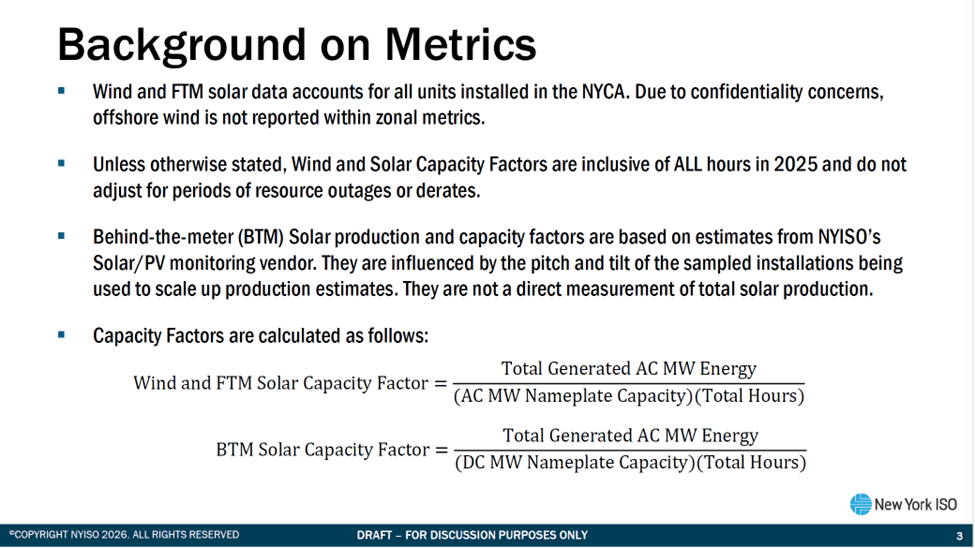
Slide 3 in the presentation (Figure 1) documents the metrics used.  Offshore wind data is not reported because there is only one active facility and NYISO does not report individual unit information.  Past presentations and datasets are also available, Annual Renewable Presentations and hourly data sets from prior years can be found at the this primary link ant the locations below.

  • BTM Solar Information is available under ‘Links’
  • Annual Wind and Solar Information is available under ‘Reports’

Figure 1: Slide 3 from NYCA Renewables 2025

Source: NYCA Renewables 2025

I am not going to describe all the material in the presentation.  I will limit this to the overviews of solar and wind, and the annual and monthly capacity factors for the renewable energy resources.  There is much more interesting information in the presentation, so I encourage you to read the document.

NYCA Wind Performance

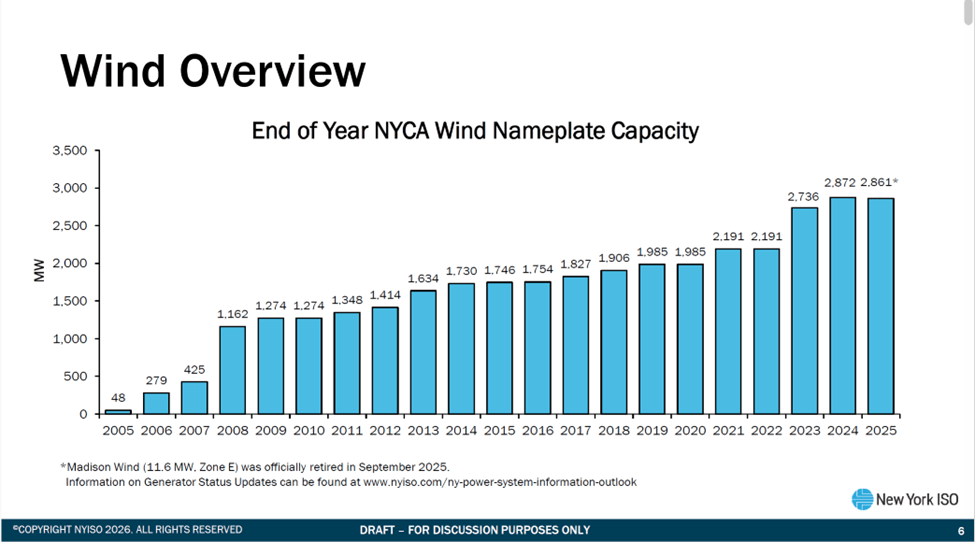
Figure 2 summarizes the wind nameplate capacity since 2005.  It is notable that there really hasn’t been an appreciable uptick in wind development since the passage of the Climate act in 2019.  That is going to change because the State and renewable energy developers have so rigged the permitting system now that any local objections are over-ruled and environmental protections are ignored.

Figure 2: Slide 6 from NYCA Renewables 2025

Source: NYCA Renewables 2025

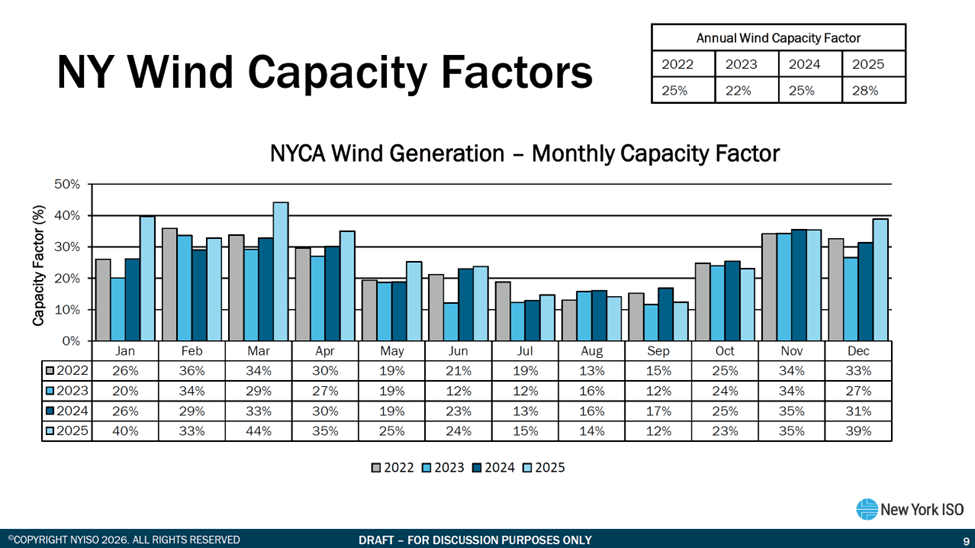
Wind and solar generating resources are intermittent. The standard metric for measuring generating availability is the  capacity factor.  It is defined as the percentage of the electricity a power plant actually generates over a period of time compared to what it could have generated if it ran at full power the entire time.  Figure 3 describes NYCA monthly and annual wind capacity factors over the last four years.  There is interannual variation – some years are windier.  Note, however, that the last year may be affected by the addition of an offshore wind facility that we would expect to have higher capacity.  On a monthly basis there is a lot of variation.  In 2025, the windiest month, March had a capacity factor of 44% while September was only 12%.  The good news is that wind is available more in the winter when we expect solar to be less because the days are shorter and the sun is lower in the sky.

Figure 3: Slide 9 from NYCA Renewables 2025

Source: NYCA Renewables 2025

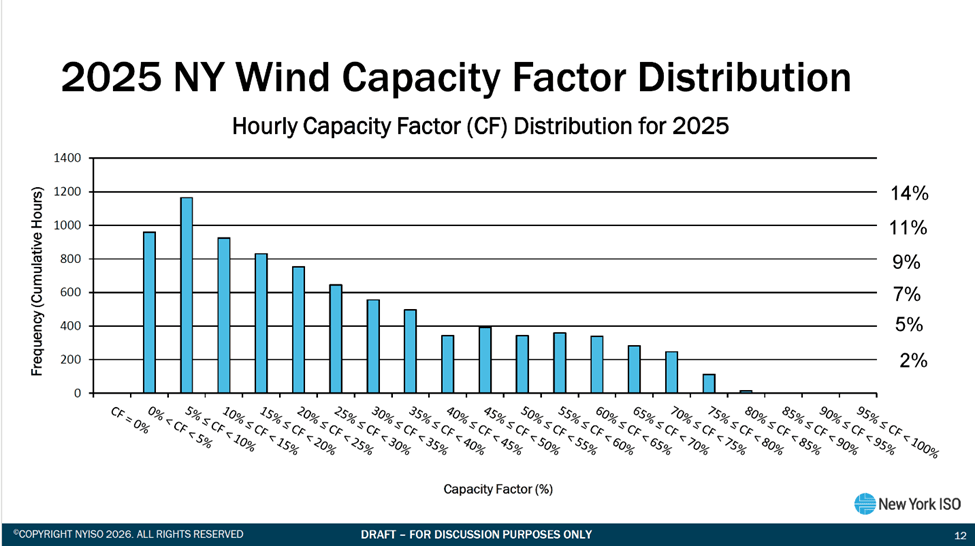
Figure 4 lists the frequency of hourly capacity factors in 2025.  There were less than 1,000 hours when the capacity factor of all the wind generators in the state were between 0% and 5%.  I added the annual percentages on the right for the hourly frequency labels on the left.  The less than 1,000 hours when the capacity factor of all the wind generators in the state were between 0% and 5% is somewhere between 9% and 11% of the annual hours.  I included this to show that the wind capacity factor across New York State was less than 10% for nearly a quarter of the hours.  At the other end, there are less than 20% of the hours when the statewide capacity factor exceeds 50%.  New York does not have an impressive wind resource capacity.

Figure 4: Slide 12 from NYCA Renewables 2025

Source: NYCA Renewables 2025

NYCA Solar Performance

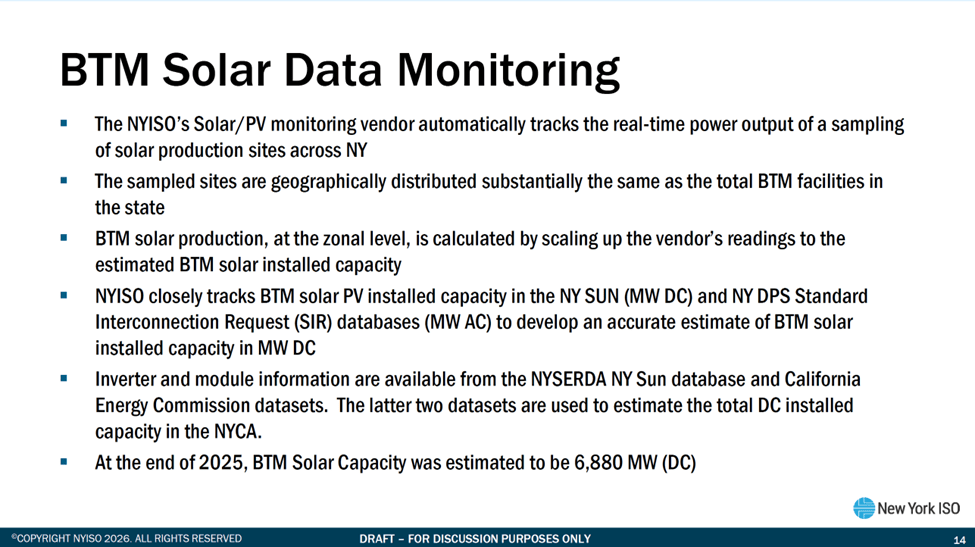
Figure 5 describes the Behind-the-Meter (BTM) solar methodology.  These solar resources are the rooftop solar panels that are not directly monitored by NYISO.  To provide the data, NYISO depends on a vendor who has instrumented a representative sample of sites across the state.  Those measurements are combined with the estimated solar capacity to estimate solar production.  This slide describes the process.

Figure 5: Slide 14 from NYCA Renewables 2025

Source: NYCA Renewables 2025

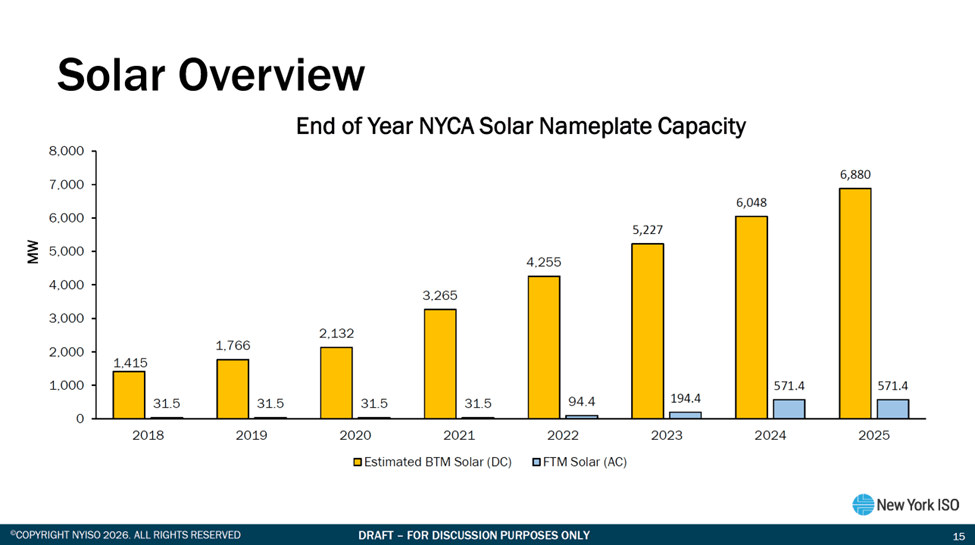
Figure 6 summarizes the solar nameplate capacity since 2018.  The Climate Act set a goal of 6 GW of distributed photovoltaic solar generation by 2025 and met the target in 2024.

Figure 6: Slide 15 from NYCA Renewables 2025

Source: NYCA Renewables 2025

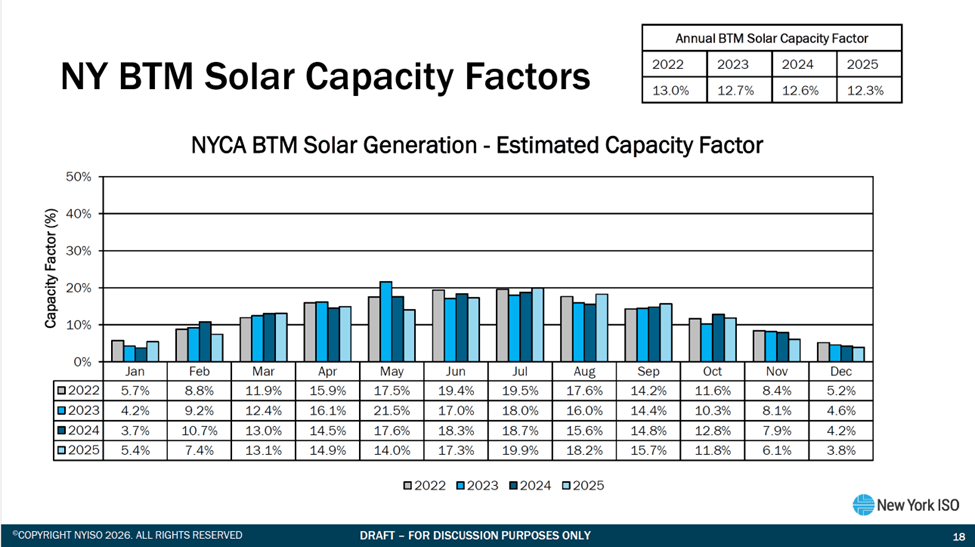
One of the more naïve presumptions by the authors of the Climate Act was the idea that success in other jurisdictions would lead to similar results in New York.  The available solar resources in California and Texas are the not the same as New York.  Figure 7 describes NYCA monthly and annual BTM solar capacity factors over the last four years.  There should be no surprise that at New York’s latitude January and December capacity factors are very low and that brings down the annual capacity factors.   In the best year rooftop solar was only 13% of the total possible. 

Figure 7: Slide 18 from NYCA Renewables 2025

Source: NYCA Renewables 2025

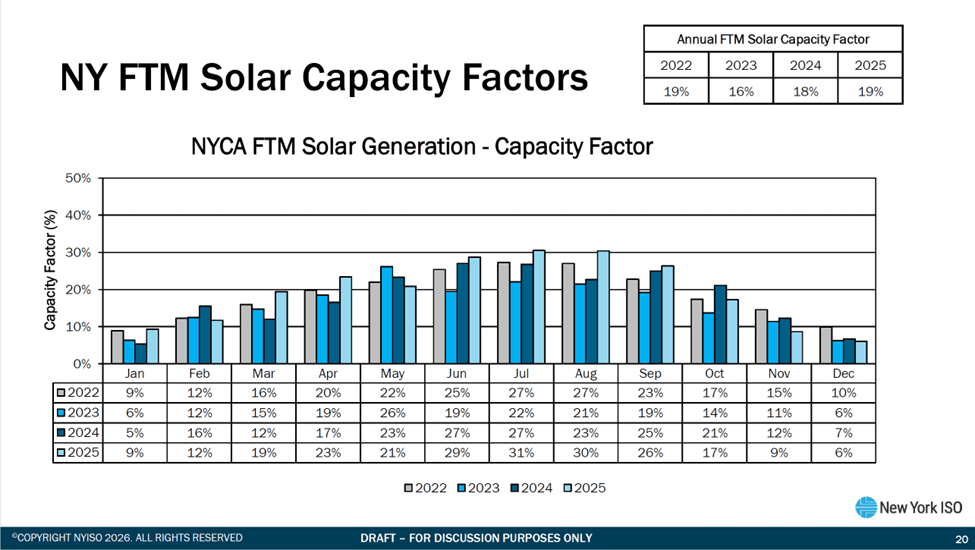
Figure 8 describes NYCA monthly and annual FTM or utility solar capacity factors over the last four years.  Utility-scale developments are sited to maximize the availability of solar resources and there is an improvement of annual capacity from 13% to 19%.  Of course, nothing can improve the length of the day so solar drops significantly in the winter.

Figure 8: Slide 20 from NYCA Renewables 2025

Source: NYCA Renewables 2025

Curtailments

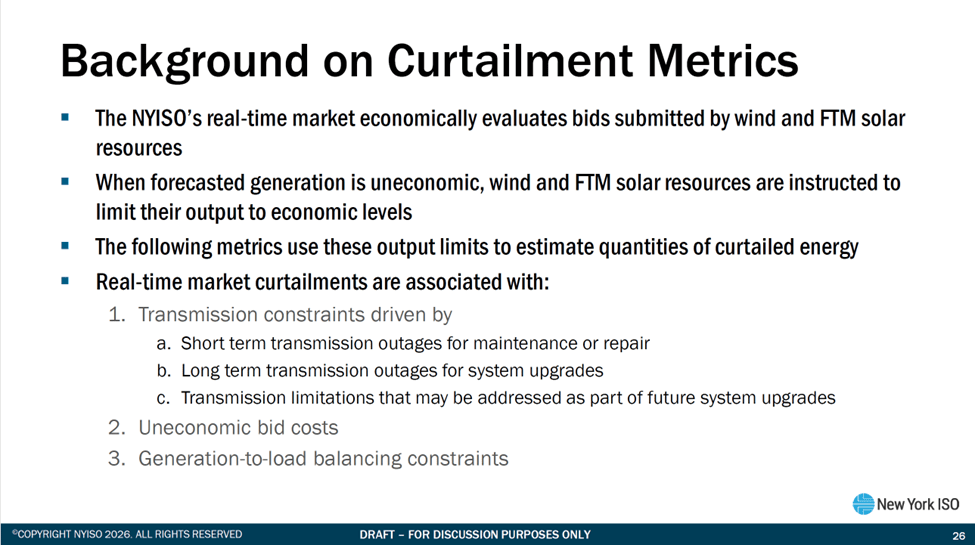
Figure 9 “Background on Curtailment Metrics” explains the criteria for curtailments.  The NYISO’s real-time market economically evaluates bids submitted by wind and FTM solar resources and when forecasted generation is uneconomic, wind and FTM solar resources are instructed to limit their output to economic levels.  This section finds that real-time market curtailments associated with transmission constraints are the primary current driver of curtailments.  Those can be outages for maintenance, repair or upgrades or something that requires upgrades to the system.  All those who claim that the Climate Act does not affect utility rates must ignore that the costs for these transmission improvements are buried in the rate cases.  Someday the over build necessary to supply peak loads with as much renewable as possible will shift the reason for curtailments to generation-to-load balancing constraints.

Figure 9:  Slide 26 from NYCA Renewables 2025

Source: NYCA Renewables 2025

Coincident Wind and Solar

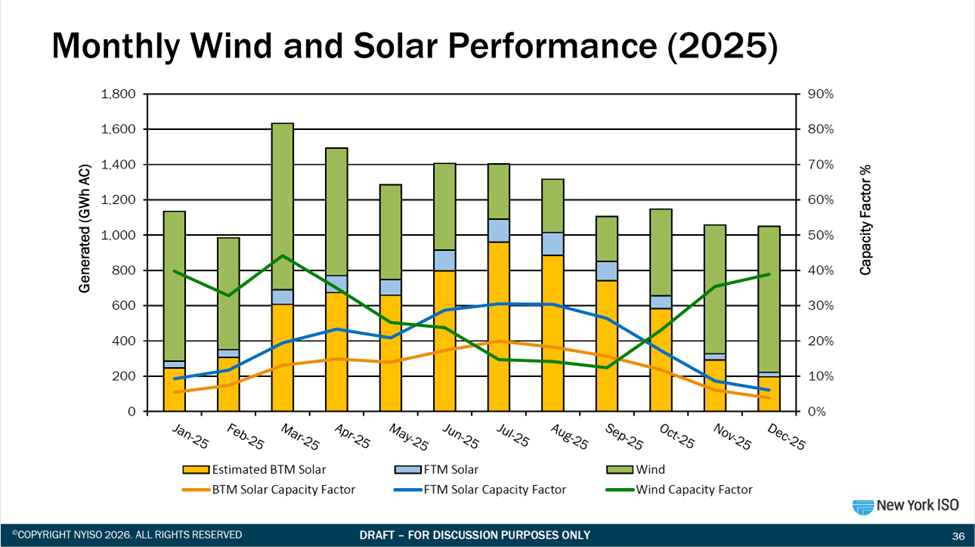
The sections describing wind and solar monthly capacity factors showed that wind was generally higher when solar was generally lower and vice versa.  This suggests that together they might be dependable.  However, both parameters must be considered at the same time.  Figure 10 describes monthly performance in 2025 and supports the idea that the combined wind and solar support each other.

Figure 10: Slide 36 from NYCA Renewables 2025

Source: NYCA Renewables 2025

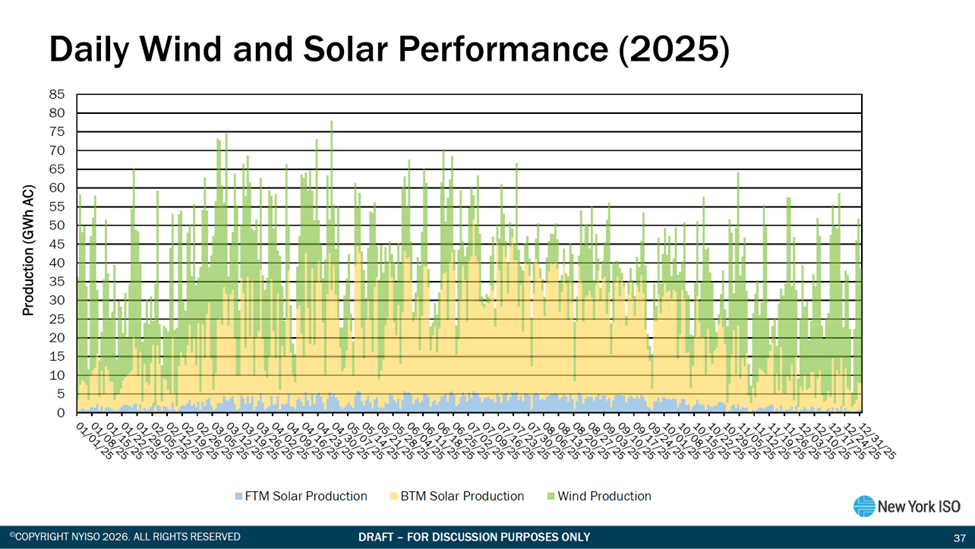
NYISO grid operators match generating resources to load variations.  If that process worked on a monthly time scales it would be easy and this observation would be relevant, but operators must match load constantly at minute intervals.  Even the wind and solar daily performance shows the challenge of constantly meeting load.  In Figure 11 the total daily renewable energy production started at 36 GWh, rose to 58 GWh but plunged to 12 GWh later in the first week. To support the “free” renewable resources, other resources must be maintained so that they can be turned on during dark doldrums when the weather does not cooperate.

Figure 11: Slide 37 from NYCA Renewables 2025

Source: NYCA Renewables 2025

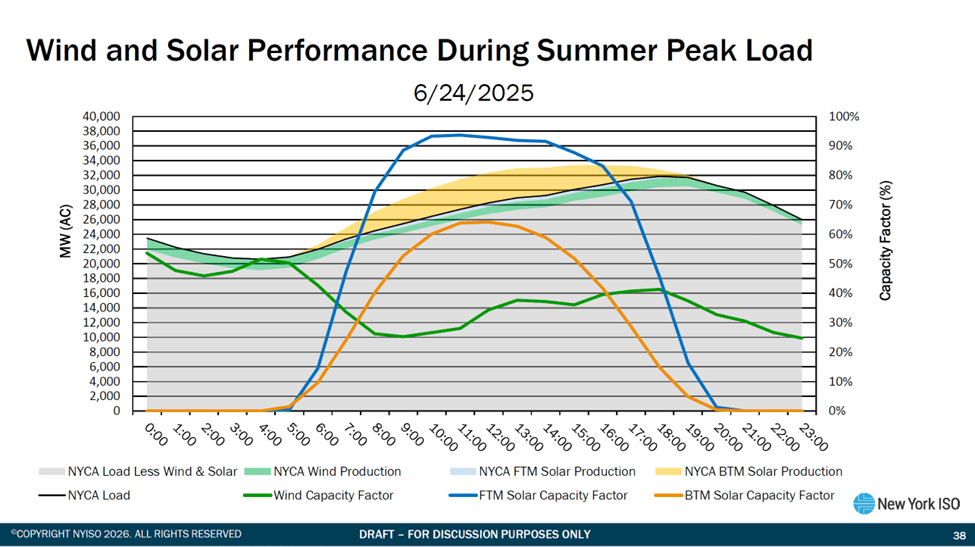
On an hourly basis the challenges are greater.  Figure 12 describes wind and solar performance during summer peak loads.  Obviously, NYISO must deal with diurnal solar availability.  Also note that wind and mostly solar appreciably reduce the generation needed from other resources for this example peak.  Based on this slide I don’t think NYISO has serious “duck curve” concerns yet.

Figure 12: Slide 38 from NYCA Renewables 2025

Source: NYCA Renewables 2025

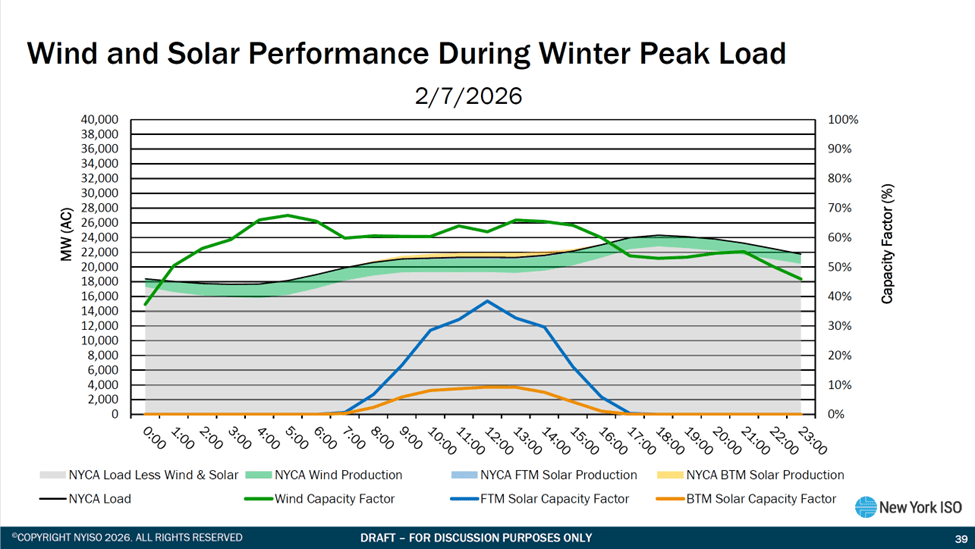
Figure 13 describes wind and solar performance during a winter peak load example.   Note that they used this year’s winter peak as an example.  It appears that wind and solar make up a smaller proportion of the total load provided so can be relied on less in the winter.

Figure 13: Slide 39 from NYCA Renewables 2025

Source: NYCA Renewables 2025

NYCA Renewables 2025 includes a section describing “Load Ramps” that addresses the NYISO system load concerns related to short-term changes to the operating loads.  I am not going to describe any slides from this part of the presentation because I do not understand it well enough to explain it to others.  For most of my readers it is sufficient to know that there is a concern that wind and solar resources could change so quickly that operators would not be able to adjust other generating units to compensate.  The results indicate that the NYISO has this under control.

Discussion

A few observations based on the data.

On March 20, 2026 Governor Hochul stated in an exclusive opinion piece in New York Empire Report that “Since I have been Governor, more than $88.7 billion has been invested in clean energy through programs that have made us an example for the rest of the nation.”  I noted that the BTM 2025 target was achieved a year early.  However, other goals are in trouble.

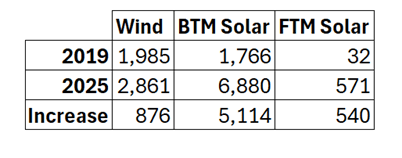
I cannot break out the renewable capacity additions since she has been Governor but the nameplate capacities in Figures 1 and 5 enable us to calculate the capacity additions since the start of the Climate Act.  Table 1 shows that wind capacity has increased 876 MW, BTM solar has increased 5,114 MW and FTM solar has increased 540 MW.  This suggests that something has to change but the question is whether it can be done responsibly.

Table 1: Renewable Capacity Additions (MW) since Climate Act

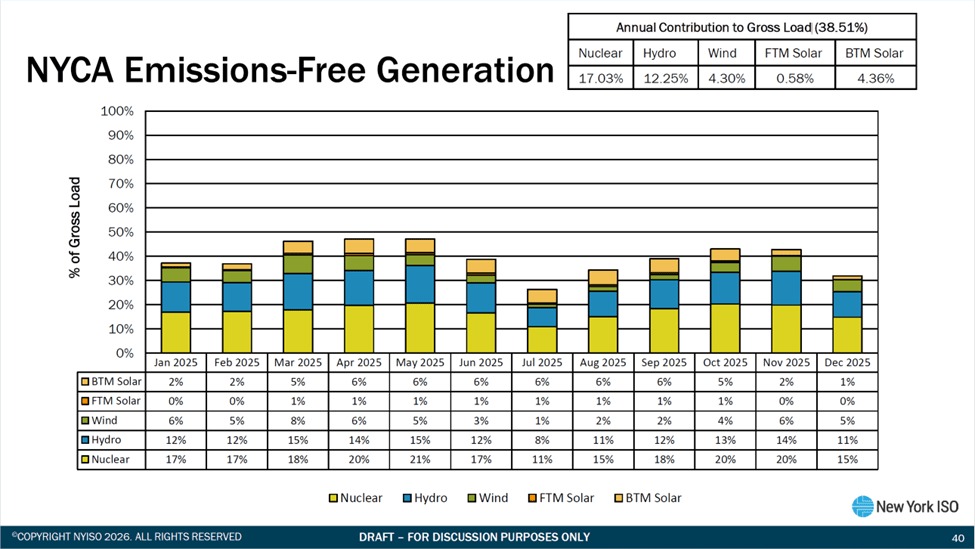
Figure 14 describes emissions free resources in 2025.  The Climate Act has a 2030 “70% renewable” target as defined in Public Service Law §66‑p as “a minimum of 70 percent of the state wide electric generation secured by jurisdictional load serving entities…in 2030 be generated by renewable energy systems” (wind, solar, hydro, certain biomass, etc.)  The law requires that “by the year 2040…the statewide electrical demand system will be zero emissions.” This is framed as a characteristic of the entire system, not just a percentage of MWh from specific technologies.

Figure 14: Slide 40 from NYCA Renewables 2025

Source: NYCA Renewables 2025

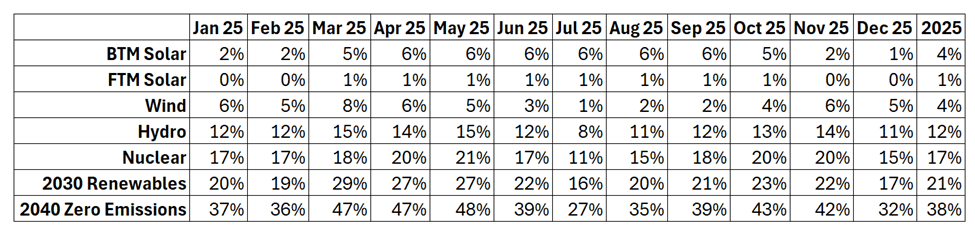
Table 2 compares the observed emissions free data to the 2030 and 2040 targets.  In 2025 the sum of solar, wind and hydro contribution to gross load was only 21%, far short of 70%.  Adding nuclear to the total, zero emissions are only 38% of the total gross load.  Trying to achieve 100% in 15 years is not likely in my opinion.

Table 2: Percentage Contribution to Gross Load

Conclusion

Proponents of renewable energy in New York frequently point to other states and claim that New York should emulate their performance.  The fact is that the location and climate of New York are not conducive to wind and solar generating resources.  The NYISO summary of 2025 NYCA renewables documents this deficiency well.

January February 2026 Winter Weather Proves the Need for DEFR

Last month I took an initial look at the impact of the January 23-27 winter storm on wind and solar energy production.  I showed that  dispatchable  emissions free  resources (DEFR) are necessary to achieve net-zero in New York.  This post extends my analysis through the end of the cold snap ending on February 9, 2026.

I am convinced that implementation of the Climate Leadership & Community Protection Act (Climate Act) net-zero mandates will do more harm than good if the future electric system relies only on wind, solar, and energy storage because of reliability and affordability risks. The opinions expressed in this article do not reflect the position of any of my previous employers or any other organization I have been associated with, these comments are mine alone.

Overview

The Climate Act established a New York “Net Zero” target (85% reduction in GHG emissions and 15% offset of emissions) by 2050.  Among its interim 2030 targets is a 70% renewable energy electricity mandate and 100% zero emissions electric generation in 2040.

In a recent article I noted instances where Governor Hochul and Public Service Commission Chair Rory Christian have raised the possibility for limited changes to the Climate Act interim targets.  A recent article by Emily Pontecorvo summarizes the Green Energy Blob take on decarbonization but does not mention reliability risks of renewable energy.  Those folks do not understand that electric systems must be built around reliability during peak demand.  One of my primary concerns with the Climate Act weather-reliant renewable energy mandates is correlated variability because the conditions that characterize the highest loads also have the weakest expected wind and wintertime solar resource availability.  That makes electric resource planning for reliability during the peak period especially challenging. 

From January 23 to January 27, 2026, a very large and expansive winter storm caused deadly and catastrophic ice, snow, and cold impacts from Northern Mexico across the Southern and Eastern United States and into Canada.  In New York total snow/sleet accumulation ranged from 8-13” near the coast and 12-17” across the interior.  As the precipitation ended a glaze of freezing rain occurred.  Following the storm there was a period of prolonged sub-freezing weather.

I summarized the weather and load impacts of the January 23 – February 9 extreme weather episode in a recent post that was based on two New York Independent System Operator (NYISO) documents: a presentation titled Winter 2025-2026 Cold Weather Operations (“Winter Operations”) by Aaron Markham, NYISO Vice President Operations and the February 2026 Operations Performance Metrics Monthly Report.  This post relies on two additional NYISO sources of data:    New York fuel-mix load data are available at the NYISO Real-Time Dashboard and the January  Operations Performance Metrics Monthly Report.

NYISO Daily Energy Production

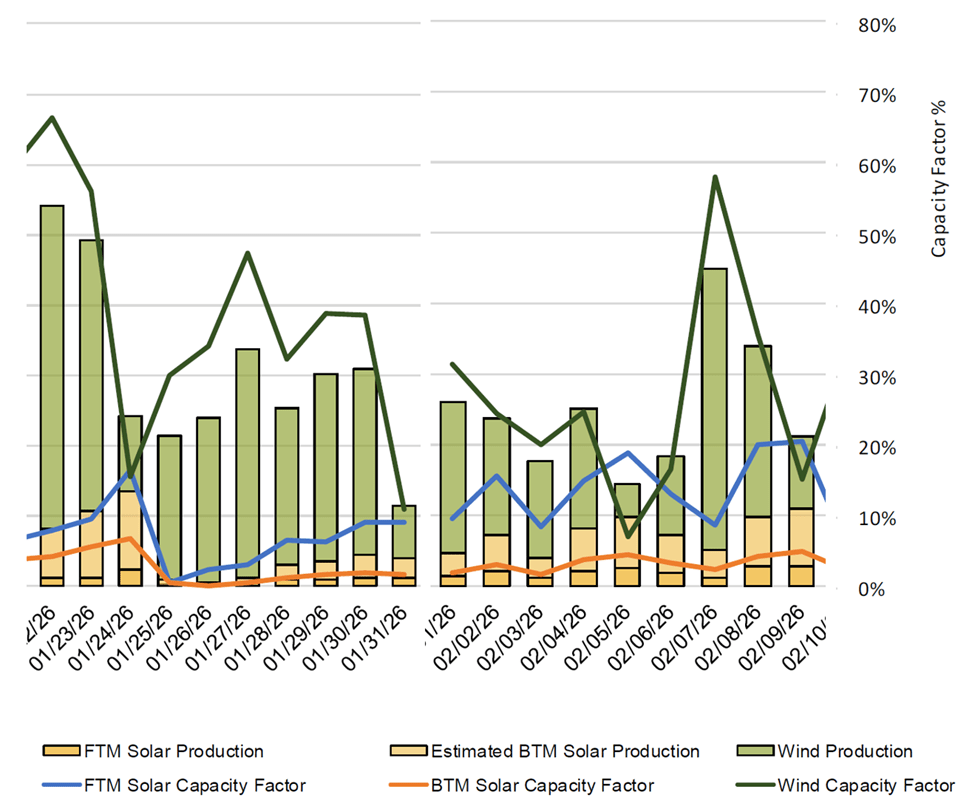
Figure 1 combines the net wind and solar performance data figures from the Operations Performance Metrics reports for the 2026 Winter episode.  It shows that solar energy production was near zero during and immediately after the snowstorm.  I interpolated data off this figure for the analysis described below.

Figure 1: Net Wind and Solar Performance Total Daily Production and Capacity Factors

Source: NYISO January and FebruaryOperations Performance Metrics Monthly Reports

©Copyright NYISO 2026. All rights reserved.

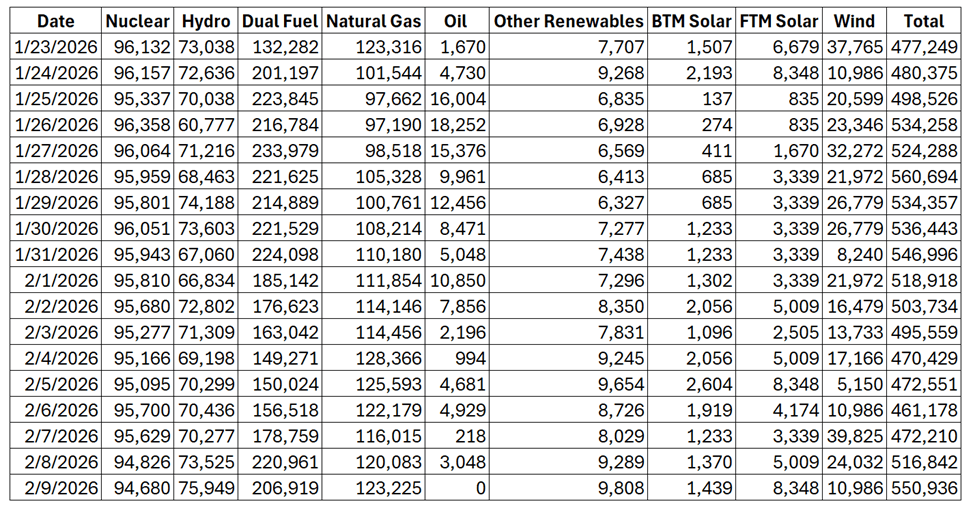
Table 1 combines data from the dashboard and the Operations Performance Metric reports.  I have previously described my use of the dashboard real-time fuel mix data to calculate daily energy use (MWh).  The generator types include real-time fuel mix data base “Hydro” that includes pumped storage hydro; “Other Fossil Fuels” is oil; “Nuclear”; “Natural Gas”; and “Dual Fuel” which are units that burn both natural gas and oil. Two renewables are shown. “Wind”, mostly land-based wind but does include 136 MW of offshore wind from the NYISO real-time fuel mix data base.  That source is also used for “Other Renewables” that covers solar energy (394 MW of “front-of-the-meter solar”), energy storage resources (63 MW), methane, refuse, or wood.  The performance metric reports break out the wind, utility-scale solar, also known as Front of the Meter (FTM) solar, and the rooftop top solar, also known as Behind the Meter (BTM) solar total daily production and capacity factors.  In this table, I subtracted the FTM solar data from the Performance Metric Report data. 

Table 1: Daily NYISO Energy Production (MWh) January 23 to February 9, 2026

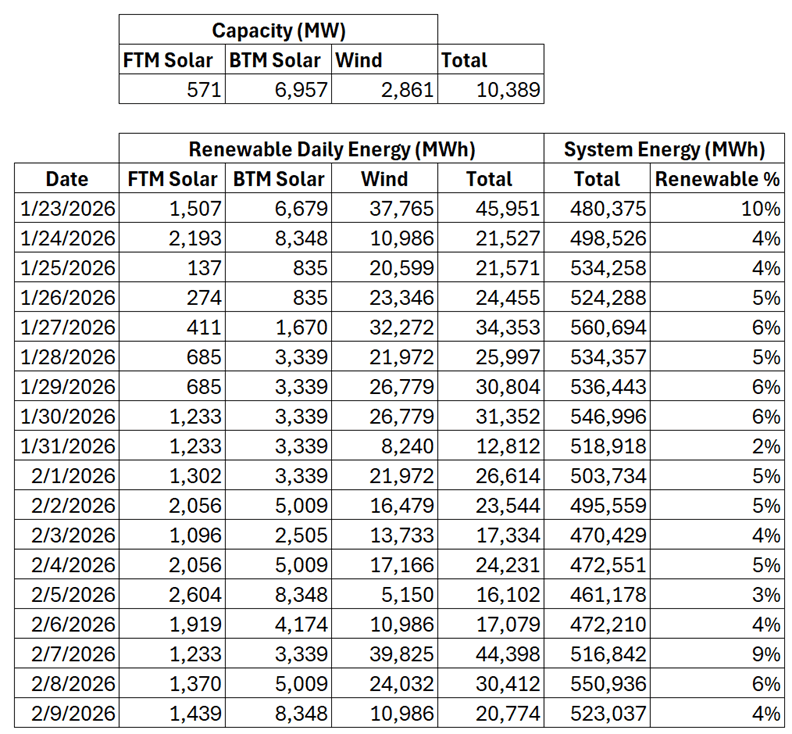
Table 2 includes two data sets.  The top table lists resource capacity (MW) from the Operations Performance Metrics Monthly Report for solar and wind resources.  The main body of the table lists the calculated renewable daily energy (MWh) for each parameter and the renewable percentage of the total system energy based on my analysis of the real-time fuel mix data.  Note that wind and solar produced less than 10% of the total energy production for 17 consecutive days during an extremely cold period with high loads and seven of those days had renewable production under 5% of the total generation.

Table 2: Resource Capacity (MW) from Operations Performance Metrics Monthly Report, Calculated Renewable Daily Energy (MWh), and Realtime Total System Energy (MWh)

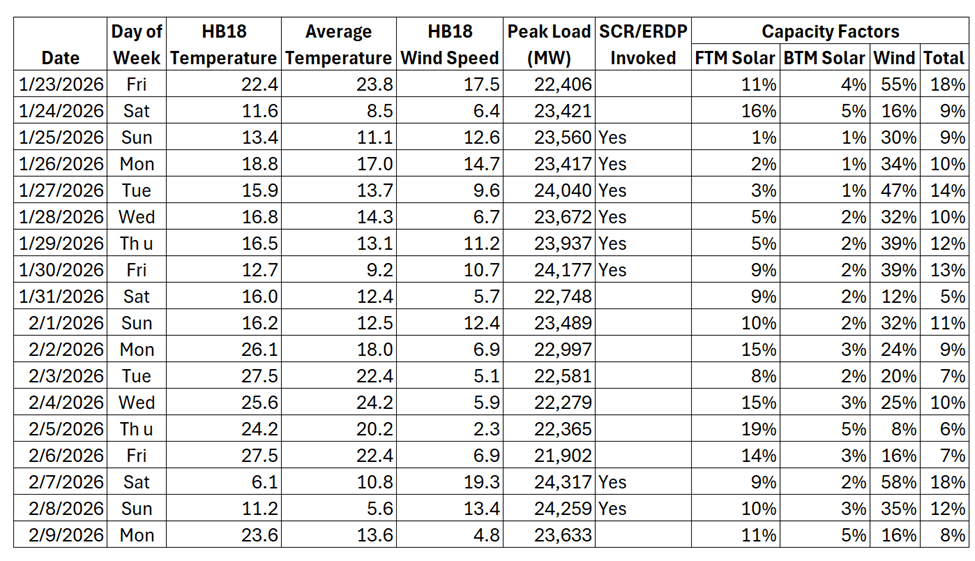
Table 3 combines a table from Markham’s Winter Operations presentation that summarizes the load and weather from January 23 through February 9 and the daily capacity factors calculated using Table 2 data.  Markham pointed out that:

  • Highest peak load (24,317 MW) occurred on Saturday, 2/7, aligning with the lowest HB18 temperature (6.1oF) and highest wind speed (19.3 mph) during the period
  • SCR/EDRP was called, which reduced the measured peak load by an estimated 400 MW

NYISO documents are heavy on jargon.  HB18 temperatures means the load‑weighted average New York Control Area temperature during hour beginning 18:00 (6–7 PM).  “SCR/EDRP” refers to two reliability-based demand response programs: Special Case Resources (SCR) and the Emergency Demand Response Program (EDRP).  Were it not for those programs the peak loads would have been around 400MW higher.

The capacity factor results are particularly important for the Public Service Law 66-P renewable energy program component of the Climate Act.  This law mandates increased use of renewable energy.  For the days when the electric system was stressed enough that the NYISO requested demand response programs note that on the renewable capacity factor on the best day was 18%. That result is because of weather conditions and will not change appreciably however much new renewable capacity is added.  As a result, if, for example, the NYISO determines that they need another 1,000 MW of energy, then providing that using renewables will require at least 5,000 MW of capacity.  That is for the best case!  To cover the 24th of January 10,000 MW of additional renewable energy capacity is needed.

Table 3: New York Control Area Weather and Peak Load Statistics and Renewable Capacity Factors for January 23 to February 9, 2026

Dark Doldrum

This episode is a great example of what the Germans call “Dunkelflaute” and I have called the dark doldrums.    This refers to episodes when solar resource availability is reduced due to the length of day or clouds and there are light winds.  Based on this episode we know that dark doldrums impacts can be exacerbated by the snow that covered solar panels with enough snow to eliminate production (Figure 1).  Note that most rooftop solar in New York City is essentially flat so snow cover is this is a significant issue there.  I am going to have to amend my worst weather label to “snowy dark doldrums”.

DEFR and Peaking Units

In an article last month I showed earlier that these conditions are the fundamental driver of the need for DEFR.  It is disappointing that clean energy advocates have continued to argue that the size of the DEFR gap has been overstated even after all the agencies responsible for electric system reliability argue otherwise.  These results should put those arguments to rest.  In this analysis, I take a slightly different approach to demonstrate both the need for DEFR and dispute arguments that things like Virtual Power Plants can replace the need for DEFR and existing electric system peaking power plants.

In New York State, peaking power plants have been vilified by environmental advocates because they emit more pollutants and are expensive to operate during peak demand periods. However, their essential role in providing power when the grid is most strained is often overlooked, as some proponents argue that their output can be replaced by expanded demand response programs, energy storage systems, and Virtual Power Plants (VPPs)

My analysis of the January data and VPP showed that the lack of renewable energy recharge means that the short-term energy storage systems will be completely exhausted early in a snowy, dark doldrum event and will not be recharged for days.  This raises the question why we would want to invest in something that may save some short tern money, but when it inevitably fails the costs will be greater than the savings and potentially threaten lives in the ensuing blackout.

One rationale for virtual power plants (VPPs) is that they could reduce or even eliminate the need for peaking power plants. Estimating how much electricity peaking units produce compared to other fossil-fired plants involves considerable interpretation. However, it is clear that oil-fired power plants operate as peaking units—the high cost of oil relative to natural gas ensures they are dispatched only when needed to meet peak demand.

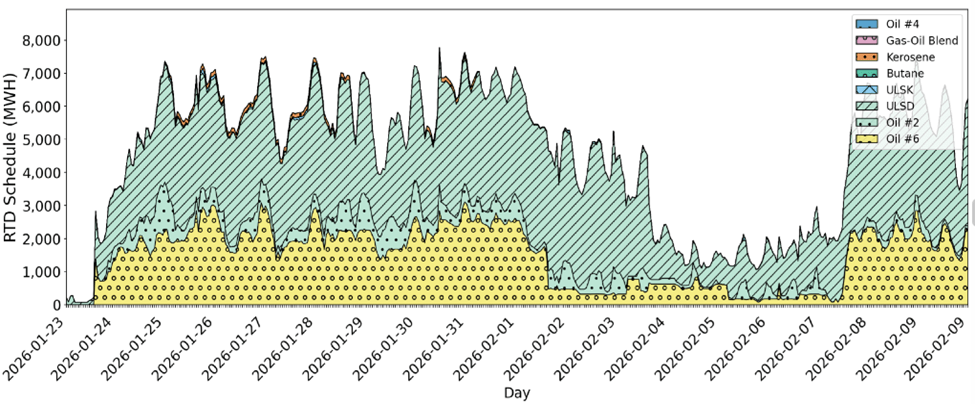
Figure 2 from the Winter Operations presentation lists the Real-Time Dispatch schedule of alternative fueled units during the 2026 extreme winter weather episode.  In other words, this represents the shows the use of oil-fired units.  Two fuels stand out: Ultra Low Sulfur Oil (ULSO) and Oil #6.  ULSO is burned in New York City at several of the vilified peaking power plants.  There are a small number of oil-fired steam boilers that use residual oil (#6).  The Winter Operations report notes that an estimated 2 million MWh were produced from liquid fuels during this period.

Figure 2: Alternative Fuel Mix Plot for January 23 – February 9, 2026

Source: Winter 2025-2026 Cold Weather Operations Presentation to NYISO Operations Committee March 19, 2025 ©Copyright NYISO 2026. All rights reserved.

These observations allow us to estimate how much additional renewable capacity would be required to replace the 2 million MWh supplied by oil. The total renewable energy produced over this period was 469,308 MWh.   During peak load periods with limited renewable output, it is likely that all short-term energy storage would be depleted early, leaving insufficient renewable generation to both meet demand and recharge storage systems. The overall renewable capacity factor in this episode was only 10% so replacing the oil-fired generation would require expanding renewable capacity from the current 10,389 MW to approximately 100,000 MW. This level of expansion is clearly unrealistic, reinforcing the conclusion that DEFR is essential.

Discussion

Large wind and solar capacities do no good when the sun doesn’t shine and the wind doesn’t blow.  This period exemplifies a period where that situation is evident.  Addressing this problem is a major concern of the NYISO resource planners. 

I wish I could say that Governor Hochul understands the magnitude of this challenge.  Alas,  Governor Hochul recently claimed that “Since I have been Governor, more than $88.7 billion has been invested in clean energy through programs that have made us an example for the rest of the nation.”  I am not sure that investments that produced less than 10% of the total energy production for 17 days during an extremely cold period with high loads is an example anyone else would want to emulate.

My last concern is that DEFR is indispensable for a renewables heavy system, yet there is still no concrete plan to commercialize and deploy any DEFR technology at the scale required. Significant technical, economic, and regulatory uncertainties remain for all proposed DEFR options, so assuming that a viable solution will simply emerge in time amounts to taking an extraordinary reliability risk with the bulk power system.

If nuclear ultimately proves to be the only practical DEFR candidate, then a grid architecture centered on wind, solar, and short duration storage cannot be implemented reliably without large scale nuclear generation. However, nuclear power is best suited to continuous, high capacity factor operation, so holding it in reserve as an infrequently used DEFR “backup” misuses the technology and wastes its economic advantages.

Nuclear generation instead should serve as the backbone of a decarbonized electric system, providing the bulk of firm capacity and energy, with wind, solar, and storage playing complementary roles. In that case, the only realistically workable path to deep decarbonization may be a nuclear centered system model, implying that large scale investment in a wind , solar , and storage only strategy would amount to pursuing a “false solution” that cannot stand on its own without nuclear support.

Conclusion

The extreme winter weather episode of January 23 – February 9, 2026, has major implications for New York Climate Act implementation.  The current debate about the possibility for limited changes to the Climate Act interim targets has focused on cost impacts.  However these unacknowledged  findings of reliability risks make an equally strong case for consideration of changes to the Climate Act.

Hochul Claims the Climate Act Can Be Affordable

On March 20, 2026 Governor Hochul claimed in an exclusive opinion piece in New York Empire Report that the climate action and affordability “can and must” go hand in hand. She did not provide substantive evidence to support that claim and her claims do not address many other Climate Leadership & Community Protection Act (Climate Act) affordability issues.

I am convinced that implementation of the Climate Act net-zero mandates will do more harm than good if the future electric system relies only on wind, solar, and energy storage because of reliability and affordability risks.  I have followed the Climate Act since it was first proposed, submitted comments on the Climate Act implementation plan, and have written over 600 articles about New York’s net-zero transition.  The opinions expressed in this article do not reflect the position of any of my previous employers or any other organization I have been associated with, these comments are mine alone.

Overview

The Climate Act established a New York “Net Zero” target (85% reduction in GHG emissions and 15% offset of emissions) by 2050.  It includes an interim reduction target of a 40% GHG reduction by 2030. Two targets address the electric sector: 70% of the electricity must come from renewable energy by 2030 and all electricity must be generated by “zero-emissions” resources by 2040. The Climate Action Council (CAC) was responsible for approving the Scoping Plan prepared by New York State Energy Research & Development Authority (NYSERDA) that outlined how to “achieve the State’s bold clean energy and climate agenda.” NYSERDA also prepared the recent State Energy Plan that was approved by Energy Planning Board (EPB).  Both the CAC and the EPB were composed of Governor Cuomo and Hochul appointees who believed that implementation of the Climate Act was only a matter of political will. 

Status

Progress  on the Climate Act is at an inflection point.  I recently described two affordability aspects of the implementation process that are causing confusion for almost everyone.  Hochul’s administration has recognized two aspects but has covered up a third component.

I think the primary reason for Hochul’s announcement is related to the first issue: New York Cap-and-Invest (NYCI) regulations.  In February the Hochul Administration “leaked” a New York Energy Research & Development Authority (NYSERDA) memo that said that “full compliance with New York’s 2019 Climate Leadership and Community Protection Act could cost upstate households more than $4,000 a year – on top of what they are already paying today”.  Note that these costs are only for this component of the Climate Act.  Last fall a decision regarding an environmentalist petition pursuant to CPLR Article 78 alleged that DEC had failed to comply with the timeframe for NYCI because DEC missed the January 1, 2024 implementation date was rendered.  The decision stated that DEC shall “promulgate rules and regulations to ensure compliance with the statewide missed statutory deadlines” and ordered DEC to issue final regulations establishing economy-wide greenhouse gas emission (GHG) limits or request the Legislature amend the law.  As we will see, Hochul is advocating changes to the law so that NYCI can be revised and the projected costs do not become an election issue.

The second issue is a PSC request for comments related to New York Public Service Law (PSL) § 66-p “renewable energy systems” that includes an indirect affordability mandate and the potential for suspension or modification of obligations if certain conditions are met and a hearing is held to determine if changes are needed.  Even though New York has seen a significant increase in arrears since the Climate Act was enacted the PSC has not address this provision.  The Commission has finally acknowledged the possible need for a hearing and asked for comments.  Rory Christian, Chair and CEO of the Public Service Commission (PSC) recently posted a brief status update regarding the PSC’s ability to make changes to the Climate Act even if there is a hearing.  Clearly, they can address aspects of the PSL 66-P renewable energy systems targets in 2030 and 2040 but little else.

Hochul’s Administration is trying to deflect attention away from the third affordability aspect of Climate Act – all the other costs not included in NYCI and utility rates.   NYCI is simply an economy-wide carbon tax and will affect the cost of energy that anyone uses in New York.  The Climate Act mandates also will require reductions in the building, transportation, industrial sectors, agricultural, forestry, and waste sectors that include aspects beside fuel.  Those costs have received very little attention.

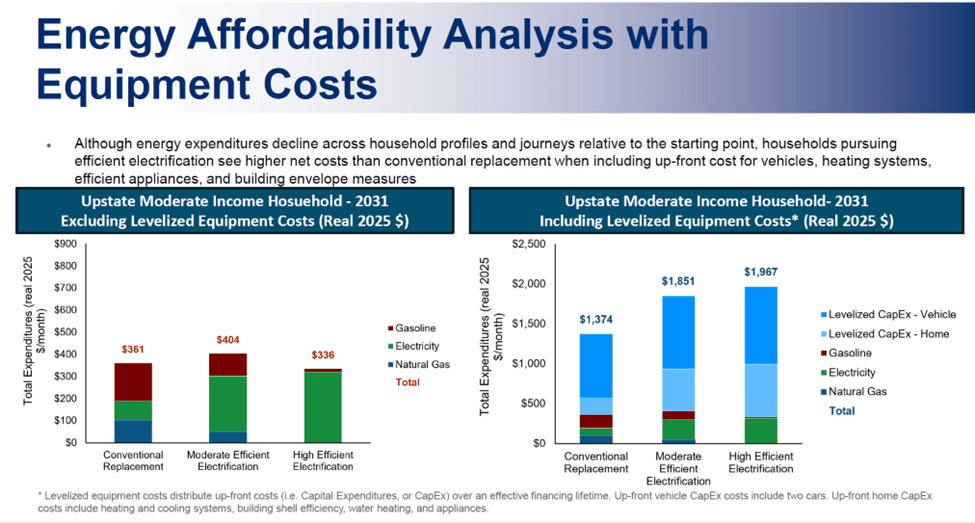
Late last year the Hochul Administration completed the New York State Energy Plan.  Plan reports included an Affordability Analysis Overview Fact Sheet that describes affordability impacts of household costs related to energy used and the need for electric vehicles to meet the Climate Act mandates for those sectors.  I summarized the contents of the fact sheet, the Energy Affordability Data Annex spreadsheet (Annex Spreadsheet)  and the Energy Affordability Impacts Analysis (Impact Analysis last December.  The results show that the Hochul Administration is not providing transparent and comprehensive costs for expected residential costs.  When the appliances, electric vehicles, and building shell upgrades necessary are included then costs increase as shown in the Figure 1.

Figure 1: NYS Energy Planning Board Meeting Presentation Slide 43

The Hochul Administration has covered up the costs buried in this figure.  The equipment cost of Climate Act compliance is the difference between replacement of conventional equipment and the highly efficient electrification equipment. The difference for an upstate moderate‑income gas‑heated household is roughly a 43% increase in levelized monthly energy‑related costs—about $7,000 per year.

Hochul’s Proposal

Governor Hochul’s Empire Report op‑ed presents New York as a national leader on climate, highlighting offshore wind contracts, large-scale renewables, Champlain Hudson Power Express, and continued participation in RGGI as evidence that the State is on track and that affordability concerns are primarily the product of federal “headwinds” and local opposition. She argues that the Climate Act is “not the driver of the high energy prices we are experiencing,” and that limited, “common‑sense” adjustments to timelines and accounting will preserve ambition while avoiding “crushing costs” for households and businesses.

The op‑ed also shifts blame outward: to the Trump administration for hostility to renewables and tax incentives, to global events like the war in Iran for high fuel prices, and to local NIMBYism and siting barriers for delays in renewable deployment. What it does not do is confront the extent to which the design of the Climate Act itself, and the implementation choices made since 2019, hardwire higher costs and reliability risks into New York’s energy system.

Hochul’s opinion piece outlined revisions to NYCI but ignored the ramifications of PSL 66-P and the State Energy Plan.   The following is a copy of the recommendations in her opinion piece.  She introduces her revisions with some general recommendations:

It’s why I am pushing a Ratepayer Protection Plan that will hold utilities accountable, reform the process by which regulators consider rate hike requests, and make it easier for working families to learn about and access the state’s Energy Affordability Programs.

And to make sure we keep the lights and heat on and costs down for New Yorkers, I have adopted an all-of-the-above approach to energy that includes more renewables, emission-free, reliable round-the-clock nuclear, and other needed power sources.

The remainder of her recommendations are sure to infuriate the zealots who advocated for the law and demand that there be no changes.  The only question is whether the Democratic lawmakers who have supported the Climate Act so far will acknowledge reality or double down on the current law. 

It’s also why, despite supporting the intentions of the Climate Act, I am pushing changes to the law as part of our budget discussions with the Legislature. This is solely out of necessity – to protect New Yorkers’ pocketbooks and economy.  Despite all the headwinds and obstacles that could not have been foreseen when the law was enacted in 2019, advocates still took the extreme step of suing the state to force it to issue regulations to meet the Climate Act’s 2030 emission reductions targets.

A judge agreed and ruled that the state must swiftly issue regulations to achieve what now would be costly and unattainable targets, unless the law is changed.

This refers to the NYCI economy-wide lawsuit and lays out the challenge to the Legislature who should change the law.  Next ,she lays out the cost of NYCI compliance while ignoring the State Energy Plan costs for equipment needed to comply with the Climate Act.

I have repeatedly said that utility rates in our state are too high. And while the Climate Act is not the driver of the high energy prices we are experiencing, the undeniable fact is we cannot meet the Climate Act’s 2030 targets without imposing new and additional crushing costs on New York businesses and residents.

Absent changes to the law, the New York State Energy Research and Development Authority found the impact of meeting the Climate Act’s 2030 targets would be staggering—more than $4,000 a year for upstate oil and natural gas households, and $2,300 more for New York City natural gas households. And gas prices at the pump would jump an additional $2.23 per gallon above where it would otherwise be.

In the next paragraphs she piously claims that costs are too high. 

As Governor, I can’t let that happen. While I am still committed to working toward our targets, with all the stress our residents are under, New Yorkers expect their elected officials to prioritize affordability.  They are suffering from high costs every single day and I for one will not ignore their cries for relief.

This is utter hypocrisy given that she knows about the levelized costs to purchase equipment. In addition, it long past time that NYSERDA admit their analyses compare mitigation scenarios to a Reference Case that already embeds zero‑emission vehicle mandates and other policies, excluding large chunks of Climate Act cost from the “action” side while still counting their benefits.  This biases cost low.  We simply do not know how much this will cost.  Hochul goes on to discuss schedule problems.

The fact is, we will be dealing with a White House outright hostile toward renewable energy for at least another three years, making it impossible for us to meet our targets without imposing higher costs on homeowners, renters, and businesses.

We need more time, and so I am proposing we amend the law to require regulations to reduce statewide greenhouse gas emissions to be issued at the end of 2030. We are seeking to change what emission limits the regulations are tied to – including a new 2040 target as well as the existing 2050 statewide emission limits. Nothing else in the CLCPA is changing regarding the existing statewide emission limit targets and these new regulations would still require the state to make timely progress, ensuring long-term policy stability.

The schedule targets mentioned must be changed because they cannot be achieved.  The politicians who arbitrarily set deadlines must recognize that the energy system is more complicated than they thought in 2019.  However, the bigger question is whether extending the deadlines will enable cost-effective implementation at any time.

Conclusion

The Climate Act has always been about politics.  New York has a woeful history of legislative mandates on the energy system, but this has never stopped Albany lawmakers from trying again.  Hochul’s pragmatic proposal is sure to infuriate the political constituency that advocated for the law and do not want changes.  The changes proposed are unquestionably needed but they only address portions of the Climate Act. 

NYISO Winter 2025-2026 Cold Weather Operations – Weather and Loads

Last month I wrote a couple of articles about the January 23-27 winter storm and its ramifications on a future electric system that depends upon wind and solar and how it demonstrated that Dispatchable Emissions-Free Resources (DEFR) will be needed.  This article describes New York Independent System Operator (NYISO) documents that extend the previous analysis through February 9.  The following documents were on the agenda for the NYISO Operating Committee March 19, 2026 meeting: a presentation titled Winter 2025-2026 Cold Weather Operations by Aaron Markham, NYISO Vice President Operations and the February 2026 Operations Performance Metrics Monthly Report.  This article is limited to the description of the weather and resulting loads.  I will follow up on the implications to the Climate Leadership & Community Protection Act (Climate Act) later.

I am convinced that implementation of the Climate Act net-zero mandates will do more harm than good if the future electric system relies only on wind, solar, and energy storage because of reliability and affordability risks. The opinions expressed in this article do not reflect the position of any of my previous employers or any other organization I have been associated with, these comments are mine alone.

Overview

The Climate Act established a New York “Net Zero” target (85% reduction in GHG emissions and 15% offset of emissions) by 2050.  Among its interim 2030 targets is a 70% renewable energy electricity mandate and 100% zero emissions electric generation in 2040. 

Electric systems must be built around reliability during peak demand.  One of my primary concerns with the Climate Act weather-reliant renewable energy mandates is correlated weather-dependent resource variability because the conditions that characterize the highest loads also have the weakest expected wind resource availability.  That makes electric resource planning for reliability during the peak period especially challenging. 

January and February Winter Weather

From January 23 to January 27, 2026, a very large and expansive winter storm caused deadly and catastrophic ice, snow, and cold impacts from Northern Mexico across the Southern and Eastern United States and into Canada.  In New York total snow/sleet accumulation ranged from 8-13” near the coast and 12-17” across the interior.  As the precipitation ended a glaze of freezing rain occurred.  Following the storm there was a period of prolonged sub-freezing weather.

Markham’s presentation summarized the cold weather event from January 23 through February 9:

  • Coldest stretch of the 2025/2026 winter season with a daily average temperature of 15.2oF.
  • Central Park was below freezing from 1/24 to 2/1 (9 days); longest consecutive day stretch since December 2017-January 2018 (14 days)
  • Albany was below freezing from 1/23 to 2/10 (19 days); longest consecutive day stretch since January 2011 (21 days)
  • Minimum temperature (-0.1o F) occurred on Sunday, February 8th and was the lowest of the season
  • Essentially equal to the Winter 90th percentile design condition (0oF)
  • Average season minimum: 3.8o F (2004-2005 to 2024-2025)

Figure 1: Observed Hourly Temperature and Wind Speed 1/23/26 to 2/9/26

Source: Winter 2025-2026 Cold Weather Operations Presentation to NYISO Operations Committee March 19, 2025 ©Copyright NYISO 2026. All rights reserved.

NYISO Real-Time Fuel Mix

New York fuel-mix load data are available at the NYISO Real-Time Dashboard.  These data include links to current and historical five-minute generation (MW) for energy generated in New York State.  I processed that data to calculate hourly averages.  The generator types include “Hydro” that includes pumped storage hydro; “Wind”, mostly land-based wind but does include 136 MW of offshore wind; “Other Renewables” that covers solar energy (394 MW of “front-of-the-meter solar”), energy storage resources (63 MW), methane, refuse, or wood; “Other Fossil Fuels” is oil; “Nuclear”; “Natural Gas”; and “Dual Fuel” which are units that burn both natural gas and oil.  Note, my calculated values are not completely compatible with the final NYISO values. 

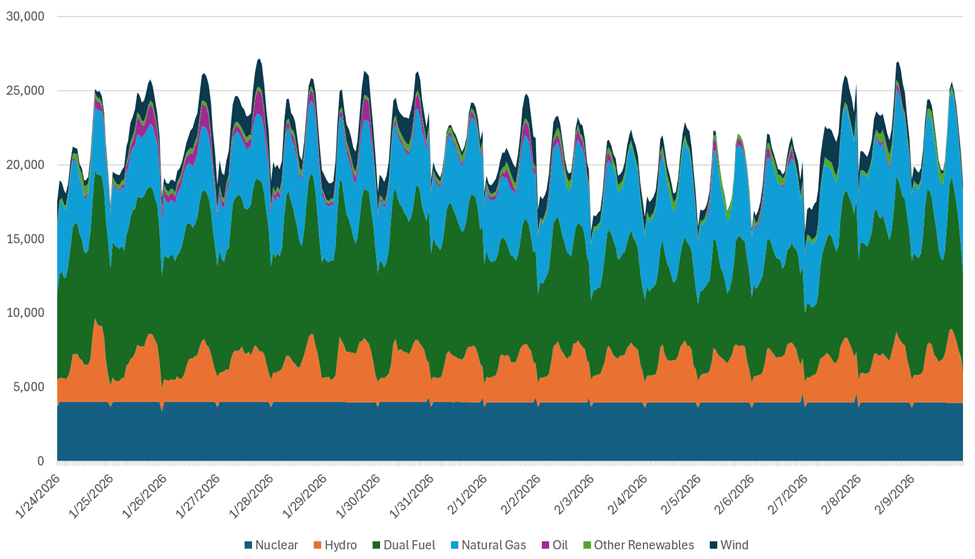
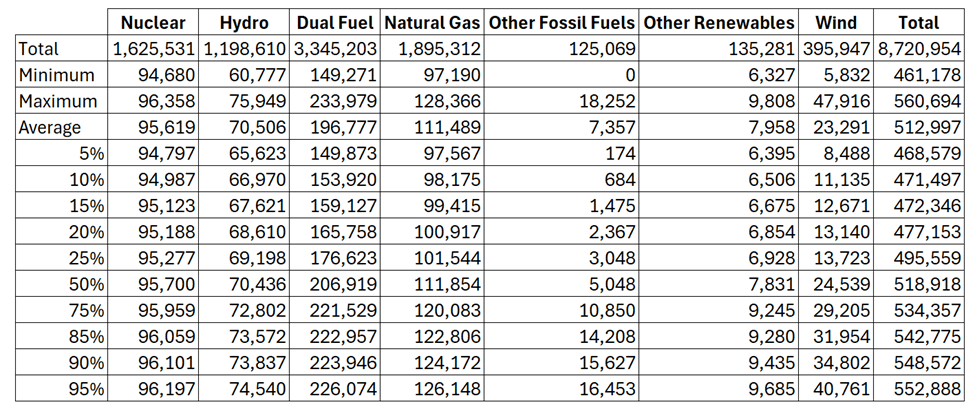
Figure 1 graphs all the fuel mix hourly data and Table 1 summarizes the data. The relative average fuel mix energy provided over these ten days was nuclear 19%, hydro 14%, and fossil fuels 62% totaling 94% of the total.   

Figure 1: Hourly NYISO Realtime Fuel Mix (MW) January 24 to February 9, 2026

Table 1: Summary of Daily NYISO Realtime Fuel Data Mix (MWh) January 24 to February 9, 2026

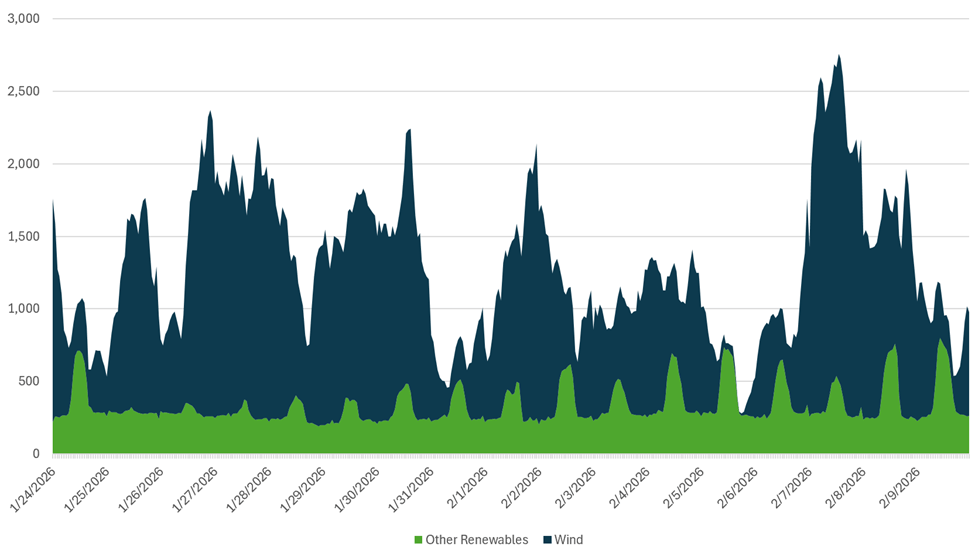
These data do not show the contribution of wind and solar well.  “Other Renewables” includes solar energy (394 MW of “front-of-the-meter solar”), energy storage resources (63 MW), methane, refuse, or wood. The methane, refuse and wood facilities show up as the relatively constant base in Figure 3.  Assuming that the 63 MW of energy storage is too small to show up, that means that the utility-scale “front-of-the-meter” solar shows up as the daily green peaks.  The snow arrived in New York on the night of 24 January and continued through the next day.  Note that utility solar was essentially zero on the 25th and did not return to the level of the 24th until February 2nd.

Figure 3: Hourly NYISO Realtime Fuel Mix Other Renewables and Wind January 24 to February 9, 2026

Loads Markham’s presentation summarized the load from January 23 through February 9:

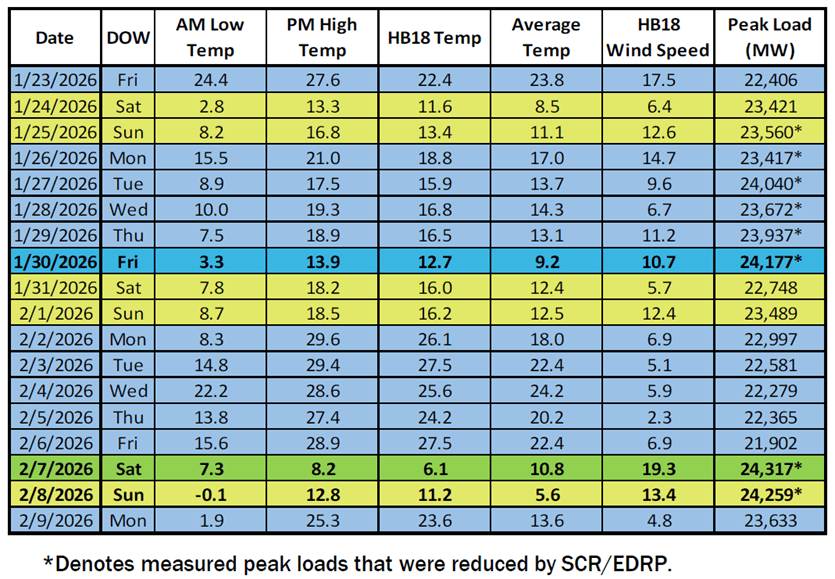
  • Highest peak load (24,317 MW) occurred on Saturday, 2/7, aligning with the lowest HB18 temperature (6.1oF) and highest wind speed (19.3 mph) during the period
  • SCR/EDRP was called, which reduced the measured peak load by an estimated 400 MW

NYISO documents are heavy on jargon.  HB18 temperatures means the load‑weighted average New York Control Area temperature during hour beginning 18:00 (6–7 PM).  “SCR/EDRP” refers to two reliability-based demand response programs: Special Case Resources (SCR) and the Emergency Demand Response Program (EDRP).

Table 1: NYCA Weather and Peak Load Statistics For January 23 to February 9, 2026

Source: Winter 2025-2026 Cold Weather Operations Presentation to NYISO Operations Committee March 19, 2025 ©Copyright NYISO 2026. All rights reserved.

This article is not going to describe the SCR/EDRP resources and what these results mean but I will define what they mean.  Special Case Resources (SCR) are demand response or behind-the-meter generation resources enrolled in the ICAP market that commit to be available to reduce load when NYISO calls an emergency event.  Emergency Demand Response Program (EDRP) is an emergency-only demand response program that pays for voluntary load reductions during NYISO-declared emergencies but does not provide capacity payments.

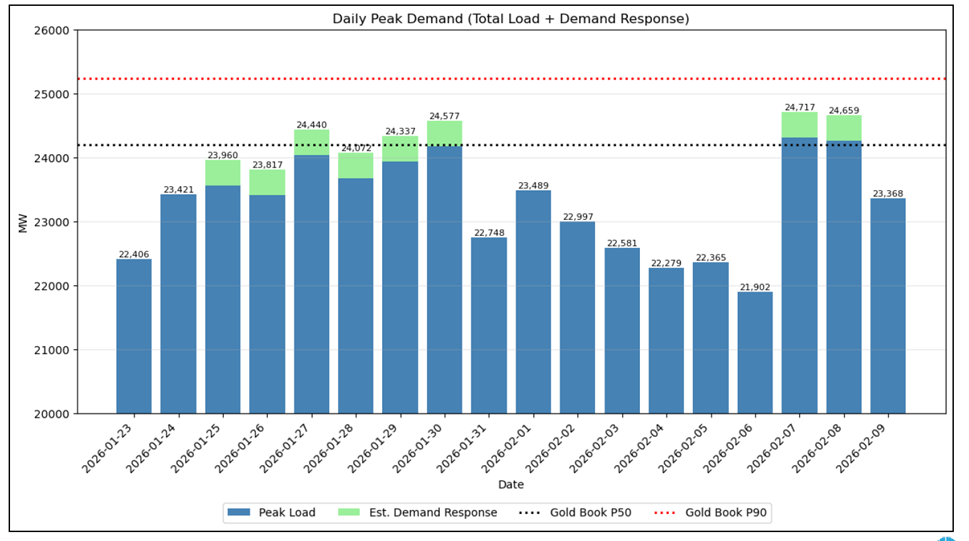
These resources do impact observed load as shown in Figure 4.  The blue bars represent the observed load and the light green the estimated reduction in load due to the SCR/EDRP programs.  The dotted lines represent the projected daily peak load from the NYISO annual load and capacity data report universally known as the “Gold Book”.  The P50 load forecast is the “most likely” baseline forecast.  Tt represents the expected New York Control Area (NYCA) load under expected future weather conditions, with the load-modifying impacts already included. The P90 estimate is the weather-uncertainty “stressed weather” forecast case for a colder-than-expected winter peak episode.  Demand during three days during the cold snap were about equal to the baseline peak load forecast of 24,200 MW.  If the SCR/EDRP demand response programs were not available, then five days would have exceeded the baseline forecast topping out at 24,717 MW on 2/7/26. 

Figure 4: Daily Peak Load and Estimated SCR/EDRP Impact

Source: Winter 2025-2026 Cold Weather Operations Presentation to NYISO Operations Committee March 19, 2025 ©Copyright NYISO 2026. All rights reserved.

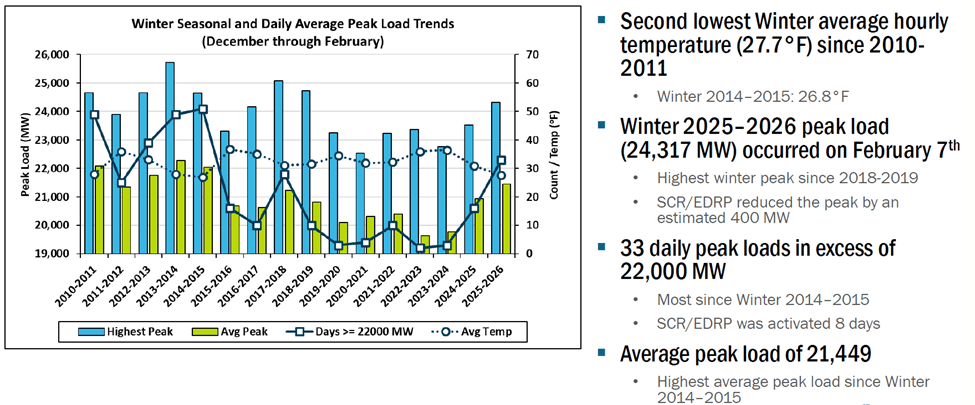
Figure 5 puts the peak loads in perspective. The cold weather this winter was the second lowest winter average since 2010-2011.  The winter 2025–2026 peak load (24,317 MW) occurred on February 7th and was the highest winter peak since 2018-2019.  Note that the SCR/EDRP demand reduction programs reduced the peak by an estimated 400 MW and was activated eight days.  There were 33 daily peak loads in excess of 22,000 MW which is the most since winter 2014–2015

Figure 5: Winter 2025–2026 Daily Peak Loads In Perspective

Source: Winter 2025-2026 Cold Weather Operations Presentation to NYISO Operations Committee March 19, 2025 ©Copyright NYISO 2026. All rights reserved.

Renewables vs. Load

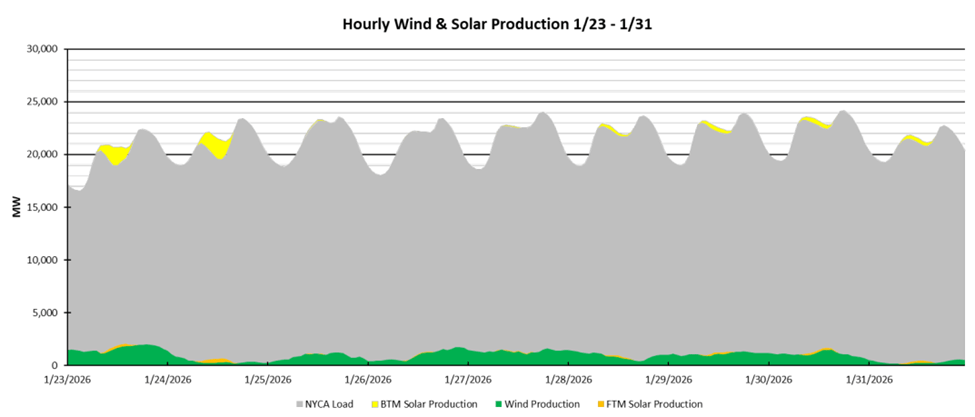
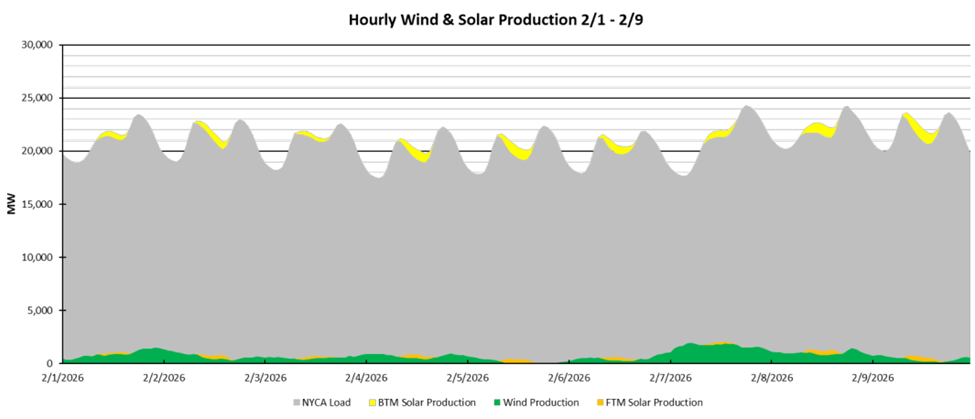
The NYISO Winter 2025-2026 Cold Weather Operations summarizes the NYCA renewables and load for the January and February portions of the cold snap in Figures 6 and 7.  Relative to the total load it is clear that wind and solar under performed during the event.  By 25 January solar output was essentially zero and did not provide much support until 4 February. 

Figure 6: NYCA Renewables vs. Load – January 23 – 31, 2026

Source: Winter 2025-2026 Cold Weather Operations Presentation to NYISO Operations Committee March 19, 2025 ©Copyright NYISO 2026. All rights reserved.

Figure 7: NYCA Renewables vs. Load – February 2 – 9, 2026

Source: Winter 2025-2026 Cold Weather Operations Presentation to NYISO Operations Committee March 19, 2025 ©Copyright NYISO 2026. All rights reserved.

The observed lack of solar is an important result.  It shows that when there was a large snowstorm, all the solar resources in New York produced virtually nothing to support the system when there were significant peak loads.  Wind performed better but still was only a small component of the total generation.  It is impossible to resolve this by building more solar and wind because all New York weather-reliant generating resources ares correlated.  One way to resolve this is to build energy storage but the amount of storage necessary is overwhelming.  All the responsible projections for future energy resources that rely on solar and wind resources agree that a new dispatchable emissions-free resource (DEFR) is needed for these situations.

Discussion

This article simply describes the observed renewable energy production and loads during the episode with the day with this winter’s coldest temperature and peak load.  Solar resources performed poorly during the episode and on the days when the wind gave out the need for DEFR is unquestionable.  I intend to follow up with another post describing the implications to future electric resource planning.  I expect that NYISO will incorporate their observations of this winter’s weather in their planning.  I would not be surprised if revisions result in substantive changes.

Conclusion

The results provided confirm my prior assertions that wind and solar fail to support the system when needed most. Proponents of the Climate Act fail to recognize that electric systems must be built around reliability during peak demand and that this winter’s weather shows how risky the dependence on wind and solar will be without DEFR. 

PSC Commissioner Christian Note Implications

Rory Christian, Chair and CEO of the Public Service Commission recently posted a brief status update regarding the Commission’s ability to make changes to the Climate Leadership & Community Protection Act (Climate Act).  He explained that they can only make changes to the electric sector targets established in the Public Service Law section of the Climate Act. This is an important distinction that has ramifications to the hints that Governor Hochul wants to make changes to the New York Cap-and-Invest (NYCI) regulations.

I am convinced that implementation of the Climate Act net-zero mandates will do more harm than good if the future electric system relies only on wind, solar, and energy storage because of reliability and affordability risks.  I have followed the Climate Act since it was first proposed, submitted comments on the Climate Act implementation plan, and have written over 600 articles about New York’s net-zero transition.  The opinions expressed in this article do not reflect the position of any of my previous employers or any other organization I have been associated with, these comments are mine alone.

Overview

The Climate Act established a New York “Net Zero” target (85% reduction in GHG emissions and 15% offset of emissions) by 2050.  It includes an interim reduction target of a 40% GHG reduction by 2030. Two targets address the electric sector: 70% of the electricity must come from renewable energy by 2030 and all electricity must be generated by “zero-emissions” resources by 2040. The Climate Action Council (CAC) was responsible for approving the Scoping Plan prepared by New York State Energy Research & Development Authority (NYSERDA) that outlined how to “achieve the State’s bold clean energy and climate agenda.” NYSERDA also prepared the recent State Energy Plan that was approved by Energy Planning Board (EPB).  Both the CAC and the EPB were composed of political appointees . 

On February 26, 2026 the Hochul Administration “leaked” a New York Energy Research & Development Authority (NYSERDA) memo that said that “full compliance with New York’s 2019 Climate Leadership and Community Protection Act could cost upstate households more than $4,000 a year – on top of what they are already paying today”. On March 5, 2026, a group of 29 New York Democratic state senators responded with a letter (“Democratic Letter”) to Governor Hochul saying they “categorically oppose any effort to roll back New York’s nation leading climate law” and urging Hochul to “stand strong in the face of misinformation” about affordability.  The letter insists that any pushback on the Climate Act amounts to “climate denial” and that only their “bold” agenda will save New Yorkers money, clean the air, and protect a livable climate for our grandchildren. That framing gets the politics right, but the facts are wrong.  Hochul’s suggestion that lawmakers need to delay emission mandates in NYCI.

Christian Linkedin Note

Christian recently posted the following on Linkedin:

A recent Times Union article highlighted a provision in the Climate Leadership and Community Protection Act (Climate Act) that provides the Public Service Commission with discretion to modify certain aspects of the law.

This is a reference to New York Public Service Law § 66-p “renewable energy systems”.  Section 66-p (4) “Establishment of a renewable energy program” states: “The commission may temporarily suspend or modify the obligations under such program provided that the commission, after conducting a hearing as provided in section twenty of this chapter, makes a finding that the program impedes the provision of safe and adequate electric service; the program is likely to impair existing obligations and agreements; and/or that there is a significant increase in arrears or service disconnections that the commission determines is related to the program”.  Christian went on:

It is important to clarify the scope of that authority. The Commission’s ability to make changes is limited to the electric sector targets established in the Public Service Law section of the Climate Act. The Commission does not have authority to amend the Climate Act’s economy-wide emissions reduction targets. Only the Legislature can amend those targets.

The distinction between Section 66-p (4) and the Climate Act’s economy-wide emissions reduction targets has caused confusion.  The economy-wide emissions reductions target refers to the mandate for New York to implement  New York Cap-and-Invest (NYCI) regulations.  I described these regulations  in a summary of Climate Act issues.  DEC was supposed to implement NYCI regulations by 1/1/2024 but has only finalized the Mandatory GHG Emissions Reporting Rule.  There have been no suggestions when the two other implementing regulations will be proposed.  A year ago a group of environmental advocates filed a petition pursuant to CPLR Article 78 alleging that DEC had failed to comply with the timeframe for NYCI because DEC missed the January 1, 2024 implementation date.  Supreme Court Judge Julian Schreibman’s decision stated that DEC shall “promulgate rules and regulations to ensure compliance with the statewide missed statutory deadlines” and ordered DEC to issue final regulations establishing economy-wide greenhouse gas emission (GHG) limits on or before Feb. 6, 2026 or go to the Legislature and get the Climate Act 2030 GHG reduction mandate schedule changed.  DEC appealed the decision which means that the deadline is suspended until the Appellate Division rules.  

The February 26, 2026 New York Energy Research & Development Authority (NYSERDA) memo that was “leaked” refers to NYCI and not PSL 66-P.  Christian’s note is all about PSL 66-P.  He explains:

Specifically, the statute provides that the Commission may temporarily suspend or modify obligations under New York State’s renewable energy program — the Clean Energy Standard — if the Commission finds that the program:

  • Impedes the provision of safe and adequate electric service; 
  • Is likely to impair existing obligations and agreements; and/or
  • Significantly increases arrears or service disconnections determined to be related to the program.

Even though New York has seen a significant increase in arrears since the Climate Act was enacted, The Commission did not hold a hearing to address their safe, adequate, and affordable obligations to New Yorkers.  Christian notes that the Commission has finally acknowledged the possible need for a hearing:

Relatedly, a third party recently petitioned the Commission requesting adjustments to the electric sector targets. The Commission has posted the petition for public comment and will be accepting comments through the end of the month.

You can read the petition here: https://lnkd.in/edE92bhF
You can submit comments here: https://lnkd.in/eVeaJA5Y

Ramifications

Recent developments paint a consistent picture that it is appropriate to reconsider the Climate Act. NYSERDA’s cap‑and‑invest memo admits that hitting statutory targets on the current schedule requires fuel price shocks and thousands of dollars per year in added household energy costs. The PSC’s request for comments shows that the state’s own regulator is now weighing whether renewable mandates under the Climate Act have crossed the line into threatening safe, adequate, and affordable service—the core mission it cannot ignore. As a result, I encourage everyone to submit comments demanding a hearing to consider adjustments to the electric sector targets.

The important point made by Christian is that the Commission has limited powers to address the myriad implementation issues observed.  It is up to the Legislature to address those other issues.  Unfortunately, this would require many lawmkers to admit that their “nation-leading” law to save the planet needs to be reconsidered.  I previously noted that 29 of the 41 Democratic senators went on the record saying they “categorically oppose any effort to roll back New York’s nation leading climate law”.  However, there are 63 seats in the Senate, so this represents a minority.  It is time to convince those 29 senators and the Assembly members that they need to step up and support the State’s obligation to provide safe, adequate, and affordable energy for all New Yorkers by addressing the observed problems.

Fundamental Implementation Issues

The Climate Act, Scoping Plan and State Energy Plan presumptions rest on a cluster of unrealistic assumptions that ignore engineering, economic, and scale realities. Lawmakers set legally binding “net‑zero” and renewable mandates without first demonstrating that they can be achieved on the required timetable while keeping electric service safe, adequate, and affordable, effectively turning the state into a live experiment.

Reliability is largely treated as a legal requirement rather than an engineering constraint: the Council assumes that a system dominated by wind, solar, and storage will work because the statute says it must, even though NYISO and others warn that needed dispatchable emissions‑free resources do not yet exist commercially on the required schedule. Costs are downplayed through modeling choices that embed major policies in the “reference” case and lean heavily on inflated “costs of inaction,” while NYSERDA’s own affordability work shows on the order of 40‑plus percent higher levelized monthly costs for a representative upstate household once capital costs are counted.

Climate Act environmental review assumes that large‑scale wind, solar, and storage build‑outs are benign, even though the cumulative impact statement has not been updated to match Scoping Plan build‑out levels or to define thresholds for wildlife loss, land conversion, or local impacts.  Subsequent revisions to permitting requirements have turned project environmental assessments into unconscionable parodies of ecological protection.

Finally, the state behaves as if its actions will meaningfully change the climate experienced by New Yorkers, despite emitting less than one‑half of one percent of global greenhouse gases, so any reductions are quickly overwhelmed by growth elsewhere.

What is Needed

There is no question that the Commission needs to hold a hearing to address the Public Service Law mandates.  Anyone who argues otherwise is not paying attention or does not want to admit that real‑world constraints in offshore wind, onshore wind, transmission, supply chains, and inflation that were not anticipated when the law passed in 2019 preclude achievement of the Climate Act 2030 targets.  The hearing will undoubtedly find that the targets need to be delayed.

A cap-and-and invest program for carbon is not the magical solution that the Climate Action Council thought it was when they recommended an “economy-wide program” to cost‑effectively meet Climate Act targets. Hochul’s concerns about NYCI affordability are legitimate, but she does not recognize New York’s experience with the similar Regional Greenhouse Gas Initiative indicate that the touted benefits of dividend investments did not include substantive emission reductions.  Because GHG emissions and energy production are closely related, the cap on GHG emissions this means that setting the caps based on the artificial Climate Act schedule will likely lead to limits on energy production.

Most of the other issues are beyond the scope of the PSL 66-P hearing or NYCI. The Legislature needs to address the other issues openly and rely on the input of subject matter experts who are responsible for energy system reliability, not just a selected few academics who agree with their preconceived notions.  First, and foremost a plan must be developed that demonstrates legally binding “net‑zero” and renewable mandates can be achieved on the required timetable while keeping electric service safe, adequate, and affordable. 

The Legislature must define acceptable safe, adequate, and affordable metrics for electric service and energy resources.  it is long past time that Legislators stop pretending to be energy experts and listen to and act on the existing reliability experts and standards of the NYISO and New York State Reliability Council.  The Legislature must demand that NYSERDA transparently provide all the costs to achieve the Climate Act mandates, not just costs for the law itself, to provide guidance for an acceptable affordability criterion. In my opinion a key component of safe electrical service is environmentally responsible generation.  The Office of Renewable Energy Siting and RAPID Act permitting guidance must establish thresholds for wildlife loss, land conversion, and local impacts. 

Conclusion

There are reasons to be optimistic that the inevitable Climate Act disaster that will occur if there are no changes might be averted before real damage is done.  The admission by Hochul that NYCI will be unaffordable and needs to be revised suggests that the Administration recognizes the affordability implications.  The Commission is accepting comments on the need for a hearing regarding the Public Service Law component of the Climate Act is also encouraging.  However, Commission Chair Christian’s note makes an important point that there are limitations on what the .Commission can do.  Ultimately, the fundamental shortcomings of the Climate Act can only be changed by the Legislature.  It is not clear whether New York lawmakers will cling  to the current timetable in the face of reality or step up and resolve the problems. I recommend that readers contact your legislators and demand that they resolve the identified problems.

Time to Reconsider New York’s Climate Act

Update: The deadline for comments noted in this post has been changed from March 30 to May 1.

New Yorkers now have hard numbers showing that the Climate Act is not just ambitious environmental policy – it is a massive, regressive cost shift onto households that Albany never honestly explained.  The good news is New Yorkers can demand that the Public Service Commission consider Public Service Law 66‑p(4), which explicitly authorizes the Commission to temporarily suspend or modify Renewable Energy Program obligations if they impede safe, adequate, and affordable electric service.  Clearly the Climate Act impedes affordable electric service and this article explains how you can submit a comment.

I am convinced that implementation of the Climate Act net-zero mandates will do more harm than good if the future electric system relies only on wind, solar, and energy storage because of reliability and affordability risks.  I have followed the Climate Act since it was first proposed, submitted comments on the Climate Act implementation plan, and have written over 600 articles about New York’s net-zero transition.  The opinions expressed in this article do not reflect the position of any of my previous employers or any other organization I have been associated with, these comments are mine alone.

Overview

The Climate Act established a New York “Net Zero” target (85% reduction in GHG emissions and 15% offset of emissions) by 2050.  It includes an interim reduction target of a 40% GHG reduction by 2030. Two targets address the electric sector: 70% of the electricity must come from renewable energy by 2030 and all electricity must be generated by “zero-emissions” resources by 2040. The Climate Action Council (CAC) was responsible for approving the Scoping Plan prepared by New York State Energy Research & Development Authority (NYSERDA) that outlined how to “achieve the State’s bold clean energy and climate agenda.” NYSERDA also prepared the recent State Energy Plan that was approved by Energy Planning Board (EPB).  Three recent events call the timeline and ambition into doubt. 

Safety Valve

New York Public Service Law § 66-p (4) “Establishment of a renewable energy program” includes safety valve conditions for affordability and reliability.   Section 66-p (4) states: “The commission may temporarily suspend or modify the obligations under such program provided that the commission, after conducting a hearing as provided in section twenty of this chapter, makes a finding that the program impedes the provision of safe and adequate electric service; the program is likely to impair existing obligations and agreements; and/or that there is a significant increase in arrears or service disconnections that the commission determines is related to the program”. 

The Legislature included Section 66-p(4) precisely to address the situation New York now faces: implementation challenges that threaten reliability and affordability as the aggressive timelines and technology requirements of the Climate Act confront real-world constraints. The Commission has both the authority and the obligation to act.

New York Cap-and-Invest

A leaked NYSERDA memo to the Hochul administration finally quantifies what the Climate Act economy-wide New York Cap-and-Invest program would mean for everyday energy prices. By 2031, the memo projects that cap‑and‑invest could add $2.23 to a gallon of gas on top of whatever motorists are already paying at the pump. It also warns that upstate oil and natural gas households could face gross annual cost increases in excess of $4,000, with New York City gas households seeing around $2,300 more per year.

The response from supporters has been negative.  On March 5, 2026, a group of 29 New York Democratic state senators responded with a letter (“Democratic Letter”) to Governor Hochul saying they “categorically oppose any effort to roll back New York’s nation leading climate law” and urging Hochul to “stand strong in the face of misinformation” about affordability.  The letter states that the memo is “based on a specific Cap & Invest program design that has not been shared with the public and clearly does not include any price guardrails, with a completely unrealistic carbon price.”  I agree that this is a new design scenario but what the senators fail to understand is that this design forces compliance.

Those numbers do not come from critics of the law; they come from the state’s own modeling of a cap-and-invest program that includes no guardrails for high carbon allowance prices.  The modeling shows that allowance prices starting around $120 per ton and rising toward $180 per ton by 2031 are necessary to force emissions cuts fast enough to comply with the Climate Act mandates. In other words, the policy path required by the statute to meet Climate Act goals is intentionally designed to drive up fossil fuel prices until families change behavior, whether they can afford to or not.

State Energy Plan Affordability

While there has been much discussion about the cap-and-invest costs, the household costs buried in the NYSERDA Energy Affordability analysis underpinning the 2025 State Energy Plan have not made the news. In public‑facing materials, the agency emphasized that electrification and efficient equipment could lower monthly utility bills for many households when you look only at energy expenditures. But a close look at the data annex and the underlying analysis reveals a very different story once the cost of buying the required equipment is included.

For an upstate, moderate‑income household that uses natural gas for heat, NYSERDA’s own analysis shows that the levelized costs to replace fossil fuel systems and vehicles with the “zero‑emission” equipment required to comply with Climate Act goals adds about $594 per month—roughly a 43% increase in monthly energy‑related costs in 2031 compared to a conventional replacement path. That equates to $7,000 per year and reflects the combined impact of new electric heating systems, building envelope upgrades, and electric vehicles necessary to match the state’s mandated trajectory. When people ask what “decarbonization” means for their pocketbook, an extra $7,000 a year for a moderate‑income upstate family is a concrete, sobering answer.

Coalition for Safe and Reliable Energy Petition

The Public Service Commission’s recent notice on the Coalition for Safe and Reliable Energy’s petition is a major crack in the façade. That petition invokes Public Service Law §66‑p(4), which explicitly authorizes the Commission to temporarily suspend or modify Renewable Energy Program obligations if they impede safe, adequate, and affordable electric service. In response, the PSC issued a formal notice on January 28, 2026, soliciting comments on whether the Climate Act’s 66‑p renewable targets should be suspended or adjusted.

That step is not routine housekeeping; it is a legal acknowledgment that the Legislature included a safety valve into the statute because it recognized that rigid mandates could collide with grid reliability and affordability. The Coalition—representing businesses and civic groups—argues that current renewable procurement obligations, layered on top of rising costs and reliability concerns flagged by the New York Independent System Operator, meet exactly that standard. When the agency charged with keeping the lights on invites public input on whether to invoke the safety valve it is effectively admitting that “full speed ahead” on the current timeline may no longer be responsible public policy.

Discussion

Taken together, these three developments paint a consistent picture that should worry anyone who cares about both the environment and ordinary New Yorkers’ standard of living. NYSERDA’s cap‑and‑invest memo admits that hitting statutory targets on the current schedule requires fuel price shocks and thousands of dollars per year in added household energy costs. The PSC’s notice shows that the state’s own regulator is now weighing whether renewable mandates under the Climate Act have crossed the line into threatening safe, adequate, and affordable service—the core mission it cannot ignore. And NYSERDA’s Energy Affordability analysis, once you include levelized capital costs, demonstrates that “electrify everything” is not a free lunch but a sustained 40‑plus percent increase in monthly costs for a representative upstate family.

Supporters will argue that long‑term climate benefits justify near‑term pain and that subsidies or future technology breakthroughs will ease the burden. But the state’s own documents show that the current design front‑loads costs onto today’s ratepayers and motorists, with no guarantee that promised benefits will materialize on schedule or be distributed fairly. Given that New York emissions are less than half a percent of global emissions there is no reason to expect any climate benefits.  When an environmental law collides this sharply with affordability, reliability, and public acceptance, clinging to the original timetable becomes less about science and more about political stubbornness.

Nothing in the Climate Act’s text requires New York to ignore new information or double down on obvious implementation problems. In fact, §66‑p(4) explicitly anticipates the need to pause or modify obligations when they jeopardize safe, adequate, and affordable service. The leaked NYSERDA memo, the PSC’s comment solicitation, and the energy affordability findings together meet that threshold: they show that the current path imposes disproportionate burdens on moderate‑income households, risks higher fuel and power prices statewide, and may stress a grid already wrestling with reliability warnings.

What You Can Do

Update – Comments are now due on May 1, 2026.

The Commission  invited interested stakeholders to submit comments by March 30, 2026 May 1, 2026, on the Petition filed by the Coalition.  Comments provided in response to the notice should reference “Case 22-M-0149.” Comments should be submitted electronically by going to http://www.dps.ny.gov, clicking on “File Search” (located under the heading “Commission Files”), entering “22-M-0149” in the “Search by Case Number” field, and then clicking on the “Post Comments” box located at the top of the page.

If you do not want to develop your own comments please consider the following that can be copied into the post comment prompt.

I support the Coalition for Safe and Reliable Energy’s petition requesting that the Commission hold a hearing pursuant to Public Service Law (PSL) Section 66-p(4) to evaluate whether to temporarily suspend or modify the targets or provisions under the Renewable Energy Program established as part of the Climate Leadership and Community Protection Act (CLCPA).

PSL 66-p(4) provides that the Commission “may temporarily suspend or modify the obligations under such program provided that the commission, after conducting a hearing as provided in section twenty of this chapter, makes a finding that the program impedes the provision of safe and adequate electric service; the program is likely to impair existing obligations and agreements; and/or that there is a significant increase in arrears or service disconnections that the commission determines is related to the program”.  A PSL 66-p(4) hearing is essential to evaluate whether the Renewable Energy Program, as currently implemented, is compatible with safe, adequate, and affordable electric service.

Safe and adequate service is imperiled by declining reliability margins documented by the New York Independent System Operator.  Acceptable reliability risks associated with the Renewable Energy Program have not been defined so the public has no assurance that the declining margins are safe.

Transmission deficiencies threaten reliable delivery.  New transmission is needed to get the renewable energy collected to where it is needed.  If this transmission is not available, then the energy supply will not be adequate.

The affordability crisis demands a hearing because safe and adequate is only possible if it is affordable.  A PSL 66-p(4) hearing is needed to define acceptable affordability metrics that can be tracked.

Multiple independent sources confirm the need for a hearing.  State agencies, the Attorney General Office, the NYISO and others have identified schedule and ambition issues associated with the Climate Act implementation that affect the viability of the Renewable Energy Program.

The Legislature included Section 66-p(4) precisely to address the situation New York now faces: implementation challenges that threaten reliability and affordability as the aggressive timelines and technology requirements of the Climate Act confront real-world constraints. The Commission has both the authority and the obligation to act.

Conclusion

Reconsidering the Climate Act does not mean abandoning climate goals; it means aligning them with reality. A hearing should find that that the program as currently structured impedes the provision of safe, adequate, and affordable electric service.  Then it could layout a path going forward that would include revisiting timelines, allowing a broader range of low‑carbon technologies, and explicitly capping household cost impacts so that climate policy does not become a de facto energy tax on working families. New Yorkers were promised a “clean, resilient, and affordable” energy future; now that the state’s own analysis shows how far current plans fall from that promise, it is not only appropriate but necessary for the Public Service Commission to address their obligation to provide safe, adequate, and affordable electric service.

South Fork Wind Malinformation

Christopher Walsh’s latest article in the Easthampton Star, South Fork Wind’s Electricity Generation Proves Reliable repeats claims from the developer that the facility provides reliable energy.  An infographic prepared for the U.S. Department of War’s Defense Counterintelligence Security Agency, defines malinformation as  sabotage because it is based on fact but is used out of context to mislead, harm, or manipulate.  Walsh’s article is based on fact but the information presented is used out of context to mislead readers into believing that the South Fork offshore wind facility provided reliable electric generation to the grid during this winter’s extreme period. 

I am convinced that implementation of the New York Climate Act net-zero mandates will do more harm than good if the future electric system relies only on wind, solar, and energy storage because of reliability and affordability risks.  I have followed the Climate Act since it was first proposed, submitted comments on the Climate Act implementation plan, and have written over 600 articles about New York’s net-zero transition.  The opinions expressed in this article do not reflect the position of any of my previous employers or any other organization I have been associated with, these comments are mine alone.

Overview

The Climate Leadership & Community Protection Act (Climate Act) established a New York “Net Zero” target (85% reduction in GHG emissions and 15% offset of emissions) by 2050.  It includes a specific target for 9,000 MW of offshore wind capacity by 2035.   

Ørsted’s South Fork Wind is the only New York operational offshore wind facility.  It has 12 turbines with 132 MW of capacity.  There are two other New York offshore wind facilities under construction but both had work suspended in December when the Trump administration issued a stop-work order suspending the lease. A federal judge issued a temporary injunction in January 2026 allowing construction to resume while the legal case proceeds.

​Empire Wind 1 (810 MW), developed by Equinor, is the first offshore wind project that will deliver power directly into New York City.  The project was approximately 60% complete when work was suspended. Empire Wind aims to deliver first electricity by late 2026 and reach commercial operation by 2027.  Supporting transmission support is proceeding.  As of late 2025, export cable installation was actively underway. Equinor reported that trenching, cable-laying, and cable pulling were ongoing on the outer continental shelf, and the export cable was brought onshore in 2025. The onshore substation at SBMT was under construction with transformer delivery completed in early 2025. An offshore substation was scheduled for installation in early 2026.

Sunrise Wind (924 MW), developed by Ørsted, also suspended work in December but work was cleared to resume in early February.  Approximately 44 of 84 monopile foundations were installed, and the HVDC offshore substation arrived from Norway and was installed in September 2025. The project is expected to be completed and operational in 2027. It is the first U.S. offshore wind project to use High Voltage Direct Current (HVDC) transmission, which reduces the number of cables needed and improves efficiency.  As of December 2025, onshore transmission work — including the converter station and duct bank — was over 90% complete. Offshore, the export cable was being tunneled through the surf zone (at 11–60 ft deep), with nearshore installation to follow.

The prices for offshore wind are significantly higher than land-based renewables.  Empire Wind 1 and Sunrise Wind contracts were repriced by the New York State Energy Research & Development Authority (NYSEDA) in early 2024 to prevent cancellation.  Their combined weighted average price is $150.15/MWh.  The 2024 NYSERDA Tier 1 solicitation average strike price was $94.73 for 23 projects totaling ~3.5GW.  That makes the offshore wind costs 59% higher.

Clearly, the Climate Act mandate for 9,000 MW of offshore wind is in jeopardy.  The question is whether that is a bad thing or not.  Walsh’s article argues that it is a bad thing.

“Reliable” South Fork Wind

Christopher Walsh’s article in the Easthampton Star, South Fork Wind’s Electricity Generation Proves Reliable is quoted below with my annotations.  

As the Trump administration pledges to appeal all five court rulings that sided with offshore wind farms under construction on the Eastern Seaboard, and Canadian officials call on the industry to shun the United States in favor of the ocean off its shores, developers of South Fork Wind, the nation’s first commercial-scale offshore wind farm, are pointing to its reliable generation of electricity in its second year of operation and during this winter’s extreme cold.

Renewable advocates focus on energy production, but power systems are built around reliability during peak demand. If you look at the grid through the lens of accredited capacity, that is, capacity that can be relied upon during peak demand – instead of average energy, the resource allocations for different technologies look radically different.  This is the energy vs. power capacity distinction that Walsh ignored.

The 12-turbine, 132-megawatt farm, electricity from which makes landfall in Wainscott, achieved a 46.3-percent capacity factor in 2025. “Capacity factor” refers to real-world performance, or the ratio of energy generated versus the maximum theoretical output of an installation running at its full rated capacity around the clock. For offshore wind, typical values are between 20 and 40 percent, reflecting intermittent wind speeds, maintenance downtime, and site efficiency.

In January of this year, South Fork Wind delivered a 52-percent capacity factor, comparable to New York State’s most efficient gas plants. Output at offshore wind farms in the Northeast — South Fork Wind, the smaller Block Island Wind, and Vineyard Wind 1, which is still under construction — is typically at its strongest during winter months, when energy supplies on Long Island are often constrained.

I take exception to the claim that the 52% capacity factor is comparable to gas plants.  If a gas plant was only limited by maintenance downtime  it can easily achieve an 85-percent annual capacity factor but more importantly they can be dispatched by the New York Independent System Operator (NYISO) as necessary to match loads including peak load conditions.

The NYISO January  Operations Performance Metrics Monthly Report includes a graph of net statewide wind and solar performance total monthly production and capacity factors (Figure 1).  These data show that the January 2026 monthly capacity factors for all New York State wind facilities was 38%, Behind the Meter (BTM) rooftop solar was 3% and  the Front of the Meter (FTM) utility-scale solar was 6%.  Offshore wind facilities are expected to perform better than onshore wind facilities and this is clearly shown by the South Fork Wind performance.

Figure 1: Net Wind and Solar Performance Total Monthly Production and Capacity Factors

Source: NYISO January Operations Performance Metrics Monthly Report

The article goes on:

Over the course of 2025, South Fork Wind generated electricity on 99 percent of all days and across 90 percent of all hours, according to its developers, the Danish energy company Orsted and the German company Skyborn Renewables. The developers assert that the wind farm generates electricity sufficient to power 70,000 average-size residences.

These claims have the reliability challenge exactly backwards.  South Fork Wind did not generate electricity on 1 percent of all days or at least 3 whole days and across 10 percent or 876 of all hours.  The problem is that peak loads are commonly associated with high-pressure systems that suppress wind generation.  As a result South Fork Wind was likely unavailable when needed most.

This effect was seen during the January 24 to January 27, 2026 winter storm.  Following the storm there was a period of prolonged sub-freezing weather that caused a peak in the electric load.  Table 1 lists daily extrapolated statewide capacity factors from Figure 2.  Consider January 31 when the statewide capacity factors were BTM solar 2%, FTM solar 9%, and wind 12%.  The total daily renewable energy capacity factor was 10% and only provided 2% of the system’s daily load.  Data from individual facilities are not available but the hourly statewide data indicate that wind capacity was less than 10% for 13 hours including the morning and evening peak loads.

Table 1: Renewable Resource Capacity Factors

Figure 2: Net Wind and Solar Performance Total Daily Production and Capacity Factors

Source: NYISO January Operations Performance Metrics Monthly Report

Wind Farm Status

The remainder of the article goes on:

Earlier this month, a federal judge handed the Trump administration a fifth consecutive loss in court challenges to its December 2025 order pausing construction of five wind farms along the East Coast. The United States District Court for the District of Columbia granted a preliminary injunction sought by Sunrise Wind L.L.C., another Orsted project, regarding the suspension order issued by the Department of the Interior’s Bureau of Ocean Energy Management. The move allows the construction of Sunrise Wind in federal waters about 30 miles east of Montauk Point to resume immediately while the underlying lawsuit challenging the administration’s order progresses.

The 924-megawatt wind farm’s export cable is to make landfall at Smith Point County Park in Shirley and is to generate electricity sufficient to power nearly 600,000 residences.

The decision follows successful challenges to the administration’s order by the developers of Empire Wind 1, a 54-turbine, 810-megawatt project being built by the Norwegian company Equinor and which is to send electricity to New York City; Revolution Wind, a joint venture between Orsted and Skyborn that is to send electricity sufficient to power 350,000 residences in Connecticut and Rhode Island; Vineyard Wind 1, jointly developed by Avangrid Renewables and Copenhagen Infrastructure Partners, which is nearly complete and has already sent electricity to Massachusetts, and Coastal Virginia Offshore Wind, under development by Dominion Energy.

An Orsted official delivered the statistics on the South Fork Wind farm at the advocacy organization Oceantic Network’s annual International Partnering Forum in Manhattan. It was there that Tim Houston, the premier of Nova Scotia, made a pitch to business executives to invest in offshore wind projects off his province rather than in the United States, where the federal government has repeatedly attempted to kill the nascent offshore wind industry while promoting fossil fuel-derived energy, which scientists say is causing dangerous and accelerating warming of the atmosphere.

“We are a predictable and reliable regulatory jurisdiction,” David MacGregor, associate deputy minister of the Nova Scotia Department of Energy, said at the conference, as quoted in The New Bedford Light, a Massachusetts digital news outlet.

Perhaps demonstrating that the United States under the Trump administration is equally predictable, Interior Secretary Doug Burgum told Bloomberg News that the administration will appeal the five court rulings that thwarted its effort to halt construction of the five offshore wind farms. The administration had cited vague national security concerns, and its December order pausing the wind farms’ construction prompted Gov. Kathy Hochul and the governors of Rhode Island, Connecticut, and Massachusetts to demand that the federal government rescind the order, and prompted the wind farms’ developers to sue the government.

Construction has since resumed on all five wind farms.

In my opinion, the rest of the article is a marketing plea by an offshore wind advocate. I don’t want to waste my time responding.

Discussion

If the New York electric system were to rely primarily on wind, solar, and energy storage then this extended period of light winds, low solar availability, and snow-covered solar panels simply cannot provide the power when needed the most.  State agencies responsible for electric system reliability agree that a new dispatchable, emissions free resource is needed for these periods but admit that there isn’t any such resource available today.  Given that there is no such technology available, proceeding under the assumption that one will magically appear is an enormous risk for reliability. 

New York currently has an energy affordability crisis because as of December 2024, over 1.3 million households are behind on their energy bills by sixty-days-or-more, collectively owing more than $1.8 billion.  Climate Act costs are already between 8.5 and 13.7% of monthly electric bills. The combined weighted average price revised contracts for the offshore wind projects under construction is $150.15/MWh.  NYISO reports that the average New York wholesale electric price in 2025 was about 74.40 dollars per MWh, up from 41.81 dollars per MWh in 2024.  Those costs do not include the price of dedicated transmission lines to get the energy to where it is needed.  Adding offshore wind at costs double the current cost of electricity will only exacerbate the energy crisis.

Conclusion

Claiming that South Fork Wind is a reliable source of electricity is based on fact but is used out of context to manipulate readers into believing that offshore wind is a viable generating resource for New York’s future.  Offshore wind is the most expensive source of electricity. Continued funding for a resource that cannot provide energy when needed most is a poor investment.

Reasons to Hold a PSL 66-P Hearing – Transmission Needs

On 1/28/26 the Public Service Commission (PSC) issued a notice soliciting comments regarding the Coalition for Safe and Reliable Energy petition.  This post describes issues related to transmission planning that I think impede the Public Service law 66-P provision for safe and adequate service.  I will submit comments arguing  that these findings obligate the PSC to hold a public hearing to determine if these transmission issues impede safe and adequate service.

I am convinced that implementation of the New York Climate Act net-zero mandates will do more harm than good if the future electric system relies only on wind, solar, and energy storage because of reliability and affordability risks.  I have followed the Climate Act since it was first proposed, submitted comments on the Climate Act implementation plan, and have written over 600 articles about New York’s net-zero transition.  The opinions expressed in this article do not reflect the position of any of my previous employers or any other organization I have been associated with, these comments are mine alone. 

Background

There is a fundamental Climate Act implementation issue.  Clearly there are bounds on what New York State ratepayers can afford and there are reliability risk limits for a system reliant on weather-dependent resources.  The problem is that there are imprecise criteria for acceptable affordability bounds or reliability limits.

Proponents of the Climate Act argue that the transition strategies in the law must be implemented to meet the net-zero mandates regardless of affordability or reliability constraints because it is the law.  However, they do not acknowledge that Public Service Law (PSL) Section 66-P, Establishment of a Renewable Energy Program, is also a law. PSL 66-P requires the Commission to establish a program to ensure the State meets the 2030 and 2040 Climate Act obligations but includes bounds.  PSL 66-P (4) states: “The commission may temporarily suspend or modify the obligations under such program provided that the commission, after conducting a hearing as provided in section twenty of this chapter, makes a finding that the program impedes the provision of safe and adequate electric service; the program is likely to impair existing obligations and agreements; and/or that there is a significant increase in arrears or service disconnections that the commission determines is related to the program”. 

Two petitions have been filed calling for such a hearing.  On 8/12/25 the Independent Intervenors filing argued that there were affordability and reliability issues and that there was an explicit requirement for the hearing because the customers in arrears threshold has been exceeded.  The Coalition for Safe and Reliable Energy filing on 1/6/26 made a persuasive argument that there are sufficient observed threats to reliability that a hearing is necessary to ensure safe and adequate service.  On 1/28/26 the Public Service Commission issued a notice soliciting comments regarding the Coalition for Safe and Reliable Energy petition which are due on 3/30/26.

Onshore Transmission Requirements

A  grid relying on wind and solar cannot be implemented without significant transmission upgrades.  The New York Independent System Operator (NYISO) has noted that New York’s Climate Act renewable energy projects depend heavily on transmission because “most new renewable capacity is being built where the wind, sun, and land are available, not where the loads are, and the existing grid cannot move that energy to the major demand centers without large curtailments and reliability problems.” 

NYISO noted that dependence on a few critical transmission projects has risks. The 2024 RNA Report notes that the base case assumes timely completion of Champlain Hudson Power Express (CHPE) and Clean Path NY (CPNY) by 2027-2028.  The status of these projects could impede safe and adequate service.

CHPE is in late-stage construction and the developer is still targeting an in-service date of May 2026.  CHPE is a 1,250 MW HVDC line delivering clean hydropower into Astoria, New York City.  The contracted delivery is on the order of 10.4 TWh per year, corresponding to a high assumed capacity factor (around 95%) and 1,250 MW of firm capacity sales.  Hydro‑Québec has stated that deliveries will be split roughly half in winter and half in summer (10.4 TWh total, 5.2 TWh per season), with an incentive to use the full line capability.  ​However, the Hydro‑Québec bid “includes summer‑only unforced delivery rights,” with “no specific delivery obligations during the winter peak.”  NYISO’s Short‑Term Reliability Process Report states that while CHPE is expected to contribute to reliability in the summer, “the facility is not expected to provide any capacity in the winter.”  The future of energy availability on this transmission line is foreshadowed by the New England Clean Energy Connect (NECEC) HVDC line that had been energized only about a week when the January 23-27 winter storm hit. Power flows from Québec to New England from this line and others largely collapsed during the cold snap.

At least it will be operating in the summer.  The Clean Path New York project has been terminated.  It was initially selected and approved as part of the Tier 4 program in Case 15‑E‑0302 (Order Approving Contracts for the Purchase and Sale of Tier 4 Renewable Energy Credits, issued April 14, 2022. The associated 178‑mile HVDC transmission facility from Delhi to Queens was advanced in Case 22‑T‑0558, Application of NYPA and Clean Path New York LLC for a Certificate of Environmental Compatibility and Public Need.  NYSERDA and the Clean Path NY developers (NYPA plus the Forward Power JV of energyRe and Invenergy) “mutually agreed to terminate” the Tier 4 REC Purchase and Sale Agreement in late November 2024.  The termination reflected cost escalation after the original 2021 award; developers sought higher subsidies, but the state declined, leading to cancellation of the underpinning contract for the 175‑mile, ~1,300 MW HVDC line and associated renewables.  NYPA later sought Priority Transmission Project (PTP) designation for the ‘Clean Path Transmission Project’ in Case 20‑E‑0197; but the Commission denied that petition in its Order Denying Petition (issued August 14, 2025).  The PSC denied NYPA’s petition because the project did not meet criteria for PTP designation, in part because NYISO studies showed relatively low projected utilization compared with CHPE and concern about ratepayer cost recovery for a line whose major flows might not materialize for decades.

The NYISO 2025 Power Trends report transmission section states that without major transmission (CHPE, CPNY) project completion that NYC reliability margins will become deficient which could impede safe and adequate electric service.  The PSC must address in a heating whether the transmission line status will impede the ability to provide safe and adequate service.

Offshore Transmission Requirements

The Climate Act includes a requirement for 9,000 MW of offshore wind by 2035.  According to a Perplexity AI query response: “New York’s offshore wind transmission situation is defined by two contrasting realities: the projects already under construction are advancing their dedicated transmission lines despite federal disruptions, while the broader coordinated transmission planning effort for future projects has been shelved due to the Trump administration’s hostility toward offshore wind.”

There are two transmission lines under construction.

Empire Wind 1 (810 MW), developed by Equinor, is the first offshore wind project that will deliver power directly into New York City.  As of late 2025, export cable installation was actively underway. Equinor reported that trenching, cable-laying, and cable pulling were ongoing on the outer continental shelf, and the export cable was brought onshore in 2025. The onshore substation at SBMT was under construction with transformer delivery completed in early 2025. An offshore substation was scheduled for installation in early 2026. The project was approximately 60% complete as of late December 2025 when the Trump administration issued a stop-work order suspending the lease. A federal judge issued a temporary injunction in January 2026 allowing construction to resume while the legal case proceeds. Empire Wind aims to deliver first electricity by late 2026 and reach commercial operation by 2027.

Sunrise Wind (924 MW), developed by Ørsted, is the first U.S. offshore wind project to use High Voltage Direct Current (HVDC) transmission, which reduces the number of cables needed and improves efficiency.  As of December 2025, onshore transmission work — including the converter station and duct bank — was over 90% complete. Offshore, the export cable was being tunneled through the surf zone (at 11–60 ft deep), with nearshore installation to follow. Approximately 44 of 84 monopile foundations were installed, and the HVDC offshore substation arrived from Norway and was installed in September 2025. Like Empire Wind, Sunrise Wind’s lease was suspended by the Interior Department on December 22, 2025. A federal judge cleared the project to resume construction in early February 2026. The project is expected to be completed and operational in 2027.

Additional transmission would be needed to service the remaining 9,000 MW of mandated offshore wind.  This was supposed to be provided by the NYC Public Policy Transmission Need (PPTN) program. 

In June 2023, the PSC identified a Public Policy Requirement for new transmission facilities to deliver at least 4,770 MW — and up to 8 GW — of offshore wind energy into New York City by 2033. The NYISO launched a solicitation in April 2024 and received 28 proposals from four developers, with estimated costs ranging from $7.9 billion to $23.9 billion.

On July 17, 2025, the PSC voted to withdraw the PPTN determination, effectively cancelling the process. The Commission stated it could not responsibly commit ratepayers to billions in transmission costs when the federal government had halted offshore wind permitting and leasing, making it impossible to predict when new generation projects would move forward. PSC Chair Rory Christian emphasized that this was about timing and ratepayer protection, not abandoning offshore wind, stating “it is a matter of when, and not whether, offshore wind generation projects will move forward”.

The PSC must address in a heating whether these decisions about offshore wind will impede the ability to provide safe and adequate service.

Conclusion

The NYISO 2025 Power Trends conclusion states that there is a risk that cumulative factors (retirements, electrification, delays) will create reliability metric violations.  It is clear from the transmission status described here that there will be a lack of sufficient transmission to get the wind and solar energy from where it is collected to where it is needed to achieve the Climate Act schedule.  This will create reliability metric violations that are incompatible with safe and adequate electric service. In my comments on the petition request, I will argue that the PSC should hold a PSL 66-P hearing to determine whether to temporarily suspend or modify the obligations of the Renewable Energy Program is therefore appropriate.

January 23-27 Winter Storm NY Grid Impacts

The recent winter storm stressed electric systems across the country. It also offers electric resource planners an opportunity to examine the impacts of future increased use of renewable energy during high-load conditions.  This article takes an initial look at the potential impact of such a weather event on the existing New York renewable resources.

I am convinced that implementation of the Climate Leadership & Community Protection Act (Climate Act) net-zero mandates will do more harm than good if the future electric system relies only on wind, solar, and energy storage because of reliability and affordability risks. The opinions expressed in this article do not reflect the position of any of my previous employers or any other organization I have been associated with, these comments are mine alone.

Overview

The Climate Act established a New York “Net Zero” target (85% reduction in GHG emissions and 15% offset of emissions) by 2050.  Among its interim 2030 targets is a 70% renewable energy electricity mandate and 100% zero emissions electric generation in 2040.. 

Electric systems must be built around reliability during peak demand.  One of my primary concerns with the Climate Act weather-reliant renewable energy mandates is correlated variability because the conditions that characterize the highest loads also have the weakest expected wind resource availability.  That makes electric resource planning for reliability during the peak period especially challenging. 

From January 23 to January 27, 2026, a very large and expansive winter storm caused deadly and catastrophic ice, snow, and cold impacts from Northern Mexico across the Southern and Eastern United States and into Canada.  In New York total snow/sleet accumulation ranged from 8-13” near the coast and 12-17” across the interior.  As the precipitation ended a glaze of freezing rain occurred.  Following the storm there was a period of prolonged sub-freezing weather.

This is a good case study for a New York extreme event that must be addressed by electric system planners.  Although the data are for New York, this is a universal problem.  It is only a matter of degree.

I relied on two sources of New York Independent System Operator (NYISO) data for this analysis.  New York fuel-mix load data are available at the NYISO Real-Time Dashboard.  The second source of data is the Operations Performance Metrics Monthly Report prepared by the NYISO Operating Committee.  I looked at data from January 22-31, 2026 to bound conditions before the storm and after.  Note that the cold weather went into February but the Metrics Report data for February are not available yet.

NYISO Real-Time Fuel Mix

The dashboard real-time fuel mix data includes links to current and historical five-minute generation (MW) for energy generated in New York State.  I processed that data to calculate hourly averages.  The generator types include “Hydro” that includes pumped storage hydro; “Wind”, mostly land-based wind but does include 136 MW of offshore wind; “Other Renewables” that covers solar energy (394 MW of “front-of-the-meter solar”), energy storage resources (63 MW), methane, refuse, or wood; “Other Fossil Fuels” is oil; “Nuclear”; “Natural Gas”; and “Dual Fuel” which are units that burn both natural gas and oil.

Figure 1 graphs all the fuel mix hourly data and Table 1 summarizes the data. The relative average fuel mix energy provided over these ten days was nuclear 18%, hydro 14%, and fossil fuels 61%.  New York’s efforts to transition to renewables yielded only 7% of the total.  In addition, the wind capacity ranged from 6% of the possible production to 96%, but 25% of the time the production was less than a quarter of possible production.

Figure 1: Hourly NYISO Realtime Fuel Mix January 22 to January 31, 2026

Table 1: Summary of Hourly NYISO Realtime Fuel Data Mix January 22 to January 31, 2026

These data do not show the contribution of wind and solar well.  “Other Renewables” includes solar energy (394 MW of “front-of-the-meter solar”), energy storage resources (63 MW), methane, refuse, or wood. The methane, refuse and wood facilities show up as the relatively constant base in Figure 3.  Making the assumption that the 63 MW of energy storage is too small to show up on this graph, that means that the utility-scale “front-of-the-meter” solar shows up as the daily peaks on the first three days.  The snow arrived in New York on the night of 24 January and continued through the next day.  Note that utility solar was essentially zero on the 25th and did not return to the level of the 22nd until the 31st.

Figure 3: Hourly NYISO Realtime Fuel Mix Other Renewables and Wind January 22 to January 31, 2026

Operations Performance Metrics Monthly Report

I used the January  Operations Performance Metrics Monthly Report for this analysis.  There is a lot of information in these reports that is relative to the prospects for a successful Climate Act transition.  So much that I am going to defer that discussion for a later post.  For this post I am only going to highlight a couple of results presented in the report.

The report includes a graph of net wind and solar performance total monthly production and capacity factors (Figure 4).  On average the higher solar output in the summer balances out the lower wind resources in the summer.  Winter total renewable resources are lower, and wind does somewhat offset the low solar output. 

Figure 4: Net Wind and Solar Performance Total Monthly Production and Capacity Factors

Source: NYISO January Operations Performance Metrics Monthly Report

Figure 5 is most important for this analysis because it breaks out the wind, utility-scale solar, also known as Front of the Meter (FTM) solar, and the rooftop top solar, also known as Behind the Meter (BTM) solar total daily production and capacity factors.  Note that these data support the assumption that the daily peaks represent utility-scale production output in Figure 3.  These data show that FTM solar has a higher output than the BTM solar.  There is no question that the January snowstorm severely impacted solar output for days. 

Figure 5: Net Wind and Solar Performance Total Daily Production and Capacity Factors

Source: NYISO January Operations Performance Metrics Monthly Report

Table 2 consists of three smaller tables.  On the left,  capacity factors derived from Figure 5 are listed for each day of the episode.  At the top, resource capacity (MW) from the Operations Performance Metrics Monthly Report are listed for solar and wind resources.  The main body of the table lists the calculated renewable daily energy (MWh) for each parameter and the renewable percentage of the total system energy that I calculated using the real-time fuel mix data. 

Table 2: Capacity Factors Derived from Figure 5, Resource Capacity (MW) from Operations Performance Metrics Monthly Report, and Calculated Renewable Daily Energy (MWh)

The total renewable output in Table 2 is an important finding.  On average, wind resources counterbalance low winter solar resource availability.  However, during dark doldrums when the wind fails renewable resources plummet.  This storm also shows that the critical renewable resource period is best described as snowy dark doldrums.

Discussion

I contacted NYISO to get the actual data for these parameters but did not get a response.  I have no doubt that NYISO staff will eventually evaluate these data in a similar fashion because of its importance to planning policy.  Their results will only differ in degree but will conclusively show that DEFR is necessary.  They may also show when DEFR is necessary as more renewables come on line and existing dispatchable resources are shut down.

The NYISIO “Gold Book” has noted that New York will become a winter peaking system depending upon the timing and composition of heating electrification.  This will exacerbate the correlation problem between peak loads and dark doldrum low renewable resource availability.  There has not been a similar snowstorm since the deployment of significant amounts of BTM solar in New York City so this is the first unsurprising confirmation that snow can severely impact solar production when the solar panels are installed on flat roofs.

Figure 6: View of BTM Solar in New York City

Conclusion

On January 31, 2026 the total renewable energy production was 2% of the potential amount available.  That was because of the weather conditions.  No amount of additional capacity is going to be able to substantively improve that percentage.  Intermittent, diffuse, and correlated electric generating resources are incompatible with electric system reliability when needed most.

On 1/28/26 the Public Service Commission issued a notice soliciting comments regarding the Coalition for Safe and Reliable Energy petition.  Comments on the Coalition petition are due on 3/30/26.  These results are another indication that it is time to demand that the PSC conduct a hearing to consider suspending or modifying the obligations of the Climate Act by submitting comments on the Coalition petition.