
Sometimes I just don’t have time to put together an article about specific posts I have read about the net-zero transition and climate change that I think are relevant. This is a summary of posts that I think would be of interest to my readers.
I have been following the Climate Leadership & Community Protection Act (Climate Act) since it was first proposed and most of the articles described are related to it. I have devoted a lot of time to the Climate Act because I believe the ambitions for a zero-emissions economy embodied in the Climate Act outstrip available renewable technology such that the net-zero transition will do more harm than good. The opinions expressed in this article do not reflect the position of any of my previous employers or any other company I have been associated with, these comments are mine alone.
Videos
Here are links to some interesting videos:
Mark Mills gives a lecture titled Green energy – folly or the future?
Scott Tinker An Honest & Sensible Conversation about Global Energy
Mike Shellenberger A Pro-Human Environmental Policy
Bjorn Lomborg How to fix climate change. But Smartly.
Climate Discussion Nexus – Sea Level Change
Failed Projections
Andrew Follett writes in the National Review that We’ve Had Six Years Left to Save the World for the Past 50 Years. Follett describes numerous examples of failed predictions of the apocalypse such as “Harvard biologist George Wald warning shortly before the first Earth Day in 1970 that civilization would end within 15 to 30 years ‘unless immediate action is taken against problems facing mankind’.” He concludes:
The Washington Post may not remember the drumbeat of failed predictions made by environmentalists over the course of the past half century, but apocalyptic rhetoric is nothing new in the cultlike echo chamber of eco-activists and extremist environmental-science scholars. Countless predictions that the end is nigh have been around for the past several decades. Don’t give away all your savings just yet.
What Will it Take?
A frequent topic of conversation I have with people who understand the electric system is when will the madness of this deeply flawed reckless transformation of the electric system fall apart. Francis Menton at the Manhattan Contrarian has been writing about the inevitable collision of zero-emissions dreams with reality for a couple of years. His latest article points out that elections in Argentina and Holland featured wins by politicians who do not subscribe to the insanity. Neither has enough support to ensure a reversal but it is an encouraging sign. The other notable event is that investors are not investing in sustainable stocks and funds as they once did. It is turning out that even with government subsidies that wind and solar projects are not making profits. He concludes:
The best thing to end the wind/solar craziness will be to have one or two jurisdictions fail spectacularly as a lesson to everyone else. I wouldn’t have wanted my own New York to volunteer for that role, but that may be what’s happening.
If Renewables are so Cheap?
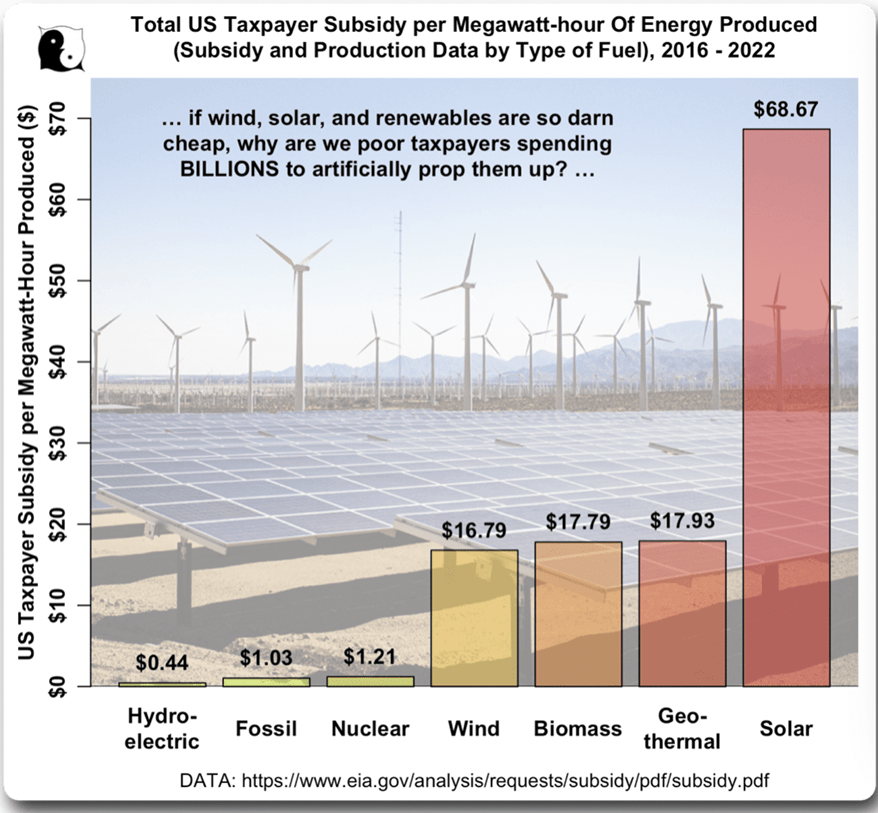
Kevin Roche explains the problem. If renewable energy is so supposedly cheap, why does it take such huge subsidies to produce it? For the record I don’t think the subsidies shown in include the costs for energy storage required when the wind is not blowing and the sun is not shining, the magical dispatchable emissions-free resource needed when there are extended periods of low renewable resource availability, and all the ancillary transmission support services not provided by wind and solar generation.
State Differences In Energy Costs
In addition to infeasibility the energy transition will certainly raise costs. This article documents the difference between states that have green energy mandates and those that do not. Seven of the top eight continental states (including New York} in terms of highest average retail electricity prices in 2023 have some sort of green energy mandates. “The differences in electricity costs are stark, with the costs of a kilowatt hour in California, Massachusetts, Rhode Island and Connecticut more than doubling the costs of the same unit in states like Idaho, Wyoming, Utah and Oklahoma” that do not have mandates.
Fifth National Climate Assessment
Climate Discussion Nexus – If Only They Were Just in It For The Money:
The Manhattan Contrarian offers a skeptical look at America’s new “Fifth National Climate Assessment” produced by a bureaucratic hydra consisting of 14 major agencies all united in believing that humanity is setting the sky on fire and the only way to stop it is for all 14 of them to get a whole lot more money. But while the problem of asking bureaucracies whose existence depends on there being a climate crisis to investigate whether there is a climate crisis is obvious enough, an even deeper problem is what happens when those bureaucracies turn to known zealots to do the writing. After all, if the corruption were merely mercenary we could, in principle, bribe them to dismiss the alarm as a hoax, in the unlikely event skeptics could ever raise the necessary funds. But at its core this crowd isn’t interested in money or, for that matter, science. As Roger Pielke Jr. exclaimed in irritation “How did Project Drawdown, The Nature Conservancy and Stripe get to write the overview chapter on climate for the US NCA?” Everyone would object, he notes, if people from known skeptical organizations were put in charge of the writing process. Yet when employees of climate advocacy organizations are handed control over the writing process we are supposed to pretend the result will be anything other than propaganda.
Making Sense of the Politics of Extreme Climate Projections
Roger Pielke Jr. describes the dynamics behind climate policy analyses in an article related to the previous one. He describes recent work that you will not hear in the mainstream media because it indicates that the worst-case projections relied on as rationale for the Climate Act are less likely. This does not mean that we should not do something, but it reinforces my belief that we have time to make sure that the net-zero transition policies will not do more harm than good.
Yet Another issue with Offshore Wind
In order to build the offshore wind facilities necessary for the Climate Act transition, an entire industry has to be developed. It is not just making the turbine blades and the supporting structures but also the construction equipment to install everything. To complicate things more, the Jones Act requires that the equipment shipped out of US ports be transported on ships built, owned, and operated by US citizens and that complicates offshore wind construction. This article explains that the “arms race” among manufacturers to build ever bigger offshore wind turbines means that the ship builders have issues. They build for one size and somebody wants to install an even bigger one by the time the ship starts work. “We will get to a certain point where there is a limit,” he said, “purely due to practicality.”

 Pragmatic Environmentalist of New York