NYSERDA Climate Act Cost Estimate Bombshell

Rebecca Lewis has posted two City and State articles that found that the Hochul Administration recognizes that the  Climate Leadership & Community Protection Act (Climate Act) is so expensive that the Governor will propose changes to the Climate Act to reduce the costly clean energy transition. 

In the first article she explains that state budget director Blake Washington described the cost burdens of the green energy requirements on average New Yorkers as “own goals” at the Citizens Budget Commission breakfast on 2/25/26.  This apparently precipitated an update on the “likely costs of CLCPA compliance” documented in a memo dated Feb. 26 that Lewis notes “lays out average costs to New Yorkers by 2031 under a hypothetical cap-and-invest system that would be necessary to meet the emissions benchmarks laid out in the Climate Act.”  This memo references my work that suggests that even these costs are underestimated.

I am convinced that implementation of the Climate Act net-zero mandates will do more harm than good if the future electric system relies only on wind, solar, and energy storage because of reliability and affordability risks.  I have followed the Climate Act since it was first proposed, submitted comments on the Climate Act implementation plan, and have written over 600 articles about New York’s net-zero transition.  The opinions expressed in this article do not reflect the position of any of my previous employers or any other organization I have been associated with, these comments are mine alone.

Overview

The Climate Leadership & Community Protection Act (Climate Act) established a New York “Net Zero” target (85% reduction in GHG emissions and 15% offset of emissions) by 2050.  Among its interim 2030 targets is a reduction target of 40% less GHG emissions and a 70% renewable energy electricity mandate. 

My recent article describing current Climate Act issues described some of the issues raised.  I explained that there are significant Climate Act issues that can no longer be ignored.  Most targets are behind schedule, and the increased costs of the Climate Act will exacerbate the existing energy affordability crisis.  DEC needs to respond to the New York Cap-and-Invest (NYCI) economy wide emission reduction initiative requirements and will have to eventually respond to the litigation saying that the State must implement the regulations or amend the law.  PSC must also address the safety valve provisions of Publc Service Law 66-P. 

These latest revelations are nothing more than acknowledgement of reality.

Budget Director Remarks

In the first article, Lewis describes remarks made by Hochul’s Budget Director at the Citizens Budget Commission breakfast on 2/25/26.  Her article states:

Blake Washington called the Climate Leadership and Community Protection Act “well-intentioned,” but said circumstances had changed since former Gov. Andrew Cuomo signed the law in 2019. “Sometimes you can change governmental rules to just fit the times and actually adapt to the realities, the realities before us, not how we wish them to be,” Washington said. He added that the estimated average cost to New Yorkers of the energy transition under current rules comes to roughly $3,000, a number the governor finds “unacceptable.”

Lewis noted:

Speaking to City & State after the CBC breakfast, Washington said state officials must have “honest conversations” about the goals currently in place the state must meet. “It’s important that we highlight the inequities that are before us,” Washington said. “If you were to follow the current law … follow the goals, you’re looking at upwards of $1.90 extra at the pump, which is not something the governor’s willing to tolerate.”

Washington strongly implied the governor wants to include changes to the climate law as part of the budget, though he stopped short of stating so explicitly and didn’t say when she would release her proposal. The executive chamber didn’t include the potential policy reforms as part of Hochul’s 30-day budget amendments, which are typically where a governor introduces new items they wish to negotiate. 

Clearly, the Hochul administration is going to do something regarding the Climate Act.

NYSERDA Cost Memo

In the second article Lewis described the contents of a NYSERDA memo from President and CEO of the New York State Energy Research & Development Authority Doreen Harris to Jackie Bray, Director of State Operations.  This appears to update some of the numbers that Washington quoted the day before.  Lewis notes also that Hochul commented on the cost issues in an unrelated press conference at the same time the memo was released.

Gov. Kathy Hochul suggested on Thursday that the cost of fully complying to the state’s climate law could cost average New Yorkers up to $3,500 each. A new memo shared with City & State from the New York State Energy Research and Development Authority places the estimated cost for upstate gas and oil households even higher. 

Lewis also notes that the memo emphasizes affordability concerns:

“If fully implemented with regulations to meet the 2030 targets, CLCPA’s original design – differing accounting standards from the internationally-accepted approach and inflexible near-term targets – would combine to yield high costs to New York households and businesses,” the memo reads. “Addressing this cost escalation is essential to deliver a policy that supports affordability and economic competitiveness and is necessary to ensure continued progress on decarbonization policy.”

She explains the ramifications and hints that there will be changes in the law:

“If fully implemented with regulations to meet the 2030 targets, CLCPA’s original design – differing accounting standards from the internationally-accepted approach and inflexible near-term targets – would combine to yield high costs to New York households and businesses,” the memo reads. “Addressing this cost escalation is essential to deliver a policy that supports affordability and economic competitiveness and is necessary to ensure continued progress on decarbonization policy.”

I was particularly interested in the cost impacts described.

Absent changes, by 2031, the impact of CLCPA on the price of gasoline could reach or exceed $2.23/gallon on top of current prices at that time; the cost for an MMBtu of natural gas $16.96; and comparable increases to other fuels. Upstate oil and natural gas households would see costs in excess of $4,000 a year and New York City natural gas households could anticipate annual gross costs of $2,300. Only a portion of these costs could be offset by current policy design.

The assumptions are not available.  However, the memo states “The estimated allowance price would begin in the neighborhood of $120/ton and rise to $179.80/ton by 2031 in real terms.”  I believe that the analysis assumes that NYCI is implemented such that the modeling forces compliance with the 2030 emission reduction target by not putting limits on the cost of allowances. (As an aside, that presumption assumes that high allowance prices will force emission reductions which is a stretch and topic for another post.)

The memo concludes

Current CLCPA targets escalate costs for New Yorkers as a result of a combination of factors. Primarily, the greenhouse gas accounting approach incorporated in statute and regulation, in combination with current emission reduction targets, mean that current law attributes higher emissions to New York than other leading jurisdictions do for the same activity, as well as higher emissions than under accepted science. This includes emissions from out-of-state fossil fuel production, which is not incorporated in jurisdictional inventories by the IPCC; attributing to bioenergy its combustion emissions and thus ignoring the treatment of the short carbon cycle by scientists and the IPCC; and the use of Global Warming Potential 20 (GWP-20), which the IPCC states is not standard practice in the scientific community and doesn’t comport with the Paris Agreement Rulebook. In addition, the targets as adopted in 2019 could not have foreseen the substantial reversal in the federal policy landscape, the disruptive and lingering impacts of COVID-19 and the subsequent supply chain crisis, the return of an inflationary economy, and the influence of geopolitical events on energy costs generally.

All this is fodder for arguments that Hochul will apparently use to claim that the Climate Act must be modified because of the expected costs.

NYSERDA Cost Underestimates

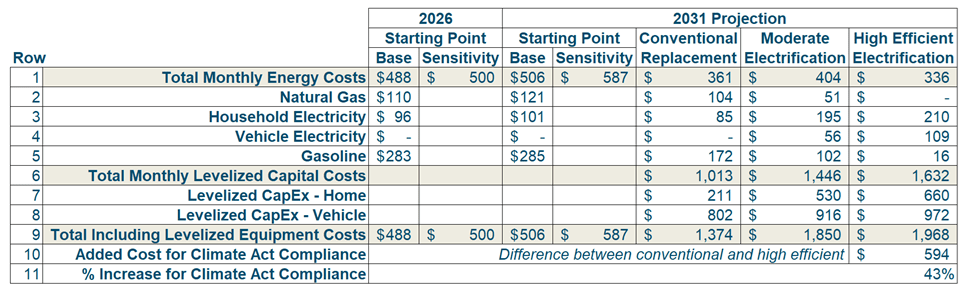
As high as these numbers are, I believe that the admitted costs in the memo are underestimated.  The State Energy Plan December 2025 Energy Affordability Data Annex spreadsheet (Annex Spreadsheet)  and the Energy Affordability Impacts Analysis (Impact Analysis) document provide the supporting documentation for the Fact Sheet. Using that data I compared costs for an Upstate New York moderate income household that uses natural gas for heat for replacement with conventional equipment and electrification equipment consistent with Climate Act goals.  The difference in monthly energy costs and levelized equipment costs necessary to comply with the Climate Act would be $594 a month greater as shown in Table 1. Details of the table contents are available here.  I believe that the cost of Climate Act compliance is the difference between replacement of conventional equipment and the highly efficient electrification equipment.  Row 10 shows this difference.  It lists the $594 increase in costs necessary for Climate Act compliance.  On an annual basis this is about $7,200.

Table 1: Upstate New York Moderate Income Household That Uses Natural Gas for Heat Projected Monthly Costs and Costs Necessary to Comply with the Climate Act

The articles and memo cost estimates are inconsistent with my evaluated cost of $7,200 per household.  Budget Director Davidson said that “the estimated average cost to New Yorkers of the energy transition under current rules comes to roughly $3,000.”  Lewis says that Gov. Kathy Hochul suggested that “the cost of fully complying to the state’s climate law could cost average New Yorkers up to $3,500 each.”  The memo states “Upstate oil and natural gas households would see costs in excess of $4,000 a year and New York City natural gas households could anticipate annual gross costs of $2,300.”  My costs are by household and the other numbers may be by person or household so that is a confounding factor.

A Perplexity AI search of the “entire Energy Affordability Impacts Analysis section of the adopted 2025 Energy Plan confirms zero mentions of cap-and-invest, carbon pricing, allowance costs, or the Clean Air Initiative anywhere in the affordability chapter.”  This means that my estimate of Climate Act costs do not include the cap-and-invest costs described in the NYSERDA memo.  For the Upstate natural gas household in the NYSERDA State Energy Plan analysis that included the costs of equipment necessary for Climate Act compliance the costs would be $11,200 a year.

Discussion

NYSERDA has never been upfront about Climate Act costs.  The NYSERDA CLCPA costs estimates use a “no action” baseline that excludes programs in place before the CLCPA was enacted but are necessary to achieve the CLCPA mandates.  That means that their analyses underestimate the costs of compliance even more than described here.  I described this misleading approach used in the State Energy Plan here and here.

Lewis described the initial response from the ideologues who unequivocally support Climate Act implementation:

Washington’s new comments also drew immediate condemnation from climate activists, who have criticized Hochul for delays in releasing key climate regulations and her willingness to expand natural gas use. Liz Moran, New York policy advocate for Earthjustice, said targeting the climate law isn’t the way to address the real utility squeeze residents are feeling. “The main driver of those increases is the cost of gas and gas pipes – not our climate law,” she said in a statement. “Failing to address gas as the problem is the actual ‘own goal.’ With the federal government decimating science-based climate protections every day, now is not the time for New York to do the same to our nation-leading climate law.”

With regards to the memo Lewis noted an even more unhinged response:

Environmental advocates immediately blasted the memo. Justin Balik, Evergreen Action’s vice president for states, said rather than running away from clean energy, Hochul should expand initiatives and programs she has already deployed, and seek opportunities for innovative clean energy solutions. “The answer here is, again, leaning into clean energy and not buying into some of these false claims from the fossil fuel community and the business lobby that somehow renewables are why people’s bills are going up,” Balik said. “And it’s troubling that those assertions are being entertained by the state right now.”

Most troubling to me is this Democratic lawmaker’s response:

“Yes we can address climate change, reduce costs for ratepayers, increase generation and create tens of thousands of good-pay jobs in the process,” state Sen. Pete Harckham, chair of the Senate Environmental Conservation Committee, said in a statement. “What we need is the political courage to do so.”

This is so wrong on so many levels that it beggars the mind.

Conclusion

Richard Ellenbogen summed this up well when he told me: “When you try to execute policies that defy physical law, costs are going to spiral out of control which is what has happened.  He concluded that “The entire CLCPA is fatally flawed, and that’s what you get when you turn energy planning over to ideologues with no knowledge of energy systems or economics.”

I have been advocating for an implementation pause for months.  Clearly the PSC must conduct a hearing to suspend or temporarily modify the Renewable Energy Program in Public Service Law 66-P.

Reasons to Hold a PSL 66-P Hearing – Transmission Needs

On 1/28/26 the Public Service Commission (PSC) issued a notice soliciting comments regarding the Coalition for Safe and Reliable Energy petition.  This post describes issues related to transmission planning that I think impede the Public Service law 66-P provision for safe and adequate service.  I will submit comments arguing  that these findings obligate the PSC to hold a public hearing to determine if these transmission issues impede safe and adequate service.

I am convinced that implementation of the New York Climate Act net-zero mandates will do more harm than good if the future electric system relies only on wind, solar, and energy storage because of reliability and affordability risks.  I have followed the Climate Act since it was first proposed, submitted comments on the Climate Act implementation plan, and have written over 600 articles about New York’s net-zero transition.  The opinions expressed in this article do not reflect the position of any of my previous employers or any other organization I have been associated with, these comments are mine alone. 

Background

There is a fundamental Climate Act implementation issue.  Clearly there are bounds on what New York State ratepayers can afford and there are reliability risk limits for a system reliant on weather-dependent resources.  The problem is that there are imprecise criteria for acceptable affordability bounds or reliability limits.

Proponents of the Climate Act argue that the transition strategies in the law must be implemented to meet the net-zero mandates regardless of affordability or reliability constraints because it is the law.  However, they do not acknowledge that Public Service Law (PSL) Section 66-P, Establishment of a Renewable Energy Program, is also a law. PSL 66-P requires the Commission to establish a program to ensure the State meets the 2030 and 2040 Climate Act obligations but includes bounds.  PSL 66-P (4) states: “The commission may temporarily suspend or modify the obligations under such program provided that the commission, after conducting a hearing as provided in section twenty of this chapter, makes a finding that the program impedes the provision of safe and adequate electric service; the program is likely to impair existing obligations and agreements; and/or that there is a significant increase in arrears or service disconnections that the commission determines is related to the program”. 

Two petitions have been filed calling for such a hearing.  On 8/12/25 the Independent Intervenors filing argued that there were affordability and reliability issues and that there was an explicit requirement for the hearing because the customers in arrears threshold has been exceeded.  The Coalition for Safe and Reliable Energy filing on 1/6/26 made a persuasive argument that there are sufficient observed threats to reliability that a hearing is necessary to ensure safe and adequate service.  On 1/28/26 the Public Service Commission issued a notice soliciting comments regarding the Coalition for Safe and Reliable Energy petition which are due on 3/30/26.

Onshore Transmission Requirements

A  grid relying on wind and solar cannot be implemented without significant transmission upgrades.  The New York Independent System Operator (NYISO) has noted that New York’s Climate Act renewable energy projects depend heavily on transmission because “most new renewable capacity is being built where the wind, sun, and land are available, not where the loads are, and the existing grid cannot move that energy to the major demand centers without large curtailments and reliability problems.” 

NYISO noted that dependence on a few critical transmission projects has risks. The 2024 RNA Report notes that the base case assumes timely completion of Champlain Hudson Power Express (CHPE) and Clean Path NY (CPNY) by 2027-2028.  The status of these projects could impede safe and adequate service.

CHPE is in late-stage construction and the developer is still targeting an in-service date of May 2026.  CHPE is a 1,250 MW HVDC line delivering clean hydropower into Astoria, New York City.  The contracted delivery is on the order of 10.4 TWh per year, corresponding to a high assumed capacity factor (around 95%) and 1,250 MW of firm capacity sales.  Hydro‑Québec has stated that deliveries will be split roughly half in winter and half in summer (10.4 TWh total, 5.2 TWh per season), with an incentive to use the full line capability.  ​However, the Hydro‑Québec bid “includes summer‑only unforced delivery rights,” with “no specific delivery obligations during the winter peak.”  NYISO’s Short‑Term Reliability Process Report states that while CHPE is expected to contribute to reliability in the summer, “the facility is not expected to provide any capacity in the winter.”  The future of energy availability on this transmission line is foreshadowed by the New England Clean Energy Connect (NECEC) HVDC line that had been energized only about a week when the January 23-27 winter storm hit. Power flows from Québec to New England from this line and others largely collapsed during the cold snap.

At least it will be operating in the summer.  The Clean Path New York project has been terminated.  It was initially selected and approved as part of the Tier 4 program in Case 15‑E‑0302 (Order Approving Contracts for the Purchase and Sale of Tier 4 Renewable Energy Credits, issued April 14, 2022. The associated 178‑mile HVDC transmission facility from Delhi to Queens was advanced in Case 22‑T‑0558, Application of NYPA and Clean Path New York LLC for a Certificate of Environmental Compatibility and Public Need.  NYSERDA and the Clean Path NY developers (NYPA plus the Forward Power JV of energyRe and Invenergy) “mutually agreed to terminate” the Tier 4 REC Purchase and Sale Agreement in late November 2024.  The termination reflected cost escalation after the original 2021 award; developers sought higher subsidies, but the state declined, leading to cancellation of the underpinning contract for the 175‑mile, ~1,300 MW HVDC line and associated renewables.  NYPA later sought Priority Transmission Project (PTP) designation for the ‘Clean Path Transmission Project’ in Case 20‑E‑0197; but the Commission denied that petition in its Order Denying Petition (issued August 14, 2025).  The PSC denied NYPA’s petition because the project did not meet criteria for PTP designation, in part because NYISO studies showed relatively low projected utilization compared with CHPE and concern about ratepayer cost recovery for a line whose major flows might not materialize for decades.

The NYISO 2025 Power Trends report transmission section states that without major transmission (CHPE, CPNY) project completion that NYC reliability margins will become deficient which could impede safe and adequate electric service.  The PSC must address in a heating whether the transmission line status will impede the ability to provide safe and adequate service.

Offshore Transmission Requirements

The Climate Act includes a requirement for 9,000 MW of offshore wind by 2035.  According to a Perplexity AI query response: “New York’s offshore wind transmission situation is defined by two contrasting realities: the projects already under construction are advancing their dedicated transmission lines despite federal disruptions, while the broader coordinated transmission planning effort for future projects has been shelved due to the Trump administration’s hostility toward offshore wind.”

There are two transmission lines under construction.

Empire Wind 1 (810 MW), developed by Equinor, is the first offshore wind project that will deliver power directly into New York City.  As of late 2025, export cable installation was actively underway. Equinor reported that trenching, cable-laying, and cable pulling were ongoing on the outer continental shelf, and the export cable was brought onshore in 2025. The onshore substation at SBMT was under construction with transformer delivery completed in early 2025. An offshore substation was scheduled for installation in early 2026. The project was approximately 60% complete as of late December 2025 when the Trump administration issued a stop-work order suspending the lease. A federal judge issued a temporary injunction in January 2026 allowing construction to resume while the legal case proceeds. Empire Wind aims to deliver first electricity by late 2026 and reach commercial operation by 2027.

Sunrise Wind (924 MW), developed by Ørsted, is the first U.S. offshore wind project to use High Voltage Direct Current (HVDC) transmission, which reduces the number of cables needed and improves efficiency.  As of December 2025, onshore transmission work — including the converter station and duct bank — was over 90% complete. Offshore, the export cable was being tunneled through the surf zone (at 11–60 ft deep), with nearshore installation to follow. Approximately 44 of 84 monopile foundations were installed, and the HVDC offshore substation arrived from Norway and was installed in September 2025. Like Empire Wind, Sunrise Wind’s lease was suspended by the Interior Department on December 22, 2025. A federal judge cleared the project to resume construction in early February 2026. The project is expected to be completed and operational in 2027.

Additional transmission would be needed to service the remaining 9,000 MW of mandated offshore wind.  This was supposed to be provided by the NYC Public Policy Transmission Need (PPTN) program. 

In June 2023, the PSC identified a Public Policy Requirement for new transmission facilities to deliver at least 4,770 MW — and up to 8 GW — of offshore wind energy into New York City by 2033. The NYISO launched a solicitation in April 2024 and received 28 proposals from four developers, with estimated costs ranging from $7.9 billion to $23.9 billion.

On July 17, 2025, the PSC voted to withdraw the PPTN determination, effectively cancelling the process. The Commission stated it could not responsibly commit ratepayers to billions in transmission costs when the federal government had halted offshore wind permitting and leasing, making it impossible to predict when new generation projects would move forward. PSC Chair Rory Christian emphasized that this was about timing and ratepayer protection, not abandoning offshore wind, stating “it is a matter of when, and not whether, offshore wind generation projects will move forward”.

The PSC must address in a heating whether these decisions about offshore wind will impede the ability to provide safe and adequate service.

Conclusion

The NYISO 2025 Power Trends conclusion states that there is a risk that cumulative factors (retirements, electrification, delays) will create reliability metric violations.  It is clear from the transmission status described here that there will be a lack of sufficient transmission to get the wind and solar energy from where it is collected to where it is needed to achieve the Climate Act schedule.  This will create reliability metric violations that are incompatible with safe and adequate electric service. In my comments on the petition request, I will argue that the PSC should hold a PSL 66-P hearing to determine whether to temporarily suspend or modify the obligations of the Renewable Energy Program is therefore appropriate.

NYISO Climate Act Concerns

I was recently asked to give a briefing about Climate Leadership & Community Protection Act (Climate Act) issues. While preparing my presentation I used Perplexity AI to generate a review of the New York Independent System Operator’s (NYISO) concerns with the Climate Act.  This article provides background documentation based on the response to that query.

I am convinced that implementation of the New York Climate Act net-zero mandates will do more harm than good if the future electric system relies only on wind, solar, and energy storage because of reliability and affordability risks.  I have followed the Climate Act since it was first proposed, submitted comments on the Climate Act implementation plan, and have written over 600 articles about New York’s net-zero transition.  The opinions expressed in this article do not reflect the position of any of my previous employers or any other organization I have been associated with, these comments are mine alone.

Overview

The Climate Act established a New York “Net Zero” target (85% reduction in GHG emissions and 15% offset of emissions) by 2050.  Among its interim targets is a 2030 70% renewable energy electricity mandate and a 2040 zero emissions requirement that are of particular concern to the NYISO.

I prepared a power point presentation for the briefing with supporting documentation that discussed Climate Act issues that need to be addressed.  The New York’s Legislative annual session revolves around  enacting the state’s April 1 budget.  The budget is an executive‑budget model which means that the Governor can stick in policy legislation like the Climate Act.  In my last post I described issues that the legislature should address this session.  This article describes concerns that the NYISO has with the Climate Act that supports my belief that the Public Service Commission (PSC) should conduct a hearing to consider suspending or modifying the obligations of the Climate Act because there are observed threats to reliability that threaten safe and adequate service.

Perplexity Summary

I used Perplexity AI to generate the following summaries of NYISO concerns.

Tightening reliability margins and resource adequacy

NYISO’s long‑term reliability and resource adequacy studies show that reserve margins are thinning as fossil units retire faster than new, firm replacement capacity and transmission arrive.

They point to:

  • A net loss of dispatchable capacity since the CLCPA was passed: several gigawatts of fossil capacity have retired while additions are largely intermittent renewables and limited-duration storage.
  • Projections in their Comprehensive Reliability Plan (CRP) and Reliability Needs Assessments that show:
    • Declining reliability margins in New York City and downstate.
    • Potential statewide shortfalls later in the 2020s/early 2030s if retirements continue at the current pace and clean resources, storage, and transmission are delayed.
  • Concern that the system is increasingly reliant on emergency procedures (demand response, voltage reductions, etc.) to meet resource adequacy criteria on peak days, which is not a sustainable operating strategy.

In short, CLCPA‑driven retirements and environmental constraints (e.g., peaker rule) are moving faster than the build‑out of firm, deliverable alternatives, tightening margins to what NYISO characterizes as “concerning” levels.

Coordination of fossil retirements with new entry

NYISO has repeatedly emphasized that fossil generator retirements must be carefully coordinated with the timing and performance of new resources:

  • They support the CLCPA recommendation to “retire fossil resources gradually and safely,” but warn that mandatory retirement schedules or environmental rules that force large blocks of capacity off the system by fixed dates, without assured replacement, can create reliability violations.
  • In New York City in particular, they highlight that:
    • Peaker rule and other environmental closures remove capacity that is both local and fast‑responding.
    • Replacement capacity must satisfy local transmission security and deliverability constraints, not just nameplate MW.
  • NYISO worries that policy and permitting processes affecting existing plants are often decided without a concrete, tested replacement portfolio in place, leaving them to fill gaps reactively through backstop reliability arrangements.

Their concern is not simply “don’t retire fossil,” but “do not retire fossil faster than the system can absorb given actual, not theoretical, replacements.”

Dependence on a few critical transmission projects

CLCPA strategies assume large amounts of new clean generation, including upstate renewables and Canadian hydro, will be deliverable to downstate load via specific major transmission projects. NYISO’s reliability plans highlight:

  • Heavy reliance on timely completion of projects like Champlain Hudson Power Express (CHPE) and other major bulk upgrades.
  • Findings that, without these projects in service on schedule, New York City’s reliability margins become extremely small or turn deficient for much of the 10‑year planning horizon.
  • Concern that delays or cancellations of such projects (or of offshore wind transmission solutions) leave the state with policy commitments that cannot be supported by the physical grid.

So one core concern is that the CLCPA architecture implicitly assumes a best‑case transmission build‑out path; NYISO’s studies are essentially saying, “If those assumptions slip, reliability breaks.”

Operational challenges from high levels of intermittent renewables

NYISO accepts that the CLCPA implies a massive increase in weather‑dependent resources, but highlights that:

  • High penetrations of wind and solar increase uncertainty in net load forecasts, requiring:
    • More operating reserves.
    • New reserve products (e.g., “uncertainty” or “dynamic” reserves) to cover forecast error and fast ramps.
  • Studies of high‑renewables scenarios show:
    • Substantial increases in required installed reserve margins to maintain the same loss‑of‑load expectation.
    • Need for significant quantities of flexible, fast‑ramping resources, including storage and responsive demand, to manage multi‑hour ramps and multi‑day low‑renewables events.
  • The system will be more exposed to extreme weather—heat waves and cold snaps—at the same time that dispatchable fossil capacity is reduced, increasing the risk that the system crosses a “tipping point” where it cannot serve load during stress events.

In other words, the CLCPA’s heavy reliance on intermittent resources forces a fundamental redesign of operating reserve and capacity constructs; NYISO’s concern is that policy timelines assume this redesign and the necessary resources will be ready and deliverable in time.

Need for “firm, zeroemissions” and longduration solutions (technology gap)

NYISO has started to stress that, to meet CLCPA’s 2040 zero‑emissions grid requirement while staying reliable, New York will need:

  • Significant quantities of “firm, zero‑emission” capacity (e.g., hydrogen‑capable turbines, advanced nuclear, long‑duration storage, carbon capture, or other technologies that can run through multi‑day renewable droughts).
  • Far more total installed capacity by 2040 than today—often characterized as roughly three times current capacity—once electrification (buildings, transport, industry) and higher reserve needs are included.

Their concern is that:

  • The CLCPA and Scoping Plan implicitly assume large volumes of such technologies will be available, cost‑effective, and sited in New York by 2040, but there is no clear, concrete procurement or market framework yet that ensures they appear.
  • Current market designs and state programs are heavily tuned to 20‑year REC‑backed wind and solar, not to capital‑intensive firm resources with different risk profiles.

So NYISO is effectively warning of a technology and market design gap between what CLCPA requires in the 2030s–2040s and what is actually under contract or in queues today.

Documentation for NYISO Issues

The Perplexity AI response to my concerns of NYISO about Climate Act goals also generated a spreadsheet table of specific issues that lists the Issue Area, NYISO Document, Specific NYISO Finding/Concern, CLCPA Statutory Provision, CAC Scoping Plan Assumption/Strategy, Gap/Disconnect, and Talking Point for identified problems.  The following sections describe the NYISO documents that address specific NYISO findings and concerns listed in the spreadsheet.

NYISO has identified issues with resource adequacy associated with declining margins in multiple reports.  The 2025 Power Trends noted that there has been a net loss of 2,041 MW since the Climate Act was enacted (4,315 MW retired, 2,274 MW added).  The Executive Summary in the 2024 Reliability Needs Assessment (RNA) Report explains that statewide resource margins are declining so fast that by 2034 there will be no surplus power without further development.  The 2025 Q3 Short-Term Assessment of Reliability (STAR) Report identified a New York City (NYC) Zone J reliability need beginning in summer 2027 that requires peaker units that have been scheduled for retirement to be retained.

The timing of fossil retirements vs new entry timing is also an NYISO concern.  The 2025 Power Trends document noted that fossil retirements are outpacing new supply additions since 2021.

The 2024 RNA Report notes that the NYC reliability need in 2033 is driven by faster generator retirements than replacement resource development.  The 2025 Q3 STAR Report noted that the NYC Peaker Rule that forces retirement by 2027-2029 is impossible unless local replacement resources are developed.

NYISO also noted that dependence on a few critical transmission projects has risks. The 2024 RNA Report notes that the base case assumes timely completion of Champlain Hudson Power Express (CHPE) and Clean Path NY (CPNY) by 2027-2028.  The 2025 Power Trends report transmission section states that without major transmission (CHPE, CPNY) project completion that NYC reliability margins will become deficient.  The NYISO submitted comments on the Scoping Plan also noted that there will be a heavy dependence on specific transmission projects that may not get built as scheduled.

NYISO has raised intermittency and operating reserves concerns.  The 2024 RNA Report resource adequacy study explains that a high penetration of intermittent renewables requires new reserve products.  The 2025 Power Trends includes an intermittency discussion that notes that wind/solar variability will increase reserve requirements and ramp capability needs.  The

NYISO Uncertainty Reserve Requirement filing defines FERC approved Uncertainty Reserve Requirement for the forecast error from renewables.

There is a clear need for a new dispatchable emissions free resource (DEFR).  NYISO has addressed this requirement in its reports.  The 2024 RNA Report, scenarios analysis states that meeting 2040 zero-emissions requires “firm zero-emission” resources not yet identified. 

The 2025 Power Trends describes this technology gap explaining that the grid needs three times current capacity by 2040 with electrification and higher reserve margins.  NYISO comments on the Scoping Plan also described the technology gap stating that long-duration storage, hydrogen, advanced nuclear are not yet commercial at scale.

New York electric load is increasing and will increase more as Climate Act electrification programs progress.  NYISO addressed load trends in several reports.  The 2025 Power Trends, load forecast section notes that large loads (data centers  and semiconductors) will add 2,567 MW demand by 2035.  The 2024 RNA Report includes large loads assumptions that predict peak demand growth accelerating due to electrification and economic development.  The 2025 Load & Capacity Data Report aka Gold Book load forecast notes that load forecast uncertainty is higher than historical due to policy-driven electrification driven by the Climate Act.

New York City presents special challenges to the grid and for the Climate Act mandates.  NYISO found in the 2025 Q3 STAR Report, Zone J findings that the Zone J (NYC) summer 2027 reliability need is driven by load growth and retirements.  The 2024 RNA Report discussion of

NYC reliability needs 2033 found that the reliability need requires compensatory MW because there are limited local alternatives.  The 2025 Q2 STAR Report Peaker Rule analysis notes that the DEC Peaker Rule removes capacity exactly when NYC needs an increase.  This means that NYISO must delay the rule’s retirement dates.

The NYISO has also noted that there are market design and investment signals that affect their response to the Climate Act mandates.  The 2025 Power Trends, market design section explains that State procurement (ORECs, Tier 1 RECs) policies reduces market price signals. 

NYISO FERC filings on the capacity market notes that capacity market suppression from state-contracted resources undermines flexibility value. 

The political manipulation of the electric market mandated by the Climate Act creates issues with planning process coordination.  The NYISO comments on the Scoping Plan noted that the

State’s Climate Act Policy planning (NYSERDA Integration Analysis) uses different assumptions than NYISO reliability planning.  The 2024 RNA Report planning assumptions notes the lack of alignment between the Scoping Plan scenarios and NYISO base case reliability studies.

The Climate Act and Department of Environmental Conservation interpretation of it have eliminated the backlog of new fossil generating units. As a result the fossil fleet is aging.  The 2025 Power Trends notes that 11% of 2024 energy production is from generators greater than 50 years old.  The existing fleet analysis in the 2024 RNA Report states that 10,000+ MW (25% of total capacity) has been in operation  greater than 50 years.

There are risks related to the implementation pace required to meet the arbitrary Climate Act targets.  The 2024 RNA Report Executive Summary notes the narrowing margins driven by statewide resource shortfalls and the rapid change pace.  The 2025 Power Trends conclusion states that there is a risk that cumulative factors (retirements, electrification, delays) will create reliability metric violations.

The NYSERDA projections do not incorporate the reliability requirements that the NYISO must address.  The 2024 RNA Report capacity accreditation description notes that the NYSERDA Climate Act analyses focus on energy (MWh) but NYISO projections must ensure resource adequacy (MW capacity available).  The 2025 Power Trends description of reliability margin metrics notes that Intermittent resources have low capacity value and the NYISO must account for reliability contribution

Discussion

Please excuse the structure of this document.  If I had time, I would have combined the two sections into a single referenced description of NYISO concerns.

This article is intended to be a resource documenting NYISO concerns with Climate Act implementation.  It demonstrates that there are real problems that Climate Act apologists ignore..  Per Public Service Law 66-P two petitions have been filed calling for a hearing that stated that NYISO’s concerns are persuasive arguments that there are sufficient observed threats to reliability that a hearing is necessary to ensure safe and adequate service.  On 1/28/26 the Public Service Commission issued a notice soliciting comments regarding the Coalition for Safe and Reliable Energy petition.  Comments on the Coalition petition are due on 3/30/26.  This information will be useful to document the NYISO concerns.

Conclusion

These concerns about electric system reliability and resource adequacy are another indication that it is time to demand that the PSC conduct a hearing to consider suspending or modifying the obligations of the Climate Act by submitting comments on the Coalition petition.