

I have been following the. Climate Leadership & Community Protection Act (Climate Act) since it was first proposed and most of the articles described below are related to the net-zero transition. I have devoted a lot of time to the Climate Act because I believe the ambitions for a zero-emissions economy embodied in the Climate Act outstrip available renewable technology such that the net-zero transition will do more harm than good. The opinions expressed in this article do not reflect the position of any of my previous employers or any other company I have been associated with, these comments are mine alone.
Videos
Energy and Illusions: Power density – Lots of resources going in, not much energy coming out means a resource that is never going to work
Hurricanes and Global Warming: Dr Neil Frank talks about climate change and the biggest storms on earth.
Isuru Seneviratne from Nuclear New York suggested a video series that I also highly recommend.
This 5-piece docu-series as ESSENTIAL as we advocate for climate policies that do not disproportionately harm the poor. It’s a riveting wake-up call made by independent thinkers who dig deep beneath the gaslighting that goes on from Enron to German “Greens.”
https://www.youtube.com/@JuiceTheSeries
Juice: Power, Politics, And The Grid is a five-part documentary series produced by two Austin-based filmmakers, Tyson Culver and Robert Bryce, that follows the success of their first film: Juice: How Electricity Explains the World, which is now available on streaming platforms around the world.
The series takes viewers from Texas to Tokyo to expose the perils facing our electric grid. It shows how we can improve the reliability of our most important energy network and address climate change by embracing nuclear energy.
Juice: Power, Politics & The Grid features interviews with top thought leaders, including historian Patty Limerick, political scientist Roger Pielke Jr., journalist Michael Shellenberger, civil rights leader Robert Apodaca, World Nuclear Association director Sama Bilbao, Sacramento County Sheriff Jim Cooper, Canadian nuclear activist Chris Keefer, author Meredith Angwin, former IEA director Nobuo Tanaka, Campaign for a Green Nuclear Deal founder Madi Hilly, and many others.
While offering a sober assessment of the challenges facing the $5 trillion-per-year global electricity business, the series concludes with a hopeful look at the future — and the future of climate change — by featuring the activists who are helping fuel renewed interest and investment in nuclear power here in the U.S. and around the globe.
Electric Vehicles
I have planned to put together a post on electric vehicles for weeks but did not get around to it. This post at Irina Slav’s substack Irina Slav on energy summarizes most of the points I wanted to make in my planned article better than I would have done. She sums up the issues:
In a commentary piece for MarketWatch earlier this month, former White House director of economic policy Todd G. Buchholz compared EVs to electric bread makers, arguing that, just like bread makers, EVs are a fad that will eventually fade.
“The 1990s bread-machine fad never benefited from public subsidies, government mandates or furious discounting to gain market share. If it had, perhaps it would have continued for a few more years,” Buchholz wrote, going on to quote President Dwight Eisenhower as saying that “you don’t lead by hitting people over the head: That’s assault, not leadership.”
Here is another article describing problems in the EV industry.
Offshore Wind
Another topic that I have been meaning to address is the current state of offshore wind.
Bud’s Offshore Energy (BOE) “Energy Production, Safety, Pollution Prevention, and More” delves into the details of offshore wind development. He recently reviewed the Bureau of Ocean Energy Management and National Oceanic and Atmospheric Administration Fisheries North Atlantic Right Whale and Offshore Wind Strategy. His key takeaways:
The document effectively summarizes the dire state of the North Atlantic Right Whale.
- The BOEM/NOAA strategy is to monitor and further assess the impacts.
- The need for mitigation will be determined through collaborative processes.
- This industry-friendly strategy contrasts sharply with the restrictive operating requirements proposed for the more speculative Rice’s whale expanded area in the Gulf of Mexico.
He describes the status of the Right Whales:
NARW status (pages 7-14):
- Roughly 237 NARWs have died since the population peaked at 481 in 2011, exceeding the potential biological removal (PBR) level on average by more than 40 times for the past 5 years (Pace III et al. 2021).
- Human-caused mortality is so high that no adult NARW has been confirmed to have died from natural causes in several decades (Hayes et al. 2023).
- Most NARWs have a low probability of surviving past 40 years even though the NARW can live up to a century.
- There were no first-time mothers in 2022.
- About 42% of the population is known to be in reduced health (Hamilton et al. 2021)
- A NASEM study confirmed that offshore wind has the potential to alter local and regional hydrodynamics
- “Effects to NARWs could result from stressors generated from a single project; there is potential for these effects to be compounded by exposure to multiple projects.” (p. 14)
I cannot imagine any scenario where a species this stressed will survive when hundreds of massive wind turbines are built across the migration routes. See the figure showing where the turbines will be built and the whales are for March.
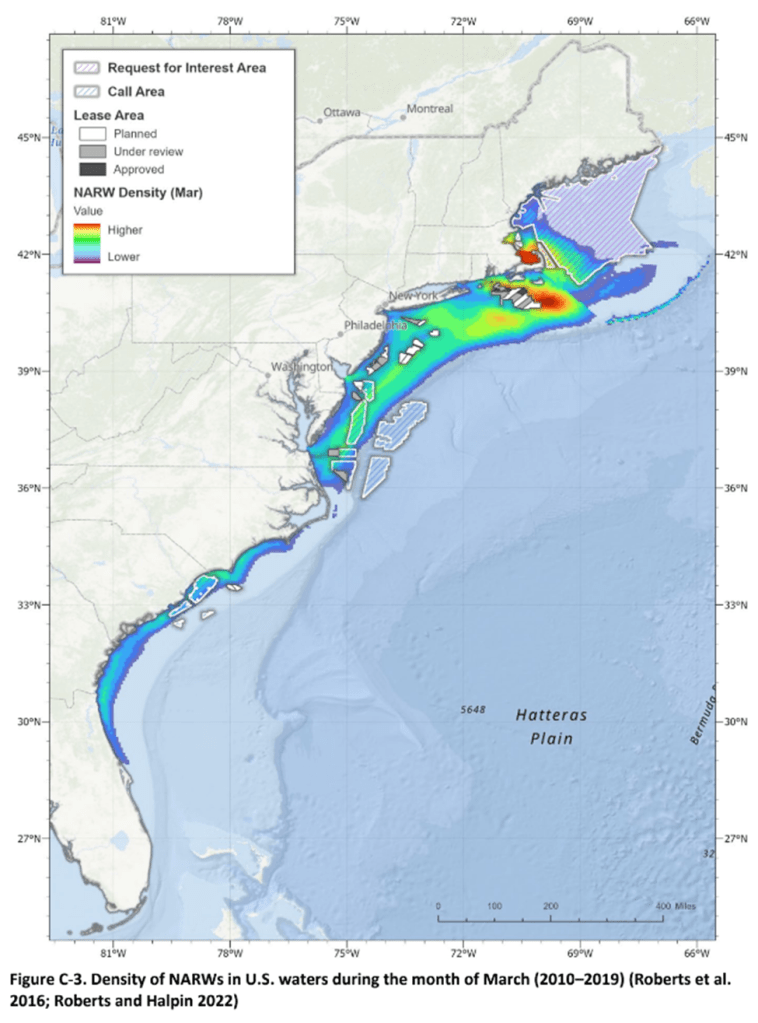
David Wojick describes three events affecting offshore wind development. Last year a number of developers cancelled their contracts to provide offshore wind power but now the first to come back to the trough seeking more money was approved in New Jersey. Wojick expects that other states will follow that lead. On the other hand a major new lawsuit has just been filed. He explains that the suit alleges that the” Federal agencies that have quickly issued the offshore wind permits have simply ignored the destructive environmental effects. This is especially true for the collective impact of combinations of nearby projects.” New York has similarly ignored the cumulative environmental impact of the proposed resources for the Climate Act. Finally, he notes that “One of the plaintiffs is the Save the Right Whale Coalition. Here, the narrow issue is the threat posed by enormous offshore wind development to the severely endangered North Atlantic Right Whale.” He includes a link to “a good picture of one of the unbelievably huge monopiles driven into the sea floor to hold up an offshore wind turbine generator” that shows what the whales are up against. Imagine the energy needed and noise created when these monstrosities are driven into the sea floor.
The mad rush to offshore wind will not just affect whales. Craig Rucker writing at Cfact describes the stress on commercial fisherman. He points out issues observed elsewhere and the lack of analysis before development occurs here.
New York State Climate Impacts Assessment: Understanding and Preparing for Our Changing Climate
This assessment deserves more attention and when the Climate Act implementation issues settle down I will return to this “scientific investigation into how climate change is affecting the communities, ecosystems, infrastructure, and industries of the Empire State.” If you are looking for an unbiased analysis of climate change in New York look elsewhere.
Without even looking hard this finding sets baloney alarms off:
Summary Finding 4: Sea level along New York State’s coastline has risen almost 1 foot in the past century and is projected to increase by another 1 to 2 feet by midcentury. Sea level rise will make chronic flooding more common in low-lying coastal neighborhoods, lead to intrusion of salt water into groundwater and freshwater coastal ecosystems, and yield more destructive storm surge during coastal storms. Coastal communities will benefit from planning and design that accounts for future sea levels.
They say that one foot in the past century has been observed. They are claiming that 1 to 2 feet additional sea-level rise will occur in half a century. For that to happen the sea level rise rate must at least double. There is no indication of such an accelerated sea-level rise rate. They have no shame hyping the most extreme estimates for climate models.
Ed Reid, Jr. writing at Right Insight does a nice job summarizing reasons why the fantasy that “intermittent renewable generation combined with electricity storage provides a reliable energy system at lower energy cost than the predominantly fossil fueled energy system it would replace.” He explains:
This fantasy is a complete and utter fraud, since those promoting it know that the generation technology they are promoting is intermittent and that the storage that they suggest would be required to overcome this intermittency and provide a reliable energy grid is inadequate, extremely expensive and unsuitable for the application.
He goes on to describe other problems.
The Campaign to Shut Down Discussion
Thomas Shepstone points out that proponents of the net-zero transition don’t want a discussion. Jo Nova brings it all together in an excellent post at her site titled “One third of UK teenagers think climate change is deliberately exaggerated.” She describes a perfect example of this in a recent article in the left-wing Guardian. The article claims that arguments that “climate solutions do not work, climate science and the climate movement are unreliable, or that the effects of global heating are beneficial or harmless” should be banned.
Response to Environmental Justice Concerns
Alex Epstein argues that this aspect of the anti-fossil-fuel movement ignores the benefits of fossil fuels and overstates their negative side-effects.

 Pragmatic Environmentalist of New York