

Frequent readers of this blog know that many of my posts are long because I get document all my statements and get bogged down in details. This is because of my background in industry where it is necessary to prove my arguments to have credibility. This is an update of articles that I have read that I want to mention but do not require a detailed post. Previous commentaries are available here.
I have been following the Climate Leadership & Community Protection Act (Climate Act) since it was first proposed and most of the articles described below are related to the net-zero transition. I have devoted a lot of time to the Climate Act because I believe the ambitions for a zero-emissions economy embodied in the Climate Act outstrip available renewable technology such that the net-zero transition will do more harm than good. The opinions expressed in this article do not reflect the position of any of my previous employers or any other organization I have been associated with, these comments are mine alone.
Hurricane Risk to Offshore Wind
I published a couple of articles about offshore wind recently (recent news and costs) in the last couple of weeks. When I saw the headline “Wind Turbines Destroyed by Typhoon Yagi,” I figured another update was coming. Robert Bradley described the not so good news about this storm and its impact on wind turbines: “Not only were older turbines destroyed by the 150 mile-per-hour typhoon (Category 4 in hurricane terms); new “more efficient typhoon-resistant versions” were leveled too.”

He referenced a 2012 article that is relevant today. The Proceedings of the National Academy of Sciences research article, “Quantifying the Hurricane Risk to Offshore Wind Turbines” (February 13, 2012) included the following conclusions:
“The U.S. Department of Energy has estimated that if the United States is to generate 20% of its electricity from wind, over 50 GW will be required from shallow offshore turbines. Hurricanes are a potential risk to these turbines. Turbine tower buckling has been observed in typhoons, but no offshore wind turbines have yet been built in the United States.”
“We present a probabilistic model to estimate the number of turbines that would be destroyed by hurricanes in an offshore wind farm. We apply this model to estimate the risk to offshore wind farms in four representative locations in the Atlantic and Gulf Coastal waters of the United States. In the most vulnerable areas now being actively considered by developers, nearly half the turbines in a farm are likely to be destroyed in a 20-y period.”
“Typically, wind turbines are designed based on engineering design codes for northern Europe and the North Sea, where nearly all the offshore and coastal wind turbines have been built. These codes specify maximum sustained wind speeds with a 50-y return period of 42.5–51.4 m/s (83–100 knots), lower than high intensity hurricanes.”
“Offshore wind turbines … will be at risk from Atlantic hurricanes…. Wind turbines are vulnerable to hurricanes because the maximum wind speeds in those storms can exceed the design limits of wind turbines. Failure modes can include loss of blades and buckling of the supporting tower.”
“In 2003, a wind farm of seven turbines in Okinawa, Japan was destroyed by typhoon Maemi, and several turbines in China were damaged by typhoon Dujuan. Here we consider only tower buckling, because blades are relatively easy to replace (although their loss can cause other structural damage).”
“There is a very substantial risk that Category 3 and higher hurricanes can destroy half or more of the turbines at some locations.”
I think it is important to point out that these conclusions were based on risks for 2012 turbines. Since then, the size of turbines has increased substantially and when that happens the structure is subject to faster winds at the upper levels. In other words a Category 3 storm could have Category 4 impacts on these huge structures. The implementation plans for the Climate Act have not mentioned the potential impacts of a loss of a large proportion of the offshore wind resources due to hurricanes but I think it is time to assess this problem.
German Energy Transition
George Santayana’s quote “Those who forget history are condemned to repeat it” is also applicable to the lessons that could be learned by observing what has happened to net-zero early adopters. Four articles about the German Energiewende, or clean energy transition should be setting alarm bells off the Hochul Administration.
Francis Menton notes that “Germany is running faster and faster to stay in place but in the meantime, it is destroying its economy.” He notes that:
According to a chart at this page, also from Clean Energy Wire and sourced to the UBA, Germany’s solar generation capacity went from 67.6 GW at year-end 2022 to 79.2 GW at year-end 2023 — an increase of more than 17%; and its wind generation capacity went from 66.1 GW to 68.8 GW, an increase of over 4%. That’s rather an enormous amount of additional capital invested in wind and solar to achieve an additional 0.3% market share in electricity generation.
From what I have seen this is a feature not a bug. At a certain point adding more solar and wind capacity does not proportionally increase market share. More importantly, what about the costs? Menton looks at the big economic picture for Germany. First, how do its electricity prices compare to other places? Here is a very useful chart from the Energy Policy Research Foundation, comparing second-half 2023 consumer electricity prices among EU countries and U.S. states:
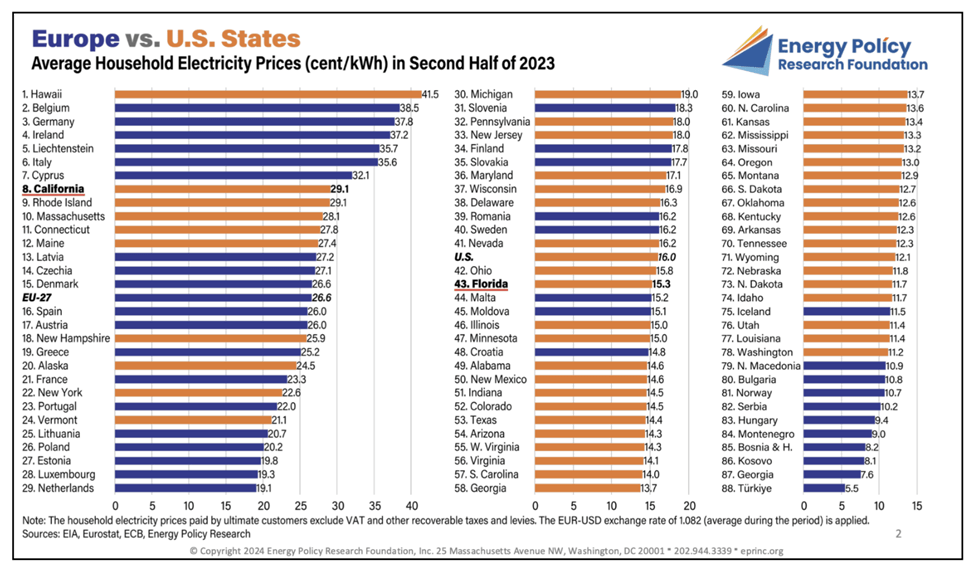
Germany way at the top of the list, over 38 cents per kWh, well over double the U.S. average. New York is position 22. I intend to keep track of this metric in the future because I don’t think NY will fare as well when the Climate Act costs kick in.
In an email Richard Ellenbogen pointed out that the authors of the Climate Act should have checked the literature because they would have seen the following from Yale.edu in December, 2018 before the passage of the Act: “Carbon Crossroads: Can Germany Revive Its Stalled Energy Transition?” It is not the only document that should have raised red flags. The article notes that:
Although the country has made a Herculean effort to shift to a clean energy economy — in just the past five years government support and costs to consumers have totaled an estimated 160 billion euros ($181 billion) — Germany’s greenhouse gas emissions have not declined as rapidly as expected in response to the vigorous expansion of renewable energy, which now generates 40 percent of the country’s electricity. Germany’s politicians are even resigned to falling significantly short of the country’s 2020 goal of reducing emissions by 40 percent below 1990 levels.
The article goes on:
Today, the Energiewende finds itself stalled and floundering. Germany’s carbon emissions have stagnated at roughly their 2009 level. The country remains Europe’s largest producer and burner of coal, which generates more than one-third of Germany’s power supply. Moreover, emissions in the transportation sector have shot up by 20 percent since 1995 and are rising with no end in sight, experts say. German consumers have seen their electricity bills soar since 2000, in part because of the renewable energy surcharge.
The transportation transition situation is getting more dire. Irina Slav describes the EV situation in Germany:
Take the latest news from the EV world, for example. Global sales were up by a lovely 20% in August. But in Europe, EV sales were down. By 33%. And that includes hybrids.
The drop was led by Germany, which last year axed subsidies for the vehicles. The axing led to a sharp decline in EV sales, so earlier this month, the government surrendered to reality — and approved new incentives, under which, per Reuters, “companies would be able to deduct up to 40% of the value of newly purchased electric and qualifying zero-emission vehicles from their tax bill in the year of their purchase, falling progressively to 6%.”
In other words, Germany’s government still thinks it’s only a matter of time until EVs become competitive. They just need a leg up. Another leg up. They might soon need a couple of more legs up because the Chinese are coming — and they’re bringing their cars as knock-down kits as their government advises they keep key EV tech at home. This would compromise some green job plans and that’s tragic.
Finally, in a breaking news report by Eric Worral he examines the German government’s attempt to fact check Trump on the green energy debacle. He summarizes recent articles documenting the failures of the Energiewende.
I could go on, because the examples show up frequently. It is obvious that there are problems with the German net-zero transition that will inevitably show up here. Why is the Hochul Administration ignoring these red flags?

 Pragmatic Environmentalist of New York