

This article was originally posted at Watts Up With That
New York City Local Law 97 (LL97) mandates that “most buildings over 25,000 square feet are required to meet new energy efficiency and greenhouse gas emissions limits as of 2024, with stricter limits coming into effect in 2030.” Rich Ellenbogen explains that the numbers underpinning Local Law 97 underestimate electric grid emissions by between 39% and 47% and uses incorrect emissions numbers to calculate the penalties and as a basis for electric grid efficiency.
Ellenbogen is the President [BIO] Allied Converters and frequently copies me on emails that address various issues associated with the Climate Leadership and Community Protection Act (Climate Act). I have published other articles by Ellenbogen including a description of his keynote address to the Business Council of New York 2023 Renewable Energy Conference Energy titled: “Energy on Demand as the Life Blood of Business and Entrepreneurship in the State -video here: Why NY State Must Rethink Its Energy Plan and Ten Suggestions to Help Fix the Problems” and another video presentation he developed describing problems with Climate Act implementation. He comes to the table as an engineer who truly cares about the environment and as an early adopter of renewable technologies going back to the 1990’s at both his home and business two decades ago.
Local Law 97
The goal of LL97 is to reduce the emissions produced by the city’s largest buildings 40 percent by 2030 and net zero by 2050. Like New York’s Climate Leadership and Community Protection Act (Climate Act) this is political theater without regard to practicality. Last July I published an article here that described an evaluation by Ellenbogen, Francis Menton, and myself that the supporting documentation for LL97 falls far short of what is needed to provide New York City (NYC) residents in affected buildings with any assurance that the LL97 mandates can be met at the same time the Climate Act is transforming the electric energy system with massive deployments of wind, solar, and energy storage and unproven generating resources. This means extraordinary risks for keeping the heat on in the winter in NYC. Ellenbogen documents specific instances where their numbers are wrong in this post.
Problems
In this section I am going to document Ellenbogen’s criticisms re-formatted from an email to a blog post.
LL97 uses false metrics to calculate carbon emissions. Contrary to what they claim, it increases the amount of energy required to run a building. The city’s electricity is 91% fossil fuel generated. For the foreseeable future, all electric heat will operate from the least efficient fossil fuel plants operating with about a 33% efficiency. After about a 7% line loss, that is 30% efficient delivered to the building. Some of the remote generation will be oil fired with a 50% higher GHG footprint than natural gas and higher NOx, SOx, and PM2.5 emissions. Even if the heat pumps are 280% efficient, that leaves a holistic efficiency of 84%, which is at least 5% – 10% lower than just installing a new high efficiency onsite gas combustion that will operate with a net efficiency of between 90% – 95%. Do they think that remote carbon emissions away from NYC buildings won’t affect climate change?
The numbers underpinning Local Law 97 are underestimating electric grid emissions by between 39% and 47%. By making the electric utility system look “greener” they are providing a false basis for the entire law.
If you look at the image below, taken from page 36 (link), you will see in clause 1 that they are using 0.000288962 tCO2e per KWh (metric tons/Kwh). Note that the document at the link cannot be downloaded which makes it very difficult for people to challenge the contents. That value equals 0.288962 tCO2e per Megawatt Hour (MWh) which can be converted (0.288962 x 2203 pounds per metric ton) to 636.5 pounds per MWh that is used as the basis for utility system emissions in LL97.
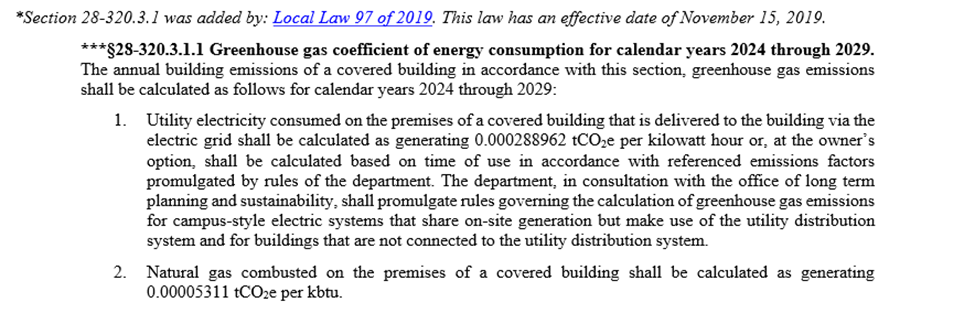
Source: §28-320.3.1.1 Greenhouse gas coefficient of energy consumption
However, if you look at the table below from the US EPA, highlighted in yellow are the actual emissions that are between 886.6 pounds per MWH and 973 pounds per MWh in NY City and Westchester. So the actual utility emissions are between 39% and 47% higher than what the city is using to calculate their policy values and the associated penalties.
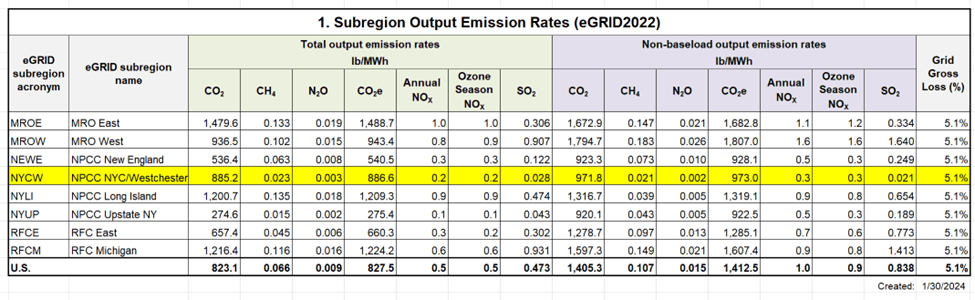
Source: EPA Summary Data: eGRID 2022 Summary Tables, abbreviated Table 1
The numbers used for future emissions are also a problem. The 636.5 pounds per MWh used in the LL97 document drops to 319 pounds/MWh in 2030 – 2034 (converted from 0.000145 value listed in the excerpt below) which is half of the 2024 value. There is no explanation of how they expect to achieve that when it is common knowledge that all of the renewable installation numbers are being pushed back. They are starting from numbers that err in their favor by over 40% and it just gets worse from there.
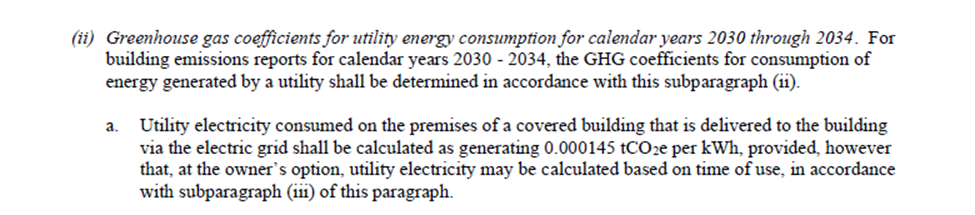
Source: 1 RCNY §103-14, CHAPTER 100 Subchapter C Maintenance of Building, page 12.
The numbers used to calculate the district steam emissions relative to the gas emissions in the document are just as big of a fantasy. New York City has an extensive steam system with over 100 miles of pipe that bring steam from central plants to buildings in Manhattan. The unacknowledged problem in LL97 is that there are extensive energy losses in the steam system. Because of the age and size of the system they are dumping the hot water at the end of the loop, the pipes leak (as exemplified by the iconic steam puffs coming out of manholes), and they have miles of high temperature steam lines dissipating energy before it ever gets delivered so there are significant losses. Nevertheless, LL97 calculations claim district steam with a 15% lower GHG footprint than 90% – 95% efficient on-site gas combustion. LL97 uses the following assumptions for building emissions taken from §28-320.3.1.1 Greenhouse gas coefficient of energy consumption page 36:
2) Gas 0.00005311 tCO2e per KWh or 399 lb. CO2e per MWh
5) Steam 0.00004493 tCO2e per KWh or 338 lb. CO2e per MWh
They are doing everything in their power to make gas look bad.
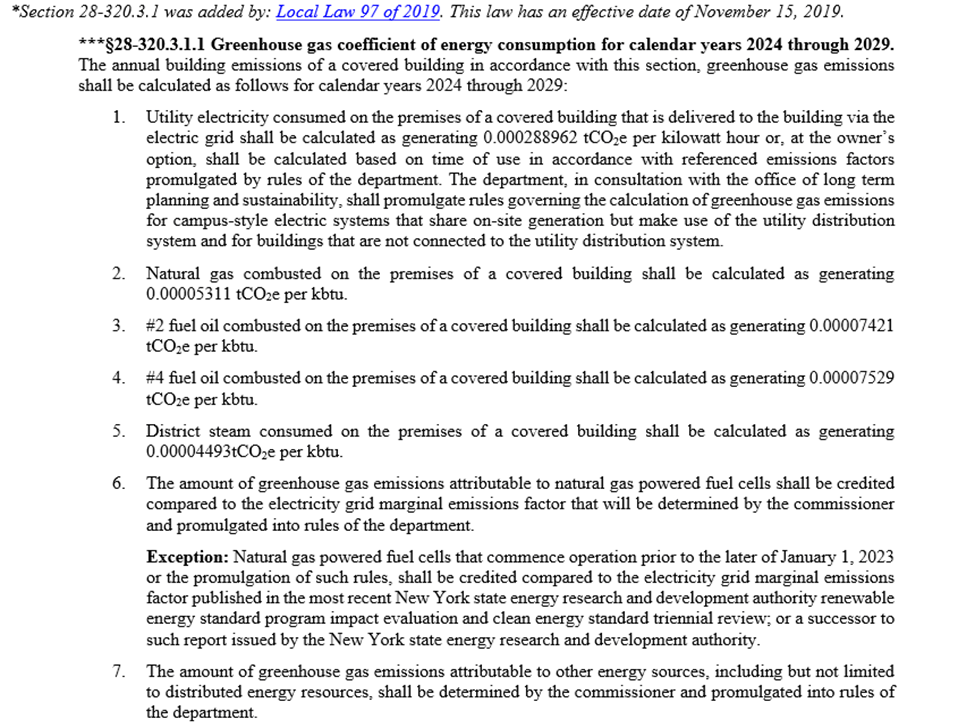
Source: §28-320.3.1.1 Greenhouse gas coefficient of energy consumption
Even more comical is the clause in section 28-320.6.3 which is also copied below regarding false statements which is meant to pertain to buildings misreporting their emissions. What they are saying is that it is okay for the city to outright lie on their policies but they will fine you up to $500,000 and put you in jail for 30 days if you do it.
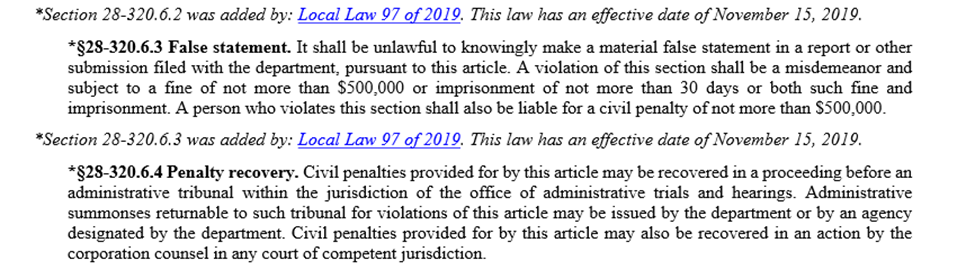
Source: §28-320.3.1.1 Greenhouse gas coefficient of energy consumption
Conclusion
On occasion Rich and I talk to each other when we discover something so absurd that it beggars the imagination. When Rich dug into the numbers and discovered these results we talked. Basically, whoever wrote this document is just pulling numbers out of thin air. It is a total fabrication. When you can easily find such flagrant errors in major parts of the document, nothing that is contained in it can be trusted. Everything has been skewed to justify someone’s worldview and policy desires.
Because of these false numbers, buildings in NY City are going be saddled with technologies that don’t produce emission savings and will simultaneously result in far higher operating costs, besides having huge upfront capital installation costs. It provides further rationale why I believe that facilities affected by LL97 should not even try to meet the law.
For those of us who have been analyzing this and understand the numbers, it has been apparent for years that the entire policies, both in LL97 and the Climate Leadership & Community Protection Act were fabrications. These numbers just prove it.

 Pragmatic Environmentalist of New York