

This is an update of articles that I have read that and want to mention but only have time to summarize briefly. I have also included links to some other items of interest. Previous commentaries are available here.
I have been following the Climate Leadership & Community Protection Act (Climate Act) since it was first proposed and most of the articles described below are related to the net-zero transition. I have devoted a lot of time to the Climate Act because I believe the ambitions for a zero-emissions economy embodied in the Climate Act outstrip available renewable technology such that the net-zero transition will do more harm than good. The opinions expressed in this article do not reflect the position of any of my previous employers or any other company I have been associated with, these comments are mine alone.
Alex Epstein
Epstein recently published two great articles. The first proposed a solution to America’s electricity crisis. The post included a video of his spoken testimony and Q&A, along with his prepared remarks, for a House Oversight Committee’s hearing on “Leading the Charge: Opportunities to Strengthen America’s Energy Reliability.” He described five damaging restrictions on reliable power that need to change:
- End criminalization of nuclear power
- End forced shutdowns of fossil fuel plants
- End onerous permitting processes
- End electricity market rules that devalue reliability
- End subsidies for unreliable power
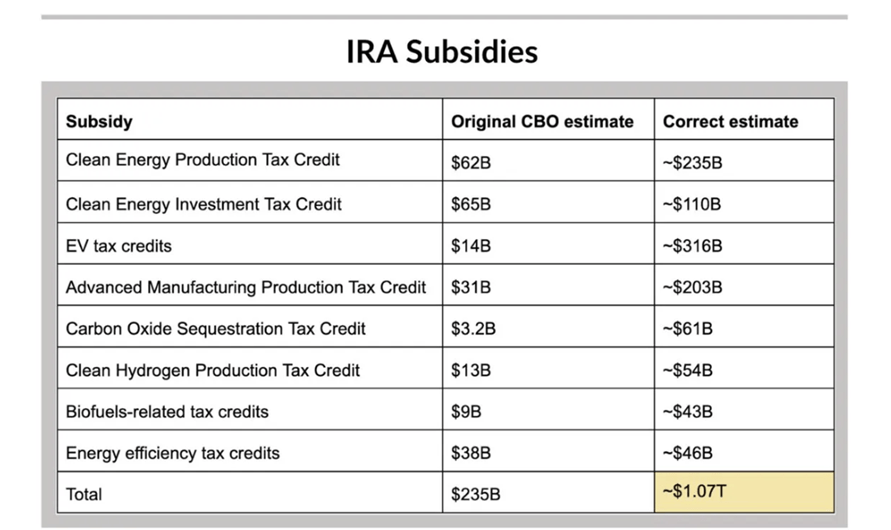
In his second article he described the Full cost of IRA subsidies. He described eight subsidies that increase the debt, increase the cost of living, prevent productive business and jobs from being created, and increase corruption.
Offshore Wind
There are signs that the offshore wind grift is running out of steam. The entire clean energy sector is in trouble. Charles Rotter notes that Nishant Gupta, founder and chief investment officer at London-based Kanou Capital LLP, didn’t mince words when describing the dire state of solar, wind, hydrogen, and fuel cell investments.
“The whole sector… is dead for now,” Gupta stated plainly. This marks a turning point—when even those inside the financial world, who have long played along with the green energy narrative, admit that the numbers simply don’t add up.
It’s no secret that the clean energy sector has been in trouble. Over the past year, the S&P Global Clean Energy Index has plummeted by 20%, while the broader S&P 500 has gained 16%. That’s a devastating underperformance, especially in an industry that was supposed to be on the cusp of taking over the world.
Gupta cites several reasons for the industry’s collapse, including high interest rates, supply chain struggles, and what he calls “political headwinds” in the U.S. The latter is a reference to the Biden administration’s green agenda losing steam, and with the Trump administration poised to undo climate-focused regulations, green investors are panicking.
In simple terms, the entire “green energy revolution” has been built on a foundation of government intervention rather than market fundamentals. Now, as subsidies and mandates run into reality, the industry is showing just how weak it really is.
The offshore wind industry is not doing itself any favors too. Recall that last summer a wind turbine failed at the Vineyard Wind industrial offshore wind complex near Nantucket, MA. One of the problems was that the company did not alert the locals about the problem. One would think that they would have learned that it is always best to explain what is going on sooner rather than later. The turbine that broke up was hit by lightning and there was no notification. Such actions will not engender public support.
Climate Science Dishonesty
Roger Pielke, Jr. frequently comments on the undeniable issues of scientific integrity in climate science. In his latest article on the topic he describes an investigation by Sveriges Radio (Swedish public radio) into multiple exaggerations and falsehoods about climate change that have been promoted by the United Nations. Examples included Sea Level Rise Misinformation, adolescent deaths due to climate change, women and children are more likely to die because of climate change, and there are increases in weather disasters. Pielke concludes:
The climate science community has a poor track record of addressing misinformation associated with those promoting climate change as a political agenda. This has been called noble cause corruption. If the United Nations is among those promoting such misinformation, we should not be surprised if the credibility of IPCC — which sits under the UN — becomes called into question, fairly or unfairly.
You can listen to the Swedish Radio report in English here — highly recommended, excellent and rare reporting on climate.
CO2 as the Control Knob for Climate
I have been thinking about writing an article about the drivers of climate change. The popular narrative and the rationale of all GHG emission reduction programs is that the greenhouse effect is the primary reason for climate change so that reducing emissions will reduce climate changes. There is no question that increasing greenhouse gas emissions will result in warming within the atmosphere but the associated caveats and impacts of this driver relative to all the other drivers suggests that emission reductions could just as easily have no discernable effect on global warming. Two articles illustrate the implications.
Andy May and Tom Shula consider the roles of energy, water vapor, and convection in the earth’s atmosphere argue that the greenhouse effect is a minor driver. However, note that WUWT editors are skeptical:
We find aspects of the CO₂ thermalization theory presented in this article to be inconsistent with well-established experimental and empirical evidence. As Richard Feynman famously stated, “It doesn’t matter how beautiful your theory is, it doesn’t matter how smart you are. If it doesn’t agree with experiment, it’s wrong.”
Extensive laboratory spectroscopy and direct atmospheric observations confirm that CO₂ plays a role in radiative heat transfer, and while water vapor is indeed the dominant greenhouse gas, the claim that CO₂’s effects are negligible does not align with measured data. That said, scientific inquiry thrives on scrutiny and debate, and we encourage readers to critically evaluate all perspectives in light of experimental validation and real-world measurements. Anthony has written primer on Carbon Dioxide Saturation in the Atmosphere also worth reading, as it describes how the logarithmic effect of CO₂ versus temperature will continue to lessen its impact even as atmospheric CO₂ concentrations increase.
Roy Spencer points out that if the greenhouse gas warming needs to be addressed then it would be appropriate to regulate the most potent greenhouse gas – water vapor. Burning any fuel produces water vapor resulting in local impacts as well as increased global warming. However, this aspect of the greenhouse effect is ignored. He notes:
The climate scientists who publish papers about the supposed dangers of greenhouse gas emissions make sure to exclude water vapor from their concerns, claiming CO2 is the thermostat that controls climate. I have commented extensively on the sleight of hand before. The vast majority of climate scientists believe CO2 controls temperature, and then temperature controls water vapor. CO2 is the forcing, water vapor is the feedback. But this argument (as I have addressed for many years) is just circular reasoning. The amount of water vapor in the atmosphere (did I forget to mention it’s our main greenhouse gas?) is partially controlled by precipitation processes we don’t even understand yet. The climate modelers simply tune their models to remove water vapor (through precipitation processes) in an arbitrary and controlled way that has no basis in the underlying physics, which are not yet well understood. Often, these simplifying assumptions translate into assuming relative humidity always remains constant.
Clearly frustrated he describes why he believes that water vapor is not regulated:
Clearly it’s not because water vapor is “necessary” to the functioning of the Earth system, since CO2 is necessary for life on Earth to exist. Which brings me back to my question, is the EPA really trying to help us when it comes to climate-related regulation?
I’m increasingly convinced that science has been hijacked in an effort to (among other motives) shake down the energy industry. This has been planned since the 1980s. It makes no difference that human flourishing depends upon energy sources which are abundant and affordable. It doesn’t matter how many people are killed in the process of Saving the Earth. The law demands regulation, and that’s all that matters.
I have evidence. In the early 1990s I was at the White House visiting Al Gore’s environmental advisor, Bob Watson, a ex-NASA stratospheric chemist who was just coming off the successful establishment of the Montreal Protocol on Substances that Deplete the Ozone Layer. He told me (as close as I can recall), “We succeeded in regulating ozone-depleting chemicals, and carbon dioxide is next“.
Keep in mind this was in the early days of the IPCC, which was tasked to determine whether humans were changing the climate with greenhouse gas emissions. Their work was just getting started, including the scientists who would assist the process. But the regulatory goal had (wink, wink, nod, nod) already been established.
So, I don’t believe the EPA is actually trying to help Americans when it comes to climate regulation. I’m sure many of their programs (waste cleanup, helping with the Flint, MI water problem, and some others) are laudable and defensible.
But when it comes to regulation related to global climate (or even local climate, as the government tries to pack even more people into small spaces, e.g. with “15 minute cities“), my experience increasingly tells me no one in the political, policy, regulatory, legal, or environmental advocacy, side of this business really cares about the global climate. Otherwise, they would admit their regulation (unlike, say, regulating the precursors to ground-level ozone pollution in cities) will have no measurable impact. They wouldn’t be trying to pack people into urban environments which we know are 5-10 deg. F hotter than their rural surroundings.
It’s all just an excuse for more power and vested interests.

 Pragmatic Environmentalist of New York