This is an update of articles that I have read that I want to mention but only have time to summarize briefly. I have also included links to some other items of interest. Previous commentaries are available here.
My primary focus lately has been New York’s Climate Leadership & Community Protection Act (Climate Act). I have been following the it since it was first proposed and most of the articles described below are related to the net-zero transition. My opinions expressed in this article do not reflect the position of any of my previous employers or any other company I have been associated with, these comments are mine alone.
As a pragmatic environmentalist I cannot over-emphasize the necessity of tradeoffs between environmental impacts and other societal benefits. New York’s energy policies offer two examples that ignore tradeoffs in an poorly considered appeal to ill-informed but politically powerful constituents. The first example is the premature shutdown of two nuclear power plants – the completed but never run Shoreham plant on Long Island and Indian Point, and the second is the political decision to ban fracking in New York. In my opinion, the best energy plan approach would be to embrace both natural gas and nuclear power.
What Might Be
David Catalfamo notes that ten years ago “New York’s leaders turned their backs on upstate communities, banning fracking in a purely political move that had nothing to do with science”. He points out that the decision at the time was because of uncertainties. Since then, it has been demonstrated that the water contamination and air quality risks are manageable, the technology has evolved to further mitigate concerns, and that New York’s ban on fracking resulted in a massive lost economic opportunity. He notes that:
While Pennsylvania added 100,000+ jobs and billions in tax revenue, upstate New York withered. The wealth didn’t disappear—it just went next door.
New York State is in desperate need for revenue to rebuild roads, fund transit, and support public services. He concludes that New York can provide funding and join the rest of the country or stay stuck in the mistakes of 2014.
Combine Natural Gas and Nuclear
Jim Willis of Marcellus Drilling News argues that the urgent need for electric energy brought on by data centers and energy-intense manufacturing proposals could be addressed by combining natural gas and nuclear in new ways. He references a new article that suggests that using small modular reactors and a different kind of gas fired power plant (reciprocating natural gas generator) offer advantages that make them a good choice for this application.
Green Energy Makes You Poorer
Sadly New York is going down a different path that will not end well. Ron Klutz describes a post by Matt Ridley that explains How the Green Energy Transition Makes You Poorer. Ridley cites a United Kingdom analysis that the net-zero transition there will reduce the GDP by 10% by 2030 if it succeeds. Giving up all the fossil fuel infrastructure strands so many assets that will be an expensive economic disaster.
The problem is simple:
If the new technologies are more efficient than the old ones, fine. LED light bulbs use about 90% less electricity than incandescent bulbs did. So yes, it does make sense to throw out your old bulbs before they expire, stranding those assets, to save electricity and money. Is the same true of a wind farm or a heat pump? No, they are demonstrably more expensive and less reliable at producing the same electricity as the devices they are replacing. They are worse, not better.
Ridley concludes:
Electricity is not an end in itself; it is a means to an end, an essential input allowing us to do the one and only thing that does, really does, represent growth—achieving more output with less input. Right now, the Net Zero transition is doing the very opposite
Battery Backlash
Robert Bryce has put together a Global Battery Rejection Database that “shows 52 communities from California to Australia have rejected battery projects. The fire at Vistra’s Moss Landing site will ignite even more opposition.”
Wind Farm Decision
The lawyer who successfully battled a massive Nebraska wind farm development describes the legal approach used. A news story explains:
A federal judge has dismissed most of a lawsuit filed by North Fork Wind against Knox County, Nebraska, after the county changed its zoning regulations, effectively halting development of a proposed 600-megawatt wind farm. U.S. District Court Judge John Gerrard ruled that North Fork Wind had not proven that Knox County’s new setback requirements and other regulations had interfered with its contracts or violated its constitutional rights to due process and equal protection. However, the judge did allow the company to proceed with a Fifth Amendment claim, arguing that the county’s actions amounted to an unlawful taking of property.
New York Climate Superfund
Ed Reid explains why the Climate Change Superfund bill is lawfare. He notes that “An appropriate topic for any discussion of lawfare, whether lawsuits alleging violation of existing laws or legislation leading to new law, is the issue of standards of evidence.“ Then he points out that alleged extreme weather of concern claims are inconsistent with the IPCC Sixth Assessment Report (AR6, Chapter 12) that “indicates no linkage between global warming and climate change and the frequency and intensity of extreme weather events with the exception of heatwaves, which are affected by increasing average temperatures.” Not surprisingly, the law is the subject of a lawsuit filed by 22 states based on constitutional grounds.
Vermont Cap and Invest Impacts
Robert Roper describes the Treasurer’s Report on their version of a cap and invest program. The estimated costs are shown below. Note that the Report concludes that the only way to get to the targets is the high price scenario.
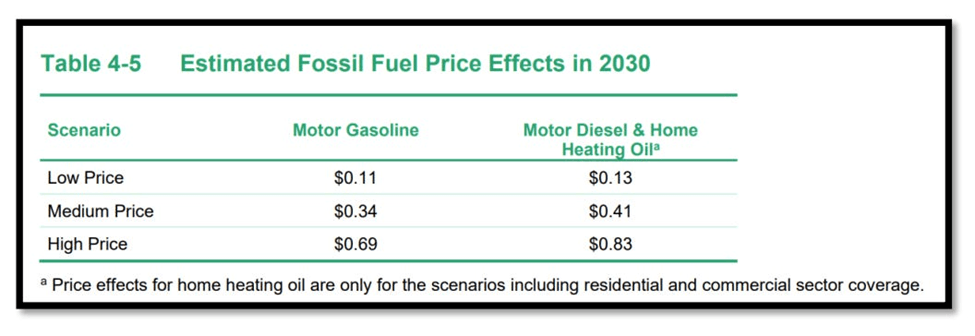
It gets worse. The high price scenario includes the mandate for “full reinvestment”. Roper explains:
What does “full reinvestment” mean? It means that all the money collected from this fuel tax must be spent on greenhouse gas reduction measures. No money collected can be redistributed to lower income Vermonters as a safety net to mitigate the cost impacts of the program. In other words, the GWSA screws poor, rural Vermonters. Hard. Especially and royally.
Videos
- Peter Ridd explains the corruption of the climate scientist field.
- Tom Shepstone recommended a video by Geoff of Geoff Buys Cars that asks the only truly important question regarding EVs: do they make money for anyone?

 Pragmatic Environmentalist of New York