

This is an update of articles that I have read that I want to mention but only have time to summarize briefly. I have also included links to some other items of interest. Previous commentaries are available here.
My primary focus lately has been New York’s Climate Leadership & Community Protection Act (Climate Act). I have been following the it since it was first proposed and most of the articles described below are related to the net-zero transition. My opinions expressed in this article do not reflect the position of any of my previous employers or any other company I have been associated with, these comments are mine alone.
Interactive Renewables Map
The New York State Office of Renewable Energy Siting and Electric Transmission (ORES) and the Department of Public Service (DPS) have a new interactive map of solar and wind project siting status. Here are the total capacity and the land covered by renewable energy sprawl.
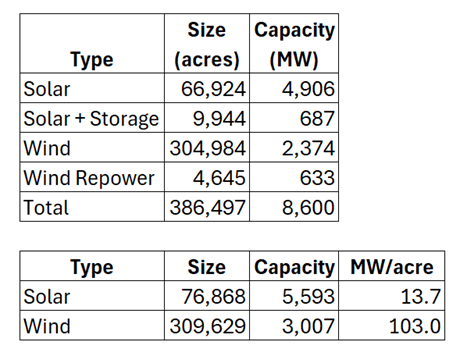
It gets worse. The following table lists the expected sprawl (acres covered) in 2040 when all the wind and solar resources are built for projections made by the New York Independent System Operator (NYISO) and the Integration Analysis (IA).

Solar Net-Metering
An interview in the Express Tribune describes hidden costs of solar energy.
The current net metering system allows solar users to sell excess electricity back to the grid at rates that do not account for the full costs of electricity generation, distribution, and infrastructure maintenance. Unlike large-scale renewable energy projects that are directly integrated into the grid, individual net-metered solar users contribute less to grid upkeep, shifting the financial burden onto traditional grid customers and utilities.
The More You Add the Worse It Gets
Bjorn Lomborg explains that Adding more solar and wind to the energy supply pushes up the price of electricity for consumers and businesses. He goes on to explain:
In Germany, electricity costs 43 cents per kWh—much more than twice the Canadian cost, and more than three-times the Chinese price. Germany has installed so much solar and wind that on sunny and windy days, renewable energy satisfies close to 70 per cent of Germany’s needs—a fact the press eagerly reports. But the press hardly mentions dark and still days, when these renewables deliver almost nothing. Twice in the past couple of months, when it was cloudy and nearly windless, solar and wind delivered less than 4 per cent of the daily power Germany needed.
Current battery technology is insufficient. Germany’s entire battery storage runs out in about 20 minutes. That leaves more than 23 hours of energy powered mostly by fossil fuels. Last month, with cloudy skies and nearly no wind, Germany faced the costliest power prices since the energy crisis caused by Russia’s invasion of Ukraine in 2022, with wholesale prices reaching a staggering $1.40 per kWh.
Lessons from California
Like many New Yorkers I worry that too many New York politicians aspire to follow California’s lead on issues. Joel Klotkin describes the cost of California climate politics. Tom Shepstone summarized the article. I found this quote especially pertinent:
In embracing the catastrophism that defines climate change as an existential threat to life on the planet, Newsom has left behind the old progressive notion of focusing on materially improving people’s lives by embracing inherently uncertain computer models predicting danger.
In California, experts from what Bjorn Lomborg, a leading skeptic of climate catastrophism, calls “the climate industrial complex” provide the justification for staggeringly expensive, socially regressive mandates based on the conjured models; the state mandates GHG reductions but leaves implementation in the hands of state agencies closely aligned with the green lobby.
As far as I can see this situation is playing out in New York as well. The whole article is worth a read.
A Mystery Solved
Michael Mann is the mainstream media’s go to person when they want to further the existential threat of climate change narrative because he is the author of the infamous hockey stick graph. In a recent article I explained that his lawsuit aimed at critics of his work had come back to bite him. Stephen McIntyre is a retired mining engineer who got interested in the numbers associated with the hockey stick and discovered that Mann concealed adverse verification statistics that proved that his conclusions were wrong. Watts Up With That published an article combining McIntyre’s “Substack, Russiagate and Other Analysis” that primarily addressed his analysis of the portion of the Mann trial that addressed Mann’s supposed loss of grants due to the people criticizing his work.
In 2009 Mann received grants totaling $2.5 million under the 2009 Obama “stimulus” bill – the so-called American Recovery and Reinvestment Act (ARRA). The article explains:
The American Recovery and Reinvestment Act (ARRA) was passed on February 17, 2009, in the first month of the Obama presidency, and had a total budget of $831 billion – about the same, allowing for inflation, as the $893 billion budget of Biden’s so-called Inflation Reduction Act in 2022. Approximately $3.1 billion of ARRA funding was allocated to the National Science Foundation (NSF).
In an interesting recent Jon Stewart podcast (link at 44 minutes), Ezra Klein noted the total failure of the ARRA program to deliver anything on its signature promises: high-speed rail, “smart” grid or interoperable electronic health care records.
That certainly does not portend well for the Inflation Reduction Act.
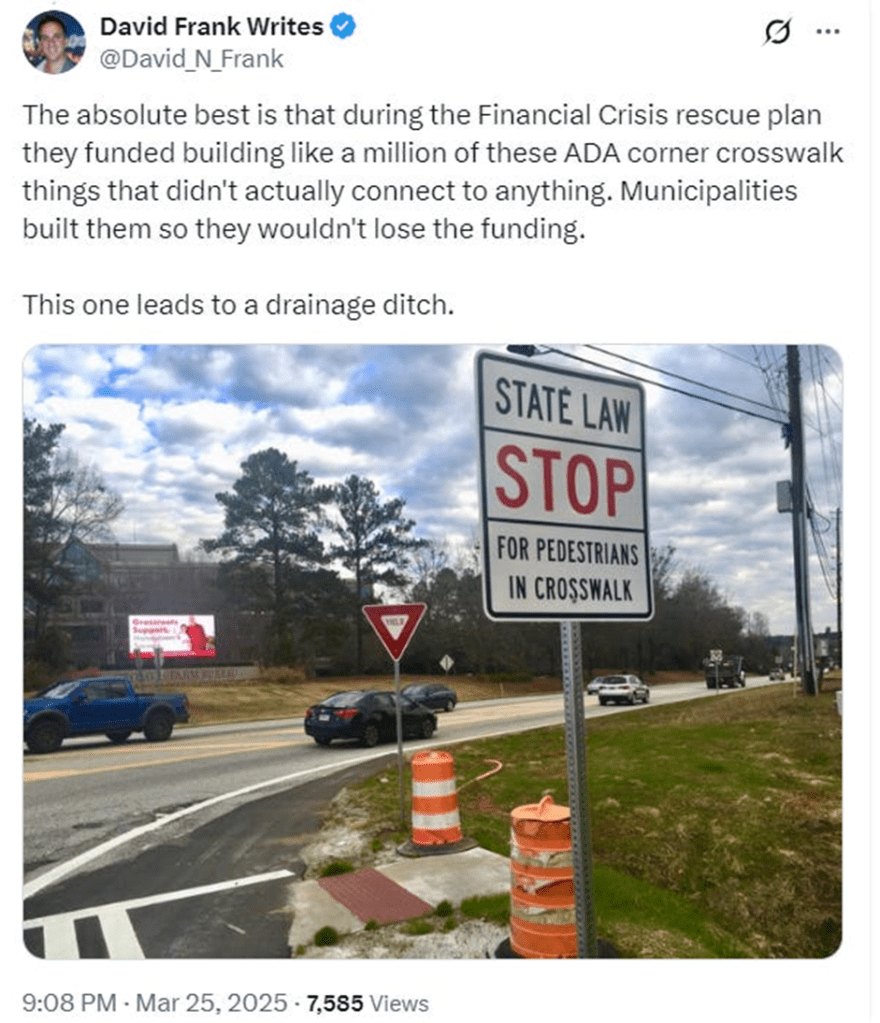
The article then explained one mystery that has bothered me for years. Have you noticed the ADA compliant crosswalks that do not connect to anything when new traffic signals are installed? It turns out that ARRA (link) did succeed in building thousands of “ADA corner crosswalk things that didn’t actually connect to anything”.

 Pragmatic Environmentalist of New York