

On October 13, 2025 the New York Independent System Operator (NYISO) released its quarterly assessment of reliability of the bulk electric system. The analysis found a deficit in reliability margins for the New York City area beginning in summer 2026. NYISO also released the draft 2025-2034 Comprehensive Reliability Plan (CRP), that provides a plan to maintain a reliable electric grid over a ten-year planning period. This post presents Richard Ellenbogen’s take on the issues raised.
Ellenbogen Background
Richard Ellenbogen has been speaking to NY State policy makers and regulators since 2019 regarding the deficiencies inherent in NY State Energy policy. He has a proven record implementing carbon reduction programs at his own manufacturing business in Westchester County where it has reduced its electric utility load by 80% while reducing its carbon footprint by 30% – 40% below that of the downstate system. I have previously published other articles by Ellenbogen including a summary description of his issues with the Climate Act. In addition, he and I have submitted several joint filings in different venues.
This post is based on an Ellenbogen email. In his introduction he note that he has been warning about this situation since the gas moratorium commenced in 2019. When he started looking at the issue it took him about 8 hours total across two evenings to realize that the state’s plan didn’t have “A snowballs chance in Hell” of working. He joined the PSC Case 15-E-0302 in July, 2023 because he was so concerned about this situation. His August 2023 filing lists all of the problems with the current plan that he had been addressing with state legislators, NYSERDA, and the PSC since 2019. Keep in mind that many of the solutions that have been proposed are from parties that have a monetary stake in the various outcomes, or from climate activists or biologists that have absolutely no idea how the system works. Ellenbogen hasn’t taken a penny from anyone for any of the thousands of hours of work that he has put into this. He just wants to see the lights stay on and to not have anyone die in a power failure. He states: “This is entirely about protecting the state’s energy system in general and the downstate system in particular because that is at a far higher risk of failure.”
Alternative Approach
In my opinion, the biggest reason to pay attention to his work is that he walks the walk. He has reduced GHG emissions at his home and factory. In addition, his home was powered though the entirety of a week-long power outage after Sandy and his factory can operate at 50% capacity during a power failure. He is working on bringing that up to 100% within a year. As a result, his recommendations are based on experience and not theory. The following quotes are from his email but include clarifying references.
Despite the mess that we are currently in, there is a viable solution to the problems described by the NYISO. The equipment could be here by 2028-2029 and installed by 2030-2032. However, it will require a sea change in the group think about natural gas. This will need to be done quickly as the rapid increase in data center construction is going to increase the lead times for this equipment. The lead time for new gas turbines from GE Vernova is now out to 2028 when I checked recently.
Retooling the three Long Island Power Plants, Port Jefferson, E F Barret, and Northport could increase their energy output and reduce their carbon emissions by about 50%. LILCO/LIPA wanted to do this in 2015 but was rebuffed by state planners that insisted on offshore wind, however that was never going to work, even before Trump. The wind bids in 2023 came in at $155/MWh, over twice that of other energy costs in the state. That is because of the Jones Act driving up installation costs or making them almost impossible to install entirely. As a comparison, offshore wind costs in the UK bid at that time, came in at $75 – $80/MWh showing the effect of the Jones Act on costs. Wind costs in Texas are at $25/MWh which is why they are having such a rapid expansion of the technology there. Additionally, wind speeds during the summer off the coast of Long Island are slower and would not support the summer peak electric demand even had the wind farms been installed.
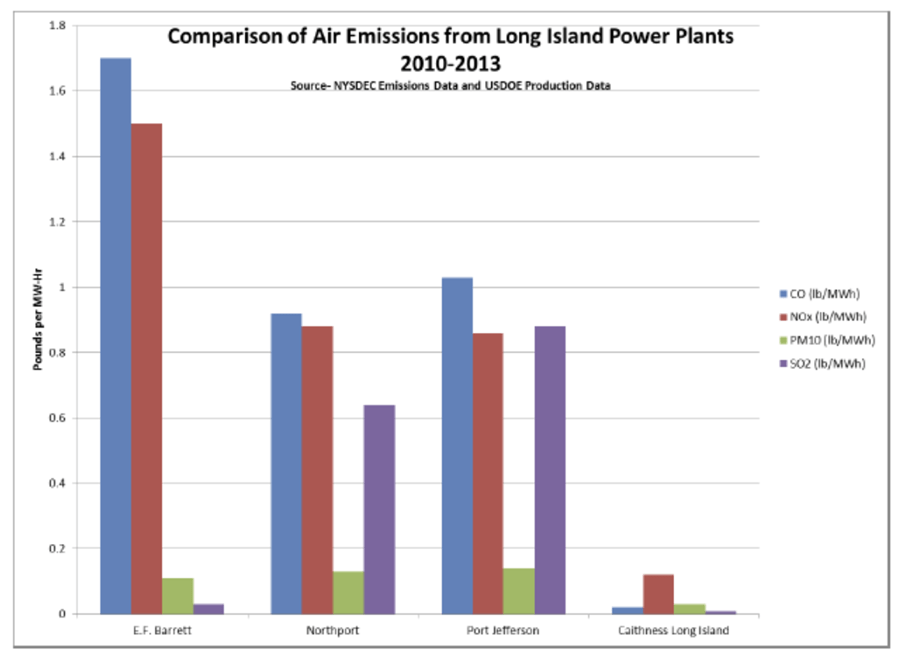
The reason that such large CO2 reductions are possible with the new plants is that they are combined cycle. The three plants that I mentioned are steam plants, date to the 1960’s and 1970’s, and are 30% to 33% efficient in turning fuel into electricity. 67% -70% of the energy goes up the chimney. A combined cycle plant uses a gas turbine on the front end to make electricity at about a 33% efficiency but then captures the heat exhaust and uses that to make steam which is then fed to a steam turbine. The combined efficiency of the entire plant is about 60% – 65% plus the newer plants have better technology for reducing NOx, SOx and particulate emissions (PM2.5, PM5, and PM 10). NOx has a carbon footprint 100 times that of CO2. The emissions profiles of the three plants mentioned plus the Caithness plant are shown on the graph from the report. Caithness is combined cycle and they wanted to build Caitness 2 but that was rebuffed because the plant was so efficient that it would have rendered the other plants worthless and there was a legal agreement signed when National Grid took them over from LILCO. You can see the radical difference in emissions in Figure 1.
Figure 1: Emissions from Long Island Power Plants (Survey of National Grid Generation Formerly Owned By LILCO)
The higher efficiency reduces the energy costs and will cut the gas use nearly in half for each plant, freeing up capacity for Caithness 2 or to install larger generators at each location so that the peaker plants in NY City could be shut down if local transmission issues are resolved. Further, because there are already generating plants at the locations, the transmission infrastructure and fuel infrastructure already exists so there will be a minimal cost to bring it up to modern standards or if the capacities are increased making it a much less expensive option than the current plans.
I wrote a paper for the PSC in February that showed how NY State could combine the newer plants with carbon capture technology and achieve a 90% carbon reduction. The equipment exists but the generating plants would have to be increased in size by about 25% to net the same power output because that much energy would be needed to liquefy the CO2 and pump it two miles underneath the ocean floor. They would still use 25% less fuel for the same amount of usable energy but would be 90% carbon free. Babcock and Wilcox has that technology available now as do some other companies. Even without the carbon capture, the combined cycle plants are extremely worthwhile and could be retrofitted with the Carbon Capture technology later as long as they were oversized now to generate sufficient energy to supply the utility loads and liquefy the CO2.
Natural Gas
Ellenbogen and I agree that the state’s position on natural gas is a problem.
Regarding the natural gas issue that has proved to be such an albatross around the state’s neck, the idea originated at Stanford with Professor Jacobsen in about 2012 and was adopted by Professor Howarth at Cornell. I offered to debate Howarth at Cornell but he declined. I told him in 2019 that his ideas were misguided, and recent studies have proven him wrong. Howarth sat on the Climate Action Council and infected it with his thinking. They stated that the rapid rise of methane in the atmosphere was due to fracking and leaking pipes in the streets. However, a study from 2022 that scooped methane out of the atmosphere found that atmospheric methane has the wrong carbon isotope to be from fossil fuels. Instead, it is primarily from organic decay so NY State reducing gas usage will have almost no effect on methane emissions but it will leave us with no electricity. The Gas Stove study from the Rocky Mountain Institute that claimed that gas stoves caused childhood asthma was equally misguided.
Another solution that could be implemented even more quickly is to replace all of the older train cars on the MTA system. I joined three other independent intervenors in the Con Ed rate case tried to have that included, to no avail. Presently, only about 25% of the MTA subway cars have regeneration. By replacing the other 75% of the older cars with newer ones that have regeneration, we could reduce the peak load on the downstate system by about 500 Megawatts and save hundreds of Gigawatt-hours of energy annually. Now, when the cars slow down their brakes get hot requiring more maintenance. By adding regeneration, cars that slow down would put electric energy back into the system where other trains could use it to operate without needing additional generation. As rush hour coincides with peak utility usage between 4 PM and 10 PM, the maximum energy savings would be occurring exactly when it was needed. The energy savings and the reduced brake maintenance would decrease the costs of operating the system. The 500 Megawatts is also more than the capacity of the oil fired peaker plants around the city. As more lower- and middle-class people use mass transit, that is actual climate justice. We have spoken to people at the MTA and they agree that this would work.
All of the above expenditures will yield monetary savings and provide the region with sufficient energy while also greatly reducing carbon emissions. Additionally, load increases from building electrification should be curtailed until we have enough generation to support it. If they want to engage in energy efficiency and carbon reduction, they can do the following which will reduce energy and electric use while also saving the ratepayers money:
- Have people eliminate oil combustion which has 50% higher emissions than gas and also has higher particulate emissions. Switch them to either gas or electric heat pumps. Oil is also much more expensive than either alternative.
- Subsidize homeowners that have electric radiant heat and get them to switch to heat pumps. It will cut their bills and their energy usage by about 60%. That technology is more prevalent upstate.
- Wrap all heating pipes with insulation to reduce heating loss and improve building envelopes (windows and insulation)
- Encourage large energy users to install CHP Systems. It’s the technology that I use in my factory and I have saved about $1 million in utility bills over the past 14-16 years while also reducing our carbon emissions by about 30% – 40%. Large apartment buildings in close proximity could also Siamese their heating systems and cooling systems and install CHP systems to run them with a great benefit.
- Add rooftop solar. As it doesn’t need transmission infrastructure it is relatively inexpensive to install and it not only reduces energy use but it also reduces transmission line losses which average to 7% over the course of the year and up to 11% during the summer when the solar arrays make most of their power.
- Get rid of NY Steam and use the steam from that plant to generate electricity. Convert NY Steam users to alternative electric heating and cooling. That will provide additional electric energy and NY Steam is a technology that has outlived its usefulness in the modern era. All of those steam puffs rising out of the streets are lost energy, the system needs a huge amount of maintenance, and because a large portion of it is “open loop”, huge amounts of hot condensate are dumped into the sewers every year putting more strain on that system and greatly increasing fresh water usage. Disposing of all of that hot water is also energy loss. They could still use the steam system for the closed loop portion of the system that is located near the steam plant. This will anger Con Ed because NY Steam is a Cash Cow for them but is being operated to the detriment of NY State residents and to the environment.
Conclusion
I am in complete agreement with Ellenbogen’s concluding remarks:
One of the reasons that Roger Caiazza and I filed the article 78 against the PSC and the state energy policy is not because I am against carbon reductions or energy efficiency but instead because the present plan is unworkable and based upon an unattainable fantasy. If the legislature doesn’t fix the mess that it has created by revising these policies, for lack of a better term, we are all screwed. The PSC is stuck trying to adhere to a state policy that isn’t going to work. I said as much when I addressed the NY Senate Energy and Telecommunications committee this past March.
That fantasy is now running headlong into reality and maybe now, people will finally understand what I have been warning about for six years.
If someone wants to install solar or wind and it is cost effective, then fine but we need sources of firm generation now.

 Pragmatic Environmentalist of New York
One thought on “Ellenbogen on Recent NYISO Reliability Concerns”