Evaluation of Cornell Report: Can renewable generation, energy storage and energy efficient technologies enable carbon neutral energy transition?

Yale Climate Connections recently described an article, Can renewable generation, energy storage and energy efficient technologies enable carbon neutral energy transition? by the Ning Zhao (Systems Engineering, Cornell University, Ithaca, NY) and Fengqi You (Systems Engineering, Cornell University and Robert Frederick Smith School of Chemical and Biomolecular Engineering, Cornell University).  The study considered the New York targets and “analyzed scientific and economic data and concluded that the goals are technologically and financially feasible.”  I reviewed their work and disagree.  The inconsistencies between their results and other analyses done as support to the Climate Leadership and Community Protection Act (CLCPA) and omissions in their evaluation method do not make their conclusions credible.

I have summarized the schedule, implementation components, and provide links to the legislation itself at CLCPA Summary Implementation Requirements.  I have written extensively in posts on implementation of the CLCPA because I  believe it will adversely affect affordability and reliability as well as create more environmental harm than good which affects my future as a New Yorker.  I have described the law in general, evaluated its feasibility, estimated costs, described supporting regulations, listed the scoping plan strategies, summarized some of the meetings and complained that its advocates constantly confuse weather and climate.  The opinions expressed in this post do not reflect the position of any of my previous employers or any other company I have been associated with, these comments are mine alone.

Background

The paper lists the following highlights:

  • A novel bottom-up optimization framework for energy decarbonization transitions.
  • Feasibility investigation on the decarbonization goals for New York State.
  • Offshore wind as major electricity source by the end of the planning horizon.
  • Heat pumps and geothermal technologies as main space heating methods.
  • Natural gas as an important but temporary energy source at early transition stage.

An optimization framework is ultimately no more than a curve fitting exercise.  Think back to a laboratory experiment where something is measured at several points, the results are plotted, and the graph is used to infer results outside the range of the observations.  The theory is that if you have enough descriptive variables, can make reasonable assumptions about the range and potential effect of each variable used, and then develop a sophisticated optimization model, then it can be used to project how, in this case, the energy system could transition to zero emissions technology.  The authors note that “To the best of our knowledge, there is no existing energy transition optimization study for the decarbonization of multiple energy sectors that incorporates region-level electricity generation and space heating thermal energy production, while accommodating scheduled energy system changes and climate targets”.

Of course, the problem is that the electric energy system is very complex.  As a result, including all the variables and constraints is a huge undertaking.  All it takes is inadvertently omitting one key constraint and the results of such a model aren’t credible.  For example, consider the Integrated Planning Model (IPM) which is used by the Environmental Protection Agency to evaluate the potential impacts of proposed air quality regulations.  The developers of IPM explain that it “provides true integration of wholesale power, system reliability, environmental constraints, fuel choice, transmission, capacity expansion, and all key operational elements of generators on the power grid in a linear optimization framework.” This model is so detailed that it includes “a detailed representation of every electric boiler and generator in the power market being modeled”.  However, in order to be able to afford to run the model simplifications are often employed.  In New York, the EPA version simplifies the transmission network so much that the fact that New York City is in a load pocket is lost and the results are not credible.  There are work arounds but, in my experience, the EPA version of this model often does not work well enough to provide credible results for New York State.

Evaluation of Figure 3

In order to evaluate the conclusions, I compared the results from the Zhou and You (2020) optimization model (“Cornell Study Model”) to observations and projections made by others.  The article does not make this easy.  For example, a key evaluation metric are the projections of annual electric generation by source shown in their Figure 3.  In order to be able to compare numbers I had to manually extract them off a blown-up version of the graph which gives a resolution of ~2,000 GWh.

As shown in Figure 3, the initial year for the study is 2019.  I assume that means that they ran their optimization model using input data so it is possible to check the accuracy of it relative to observed data.  I checked the model’s annual electric generation by source against the observed data that year from the New York Independent System Operator (NYISO) 2020 Load & Capacity Data report in Table III-3c Annual Net Energy Generation by Zone and Type – 2019

Despite the low resolution possible with my interpretation of the graph it is clear that the model does not do an adequate job representing the New York electric system annual electricity generation by source relative to 2019 data.  There were comparison data available for seven source categories.  There was insufficient resolution or it was not clear which source category should be used for the comparison for the others.  I don’t think there are any ambiguities for the nuclear, on-shore wind, and import generation categories.  The Cornell Study Model over-predicted nuclear generation by 24% or nearly 11,000 GWh.  Worse it exceeds maximum possible generation if the nameplate capacity operated every hour of the year by 7,106 GWh or 15%.  In order to get the 2019 generation shown in the graph, the 1,985 MW of onshore wind capacity would have had to be 46% vs. the observed 25%.  The Cornell Study Model under-predicted imports by 14,037 GWh or 61%.  There is an 11% difference in the hydro numbers but I think that is due to the exclusion of pumped hydro in the Cornell Study Model.  The remaining three categories are all natural-gas firing categories.  If they are all summed up the difference is less than 10% which is close enough for this methodology.

The 2040 Figure 3 generation source type projections were also evaluated.  Last fall the Analysis Group presented the results from their Climate Change Phase II Study for the NYISO.  Importantly, the analysis looked at the generation resource requirements “that meets electricity demand in every hour all year”.  Last October  I evaluated their results and noted that I agree with the methodology but was worried that they had not done an adequate job defining the worst renewable resource availability case.  Because they evaluated one-month periods their electric energy projections (GWh) are not comparable to the Cornell Study Model.  The Analysis Group did provide capacity (MW) projections for different generation sectors.  The Cornell Study report includes supplemental data with a spreadsheet (S1_Data_for_Policy_and_Geothermal) that lists capacity factors used in 2040.  Assuming that the capacity of each sector equals the projected energy (GWh) in Figure 3 divided by those capacity factors and number of hours, then there is comparable capacity (MW) data.  For energy storage I used information from section 6 of the paper: “For the energy transition under the scenario with carbon price policy and geothermal technologies, the electricity storage capacities in 2025, 2030 and 2050 are 2.9, 4.4 and 7.2 GW, respectively; the energy capacity for electricity storage are 3.7 GWh in 2025, 5.6 GWh in 2030, and 9.3 GWh in 2050”.  For 2040 I took the average of the 2030 and 2050 projections.

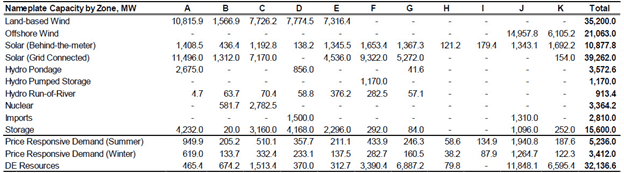
Tables 9 -12 in Climate Change Impact and Resilience Study Phase II list the nameplate capacity for zero-emission resource sectors.  I compared the Cornell Study Model nameplate capacities as calculated above in a summary table.  The Resilience Study considered two cases: one with the CLCPA mandates and one without.  The Study also compared their results with NYISO Grid in Transition study that also seeks to understand the reliability and market implications of the State’s plans to transition to clean energy sources.  That study also considered two similar cases.  The energy transition case study projections for both studies are markedly different than the Cornell Study.  For example, in Table 9 the Resilience Study projects on-shore wind capacity 68% higher, distributed solar 41% higher, utility-scale solar 88% higher, nuclear 29% higher, and energy storage 63% higher.  Of the 12 resource categories in the Resilience study only on is “close” at 11% different.

Discussion

I will briefly explain why I think there are such significant differences.  The biggest problem is the time-scale for the evaluation.  The paper states:

The demand predictions for annual electricity and space heating thermal energy within the planning horizon for New York State are shown in Fig. 2(a) in blue and orange curves, respectively. The energy demands are expressed in an annual basis, which has been applied in previous optimization works on energy system transition considering high-penetration of variable renewable energy. The spatial resolutions for both the electric and space heating thermal energy are state level.  In other words, the state-level demands as shown in Fig. 2(a) would be balanced with the energy supply in the state through optimization.

I interpret that to mean that the optimization is based on annual state-wide parameters.

If my interpretation is correct, then the entirety of the Cornell Study Model results can be ignored.  On an annual basis the Texas electric system worked but when there was a short-lived extreme stress on load the result was massive blackouts.  All the credible work done for CLCPA implementation determine the resource requirements based on short periods because an electric system that depends upon renewable energy has to address the period with the lowest wind and solar availability not any long-term average.

The ultimate problem is that no matter how many wind turbines and solar panels there are, when the sun isn’t shining and the wind isn’t blowing no electricity is generated.  In fact, the credible studies include a special resource to address those periods.  On October 8, 2020 Kevin DePugh, Senior Manager for NYISO Reliability Planning, made a presentation  that lists the characteristics of this Dispatchable Emissions-free (DE) resource:

  • Large quantity of DE Resource generation is needed in a small number of hours;
  • DE Resource has low capacity factor (~12%) during the winter;
  • DE Resource has only a 3.7% capacity factor in the summer;
  • DE Resource is not needed at all during spring and fall;
  • Substantial quantity of DE Resource capacity is needed, the energy need is minimal;
  • DE Resource must be able to come on line quickly, and be flexible enough to meet rapid, steep ramping need;
  • On an average day, storage can meet evening peaks, but the DE Resource must generate if storage is depleted and renewable generation is low; and
  • In the Winter CLCPA scenario, the DE Resource output across the state must increase from 362 MW (1.1% of DE Resource nameplate capacity) to27,434 MW (85.4% of name plate capacity) in six hours of the most stressed day.

The Cornell Study Model did not address this problem because they optimized using annual parameters.  Omitting this problem is a fatal flaw.

I noted other issues before I stopped looking.  As noted previously the optimization model did not reproduce the 2019 resource mix.  For energy storage, “the technology specification  and economic data for Hornsdale Power Reserve Battery Energy Storage System that was installed by Tesla are used for battery storage systems in this study”.  However, the facility is making most of its money providing Frequency Control Ancillary Services and is not being used for energy storage.  I think the state-wide optimization approach smooths out all the transmission constraint issues which is a problem even in the considerably more detailed IPM system.  The optimization model projected that 25,714 MW of offshore wind capacity would be needed but the National Renewable Energy Lab (NREL) has determined that New York offshore technical potential estimate is only 21,063 MW.

Conclusion

I have no doubt that advocates for the CLCPA will point to the Yale Climate Connections report of this study as proof that New York’s climate goals are achievable.  However, even this cursory evaluation of the approach and results indicates that the claim that the goals are technologically and economically feasible are simply not credible.

Climate Leadership and Community Protection Act Lesson from the German Energiewende

The German Energiewende (“energy transition”) is often touted as an example for the Climate Leadership and Community Protection Act (CLCPA).  I agree but, as explained in a recent article Daniel Wetzel at German national daily Die Welt, the attempt to transition to green energy has shown that there are significant problems using today’s technology.

I have summarized the schedule, implementation components, and provide links to the legislation itself at CLCPA Summary Implementation Requirements.  I have written extensively in posts on implementation of the CLCPA because I  believe it will adversely affect affordability and reliability as well as create more environmental harm than good which affects my future as a New Yorker.  I have described the law in general, evaluated its feasibility, estimated costs, described supporting regulations, listed the scoping plan strategies, summarized some of the meetings and complained that its advocates constantly confuse weather and climate.  The opinions expressed in this post do not reflect the position of any of my previous employers or any other company I have been associated with, these comments are mine alone.

According to Clean Energy Wire’s guide to the Energiewende, “Germany’s experience offers valuable insights and can serve as an example on how to wean a major economy off fossil fuels, even for countries with their own unique conditions and challenges”.   However, a German Government Audit report warns that the Energiewende is causing higher costs, and that there is a real danger of electricity shortfalls.  Pierre Goslin summarizes the report in “Explosive” German Government Audit Report: “Energiewende” Has Become “A Danger to all Germany”.

Goslin reports:

The “Energiewende” (transition to green energies) has seen Germany recklessly rush into wildly fluctuating wind and solar energy without properly planning the grave impacts they would have on the power supply grid and prices.

The German auditors had already voiced harsh criticism three years earlier in another special report, whose main focus had been on the high cost of the Energiewende. The latest report now also includes “an explosive analysis” on power supply instability and the high probability of power shortfalls.

The report finds that not only have the costs spiraled out of control, but that the German federal government “does not have a sufficient view of the emerging, real dangers to the security of supply” and that “ever higher electricity prices” are to be feared in the current system.

German electricity are among the highest in the world, and there is still no end in sight for the cost spiral. One study found that another whopping 525 billon euros will be needed by 2025 to upgrade the power grid, according to Die Welt.

The development of green energies in Germany has gotten so bad that the Federal Audit Office sees the risk the Energiewende could “endanger Germany as a business location and overburden the financial sustainability of electricity-consuming companies and private households.”  “This can then ultimately jeopardize the social acceptance of the energy transition,” warned Scheller.

Die Welt characterizes the Government Audit report as “explosive” and a long overdue wake-up call. The auditors accuse the federal government of not having properly taken into account the consequences of the coal phase-out, making assumptions that seem “unrealistic or are outdated by current political and economic developments” and making overly optimistic assumptions on the future available wind and sun.

Advocates for the CLCPA believe that wind and solar provide an economic way to transition off fossil fuels.  David Wojick recently published an article that succinctly explains why that approach why one factor makes that a false assumption: the Minimum Backup Requirement (MBR).  Wojick explains that “The minimum backup requirement is how much generating capacity a system must have if it is to reliably produce the electricity we need when wind and solar don’t.”  I have written about this issue but was unable to simply describe it this well.

Michel at the Trust, yet Verify blog evaluated the potential effect of increased electricity production from intermittent energy sources in a post using a simple solar and wind capacity increase data analysis model and found that in Belgium in enormous amounts of over-building are required to cover periods with low wind and solar.  With help from Michel we did a similar analysis for New York and I found that even with unrealistic assumptions about the “best case” availability of solar and wind capacity, there are periods with significant deficits. In order to prove the extraordinary claim that solar and wind can replace existing fossil the State of New York, a similar type of analysis using actual data to estimate realistic energy production must be done. That is the only way to provide the extraordinary proof showing just how much energy storage will be required to prevent deficits.

Conclusion

The Government Audit report accuses the federal government of making assumptions that seem “unrealistic or are outdated by current political and economic developments” and making overly optimistic assumptions on the future availability of wind and sun available.  The draft plans for the CLCPA are going down that same path.  I believe the German results will also occur in New York.

Climate Leadership and Community Protection Act Off-shore Wind Resiliency

New York’s Climate Leadership and Community Protection Act (CLCPA) establishes targets for decreasing greenhouse gas emissions, increasing renewable electricity production, and improving energy efficiency. 

The CLCPA was described as the most ambitious and comprehensive climate and clean energy legislation in the country when Cuomo signed the legislation but there is one massive flaw.  The lawmakers who enacted this law presumed that the transition of the state’s energy system could be implemented by political will so did not include feasibility conditions in the targets or schedules.  This post is a short description of one aspect of the many implementation problems of this law.

I have summarized the schedule, implementation components, and provide links to the legislation itself at CLCPA Summary Implementation Requirements.  I have written extensively in posts on implementation of the CLCPA because I  believe it will adversely affect affordability and reliability as well as create more environmental harm than good which affects my future as a New Yorker.  I have described the law in general, evaluated its feasibility, estimated costs, described supporting regulations, listed the scoping plan strategies, summarized some of the meetings and complained that its advocates constantly confuse weather and climate.  The opinions expressed in this post do not reflect the position of any of my previous employers or any other company I have been associated with, these comments are mine alone.

One of the targets of the CLCPA is to develop 9,000 MW of offshore wind by 2035.  This is considered necessary because off-shore wind has a higher resource availability.  Importantly this is just the start of what is accepted as a much larger offshore wind capacity that eventually will be needed for the ultimate goal of a net-zero emissions economy in New York in 2050.  For example, the Brattle Group analysis for the NYISO, New York’s Evolution to a Zero Emission Power System, estimates that 25,000 MW of offshore wind will be needed in 2040.  This article considers resiliency of the offshore wind capacity needed for the CLCPA.

Tony Heller writing at  Real Climate Science does an amazing job digging up newspaper accounts of past weather events like this description of the “Greatest Cataclysm in American History”.   In that article he uses newspaper archives and other contemporaneous accounts to describe the extreme weather on March 27, 1913 when there was widespread flooding in Indiana and Ohio, a massive tornado hit Omaha, NE, and tornadic storms ranged east into Pennsylvania.  One can only imagine the hysterical cries of climate change impacts if this situation were to repeat itself today. 

I think that comparing the weather of the past to today is important to understand that natural variability causes most of the observed extreme weather observed.  Historical weather observations should also be used to evaluate plans for the future.  If we cannot plan for the past then we shouldn’t even try to plan for the future.  Heller recently described a 2014 report from the Swiss Reinsurance (Swiss Re) Company titled “The Big One, the East Coast’s USD 100 billion hurricane event” that is the impetus of this post.  In the report Swiss Re examines how the 1821 Norfolk and Long Island hurricane would impact the region today. 

The Swiss Re report’s introduction describes the storm:

Nearly 200 years ago, a powerful hurricane decimated the Mid-Atlantic and Northeast United States. Packing wind gusts of over 156 miles per hour, the Norfolk Long Island Hurricane of 1821 surged up the Eastern Seaboard creating chaos and wreaking havoc from the Outer Banks of North Carolina all the way up to the Boston metropolitan area. If this hurricane was measured by today’s standards, it would be a strong Category 4 storm — unlike anything the Mid-Atlantic and Northeast have recently seen or experienced.

In comparison, Hurricane Sandy, with its unique track, 1,000-mile-wide wind field, and low central pressure, pushed record-breaking storm surge into the New York and New Jersey coasts, destroying businesses, homes, and lives in a short 24-hour period. But for all the devastation and damage that Hurricane Sandy brought, its intensity at landfall, measured by 1-minute maximum sustained winds, was equivalent to a weak Category 1 hurricane. Other events in recent years (Irene, Isabel, Gloria, and Bob), while significant, weakened prior to landfall, coming onshore as either Category 1 or Category 2 hurricanes, and not the major hurricanes originally anticipated and feared.

The report states that “If the 1821 Hurricane were to happen today, it would cause 50% more damage than Sandy and potentially cause more than $100 billion in property losses stemming from storm surge and wind damage.”  I had never heard of this storm but I knew about the “Great Hurricane of 1938” which decimated Long Island and New England leaving over 700 dead.  The question is how would a hurricane similar to these storms New York’s proposed offshore wind facilities.

The New York State Energy Research and Development Authority Offshore Wind Projects site describes the current status of the program to reach the 9,000 MW target by 2035.  As of early 2021 there are five offshore wind projects in active development.  The following figure from the website shows where the projects from the first two offshore wind procurements are located.

I wondered whether a storm with the same track as the 1821 and 1938 hurricanes would affect these locations. The Swiss Re report reconstructed the storm track and wind field for the 1821 hurricane:

The New York City National Weather Service has a web page describing the Great Hurricane of 1938 that includes a wind field map developed by Dr. Isaac Ginis at the University of Rhode Island:

The answer to my question whether a storm similar to the 1821 and 1938 hurricanes would affect the five offshore wind projects is unequivocally yes.  The Forward of the Swiss Re report makes an important point regarding this threat:

It’s been two years since Hurricane Sandy reminded us that the Northeast United States is vulnerable to hurricanes, and for those still recovering from the storm’s aftermath, the trauma of the hurricane continues. Yet despite Sandy being the third largest hurricane loss on record, the majority of New York, New Jersey, and other Northeast residents did not experience how devastating a hurricane could be. For many of us Sandy is little more than a distant memory of a temporary inconvenience.

In the months following Sandy many experts told us that Hurricane Sandy was a very unusual event. It was unusual in terms of its westward storm track, its interaction with the jet stream, the high tide, and how it intermingled with the continental weather systems. They tell us that the probability of a similar storm taking the same perpendicular track as Sandy is at least one in 500 years.

Once in 500 years is misleading. Although Sandy was unusual in a meteorological sense, it wasn’t a particularly intense storm and lacked the widespread high winds and rainfall that can occur with a Northeast hurricane. It’s highly unlikely that we will see a hurricane with the same characteristics as Sandy. However it’s very likely (1 in 50 years) that we will see, and in fact, have seen, other hurricanes in the Northeast that would have caused economic damages equal to or greater than those caused by Hurricane Sandy if they were to occur today. Sandy is a harsh reminder of what greater event potentially awaits us.

Conclusion

The official story is that renewable energy like offshore wind will be more diversified and resilient than the current electrical system. Different types of fuels at existing power plants truly provide a redundant and flexible power system that can provide reliable electricity when needed.  In contrast wind and solar power which are utterly dependent upon the vagaries of weather cannot be called flexible and certainly are not dependable without additional energy storage and grid support services that markedly increase the cost.  The claim that wind and solar are less prone to massive outages is absurd given that every night with calm winds causes an outage of both of these generating resources.  

Unfortunately, resiliency in the event of extreme weather is an even bigger problem. There is no question that a hurricane with stronger winds than Sandy will go through the area where New York is developing offshore wind.  The fact that two hurricanes with winds well over 100 mph have passed over New York’s offshore wind development areas should be a major concern.  I worry that New York will invest billions in these resources, get to a point where they are necessary for reliability only to see one storm come through and knock out the resource for an extended period. 

CLCPA Power Generation Advisory Panel Comments on the Texas Energy Debacle

Since the Texas energy debacle of 2021, I have been examining how the Power Generation Advisory Panel is treating reliability in its recommendations for the implementation of the Climate Leadership and Community Protection Act (CLCPA).  I wrote several articles reviewing the Analysis Group Climate Change Impact and Resilience Study (“Resilience Study”) prepared for the New York Independent System Operator (NYISO) relative to the Texas energy debacle.  This culminated in comments submitted to the Power Generation Advisory Panel that I will summarize in this article.

I have written extensively on implementation of the CLCPA closely because I worry that its impacts on affordability, reliability and the environment affect my future as a New Yorker.  I have described the law in general, evaluated its feasibility, estimated costs, described supporting regulations, listed the scoping plan strategies, summarized some of the meetings and complained that its advocates constantly confuse weather and climate.  I described my initial impression of the Texas blackout, described the initiatives and analyses provided to the panel that were relevant and evaluated reliability in the enabling initiatives in earlier articles.  The opinions expressed in this post do not reflect the position of any of my previous employers or any other company I have been associated with, these comments are mine alone.

Background

I have summarized the schedule, implementation components, and provide links to the legislation itself at CLCPA Summary Implementation Requirements.  Section § 75-0103 in the CLCPA establishes the New York state Climate Action Council (CAC). The CAC is supposed to “prepare and approve a scoping plan outlining the recommendations for attaining the statewide greenhouse gas emissions limits” by December 31, 2021.   In order to “provide recommendations to the council on specific topics, in its preparation of the scoping plan, and interim updates to the scoping plan, and in fulfilling the council’s ongoing duties”, the CAC (§ 75-0103, 7) “shall convene advisory panels requiring special expertise and, at a minimum, shall establish advisory panels on transportation, energy intensive and trade-exposed industries, land-use and local government, energy efficiency and housing, power generation, and agriculture and forestry”.  Once the process started it became clear that another panel covering waste would be needed.  Advisory panel meetings and materials are available on New York’s Climate Act website.

I have been following the activities of the Power Generation Advisory Panel since they began work because I believe this is the most important panel.   It is the most important because electrification of as many current fossil-fueled sources as possible is necessary to meet the CLCPA targets.  Therefore, the zero-emission electric system has to provide reliable and affordable electrical energy for what I believe will be higher loads than today.  

Discussion of comments

On March 25, 2021 I submitted comments to the Power Generation Advisory Panel.  It is not clear how this panel and the others address comments submitted.  I understand that there is a share drive that contains all the comments received but I don’t think that is an adequate mechanism for the panel’s use.  This process is intense and time-consuming for all the participants and it is unfair for the members of the panel to have to sift through comments.  It would be far better for agency staff to review all the comments, categorize them, provide synopses of comment categories and highlight comments of particular interest.  Ideally, these reviews could be used to invite commenters with important issues to provide the opportunity to interact directly with the panel.  As far as I can tell the comments are treated as requirement of the law rather than a resource for developing the best recommendations.  I doubt that the majority of the panel members have read any of my comments.

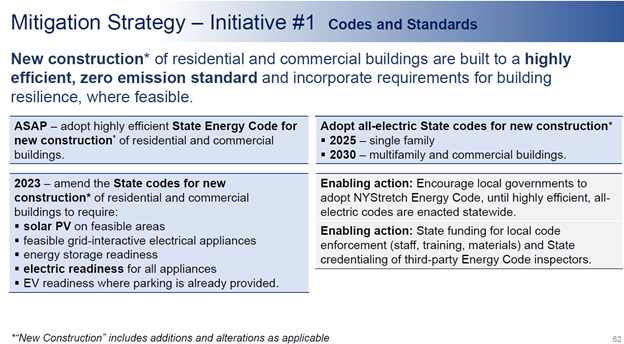
At the February 12 and 22 and March 10, 2021 Power Generation Advisory Panel meetings ten “enabling” initiatives or strategy recommendations for the Climate Action Council were discussed.  The CLCPA Power Generation Advisory Panel Enabling Strategy Initiatives Summary table lists 15 different initiatives for possible recommendations.  At the time of this writing ten of the initiatives have been discussed.  I assume that the remaining initiatives will be discussed at upcoming meetings.  I reviewed these initiatives relative to the lessons I learned from the Texas energy debacle and my comments addressed my findings.

I believe that reliability and affordability should be primary drivers of the CAC scoping plan.  I think a primary shortcoming of the CLCPA is the presumption that the transition is feasible. When the law was enacted it was described as the most ambitious and comprehensive climate and clean energy legislation in the country and supporters were happy with transition schedule.  While there is political capital in being the first and “best”, the reality is that no jurisdiction has implemented anything close to the targets of the CLCPA.  It is concerning that those jurisdictions that have tried have had problems with affordability and reliability.  In that regard it is important to consider the February 2021Texas blackouts.

My over-arching concern with the draft recommended enabling initiatives is a lack of focus on reliability.  I worry that some commenting stakeholders and even some members of the panel under value reliability and would accept blackouts in the future.  My comments describe blackouts that have affected New York City and the responses that were implemented to prevent future blackouts.  I go on to describe the impacts of the Texas blackout in February 2021, reasons it occurred, and what needs to be done to prevent a re-occurrence.  As New York transitions its electric system to one dependent upon renewables all of the issues raised by that blackout need to be addressed. 

I do not believe that the 2021 Texas energy debacle was caused by the lack of wind and solar resources but the fact is that they were not available when needed most.  The situation does foreshadow the difficulty providing reliable electricity in a system that depends on renewables when the wind isn’t blowing at night.  The primary cause for the blackouts was a lack of planning manifested by an electric market that only pays for the energy produced.  As a result, there is no incentive to develop the capacity needed for rare extreme conditions so when it was needed it simply was not there.  Both Federal and Texas policy prioritized and subsidized unreliable energy sources (wind and solar) at the expense of reliable ones (natural gas, coal and nuclear) for decades and this was a contributing factor.  The problem that New York has to address to avoid a similar problem is that the coldest air of the winter and the highest demand occurs when cold air moves in behind a cold front.  This Arctic air is associated with a cold core high pressure system pushing the front.  Those high-pressure systems have very little wind and, in the winter, there is little solar energy available in the best case.

My comments described the New York reliability planning process which will have to confront this issue.  I showed that reliability risks are increasing in New York because of diversity, redundancy, flexibility, dependability, and resiliency changes in the electrical sector.  I went on to explain that the Analysis Group Climate Change Impact and Resilience Study (“Resilience Study”) and similar work by E3 for the CAC implementation process both highlight the problem that in order to meet the CLCPA emissions reduction goals a resource category that provides firm, dispatchable and zero-emissions generation is needed when wind and solar resources are low or non-existent.  Because the only proven technologies that can provide those resources are nuclear and hydro which are unlikely to provide additional significant future energy in the future, both the Analysis Group and E3 include a placeholder resource category in their projections for future electric generation. Meeting the resource needs for the identified energy deficit gap is necessary and it is a major technological challenge.

My comments argued that the Power Generation enabling initiatives should specifically address concerns derived from the Resilience Study conclusions: “The variability of meteorological conditions that govern the output from wind and solar resources presents a fundamental challenge to relying on those resources to meet electricity demand” and “Energy storage resources that are currently and expected to be available can fill part, but not all of the gap needed to maintain system reliability”.  Of course, the third concern is what can be done about the energy storage gap itself. 

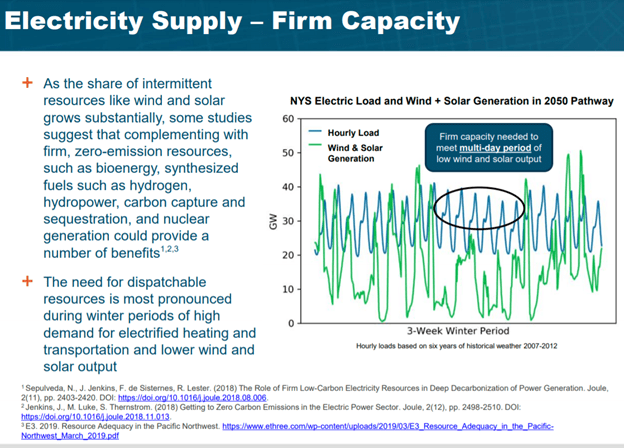
I recommended that the enabling initiatives emphasize planning requirements.  It is necessary to understand how many renewable resources are available during the likely worst case, the multi-day winter wind lull, and an initiative addressing this should be included.  There are initiatives included to address energy storage resources but they should be re-framed to recognize that this technology is not mature and that there are significant implementation challenges to overcome even to meet the 2030 goal.  It cannot be over-emphasized that the only firm, dispatchable and zero-emissions technologies available today are nuclear and hydro.  The relevant initiative does not adequately address the Analysis Group points that: “There is a void that will need to be filled with technologies and/or fuels that ‐ at the scales that would be required ‐ are currently neither proven nor economical” and “There is no doubt a major amount of technological change that will happen over the next twenty years, rendering it very difficult to forecast a future resource set with reasonable confidence”.  A separate initiative should be included that spells out a planning process to meet this challenge and notes that until this technology is available and deployable the 2040 zero-emission target cannot be met without reliability consequences

Conclusion

I concluded that the lesson to be learned is that the Texas energy policy emphasis on unreliable renewable energy sources without addressing the need for firm, dispatchable and zero-emissions generation led to a catastrophic blackout.  I believe that it is incumbent upon the Power Generation advisory panel to ensure that New York’s transition to a zero-emissions electric energy grid does not result in a similar fiasco.  At this time the Power Generation Advisory Panel is not placing sufficient emphasis on the reliability issues raised by E3 and the Analysis Group that need to be addressed to prevent future blackouts.  I trace this problem back to the Cuomo administration approach for implementing the CLCPA.  David Zaruk, an EU risk and science communications specialist, and author of the Risk Monger blog recently described  the current state of policy leadership that describes the problem: 

“The world of governance has evolved in the last two decades, redefining its tools and responsibilities to focus more on administration and being functionary (and less on leadership and being visionary). I have written on how this evolution towards policy-making based on more public engagement, participation and consultation has actually led to a decline in dialogue and empowerment. What is even more disturbing is how this nanny state approach, where our authorities promise a population they will be kept 100% safe in a zero-risk biosphere, has created a docilian population completely unable and unprepared to protect themselves.”

His explanation that managing policy has become more about managing public expectations with consultations and citizen panels driving decisions describes the Advisory Panels to the Climate Action Council.  He says now we have “millennial militants preaching purpose from the policy pulpit, listening to a closed group of activists and virtue signaling sustainability ideologues in narrowly restricted consultation channels”. 

This is exactly what is happening on this panel in particular.  Facts and strategic vision were not core competences for the panel members.  The Cuomo administration chose members based more on their allegiance to the political agenda of the CLCPA than on their energy system expertise.  Because of their belief that climate change is an existential threat, their biggest concern is eliminating fossil fuel use as soon as possible.  The Cuomo administration and some panel members don’t understand or don’t want to understand that there are reliability ramifications to the shutdown of firm, dispatchable sources of electric power if the zero-emissions replacement technology is unavailable.  It is likely that will be the case in the CLCPA transition schedule.  That the rational result may be a delay in the schedule is unthinkable to them.  Of course, when the inevitable blackout occurs and people literally freeze to death in the dark, they won’t be accountable.

Climate Leadership and Community Protection Act NYISO Resilience Study and the Texas Energy Debacle – Reliability Resources Update

As part of my review of the Texas energy debacle relative to New York I assessed whether the implementation of the Climate Leadership and Community Protection Act (CLCPA) would affect reliability.  I wrote a couple of articles reviewing the Analysis Group Climate Change Impact and Resilience Study (“Resilience Study”) prepared for the New York Independent System Operator (NYISO) relative to the Texas energy debacle and compared their findings relative to the CLCPA power generation advisory panel strategy recommendations.   This is an update addressing additional recommendations that have been presented since the earlier article and a more detailed examination of the enabling initiatives components addressing reliability.

I have written extensively on implementation of the CLCPA closely because I worry that its impacts on affordability, reliability and the environment affect my future as a New Yorker.  I have described the law in general, evaluated its feasibility, estimated costs, described supporting regulations, listed the scoping plan strategies, summarized some of the meetings and complained that its advocates constantly confuse weather and climate.  The opinions expressed in this post do not reflect the position of any of my previous employers or any other company I have been associated with, these comments are mine alone.

 Generation Advisory Panel Draft Enabling Initiatives

At the February 12 and 22 and March 10, 2021 Power Generation Advisory Panel meetings ten “enabling” initiatives or strategy recommendations for the Climate Action Council were discussed.  The CLCPA Power Generation Advisory Panel Enabling Strategy Initiatives Summary table lists 15 different initiatives for possible recommendations.  At the time of this writing ten of the initiatives have been discussed.  I assume that the remaining initiatives will be discussed at upcoming meetings.

In a recent post I said I was disappointed with the initiative topics addressed by the panel.  Given that no jurisdiction anywhere has actually implemented a zero-emissions electricity generating system I believe that the emphasis of this advisory panel should be on initiatives that enable or implement zero-emissions generation and the necessary supporting infrastructure including transmission necessary to deliver the power generated when and where needed.  Affordability and reliability should also be considered.  The reason I am disappointed is that resources were squandered on four topics that are out of the scope of power generation and are being considered by other advisory panels.

I believe that the enabling initiatives should specifically address three concerns derived from these Resilience Study conclusions: “The variability of meteorological conditions that govern the output from wind and solar resources presents a fundamental challenge to relying on those resources to meet electricity demand” and “Energy storage resources that are currently and expected to be available can fill part, but not all of the gap needed to maintain system reliability”.  Of course, the third concern is what are they going to do about the missing energy resources gap that will need to be filled with technologies and/or fuels that ‐ at the scales that would be required ‐ are currently neither proven nor economic.

The focus of this post is whether the draft initiatives adequately address the reliability resource issues described in the Resilience Study.  In a previous post I explained that the Integration Analysis will incorporate the recommended initiatives in the development of the economy wide analysis of energy supply, energy demand and other aspects of the economy affected by the CLCPA.

Discussion

In this analysis I looked at all the initiative to see how many components specifically addressed reliability issues.  The Generation Advisory Panel Enabling Initiative Components that Explicity Address Reliability Issues table lists eight initiatives that have components that explicitly address reliability and categorizes which components address it.  There are 36 components and 29 address reliability in some fashion.  The key question is whether the enabling initiatives address the three concerns in the Resilience Study.

The first enabling initiative addresses reliability more than any other.   As such it is instructive to consider the notes from the February 12 meeting where this was discussed as well as the draft summaries.  I extracted the relevant notes for this initiative, annotated my comments in the linked document and will summarize the discussions here.  There are two categories of technology solutions in this enabling initiative: those required to meet the 2030 goal and those to meet the 2040 goal.

The Technology Solutions initiative has two components for the 70 by 30 goal: “focus on energy delivery, the economics of long duration and seasonal storage, siting, and identifying technology gaps” and “aggressive deployment of current renewable energy and storage technologies”.  It appears to me that these components are simply calls to build as much as possible as fast possible and worry about whether that will work, much less address whether this plan is effective, later.  I think this might lead to problems.  For example, at the 19 January 2021 Climate Action Council meeting the meeting presentation announced that New York’s 2020 renewable energy standard solicitation includes 22 new large-scale renewable energy projects including the 110 MW Rutland Center Solar One project due east of Lake Ontario in the north central part of the state.  This may not be an appropriate location if the multi-day winter period of calm is the critical worst-case period because this site is in the Lake Ontario snow belt.  As a result, it is likely that during the worst-case renewable resource availability period the panels will be covered by snow and provide no support at all for the New York electric system. To effectively address that period, solar in similar locations should be discouraged.

I do not believe the components described to meet the 2030 goal adequately address reliability.  From what I understand in the summary and notes, the panel believes that meeting the 70% reduction of GHG emissions by 2030 will not require technological breakthroughs, only accelerated deployment and investments.  I think that presumes that we are not that far away from the target, but we don’t know how far we have to go because current levels of emissions using New York’s methodology have not been released.  The key question is whether the New York inventory adjustments for methane are so large that could make this a more difficult goal to achieve than is commonly believed today.  I believe that it might be necessary to have long-duration storage in the energy mix needed to meet the 2030 goal and that means natural gas is going to be needed until long-duration energy storage can be implemented at scale and in time.  It appears that is a controversial presumption within the panel.  I am also concerned that the reality of current energy storage technology does not comport with what will be needed.  No jurisdiction has implemented energy storage at the levels likely needed so there may be unforeseen issues.  Finally, I believe we do not know enough about renewable energy resources worst case availability to determine whether present technology can provide enough power to keep the lights on.

There are four components for the achievement of the 100 by 40 goal.  The first component is “detailed, holistic, modeling within a zero-emissions world to identify needed technologies”.  Clearly, in order to meet the 2040 goals technological innovations will be required and this kind of modeling is necessary to define the problem.  Unfortunately, I don’t think most of the panel understands just how large a challenge this is.  Moreover, there is not universal understanding that replacing fossil fuel infrastructure should only be done when those innovations have produced technology that is mature enough to be available for deployment.  That takes time.  This goes back to the politically correct but technical unreality that replacing fossil fuels is only a matter of political will.  It is not clear that all the members of the panel understand the difference between a political slogan and reality.

Finally note that there were complaints about an over-emphasis on the last 5-10%.  The comment that the “conversation about the last 5-10% is a distraction” demonstrates a lack of knowledge about the reality problem.  The electric system is designed to provide reliable service under all conditions and it turns out that in order to do that the prime consideration becomes how do you handle peak load periods – the last 5-10%.  The Texas energy system did not consider the last 1% and look what happened.  I believe that not emphasizing the last 5-10% will lead to blackouts sooner and more often.

Also included in the 100 by 40 goal are two other components: “Support NYSERDA in its innovation efforts, including the development of a consortium of stakeholders to develop these solutions” and “supporting utility-scale demonstration projects of new technologies, including storage and transmission and distribution”.  Both are necessary steps in order to develop the technology needed for a reliable system.

The final component of this initiative is “during planning, emissions free resources (e.g., storage, energy efficiency, distributed renewable energy) should be prioritized where feasible when considering end uses, technology limitations, and costs. However, should a substitute for natural gas still be needed, advanced green hydrogen and possibly RNG could fill this gap in order to maintain reliability, if scalability, feasibility, and environmental impact issues can be addressed”. These technologies have been disparaged during discussions because they allegedly empower natural gas use.  That concerns me because it appears to limit future technologies.  Given the magnitude of the challenge and necessity for dispatchable emissions free resources, I think it is premature for anything to be taken out of consideration in the initial strategies.

Subsequent to the first meeting, two other topics were added to “build into Technology Solutions recommendation”.   The first was described: “As the State moves towards a zero emissions grid in 2040, flexible and dispatchable resources will be critical. Further analysis, technical development, and research is needed in order to determine the feasibility, climate impact, and health impacts of advanced fuels and nuclear.”  The second description stated that: “Under current NYS policy and regulation, upstate nuclear facilities are within the resource mix (with existing financial support) until at least 2030. The contribution of nuclear power to the 2040 resource mix and any additional policy actions needed should be evaluated prior to the cessation of the Zero Emissions Credit (ZEC) Program in 2029.”  My impression is that they both were added in response to comments received in the public input sessions included in these meetings.  I was surprised by the number of comments made by people supporting nuclear and opposed to shutting down the final unit at the Indian Point nuclear station.  I am sure that the Generation Advisory Panel was just a surprised as I was.  Obviously, if the climate crisis is an existential threat to society and to address that there is a need for a as yet unidentified new technology to provide zero-emissions dispatchable power, then shutting down 2,000 MW of generation that meets those criteria is the worst thing you can do.  However, the odds of not shutting down Indian Point are vanishingly small in the current political climate of New York.  I agree with the implication of the nuclear topic that nuclear is needed to help meet the CLCPA targets.

The first topic has a component that states that “During planning, emissions free resources (e.g., storage, energy efficiency, distributed renewable energy) should be prioritized where feasible when considering end uses, technology limitations, and costs. However, should a substitute for natural gas still be needed, advanced green hydrogen and possibly RNG could fill this gap in order to maintain reliability, if scalability, feasibility, and environmental impact issues can be addressed.”  This reinforces my impression that the issue of renewable natural gas and advanced green hydrogen as sources of dispatchable zero-emissions energy is a big concern for this panel.  It appears that the ideological and irrational fear of natural gas is spilling over to other similar fuels.  Four other components in this topic addressed the analysis and research needed to actually implement these technologies.

The second initiative is “Market Solutions”.  New York’s electricity market is de-regulated so implementation is not simply a matter of telling the state utilities to do it.  Instead, market rules have to be designed to entice companies to provide the necessary services.  With all due respect to market economists, my impression is that anticipating all the consequences, potential opportunities for market manipulation, and market signals needed is more likely to be a trial-and-error process than a success story in the first try.  The Texas electricity market is not trying to incentivize 100% zero-emissions electricity and did not successfully pull that off.

The third and fourth initiatives address energy storage. Given that the membership of the panel includes people from the energy storage industry it is not surprising that the initiative is a blueprint for the expansion of that industry.  While unquestionably necessary, this is another instance where it appears to me that these are simply calls to build as much as possible, as fast possible and worry about whether everything will out work later, much less address whether this approach is feasible and affordable.  In addition, the existing storage technology initiative presumes that current technology can be deployed at the scale needed in the time needed.  Given the infancy of the technology I think that is unlikely.

Enabling initiative 7, “Grow Renewables” follows the pattern of initiatives that call for implementation before analysis.  One component notes that most renewable energy has been installed upstate but that it needs to be available downstate as well.  It seems to me that a feasibility analysis to see if that is possible would be appropriate.  The last component states that new and upgraded transmission will be needed but the need for transmission support services is not mentioned.

Given that my main concern is reliability, Initiative 8: Reliability for the Future Grid promised to be the answer to that concern.  Unfortunately, the initiative is more for a reliability tracking system during implementation than a comprehensive plan to maintain reliability from the get go.  My over-riding concern is the lack of a comprehensive assessment of renewable resource availability for New York. Instead, it is just presumed that there is enough energy available from wind and solar resources coupled with energy storage to make it work.  The Resilience Study also makes that point but their availability analysis did not consider the joint distribution of wind and solar resources and was over a relatively short period.  Given that the New York reliability standard for a loss of load is a once in ten-year occurrence and that the last time Texas had a similar cold weather event was ten years ago, a minimum of ten years needs to be studied to ensure reliability.

Conclusion

I believe that this is the most important advisory panel because electrification of as many current fossil-fueled sources as possible is necessary to meet the CLCPA targets.  Therefore, the zero-emission electric system has to provide reliable and affordable electrical energy for what I believe will be higher loads than today.

To be clear, the 2021 Texas energy debacle was not caused by the lack of wind and solar resources but it does foreshadow the difficulty replacing them when the wind isn’t blowing at night.  The lesson to be learned is that Texas energy policy prioritized and subsidized unreliable energy sources (wind and solar) at the expense of reliable ones (natural gas, coal and nuclear) for decades but did not incorporate market mechanisms to ensure that the system could operate under conditions that had occurred in the past.  It is incumbent upon the Power Generation advisory panel to ensure that New York’s transition to a zero-emissions electric energy grid does not result in a similar fiasco.  Unfortunately, the enabling initiatives do not explicitly address the factors needed to ensure this will not be the case.

I believe that the enabling initiatives should specifically address three concerns derived from these Resilience Study conclusions: “The variability of meteorological conditions that govern the output from wind and solar resources presents a fundamental challenge to relying on those resources to meet electricity demand” and “Energy storage resources that are currently and expected to be available can fill part, but not all of the gap needed to maintain system reliability”.  Of course, the third concern is what are they going to do about the energy storage gap.  In order to understand meteorological variability it is necessary to understand how many renewable resources are available during the likely worst case, the multi-day winter wind lull and an initiative addressing this should be included.  There are initiatives included to address energy storage resources but they should be re-framed to recognize that this technology is not mature and that there are significant implementation challenges to overcome even to meet the 2030 goal.  It cannot be over-emphasized that the only firm, dispatchable and zero-emissions technologies available today are nuclear and hydro and it is unlikely that we can expect significant increased energy from them.   The relevant initiative does not adequately address the Analysis Group points that: “There is a void that will need to be filled with technologies and/or fuels that ‐ at the scales that would be required ‐ are currently neither proven nor economical” and “There is no doubt a major amount of technological change that will happen over the next twenty years, rendering it very difficult to forecast a future resource set with reasonable confidence”.  A separate initiative should be included that spells out a planning process to meet this challenge and notes that until this technology is available and deployable the 2040 zero-emission target cannot be met without reliability consequences.

I am very concerned that there appear to be members of this panel that either do not understand or do not want to understand the necessary planning needed to ensure reliability and that maintaining reliability is a prime responsibility for any recommendations to the Climate Action Council. There should be an initiative that specifically addresses that prime directive in addition to the initiative that tracks reliability.

Climate Leadership and Community Protection Act Generation Advisory Panel Draft Enabling Initiatives

Since mid-February the Power Generation Advisory Panel has been discussing “enabling” initiatives or strategy recommendations for the Climate Action Council.  Unfortunately, as I show in this post, there has been insufficient focus on affordability and reliability.  In this instance reliability necessarily has to incorporate feasibility because the zero-emissions energy production necessary to meet the Climate Leadership and Community Protection Act goal for a zero-emissions electric system by 2040 is unprecedented.

I have written extensively on implementation of the CLCPA closely because its implementation will affect reliability, affordability and I believe the environmental impacts will be significantly worse than doing nothing.  I have described the law in general, evaluated its feasibility, estimated costs, described supporting regulations, listed the scoping plan strategies, summarized some of the meetings and complained that its advocates constantly confuse weather and climate.  The opinions expressed in this post do not reflect the position of any of my previous employers or any other company I have been associated with, these comments are mine alone.

Background

The CLCPA mandated an implementation plan that specified that the Climate Action Council would get recommendations from advisory panels for the development of the Scoping Plan that outlines how the CLCPA goals will be met.  The law specified that membership should represent individuals with direct involvement or expertise in matters to be addressed by the advisory panels.  The panels have been drafting enabling initiatives and discussing them in open meetings since the beginning of the year.

However, the law did not specify the topics that panels should address in the recommendations to the Council.  That is the first problem with this panel.  I believe that this is the most important panel because in order to meet the CLCPA targets electrification of everything is necessary.  The only way to electrify everything is to generate that power with zero-emissions.  Unfortunately, that is an enormous technical challenge and, frankly, most of the members of this panel don’t have the necessary direct involvement or expertise to appreciate the problem and I have seen little suggestion that some of the more vocal members have attempted to understand them.  As a result, the draft initiatives are disappointing.

The Power Generation Advisory Panel meetings since the middle of February have been discussing their draft initiatives.  The draft initiatives are discussed in the meeting materials and are available:

February 12, 2021

February 22, 2021

March 10, 2021

Discussion

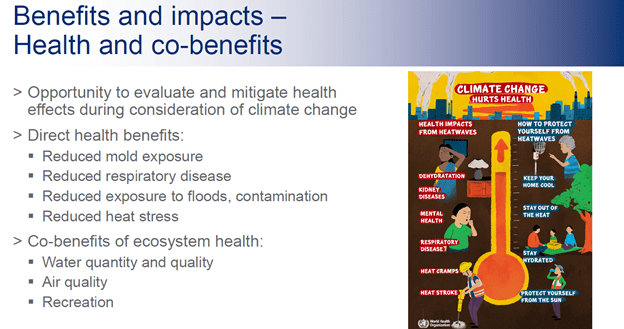
There is a standard format for the discussion presentation slides.  The first slide includes a description of the initiative with an estimate of cost and ease of implementation.  Risks and barriers to success as well as possible mitigating factors are also listed.  The second slide presents components of the initiative including the entity responsible for completion, schedule, and stakeholders that have to be included.  On the final slide, the anticipated benefits and impacts are presented.  Note, however, that the focus in the final slide is on justification of the initiative as its topics cover disadvantaged communities, health and co-benefits, and transitional effects on businesses, industries and workers.  In my opinion this focus is mis-placed because the slide does not specifically address affordability, reliability, and feasibility.

The CLCPA Power Generation Advisory Panel Enabling Strategy Initiatives Summary table lists 15 different initiatives for possible recommendations.  At the time of this writing ten of the initiatives have been discussed.  I assume that the remaining initiatives will be discussed at upcoming meetings.

As noted previously, I am disappointed with the initiative topics addressed by the panel.  Given that no jurisdiction anywhere has actually implemented a zero-emissions electricity generating system I believe that the emphasis of this advisory panel should be on initiatives that enable or implement zero-emissions generation and the necessary supporting infrastructure including transmission necessary to deliver the power generated when and where needed.  I have categorized the initiatives in the CLCPA Power Generation Advisory Panel Enabling Strategy Focus of the Initiatives Summary table. Enabling generation initiatives should address the technological challenges for various aspects of the components needed to provide 100% zero-emissions electricity generation.   Note that at the last meeting two additional components were presented for the first initiative, Technology Solutions.  That means that five of the fifteen initiatives address this challenge. They include storage technologies, distributed generation, and advanced fuels.  The initiative with the most components was technology solutions.  I think it would have been appropriate to divvy that up into several specific initiatives rather than have so many components.

It is not enough to just have the generation technology available.  It has to be implemented.  For example, because the electrical generation market in New York is de-regulated, market mechanisms to provide the necessary resources have to be developed.  The other initiatives address siting, development concerns, and transmission delivery.

In my opinion the fundamental implementation criteria should be reliability and affordability.  Because each initiative did not explicitly address those factors, I agree that the Access and Affordability for All and the Reliability for the future grid initiatives should be included.

Those eleven initiatives, especially because the technology solutions initiative could easily be separated into other initiatives, are more than enough for this panel to tackle.  Unfortunately, a lack of focus on enabling technologies and implementation requirements by the advisory panel leadership allowed the panel to waste resources on four out of scope topics.  Workforce development is so important that there is a working group dedicated to it.  The only reason methane leakage was considered is that some members of the panel are fervently against natural gas use and want to eliminate the possibility of future use.  The other two topics, fossil fuel-fired electricity generation and electrification of buildings and transportation, have not been discussed.  In order to meet the CLCPA target fossil fuels cannot be used so the only issue is timing.  Timing should be contingent upon the availability of alternate technologies although I am not sure that is universally accepted by panel members.  There are advisory panels dedicated to both buildings and transportation so any time spent on that is duplicative and unnecessary.

The resources squandered on duplicative efforts are particularly galling because I believe that the feasibility of a zero-emissions electric system has not been adequately addressed.  I have noted previously that the lack of a comprehensive assessment of renewable resource availability for New York could be a problem. Until the availability of those resources are understood much better then we won’t know how much wind, solar and energy storage is needed for the worst case multi-day winter doldrum period.  Coupled with the fact that the current GHG emissions won’t be available until early next year, it is impossible for anyone to project what resources will be needed.  Until the Climate Action Council has that information to work with it is not possible to determine if the proposed strategies will prevent future reliability issues.

Conclusion

This overview of the generation advisory panel initiatives shows that it is not focused on affordability and reliability.  I should note that the initial discussion points did not even include reliability.  That was added but it still is treated more like an afterthought than a priority requirement.  I will follow up with another post on the reliability initiatives relative to the recent Texas energy debacle.

Unfortunately, that is not the only problem.  The initiatives also appear to me to be overly dependent upon technologies and/or fuels that ‐ at the scales that would be required ‐ are currently neither proven nor economic.  It is not clear from the discussions that all the panel members recognize those technical limitations.  The CLCPA law specified that panel membership should include individuals with direct involvement or expertise in matters to be addressed by the advisory panels but the Cuomo Administration chose members based more on who they knew than what they know.  The energy system of the state is too important to be left to idealogues who don’t understand the technology and physics of the electric system so I am really worried how this will play out.

Texas Lessons to Keep the Lights On Dangers

On March 14, 2021 the Syracuse Post Standard published a commentary “To keep the lights on, take these lessons from Texas” by Dr. David Murphy, an associate professor of environmental studies at St. Lawrence University.  Unfortunately, most of what he said is incorrect and what he proposed will guarantee that New York’s lights will go out.

Unsaid in the commentary is that much of what Dr. Murphy proposed is being incorporated into the implementation plans for the Climate Leadership and Community Protection Act (CLCPA).  I have summarized the schedule, implementation components, and provide links to the legislation itself at CLCPA Summary Implementation Requirements.  I have written extensively in long posts on implementation of the CLCPA because I believe that it will negatively affect reliability, affordability and the environment.  I have described the law in general, evaluated its feasibility, estimated costs, described supporting regulations, listed the scoping plan strategies, summarized some of the meetings and complained that its advocates constantly confuse weather and climate.  The opinions expressed in this post do not reflect the position of any of my previous employers or any other company I have been associated with, these comments are mine alone.

Dr. Murphy has a Ph.D. in Environmental Science and Master of Science in Environmental Science, State University of New York, College of Environmental Science and Forestry, Syracuse, NY and Bachelor of Arts in Biology, The College of the Holy Cross, Worcester, MA.  He has authored a textbook Renewable Energy in the 21st Century and according to his webpage at St. Lawrence University, he “has also published widely in the popular press.”  Note in particular that “has been featured on a number of episodes of the podcast The Energy Transition Show with Chris Nelder, a popular podcast in energy technology and climate change activist circles.”  Based on this I characterize Dr. Murphy as a professional climate change activist whose career depends on the narrative that climate change is an existential threat.

To keep the lights on, we should take these lessons from Texas

In the following section I will provide my italicized and indented comments on his commentary.  For a detailed overview of the Texas deep freeze I recommend this article by Weather Blogger Chris Martz.  He explains that Arctic cold weather events have occur regularly, the weather conditions associated with these events always include high pressures with very light winds so wind resources will always stop working, and that “to blame weather events that have occurred many times before on man-made climate change is absurd”.

 The tragedy in Texas is viewed by many as another glimpse of our uncertain future, and that brings up the question of whether it is possible to be prepared for scenarios we can’t even imagine in the new, climate-changing world.

In climate change activist circles any unusual weather is due to climate change.  Martz points out that cold waves are an expression of natural atmospheric variability and result in record cold temperature.  This was a record-breaking event.  He goes on to point out that the earth is warming and that the “frequency of cold waves, the number of record low temperatures, and the percent of land area observing unusually cold temperatures have all declined over the last century”.  Nonetheless, the important point is that similar cold snaps occurred in 2011, 1991, 1990, 1989, 1983, 1963, and 1961 and electrical outages occurred in some of those cold snaps.  The real question is whether Texas adequately planned for the past, not whether we can plan for an uncertain future.

The storm wreaked havoc on almost all major power-producing technologies. A nuclear generator supplying electricity to 1 million homes tripped off-line due to the cold weather impacting a pump system. Natural gas supplies for heating homes froze up. And wind turbines froze in place. The more climate changes, the harder it will be to predict, and outages like the one in Texas are all but guaranteed. The Biden administration must develop a resilient power grid where outages impact fewer people for less time. To build a resilient grid, we should focus on redundancy and decentralization.

This was not a climate change problem.  Instead, it was poor planning for a variety of reasons and, in my opinion, something similar is not likely in New York because the New York electric market has different rules and priorities.  However, given that New York’s CLCPA mandates a transition to zero-emissions electric sources the question becomes is this more likely in the future?  I agree with Dr. Murphy when he says we should focus on redundancy to prevent something similar in the future but disagree what counts as valuable redundancy.  I see no value in de-centralization.

Redundancy means that if there is a failure in one part of the system, another can perform that same task, avoiding a large-scale outage or an outage altogether. Slightly more than half of Texas’ electric grid relies on one fuel source — natural gas —and another quarter relies on wind.

Compared to Texas New York currently has a more redundant electric system because there are more options for generating electricity and used to be much more redundant.  In 2019, New York electricity was generated 38% by natural gas, 23% by hydro, 33% by nuclear, 3% by wind and solar and 2% by other sources.  In 2001, New York electricity was generated 16% by coal, 27% by natural gas, 11% by oil, 16% by hydro, 28% by nuclear, 0% by wind and solar and 2% by other sources.  One key aspect of redundancy is the ability to store fuel on-site which is a feature of coal, oil, hydro and nuclear.  All three fuels are used much less than in 2001.  It is also important to be able to transport the fuel different ways which is another feature of coal and oil that has disappeared.  Based on these trends New York electric generation is becoming less redundant and thus more likely to have blackouts.

Microgrids, small grids within a larger system, are another form of redundancy. Microgrids can operate in “island mode” — if the larger grid is collapsing, the microgrid shuts communication and operates alone, keeping lights on. Alaska —with expansive land and isolated populations — has a number of microgrids. The Longhorn State has few.  Decentralizing power production systems also is important. When one reactor at the South Texas Nuclear Power Station went offline due to the cold temperature, power to supply 1 million homes went off-line. This makes entire cities, not just small towns, vulnerable.  We need many microgrids using many energy sources, both large and small — and by small I mean as small as rooftop solar panels and battery storage systems.

 De-centralized microgrids powered by wind and solar are a climate activist talking point but I don’t believe they stand up to scrutiny.  While it is true that a microgrid can operate without being connected to the grid the question is whether the factors that caused the grid to collapse also affect the microgrid.  In the case of extreme weather events, damage to microgrids powered by wind and solar is also likely. 

 The bigger problem is whether a microgrid can provide necessary power when and for as long as it is needed. Murphy neglects to point out that the Alaskan micro-grids are powered by fossil fuels that can be stored on-site.  His vision is for micro-grids powered by wind and solar.  Martz points out that energy demand is highest during both periods of extreme cold and extreme heat and that such weather conditions are associated with high pressure and very light wind speeds, which means, wind turbines will stop working.  Coupled with the fact that New York solar radiation is reduced by day length, cloudy conditions, and snow cover, I am very leery that sufficient renewable energy resources are available to meet the demands of winter peak load.

 In order to meet New York’s climate law goals heating and transportation will have to be electrified.  As a result, even more electricity will be needed.  Because renewable energy is intermittent, energy storage is required. This is a particular problem because demand varies and when the demand is highest it is also needed most.  Murphy’s rooftop solar panels and battery storage system approach may work most of the time but in order to provide reliability during the coldest periods the amount of energy storage needed for one or two days a year may be uneconomic.  This is precisely what happened in Texas.  Ratepayers enjoyed low rates because the electric market did not incorporate a mechanism for generators to pay for measures that would ensure they could provide power during intense cold snaps.  When the record-breaking cold weather occurred, the system could not provide the necessary energy at any cost so the system broke down.

All this requires a paradigm shift in thinking. For the past century, we have built grids that take what energy guru Amory Lovins calls the “hard energy path.” This means building big, centralized generators that produce massive amounts of electricity in a one-way grid system to deliver power to customers.  We need a 21st century version of Lovins’ “soft energy path” that focuses on energy conservation, solar and wind power. These technologies, in contrast to huge nuclear generators, are smaller and more flexible. And, since many more will be needed and spread across the country, they will be much less prone to massive outages like that in Texas.

Climate activists love to disparage the current electrical system with its centralized generating stations but the fact is that they provide affordable and reliable electricity.  There are inherent economies of scale that enable large power plants to provide power for millions cheaply and efficiently.  Moreover, different types of fuels at these power plants truly provide a redundant and flexible power system that can provide reliable electricity when needed.  In contrast wind and solar power which are utterly dependent upon the vagaries of weather cannot be called flexible and certainly are not dependable without additional energy storage and grid support services that markedly increase the cost.  The claim that wind and solar are less prone to massive outages is absurd given that every night with calm winds causes an outage of both of these generating resources. Furthermore, he point out that “many more will be needed and spread across the country” means that wind turbines and solar panels will sprawl across New York with significant  impacts to birds and bats.

The Biden plan calls for a modern grid system, but details are unclear. The Green Act of 2020 introduced in the House doesn’t address grids. If we want to avoid crises, the plan must include redundancy and decentralization. We must encourage more people to produce their own energy.  Investing in local production and ownership of energy systems makes energy systems more resilient and creates jobs.

One climate alarmist cherished belief is that because the wind is always blowing somewhere the solution to local wind calms is a transmission system that can move the power from those locations to calm locations.  There are problems however. 

 The fundamental issue for keeping the lights on is that wind is intermittent.  I found that in New York in 2018 there were 1,982 MW of onshore wind energy nameplate capacity that generated 3,985 GWh of electrical energy for a state-wide annual capacity factor of 24.5%.  The problem is that I also found that over a sixteen-month period there were 25 hours when none of the 24 wind facilities in the state produced any power, that 36% of the time less than 200 MW per hour was produced and that half the time hourly wind output was less than 324 MW.  The worst case is a long duration period with light winds. I found 12 periods when less than 100 MW of the state’s total wind capacity of 1,982 MW was available for 24 hours, 5 periods for 36 hours, and one period of 58 hours. Evaluation of wind energy on continental scales in Australia shows that large high pressure systems can cause light winds over continental scales.  The grid solution to intermittency is fatally flawed.

 New York’s worst case wind energy deficit was 58 hours long when wind output was less than 100MW meaning that in order to replace the total onshore wind capacity 1,800 MW has to be generated elsewhere and transmitted to New York.  In order to be absolutely positive that amount of power is available, dedicated renewable resources someplace where the winds are guaranteed to not also be calm are required.  In other words, both the wind turbines and the transmission capacity necessary cannot be used for anything else.  I expect that would be uneconomic.   Alternatively, energy storage could be developed but the problem is there is no long-duration energy storage technology currently available that can be deployed in the necessary quantities.

 It is not clear to me how wind and solar resources can be considered redundant.  Putting all our energy production into two limited types of intermittent resources seems anything but redundant and given their susceptibility to weather impacts it certainly is not a resilient option..

Clean energy jobs account for roughly 40% of energy sector jobs in the U.S., and according to a Brookings Institution report, they are also better paying than most jobs across the country.

While I am not sure that I reviewed the Brookings Institution report referenced, I suspect that the Brookings report Advancing Inclusion through Clean Energy Jobs has the same biases are present in all their work.  I believe the appropriate jobs metric limits clean energy jobs to those that would not exist in the absence of clean energy initiatives.  However, the Brookings definition of clean energy jobs encompasses jobs that go well beyond the work necessary for a clean energy economy.  For example, in the environmental management sector they include hazardous materials removal workers, refuse and recyclable material collectors, and septic tank servicers and sewer pipe cleaners.  Consequently, they are taking credit for “clean energy” jobs that would exist anyway which makes the claim that 40% of the jobs in the energy sector are in clean energy exaggerated.

By encouraging individuals and local communities to produce their own energy, we will also increase energy democracy, so that not just the downtown, wealthy areas remain with power while the poorer neighborhoods experience outages, such as what happened in Texas. We can’t predict the future, and outages will continue to occur, we can only hope to minimize their impact, and focusing on a resilient future is the only path to do so.

The presumption that individuals have the desire and means to produce their own energy is a great theory but in practice I suspect most people have a greater desire for affordable and reliable electricity. Until it is demonstrated that investing in the capability to provide reliable power as proposed when I need it is cheaper than current costs, I suspect that I am not the only skeptic of the economics of this approach.  As to viability my roof line runs north-south so I do not have the optimal setup for solar panels and I live in the cloud and snow belt downwind of Lake Ontario so solar is not dependable in the winter.

 Energy democracy is a slogan long on emotion but short on content.  I don’t understand what is meant by energy democracy or the basis of the argument so I cannot respond.

 The Texas lesson should be that they did not develop an electric market that rewarded development of infrastructure to withstand cold temperatures that have been observed in the past.  My concern is that while community energy approach may work most of the time there will be times, likely when the power is needed the most, that it won’t work.  Any resources diverted to this aspirational, feel-good approach reduce what is available to a solution that provides power all the time. 

 The other Texas warning should be the pitfalls of an over-dependence upon wind energy.  The coldest air of the winter and the highest demand occurs when cold air moves in behind a cold front.  This Arctic air is associated with a cold core high pressure system pushing the front.  Those high pressure systems have very little wind.  Martz nailed it when he said “When it comes to a life and death situation, what would you do? Use fossil fuels to keep warm and survive, or freeze yourself to death once wind power fails in order to save the planet?”

Conclusion

Dr. Murphy concludes that “We can’t predict the future, and outages will continue to occur, we can only hope to minimize their impact, and focusing on a resilient future is the only path to do so.”  The real cause of the Texas energy debacle was to fail to address obvious impacts associated with observed cold weather outbreaks in the winter.  Our first priority should be to plan for the future based on what has happened in the past because if we cannot do that then there is no way we can plan for future changes.

His recommendation is to build a resilient grid which focuses on redundancy and decentralization.  A redundant electric system exceeds what is normally needed and necessary for as wide a range of conditions as possible.  It is unclear how solar energy that is only available half the time, is reduced when it is cloudy, and can go to zero when panels are covered with snow can be considered redundant.  His suggested approach relies on energy conservation, solar and wind power and that might work most of the time.  Unfortunately, an electric system that fails to provide power when it is needed most is a recipe for catastrophe, just like Texas.

Energy conservation is a no regrets approach but it is naïve to expect that energy loads won’t continue to peak and grow when the weather is very cold or very hot, especially when New York’s CLCPA mandates heating electrification.  When the electric system transitions to solar and wind power, the critical weather period will be a multi-day wind lull in the winter because both wind and solar energy availability is very low.   In order to provide power during those periods for Murphy’s de-centralized large energy sources and rooftop solar panels, the energy storage systems necessary for them to be independent of the centralized system will have to be large.  I expect that installing large batteries for short periods of the year will be uneconomic.  Advocates for this approach have to prove otherwise.

Like it or not New York is rushing ahead to incorporate the themes in Dr. Murphy’s commentary in the implementation plans for the CLCPA.  It cannot be over-emphasized that these concepts have not been implemented anywhere on the scale necessary to transition the New York electric grid.  Moreover, initial attempts in other jurisdictions have shown that costs have gone up and reliability has gone down.  The real lessons of the Texas energy debacle should be caution is needed, that reliance on intermittent resources is risky, and that failure will have catastrophic impacts.


New York Value of Carbon Calculation of Benefits Issue

I have been trying to get involved and stay involved in the Climate Leadership and Community Protection Act (CLCPA) implementation process over the past year.  There are many pieces and parts to this process so keeping track of everything much less providing comments is difficult for stakeholders and New York agency staff.  I readily admit that agency staff also have a challenge keeping track of all the components and deciding priorities for what needs to be addressed and when.  This post documents one particular issue that I have raised and the lack of response.

I have written extensively on implementation of the CLCPA closely because its implementation affects my future as a New Yorker.  I have described the law in general, evaluated its feasibility, estimated costs, described supporting regulations, listed the scoping plan strategies, summarized some of the meetings and complained that its advocates constantly confuse weather and climate.  The opinions expressed in this post do not reflect the position of any of my previous employers or any other company I have been associated with, these comments are mine alone.

Background

One key component is the New York State guidance document Establishing a Value of Carbon, Guidelines for Use by State Agencies (the “Guidance”).  My particular concern is that the Guidance includes a recommendation how to estimate emission reduction benefits for the strategies that will be used to justify costs.  I believe that the guidance approach is wrong because it applies the social cost multiple times for an emission reduction.  As documented earlier, I sent an email to the DEC Climate Office explaining that the example they used to estimate emission reduction benefits claims that the value of carbon should be calculated for each year.  However, the standard damages approach value is the net present benefit of reducing carbon dioxide emissions by one ton because the calculation methodology estimates benefits out to 2300.  It is incorrect to claim credits for those benefits more than once.

I did not get any response for a couple of weeks and so I mentioned it as part of the article’s description of a general lack of responsiveness to comments on the CLCPA.  Soon after publishing the article I did get a response.  Dr. Suzanne Hagel said that it was “really useful” and that it would be raised with others as they “develop the accounting for the Scoping Plan”.  She went on to say that “I expect that we will be making additional updates to the Value of Carbon guidance and this would be one update that could be addressed”.

Problems

On February 26, 2021 the integration analysis technical resources that will be used to develop the scoping plan for the CLCPA were updated:

They describe the inputs and assumptions for the economy wide analysis of energy supply, energy demand and other aspects of the economy affected by the CLCPA.   My problem is that in the following Cost Accounting Philosophy from the Draft Inputs and Assumptions Summary it notes that “Value of avoided GHG emissions will be calculated based on guidance developed by DEC”. 

My concern is that if the error I identified is not corrected then the integration analysis work will have to be revised.  It is better to get this cleared up sooner rather than later so I sent an email suggesting that this issue should be addressed now.  After waiting two weeks for a response, I prepared this article.

Since the time I sent the email I found another report that uses the guidance as written, that is to say wrong.  A new report “The Fossil Fuel End Game, A frontline vision to retire New York City’s peaker plants by 2030” is “the first detailed strategic and policy road map to retire and replace an entire city’s fossil-fuel peaker power plants”. The report also “highlights the alarming economic, environmental, and social costs of New York City’s existing peaker plants”.  Those calculated costs use the Value of Carbon guidance as published and incorrectly claim social benefits every year for the carbon dioxide reductions proposed.  Over 88% of the purported economic impact of peaker plants in New York City is accounted for by the incorrect emission reduction benefits methodology.

Discussion

In my experience if I find something directly contradicting regulatory guidance, I get second opinions.  In this case, I documented contact with Dr. Richard Tol, Professor of the Economics of Climate Change at Vrije Universiteit Amsterdam and a Professor of Economics at the University of Sussex who has direct experience estimating the value of carbon or social cost of carbon (SCC).  He graciously responded and explained that “The SCC should not be compared to life-time savings or life-time costs (unless the project life is one year).”  I also checked with colleagues who supported my arguments.  I have not mentioned it to DEC but I even went so far as to contact an acquaintance at Resources for the Future about the recommended methodology and after a couple of email exchanges he also agreed that, in this context, it is incorrect to claim GHG emission reduction credits annually.  My point is that I am confident that the proposed methodology is incorrect and must be changed.

Conclusion

I would like to think that all the work I do to provide meaningful comments is appreciated by agency staff.  One way to show that appreciation would be to acknowledge receipt of comments and respond to the issue raised if there is a time sensitivity.  Unquestionably, in many cases the response is likely to be thank you but we disagree.  As long as the record shows my comment and their response explaining why they disagree the public stakeholder process is working.

Once in a while however a real problem is identified.  It is disappointing and not in the best interests of the stakeholders when problems are not addressed in a timely fashion.  In this instance this issue needs to be resolved sooner rather than later so that the consultants responsible for the integration analysis don’t end up having to re-do analyses and documentation so there is a time sensitivity concern.  In addition, every analysis that incorporates the incorrect guidance includes an error that reduces the credibility of the analysis and could affect the recommendations.  Hopefully I will be able to update this post soon to note that the issue has been addressed.

Climate Leadership and Community Protection Act Unpublished Letter to the Editor of the Syracuse Post Standard

New York’s Climate Leadership and Community Protection Act (CLCPA) establishes targets for decreasing greenhouse gas emissions, increasing renewable electricity production, and improving energy efficiency.  The subject of this post is an unpublished letter to the editor of the Syracuse Post Standard.

The CLCPA was described as the most ambitious and comprehensive climate and clean energy legislation in the country when Cuomo signed the legislation but there is one massive flaw.  The lawmakers who enacted this law presumed that the transition of the state’s energy system could be implemented by political will so did not include feasibility conditions in the targets or schedules.  As a result, I believe the reliability and affordability of electricity will be affected.

I have summarized the schedule, implementation components, and provide links to the legislation itself at CLCPA Summary Implementation Requirements.  I have written extensively in long posts on implementation of the CLCPA because its implementation affects my future as a New Yorker.  I have described the law in general, evaluated its feasibility, estimated costs, described supporting regulations, listed the scoping plan strategies, summarized some of the meetings and complained that its advocates constantly confuse weather and climate.  The opinions expressed in this post do not reflect the position of any of my previous employers or any other company I have been associated with, these comments are mine alone.

Background

The CLCPA is going to radically change New York’s energy use in order to reach net-zero greenhouse gas emissions by 2050.  Over the past year, the implementation process has started and I am convinced that most New Yorkers have no clue what is coming so I have been trying to get the local newspaper to print a letter to the editor.

Last fall I submitted a couple of letters specifically arguing that it should be a consideration when voting.  In early January I sent the following commentary, a longer letter to the editor, to the Syracuse Post Standard describing what is coming in an effort to get more people aware of the law.  In my cover letter I offered to discuss the law with the editorial board.  Around the same time, the newspaper sent out an email asking for reader input.  I responded to that too.  The answer in all cases was crickets.

Hyperlinked Submittal – The following is a hyperlinked version of my submittal

New York’s Climate Leadership and Community Protection Act (CLCPA) became effective this year and the implementation process has started. Political appointees on the Climate Action Council and seven advisory panels are currently developing a scoping plan that outlines strategies for attaining the statewide greenhouse gas emissions targets of a 40% reduction of 1990 emissions by 2030 and a zero-emission electric sector by 2040.  The Department of Environmental Conservation (DEC) implemented two regulations supporting the CLCPA implementation late last year.

Only now is it becoming clear what this will mean to the residents of New York but I believe most people have no idea what is coming.  If you are worried about energy affordability and reliability, I recommend that you pay attention in the next several months as the plans to electrify as much of the economy as possible using mostly solar and wind are presented.

DEC implemented a rule setting the 1990 baseline and established a value of greenhouse gas emissions.  Following the precedent set by the CLCPA, the rules follow methodologies established by the Intergovernmental Panel on Climate Change (IPCC) where convenient but veer away when doing so suits the agenda.  In particular, the law and these rules intend to eliminate the use of fossil fuels as soon as possible.  When you hear the phrase no new fossil fuel infrastructure that means you won’t be able to buy gasoline or diesel vehicles by 2035 or heat your homes and water or cook with natural gas, oil, or propane in the same time frame.

By the end of 2024, DEC will promulgate rules and regulations to ensure compliance with the CLCPA targets.  Great Britain has similar targets and has proposed bans on fossil fuel heating systems in 2033 thereby mandating electrifying heating.  There also is a recommendation that properties cannot be sold unless they meet minimum energy efficiency standards in 2028.  To ensure compliance New York will have to do something similar.  Having lived through a couple of multi-day electric blackouts I am very leery about having to depend upon electricity to heat my home.  Despite significant investments in insulation and upgraded windows, my house is still uncomfortable at times during the winter.  I don’t think an electric heat pump is going to be able to adequately heat my home.

You will be told that this will be cost effective because it reduces the negative costs of climate change as established by their value of carbon guidance.  You probably won’t hear that the purported social benefits are based on impacts projected out to 2300, the benefits will accrue almost entirely outside of New York, and that even those benefits are highly dependent upon the assumptions made.  In every instance the values chosen maximize the alleged benefits to reduce carbon emissions.

You might hear that the State has done a wonderful job investing the proceeds from the existing Regional Greenhouse Gas Initiative program that already taxes your electricity.  You won’t hear that New York has the highest administrative costs of any state in the program and you won’t hear that the overall costs per ton reduced exceed the value of carbon benefits.  I am positive you won’t be told that after New York makes all those reductions that the global temperature will be reduced by less than the average temperature between your head and your feet.

I recommend Bjorn Lomborg’s recent book “False Alarm: How Climate Change Panic Costs Us Trillions, Hurts the Poor, and Fails to Fix the Planet”.  He shows that we are committing to try to solve climate change with policies that he demonstrates will not make much of a difference but will cost a lot and not do much to change global warming.  Moreover, “Our extraordinary focus on climate also means we have less time, money and attention to spend on other problems” and lists a host of ways the time and money could be better spent.  All his lessons are relevant to New York.

I am sure everyone agrees that if we could ensure better weather that we would be willing to spend more on energy, accept some inconveniences, and agree to fewer choices for energy systems.  However, the CLCPA will not solve global warming if only because the increases in emissions in developing countries are far greater than reductions we can meet.  How much people are willing to pay to try to set an example is a personal choice but many people are already having trouble paying for energy so this law must make affordability a primary condition.  Despite the claims of the renewable energy developers there are serious issues using solar and wind during a multi-day, light wind period in New York’s winters.  Finally, New York’s record for greenhouse gas emission reductions is not cost-effective relative to their benefits standard.  This all means that New York might better invest money in adapting to extreme weather, improving energy efficiency, and researching alternatives to fossil fuels that could bring down the costs.

Conclusion

I am disappointed that the Syracuse Post Standard chose to not publish this.  I think New Yorkers should be aware of the potential impact of the CLCPA on affordability and reliability as I outlines in this commentary.   None of the advisory panel strategies have included potential costs but I have no doubts that the costs will be extraordinary.  Keep in mind that all this was written before the Texas Energy Debacle showed what can happen if reliability is not adequately addressed.  I wrote that I don’t think something similar could happen in New York but I also am worried that serious challenges must be overcome to make a reliable system sufficiently robust to meet a similar extreme weather event and that meets the CLCPA mandates.

I encourage New York readers to follow the CLCPA and get involved.

Announcing the Pragmatic Environmentalist of New York Facebook Page

In response to suggestions from people that I respect, I am going to publicize articles that are of general interest on my Pragmatic Environmentalist of New York blog.  People need to be made aware of the implications of New York energy and environmental policy.  This article announces this initiative and serves as a test of the methodology.

Disclaimer

I am a retired electric utility meteorologist with nearly 40 years-experience analyzing the effects of meteorology on environmental impacts.  Over that time, I have dealt with a wide range of environmental issues and researched many relevant topics to New York’s environmental and energy sectors.  The opinions expressed in my blog articles do not reflect the position of any of my previous employers or any other company I have been associated with, the comments are mine alone.

My blog describes environmental issues from a pragmatic viewpoint.  Pragmatic environmentalism is all about balancing the risks and benefits of both sides of issues.  Unfortunately, public perception is too often driven by scary one-sided stories that have to be rebutted by getting into details.  This blog will attempt to show the side of environmental issues that gets overlooked too often. My background as a scientist and my responsibilities to provide technical comments on new or revised regulations means that I tend to get bogged down in technical details that are, too be kind, pretty wonky.  I will not announce all the articles that I publish but will alert interested people on topics of general interest that do not delve into all the technical details.

Recent Posts of Interest

The following recent posts would have been announced on the Facebook page if it had been set up.  The Climate Leadership and Community Protection Act (CLCPA)

PEONY Organization

Posts on the Pragmatic Environmentalist of New York blog are classified into different categories as summarized below.  Clicking on the link in each category will take you to all relevant posts in that category.

Pragmatic Environmentalist of New York Principles

Pragmatic environmentalism balances environmental impact and public policy risks and costs.  I believe that pragmatic environmentalism is exemplified by these principles.

RGGI Posts

This page lists my posts on the Regional Greenhouse Gas Initiative (RGGI).   I have been involved in the RGGI program process since its inception and I blog about the details of the RGGI program because very few seem to want to provide any criticisms of the program.  Before retirement from a non-regulated generating company, I was actively analyzing air quality regulations that could affect company operations and was responsible for the emissions data used for compliance.  As a result, I have a niche understanding of the information necessary to critique RGGI.

New York Climate Leadership and Community Protection Act

In July 2019 Governor Cuomo signed the Climate Leadership and Community Protection Act which is described as the “most aggressive climate law in the United States”.   This is a huge effort and will affect every New Yorker but I don’t think many people are aware of its existence much less its potential impacts.  The following posts describe various aspects of the law.

CLCPA Overview

These posts generally describe the CLCPA and its benefits.

CLCPA Feasibility

This law does not provide for an analysis to determine if it can be implemented affordably and with no impact on reliability.  Suffice to say that the lack of a feasibility study before picking the emission reduction and renewable energy targets makes for a target rich environment.

CLCPA Costs

This page summarizes the results of my calculations of the observed costs of the environmental initiatives of New York Governor Andrew Cuomo in general and the Climate Leadership and Community Protection Act in particular.  I also provide links to estimates by others outside the Administration as I find them.

CLCPA Supporting Regulations

The CLCPA mandates regulations to support the implementation of the law.  This page provides links to my posts on those regulations.

CLCPA Scoping Plan Strategies

This page describes the implementation strategies proposed by the Climate Action Council advisory panels.

CLCPA Weather vs. Climate

The difference between weather and climate is constantly mistaken by Climate Leadership and Community Protection Act (CLCPA) advocates.  This page references my evaluations of climatic effects that turned out to be weather events and examples by other authors.

CLCPA Meeting Summaries

This page provides links to Climate Action Council and advisory panel meetings.

CLCPA Comments Submitted

This page provides links to the comments I submitted.

Accelerated Energy Growth and Community Benefit Act

This legislation provides expedited permitting for CLCPA renewable energy developments.

NYS Carbon Pricing Initiative Page

The New York Independent System Operator (NYISO) has been evaluating a carbon pricing plan for New York’s electricity market.  This page covers that initiative and other similar proposals.  My background with trading programs and the electric industry has prompted me to delve into the details of this plan.

New York Energy Policy

There is a movement underway to transform the New York State electric energy system because we have to do something about climate change.  I am motivated to prepare blog posts on this topic so that there is at least one voice of the unaffiliated public whose primary interest is keeping the electric energy system as resilient and affordable as it is currently.

New York State Environmental Policy

New York environmental policy is too often driven by ideology and not science.  These posts address example policies that are not a pragmatic balance of risks and benefits.

Global Warming

As a meteorologist I have the background, education and experience to have what I think is a learned opinion on the risk of global warming.  These posts address the science of global warming.

Transportation and Climate Page

This page lists posts on transportation initiatives related to climate including those published at Watts Up with That.

Personal Comment Submittals

This page lists posts on this blog that describe and archive my public submittals to various regulatory agencies.

 Air Quality

My niche experience is air quality meteorology.  These posts address particular topics in that realm.

Reforming the Energy Vision

New York energy policy is too often about style rather than substance.  Reforming the Energy Vision (REV) is the Cuomo label for clean and green energy policies.  In 2018 I started a blog to address specific REV topics but the fast-changing political label game has mixed these efforts up with the CLCPA.  This category link is to my other blog.

New York Green New Deal Page

On January 15, 2019 New York State Governor Andrew M. Cuomo did his State of the State Address that included his version of the Green New Deal environmental agenda.  Incredibly, in July 2019 the NYS Legislature promulgated an even more ambitious law, the Climate Leadership and Community Protection Act, that he signed into law.  As a result, these posts are not the drivers of NY energy policy that I thought they would be.  This page is no longer being updated.

National Grid Northeast 80 by 50 Pathway

With the passage of the Climate Leadership and Community Protection Act this blatant attempt by National Grid to curry favor with the Cuomo Administration and other politicians is so passé.  Imagine only proposing to get an 80% reduction by 2050 when the race to the bottom to be the most aggressive is now set at 85% with 15% offsets – the 100% target.  These posts describe this effort but it is no longer being updated because it so old school to only get an 80% reduction.

Conclusion

Stay tuned and if my articles are of interest please consider sharing them with others.