

Climate Leadership and Community Protection Act Power Generation Advisory Panel Peaking Power Plants

On January 11, 2021 the Climate Leadership and Community Protection Act Power (CLCPA) Generation Advisory Panel met as part of the Climate Action Council Scoping Plan development process.  The meeting tested a consensus building process to address the “problem” of peaking power plants.  This post addresses that discussion.

On July 18, 2019 New York Governor Andrew Cuomo signed the Climate Leadership and Community Protection Act (CLCPA), which establishes targets for decreasing greenhouse gas emissions, increasing renewable electricity production, and improving energy efficiency.  I have written extensively on implementation of the CLCPA closely because its implementation affects my future as a New Yorker.  I have described the law in general, evaluated its feasibility, estimated costs, described supporting regulations, listed the scoping plan strategies, summarized some of the meetings and complained that its advocates constantly confuse weather and climate.  The opinions expressed in this post do not reflect the position of any of my previous employers or any other company I have been associated with, these comments are mine alone.

Background

Last summer I wrote that New York State energy and environmental policy is more about optics than facts as exemplified by  opinion pieces, reports, and even policy proposals related to peaking power plants in New York City.  The perception that they have significant local impacts and have no use in the future has now invaded the CLCPA implementation process.

The optics post summarized three detailed technical posts all related to the PEAK Coalition report entitled: “Dirty Energy, Big Money”.  The first post provided information on the primary air quality problem associated with these facilities, the organizations behind the report, the State’s response to date, the underlying issue of environmental justice and addressed the motivation for the analysis.  The second post addressed the rationale and feasibility of the proposed plan relative to environmental effects, affordability, and reliability.  Finally, I discussed the  Physicians, Scientists, and Engineers (PSE) for Healthy Energy report Opportunities for Replacing Peaker Plants with Energy Storage in New York State that provided technical information used by the PEAK Coalition.

In brief, peaking power plants are used to ensure that there is sufficient electricity at the time it is needed most.  The problem is that the hot, humid periods that create the need for the most power also are conducive to the formation of ozone.  In order to meet this reliability requirement ~ 100 simple cycle turbines were built in New York City in the early 1970’s that were cheap and functional but, compared to today’s standards, emitted a lot of nitrogen oxides that are a precursor to ozone.  The Peak Coalition report claims that peaking units operate when energy load spikes, are mostly old, and have high costs.  However, they expand the definition of peaking units to just about every facility in the City including units that are new, have low emission rates, and have lower costs than claimed. Environmental Justice advocates claim that the expanded definition peaking power plants are dangers to neighboring environmental justice communities.  However, my analyses found that the alleged impacts of the existing peaking power plants over-estimate impact on local communities relative to other sources. 

There is a category of existing simple cycle peaking turbines in New York City that are old, inefficient and much dirtier than a new facility and clearly should be replaced.  However, they reliably produce affordable power when needed most.  PSE and the PEAK Coalition advocate a solar plus energy storage approach and that has become the preferred approach of the majority of the Power Generation Advisory Panel members.  It is not clear, however, if that is a viable option.

Peaking Power Plant Status

By definition, for EPA reporting purposes 40 CFR Part 75  §72.2, a combustion unit is a peaking unit if it has an average annual capacity factor of 10.0 percent or less over the past three years and an annual capacity factor of 20.0 percent or less in each of those three years. As noted previously the utility industry considers the combustion turbines built expressly for peak periods as the New York City peaking plants.  PSE chose to select peaking power plants based on the following criteria: fuel type: oil & natural gas; Capacity: ≥ 5 MW; capacity factor: ≤15% (3-yr. avg.); unit technology type: simple cycle combustion turbine, steam turbine & internal combustion; application: entire peaker plants & peaking units at larger plants; and status: existing and proposed units. 

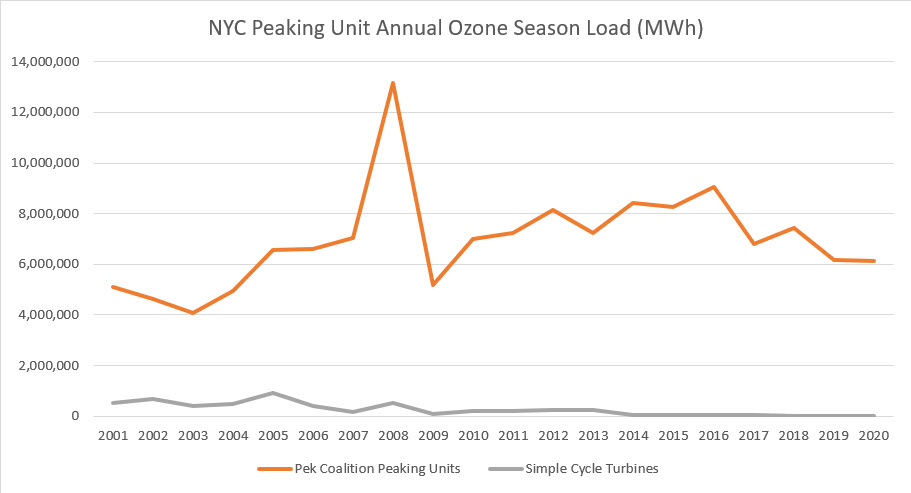
There is another nuance to the peaking units story. Because the primary concern with the combustion turbines that run so little is ozone attainment, they only are required to report data during the Ozone Season (May 1 to September 30). The NYC Peaking Unit Annual Ozone Season Load graph shows the trend of the simple cycle combustion turbine peaking unit and the Peak Coalition peaking unit ozone season load. Since 2001, the simple cycle turbines load trend is down and in 2020 the ozone season total energy produced was only 8,155 MWh compared to a peak over this period of 897,939 MWh in 2005. On the other hand, the Peak Coalition peaking units have only been trending down since 2017. Over that short a period the effects of weather may be the primary driver of any load changes.
The New York City Ozone Season Trends table categorizes the units as simple cycle turbines (the industry “peakers”), all the other turbines, boilers that provide electricity and steam boilers that provide steam.  In the last 20 years a number of combined cycle combustion turbines that are more efficient than the simple cycle turbines and the boilers.  In 2020, that category provided the most energy of any of the units considered displacing most of the simple cycle turbine output and a big chunk of the boilers producing electricity.  As shown in the table, in 2020 the “peakers” only generated 8,155 MWh and emitted 6,927 tons of CO2 and 28 tons of NOx.  The combined cycle turbines produced 3,968,562 MWh, 1,772,752 tons of CO2 and 103 tons of NOx and the boilers produced 2,172,185 MWh in 2020, 1,654,514 tons of CO2 and 752 tons of NOx in the 2020 Ozone Season.

Alternatives

I don’t think that many of the members of the power generation advisory panel really understand the electric system.  Although the simple cycle turbine peaking units have run less and less, completely eliminating them is still a significant undertaking.  Nonetheless, last year the Department of Environmental Conservation promulgated a new regulation that will shut them down on a schedule based on complete assurance that equally reliable options are available.  In order to eliminate the units in the Peak Coalition report is a much more difficult problem.  Unfortunately, to the ill-informed it is a simply a matter of political will.

The apparent preferred option is to use energy storage ultimately powered using renewables.  In December 2020, 74 Power Global and Con Edison announced the signing of a seven-year dispatch rights agreement for the development of a 100-megawatt battery storage project, the East River Energy Storage System, in Astoria, Queens.  The NRG Astoria Gas Turbine facility presently consists of 24 16MW simple cycle turbines is also located at the same location.  The East River Energy Storage System is rated to provide 4 hours at 100 MW capacity or 400 MWh.  On the other hand, those 24 16MW turbines can run all day if the need arises to produce 9,216 MWh or 23 times more energy. 

Unfortunately, that is not the end of the bad news for energy storage.  Last year I estimated the energy storage requirements of the CLCPA based on a NREL report Life Prediction Model for Grid-Connected Li-ion Battery Energy Storage System that describes an analysis of the life expectancy of lithium-ion energy storage systems.  The abstract of the report notes that “The lifetime of these batteries will vary depending on their thermal environment and how they are charged and discharged. To optimal utilization of a battery over its lifetime requires characterization of its performance degradation under different storage and cycling conditions.”   The report concludes: “Without active thermal management, 7 years lifetime is possible provided the battery is cycled within a restricted 47% DOD operating range. With active thermal management, 10 years lifetime is possible provided the battery is cycled within a restricted 54% operating range.”  If you use the 54% limit the 400 MWh of energy goes down to 216 MWh and the existing turbines can produce over 42 times as much energy in a day.

The mantra of the environmental justice advocates on the power generation advisory panel is that “smart planning” and renewables will be sufficient to replace fossil generation peaking plants.  In the absence of what is exactly meant by “smart planning” I assume that it will be similar to the New York Power Authority agreement to “assess how NYPA can transition its natural gas fired ‘peaker’ plants, six located in New York City and one on Long Island with a total capacity of 461 megawatts, to utilize clean energy technologies, such as battery storage and low to zero carbon emission resources and technologies, while continuing to meet the unique electricity reliability and resiliency requirements of New York City.”  Beyond the press release however, is a major technological challenge that if done wrong will threaten reliability. 

Moreover, the costs for this technology seem to be an afterthought.  The Energy Information Administration says the average utility scale battery system runs around $1.5 million per MWh of storage capacity. That works out to $600 million for the East River Energy Storage System.  NYC currently peaks at around 13,000 MW– just to keep the city running. I get the impression that one aspect of “smart” planning is to shave peaks but the CLCPA targets will require electrification across all sectors.  I don’t think that any peak shaving programs can do much to reduce the current summer peak and the peak will certainly shift to the winter when peak shaving and shifting of heating is unrealistic.  Assuming the same peak level and that the daily total peak above the baseline requires 104,000 MWhr, that means that 481 East River Energy Storage Systems operating at the NREL 54% limit would be needed to cover the peak at a cost of $289 billion.  Throw in the fact that the life expectancy is ten years and I submit this unaffordable.

NYC Solar

Even if you have enough energy storage, the mandates of the CLCPA require the use of solar and wind resources to provide that energy.  There are specific in-city generation requirements for New York City that have been implemented to ensure there is no repeat of blackouts that were caused by issues with the transmission and generation system.  It is not clear to me how this will be handled within the CLCPA construct but there is a clear need for in-city generation.  Clearly massive wind turbines are a non-starter within NYC so that leaves solar.  The problem is that a 1 MW solar PV power plant will require between 2.5 acres and 4 acres if all the space needed for accessories are required.  Assuming that panels generate five times their capacity a day 43.2 MW of solar panels can generate the 216 MWh of energy available from the East River Energy Storage System and that means a solar array of between 108 and 173 acres.  To get the 104,000 MWh needed for the entire NYC peak between 10 and 16 square miles of solar panels will be needed. 

Public Policy Concerns

I have previously described how the precautionary principle is driving the CLCPA based on the work of David Zaruk, an EU risk and science communications specialist, and author of the Risk Monger blog.  In a recent post, part of a series on the Western leadership’s response to the COVID-19 crisis, he described the current state of policy leadership that is apropos to this discussion: 

“The world of governance has evolved in the last two decades, redefining its tools and responsibilities to focus more on administration and being functionary (and less on leadership and being visionary). I have written on how this evolution towards policy-making based on more public engagement, participation and consultation has actually led to a decline in dialogue and empowerment. What is even more disturbing is how this nanny state approach, where our authorities promise a population they will be kept 100% safe in a zero-risk biosphere, has created a docilian population completely unable and unprepared to protect themselves.”

His explanation that managing policy has become more about managing public expectations with consultations and citizen panels driving decisions describes the Advisory Panels to the Climate Action Council.  He says now we have “millennial militants preaching purpose from the policy pulpit, listening to a closed group of activists and virtue signaling sustainability ideologues in narrowly restricted consultation channels”.  That is exactly what is happening on this panel in particular.  Facts and strategic vision were not core competences for the panel members.  Instead of what they know, their membership was determined by who they know.  The social justice concerns of many, including the most vocal, are more important than affordable and reliable power.  The focus on the risks of environmental justice impacts from these power plants while ignoring the ramifications if peaking power is not reliably available when it is needed most does not consider that a blackout will most likely impact environmental justice communities the most.

Conclusion

There are significant implementation issues trying to meet the CLCPA mandates in New York City.  Energy storage at the scale needed for any meaningful support to the NYC peak load problem has never been attempted.  The in-city generation requirements have to be reconciled with what could actually be available from solar within the City.  All indications are that the costs will be enormous. Importantly, I have only described the over-arching issues.  I am sure that there are many more details to be

reconciled to make this viable and there are as yet unaddressed feasibility issues.

I have previously shown that the Peak Coalition analysis of peaking plants misses the point of peaking plants and their environmental impacts.  The primary air quality health impacts are from ozone and inhalable particulates.  Both are secondary pollutants that are not directly emitted by the peaking power plants so do not affect local communities as alleged.  While nothing detracts from the need to retire the old, inefficient simple cycle turbines, replacing all the facilities targeted by the Peak Coalition is a mis-placed effort until replacement technologies that can maintain current levels of affordability and reliability are commercially available.  At this time that is simply not the case.

New York Peaking Power Plants and Environmental Justice Summary

New York State energy and environmental policy is more about optics than facts.  Nowhere is this more apparent than the recent spate of opinion pieces, reports, and even policy proposals related to peaking power plants.  I evaluated the basis of these items in a series of three posts but because they are very technical I have elected to summarize this issue in this post.

I think this is an important because the vilification of peaking power plants is getting all sorts of undeserved attention.  Although the peaking plants are alleged to be a primary driver of the environmental burden in neighboring environmental justice communities that is unlikely to be the case.  Combine that with the enormous costs of energy storage and the difficulty siting enough renewables within the city to replace these plants that means that a clean energy “solution” is likely not in the best interests of society, particularly in the admittedly over-burdened environmental justice communities.

This post is a summary of three detailed technical posts.  The PEAK Coalition recently released a report entitled: “Dirty Energy, Big Money”.  My first post provided information on the primary air quality problem associated with these facilities, the organizations behind the report, the State’s response to date, the underlying issue of environmental justice and addressed the motivation for the analysis.  My second post addressed the rationale and feasibility of the proposed plan relative to environmental effects, affordability, and reliability.  Finally, I discussed the  Physicians, Scientists, and Engineers (PSE) for Healthy Energy report Opportunities for Replacing Peaker Plants with Energy Storage in New York State that provided technical information used by the PEAK Coalition.

I am a retired electric utility meteorologist with nearly 40 years-experience analyzing the effects of meteorology on electric operations.  I have been involved with the peaking power plants in particular for over 20 years both from a compliance reporting standpoint and also evaluation of impacts and options for these sources.  This background served me well preparing this post.  The opinions expressed in this post do not reflect the position of any of my previous employers or any other company I have been associated with, these comments are mine alone.

The Problem

There are two drivers for peaking power plant issues.  In order to provide electricity to everyone who needs it when they need it, the New York Independent System Operator (NYISO) has to balance power availability with the load on the system.  NYISO is responsible not only for the real-time deliver of power but also for reliability planning.  If the load did not vary this would be much less difficult, but the reality is that load varies diurnally and seasonally.  Most important is meeting demand when loads are highest in the summer and winter when it is necessary to provide electricity to maintain the health and well-being of customers. Ultimately the problem boils down to the fact that there are short periods when so much load is needed that there are units dedicated by intent or circumstances to provide just that load during the year.  This is expensive and inefficient but is, in my opinion, a problem with no easy solution.

The second driver for this issue is that the hot and humid conditions that cause the high energy use in the summer peak are also the conditions conducive to ozone formation and higher levels of PM2.5.  New York State has been working on the issue of emissions and air quality on high electric demand days specifically since at least 2006.  While there is an undeniable link between high energy demand and the high emissions that create peak ozone levels there is on over-riding requirement to keep the power on when it is needed most.

The reports both suggested that the payments for the peaking power were unreasonable.  The PEAK Coalition believes that these plants “receive exorbitant payments from utilities and other energy service providers just for the plants to exist”.  This is not my area of expertise but based on the turnover of ownership and other factors, I don’t believe that they are the profit centers the PEAK Coalition believes they are.  Importantly, the units do run when power is needed most so there is a reason for them to exist.

The Analysis

I found that the basis for the technical aspects of the PEAK Coalition report is work by Physicians, Scientists, and Engineers (PSE) for Healthy Energy.  PSE evaluated Federal data peaking power plants across the country based on fuel type, capacity, technology and how much they ran.  This is a blunt approach that cannot address any of the nuances that have resulted in some units running for short times.  In New York for example, there are simple cycle turbines in New York City that were built specifically to provide peaking power.  There also are some large oil-fired units that run little because their fuel costs are so high.  Off the top of my head I also note that there are units that burn oil and run only when needed due to natural gas supply constraints, but there certainly could be other reasons some units run so little.  As a result the simplistic proposal for replacement is only valid for some of the facilities at best.

In order to prove the need for a clean energy alternative, PSE combined the peaking power plant data with ambient air quality data to show that the peaking plants often run at the same time that there are National Ambient Air Quality Standard exceedances.  That is a well-known fact.  PSE also developed a “cumulative vulnerability index that integrates data on health burdens (asthma, heart attacks, premature birth rates); environmental burdens (ozone, particulate matter, toxics, traffic proximity, lead paint, and hazardous facilities); and demographic indicators (low-income, minority, linguistically isolated, and non-high school-educated populations)”.  All of these data were combined to make the claim that these plants need to be replaced.

However, I don’t think that the PSE approach made a convincing case that the peaking power plants are a primary driver of environmental burdens on neighboring communities.  Their vulnerability index lists other factors but makes no attempt to attribute impacts to each factor.  The ultimate problem with this approach is that the peak unit justification relies on environmental burdens from ozone and particulate matter air quality impacts.  However, ozone is a secondary air pollutant and the vast majority of ambient PM2.5 from power plants is also a secondary pollutant.  As a result, there is enough of a lag between the time emissions are released and creation of either ozone or PM2.5 that the impact is felt far away from the adjacent communities.  That means that the accused peaking power plants do not create the air quality impact problems alleged to occur to the environmental justice communities located near the plants.  In fact, because NOx scavenges ozone, the peaker plants reduce local ozone if they have any effect at all.

The Solution

Dirty Energy, Big Money states “Experts have found—and real-world examples have proven—that battery storage and renewable generation may be less expensive to develop and manage than the rarely used but heavily polluting fossil fuel power plants, while also meeting or exceeding the same performance standards”.  This statement is just plain wrong as I showed in detail.  As soon as energy storage is added to the renewable “solution” the projected costs rise exponentially and there are no real-world examples supporting this as a proven policy approach.  Moreover, the difficulties and cost of siting enough renewable energy within New York City to meet the in-city generation requirements also suggest enormous costs.

New York’s irrational war on natural gas continues in this vilification of peaking power plants.  I do not dispute that there is a New York City peaker problem where old, inefficient combustion turbines designed to provide peak power are being used to provide critically needed power when needed most. In order to force their replacement the New York State Department of Environmental Conservation (DEC_promulgated new  limits for the simple cycle turbines such that they will be required to install controls or shut down. They should be replaced and probably should have been replaced long ago so the question is why hasn’t this happened.

In my opinion the continued operation of the old simple cycle turbines in New York City is the result of New York’s de-regulated market place.  I am absolutely sure that in a regulated environment the responsible utility would have made a case to the Department of Public Service that replacement with cleaner, more efficient generation was needed, the Department would have agreed  and after it was approved the utility would have built the replacements units and been guaranteed a reasonable return on their investment.  However, in the de-regulated market there wasn’t a strong enough financial incentive to replace the old units.  Before I retired in 2010, I worked on two separate permit applications for new, efficient, and cleaner replacement power for one set of the old combustion turbines.  In both instances the permits were approved but the replacements were never built, apparently because the company decided that the business case was not strong enough to warrant the investment.

According to the plans submitted to comply with DEC’s peaking power plant rule only one company is planning to build replacement peaking power. I fear that in today’s political climate that the proposed re-powering of Gowanus will not be permitted because it is new fossil fuel infrastructure.  However, it is fundamentally different inasmuch as the proposed plant is on a barge.  If New York’s aspirational climate agenda works out  then it won’t be needed and it can simply be moved away to another location to serve as a bridge source of energy elsewhere.  However, I am unconvinced that the clean energy alternatives proposed will work, much less be affordable.  Therefore, this proposed project is invaluable insurance for reliability and affordability.

Conclusion

The claims that peaking power plants are dangers to neighboring environmental justice communities are based on emotion.  In the evaluation I did of the PSE analysis and the PEAK Coalition report, I found that the alleged impacts of the existing peaking power plants over-estimates impact on local communities relative to other sources.  The existing simple cycle peaking turbines in New York City are old, inefficient and much dirtier than a new facility and clearly should be replaced.  However, they reliably produce affordable power when needed most.  In order to maintain that affordability and reliability I think it is best to rely on a proven solution such as the proposed Gowanus re-powering project.  The solar plus energy storage approach advocated by PSE and the PEAK Coalition will likely increase costs significantly if it works.  I cannot over-emphasize the fact that it may not work because solar and energy storage is not a proven technology on the scale necessary to provide New York City’s peaking power requirements.  Sadly in the rush to prove politically correct credentials this unproven technology may be chosen despite the risks to power reliability.

PSE Healthy Energy: New York State Peaker Power Plants

Update June 30, 2020:  I wrote a layman’s summary on this issue here.

Physicians, Scientists, and Engineers (PSE) for Healthy Energy is a multidisciplinary, nonprofit research institute that studies the way energy production and use impact public health and the environment. One of their recent programs is the Energy Storage Peaker Plant Replacement Project.  That work formed much of the technical basis for the PEAK Coalition report entitled: “Dirty Energy, Big Money”.  I have prepared two posts on that document (here and here).  This post addresses the PSE report Opportunities for Replacing Peaker Plants with Energy Storage in New York State.

I am a retired electric utility meteorologist with nearly 40 years-experience analyzing the effects of meteorology on electric operations.  I have been involved with New York peaking power plants in particular for over 20 years from a compliance reporting and operations standpoint and also evaluated impacts and options for this kind of source.  This background served me well preparing this post.  The opinions expressed in this post do not reflect the position of any of my previous employers or any other company I have been associated with, these comments are mine alone.

Energy Storage Peaker Plant Replacement Project

PSE defines the alleged problem in the introduction to this project as follows:

The United States relies on more than 1,000 natural gas- and oil-fired peaker power plants across the country to meet infrequent peaks in electricity demand. These peaker plants tend to be more expensive and inefficient to run for every megawatt-hour generated than baseload natural gas plants and emit higher rates of carbon dioxide and health-harming criteria air pollutants. Peaker plants are also typically disproportionately located in disadvantaged communities, where vulnerable populations already experience high levels of health and environmental burdens.

The text for the New York specific report describes the problem similarly:

Across New York, 49 oil- and gas-fired peaker power plants and peaking units at larger plants help meet statewide peak electric demand.  These include both combustion turbines designed to ramp quickly to meet peak demand, and aging steam turbines now used infrequently to meet peak needs. More than a third of New York’s peaker plants burn primarily oil, and three-quarters are over 30 years old resulting in numerous inefficient plants with high rates of greenhouse gas and criteria pollutant emissions for every unit of electricity generated. Some of these plants are in very urban areas: ten plants have more than a million people living within three miles. One-third of the plants are located in areas the state considers to be environmental justice communities, where vulnerable populations typically already experience high levels of health and environmental burdens. New York has set energy storage targets and recently designed peaker plant emission reduction targets, providing an opportunity to replace inefficient, high-emitting peaker plants in vulnerable communities throughout the state with energy storage and solar.

Their proposed solution:

Renewable energy and energy storage systems are beginning to emerge as competitive replacements for this fossil fuel infrastructure. Simultaneously, numerous states across the country are designing incentives and targets to support energy storage deployment. Together, these developments provide a unique opportunity to use energy storage to strategically displace some of the most polluting peaker power plants on the grid.

In the Energy Storage Peaker Plant Replacement Project PSE did a screening analysis across nine states that identified peaker power plants that “may be prime candidates for replacement based on operational and grid characteristics, and whose replacement may yield the greatest health, environment and equity co-benefits”.  They claim that their approach “aligns state efforts to adopt energy storage with environmental and societal goals”.

The following section is the summary of the report.  Based on my review of the New York State-specific results I believe further study is needed to actually determine if all the peaker units identified can actually be considered candidates for replacement with energy storage and solar.  I also worry that the PSE analysis is mis-leading inasmuch as it does not address the fact that peaker plants fulfill niche operational backup roles that vary widely across the country.  I am familiar with New York State peaker plants and will show why that is important in New York.

PSE Summary

“The majority of New York’s peaker plants are located in densely urban areas in New York City and Manhattan, a region that is in non-attainment for federal ozone standards. These include old, inefficient  and oil-burning units near populations that experience high cumulative environmental health and socioeconomic burdens.  The state’s new emission reduction standards for nitrogen oxides, along with its energy storage deployment goals, provide a clear opportunity to target inefficient and polluting facilities for replacement with cleaner alternatives, particularly in urban areas. In the attached table, we provide operational, environmental and demographic data for New York peakers and nearby populations. Indicators such as nearby population, emission rates, heat rate (a measure of efifciency), operation on poor air quality days, capacity factor, typical run hours, and location in an environmental justice community or in an import-constrained load zones downstate can help inform whether a given plant might be a good target for replacement with storage, solar+storage, demand response, or other clean energy alternatives. These data should be accompanied by engagement with accompanied by engagement with affected communities to determine replacement priorities and strategies.”

The New York report has four sections: New York State Policy and Regulatory Environment, New York State Peaker Plants, Nearby Populations, and Emissions and the Environment.  I will address those sections in the following.

New York State Policy and Regulatory Environment

There isn’t much to comment on in this section.  The PSE report only describes New York’s climate initiatives.  Although the summary notes that New York has new emission reduction standards for nitrogen oxides, it does not highlight the fact that the regulation was specifically intended to address emissions from the old, inefficient simple cycle combustion turbines in New York City.  I described New York’s specific initiatives in my background post on the PEAK Coalition Dirty Energy, Big Money report.

New York State Peaker Plants

This analysis and report were intended to provide background information to support “clean energy alternatives” for peaker plants.  A primary component of that information is identification of peaker plants.  The technical documentation describes peaker power plants and the selection criteria used in their screening analysis.  PSE states “The phrase peaker plant commonly refers to fossil fuel-burning power generation used to meet peak demand on the electric grid, but the term itself does not have a precise definition”.  Actually, for EPA reporting purposes there is an exact, regulatory definition.  40 CFR Part 75  §72.2, states that a combustion unit is a peaking unit if it has an average annual capacity factor of 10.0 percent or less over the past three years and an annual capacity factor of 20.0 percent or less in each of those three years.

PSE chose to select peaking power plants based on the following criteria: fuel type: oil & natural gas; Capacity: ≥ 5 MW; capacity factor: ≤15% (3-yr. avg.); unit technology type: simple cycle combustion turbine, steam turbine & internal combustion; application: entire peaker plants & peaking units at larger plants; and status: existing and proposed units.  Relative to the peaking power plants subject to EPA reporting requirements, the biggest difference is that the PSE criteria selects small units between 5 and 15 MW that are so small that their emissions and impacts are generally considered insignificant.  Those facilities do not report continuous emissions monitoring data that the units >15 MW do.

Briefly, PSE collected data from EPA and EIA then screened it with their criteria to identify peaking units.  They calculated operational and emissions data.  Then they compared operational data with ambient monitoring data and found periods when the peaking units operated during periods of high ambient levels.  This is a straight-forward number crunching exercise and I have no comments on the methodology.

The technical and policy documentation for the Energy Storage peaker plant replacement project includes a section titled “Grid requirements: transmission constraints and capacity needs” that includes a discussion of New York.  For the most part PSE relied on the New York Independent System Operator analyses of the peaker plants. They note that the impacts of removing capacity is highly location dependent quoting NYISO reports: “lower amounts of capacity removal are likely to result in reliability issues at specific transmission locations” and that NYISO did not “attempt to assess a comprehensive set of potential scenarios that might arise from specific unit retirements”.  Despite the fact that NYISO cannot make specific recommendations PSE goes ahead and makes recommendations for five plants in New York City and five plants on Long Island that are “replacement opportunities” in PSE Peaker Documentation Table 5.3.

While I am certainly no expert on New York City reliability requirements I believe that there are ramifications not considered by PSE.  The NYISO Gold Book Data for Table 5.3 Replacement Opportunities table provides additional data for the PSE opportunities.  First note that PSE did not identify peaking units that operate at facilities with other units.  There is a combustion turbine at Northport and Arthur Kill that operates with the capacity factor listed.  PSE apparently does not understand that the primary purpose of those units is for black starts, that is to say when they provide power necessary to start the steam turbine units when there is no off-site power available.  In theory battery storage could be used for that but because of reliability considerations the battery would have to always be kept with enough energy to start the plant for the very rare occasion when there is a blackout.  There is no way that could be cost-effective.  My table also lists the fuel burned and it is instructive that all but one of the units listed can burn kerosene or number 2 fuel oil.  There are specific requirements for minimum oil burning when there is a possibility that the gas supply could be cut off.  Because this is not the standard peaking power plant replacement scenario, I am not sure whether battery storage would be cost-effective for this requirement.

Advocates for “clean energy alternatives” point out that New York has a law that requires that no electricity will be generated by fossil fuels in 2040.  Until such time that the State has a plan to meet that goal that explains how reliability and affordability can be maintained, then I will continue to believe that meeting that aspirational goal is more than simply a matter of political will.  For example, the Gowanus power plant has a nameplate capacity of around 540 MW. For all the Article Ten solar energy applications currently in the queue 5.4 acres per MW was the lowest spatial requirement.  That means that solar panels totaling at least 4.6 square miles will be needed to replace this source of in-city generation. While that may be possible, there are a host of logistical issues starting with the need to provide the power where it is needed when it is needed.  New York City is a load pocket relative to the rest of the grid but there are numerous smaller load pockets within the city.

Nearby Populations

The report notes that “Ten of the New York peaker plants each have more than a million people living within a three-mile radius. The most urban plants tend to also be in relatively low-income, minority communities, due to both the location of some facilities in low-income, environmentally overburdened communities of color.”  In my background post on the PEAK Coalition Dirty Energy, Big Money report I described the environmental justice concept of dis-proportionate impacts.  I do not know how to deal with dis-proportionate impacts when the location of some facilities impact rich communities at the same time they impact low-income communities.

PSE developed a “cumulative vulnerability index that integrates data on health burdens (asthma, heart attacks, premature birth rates); environmental burdens (ozone, particulate matter, toxics, traffic proximity, lead paint, and hazardous facilities); and demographic indicators (low-income, minority, linguistically isolated, and non-high school-educated populations)”.  It is vital to determine the effect of the peaker power plants relative to all the other impacts on the admittedly over-burdened environmental justice communities.

Emissions and the Environment – Air Quality Impacts

In order to determine the relative impact of peak power plants we have to consider their air quality impacts.  In order to be permitted to operate, all power plants have to evaluate the potential impacts of their emissions relative to the National Ambient Air Quality Standards (NAAQS).  There are two types of standards.  Primary standards provide public health protection, including protecting the health of “sensitive” populations such as asthmatics, children, and the elderly. Secondary standards provide public welfare protection, including protection against decreased visibility and damage to animals, crops, vegetation, and buildings.  Air quality models combine information about the emissions, operating characteristics, and meteorological conditions to estimate the ambient concentrations from the power plants and those estimates are compared to the NAAQS.  If the contribution from the facility directly causes an exceedance of any NAAQS limit then the plant cannot operate until changes are made to reduce the impact.  If nothing can be done to reduce the impacts lower than the limits then it cannot be permitted to operate.

The air quality modeling used to permit a power plant to operate considers pollutants like sulfur dioxide and nitrogen dioxide that are directly emitted by the plant.  Power plants also emit pollutants that are precursors to other pollutants that form in secondary reactions.  Modeling secondary pollutants is more complicated and ascribing the impacts of particular facilities on air quality is more difficult.  Permit conditions for secondary pollutants such as ozone and inhalable particulate matter can also limit emissions of the precursor pollutants.

In my opinion the most difficult air quality issue today is ozone attainment because the emission source characteristics and meteorological conditions are not only complex and difficult to understand but also because making the reductions necessary are costly and impactful.   Ground-level ozone is created by chemical reactions between oxides of nitrogen (NOx) and volatile organic compounds (VOC). Those pollutants are emitted by cars, power plants, industrial boilers, refineries, chemical plants, natural sources and other man-made sources and when they chemically react in the presence of sunlight, they create ozone.  Ozone is most likely to reach unhealthy levels on hot sunny days in urban environments but because NOx and VOC as well as ozone can be transported long distances by wind, rural areas are affected and urban areas are affected by sources far upwind.

It has been observed that when widespread transportation restrictions are implemented (e.g. during the Atlanta Olympics) that there is a marked improvement in ozone levels.  However, the fact is that there is little societal desire to maintain the draconian restrictions of automobile use that produce those improvements.  For peaking power plants, the problem is that the conditions most conducive to create ozone are also the hot and muggy conditions that increase electricity demand for cooling, so the peak load of electric generation produces the most emissions at the worst time.  However, in order to provide the power necessary to keep the lights on when people really want and need it, the existing power grid has peaking facilities.  In my second post on the PEAK coalition report I described the process used to determine if these units are needed and why I think they have not been replaced yet.

Recall that PSE developed a cumulative vulnerability index that integrates data on environmental burdens including ozone and particulate matter.   The point of this entire discussion is that ozone is a secondary air pollutant and the vast majority of ambient PM2.5 from power plants is also a secondary pollutant.  In other words, there is a lag between the time of relevant emissions and creation of either ozone or PM2.5.  As a result, the accused peaking power plants do not create the air quality impact problems alleged to occur to the environmental justice communities near the peaking power plants.  In fact, because NOx scavenges ozone the peaker plants reduce local ozone if they have any effect at all.

Conclusion

The PSE report notes that “These data should be accompanied by engagement with accompanied by engagement with affected communities to determine replacement priorities and strategies.”  I do not want anyone to misunderstand that I am not arguing that something should not be done about New York City’s simple cycle combustion turbine peaking power plants.  They are old, inefficient and relatively dirty.  However, in order to do the right thing, we need to understand all the background information.  The PSE analyses and the PEAK Coalition vilification of fossil-fired power plants only tells one side of the story and, inasmuch as most of the alleged environmental impacts are based on ozone and PM2.5 impacts, they misleadingly imply much more of an environmental benefit to the affected communities than will actually occur if the existing power plants are replaced by the latest generation of natural-gas fired power plants.

As noted in my post on the feasibility of the “clean energy alternative”, I have reservations about that proposed solution.  Even though the cost for developing renewable energy resources is allegedly cheaper than the cost of equivalent fossil-fired energy resources, the cost to ensure that electricity is available when and where it is needed for the two resources are not even close.  Because renewable energy is intermittent energy storage is required and my feasibility post demonstrated those costs are immense and would have to drop by an order of magnitude to make the solar+storage option comparable in cost.

Post Script

The PSE report Opportunities for Replacing Peaker Plants with Energy Storage in New York State includes a table that lists all the power plants in New York State that meet their screening criteria defining a peak plant.  The title of the report suggests that this list contains facilities that could be replaced by energy storage.  However, it includes steam turbine units that burn residual oil.  Because those units burn an expensive fuel, they don’t run much but because their operating costs are relatively low, they can be kept available for the rare occasions when they are needed. I was working at one of the named Upstate plants, Oswego, when the 2003 Northeast blackout occurred.  When the transmission system lost power, three nuclear units nine miles east of the plant had to shut down.  In order to bring the system back on-line, both of Oswego’s 850 MW units were turned on, ran for a combined 231 hours and generated 71,684 MWh.  I cannot think of any scenario where it would be in the best interest of New York to build enough energy storage to replace the Oswego power plant for this type of incident.

PEAK Coalition Dirty Energy, Big Money: Background on the Issues

Update June 30, 2020:  I wrote a layman’s summary on this issue here.

New York State energy and environmental policy is more about optics than results.  Nowhere is this more apparent than the recent spate of opinion pieces, reports, and even policy proposals related to peaking power plants.  In May 2020, the PEAK Coalition released a report entitled: “Dirty Energy, Big Money”.  The focus of the study is the “peaker” power plants that operate when energy demand in New York City spikes above normal levels.  Because I have been involved with this issue and these plants for over 20 years, I want to review this report.

At first glance there are enough technical issues for a blog essay but when I started to research the article, I realized that I needed to do a background post on the primary air quality problem associated with these facilities, the organizations behind the report, the State’s response to date, the underlying issue of environmental justice and address the motivation for the analysis.  This post addresses those aspects of the report and will be followed up by a post on technical issues and another post on the analysis that was the basis of the technical claims.

I am a retired electric utility meteorologist with nearly 40 years-experience analyzing the effects of meteorology on electric operations.  I have been involved with the peaking power plants in particular for over 20 years both from a compliance reporting standpoint and also evaluation of impacts and options for these sources.  This background served me well preparing this post.  The opinions expressed in this post do not reflect the position of any of my previous employers or any other company I have been associated with, these comments are mine alone.

 Air Quality Background

In my opinion the most difficult air quality issue today is ozone attainment.  Ground-level ozone is created by chemical reactions between oxides of nitrogen (NOx) and volatile organic compounds (VOC). Those pollutants are emitted by cars, power plants, industrial boilers, refineries, chemical plants, natural sources and other man-made sources and when they chemically react in the presence of sunlight, they create ozone.  Ozone is most likely to reach unhealthy levels on hot sunny days in urban environments but because NOx and VOC as well as ozone can be transported long distances by wind rural areas are affected and urban areas are affected by sources far upwind.  Ultimately the problem is that the conditions most conducive to create ozone are also the conditions that increase electricity demand for cooling so the peak load of electric generation produces the most emissions.  In order to provide the power necessary to keep the lights on when people really want and need it, the existing power grid has facilities that were designed to operate infrequently.  In New York City that capability is exemplified by 86 simple-cycle turbines currently operating.

The PEAK Coalition defines their problem with the existing situation as follows:

“On days with extreme weather, like heat waves or sub-zero temperatures, residents consume more energy to stay cool and warm, which puts excessive demand on the grid. In response to this increased demand in electricity, highly polluting power plants known as “peakers” fire up in the South Bronx, Sunset Park, and other communities of color throughout New York City. These inefficient peakers spew harmful emissions into neighborhoods already overburdened by pollution, exacerbating widespread health problems. Peaker plants are a prime example of how low-income communities and communities of color bear the brunt of a host of energy and industrial infrastructure that poses significant public health and environmental hazards.”

Note that the Coalition quite rightly points out that these power plants also operate in the winter when energy demand also increases.  As New York State implements its aspirational greenhouse gas emission reduction goals natural gas and oil heating will have to be replaced by electric heating so demand will be further increased.

State Response

The air quality problem in the Northeast is so complicated that the Clean Air Act created the Ozone Transport Commission (OTC) specifically to with EPA on transport issues and for developing and implementing regional solutions to the ground-level ozone problem in the Northeast and Mid-Atlantic regions.  New York State has been actively involved with this organization since its inception. The first related presentation that I could find that specifically addressed emissions and air quality on high electric demand days was in 2006.  While there is an undeniable link between high energy demand and the high emissions that create peak ozone levels there is on over-riding requirement to keep the lights on.

DEC worked for years with other agencies, the New York Independent System Operator and other stakeholders to address this aspect of the peaking units.  Ultimately in late 2019 they promulgated new  limits for the simple cycle turbines such that they will be required to install controls or shut down. The compliance date for that regulation is May 2023 and the state may grant a two-year compliance extension to peaker plants deemed a “reliability resource by the NYISO or transmission owner”.  The reliability analyses and expected responses are evolving at this time.

Advocates believe that EJ communities are New York City’s most climate-vulnerable people.  New York State recently enacted the Climate Leadership and Community Protection Act (CLCPA) that establishes Statewide GHG emission reduction requirements and renewable and clean energy generation targets. The CLCPA also includes “multiple provisions that recognize that historically disadvantaged communities often suffer disproportionate and inequitable impacts from climate change”. The DEC is currently revising its proposing revisions to 6 NYCRR Part 242, “CO2 Budget Trading Program” that implement regulations for the Regional Greenhouse Gas Initiative (RGGI).  The proposed revisions expand its applicability to include certain smaller sources that are also named in this report.

PEAK Coalition

The PEAK Coalition has been organized to “end the long-standing pollution burden from power plants” in New York City’s environmental justice communities.  According to their overview the following organizations are in the PEAK Coalition: UPROSE, THE POINT CDC, New York City Environmental Justice Alliance (NYC-EJA), New York Lawyers for the Public Interest (NYLPI), and Clean Energy Group (CEG).  UPROSE promotes “sustainability and resiliency in Brooklyn’s Sunset Park neighborhood through community organizing, education, indigenous and youth leadership development, and cultural/artistic expression”.  THE POINT Community Development Corporation is “dedicated to youth development and the cultural and economic revitalization of the Hunts Point section of the South Bronx”.  NYC-EJA is a “non-profit, city-wide membership network linking grassroots organizations from low-income neighborhoods and communities of color in their struggle for environmental justice”.  NYLPI has “fought for more than 40 years to protect civil rights and achieve lived equality for communities in need”.  CEG is a “leading national, nonprofit advocacy organization working on innovative policy, technology, and finance strategies in the areas of clean energy and climate change”.

Report Acknowledgements

The following is the text from the report’s acknowledgement section:

Dirty Energy, Big Money was prepared by the PEAK Coalition and produced in collaboration with a national network of research partners. This report would not have been possible without the help of many dedicated people. We want to thank the exceptionally hard working and talented teams at Strategen Consulting and at Physicians, Scientists, and Engineers for Healthy Energy for their assistance.

The authors would also like to thank the New York State Energy Research and Development Authority, New York Power Authority, and New York City Council member Costa Constantinides for their continued support in helping advance the transition to a cleaner and more equitable energy system.

Finally, PEAK also thanks the numerous individuals and organizations that provided constructive technical feedback during the stakeholder review period. These efforts dramatically improved the quality of the final product.

This report was made possible through the generous support of the Scherman Foundation’s Rosin Fund. The views reflected in the report are entirely those of the authors.

Environmental Justice

This section provides an overview of environmental justice as background to the report.  EPA defines environmental justice as “the fair treatment and meaningful involvement of all people regardless of race, color, national origin, or income, with respect to the development, implementation, and enforcement of environmental laws, regulations, and policies”. They state that this goal will be achieved “when everyone enjoys: the same degree of protection from environmental and health hazards, and equal access to the decision-making process to have a healthy environment in which to live, learn, and work”.

The New York State Department of Environmental Conservation (DEC) defines environmental justice as the “fair and meaningful treatment of all people, regardless of race, income, national origin or color, with respect to the development, implementation, and enforcement of environmental laws, regulations and policies. Environmental Justice allows for disproportionately impacted residents to access the tools to address environmental concerns across all of DEC’s operations”.

Ultimately environmental justice (EJ) is another way of expressing the Golden Rule and I fully support the concept and intent of incorporating specific requirements to address this in environmental decision-making.  So far so good.  However, I am a numbers guy and have had trouble figuring out how this should be applied in practice.  New York State’s Article 10 permitting process for siting major electric generating facilities references the DEC regulation Part 487 “Analyzing Environmental Justice Issues in Siting of Major Electric Generating Facilities Pursuant to Public Service Law Article 10”.  In my opinion, New York’s approach to environmental justice is keyed to disproportionate impacts.

The definition of disproportionate is critical to the ramifications of New York EJ regulation.  However, the definition is so vague that interpretation is a problem.  Disproportionate impact analysis requires comparison between the EJ community and a “Comparison Area”.  The Comparison Area is defined as a community in the same county and adjacent to the EJ community.  Section 487.9 Comprehensive Demographic, Economic and Physical Descriptions (d)(2) defines the measures used for the comparison:

In evaluating the significance of any adverse environmental and public health impacts of the proposed facility, the applicant shall measure the impacts against regulatory thresholds or standards, as applicable, and shall also consider the following:

    1. scope, magnitude, frequency, and duration of the impacts on the environment, public health, and quality of life in the Impact Study Area;
    2. nature of the impacts on sensitive populations including children and the elderly;
    3. degree of increased risk in the event of natural or man-made disasters; and
    4. any other information necessary to evaluate significance of the adverse impacts.

For the purposes of illustrating the potential difficulties defining disproportionate impacts, consider the following example for the air quality impacts of a facility on three communities.  In all the examples, the total impact is less than the National Ambient Air Quality Standard so the concern is whether the effect of the facility is disproportionate.  Mediterranean Avenue and Baltic Avenue represent the Environmental Justice Community of Monopoly where the lowest rents are charged.  The comparison communities are the adjacent properties of Oriental, Vermont and Connecticut Avenues (grey community) and Park Place and Boardwalk (blue community) where the highest rents are charged.

The Disproportionate Impact Table illustrates the wide range of relative impacts for this simple example.  If the EJ community is impacted by the facility and impacted by cumulative impacts while the comparison communities are not affected by either, then the impact is clearly disproportionate.  If all the impacts are the same then the impact clearly is proportionate. However, neither situation is likely.  Adjacent communities likely have similar direct and cumulative impacts and must have the same background. Even when dealing with a specific numerical limit, interpretation is ambiguous.  For example, if the impacts to the EJ community and the grey comparison community are the same, but the blue community has very much lower impacts is that disproportionate to the EJ community?

As previously noted, I support the concept that EJ communities should not be disproportionately impacted by power plants.  Assuming that stakeholders can agree on what constitutes a disproportionate impact then we can move forward.  The problem that I believe is coming up now is that the EJ advocacy organizations are demanding zero risks in order to redress past injustices.  For example, in May 2017 Governor Cuomo announced New Locally Sourced Microgrid to Power the Empire State Plaza but the following February the New York Power Authority announced additional studies for the project in response to intense EJ advocacy efforts.  In September 2019 the microgrid plan was cancelled much to the delight of the local EJ advocates.  While the microgrid plan did have effects on the local community they represent orders of magnitude less impacts than the original facility but that was not good enough.  There is no benign way to generate electricity.  I worry that emotional arguments will color future EJ discussions and prevent rational decision-making for cost-effective solutions.

Motivation for the Report

The overview of the report notes that The PEAK coalition will be the “first comprehensive effort in the US to reduce the negative and racially disproportionate health impacts of a city’s peaker plants by replacing them with renewable energy and storage solutions”. Their collaboration brings “technical, legal, public health, and planning expertise to support organizing and advocacy led by communities harmed by peaker plant emissions”. They propose a “system of localized renewable energy generation and battery storage to replace peaker plants”.  This is supposed to “reduce greenhouse gas (GHG) emissions, lower energy bills, improve equity and public health, and make the electricity system more resilient in the face of increased storms and climate impacts”. I will address those claims in another post.

As noted, the CLCPA includes specific requirements to address EJ community concerns, DEC has promulgated a law that will shut down 100 of the old and inefficient simple cycle turbines as soon as possible without endangering reliability and the proposed revisions to New York’s RGGI rules expands applicability to many of the sources that are called out in the report.  It seems to me that this shows that the Cuomo Administration has delivered on its promises to the EJ community so why did this report come out at this time.

The conclusion of the report suggests that the timing is an example of not letting a crisis go to waste.

“As the nation faces an unprecedented public health crisis with the COVID-19 respiratory virus, the historic and disproportionate environmental burdens imposed on the most vulnerable among us by burning fossil fuels can no longer be ignored as a serious public health threat. COVID-19 has cast a light on the existing health disparities and vulnerability in environmental justice communities. New research links the direct correlation between long-term exposure to air pollution and significantly higher rates of death in people with COVID-19, which we are seeing now in environmental justice communities long-plagued by health disparities and vulnerability due to the exposure to air pollution from peaker plants—nearly always sited in under-resourced communities.”

I believe that this “new research” is referring to a Harvard study that on April 24, 2020 claimed “ that an increase of 1 μg/m3 in PM2.5 is associated with an 8% increase in the COVID-19 death rate (95% confidence interval [CI]: 2%, 15%”.  Several days earlier this report was claiming that the increase in death rate was 15%.  But a new study from University of Washington and Stanford University researchers reports an inverse relationship between smoking and death from COVID-19 — i.e., countries with higher rates of smoking had lower rates of death from COVID-19.  As noted here, smoking is a very intense exposure to PM2.5. In breathing an hour of average US air, you will shallowly inhale less than 9 micrograms of PM2.5. Compare that with smoking a single cigarette during which you will deeply inhale anywhere from 10,000 to 40,000 micrograms of PM2.5.  I suggest that it is premature to claim any effect on COVID-19 from air pollution.

Conclusion

While I support the concept of addressing environmental justice concerns, I also suspect that criticizing aspects of their demands is something akin to disparaging mom and apple pie.  The primary reason I prepare these analyses is that I believe that cheap and reliable energy, in general, and electricity, in particular, is a basic human right so that should be a primary social and environmental justice concern.  I am convinced that that New York State energy policy is going raise the cost of energy significantly and I worry that it will risk electric reliability as well.  I intend to follow this background post up with an evaluation of the technical claims and proposed solutions in this report to see how they rate in that context.


New York City Energy Storage Peaking Turbine Replacement

The biggest air quality issue in New York State is compliance with the National Ambient Air Quality Standard for Ozone. In order to meet that limit the New York State of Department of Environmental Conservation (DEC) proposed regulations earlier this year to lower allowable nitrogen oxide (NOx) emissions from simple cycle and regenerative combustion turbines during the ozone season. The problem is that these turbines are needed to keep the lights on during periods when needed most so replacement is not very simple as I explained in an earlier post.

This post describes the State’s evaluation of the politically correct alternative, energy storage, to provide the power generated by these turbines. This post addresses the report findings for turbines that could be directly replaced by energy storage. I want to emphasize that the following represents my opinion and not the opinion of any of my previous employers or any other company with which I have been associated. I have been following the operational implications of these turbines and their effect on ozone for over 20 years.

Background

The evaluation of using energy storage to replace these peaking units is part of the New York State Energy Storage Roadmap announced by Governor Cuomo in June 2018. As part of that effort the Department of Public Service (DPS) established an Energy Storage Deployment Program. On July 1, 2019, Energy Storage Deployment Program Report – Unit by Unit Peaker Study was submitted to the docket for Case 18‐E‐0130 – In the Matter of Energy Storage Deployment Program. DPS staff, working with New York State Energy Research and Development Authority (NYSERDA), Long Island Power Authority (LIPA), New York Independent System Operator (NYISO), NY Department of Environmental Conservation (DEC), Con Edison, and consulting firm Energy and Environmental Economics, Inc. (E3) prepared the report. The DPS December 12, 2018 Order Establishing Energy Storage Goal and Deployment Policy directed them to develop a unit‐by‐unit operational and emission profile study and methodology to determine which downstate peaking power plant generating units are potential candidates for repowering or replacement. My previous post describes these peaking turbines and more detail on the rationale for replacement so I will not repeat that material here.

The December 2018 DPS Energy Storage Goal and Deployment Policy specified what was to be included in the analysis. It was to “include a series of reliability and operational assessment studies looking at the equivalent level of ‘clean resources’ that could provide the same level of reliability as the existing peaker units. Hybridization and repowering with energy storage, as well as replacement with stand-alone energy storage, should be explicitly examined, according to the Roadmap.”

According to the description in Energy Storage Deployment Program Report – Unit by Unit Peaker Study:

The analysis relies on historical 2013 hourly operational and emissions data for the approximately 4,500 MW of affected peaking units across the state (almost entirely concentrated in New York City, Long Island, and the Lower Hudson Valley) to examine the technical feasibility of energy storage or energy storage paired with solar providing equivalent historical generation of the peaking units. Peaker operational and emissions data from 2013 was chosen because this reflects the peak NYISO demand year, and the correspondingly high levels of peaker operation which occurred in July 2013. This served as a proxy for representing peak‐level system operations, although theoretical peak system operations may impose incremental needs beyond those of 2013. The study did not consider system changes after 2013 that may impact how conventional peaking units and energy storage resources operate in the future, such as retirements of existing units, changes in the overall levels and patterns of demand, new transmission solutions, and/or the addition of more intermittent, renewable energy.

Analysis

I am not a fan of the approach used in this analysis because I think it gives some mis-leading unit specific information. In the first place they considered all turbines as candidates not understanding that the primary purpose of some turbines is not to provide power during high load demand periods. They wasted effort considering the Jamestown Public Utilities turbine in Western New York that runs on the order of half the time. Peaking turbines are defined as units with an “average annual capacity factor of 10.0 percent or less over the past three years”. In addition there are turbines at steam boiler facilities that are necessary for “black start” situations when there is a blackout and the power necessary to start up the boiler is unavailable from the grid. Because that is a very rare instance the units are also run to provide power for peak power periods. In my opinion it would not be cost effective to dedicate energy storage for this application. You could not use it for peak loads because you never know when the grid power won’t be available. In conclusion the report considered units that should not have been included.

According to Table A-1 in the report, there are 3,780 MW of peaking turbines in New York. The report concludes that “Overall, at least 275 MW of peaking units, or around six percent of the total rated capacity of the fleet, are found to be potential candidates for replacement with 6‐hour energy storage sized to the maximum 2013 output of each peaking unit.” That means that a 6-hr energy storage system would be able to replace 7% of the existing peaking turbine capacity. The report goes on to say that “This number increases to over 500 MW when using 8‐hour duration storage”, but that only increases the replacement of existing capacity to 13%.

I don’t disagree with their conclusion that “Energy storage or a combination of energy storage and solar can contribute towards meeting NOx limits for a large number of units”. However there is a long way between “can contribute” and “will actually be an option used”. This is a preliminary scoping study. It notes that the “minimum size storage required to meet the NOx requirements can vary between units of the same facility” but does not recognize that the variation between sister units at a facility does not mean that one unit is more of a candidate than another.  The reality is that affected sources will adopt a facility‐wide strategy to meet the NOx limits and those strategies were not examined in this report.

There are other issues as noted in the Conclusion and Recommendations for Further Study. They note that “A more detailed analysis will be needed to understand the reliability impacts of specific unit replacements, especially as loads and resources change with greater electrification of transport and buildings and higher penetrations of renewables.” Many of these peaking units are in load pockets and changes in the load will drive whether energy storage is viable.

Costs

The report states that “A more detailed and thorough benefit‐cost analysis would need to be performed to understand the true economic viability of the replacement and/or hybridization options presented in this analysis.” Therein lies the biggest issue of energy storage – the cost. For those of us outside of Albany who care about costs a recently released report from the National Renewable Energy Lab (NREL): “2018 U.S. Utility-Scale Photovoltaics-Plus-Energy Storage System Cost Benchmark” provides information that can be used to estimate the costs of the energy storage option.

The NREL study lists costs for durations up to four-hours but the DPS report also includes six-hour and eight-hour durations. Table 3 in the NREL document, Detailed Cost Breakdown for a 60-MW U.S. Li-ion Standalone Storage System with Durations of 0.5–4 Hours, provides the information necessary to extend their projections to those different durations. I fit a linear regression model to describe the relationship between the specific costs and energy storage duration from the NREL table. I use Statgraphics Centurion software from StatPoint Technologies, Inc. to do my statistical analyses because it enables the user to choose the best relationship from 27 different linear regression equations. In this evaluation, in every instance, the reciprocal-X model (Y = a + b/X) statistic was the best choice and every regression had an R-squared coefficient great than 99.9% which indicates a strong relationship and suggests that these estimates are good enough for this analysis.

The NREL analysis includes all the costs for a greenfield energy storage project so I calculated values of retrofit potential costs that exclude the land acquisition costs. I estimate the installed cost for energy to be $343/kWh for an eight-hour battery system, $355/kWh for a six-hour battery system, and $380/kWh for a four-hour battery system.

The table NYC Energy Storage Peaker Replacement Summary lists data from the DPS study and calculated values. Table E1 in the DPS report lists the total nameplate capacity (MW) of peaking units that can potentially be fully replaced with storage to meet the 2025 NOx limits at 100% sizing to each unit’s 2013 peak generation. Note that I did not include the upstate turbine included in the DPS report in this analysis because it is not a peaking turbine. There are 36 MW of peaking unit capacity in New York City and Long Island that can be replaced with four hours of storage, 229 MW that can be replaced with six hours of storage, and 463 MW with eight hours of storage for a total of 728 MW. This is 18% of the 2013 peak load in New York City and on Long Island. Table A estimates the replacement cost estimate using the NREL report numbers and shows that replacing 18% of the load with Li-ion battery storage would cost $1.8 billion.

The cost per ton removed further demonstrates the staggering cost implications. I could not figure out which particular units were candidates for replacement because my analysis of Table B-1 did not result in the same number of units in each category. As a result I could not calculate the unit-specific cost per ton removed. Instead I just used the total emissions from all the sources the report’s Table 3: Peaking Units 2013 Operational Data. Table B shows the costs if all the emissions from all the peaking units came only from the 728 MW that can be replaced by energy storage. The cost to remove a ton of NOx is over $900,000 per ton and cost to remove a ton of CO2 is over $1,000 per ton. In order to put those numbers in perspective consider that the social cost of carbon (the alleged societal cost per ton of CO2 emitted) is currently around $50 by the Obama administration method and less than $5 by the Trump administration.

Conclusion

The report concludes “Overall, the findings suggest that there is an opportunity to consider replacing or hybridizing a substantial portion of the peaking units subject to DEC’s proposed NOx rule with a fleet of storage resources paired with solar. Such an outcome would potentially deliver significant environmental benefits, advance the state’s carbon reduction and clean energy goals, as well as benefit historically disadvantaged populations and communities such as environmental justice areas in line with the goals of the Climate Leadership and Community Protection Act.” However these results show that the cost of energy storage replacement is at least an order of magnitude greater than the cost of carbon’s impacts so this opportunity is not a cost-effective way to advance the state’s carbon reduction and clean energy goals.

New York Peaking Turbines


On February 28, 2019 the New York State of Department of Environmental Conservation (DEC) proposed regulations to lower allowable nitrogen oxide (NOx) emissions from simple cycle and regenerative combustion turbines during the ozone season. On the face of it this should be a relatively simple air quality issue but it is complicated by Governor Cuomo’s clean energy agenda. I am motivated to write this post on air quality regulation and energy policy because the majority of what has been said so far about this regulation fails to discuss the complexities of the issue and misses the point of the regulations.

This post describes an open regulatory issue and I want to emphasize that the following represents my opinion and not the opinion of any of my previous employers or any other company with which I have been associated. Ozone pollution is currently New York State’s most difficult air quality issue and I have been following the particular aspect of these turbines and their effect on ozone for over 20 years. I will try to show in this post the background of the problem and how this regulation is embroiled in energy policy implications that are complicating the issue considerably.

Background

The proposed regulation covers simple cycle and regenerative combustion turbines but I am going to focus on just simple cycle turbines in New York City which make up the majority of the turbines in question. In the early 70’s Consolidated Edison was an integrated utility and responsible for generating and distributing electricity to New York City. Their generation planners developed a fleet of baseload, intermediate and peaking generating plants to provide power for the expected demand. (If you are unfamiliar with this concept I recommend the Generation Planning 101 section at this link).

Keep in mind that New York City requires massive amounts of power and there are geographical limitations as to how much can be imported in so the whole metropolitan area is a load pocket.   Moreover there were areas in the City that had their own load issues, i.e. they are in load pockets within the City-wide load pocket. In order to provide peaking power for the City and those areas Con Ed developed four combustion turbine facilities that use simple cycle turbines: Astoria (558 MW current nameplate capacity), Gowanus (640 MW), Narrows (352 MW) and Ravenswood (375.3 MW). According to the NYISO “Gold Book” in 2017 the net energy generated from all four facilities was 212.2 GWh with an overall capacity factor of 1.3% as shown in New York City Simple Cycle Peaking Turbines Summary.

New York City Simple Cycle Peaking Turbines Summary
  Number of Name Plate 2017 Net Energy Capacity
Facilities Turbines (MW) GWh Factor
Astoria 12 558.0 103.2 2.1%
Gowanus 32 640.0 31.9 0.6%
Narrows 16 352.0 56.6 1.8%
Ravenswood 10 375.3 20.5 0.6%
Total 70 1,925.3 212.2 1.3%

The units at these facilities are known as peaking turbines for a reason. They only run when power is really needed. For New York City this is primarily during the summer when load peaks due to air conditioning load. When Consolidated Edison was responsible for electric system reliability they had a fuel and generating mix that addressed peak load using these relatively cheap to install and operate turbines. Simple cycle turbines are basically jet engines hooked up to an electrical generator. In order for these sources to be profitable they have to recover all their operating and maintenance costs for the year during those peak periods. Part of the reason costs go up so much when energy demand is high is because of this effect.


While appropriate at the time they are ready for replacement. The turbines at these four facilities are approaching 50 years old, they are inefficient inasmuch as they burn more fuel than a new turbine to produce the same amount as power, and they are dirty, that is to say their emission rates are much higher than a modern turbine.


However, New York State de-regulated the electric sector at the turn of the century. As part of that process, Consolidated Edison sold most of their generating facilities and, in order to encourage competition, the in-city fossil generation assets were sold to three different companies. In the simpler time before de-regulation, DEC would have promulgated a phase-out rule and Consolidated Edison would have proposed replacement power generating facilities and received cost recovery from the NYS Department of Public Service in a rate case because of the obvious need.   Today’s owners have no such assurances. Instead they have to rely on the market to recover their investment costs. As a result energy policy is a major concern.


Ozone Air Quality Issue

As noted previously, ozone is New York State’s most difficult are quality problem. Despite years of progress ozone stubbornly fluctuates around the current National Ambient Air Quality Standard (NAAQS) limit that protects human health. It is important to keep in mind that the limit has changed over time so there has been progress but reaching the current limit has proven difficult. Ground-level ozone is not directly emitted into the atmosphere. Instead it is created in a complex photo-chemical reaction (it needs sunlight) from oxides of nitrogen (NOX) and volatile organic compounds (VOC). It is difficult to control in New York City because there are two pollutants, the reaction that creates ozone takes time so wind transport is an issue and transport in the complicated wind regimes along the Atlantic and Long Island Sound coastlines is difficult to simulate.


Ozone reaches unhealthy levels on hot sunny days and therein lies the rub. On hot sunny days people want air conditioning and as a result those are the days of peak load. That means that the peaking turbines usually run on those days most conducive to ozone formation. On those days reductions at all sources of NOX and VOC have been considered to control ozone. Because NOX is emitted from all combustion sources and VOCs are emitted from most things that have an odor there are all kinds of sources that affect ozone concentrations. Peaking turbines are one of the last large sources and I believe need to be controlled. As a side note however, I don’t think that when they are controlled that ozone compliance will be attained but it is progress and their time has come.

Electric Sector Energy Policy

If this were only an air quality issue the New York State Department of Environmental Conservation (DEC) would have simply promulgated a rule that requires phase out over time a long time ago. Unfortunately, there are energy policy ramifications, because while they are dirty, they also are necessary to provide power during peak periods. DEC wants to keep the lights on so they have not proposed such a rule until this time. During the development of the regulation the primary concern was how to develop a regulation that would give time for replacement power to be developed.

According to de-regulated utility theory the market will respond to needs when the price is right. In this case, that will be when developers believe the market supports permitting and building replacement power plants. I am not an economist or power plant developer but it is my opinion that you asking a lot of the market to provide an incentive to an investor to commit to developing a power plant anywhere, but (as we shall see) in New York that is doubly true. So what is the peaker market situation in New York? As mentioned before three companies currently own the four primary peaker turbine facilities in New York. One has not done anything. As far as I can tell that simply may because their facility has more site constraints than the other two companies. The other two companies have replacement plans.

According to the NYISO Gold Book, NRG Energy first proposed to re-power its Astoria Gas Turbine facility in the 2009 Gold Book and there is a project proposed in the most recent edition. Their plan is to build “fast-response, high efficiency combined cycle” turbines to replace the existing facility. New York has excruciating permitting requirements for power plants which are a major hurdle for development. The fact that NRG has a permitted project is a big plus. Again, I am no economist or power plant developer, but it appears to me that NRG thought they could make money when they were doing the permitting but has not yet decided to commence construction so they are not sure they can make money re-powering its turbines. Only time will tell whether that economic decision will change when this regulation is implemented.

Eastern Power Generation owns the Gowanus and Narrows turbine facilities. They have proposed to re-power Gowanus and retire Narrows at the formal start of their permitting process so they are navigating the process. In addition to emission reductions, their proposal will reduce the peak amount of power that can be generated. Given that their permitting program is proceeding they must believe they can make money once the facility is built.


To recap, DEC has proposed a regulation to phase out older peaking turbines because of their high emissions that affect ozone concentrations. The phase out is complicated by the need to insure peaking power is available but two owners have expressed interest in developing replacement power plants to meet that need. So on the face of it all looks good. If only it were this simple.

New York State Announcement

The only official announcement of this rule was from the New York State Energy Research and Development Authority (NYSERDA).

Governor Andrew M. Cuomo today announced that the New York State Department of Environmental Conservation released proposed regulations to improve air quality and protect public health with new, stringent requirements on peak-use power plants. The proposal will substantially reduce emissions from the “peaking” power plants operating on the hottest days with the most air pollution. These dirty, inefficient plants, are also major sources of carbon pollution. Transitioning away from them is a critical component of achieving Governor Cuomo’s nation-leading Green New Deal. These regulations will help to reduce greenhouse gas emissions 40 percent by 2030 and shift to 100% clean electricity by 2040.

“Climate change is a frightening reality, and while the federal administration buries its head in the sand, New York is taking action to protect our environment and the health of our residents,” Governor Cuomo said. “These proposed regulations are a critical step toward getting older, dirty power plants off the grid in the state’s most vulnerable areas, and demonstrates New York’s leadership in developing a clean energy economy and healthier communities for generations to come.”

There are several odd things about this announcement. Firstly, it did not come from the agency responsible for the rule. I am not sure why DEC would not have made it. The press release correctly notes that it will substantially reduce emissions from peaking power plants. However it states that these units are “also major source of carbon pollution”. Then it goes on to state that this is a critical component for the greenhouse gas emissions goals. The comment about “getting older, dirty power plants off the grid in the state’s most vulnerable areas” is an apparent sop to the environmental justice community. The bottom line is that we have gone from an air quality issue complicated by de-regulation to a “critical” component of Governor Cuomo’s Green New Deal and all the political pandering that entails. I address these points relative to the real world below.

Cuomo’s announcement says that these sources are a major source of carbon pollution. The four peaking turbine facilities I am focusing on in this post emitted 79,385 tons of CO2 in 2017. Other RGGI affected sources in New York emitted 26,064,607 tons of CO2 in 2017. I do not agree that 0.32% of the electric sector emissions is significant. The claim that these turbines are a major source of carbon pollution is absurd.

Cuomo also claims that this is a critical component of the needed reductions for his goals. The NYSERDA Greenhouse Gas Inventory 1990-2015 contains an inventory of historical greenhouse gas emission data from 1990-2015 for New York State’s energy and non-energy sectors. It shows that in 2015 the electric sector was responsible for 16.3% of the state’s emissions. The percentage of these peaking turbines to total electric sector emissions is only 0.043%.   One of the Cuomo goals is to reduce total NYS emissions 80% from 1990 levels. In 1990 CO2 emissions in New York State totaled 185,719,081 tons so the goal will be to get down to 37,143,816 tons. In 2015, CO2 emissions were 164,726,801 tons so the State “only” has to reduce another 127,582,985 tons. If the state is to meet the 2050 goal, then reductions of 3,645,228 tons per year are necessary. In other words the peaking turbines “critical” component (79,385 tons) is 2.2% of the reduction needed for one year which is, again, absurd.

My concern is with the energy policy implications. The announcement also quotes Cuomo as saying “These proposed regulations are a critical step toward getting older, dirty power plants off the grid in the state’s most vulnerable areas”. While these plants are indisputably old and dirty the energy policy question is whether they can be replaced by markedly cleaner fossil. Cuomo was badgered into “committing” to no new natural gas plants in May 2018. In February 2018 the Administration forced the New York Power Authority to do additional studies of the proposed Empire State Plaza Microgrid and Combined Heat and Power Plant project in Albany because the power plant was going to be powered by natural gas in response to local pressure to not use natural gas. I am not sure what the Administration position is on natural gas units for his Green New Deal. Additionally note that the New York City Council Climate Mobilization Act proposed regulation requires the city to complete a study over the next two years on the feasibility of closing all 24 oil- and gas-burning power plants in city limits and replacing them with renewables and batteries. Ultimately the question is whether the environmental agenda for absolutely no more natural gas infrastructure will derail the proposals for new power plants.

 The air quality issue is whether these climate related energy agenda policies will affect the schedule for the replacement of these power plants. One last time, I am no economist or power plant development investor but it seems to me that these are not policies that encourage the proposed re-powering projects. On the other hand I have done enough energy research to determine that replacing dispatchable peaking power with renewables and enough energy storage to guarantee power is available for the peak needs given New York City constraints is a technological reach and a money pit. I fear that the politicians are going to delay what I believe what will ultimately be determined as necessary re-powering projects.

 Conclusion

While many stories I have read about the proposed regulation to retire these peaking turbines as a component of Cuomo’s clean energy initiatives that is not the case. The New York City peaking turbines need to be replaced as part of the process of ozone attainment. They are dirty and inefficient but most of all they are approaching 50 years old and may fail when needed most. Proposals have been made to replace existing units with modern, efficient and markedly cleaner units. Unfortunately the energy innumerate claim that they can be replaced with renewables but the reality is that that is a technological stretch. The real story is that Cuomo’s energy initiatives will likely delay replacing these units or putting the City at risk of another black out banking on an untried and technologically challenging renewable and storage plan.