I have described several New York Office of Renewable Energy Siting (ORES) solar project application decisions and was all but certain that no project would ever be rejected. On August 9, 2022 the The New York State Board on Electric Generation Siting and the Environment (Siting Board) denied approval to North Side Energy Center, LLC (North Side) to build and operate a 180-megawatt solar farm in St. Lawrence County. This post describes the decision.
New York’s Climate Leadership and Community Protection Act (Climate Act) Act establishes a “Net Zero” target (85% reduction and 15% offset of emissions) by 2050. I have written extensively on implementation of the Climate Act. Everyone wants to do right by the environment to the extent that efforts will make a positive impact at an affordable level. My analysis of the Climate Act shows that the ambitions for a zero-emissions economy outstrip available renewable technology such that the transition to an electric system relying on wind and solar will do more harm than good. The opinions expressed in this post do not reflect the position of any of my previous employers or any other company I have been associated with, these comments are mine alone.
New York Solar Development
I prepared a detailed description of the New York permitting process in a recent post so I will not repeat all that information here. In brief, in order to expedite the permits for wind and solar projects New York State has established the Office of Renewable Energy Siting (ORES) which is housed within the Department of State. ORES has the authority to over-rule any local objections to renewable projects if they are unduly burdensome. To this point all the projects proposed have been approved.
I have been writing about problems associated with utility-scale solar development in New York based on input from readers of my blog. In my opinion if you are going to develop solar on the scale proposed in the Climate Act, then there should be a plan for responsible siting. My recent post on another solar project included background information for New York solar development. The takeaway message is that New York has not implemented any kind of a policy that protects prime farmland or addresses responsible solar siting for utility-scale developments. Frankly I was beginning to think that no solar development project would ever be rejected.
North Side Energy Center Decision
North Side Energy Center is being developed by a subsidiary of NextEra Energy Resources, LLC. NextEra Energy Resources is the world’s largest generator of renewable energy from the wind and sun. According to their website, the company has been investing in clean energy for more than 25 years and has a track record of safely building and operating renewable energy centers. The docket for the application is available here.
The Project as proposed would generate up to 180 megawatts (MWs) of solar energy and would consist of commercial-scale solar arrays in a tracker racking system of approximately 8 to 13 feet, but as much as 18 feet, in height. The Project also includes inverters and other components; approximately 7 miles of access roads with widths between 12 and 20 feet; parking, materials and equipment laydown, and construction staging areas; approximately 33 miles of buried and overhead electric collection lines; a collection substation covering approximately 2.2 acres of currently forested land; electrical point of interconnection facilities; an adjacent 230 kilovolt (kV) switchyard; transmission lines; and chain-link fencing seven feet in height around the entire Project.
The North Side project area consisted of approximately 2,235 acres of leased land. The project was to be sited in rural areas in each of the three towns, which is comprised of agricultural and forested land and includes 37 wetland areas and 11 regulated streams. The wetlands total 1,504 acres, or 67 percent — more than two-thirds – of the project area. The project components were proposed to be located on approximately 1,200 to 1,400 acres of the 2,235 acres making up the project area, and were estimated to impact more than 500 acres of wetlands. In addition, seven threatened or endangered species were documented in the project area.
The Order explains the rationale for the disapproval:
After a thorough and complete review of the project and its impacts, the Siting Board denied the application because the adverse environmental impacts associated with construction and operation of the project, specifically impacts to wetlands and threatened and endangered species, have not been minimized or avoided to the maximum extent practicable, as required by law. In addition, the project developer was unable to demonstrate it would comply with applicable State environmental laws related to wetlands and threatened and endangered species.
The presence of several threatened and endangered species, as well as species of special concern in the project area, is not disputed by North Side. The species observed on the site include: Endangered: Short-Eared owls and Golden Eagles; Threatened: Blanding’s Turtles, Northern Harriers, Sedge Wrens, Upland Sandpipers, and Bald Eagles; and Species of Special Concern: Vesper Sparrows, Grasshopper Sparrows.
I have been involved with environmental permitting applications for years. One of the cardinal rules is to avoid wetlands as much as possible. It is amazing that the developer thought that they could get a permit for a project that impacted more than 500 acres on a project footprint of 1,200 to 1,400 acres. Apparently, the word is out that New York is wide open for development and NextEra thought they could get away with it.
My focus on past decisions has been the impact of agricultural lands. For once a project has been proposed that does not exceed the New York State Department of Agriculture and Markets goal for agricultural land conversion. According to the Ag and Markets brief:
Of the overall 2,241-acre Project Area assessed. The Applicant states that approximately 35 percent (781.5 acres) will be used for Project Components within a fenced area of 980.7 acres to generate 180 MW of renewable energy. The Applicant also states that the remaining land outside of the Project’s fenced area will remain under its existing uses. The Project is sited within mapped Agricultural Districts. One hundred twenty-one (121) acres of soil within the Project Area are classified in mineral soil groups 1-4. Similarly, 82 acres of the lands classified as Prime Farmland are proposed to be impacted withing the 1,100-acre Limits of Disturbance.
The Department’s goal is for a project to limit converting agricultural areas to no more than 10% of mineral soil groups 1-4 classified by the Department’s NYS Agriculture Land Classification, which the Department has identified as New York State’s most productive farmland.
In this case, the Applicant has met the Departments’ siting policy in that the settlement layout and does not propose to impact more than 10% of agricultural lands comprised of Mineral Soil Groups 1-4, as described by the NYS Agricultural Land Classification.
Ramifications
One amusing aspect of the State’s description of the decision was the apologetic tone of the press release. First was the caveat that they have been approving projects:
To date, the Siting Board has approved 17 renewable energy projects since 2018. North Side is the first renewable energy project rejected by the Siting Board. Additionally, the recently created New York State Office of Renewable Energy Siting has approved five renewable energy projects to date. North Side was expected to begin commercial operation in the fourth quarter of 2023.
Then the description claimed that the State tried to get the developer to make changes thus deflecting blame:
It’s important to note that significant efforts by State agency parties were made throughout the review process to have the developer change the project to reduce the impacts on wetlands and endangered species, including by reducing the size of the project. The developer can seek rehearing and appeal the Siting Board’s decision or file a new application.
While it is encouraging that the State did deny the application for a renewable project it is important to note that the application was incredibly arrogant. The idea that a project that a project that impacted 500 acres of wetlands (over a third of the disturbed area in the project!) would be approved should have been rejected out of hand by the developer. That NextEra thought they could get away with it speaks volumes about the impression that outside of the state developers have about New York solar siting.
Unfortunately, there is no sign that ORES is concerned about the effect of massive utility-scale solar development on New York’s agricultural industry in general and on the loss of prime farmland in particular. Until such time that utility-scale solar is required to meet the New York Department of Agriculture and Markets guidelines for responsible solar siting irresponsible solar developers like NextEra will continue to destroy prime farmland.
People ask me questions about aspects of the articles I write. I recently described the New York Office of Renewable Energy Siting (ORES) approved Hecate Energy’s permit for the 500-megawatt (MW) Cider Solar Farm. The question that came up asked about the business model of the solar developers. I did some digging and found enough information to eviscerate any claims that solar developers do not get subsidies.
New York’s Climate Leadership and Community Protection Act (Climate Act) Act establishes a “Net Zero” target (85% reduction and 15% offset of emissions) by 2050. I have written extensively on implementation of the Climate Act. Everyone wants to do right by the environment to the extent that efforts will make a positive impact at an affordable level. My analysis of the Climate Act shows that the ambitions for a zero-emissions economy outstrip available renewable technology such that the transition to an electric system relying on wind and solar will do more harm than good. The opinions expressed in this post do not reflect the position of any of my previous employers or any other company I have been associated with, these comments are mine alone.
Climate Act Background
The Climate Action Council is responsible for preparing the Draft Scoping Plan that will “achieve the State’s bold clean energy and climate agenda”. The basis of the document is strategies developed in the integration analysis prepared by the New York State Energy Research and Development Authority (NYSERDA) and its consultants. The Draft Scoping Plan projects total solar resource capacity will be between 41,420 and 43,432 MW in 2040. There is a target for 10,000 MW of distributed solar so for an upper bound assume that utility-scale solar resources of at least 31,420 MW will be needed by 2040.
Solar Subsidies
A reader asked about the subsidies available to solar developers. This article will address direct subsidies that are the ones we usually think of and I will also describe a massive indirect subsidy.
Because sunlight, the fuel source for solar energy, is free, solar energy has steady, predictable power production costs. As the price of other power generation grows, solar energy will help to mitigate overall electricity price increases.
In theory because the solar farm doesn’t need to pay for fuel their generation costs are so low that they should be profitable just getting the market price of the power that they produce. However, there are direct subsidies that are available to solar developers.
New York provides so many incentives that companies that provide financial capital for solar development have web pages devoted to New York. For example, SolRiver Capital is “interested in New York because of its strong state programs and incentives for solar, including remote net energy metering and the NY Megawatt (MW) Block program. In addition, the state has a high volume of direct PPA’s and utility PPA’s with high-quality offtakers.”
SolRiver Capital describes the incentives. Remote net energy metering or RNEM “allows a farm or non-residential utility customer to generate energy in one location to apply against their meter in another location. This enables customers to use solar that would otherwise have a site that’s unsuitable or too small for it.” The New York Megawatt Block program “provides regional incentives for commercial and industrial solar projects (>200kW). The incentive comes in the form of a $/kWh rebate based on the expected system production.” In my opinion these subsidies don’t have much of an effect on consumers.
A Utility Purchase Power Agreement (PPA) is an agreement between a utility and a generator, in which the utility buys power from a solar system that’s interconnected to the utility grid. In addition to buying power, it’s common to see a utility purchase renewable energy credits. New York utilities are required to disclose environmental information on “the types of fuels used to generate electricity, air emissions resulting from generating electricity, and a comparison of those emissions to a statewide average.” If they are not already doing so the electric service providers will be required to provide certain percentages of renewable energy to their customers. In order to track those energy attributes, the state has set up the New York Generation Attribute Tracking System (NYGATS) which is used to track renewable energy credits. In order to meet the mandates, the utilities have to buy the renewable energy credits in a purchase power agreement and those costs are passed on to consumers.
A direct power purchase agreement refers to an agreement between a customer and a generator, in which the customer buys power from an on-site solar system. According to SolCapital “This is a plain-vanilla structure and very common for solar projects”. This is another subsidy that I don’t think has much of an impact on consumer costs.
In addition to those subsidies, developers get Investment Tax Credit for solar developments. Commercial and utility-scale projects which have commenced construction before December 31, 2023 may still qualify for the 26 or 22 percent ITC if they are placed in service before January 1, 2026. NYSERDA provides subsidies that vary by location and by each bidding round. There are non-recourse loans for solar project development cost plus exemption from sales and mortgage taxes and fees plus state mandated payment in lieu of taxes agreements imposed on local governments. I have no idea how much those direct subsidies total but those costs are eventually passed on to consumers.
Indirect Renewable Energy Subsidy
In my opinion, the biggest effect on consumer costs are the indirect costs needed to make renewable energy work. Wind and solar resources and intermittent and diffuse. A reliable electric power system is very complex and must operate within narrow parameters while balancing loads and resources. Obviously, the energy generated from solar facilities is zero when the sun is not shining and zero from wind turbines when the wind is not blowing. In order to provide the energy needed at all times someone has to pay for the storage resources needed when wind and solar resources are unavailable. Because those resources are diffuse the transmission system is necessary. It turns out that wind and solar resources do not support the grid. New York’s conventional rotating machinery such as oil, nuclear, and gas plants as well as hydro generation provide a lot of synchronous support to the system. This includes reactive power (vars), inertia, regulation of the system frequency and the capability to ramping up and down as the load varies. Wind and solar resources are asynchronous and cannot provide this necessary grid ancillary support.
Some, but not all of the disadvantages of solar and wind energy in this regard can be mitigated through electronic and mechanical means. When these renewable resources only make up a small percentage of the generation on the system, it is not a big deal. The system is strong enough that letting a small percentage of the resources that don’t provide those services to lean on the system. But as the penetration of solar and wind energy increases the system robustness will degrade and reliability will be compromised without costly improvements. All of these costs are necessary and none of those costs are supported by the wind and solar developers.
In my Draft Scoping Plan comments on the electric system I estimated the costs for the projected generating capacity described in the Draft Scoping Plan Integration Analysis. I estimated that the mitigation scenarios overnight cost just to develop the resource capacity needed to transition to a zero-emissions electric system in 2040 range from $220 billion to $400 billion. I also found that the costs for energy storage and the zero-carbon firm resource necessary to provide power when there is an extended period of little to no wind and solar resources were more than half the total cost. In other words, wind and solar developers are indirectly subsidized because they do not pay for the resources needed to make the electric grid reliable at all times. That cost appears to be on the order of the cost of the development itself.
Conclusion
There is no question that there are massive subsidies for wind and solar development that will affect the energy costs of all New Yorkers. I believe that at the end of the day affordability will become a major issue in New York just like it has in every other jurisdiction that has attempted a net-zero transition.
In my recent post on the Hecate Energy Cider Solar Farm I expressed my disappointment that the State has abrogated its responsibility to protect prime farmland from solar development. Given all these subsidies it is obvious why a solar developer can out-bid a farmer to rent prime farmland. Until there is a state policy that codifies the Department of Ag and Markets prime farmland protection guidance for solar development, out-of-state developers will come in and plop down solar farms wherever they can outbid farmers for land that is easiest and cheapest for them to build.
The New York Office of Renewable Energy Siting (ORES) approved Hecate Energy’s permit for the 500-megawatt (MW) Cider Solar Farm on July 25, 2022. Because this is the first permit issued by ORES for a project that’s application was initially filed with the new state office under the Section 94-c rules it is worth a look. If this is any indication of how the State is going to permit all projects going forward I don’t think it will be in the best interests of the State.
New York’s Climate Leadership and Community Protection Act (Climate Act) Act establishes a “Net Zero” target (85% reduction and 15% offset of emissions) by 2050. I have written extensively on implementation of the Climate Act. Everyone wants to do right by the environment to the extent that efforts will make a positive impact at an affordable level. My analysis of the Climate Act shows that the ambitions for a zero-emissions economy outstrip available renewable technology such that the transition to an electric system relying on wind and solar will do more harm than good. The opinions expressed in this post do not reflect the position of any of my previous employers or any other company I have been associated with, these comments are mine alone.
New York Permitting Requirements
New York’s Article Ten process defines the permitting requirements for all large-scale electric generating new construction or expansion. It includes extensive and time-consuming public notification and public participation requirements. The 2011 revisions to the Article Ten law were intended to speed things up but were largely ineffective in that regard. In early April 2020, NYS passed the Accelerated Renewable Energy Growth and Community Benefit Act (AREGCBA) as part of the 2020-21 state budget. The legislation was intended to ensure that renewable generation is sited in a timely and cost-effective manner.
AREGCBA established the Office of Renewable Energy Siting (ORES) which is housed within the Department of State. It will “consolidate the environmental review of major renewable energy facilities and provide a single forum to ensure that siting decisions are predictable, responsible, and delivered in a timely manner along with opportunities for input from local communities”. All large-scale, renewable energy projects 25 megawatts or larger will be required to obtain a siting permit from the Office of Renewable Energy Siting for new construction or expansion. However, during the transition developers can decide to finish their Article Ten permit application rather than convert to the new program. The AREGCBA application requirements are intended to primarily speed the process up but there is a provision that makes the opportunity for input from local communities a sham. In particular, ORES can find any local zoning code to be “unreasonably burdensome in view of CLCPA targets and the environmental benefits of the Facility” and simply over-ride the requirement. The very first permitting decision over-rode a local noise ordinance.
New York Solar Development Background
I became aware of the particular issues of utility-scale solar development on agriculture after I had a couple of people contact my blog describing issues that they had and suggested that I look into the issue. The problems that they raised are real, the solutions are available, but in the rush to develop as many renewable resources as quickly as possible the State of New York has dropped the ball on responsible utility-scale solar development. Given the massive amount of projected utility-scale solar generation capacity required to meet Climate Act goals the rush to develop solar projects could easily lead to the permanent loss of significant amounts of prime farmland that will hurt farming communities and endanger Climate Act strategies to sequester carbon in soil.
In my opinion if you are going to develop solar on the scale necessary, then there should be a plan for responsible siting. There is a policy option roadmap for the proposed 10 GW of distributed solar development. However, there is not an equivalent set of policies for utility-scale solar development. Given the magnitude of the potential impacts to prime farmland I submitted a comment to the Climate Action Council recommending that they impose a moratorium on the development of utility-scale solar projects until permitting requirements have been established for responsible solar siting and protection of prime farmlands. Not surprisingly there has been no response.
I described a workshop “What’s the Deal with Renewable Energy & Agriculture?” co-hosted by New Yorkers for Clean Power (NYCP) and Alliance for Clean Energy NY (ACENY) that discussed the compatibility of solar energy development and agriculture in New York State. In my opinion, all the speakers were advocating responsible solar development that minimizes the use of the best agricultural farmland soils. Whatever your position is with respect to the industrial solar development that to me is a key requirement. If a project meets all the New York State Department of Agriculture and Markets (Ag and Markets) guidelines and the ORES requirements then, given the current state law mandating massive buildouts of solar energy, the application should be approved.
There are Ag and Markets guidelines that have been described in prepared testimony by Michael Saviola from the Department of Agriculture and Markets that I believe represent best practices and should be mandatory going forward. In particular, “The Department’s goal is for projects to limit the conversion of agricultural areas within the Project Areas, to no more than 10% of soils classified by the Department’s NYS Agricultural Land Classification mineral soil groups 1-4, generally Prime Farmland soils, which represent the State’s most productive farmland.” In a post on the Garnet Energy Center, I explained that the permit decision for that facility will be a litmus test to see if the State is going to protect farming communities. The Saviola testimony clearly demonstrates that the proposed project is inappropriate because “the facility will result in or contribute to a significant and adverse disproportionate agricultural impact upon the local farming community”. Unfortunately, a nearby similar solar project was approved despite the fact that the Ag and Markets testimony noted that for the Trelina Solar Project “The Department estimates that greater than 68% of the of the limits of disturbance includes the conversion of farmland classified as Prime Farmland Soil” which clearly exceeds the Department goal.
Solar developers are quick to point out that a landowner gets revenue when a solar project is developed. However, when land is taken out of production it will reduce farm jobs and the economic activity may be improved during construction but once the facility is operational there are very few economic benefits to essential local businesses. Furthermore, taking the land out of production may make other farmers who have been renting that land to make their operations viable will not be able to support the investments they have made in facilities, livestock, or equipment.
Hecate Energy Cider Solar
According to the website summary the Cider Solar Farm will be a 500-megawatt photovoltaic solar facility capable of supplying 920,000 MWh (21% capacity factor). It will use photovoltaic panels on tracking structures that follow the sun throughout the day to optimize power production. It will be located in the towns of Elba and East Oakfield, Genesee County, NY. For those unfamiliar with the area, it is pretty flat, fertile and great for farming. Unfortunately it is also good for cheap solar development.
The Project components will be located on a Project Site of approximately 4,650 acres, comprised of 67 parcels of leased private land owned by 31 land holding entities. The total Project Footprint is approximately 2,452 acres, which includes both temporary and permanent disturbance and comprises the limit of disturbance (LOD).
The proposed Solar Facility will directly contribute significantly to New York State’s Climate Leadership and Community Protection Act (CLCPA) targets by producing up to 500 MW of emissions-free, low-cost, renewable solar energy to New York’s energy market. The Facility will produce enough zero-emissions energy to power more than 125,000 homes in NYS. The Facility will also create job opportunities, support economic growth, and protect the public health, safety and environment by significantly reducing greenhouse gas emissions. Without limitation, the Facility will result in a reduction of over 400,000 tons of greenhouse gas emissions in New York State (DMM Item No. 35, Exhibit 2 Overview and Public Involvement, September 3, 2021, at 2).
It all sounds wonderful but the more you read the more issues come up. The fact is that ORES can just do whatever it wants despite the concerns of the locals:
Executive Law § 94-c(5)(e) provides that a Siting Permit may only be issued if the Office makes a finding that the proposed Facility, together with any applicable Uniform Standards and Conditions, Site Specific Conditions, and compliance filings set forth in the Permit would comply with applicable laws and regulations. In making this determination, the Office may elect not to apply, in whole or in part, any local law or ordinance which would otherwise be applicable if it makes a finding that, as applied to the proposed Facility, it is unreasonably burdensome in view of the CLCPA targets and the environmental benefits of the proposed Facility.
In compliance with Executive Law § 94-c(5)(e), the Office has considered, without limitation, the proposed Facility’s contribution of up to 500 MW toward New York State’s CLCPA targets, and the environmental benefits of producing enough zero-emissions energy to power more than 125,000 homes in New York State and reduce greenhouse gas emissions by at least 400,000 tons in the State.
The Permittee has requested that the Office elect not to apply the following provisions of local law or ordinance. The Office hereby determines not to apply, in whole or in part, the following local law or ordinance provisions, which when applied to the proposed Facility, are unreasonably burdensome in view of the CLCPA targets and the environmental benefits of the proposed Facility. In making the determinations herein, the Office has balanced the proposed Facility’s competing impacts to multiple resources, and considered the Permittee’s proposed measures to avoid, minimize or mitigate those impacts to the maximum extent practicable, while ensuring protection of the environment and consideration pertinent social, economic and environmental factors.
Bottom line is that ORES over-ruled the Towns of Elba and Oakfield zoning ordinances that were“unreasonably burdensome” for the developer. A quick skim through the response to comments reveals a similar attitude to dismiss any local issues and concerns. For example, in response to a question about the impact of the project on property values the response was:
While § 94-c of the Executive Law does not require consideration of impacts on adjacent or nearby property values, it does require the Permittee to identify the relevant area of environmental concern and propose measures to avoid, minimize, or mitigate to the maximum extent practicable, potential significant adverse environmental impacts of the Facility.
Agricultural Resources
Exhibit 15: Agricultural Resources describes the zoning, farmland classifications, and infrastructure in the area, maps of the resources, and plans for agriculture, remediation, and co-utilization. It defines three study areas in the Glossary of Terms. The “Project Area” refers to the Project Site and surrounding/adjacent land totaling approximately 7,518 acres. The “Project Footprint” refers to the limit of temporary and permanent disturbance within the Project Site caused by the construction and operation of all components of the Project totaling approximately 2,452 acres. The “Project Site” refers to those privately owned parcels under option to lease, purchase, easement or other real property interests with the Applicant in which all project components will be sited totaling approximately 4,650 acres.
Exhibit 15 includes an assessment of agricultural land use within five miles of the Project Site. In the discussion of the lands within certified NYS agricultural districts the text states: “The Project Area includes a total of approximately 7,845 acres, while the Project Site includes approximately 4,650 acres, and the Project Footprint is comprised of approximately 2,452 acres.” Note that the Project Area in the Glossary (7,518) and in this paragraph are not the same.
The section in this exhibit titled “Farmland Classification Mapping” lists landcover class data.
According to NLCD data, the dominant landcover class in the Project Site is active agriculture, followed by forestland. Agricultural lands in the Project Site are comprised of active agricultural land (both row crops and mowed/maintained hayfields) and there are numerous family and commercial farms and farm structures in the Project Site. Row crops comprise approximately 68% (3,143 acres) of the Project Site, and less than 1% (23 acres) of the total Project Site is maintained hayfields. Additionally, there is approximately 3.5% (161 acres) of the Project Site where the dominant land cover is grasslands or pasturelands.
Relative to agricultural soils, the Project Site includes approximately 41% (1,912 acres) of land classified as Prime Farmland, 27% (1,252 acres) as Prime Farmland if Drained, 19% (891 acres) as Farmland of Statewide Importance, and 13% (596 acres) as Not Prime Farmland (Natural Cooperative Soil Survey 2020). A map of the existing farmland classifications within the broader Project Area is included as Figure 15-3: Prime Farmlands and Drainage Features. A discussion of how the Project will avoid or minimize impacts to agricultural production areas and the effects the Project has on use of the land for future farming operations is included in Section (b)(3) of this Exhibit.
There is another section “Active Agricultural Businesses and Related Infrastructure” that describes local farming. It notes that the “Project Site is located within Genesee County Agricultural District #2 and includes approximately 3,166 acres (68%) of land designated as actively farmed.” There are 11 farms within the Project Site and six non-participating farms within the Project Area but not within the Project Site.
The “Potential Construction Impacts and Methods to Facilitate Farming During Construction” section gets to the core of my concern:
Potential impacts to agricultural land during construction will occur primarily from equipment movement and the installation of Project components including solar panels, mounting posts, inverters, access roads, buried electrical collection lines, temporary construction laydown areas and the substation. Most of these impacts will displace farming practices on agricultural lands during the operational life of the Project, while some construction activities will only create temporary disturbances to farming activities.
Although the solar panels and maintained areas, i.e., those areas within the fenceline not covered by panels or another project component, will cover approximately 2,178.9 acres total and 2,159 acres of active agricultural land, only 0.9 acres of permanent ground disturbance will occur for the installation of racking systems and associated steel posts. The Project’s racking system will be pile-driven to minimize subsurface ground disturbance. Areas under panel arrays would be taken out of agricultural production during the operational life of the Project, estimated to be a maximum of 30 years. Once Project construction has been completed, a native seed mixture will be used as ground cover to enable soil recovery, replenish soil nutrients and mitigate soil erosion. The Project will avoid using pesticides and herbicides, to the extent practicable,1 and surface grading will be limited to the minimal amount necessary to accommodate panel areas, access road and substation areas. A total of 2,159 acres of land will be removed from agricultural use during the operational life of the project. However, once decommissioned, agricultural land sited within the Project Footprint will be restored and able to return to its prior land use condition.
In my opinion this text removes any doubt that State policy is renewable energy is the priority over agriculture. Recall that the Department of Ag and Markets goal is for projects “to limit the conversion of agricultural areas within the Project Areas, to no more than 10% of soils classified by the Department’s NYS Agricultural Land Classification mineral soil groups 1-4, generally Prime Farmland soils, which represent the State’s most productive farmland.” The text does not present their numbers so that an easy comparison can be made. The 4,650 acre Project Site is 41% Prime Farmland (1,912 acres) and another 27% (1,252 acres) would be Prime Farmland if drained. The Ag and Markets goal is for the Project Area but no soil classification data are presented for that category. The text admits that the solar panels and maintained areas of this project “will cover approximately 2,178.9 acres total and 2,159 acres of active agricultural land”. It stands to reason farmers would actively cultivate Prime Farmland. In that case the project is converting 88% of the Prime Farmland in the Project Site to solar panels and maintained areas. There is no scenario where this project meets the Ag and Markets goal.
Discussion
There is plenty of land that could be used for solar farms that is not actively farmed prime farmland. The New York State Department of Environmental Conservation Forests website states that forests cover 18.6 million acres of the state’s 30.2 million acres. The New York Farm Bureau says that according to the United States Department of Agriculture 2017 Ag Census, there were 33,438 farms in New York State and 6,866,171 acres in production. The following table is a summary of data in the Farmland Class of Soil Map Units in New York.
Obviously, there is a desperate need for a development plan or there will be impacts on the viability of New York’s agriculture industry. The question that the State has to answer is how much farmland can be converted to solar sprawl without impacting the agricultural sector. Exhibit 15 argued that this is not permanent conversion but Department of Ag and Markets testimony has argued, correctly in my opinion, that when the panels reach their end of useful life they will be replaced with a new set of panels. ORES apparently does not consider the Department of Ag and Markets solar siting goal on prime farmland a requirement and recent Article Ten proceedings have also ignored it.
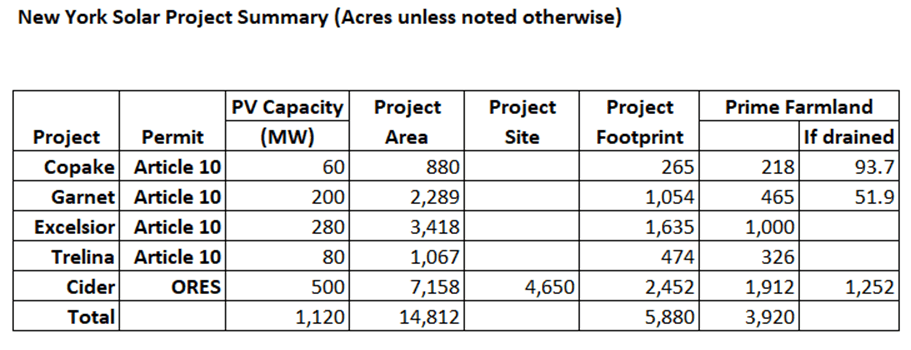
I have been following a number of solar projects and the project areas can be used to derive a first-order approximation of future land area needed as shown in the following table. The project footprint using these numbers is 5.25 acres per MW. At the current rate 67% of those acres are prime farmland.
The cumulative effects are the primary concern. Exhibit 15 includes an assessment of other local renewable projects within five miles of this project:
Based upon a review of the New York State Department of Public Service and ORES websites, as if the time of this Application, there are three proposed renewable energy facilities located in Genesee County and neighboring Orleans County. These include the 280-MW Excelsior Energy Center in the Town of Byron located approximately two (2) miles east; the 200-MW Orleans Solar Project in the towns of Barre and Shelby located approximately three (3) miles northwest; and the 200-MW Heritage Wind Project in the Town of Barre located approximately one and a half (1.5) miles north.
Based on the first order approximations from the previous table another 2,520 acres will be converted to glass, copper and steel solar sprawl and we will lose another 1,680 acres of prime farmland. Eleven farms sold out to Hecate Energy for the Cider Solar project so we can expect to lose another ten for the two other solar projects. How many customers can the local suppliers of farm materials and equipment afford to lose before they go out of business?
The Draft Scoping Plan had three scenarios for future solar resource development. The total solar resources projected were between 41,420 and 43,432 MW in 2040. There is a target for 10,000 MW of distributed solar so for an upper bound assume that utility-scale solar resources of at least 31,420 MW will be needed by 2040. That equates to solar sprawl covering 164,961 acres and the loss of a large number of farmers.
Conclusion
It was difficult for me to write this post because I was so upset at the blatant disregard for agricultural issues evident in the decision to permit this facility. There is plenty of land available that is not on prime farmland that can be used for solar development. Until there is a state policy that codifies the Department of Ag and Markets guidance for solar development, out-of-state developers will come in and plop down these facilities where it is easiest and cheapest for them to build. It would be even better for the State to develop a siting policy that incorporates that guidance and other factors so that development is as effective as possible. I have little faith that the Climate Action Council will address this these needs
My primary concern with this project is how it relates to the Climate Leadership and Community Protection Act. In particular, I believe that the massive resouces that have to be devoted to diffuse and intermittent renewable energy development will have worse impacts on the environment than the purported effects of climate change in New York. The opinions expressed in this post do not reflect the position of any of my previous employers or any other company I have been associated with, these comments are mine alone.
Trelina Energy Center
There is another utility-scale solar project being developed near the Garnet project. Late last year the New York State Board on Electric Generation Siting and the Environment (Siting Board) granted approval to build and operate the Trelina Solar Project, an 80 megawatt (MW) solar farm in the Town of Waterloo, Seneca County that is being developed by NextEra Energy Resources, the same company that is developing the Garnet Energy Center. I published an article about the approval process and noted that despite the fact that the New York Department of Agriculture and Markets (Ag & Markets) testimony clearly demonstrated that the project did not meet the Department’s siting policies the project was approved.
As part of the regulatory analysis of the project Michael Saviola, an Associate Environmental Analyst with Ag & Markets submitted prepared testimony on the Trelina Solar Project application. His testimony made a compelling case against the project. In response to the question “What Department policies are subject to the proceeding”, he responded (Line 20, page 6):
As previously mentioned, The Department discourages the conversion of farmland to a non-agricultural use. However, to support the New York State’s CLCPA initiatives, the Department has developed a siting policy supportive of solar development efforts on agricultural lands if (his emphasis added) the proposed projects are properly sited on lands other than the State’s most productive farmland. The Department’s goal is for projects to limit the conversion of agricultural areas within the Project Areas, to no more than 10% of soils classified by the Department’s NYS Agricultural Land Classification mineral soil groups 1-4, generally Prime Farmland soils, which represent the State’s most productive farmland. Soils classified with the soil groups 5-10 are identified as having soil limitations. The only responsible position the Department can take to stay true to the 7 AML Article 25-AA §300 and to support the NYS CLCPA renewable energy initiative is to ensure the preservation of agricultural areas involving soils classified as soil groups 1-9 for the production for food and fiber, as well as not object to proposed development on lesser productive soils, i.e. agriculture lands comprised on classified mineral soil groups 5-10.
The overall Project Area is 1,067 acres and “only approximately 44.4 percent will be used for Project Components within a fenced area of approximately 418 acres to generate 79.5 to 80 MW of renewable energy”. Note, however, that the testimony notes that “The Department’s goal is for projects to limit the conversion of agricultural areas within the Project Areas, to no more than 10% of soils classified by the Department’s NYS Agricultural Land Classification mineral soil groups 1-4, generally Prime Farmland soils, which represent the State’s most productive farmland.” The testimony also notes that “The Department estimates that greater than 68% of the of the limits of disturbance includes the conversion of farmland classified as Prime Farmland Soil”.
The application argues that the project only disturbs 4.9% of all the prime farmland in the Town of Waterloo and presumably would argue that means they meet the intent of the Department policy. The problem with that is there is no master plan for development and no assurances that other more responsibly sited facilities could not be constructed in the Town of Waterloo that would raise the town total over the 10% goal of the Department. The Ag and Markets testimony also argues against the claims that only 10.05 acres will be permanently disturbed. The testimony explains that 474.1 acres will be permanently disturbed because “as long as NYS incentives for the development of renewable energy exists, the complete decommissioning of solar electric energy generation, and full resumption to agricultural use is not likely to occur”.
I concluded that the press release describing the Siting Board’s decision statement that the process “follows a detailed review and robust public participation process to ensure that the solar farm meets or exceeds all siting requirements” is demonstrably false.
Ag & Market Solar Energy Project Policies
On March 10, 2022 Michael Saviola submitted prepared testimony on the Garnet Energy Center application. As before his responsibility was “to determine if the Project as proposed follows the Department’s Guidelines for Agricultural Mitigation for Solar Energy Projects.” This section provides some background on Ag & Market/Department policies. He notes that the Department of Ag and Markets does not have an opinion on the need for utility-scale solar generation but (Page 6, line 3):
The Department discourages the conversion of farmland to a non-agricultural use. This effort is in accordance with Section 4 of Article 14 of the 2018 New York State Constitution, which provides for the conservation of agricultural lands, as well as NYS Agriculture and Markets Law (AML), Article 25-AA, §300, which more specifically states:
“It is, therefore, the declared policy of the state to conserve, protect and encourage the development and improvement of its agricultural land for production of food and other agricultural products. It is also the declared policy of the state to conserve and protect agricultural lands as valued natural and ecological resources which provide needed open spaces for clean air sheds, as well as for aesthetic purposes.”.
After acknowledging that the Department is aware of the Climate Act and supports the general initiative, the testimony goes on to state that these projects are permanent installations (Page 6, line 20):
The Department will continue to discourage the conversion of agriculture land to a non-agricultural use. Prior to large-scale solar development, the Department has not been associated with PSL 22 Article 10 cases that constitute large, long-term conversion of agricultural lands to non-agricultural uses. Commercial wind generating facilities generally allow for farming activity to continue once the project is in-service. In comparison, the solar industry arguably eliminates the ability to perform normal viable agricultural operations within, and potentially immediately surrounding the facility. This constitutes a long-term conversion to a non-agricultural use. Due to increasing NYS energy goals encouraging renewable energy development, we see no reason facilities will not be upgraded and re-leased to maintain the growing or static renewable energy demand, in this case, 35 years from energization. The Department further asserts that as long as NYS incentives for the development of renewable energy exists, the complete decommissioning of solar electric energy generation, and full resumption to agricultural use is not likely to occur.
In response to the question “What Department policies are subject to the proceeding”, he responded (Line 17, page 7):
As previously mentioned, The Department discourages the conversion of farmland to a non-agricultural use. However, to support the New York State’s CLCPA initiatives, the Department has developed a siting policy supportive of solar development efforts on agricultural lands if (his emphasis added) the proposed projects are properly sited on lands other than the State’s most productive farmland. The Department’s goal is for projects to limit the conversion of agricultural areas within the Project Areas, to no more than 10% of soils classified by the Department’s NYS Agricultural Land Classification mineral soil groups 1-4, generally Prime Farmland soils, which represent the State’s most productive farmland. Soils classified with the soil groups 5-10 are identified as having soil limitations. The only responsible position the Department can take to stay true to the 7 AML Article 25-AA §300 and to support the NYS CLCPA renewable energy initiative is to ensure the preservation of agricultural areas involving soils classified as soil groups 1-9 for the production for food and fiber, as well as not object to proposed development on lesser productive soils, i.e. agriculture lands comprised on classified mineral soil groups 5-10. Additionally, the Department requires the Applicant to follow Department Guidelines for constructing solar facilities in agricultural lands. Draft Certificate Condition 47 and 95 identifies the Applicant’s agreement to comply with Department’s Guidelines entitled Solar Energy Projects – Construction Mitigation for Agricultural Lands (Revision 10/18/2019), specifying construction mitigation techniques intended to protect and restore agricultural soil resources. Furthermore, the Applicant has agreed to consult with the Department for any potential deviation from the Guidelines to develop applicable construction and restoration alternatives.
In response to the question: What are the primary agricultural impacts associated with the construction of a commercial solar energy generation facility on agricultural lands the testimony states: (Line 16, page 8)
The construction of a commercial solar energy generation facility within agricultural land constitutes a long-term impact and permanent conversion of farmland to an industrial (non-agricultural) use. The development of solar arrays and ancillary facilities (including panels, panel racking, transformer/inverter equipment pads, access roads, security fencing, substations, energy storage options, operation and maintenance facilities, planted visual screening areas, etc.) makes it infeasible to continue farming on viable agricultural land within the Project area. Furthermore, the location of project-related infrastructure- panel spacing and alignment in agricultural fields create obstacles that the farm operator will have to avoid during numerous types of agricultural equipment operations; including, but not limited to, cultivation, seeding, nutrient recycling, weed management, harvest, etc. The difficultly created by the obstacles forces the farm operator to abandon use of the field.
Impacts to agricultural lands remaining outside of the security fencing also has a high likelihood to become abandoned and/or orphaned. More specifically, these generally narrow areas outside the fenced facility are created by development limitations (municipal setbacks, buffers, etc.) and limit the conduct of mechanized farming. The scenarios cited above create narrow strips of land that although may be available to some agricultural producers are unattractive for most commercial farm operators, as they are inefficient to harvest crops due to the limitations of acreage and maneuverability for modern mechanized farming equipment. These “indirect” impacts often result in the loss of additional farmland which, in turn, result in a decrease in mechanized farming efficiency leading to a reduction in the production of crops, livestock and livestock products necessary for food production and security.
On page 10 line 8, the testimony asks the question How does the siting of commercial solar project-related infrastructure impact agricultural operations?
There are several potential impacts. Farms demand a certain acreage to meet their business, long-term staffing, and environmental objectives and to remain viable. If leased land is abruptly lost to another use, such as a solar installation, the farm will grow and market less produce, grains, forages, and livestock products; may have to downsize and lay-off employees; and could be challenged to have adequate acreage for proper manure nutrient recycling. Such changes may force the farm to close. As in other sectors, farmers seek improvements to management and efficiency to remain competitive and viable. Larger, more efficient tillage, planting, crop management, and harvesting equipment is one example of how farmers have adapted to remain viable and more productive. Often, this equipment can include two pieces of harvesting or tillage equipment pulled by a single tractor. As the size of the farming equipment has increased over the years, the turning radius for the equipment has also increased. The location of access roads and other project-related infrastructure in an agricultural field creates an obstacle which the farm operator has to avoid during field planting and harvesting operations. Placement of project-related infrastructure in agricultural fields can result in a loss of productive acreage as well as a decrease in field operation efficiency or viability with the larger planting and harvesting equipment because of the increased turning radii required. Depending on the location of project-related infrastructure, primarily solar arrays and access roads, the loss of acreage available to farming, and the loss of farming efficiency or farm viability can be significant and, in some cases, devastating to farms and for food production.
Garnet Energy Center
The Garnet Energy Center is a proposed 200-megawatt solar project with 20 megawatts of energy storage located in the town of Conquest in Cayuga County, N.Y. NextEra Energy Resources is also developing this project. According to the July 2021 Proposed Array Layout the project area is 2,288 acres and the facility area (area within in project fence line) is 1,054 acres. The fenced area encloses the solar arrays, inverters, energy storage modules and the project substation.
On Page 12, line 18 of Saviola’s testimony he addresses the question “Does the facility layout follow the Department’s Solar Guidelines and does it align with the Department’s siting policy?”
In general, access roads should follow field edges and the solar arrays should not be sited in a manner in which agricultural areas become orphaned as described in my testimony above. Additionally, the Department finds the Applications proposed siting is not consistent with the Department’s siting policy because it will occur on almost 30% of active farmland classified as Prime Farmland (Generally, Mineral Soil Groups 1-4) within the proposed project. The Application update states that the project will occupy nearly 1,000 acres of land to generate up to 200 MW of electricity, however, areas located outside of fenced areas will likely become fallow or orphaned as a result of screening requirements and setbacks. This will eliminate crop production on nearly 1,000 acres of agricultural lands for a minimum of 30 years-worth of crop yields from some of the most productive farmland soils in the State. While the Applicant describes the impact to agricultural land and farming, in general, as temporary, a 30-year loss of the production of crops, livestock and livestock products constitutes a long-term conversion to a nonagricultural use and a long-term loss of food production. Although a decommissioning plan has been prepared, there is virtually no reasonable assurance that the project will be decommissioned and that the full resumption back to agricultural use will be reestablished.
As if this is not enough the testimony goes on to respond negatively to NextEra’s response to questions. For example, “True long-term impacts include the approximate 30 plus year loss in the production of crops, livestock and livestock products as a result of project-related components being constructed inside the fence. Nearly 1,000 acres of farmland will be taken out of production.” (Page 14 line 5). On Page 15, line 18 agricultural co-utilization is discussed: “The Applicant indicates that they have not considered incorporating agricultural co-utilization as part of the Project. They indicate that there is not sufficient space for co-utilization.” And goes on to say he does not agree with this response: “There is ample space inside the fence for agricultural activities such as sheep grazing, apiary incorporation and pollinator species, and small-scale grass hay production, nor have they demonstrated any reduced impacts to agriculture from the increased density of the panels. The Applicant should work with hosting farmers to explore dual-use, or agrivotalic projects. Similarly, the response to questions about subsurface drainage systems was eviscerated.
On page 19, line 18 comes this: “It is the Department’s opinion that the facility will result in or contribute to a significant and adverse disproportionate agricultural impact upon the local farming community. They have not avoided, offset or minimized agricultural impacts to the maximum extent practicable using verifiable measures”.
Responsible Solar Energy Siting
There are other efforts that define what is needed to site utility-scale solar projects to minimize impacts. In December 2021 New Yorkers for Clean Power (NYCP) and Alliance for Clean Energy NY (ACENY) co-hosted a workshop “What’s the Deal with Renewable Energy & Agriculture?” that discussed the compatibility of renewable energy and agriculture in New York State and all the speakers advocated responsible solar development that minimizes the loss of prime farmland. Three other examples follow.
The Saviola testimony describes a document on responsible siting of utility-scale solar development:
The American Farmland Trust published a study in February 2022 on smart solar siting on farmland in New York State. This study was completed with input from, and collaboration with, advisory members from government and non-governmental organizations, solar industry advocates, not-for profit land trusts, solar developers, and academia. The study was conducted to develop smart solar strategies to meet climate goals while supporting its agricultural economy and future food security. The report reveals trends that show that good quality farmland has been a first-choice site for solar development. As in with this proceeding here. The lowest hanging fruit. The study strongly recommends against siting solar infrastructure on prime farmland or farmlands comprised of Mineral Soil Groups 1-4 and to site infrastructure on marginal lands. The Study also indicates that farmers are interested in agrivotalics. The Study concludes by stating that the choices we make today about where and how solar projects, particularly large-scale facilities, are sited on active farmland will make a difference to rural economies and influence our ability to farm and grow food in New York to feed ourselves and reap environmental benefits now and into the future.
Farmland protection and the maintenance of a vibrant agricultural economy are important State policy goals. New York State recognizes the importance of collaboration between the agriculture and clean energy sectors as a critical part of the State’s overall decarbonization strategy. NYSERDA works in close coordination with the Department of Agriculture and Markets (NYSAGM) and other stakeholders to responsibly support the development of renewable energy projects. In the 2019 NY-Sun Expansion Petition, NYSERDA described the interaction of distributed solar with agriculture in New York:
“The majority of projects in [the Upstate C/I] market sector are expected to be ground-mounted arrays ranging between 5 MW and 7.5 MW in size, which occupy approximately 20 – 25 acres of land, typically on rural properties that are leased or sold to the solar developer by the landowner. Notably, this includes properties that are currently used, or could potentially be used for, agricultural production. While NYSERDA expects that the total agricultural acreage utilized for distributed solar projects will remain modest as compared to total farmland in New York State, through its implementation efforts, NYSERDA will act to ensure that negative impacts to farmland and the State’s agricultural economy are avoided and minimized, and where they are unavoidable, mitigated. NYSERDA, working with partner agencies and stakeholders, has already taken multiple actions along these lines and will pursue additional actions under an expanded NY-Sun program.” (This section is from the NY-Sun Petition, p. 21.)”
In the subsequent two years, NYSERDA and NYSAGM have continued to work in partnership to put in place requirements for solar projects to minimize impact to farming and agricultural soils. (These requirements include, inter alia: complying with New York State Agriculture and Markets Law; submitting appropriate notices to NYSAGM and local Agricultural and Farmland Protection boards; executing a copy of the Guidelines for Solar Energy Projects – Construction Mitigation for Agricultural Lands document published by NYSAGM; and making a Mitigation Fund payment or committing to other mitigation measures where impacted agricultural soils exceed 30 acres.) These requirements have already demonstrated their effectiveness: In 2021 to date, all 50 distributed solar projects subject to these requirements, totaling 1,037 acres of affected area, have committed to avoiding and minimizing impacts to prime soils in consideration of the solar layout. For 48 of these projects, all unaffected portions of the farms hosting the solar projects, a total of 3,385 acres, will remain in agricultural production. Many of the farmers hosting projects on a portion of their land report that the steady lease revenue from the solar projects has enabled them to continue farming on most of their property despite challenging agricultural economic pressures.
Finally, the New York State Energy Research & Development Authority Agricultural Technical Working Group is working on a “Smart Solar Siting“ scorecard to encourage responsible siting of renewables on agricultural land. The scorecard lists five area to avoid:
Avoid prime agricultural soils
Farmland in active cultivation
Forested land
Wetlands
Grass lands
Conclusion
In my opinion, the American Farmland Trust report, the state’s policies for distributed solar and the Agricultural Technical Working Group analyses will eventually be used to form the basis of a state-wide policy for responsible siting of utility-scale solar development. In the meantime, it is inappropriate to allow projects like the Garnet project to proceed.
The Garnet Energy Center permit decision will be a litmus test to see if the State is going to protect farming communities. I believe that the testimony clearly demonstrates that the proposed project is inappropriate because “the facility will result in or contribute to a significant and adverse disproportionate agricultural impact upon the local farming community”. Ag and Markets testimony for the Trelina project was similarly negative but that got approved. At a minimum the project approval should be delayed until guidelines for responsible utility-scale solar development are available and I submitted comments to the docket to that effect. If the Siting Board ignores the Ag and Markets testimony and the clear need to wait for guidelines, then it will be clear that the State is not going to protect farming communities.

 Pragmatic Environmentalist of New York