Commentary on Recent Articles October 25, 2024

Frequent readers of this blog know that many of my posts are long because I document all my statements.  This is because of my background in industry where it is necessary to prove my arguments to have credibility.  This is an update of articles that I have read that I want to mention but do not require a detailed post.  I have also included links to some other items of interest.  Previous commentaries are available here

I have been following the Climate Leadership & Community Protection Act (Climate Act) since it was first proposed and most of the articles described below are related to the net-zero transition.  I have devoted a lot of time to the Climate Act because I believe the ambitions for a zero-emissions economy embodied in the Climate Act outstrip available renewable technology such that the net-zero transition will do more harm than good. The opinions expressed in this article do not reflect the position of any of my previous employers or any other company I have been associated with, these comments are mine alone.

Videos

Delusions of Energy Storage

John Robson interviews Judith Curry

Chocolate Teapot Fallacy

David Turver writing at Eigen Values Substack described his attendance at the Battle of Ideas Festival in London.  He had the opportunity to respond to the argument that renewables were a viable alternative to nuclear power.  He made the points that has the smallest overall environmental footprint of all energy sources because it doesn’t take up much land and has very low mineral intensity. The physics of nuclear power are far superior to any other energy source because of its extremely high energy return on energy invested, meaning we get far more energy out than we expend building the power plants, and the output is reliable.

He also made the point about the chocolate teapot fallacy.

Arguing for wind and solar in place of nuclear power is akin to arguing in favour of chocolate teapots because you cannot wait for a ceramic one. No matter how many chocolate teapots you buy, you can never make tea; just like no matter how many wind turbines and solar panels you install you can never run a modern economy on intermittent electricity.

Mistake to Abandon Fossil Fuels

CFact explains Ron Stein believes it would be a mistake to abandon fossil fuels.  I have been meaning to raise this issue for a while.  It boils down to the fact that fossil fuels are not only used for transportation and electricity production and the “world’s rush to reduce carbon emissions is overlooking an irreplaceable reality: the petrochemical foundations of modern society.”

“If we stop using crude oil, we’re working backwards – back to the 1800s,” Mr. Stein states. He isn’t being hyperbolic. From today’s phones and medical devices to clothing, packing, and the very infrastructure of homes, most of the products that define modernity are either made from or rely heavily on oil derivatives. It’s not just a matter of cutting down on gasoline or heating oil – reducing crude oil production affects the manufacturing of everything from electric vehicle batteries to renewable electricity infrastructure itself.

Many energy policy makers mistake electricity generation for the sole metric of electricity transition. But electricity is only one aspect of energy consumption. The more difficult truth is that fossil fuels don’t just keep the lights on; they’re embedded in nearly every stage of the supply chain, from raw material extraction to the production of finished goods. While the turbines and solar panels provide electricity, they do not replace the oil-derived components necessary to build those same renewable technologies.

Mr. Stein points to this gap in understanding as a critical oversight: “Policymakers are talking about energy as if it’s synonymous with electricity, but that’s not the case. Everything that needs electricity, from the smallest lightbulb to the most advanced microchip, is made from petrochemicals.”

………………………..

Truly, Ronald Stein’s perspective is a refreshing reminder: the answer to Earth’s energy crisis isn’t a zero-sum game. Rather, it’s about striking a delicate balance – one that safeguards the progress humans have made while building a sustainable future that works for everyone.

Hydrogen Follies

Francis Menton writing at the Manhattan Contrarian summarizes the costs of hydrogen storage. as a dispatchable emissions free resource (DEFR).  The Climate Act Scoping Plan uses hydrogen as the placeholder DEFR for New York’s 2040 zero-emissions fantasy.

Menton describes a new study that appeared in the scientific journal Joule on October 8 with the title “Carbon abatement costs of green hydrogen across end-use sectors.”  He quotes the introduction:

Although low costs of hydrogen storage and distribution (<$1/kgH2) are possible through economies of scale, this requires high utilization of storage and distribution infrastructure, which is not applicable to all end-use sectors. If storage and distribution infrastructure is used at a low rate, costs increase significantly. Salt cavern storage costs increase from less than $0.50/kgH2 to $6/kgH2, on average, if stores are cycled fewer than 10 times per year, for example, in the context of seasonal changes in demand (e.g., heating or electricity generation).

Menton refers to his post on September 28, 2023 that covered a Report then just out from Britain’s Royal Society dealing with issues of long-term energy storage to back up wind and solar generators. He explains that the Royal Society had collected weather data for Britain for some 37 years and documented that “there are worst-case wind and sun “droughts,” comparable to rain droughts, that may occur only once every 20 years or more.”  Similar analysis in New York was used to determine that DEFR is necessary to back up wind and solar electricity generation without fossil fuel back-up to cover these worst-case droughts.  Menton argued that these data indicate that over the 37-year period half of the full storage backup would have been required twice and a quarter only once.  This would raise the cost of storage a lot.  The Royal Society Report includes the following graph of potentially needed withdrawals from storage to cover these worst case droughts:

For context the New York Independent System Operator (NYISO) 2023-2042 System Resource Outlook projected that between 26 and 32.5 GW of hydrogen DEFR generating between 2 and 4 GWh of energy would be needed in 2040 and the Integration Analysis projected that 17.5 GW of DEFR generating 2 GWh would be needed.  Those numbers do not account for the frequency that the full backup will be used.

Menton concludes:

I understand that there are people moving forward on setting up some of this hydrogen infrastructure, funded with government subsidies. It’s almost impossible to imagine how much subsidies it would take to make such a system fully functional. It will never happen.

The Big Lie – Solar and Wind are Cheapest Forms of Energy

Ed Reid describes the big lie:

The solar and wind industries and their government and NGO supporters continually assert that a renewable plus storage grid would be more economical and more resilient than the current grid. Both assertions are demonstrably false. These assertions are not merely misinformation. Rather, they are intentional disinformation.

He summarizes the reasons concisely in one place.  Although the capital costs per unit of rated capacity of fossil fired generators and wind and solar facilities may be comparable, and even if renewables are lower, there are five reasons why that does not matter.  Over a year renewables are limited by the amount of energy they produce.  Reid uses one number, but I think that in round numbers solar produces around 20% of its rated capacity and wind about one third.  A fossil generator can produce 90% of its rated capacity.  Therefore, it takes three times as much wind capacity to produce the same amount of energy and solar at least four times as much.

To provide reliable power energy storage is needed for short term variations, seasonal variations, and worst-case variations in renewable resource output.  The useful lives of wind and solar are shorter than fossil units and storage useful life is even less.  He also points out that wind and solar are less resilient than conventional generation.

Nantucket Wind Update

Bud’s Offshore Energy website compares the Bureau of Safety and Environmental Enforcement (BSEE) latest statement and recent GE Venova (GE) statements:

  • BSEE: Vineyard Wind is still prohibited from installing blades, producing power or conducting any activity on the damaged A-38 turbine.
  • GE: We are “really now getting to a point of shifting back to execution out at sea.” (Not at all what BSEE said.)
  • BSEE: BSEE may permit other specific activities after a risk analysis has been performed and mitigations adopted.
  • GE: We were “granted approval to return to installing new blades on turbines at the project once stringent safety and operational conditions are met.” (Positive spin of the BSEE statement implying that approval is assured.)
  • BSEE: Root cause analysis of the blade failure has not yet been provided to BSEE.
  • GE: “We have finalized root cause analysis and confirm the blade at issue at Vineyard Wind was caused by a manufacturing deviation from our factory in Canada.” (Then why doesn’t BSEE have the analysis? Is the Canadian plant being scapegoated?)
  • BSEE: No timetable for completion of BSEE investigation (This could present a dilemma for BSEE. How do you allow the resumption of blade installation and power generation before the investigation has been completed? Will the report be held until the Harris or Trump administration gives the go-ahead?)

Finally, as expected, we can now conclude that the blades being shipped from New Bedford to France were defective.

Meanwhile the Town and County of Nantucket describe this issue as the Vineyard Wind Turbine Crisis.  The Rhode Island Current updates the current plan.  I think this may have widespread ramifications.

Commentary on Recent Articles

Frequent readers of this blog know that many of my posts are long because I get document all my statements and get bogged down in details.  This is because of my background in industry where it is necessary to prove my arguments to have credibility.  This is an update of articles that I have read that I want to mention but do not require a detailed post.  Previous commentaries are available here

I have been following the Climate Leadership & Community Protection Act (Climate Act) since it was first proposed and most of the articles described below are related to the net-zero transition.  I have devoted a lot of time to the Climate Act because I believe the ambitions for a zero-emissions economy embodied in the Climate Act outstrip available renewable technology such that the net-zero transition will do more harm than good. The opinions expressed in this article do not reflect the position of any of my previous employers or any other organization I have been associated with, these comments are mine alone.

Hurricane Risk to Offshore Wind

I published a couple of articles about offshore wind recently (recent news and costs) in the last couple of weeks.  When I saw the headline “Wind Turbines Destroyed by Typhoon Yagi,” I figured another update was coming.  Robert Bradley described the not so good news about this storm and its impact on wind turbines: “Not only were older turbines destroyed by the 150 mile-per-hour typhoon (Category 4 in hurricane terms); new “more efficient typhoon-resistant versions” were leveled too.”

He referenced a 2012 article that is relevant today.  The Proceedings of the National Academy of Sciences research article, “Quantifying the Hurricane Risk to Offshore Wind Turbines” (February 13, 2012) included the following conclusions:

“The U.S. Department of Energy has estimated that if the United States is to generate 20% of its electricity from wind, over 50 GW will be required from shallow offshore turbines. Hurricanes are a potential risk to these turbines. Turbine tower buckling has been observed in typhoons, but no offshore wind turbines have yet been built in the United States.”

“We present a probabilistic model to estimate the number of turbines that would be destroyed by hurricanes in an offshore wind farm. We apply this model to estimate the risk to offshore wind farms in four representative locations in the Atlantic and Gulf Coastal waters of the United States. In the most vulnerable areas now being actively considered by developers, nearly half the turbines in a farm are likely to be destroyed in a 20-y period.”

“Typically, wind turbines are designed based on engineering design codes for northern Europe and the North Sea, where nearly all the offshore and coastal wind turbines have been built. These codes specify maximum sustained wind speeds with a 50-y return period of 42.5–51.4 m/s (83–100 knots), lower than high intensity hurricanes.”

“Offshore wind turbines … will be at risk from Atlantic hurricanes…. Wind turbines are vulnerable to hurricanes because the maximum wind speeds in those storms can exceed the design limits of wind turbines. Failure modes can include loss of blades and buckling of the supporting tower.”

“In 2003, a wind farm of seven turbines in Okinawa, Japan was destroyed by typhoon Maemi, and several turbines in China were damaged by typhoon Dujuan. Here we consider only tower buckling, because blades are relatively easy to replace (although their loss can cause other structural damage).”

“There is a very substantial risk that Category 3 and higher hurricanes can destroy half or more of the turbines at some locations.”

I think it is important to point out that these conclusions were based on risks for 2012 turbines.  Since then, the size of turbines has increased substantially and when that happens the structure is subject to faster winds at the upper levels.  In other words a Category 3 storm could have Category 4 impacts on these huge structures.  The implementation plans for the Climate Act have not mentioned the potential impacts of a loss of a large proportion of the offshore wind resources due to hurricanes but I think it is time to assess this problem.

German Energy Transition

George Santayana’s quote “Those who forget history are condemned to repeat it” is also applicable to the lessons that could be learned by observing what has happened to net-zero early adopters.  Four articles about the German Energiewende, or clean energy transition should be setting alarm bells off the Hochul Administration. 

Francis Menton notes that “Germany is running faster and faster to stay in place but in the meantime, it is destroying its economy.”  He notes that:

According to a chart at this page, also from Clean Energy Wire and sourced to the UBA, Germany’s solar generation capacity went from 67.6 GW at year-end 2022 to 79.2 GW at year-end 2023 — an increase of more than 17%; and its wind generation capacity went from 66.1 GW to 68.8 GW, an increase of over 4%. That’s rather an enormous amount of additional capital invested in wind and solar to achieve an additional 0.3% market share in electricity generation.

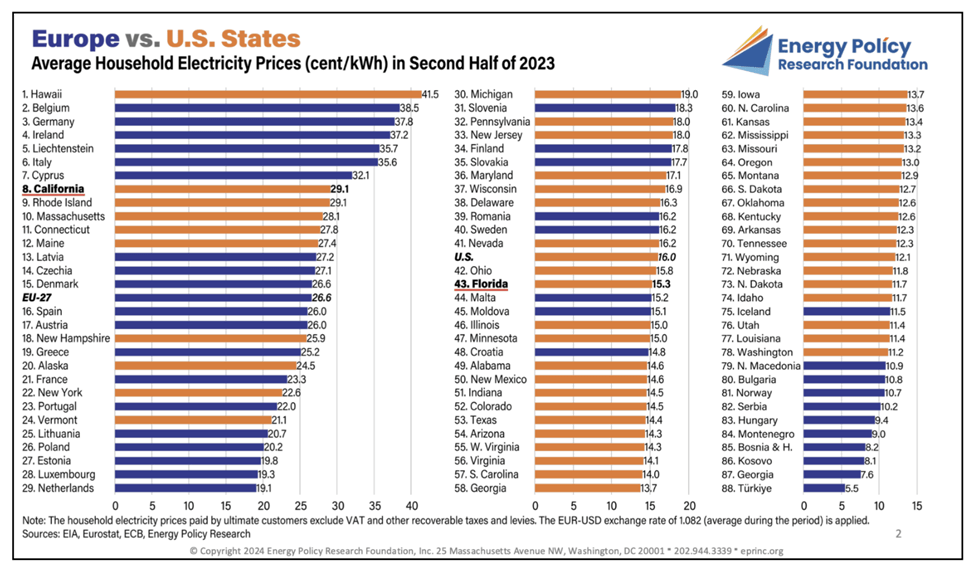
From what I have seen this is a feature not a bug.  At a certain point adding more solar and wind capacity does not proportionally increase market share.  More importantly, what about the costs?  Menton looks at the big economic picture for Germany. First, how do its electricity prices compare to other places? Here is a very useful chart from the Energy Policy Research Foundation, comparing second-half 2023 consumer electricity prices among EU countries and U.S. states:

Germany way at the top of the list, over 38 cents per kWh, well over double the U.S. average. New York is position 22.  I intend to keep track of this metric in the future because I don’t think NY will fare as well when the Climate Act costs kick in. 

In an email Richard Ellenbogen pointed out that the authors of the Climate Act should have checked the literature because they would have seen the following from Yale.edu in December, 2018 before the passage of the Act: “Carbon Crossroads: Can Germany Revive Its Stalled Energy Transition?” It is not the only document that should have raised red flags.  The article notes that:

Although the country has made a Herculean effort to shift to a clean energy economy — in just the past five years government support and costs to consumers have totaled an estimated 160 billion euros ($181 billion) — Germany’s greenhouse gas emissions have not declined as rapidly as expected in response to the vigorous expansion of renewable energy, which now generates 40 percent of the country’s electricity. Germany’s politicians are even resigned to falling significantly short of the country’s 2020 goal of reducing emissions by 40 percent below 1990 levels.

The article goes on:

Today, the Energiewende finds itself stalled and floundering. Germany’s carbon emissions have stagnated at roughly their 2009 level. The country remains Europe’s largest producer and burner of coal, which generates more than one-third of Germany’s power supply. Moreover, emissions in the transportation sector have shot up by 20 percent since 1995 and are rising with no end in sight, experts say. German consumers have seen their electricity bills soar since 2000, in part because of the renewable energy surcharge.

The transportation transition situation is getting more dire.  Irina Slav describes the EV situation in Germany:

Take the latest news from the EV world, for example. Global sales were up by a lovely 20% in August. But in Europe, EV sales were down. By 33%. And that includes hybrids.

The drop was led by Germany, which last year axed subsidies for the vehicles. The axing led to a sharp decline in EV sales, so earlier this month, the government surrendered to reality — and approved new incentives, under which, per Reuters, “companies would be able to deduct up to 40% of the value of newly purchased electric and qualifying zero-emission vehicles from their tax bill in the year of their purchase, falling progressively to 6%.”

In other words, Germany’s government still thinks it’s only a matter of time until EVs become competitive. They just need a leg up. Another leg up. They might soon need a couple of more legs up because the Chinese are coming — and they’re bringing their cars as knock-down kits as their government advises they keep key EV tech at home. This would compromise some green job plans and that’s tragic.

Finally, in a breaking news report by Eric Worral   he examines the German government’s attempt to fact check Trump on the green energy debacle.  He summarizes recent articles documenting the failures of the Energiewende.

I could go on, because the examples show up frequently.  It is obvious that there are problems with the German net-zero transition that will inevitably show up here.  Why is the Hochul Administration ignoring these red flags?

Commentary on Recent Articles 30 August 2024

Frequent readers of this blog know that many of my posts are long because I get document all my statements and get bogged down in details.  This is because of my background in industry where it is necessary to prove my arguments to have credibility.  This is an update of articles that I have read that I want to mention but do not require a detailed post.  Previous commentaries are available here

I have been following the Climate Leadership & Community Protection Act (Climate Act) since it was first proposed and most of the articles described below are related to the net-zero transition.  I have devoted a lot of time to the Climate Act because I believe the ambitions for a zero-emissions economy embodied in the Climate Act outstrip available renewable technology such that the net-zero transition will do more harm than good. The opinions expressed in this article do not reflect the position of any of my previous employers or any other organization I have been associated with, these comments are mine alone.

Natural Gas Politics and Production

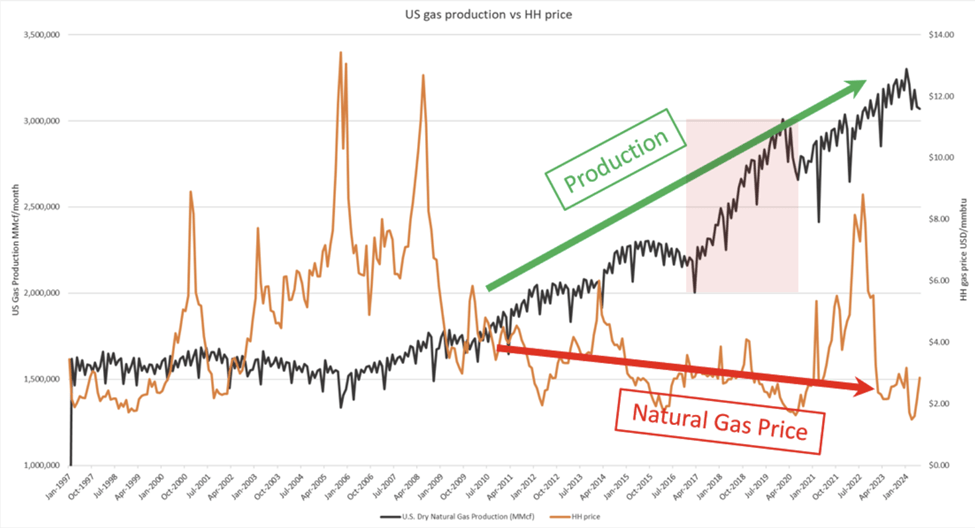
Canadian Terry Etam describes the natural gas conundrum in which the widespread deployment of fracking technology enabled producers to accelerate the production of natural gas “while simultaneously driving prices into the toilet”. 

Etam describes the graph:

First, the gradual increase in production from about 2006 onwards was the result of the high prices of 2002-2006, which spurred development and led to the unlocking of the US’ vast shale gas resource. High prices footed the bill for shale exploration and experimentation, which set the stage for future growth.

One of the biggest reasons for these wild trajectories is that the industry just keeps getting better and better at getting gas out of tough formations. (While there are many ways drilling and completions are improving, these advancements should not be confused with the simple act of drilling longer horizontals which is often viewed as an efficiency gain – it is a capital efficiency gain, no doubt, but not like an improved frac is – a longer lateral simply chews up the reservoir faster. One day in a decade or two we will look back and go, oh yeah, maybe that was significant…).

Those technological/fracking improvements drove the first waves of growth, but don’t completely explain the steepest part of the curve. Note in particular the pinkish shaded box, corresponding to roughly April 2017 to April 2021. Over that four-year period, the US added about 27 bcf/d, which is about 1.5 times Canada’s entire output, while prices fell from about $3.00/mmbtu to $2.00. That’s the sort of antics a guy like Warren Buffett really frowns on.

He goes on to explain that the future is not clear:

Today, here in mid 2024, the future is murky. We know a few things: that the US (and Canada) are both capable of a lot more natural gas production. We know that demand is going to go up over the next half decade at a minimum, possibly by as much as 30 percent, due to new LNG export terminals and data center/AI demand.

What we don’t know is how easy it will be to build any new infrastructure to enable new volumes to get to where they need to be. We’re well used to this problem in Canada, of course, which is a basket case; it is a miracle that Coastal GasLink was built at all, and it is hard to imagine any entity having the intestinal fortitude to attempt any new greenfield interprovincial infrastructure, which is federally regulated, which means the ruling alliance would laugh you off Parliament Hill for even showing up with your briefcase

The US is not far behind; the only significant interstate gas pipeline to go into service in the past few years has been the Mountain Valley Pipeline which was many years delayed by swarming activist attacks, and was completed at double the initial cost estimate (MVP was first proposed in 2014, and was scheduled to come onstream in 2018; it finally started flowing gas in 2024). A more realistic reading of the current US natural gas interstate pipeline system is this: In July 2020 the Atlantic Coast Pipeline, a large and critical new pipe that would have taken excess Appalachia gas to a thirsty US east coast, which was six years in planning, was shelved despite receiving a 7-2 vote of approval from the United States Supreme Court (from the project cancellation news release: “A series of legal challenges to the project’s federal and state permits has caused significant project cost increases and timing delays. These lawsuits and decisions have sought to dramatically rewrite decades of permitting and legal precedent including as implemented by presidential administrations of both political parties. As a result, recent public guidance of project cost has increased to $8 billion from the original estimate of $4.5 to $5.0 billion… This new information and litigation risk, among other continuing execution risks, make the project too uncertain to justify investing more shareholder capital.”)

To emphasize just how tough it is to actually build a new pipeline, Dominion Energy, one of the Atlantic Coast partners, took a $2.8 billion charge to earnings in cancelling the project. Think about that. A public company chose to eat a $2.8 billion loss rather than attempt to build a new, approved pipeline.

He concludes that there is so much uncertainty in the gas markets that any projections for the future are speculative.    I conclude that politicians and energy policies don’t work well together.

National Center for Energy Analytics

I received an email from an interesting organization that can help is all understand energy policies.  The National Center for Energy Analytics is a “new energy think tank devoted to data-driven analyses of policies, plans, and technologies surrounding the supply and use of energy essential for human flourishing.”  Executive Director Mark P. Mills explains:

Modern civilization hinges on abundant, affordable, and reliable energy. Policies ignoring those fundamentals are doomed to fail. There is of course the constant refrain that an energy transition—a shift away from oil, natural gas, and coal—is not only underway, but accelerating. However, hydrocarbons continue to supply over 80 percent of America’s and the world’s energy, a proportion largely unchanged in two decades. The Inflation Reduction Act (IRA), designed to expedite a transition, is projected to cost between $2 trillion and $3 trillion, far exceeding initial claims. That level of spending, alongside similar state-level initiatives, means that energy issues are unavoidably a central feature of U.S. economic and policy debates.

Energy policies are essentially bets on how we can meet future demands. But, setting aside the usual aphorisms about predicting the future, history shows that innovators have always created far more ways to consume energy than to produce it. Thus effective energy policies must not only anticipate the future but also do so while simultaneously meeting the three core energy metrics of ensuring abundance, affordability, and reliability. The energy transition is a popular narrative, but the practicalities of physics, engineering, and economics point to a future that will see an enduring reliance on hydrocarbons.

Claptrapping

Irina Slav captures my frequent feeling of helplessness when I try to see how uninformed political pressures are adversely affecting the energy system. 

One of the marks of helplessness is the frequent use of a specific word or a group of words to describe a situation you cannot change, which fact invokes the feeling of said helplessness.

I know this because I frequently use the word stupid and synonyms to describe the people leading us into the energy transition. This is in part because they are, indeed, stupid, and in part because I cannot do anything to stop them. On a positive note, it seems some of the most devout transitionistas are also feeling quite helpless.

She goes on to describe a recent article:

In a commentary piece for the Financial Times on Wednesday, its business columnist and associate editor Pilita Clark called out Elon Musk and Donald Trump for what she described as “misleading, misinformed or just plain baffling utterances that continue to gush forth in the face of an increasingly evident problem.”

She also described the pushback against the climate change narrative as “claptrap”. A total of seven times. In an 800-word piece. Ms. Clark was not a happy associate editor when she wrote that piece.

Slav describes the whole commentary.  Ms. Clark complains that there are people who have the audacity to make “rubbish claims” about the green technologies that are supposed to save us from climate Armageddon.  Slav responds that despite the obvious issues with the technologies and the cost of implementing them that the UK political war on fossil fuel companies is driving the companies away:

“If the government implements the kind of windfall taxes they are talking about, then you end up with a cliff edge in UK energy production because the industry will be taxed into uncompetitiveness,” Chris Wheaton from Stifel said. “That is going to cause a very dramatic decline in investment and therefore production and jobs, and a big hit to energy security.”

I recommend reading the whole article.  She offers several more examples of the cost and environmental impacts of the “clean energy” transition in an entertaining way.

Billion Dollar Disasters

One of the arguments used by activists is that we must address climate change because we are seeing the effects now.  As proof the apparent increase in the costs of disaster losses from the National Oceanic and Atmospheric Administration (NOAA) are frequently cited.  Roger Pielke, Jr. called their numbers out noting that their dataset is “a clever public relations gimmick, to be sure, but it should never be used in scientific research, climate assessment reports, or as a grounding for policy.” 

Early this year he submitted a “request for correction” and notes that NOAA did respond.  They admitted that the documentation and transparency of the disaster loss dataset needs to be improved.  Pielke suggested that NOAA align their methods to be consistent with the Intergovernmental Panel on Climate Change but, not unlike New York, the response blew off the issue and suggested that they will continue to do what they are doing.  Pielke concludes “Based on what NOAA has found, no one should be using the dataset in research or in a scientific assessment — Unless of course the goal is PR, not science.”

Lomborg Newsletter

The always informative Bjorn Lomborg newsletter had several interesting articles.  He explained why a scare story of polar bears dying out is a tactic that leaves us poorly informed.  I agree with his argument that in order to achieve the transition proposed that clean energy innovation is necessary.  He also makes persuasive argument that it is not in the best interests of the third world to decarbonize with existing technology that is so expensive.  In my opinion that underscores the need for clean energy innovation.  Even though there are green energy subsidies of almost $2 trillion each year he explains that “when societies add more renewable energy, most of it never replaces coal, gas or oil. It simply adds to energy consumption”.

Follow the Energy Transition Money

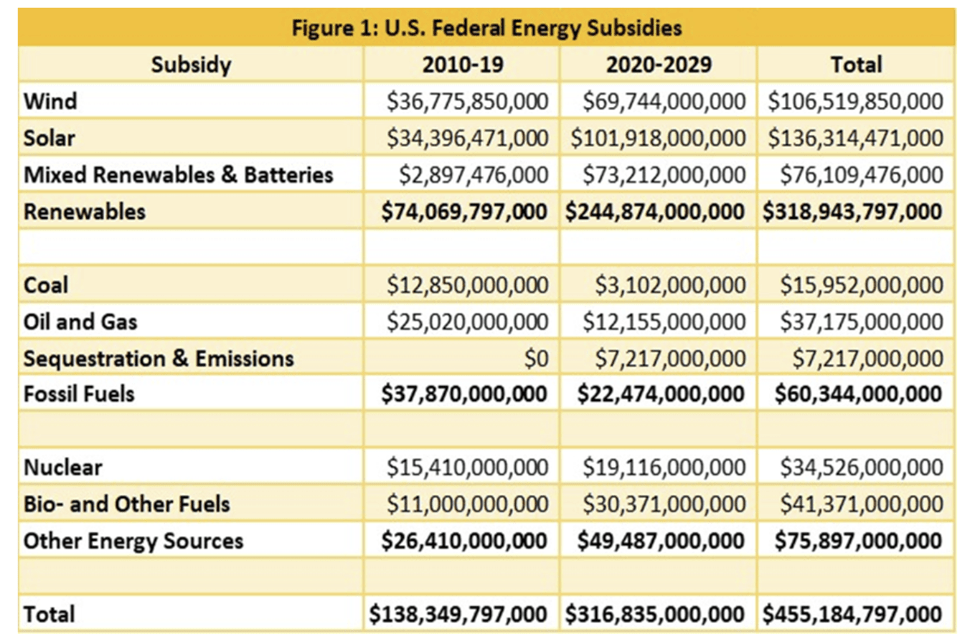
Bill Peacock quantifies the subsidies given to fossil fuels, nuclear and renewables.  He includes a table based on information sourced from Bennett, et al; U.S. Joint Committee on Taxation 2019 & 2023U.S. EIACongressional Budget Office.

Peacock notes:

Perhaps these claims are efforts to distract from massive renewable energy subsidies that are driving the “energy transition” from fossil fuels to renewables. As seen above, renewables received $74 billion from the U.S. government in 2010–19. They are expected to increase to $244 billion from 2020 to 2029.  The subsidies are the only reason that wind and solar generation exist on the U.S. grid at commercial scale.

He also provides costs per energy produced or MWh:

Peacock goes on to document the impacts on reliability and increased costs that are a direct result of these subsidies.  I agree with his conclusion:

When politicians take over markets, bad things happen. Costs increase, consumer choices are thwarted, and well-connected businesses get rich off taxpayers. We see all these things happening in the U.S. energy transition from fossil fuels to renewables. The only way to eliminate these and other harms is to let the market work and eliminate all energy subsidies—federal and state—in America.

Commentary on Recent Articles 21 August 2024

Frequent readers of this blog know that many of my posts are long because I get document all my statements.  This is because of my background in industry where it is necessary to prove my arguments to have credibility.  This is an update of articles that I have read that I want to mention but do not require a detailed post.  Previous commentaries are available here

I have been following the Climate Leadership & Community Protection Act (Climate Act) since it was first proposed and most of the articles described below are related to the net-zero transition.  I have devoted a lot of time to the Climate Act because I believe the ambitions for a zero-emissions economy embodied in the Climate Act outstrip available renewable technology such that the net-zero transition will do more harm than good. The opinions expressed in this article do not reflect the position of any of my previous employers or any other organizatin I have been associated with, these comments are mine alone.

Reasons to Oppose Renewable Energy

Brenda Hansen at Go Constitutional responded to the question why she opposed renewable energy in a post republished at Energy Security and Freedom Substack.  She explained that she opposes large-scale solar and wind projects on moral grounds:

The political movement to pivot away from high-density energy sources (such as fossil fuels, natural gas, and nuclear) and attempt to transition to solar and wind is unethical because it will diminish human flourishing and will harm my fellow human beings – starting first with the most vulnerable.

Hansen does a good job explaining that when it comes to human flourishing, energy matters.  If energy is not abundant and affordable, then “people need to spend an inordinate amount of time seeking and obtaining it”.  The problem with renewables is that “Power from solar and wind is inherently unreliable, and this built-in characteristic of these energy sources will never change.” 

She goes on to make an elegant point about affordability:

Turning our attention to affordability, energy that is unreliable cannot be considered abundant. Abundant energy, after all, always is there, always available, always ready to use. Such is not the case with solar and wind. When a product or commodity is not abundant, it becomes expensive.

I also endorse her moral accountability argument:

Considering these scientific realities (the unpredictable, unreliable, intermittent, low-density, low-efficient nature of solar and wind), ought to cause a pause. Do officials and bureaucrats who make energy decisions for us ever ponder the science and consider the consequences of the policies they are promoting?

As much as the developers and attorneys who represent them may annoy me, I understand they are doing what they were designed to do – maximize profit – and so I point my finger squarely at leaders in high office of government and academia and ask:

“Do you care about human flourishing? Do you care about the vulnerable in the world – such as the children who are laboring in mines in the Congo or Angola to collect the rare earth metals and nickel and cobalt needed for your solar arrays, wind turbines, and battery systems? In your pride and arrogance – patting yourself on the back for your concern toward a carbon-free future – have you no shame for the green colonialism you are forcing on the most vulnerable nations and peoples of the world? Why don’t you care about the science that reveals that what you are trying to accomplish – net zero – will only come at a devastating cost to humanity?”

The entire article is well worth reading.

Farming, Mining, and Energy Development

Tom Shepstone provided a link to an op-ed about farming and mining that epitomizes pragmatic environmentalism.  The question raised is “Why does it seem we are comfortable demanding a supply when we are uncomfortable supplying the materials to meet the demand?”

As the child of a farmer that also ran a locker plant that “served for decades as the meat-processing and freezer storage facility for local beef and hog farmers” Julie C. Lucas learned about tradeoffs early:

I was forced to look my dinners in the eye from the moment I first bottle-fed a calf or chased a piglet around the barn to the moment we loaded the animals onto a trailer to make the short drive to the locker plant. We were taught that our choices have consequences, that sustaining our lives sometimes meant taking the lives of animals, and we had to accept responsibility for that and demonstrate compassion and gratitude for those resources.

Or we had to choose not to eat meat.

As the executive director of Mining Minnesota Lucas now is working to advance responsible development of natural resources.  She points out:

While we all have the option of giving up meat or animal products if we are uncomfortable with the sourcing, we do not have the option of living in a world without minerals and mining. Even living off the grid requires mining the Earth’s resources for the necessary tools to build and maintain life. Saying “no mining here” while continuing to consume electricity, heat our homes, and live our 21st-century lives should make us all uncomfortable. We need to look our consumerism in the eye and demonstrate understanding and gratitude for the miners and resources that sustain us.

The op-ed closes with a plea to have an honest conversation about the tradeoffs between the mining necessary for society and local impacts.  Responsible mining can minimize impacts while providing the necessities for society only if pragmatic tradeoffs are accepted.

Alex Epstein – Sound Bites on Fossil Fuels

Epstein describes easy-to-remember points on the advantages of fossil fuels with three articles describing core truths about fossil fuels:

1.           We must think about fossil fuels in a balanced way.

2.           Only by using fossil fuels can 8 billion people have the energy they need to survive and flourish.

3.           The climate positives of fossil fuels far outweigh the climate negatives.

Fossil fuels have positives as well as negatives.  Detractors only consider the negatives.  Fossil fuels are essential to the infrastructure necessary to master climate danger – too hot and too cold weather.

Activists who want to stop using fossil fuels ignore the benefits of fertilizer and modern agricultural practices essential to feeding 8 billion people.  Epstein points out that fossil fuels are uniquely cost-effective due to being naturally stored, concentrated, and abundant, they are uniquely cost-effective due to 100+ years of innovation, and only nuclear rivals fossil fuels’ natural attributes—but it has been crippled by irrational policy.

The use of fossil fuels has led to climate mastery that has made society better able to cope with extreme weather.  This is proven by the massive reduction in extreme weather and drought death rates.  Epstein includes other examples that are well worth checking out.

Weather Trend Confounding Factors

Adirondack Explorer reports:  Meteorologists this week confirmed, through the help of satellite data, that two more tornadoes hit upstate New York during the severe weather event of July 16 — meaning a total of seven twisters hit the Adirondacks that day.

The recent additions were in remote, wooded areas without roads — necessitating a damage analysis through satellite and radar, said Christina Speciale, a meteorologist with the National Weather Service in Albany. An EF-1 tornado was confirmed in Limekiln on the Herkimer and Hamilton County border. That twister reached a high speed of 100 mph, and caused 4 miles’ worth of damage. Another EF-1 tornado was confirmed in Wilcox Lake Forest on the border of Hamilton and Warren counties; the damage was similar to the one recorded in Limekiln.

The point is that these tornadoes would not have been counted before the advent of satellite and radar damage analysis.  Claiming that climate change is here and happening now because there are more tornadoes is a weak argument because sampling differences affect trends.

Net-Zero Test

Francis Menton, Rich Ellenbogen, and I have argued that a fully functioning demonstration project to prove that the a net-zero jurisdiction can work should be a prerequisite before proceeding with the Climate Act implementation.  Irina Slav points out that the Paris Olympics attempted to do exactly that. 

Since I don’t really follow the Olympics, it was belatedly that I learned this year’s edition was supposed to be the greenest in the history of the games but when I did learn it eventually, it was more than I could have ever asked for.

Predominantly vegetarian food, no air conditioning in athletes’ rooms and on the buses that transport the athletes to the venues, eco-friendly mattresses, swimming in the Seine instead of pools (I’m not sure how exactly this falls under the net-zero label but whatever) — the French had really taken their net-zero mission seriously. And they promptly turned into a laughing stock.

She explains:

The Paris Olympics have turned into a summary of the energy transition in a nutshell: a complete disregard of physical realities in favour of a fantastical goal that has about the same chance of succeeding as a vegan hockey team beating a meat-eating team.

Time of Use Tariffs

Smart meters are coming to New York State.  The utilities claim that they will not be involuntarily used to set a time of use price but I believe that once they are installed in sufficient numbers that consumers will be forced into such a rate structure.  David Turver describes issues with this approach in Great Britain.

In theory incentivizing consumers to use less power when load traditionally peaks will make markets more efficient.  Turver explains how this is supposed to work.  He points out that this demand side approach could eventually be coupled with solar variability to encourage consumers to use more when solar generation peaks to reduce the impact of surplus power.  He concludes that consumers will be on the losing end of this approach.

Commentary on Recent Articles 4 August 2024

Frequent readers of this blog know that many of my posts are long because I get document all my statements.  This is because of my background in industry where it is necessary to prove my arguments to have credibility.  This is an update of articles that I have read that I want to mention but do not require a detailed post.  Previous commentaries are available here

I have been following the Climate Leadership & Community Protection Act (Climate Act) since it was first proposed and most of the articles described below are related to the net-zero transition.  I have devoted a lot of time to the Climate Act because I believe the ambitions for a zero-emissions economy embodied in the Climate Act outstrip available renewable technology such that the net-zero transition will do more harm than good. The opinions expressed in this article do not reflect the position of any of my previous employers or any other company I have been associated with, these comments are mine alone.

Vermont Clean Heat Standard

Robert Roper publishes the Behind the Lines Substack where he writes about Vermont politics. His latest article describes the Vermont Clean Heat Standard which is their equivalent to the New York HEAT Act.  I recommend reading it highly. 

Roper explains that when the “Agency of Natural Resources secretary, Julie Moore, testified to the Senate Natural Resources & Energy Committee back in January 2023 that the cost of the Clean Heat Standard program would be $2 billion over the first five years, 2026-2030, — an amount that she said would result in an additional 70¢ per gallon for home heating fuels– oh, did she catch hell!  Supporters of the program decried her “back of the envelope” calculations and demanded that a proper study be done:

Critics seized on Moore’s honest assessment of the limitations of her own calculations, “I’m confident this is wrong. I could easily be off by a factor of two here,” to imply that her assumptions were not just wildly wrong but wildly high.

So the State did a professional study that was just completed and the draft released.  Roper writes:

The Clean Heat Standard Potential Study, Final Draft Results were presented to the Public Utilities Commission’s Technical Advisory Group (TAG) on July 25, and according to their professional (let’s see if Senator Bray gives them weight) calculations, the Clean Heat Standard program will cost Vermonters $17.3 billion between 2026 and 2050. In the up-front years that Secretary Moore analyzed (2026-2030), the report shows the cost at being around $7.25 billion, or over three and a half times more than Moore’s estimates.

Roper concludes with the point that these costs are just for the home heating sector.  No costs yet for the transportation sector.

Green Hydrogen

The placeholder technology to provide the necessary dispatchable emissions-free resource is green hydrogen.  However, there are physical constraints that make this an impossible dream.  At Stop These Things two articles describing those constraints were describedJohn Gideon Hartnett describes the ways hydrogen can be generated and concludes “It is pure fiction to believe you can somehow separate water into its natural component gases and then burn them again to produce energy efficiently.”  An article by Graham Lloyd describes the demise of an Australian green hydrogen project.

Electric School Buses

This news article gives a good overview of the New York electric school bus program.  It makes the point that when New York school districts borrow money to buy buses they must get specific approval from the voters.  As a result, there is local veto power over an unfunded state mandate.

Even proponents admit that electric bus costs are higher and that there are range limitations today.  One quote by a National Grid spokesperson epitomizes a common belief amongst advocates: “The technology is going to drastically improve by 2035,” she said. “So we don’t encourage you right now to be thinking about the field trips or the state championships, because we need time to build out the infrastructure.” The first problem is that for the technology to improve a lot it might be necessary to repeal some laws of physics.  School districts have pointed out that current technology is incompatible with long trips such as field trips. The cavalier wait until “they” build more infrastructure remark ignores the amount of infrastructure needed and the costs. 

CO2 Impact on Global Temperatures

Stephen Heins references a study published in Science Direct, concludes that even though most publications attempt to depict a catastrophic future for the planet due to an increase in CO2, there is serious doubt that this is, in fact, the case.

Judith Curry notes that calling warming is dangerous is questionable:

“This whole issue of ‘dangerous’ is the weakest part of the whole argument,” Curry, Professor Emeritus and former chair of the School of Earth and Atmospheric Sciences at the Georgia Institute of Technology, said. “What is dangerous? Everybody has a different idea of what’s good. The only harm from warming is rising sea levels. And that’s a slow creep unless something catastrophic happens, say, to the West Antarctic ice sheet. And if something catastrophic happens there, that’s as likely to be associated with under-ice volcanoes as it is to be with global warming.”

Residential Solar

Norman Rogers looks at residential solar from three points of view:

Three points of view are relevant, of the homeowner, of the utility company, and of society. The homeowner is usually pleased because in most cases he thinks he pays less for electricity. This is not because solar energy is cheap, but because the rest of world is subsidizing him. He may not realize the true cost of the solar electricity. The utility doesn’t like residential solar because it makes the utility lose money and lose control of the grid subjected to uncontrollable input from thousands of residential solar installations. From the viewpoint of the larger society, it is a waste of resources that accomplishes nothing for the economy while making the public incorrectly think solar is a bargain.

I do not like residential solar installations because I subsidize them.  Rogers explains that residential solar owners do not contribute to the utility’s cost of capital investment. “The utility must have infrastructure sufficient to handle the hottest day in July. The rest of the time the equipment is underutilized.”  Solar owners expect that the rest of this will provide them with power on the hottest day when the grid is most stressed but do not pay their fair share for that infrastructure.

Rogers goes on to explain why he thinks that it is time to kill the residential solar industry.

Calling for a Pause to the Climate Act

In the past couple of weeks there have been calls to conduct a comprehensive assessment of the Climate Act.  The Business Council of New York issued a statement calling for a pause.  The Orlean Times Herald   quoted Ken Pokalsky: ““Stakeholders in the state’s climate policy implementation efforts are increasingly concerned about the achievability of key (Climate Act) mandates, and what that means for the future reliability and cost of the state’s energy system.”

Responding to the comptroller’s report, Upstate United Executive Director Justin Wilcox stated, “Following the release of the New York State Comptroller’s most recent audit, we reiterate our calls to pause the implementation of the Climate Leadership and Community Protection Act (CLCPA) until critical issues are addressed. Moreover, the report shared today highlights what we have been saying publicly for years – utility bills are rising dramatically, and New Yorkers continue to be left in the dark when it comes to the true costs associated with the CLCPA.”

Senator Tom O’Mara opined in the Hornell Sun that “Doubts continue to grow over New York’s climate mandates”.  He called for a public discussion of the Climate Act:

That discussion must start out with what the Albany Democrats failed to do in the first place six years ago: a true cost-benefit analysis of New York State eliminating our 0.4% of global carbon emissions and what impact that will have on the climate change issues we have been dealing with. While I fully support efforts to lower emissions, it must be done in a responsible manner that will actually make a difference on climate. If that answer is nil, which I believe it will be, we should focus our resources toward resiliency on the effects of climate change.

Senator George Borrello urged state leaders to hit the pause button on this effort in order to devise workable, affordable plan:

Now is a good time to hit the pause button on this collapsing house of cards. A climate agenda developed primarily by bureaucrats and environmental activists was bound to be unworkable in the real world. Rather than continuing to flounder in the face of unachievable goals and burdening ratepayers, businesses, school districts and organizations with the costs of poorly supported mandates, I urge the governor and majorities in the legislature to reassess and authorize a thorough study, led by energy experts and engineers, of how our state can pursue green energy goals in a way that is affordable and achievable.

How Much?

Institute for Energy Research describes Treasury Secretary Janet Yellen’s recent statement that the global energy transition will cost $78 trillion through 2050 or $3 trillion a year, of which the United States should spend $1 trillion per year–more than it spends for national defense.  The article notes that:

Under President Biden, the climate change spending movement began with the Democrat-passed Inflation Reduction Act that was supposed to cost taxpayers $369 billion in climate spending. But the congressional budget estimators misjudged the number of firms and consumers wanting to reduce their taxes by capturing tax credits and other incentives of the bill with estimates now showing the bill will cost over a trillion dollars—three times the original estimate.

Meredith Angwin explains how the capacity market in the adjoining PJM market capacity market clearing price went from $28.92/MW-day for the 2024-2025 auction to $269.92/MW-day for the 20205-2026 auctions.  Angwin does a good job describing the policy framework of electric markets like PJM.  I recommend reading the article and the comments to understand what will eventually come to NY.

New York Might Not be the First

I have always thought that either New York or California would be the first states to see a catastrophic blackout due to the energy transition away from fossil fuels.  Isaac Orr and Mitch Rolling presented slides from their presentation on the state of the Midcontinent Independent System Operator (MISO) for the Energy Policy Research Foundation’s Electricity Policy Working Group.  They describe issues resulting from premature retirement of resources in favor of renewable energy and demand response programs to reduce load.  They conclude:

Obviously, something will have to give. The region will either need to scale back the scheduled retirements of coal, nuclear, and natural gas power plants to meet this rising demand or forego the economic growth that would accompany the increase in electricity consumption.

This reality exposes the silliness of arguments that rely heavily on demand response—or, as we like to call it, the opposite of Motel 6: We’ll turn the lights out on you—to keep the grid solvent. Not consuming energy comes at a cost, and states like Michigan are currently bending over backward to get these energy-hungry projects.

Unless MISO states get their energy policies in order, there won’t be any room at the inn.             

Commentary on Recent Articles 14 July 2024

Frequent readers of this blog know that many of my posts are long because I get document all my statements.  This is because of my background in industry where it is necessary to prove my arguments to have credibility.  This is an update of articles that I have read that I want to mention but do not require a detailed post.  Previous commentaries are available here

I have been following the Climate Leadership & Community Protection Act (Climate Act) since it was first proposed and most of the articles described below are related to the net-zero transition.  I have devoted a lot of time to the Climate Act because I believe the ambitions for a zero-emissions economy embodied in the Climate Act outstrip available renewable technology such that the net-zero transition will do more harm than good. The opinions expressed in this article do not reflect the position of any of my previous employers or any other company I have been associated with, these comments are mine alone.

Basic Economics and Renewable Energy Development

This is a great article I recommend that you read the whole thing.  Irina Slav explains a fundamental factor affecting the deployment of wind and solar. 

The biggest developer of wind and solar in Europe, Norway-based Statkraft, said last month that electricity prices in Europe have gone too low and production costs have gone too high, so it’s planning fewer projects for the immediate future.

“The transition from fossil to renewable energy is happening at an increasing pace in Europe and the rest of the world. However, the market conditions for the entire renewable energy industry have become more challenging,” Statkraft’s chief executive told the Financial Times.

Obviously, she was being modest and if she was being honest instead, the quote would have gone as follows: “The attempted transition to renewable energy is happening at an increasing pace, so market forces are kicking in more noticeably than before, making conditions for the industry more challenging.”

Slav goes on to argue that supply and demand is the fundamental driver of economic growth:

presence of so many massively huge corporations) supply and demand play equal roles as fuel for the growth engine. When supply for a product goes too high, demand lags behind, supply declines and, unless demand remains low and the product is replaced by another, demand begins to exceed supply and causes a supply rebound.

Of course this is as basic an explanation as is possible to produce but it serves my purpose, which is a comparison with planned economies. In planned economies, demand is a secondary concern. In planned economies, you buy what’s in front of you and don’t ask for a choice because there is none.

I encourage you to read the article because her arguments that the net-zero transition planned economy is destined to fail are compelling.  She concludes:

Twenty years of transition attempts and we are still at the “wind and solar are free” stage of denial. The market will fix all this eventually but the signs are multiplying that the pain during the healing process will be of the more rather than less severe variety.

Gaslighting of the Year Nominee

Gaslighting refers to “the act or practice of grossly misleading someone especially for one’s own advantage”.  The Free Press TGIF edition describes Jack Schlossberg:

Jack Schlossberg is Vogue’s newest political correspondent. But besides being insanely hot and the only surviving grandson of JFK, Schlossberg’s contribution to the political landscape amounts to a series of bizarre videos on Instagram where he puts on different accents to tell his followers why they should vote Biden. There’s one where he’s pretending to be a guy from Southie who cares about reproductive rights and another where he plays a British character called Reginald who wants to tell you about oil production under our current president.

In his monologue about oil production, he claims that it has reached record levels under Biden.  Bud’s Offshore Energy notes that the opinions of State and local governments and tribes are fully considered as long as they are aligned with the preordained political decision.  The example given was the Bureau of Land Management (BLM) rule making the National Petroleum Reserve in Alaska (NPR-A) off limits to oil and gas development.  To claim that Biden contributed to the record oil production when in the first week of his administration he introduced  a moratorium on new oil and gas leasing on federal lands makes Schlossberg a gaslighter of the year nominee.

Crude oil isn’t just for electricity

Ronald Stein makes a very good case that ridding the world of crude oil without a replacement is global suicide.  The fact is that there are so many products produced with oil that society would basically would come to a stop without them.

The world has also experienced significant economic growth and prosperity, benefiting from the more than 6,000 products that are derived from fossil fuels. These products support the following infrastructures and were not around a few short centuries ago because they all need components and parts made from fossil fuels that were NOT available in the pre-1800s.

  • Non-animal powered Transportation
  • Airports
  • Hospitals
  • Electronics
  • Telecommunications
  • Communications systems
  • Militaries
  • Space programs

I am continually amazed by the folks that think we can go cold turkey from fossil fuels that provide so many benefits.  This article is a good reminder of those benefits.

Methane

One of the most glaring examples of the misinformed “science” behind the Climate Act is the irrational obsession with methane.  Steve Gorham explains that “Claims about the global warming potential of methane are accurate in the laboratory, but not in the atmosphere.”  He goes on to point out “Because of greenhouse gas saturation in the atmosphere, methane regulations across the world will have no measurable effect on global temperatures.”  The article is a good overview of the irrelevance of methane. There is more information on this topic on my methane page

Ithaca NY Climate Goal

Rich Ellenbogen describes the link between a Christian Science Monitor article on the Ithaca climate goal and our warning about New York City’s Local Law 97.  One recommendation in our report is the necessity of a test case to prove the viability of wholesale electrification relying on renewables.  We arbitrarily picked Ithaca because I knew they had some climate goals, but I did not realize how ambitious the Ithaca plan was.

On July 10, there was a puff piece in the Christian Science Monitor regarding Ithaca’s electrification plan.  It discusses building retrofits for electrification but totally ignores all of the associated infrastructure that will be needed to support the electrified buildings.  Infrastructure that does not presently exist at utility scale, and won’t for decades.  It also shows all of the difficulties that a city of 33,000 – 40,000 is having achieving this, and despite having large amounts of funding lavished upon them, they are missing their deadlines.

For a city of over 8 million, those issues will be orders of magnitude greater and funding will run out well before the process is even 5% completed.  Ithaca also does not have the major power transmission issues that exist in the downstate region that will make the transition even more difficult.

This is nothing that hasn’t been obvious for over 5 years but as the implementation deadlines approach, it is more critical than ever to educate people as to the mess that the city and state government have placed us in so that we can hopefully prevent loss of life.

Commentary on Recent Articles 7 July 2024

Frequent readers of this blog know that many of my posts are long because I get document all my statements.  This is because of my background in industry where it is necessary to prove my arguments to have credibility.  This is an update of articles that I have read that I want to mention but do not require a detailed post.  Previous commentaries are available here

I have been following the Climate Leadership & Community Protection Act (Climate Act) since it was first proposed and most of the articles described below are related to the net-zero transition.  I have devoted a lot of time to the Climate Act because I believe the ambitions for a zero-emissions economy embodied in the Climate Act outstrip available renewable technology such that the net-zero transition will do more harm than good. The opinions expressed in this article do not reflect the position of any of my previous employers or any other company I have been associated with, these comments are mine alone.

Supreme Court Ends the Chevron Defense

Francis Menton explains: “when the legality of a regulatory action of a federal agency is challenged in court, should (or must) the court “defer” to the interpretation that the agency itself has given to the governing statute, or to the challenged regulation?” the Chevron defense deferred to the agency.  He states:

Chevron deference” is the ultimate unfettering of the government to enable it to expand as much as it wants, and with nothing to stop it.  Of course every agency interpretation of a statute or regulation will be in a way to give the agency itself more power!  For Exhibit A, look to the EPA under Obama, which has interpreted the term “waters of the United States” to cover every puddle and wet spot (in order to claim jurisdiction over a good half of all private land) and has determined that a colorless, odorless gas (CO2) is a “danger to human health and welfare” (in order to claim jurisdiction over the entire energy sector of the economy).”

Roger Pielke, Jr. explains why he would have joined the dissent on the decisions and Robert Bryce argues that the decision “finally brings some balance into the regulatory world”.  I think the defense has led to one-sided decisions that are not in the best interests of society, so I applaud the decision.

New York Climate Super Fund

The New York legislature has passed the Climate Change Superfund Act but it has not been signed by Governor Hochul.  The Institute for Energy Research explains:

The legislation would impose a retroactive tax on fossil energy companies that have emitted greenhouse gases and operated within the state over the last seventy years. If passed, the new law will impose $75 billion in repayment fees for “historical polluters,” who lawmakers assert are primarily responsible for climate change “damages” within the state. New York will “assign liability to and require compensation from companies commensurate with their emissions” over the last “70 years or more.” The bill would establish a standard of strict liability, stating that “companies are required to pay into the fund because the use of their products caused the pollution. No finding of wrongdoing is required.”

It is unclear why New York legislators believe $75 billion in repayment fees would not increase costs to consumers but numeracy is not a strong suit of the legislature.  I suspect that there will be legal challenges as well.  It is kind of mind boggling that the bill demands payment for something without requiring a finding of wrongdoing.  Given that Hochul as indicated that she intends to run for Governor in 2026 I would not be surprised if she signs the bill.

Proposal to Raise the New York Distributed Solar Target

PV magazine describes a New York Solar Energy Industries Association (NYSEIA) report to Governor Kathy Hochul, requesting a raised target for the state’s distributed solar targets.  The current target is 10 GW by 2030 and NYSEIA proposes raising the target to 20 GW by 2035.  A quick look at the report suggests that I should address some of the claims made but, in this commentary, I want to address one issue.

Given the problems raised in the New York Independent System Operator Power Trends 2024 report, I believe that New York’s energy planning should focus on the wind and solar resource gap that was addressed at the first session of the Department of Public Service Proceeding 15-E-0302 technical conference held on December 11 and 12, 2023 entitled Zero Emissions by 2040.  I described the problem and the new category of generating resources called Dispatchable Emissions-Free Resources (DEFR) necessary to keep the lights on during periods of extended low wind and solar resource availability. 

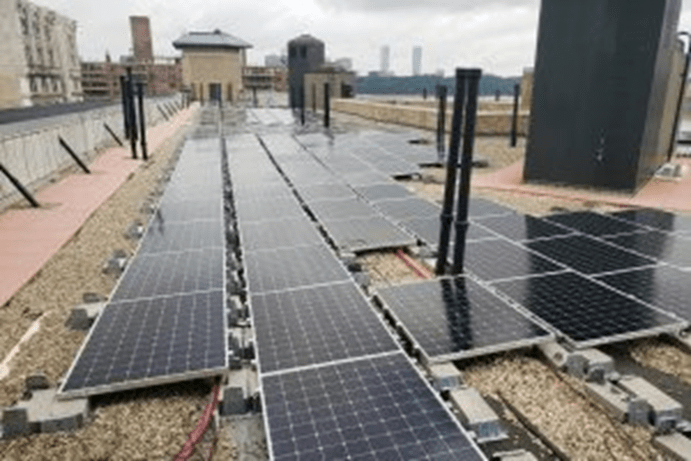
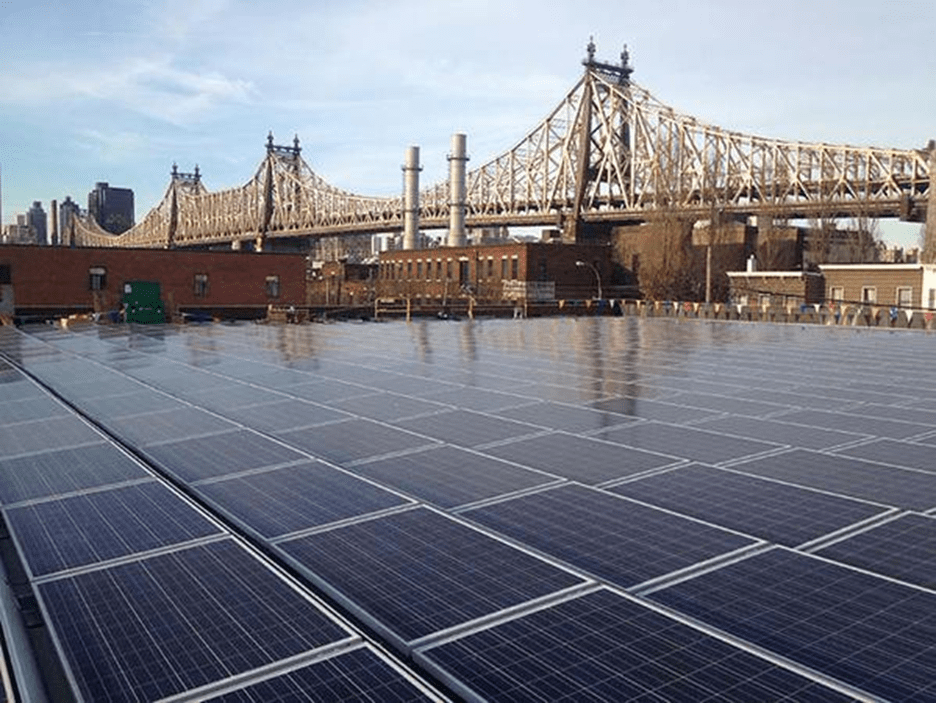
The problem with solar is that it is not expected to provide any energy when the future winter load peaks after the sun has gone down.  Distributed solar has a related problem.  Roof top arrays are commonly used for distributed solar and in New York City many arrays are flat as shown below.

Source: https://www.brightpower.com/new-york-city-solar-co-op/

Source: https://www.gothamgazette.com/authors/130-opinion/5800-new-york-city-can-shine-with-solar-power-leibowitz-richards

Just imagine how these panels will look after a significant snowstorm.  There is no place to put the snow even if it could be cleared.  It is not unusual for the coldest weather and the highest loads to occur after an impactful snowstorm.  In that instance, rooftop solar will not only be unavailable during the peak hour but could be impacted for days after the snowstorm.  Spending more money on distributed solar that will not help address future peak winter loads is a waste.

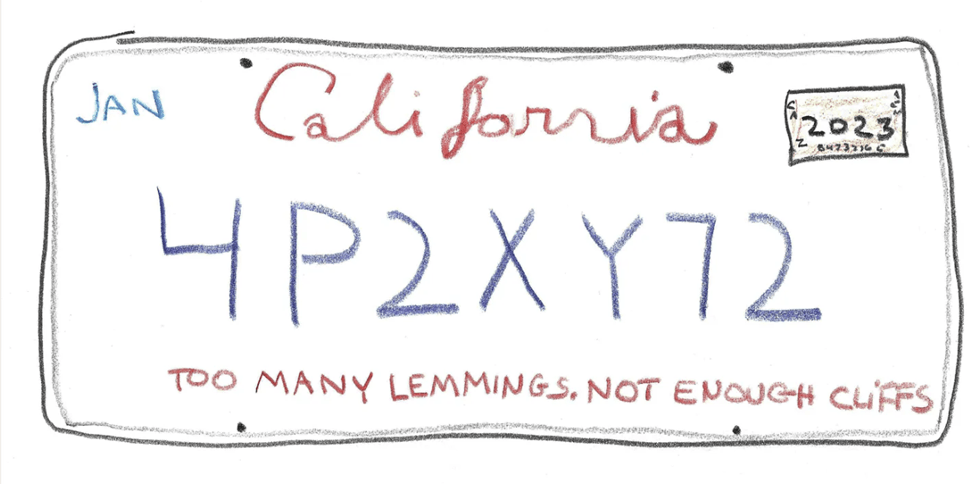
California in one License Plate

The Free Press TGIF edition published this cartoon by David Mamet:

India is Going Gangbusters on Coal

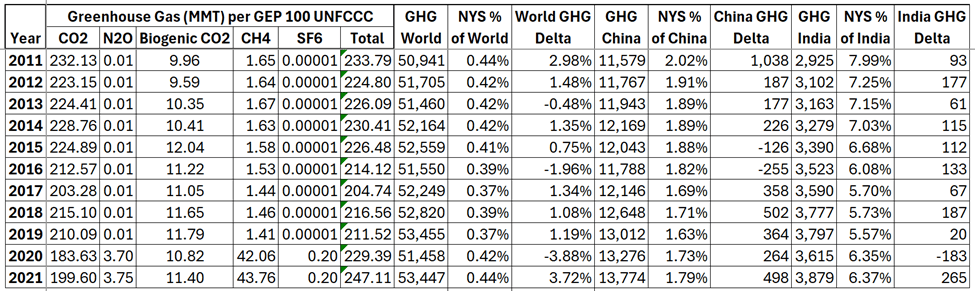
Jo Nova notes that India burns more coal than the US and Europe combined and just ordered $33b in “new coal plants”.  I compared NYS GHG emissions with India and China using data from Our World in Data.  In 2021, NYS GHG emissions (GWP-100) were 247 million metric tonnes (MMT).  GHG emissions from China were 13,774 MMT and from India were 3,879 MMT.  The increase in emission from 2020 to 2021 were 498 MMT in China and 265 MMT in India.  New York emissions will be supplanted by emissions from China or India in less than one year.

Somebody explain to me why New York is doing this again.

Here are a few other items of interest.

Videos

Articles

  • New York City sea-level rise alarmism is misplaced.
  • Reason for 2023 Record Warming Javier Vinós makes the case that the primary reason for the spike in temperatures was natural.  In particular a very rare underwater volcano that injected water vapor into the stratosphere.
  • Chuck Schumer’s ‘Dear Friend’ Invested in Solar as Schumer Secretly Negotiated Climate Bill.  You will never be able to convince me that it is not all about the money.  “More and more, it appears the ‘green’ in much of the green agenda has a lot less to do with the environment than it does with transferring taxpayer funds to preferred special interest bank accounts,” said Michael Chamberlain, the director of government watchdog group Protect the Public’s Trust.
  • Adults take charge: “Chaotic and only occasional wind and solar generation is what you get when infants run the show. Now in a ‘wait til your father gets home’ moment, governments of an adult bent are taking a firm grip on energy policy. Ditching the suicidal renewable energy targets and plumping for nuclear power, principally because it works.”  I love the illustration for the article.

Commentary on Recent Articles

Frequent readers of this blog know that many of my posts are long because I get bogged down documenting my statements.  This is because of my background in industry where it is necessary to prove my arguments to have credibility.  One disadvantage of that is that many articles that get my attention are not mentioned here because of a lack of time.  I tried to address that with a fortnightly update on those articles but am going to try an experiment where I add a little commentary to articles that are of interest on a more frequent basis.

I have been following the Climate Leadership & Community Protection Act (Climate Act) since it was first proposed and most of the articles described below are related to the net-zero transition.  I have devoted a lot of time to the Climate Act because I believe the ambitions for a zero-emissions economy embodied in the Climate Act outstrip available renewable technology such that the net-zero transition will do more harm than good. The opinions expressed in this article do not reflect the position of any of my previous employers or any other company I have been associated with, these comments are mine alone.

Physical Restraints to the Transition

In the Climate Act and elsewhere the strategy is to electrify everything possible.  Many practical issues are overlooked by transition proponents such as the enormous requirements for copper necessary for electric infrastructure to replace fossil fuels.  Substack Penguin Empire Reports explains that “A renewables grid is far more ‘copper hungry’ than a fossil fuel/ nuclear grid for two reasons: The ‘greener the grid,’ the more generators you’ll probably need to produce the same amount of electricity (on average) …multiplied by…. Each renewable generator needs more copper per unit than fossil fuel generators.”

Irinia Slav addresses the copper shortage situation.  Copper prices have gone up because demand is greater than supply.  Why aren’t miner rushing to mine more? Slav describes the “monumental wall of reasons for miners to not be looking for copper growth opportunities and that wall is standing right in the way of trillions in transition investments planned, hoped for, and cherished by politicians, activists and Fatih Birol.”

The Climate Act Scoping Plan cost estimates assume that implementation costs will go down in the future but given the scarcity of the raw materials necessary for the transition is that an appropriate assumption?

Have We Reached Peak Green?

Tom Shepstone highlights German media editorial in Tichys Einblick about the recent European election and the tilt to the right:

Prosperity issues can only be sold to people who can afford a heat pump or an ecological package. For most young people, however, it is clear: they will not retire at 70, they will not buy a house, and they may not be able to support a family – and if they do, their children will grow up in problem areas, in rural wasteland or in an environment of left-wing indoctrination.

Lazard’s Levelized Cost of Energy Estimates

The most common reference for claims that new renewable wind and solar facilities are cheaper than natural gas generators is Lazard’s Levelized Cost of Energy Estimates.  Isaac Orr and Mitch Rolling explain why those claims cook the books.

What Am I Missing Here?

PV magazine notes that New York invests $5 million in agrivoltaics.  They note:

The New York State Energy Research and Development Authority (NYSERDA) announced that $5 million is now available for demonstration projects that co-locate solar and agriculture within the state. Each project can receive up to $750,000. The state aims to expand the body of knowledge on the technical and financial viability of solar agrivoltaic facilities.

Sounds good because the Hochul Administration has still not mandated that utility-scale solar developers meet the NYS Department of Agriculture & Markets (NYSDAM) prime farmland guideline: “The Department’s goal is for projects to limit the conversion of agricultural areas within the Project Areas, to no more than 10% of soils classified by the Department’s NYS Agricultural Land Classification mineral soil groups 1-4, generally Prime Farmland soils, which represent the State’s most productive farmland.”  

Here is what I do not understand:

According to NYSERDA summary documentation, eligible crops, livestock, and livestock products include, but are not limited to:

  • Field crops, including corn, wheat, oats, rye, barley, hay, potatoes and dry beans.
  • Fruits, such as apples, peaches, grapes, cherries and berries.
  • Vegetables, such as tomatoes, snap beans, cabbage, carrots, beets and onions.
  • Horticultural specialties, including nursery stock, ornamental shrubs, ornamental trees, and flowers.
  • Livestock and livestock products, including cattle, sheep, hogs, goats, horses, poultry, ratites (such as ostriches, emus, rheas and kiwis), farmed deer, farmed buffalo, fur bearing animals, wool bearing animals (such as alpacas and llamas), milk, eggs, and furs.
  • Maple sap.
  • Christmas trees derived from a managed Christmas tree operation whether dug for transplanting or cut from the stump.
  • Aquaculture products, including fish, fish products, water plants and shellfish.
  • Woody biomass, which means short rotation woody crops raised for bioenergy, and does not include farm woodland.
  • Apiary products, including honey, beeswax, royal jelly, bee pollen, propolis, package bees, nucs and queens. “Nucs” are defined as small honeybee colonies created from larger colonies, including the nuc box – a smaller version of a beehive, designed to hold up to five frames from an existing colony.
  • Actively managed log-grown woodland mushrooms.
  • Industrial hemp as defined in Section 505.

Eligible crops include apples, peaches, cherries, maple trees, and Christmas trees?  Trees will shade solar panels.  So, this approach is inconsistent with my understanding that the intent of agrivoltaics was to use the farmland within the solar panels to try to make up for the loss of the productive farmland.  The intent of the NYSDAM guideline won’t be addressed either.  So what am I missing?