

New York’s energy planning process continues its efforts to meet the aggressive goals of a remodeled energy system that relies on renewable energy. The latest boondoggle in that effort is a plan to price carbon in the wholesale electric market. I have not been able to let that go by without throwing in my two cents so this post describes my second submittal in the formal proceeding. I have been submitting my comments because I am convinced that all these efforts will cost extraordinary amounts of money but will have no discernable impact on global warming or any of the purported effects.
As part of the release of Pricing Carbon into NYISO’s Wholesale Energy Market to Support New York’s Decarbonization Goals (hereinafter the “Brattle Report”) there was an introduction authored by Brad Jones, President & CEO of the New York Independent System Operator (NYISO) and John Rhodes, Chief Executive Officer of the New York State Department of Public Service (DPS). The introduction described the rationale for the report:
In this regard, the NYISO began a project through its stakeholder process in the fall of 2016 to examine the potential for using carbon pricing within wholesale markets to further New York’s energy goals. Initially, The Brattle Group was retained by the NYISO to evaluate conceptual market design options for integrating the social cost of carbon, a widely recognized regulatory standard, into competitive wholesale energy markets administered by the NYISO. That analysis explored how carbon pricing can align wholesale markets with state energy policies and looked at several factors, including the effect on customer costs and emissions reductions.
The Executive Summary of the Brattle Report notes that “Harmonizing state goals and the operation of wholesale electricity markets could leverage market forces to more efficiently meet both state goals and traditional electric system goals of providing affordable, reliable supply.” This statement makes for a nice slogan, but the reality is different. In this post I show that there are barely enough electric sector emissions available to meet the 2030 goal and nowhere near enough for the 2050 goal. Because the proposed carbon price is on only one sector of the economy, the theory that increasing the price of carbon will drive the market to less carbon intensive alternatives fails. Instead, driving up the price of electricity makes the conversion to electric based residential heating and transportation more difficult. I consider these fatal flaws to the proposed initiative.
The Reforming the Energy Vision (REV) state energy goals in 2030 are a 40% reduction in Greenhouse Gas (GHG) emissions from 1990 levels and a 50% renewable generation. In 2050 the goal is an 80% Reduction in GHG emissions from 1990 levels. The NYSERDA Patterns and Trends document notes that the 1990 Carbon Dioxide equivalent (CO2e, standing in for GHG) emissions were 235.8 million metric tons so the 2030 goal is 141.5 million metric tons or a 94.3 million ton reduction. In 2050 the goal is 47.2 million metric tons which is a 188.7 million metric ton reduction.
Figure 1 shows the trends in New York State CO2e emissions, energy (TBtu) and CO2e intensity which is the emissions divided by the energy. Note that the energy used in New York rose until 2005 and has since started to drop while the pattern of CO2e has ebbed and flowed more but has also dropped since 2005. The question is whether pricing carbon in the electric sector can affect these trends to meet the state goals. In order to do that we have to look at what drove the trends.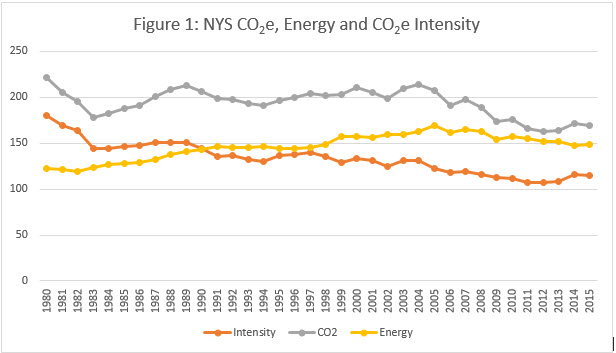
In order to reduce GHG emissions there are three direct approaches:
- Replace energy sources that generate GHGs with ones that don’t
- Energy efficiency – use energy more effectively
- Energy conservation – use less energy
In addition there are a couple of indirect ways: reduce the population and reduce the gross state product or economic growth. I mention those two methods to point out that neither approach is politically palatable as an approach to reduce GHG emissions and that historically the gross state product has increased and population has stayed relatively constant.
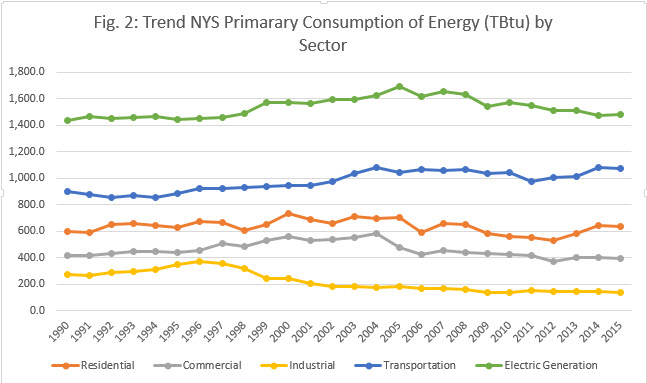
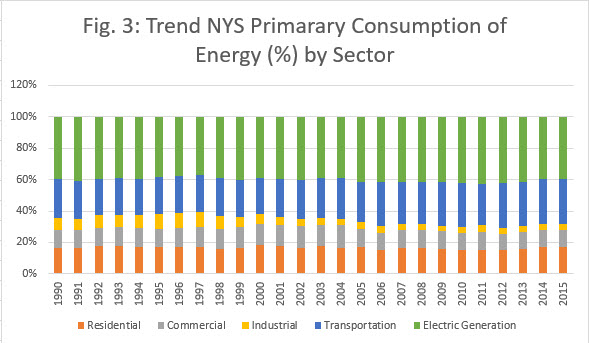
The NYSERDA Patterns and Trends document contains the energy and emissions data by sector needed to evaluate the causes of the observed reductions. Figures 2 and 3 show the trend of primary energy consumption by the residential, commercial, industrial, transportation and electric energy production sectors by total energy use (TBtu) and % of total. Residential has bounced around but is effectively the same since 1080 and the commercial sector trended up but has trended down to roughly the same levels as 1990. Given the growth in the economy it appears it appears to me that investments in conservation and efficiency have produced some results. The most notable decrease has been the industrial sector, down over 200 TBtu since 1980. While efficiency and conservation have helped with that it is more likely a result of the decline of the industrial sector in New York. Transportation energy use has grown consistently since the mid-80’s. The electricity sector grew until approximately 2005 and has since dropped. It does not appear on the basis of historic trends that energy conservation and energy efficiency will be major factors for compliance with the emissions goals.
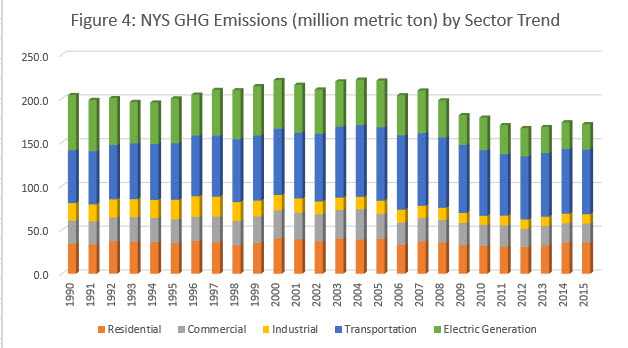
That leaves carbon emission reductions to make the majority of the reductions necessary. Figures 4 and 5 show the trend of GHG emissions by the residential, commercial, industrial, transportation and electric energy production sectors and % of total. Note that these are emissions from fuel combustion only so the totals are not the same as shown before. The emissions trends for residential, commercial, industrial and transportation sectors are similar to the energy trends. Residential and commercial are roughly the same, industrial is down, and transportation is up. Electricity sector emissions are down more than the total energy. This is the only sector the proposed price on carbon will affect.

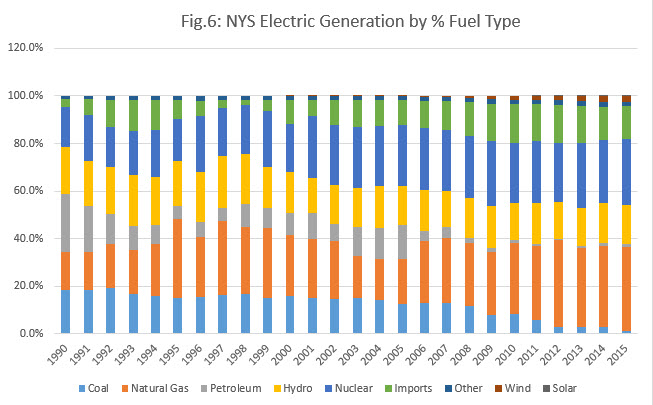
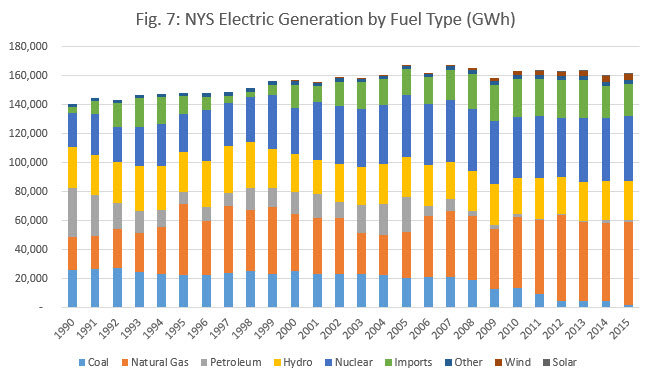
Because the electric generation sector is the only sector that will be affected by the proposed carbon price we need to evaluate the sources of electricity generated in New York. Figure 6 shows the percentage of electricity provided by different sources: coal, natural gas, petroleum (residual oil and distillate), hydro, nuclear, imports, other (landfill gas & biomass), wind and solar. Coal and petroleum have gone down significantly since 1990. Natural gas has increased significantly as has imports. After Nine Mile Point unit 2 came on-line nuclear has stayed about the same as has hydro. In the past few years enough solar and wind have come on line to appear on the chart. Figure 7 shows the total energy provided by the same categories. Clearly the biggest changes have been the reduction of coal and petroleum fuel use and increase of natural gas and imports.
In order to determine how much the carbon pricing program can directly affect CO2e emissions we need to look at the electric sector emissions relative to emissions from the rest of New York State. Figure 8 shows the trends and Table 1 NYS Trend of CO2 by electric sector and rest of state shows the data. Statewide coal and electric sector oil have gone down 55 million metric tons but since 1990 natural gas has gone up. It can be argued that for the most part the major decreases in coal and oil were the result of changes in the relative cost of fuel and had nothing to do with New York State policy. Moreover, the State has drafted regulations to eliminate the use of coal so carbon pricing will have no effect on those emission and there are only 3.9 million metric tons of reduction available anyway. With respect to electric sector emissions, no further oil use reductions are expected because the current levels represent the minimum emissions necessary to maintain oil as a backup and emergency use fuel. That leaves natural gas emissions.
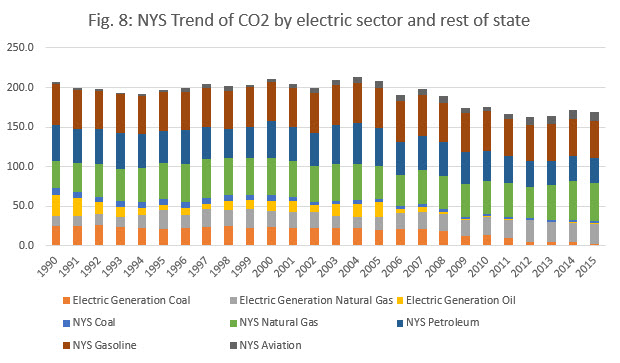
Overall, the total emissions in 2015 are only down 18% to 169.5 million metric tons and the 2030 target is 141.5 million metric tons so further reductions of 28 million metric tons are necessary. Putting a price on electric sector carbon could, in theory, reduce the total sector emissions of 29.2 million metric tons. However, the primary way to reduce emissions from the other sectors is to replace fuel combustion with electricity. The unintended consequence of the carbon price then will be to increase the price of electricity making those conversions less attractive.
On one hand carbon pricing is touted as a market-based solution to carbon reductions. However, that only works when the tax is applied to the entire economy. The proposed New York carbon pricing approach is only for the electric generation sector, so market intervention will be required to subsidize the electrification conversions necessary to meet the targets if only because the proposal increases the cost of electricity making conversions less attractive. As soon as that happens the elegant market-based solution devolves into special interest lobbying at the expense of the general public.
Already labor unions, community groups, environmental organizations, faith communities, and environmental justice advocates are supporting just such a carbon tax scheme. While the New York State Climate and Community Protection Act (CCPA) (S.8005 / A.10342) covers all sectors it specifically proposes to not only return the revenues to ratepayers but also includes subsidies to renewable energy sources in general and targeted subsidies as well and worker and community support.
While the intent of carbon pricing to harmonize state goals and the operation of wholesale electricity markets to leverage market forces to more efficiently meet both state goals and traditional electric system goals of providing affordable, reliable supply makes for a nice slogan the reality is different. There are barely enough electric sector emissions available to meet the 2030 goal and nowhere near enough for the 2050 goal. Because the proposed carbon price is on only one sector of the economy, the theory that increasing the price of carbon will drive the market to less carbon intensive alternatives fails. Instead, it drives up the price of electricity which makes the conversion to electric-based residential heating and transportation more difficult.
 Pragmatic Environmentalist of New York