Climate Leadership and Community Protection Act Power Generation Advisory Panel Strategies Comment

The Climate Leadership and Community Protection Act (CLCPA) became effective on January 1, 2020 and establishes targets for decreasing greenhouse gas emissions, increasing renewable electricity production, and improving energy efficiency.  The law mandated the formation of the Climate Action Council to prepare a scoping plan to outline strategies to meet the targets.  This is one of a series of posts describing aspects of that process.  This post is my reaction to the Power Generation Advisory Panel’s initial strategies.

I am very concerned about the impacts of the Climate Leadership and Community Protection Act (CLCPA) on energy system reliability and affordability.  There are very few advocates for the typical citizen of New York who has very little idea about the implications of the CLCPA on energy costs and personal choices. I am a retired electric utility meteorologist with nearly 40-years-experience analyzing the effects of meteorology on electric operations. I believe that gives me a relatively unique background to consider the potential quantitative effects of energy policies based on doing something about climate change.  The opinions expressed in this post do not reflect the position of any of my previous employers or any other company I have been associated with, these comments are mine alone.

Power Generation Strategy Comments

I am disappointed by this panel’s strategies.  Arguably the strategies from this panel are the most important because a basic tenet of decarbonization is electrification of everything.  If the proposed strategies are not realistic then everything else fails.  I have no seen no sign that there is sufficient focus on strategies that address reliability and affordability of a completely transformed electric sector.

In a post on the peaking power plant problem in New York City I included a section on public policy concerns.  I have previously described how the precautionary principle is driving the CLCPA based on the work of David Zaruk, an EU risk and science communications specialist, and author of the Risk Monger blog.  In a recent post, part of a series on the Western leadership’s response to the COVID-19 crisis, he described the current state of policy leadership that is apropos to this panel.  He explains that managing policy has become more about managing public expectations with consultations and citizen panels driving decisions than trying to solve problems.  He says now we have “millennial militants preaching purpose from the policy pulpit, listening to a closed group of activists and virtue signaling sustainability ideologues in narrowly restricted consultation channels”.  That is exactly what is happening on this panel in particular.  Facts and strategic vision were not core competences for the panel members.  Instead of what they know, their membership was determined by who they know.  The social justice concerns of many, including the most vocal, are more important than affordable and reliable power.  The emphasis on the risks of environmental justice impacts from the power generation sector is detracting from the need to develop a scoping plan that ensures affordable and reliable electricity.

It is not clear that the members even understand the enormity of the challenge.  I used the panel’s email address for public comments last October to suggest a workshop to explain how energy systems work and quantify how much energy is needed and where to provide reliable power to give the panel members a common basis.  I even included an overview of the energy system to show why the workshop is needed.  There is no sign that anyone on the panel is aware of my comments and there hasn’t been a workshop.  I naively believed that that the deep decarbonization workshop would address this need.  Unfortunately, the workshop did not provide any discussion of the reliability challenges.  Instead, the workshop mostly reinforced the notion that CLCPA targets will be met because of the political will of the State.  Long-duration energy storage is the key need and a presentation on that was useful but it did not address the availability or applicability to New York so it is not clear if there is a viable solution to this critical requirement in the timeframe needed.  The keynote, hydrogen, and carbon sequestration presentations all sound great superficially but no context relative to New York needs was given and they all have serious technological or implementation issues.

The panel organized itself into four sub-groups: equity, barriers, solutions for the future, and resource mix.  They presented ten strategies in the presentation to the Climate Action Council.  I address their strategies below.

The equity sub-group presented three strategies.  I don’t think these should be stand-alone strategies.  Instead, these concerns should be incorporated into strategies for the transition similar to how equity considerations were handled by all the other panels.

The first strategy addressed community Impact suggesting the development of recommendations to identify and proactively address community impacts relating to health concerns, access to renewables and energy efficiency, and siting.  Four equity concerns are described:

        • Reduce disproportionate impacts in overburdened communities (e.g. the operation of high emission power generation facilities result in significant health concerns for neighboring communities)
        • Consider means for increasing access to energy efficiency, solar, and community distributed generation projects to specifically assist disadvantaged communities
        • The siting of renewable projects and their potential impact on local communities both in the short and long term, particularly in rural areas
        • The impacts on communities (e.g. jobs, revenues, etc.) where energy facilities are being retired

The operation of high emission power generation facilities refers to peaking power plants which has become a rallying topic for environmental justice advocates.  Its inclusion confirms my suspicions that panel members need to be provided background information because there are some basic misunderstandings. I prepared and submitted a comment to powergenpanel@dps.ny.gov explaining that the presumption that these peaker plants are contributing to local health impacts because of ozone and particulate matter impacts is simply a wrong premise.  I described another problem in another comment that explained that there is a mis-understanding which New York City power plants are for peaking purposes and which ones are used for other services.

Considering means to increase energy efficiency, solar, and community distributed generation projects to specifically assist disadvantaged communities is also problematic.  This is a power generation strategy so energy efficiency is a different panel’s concern.  In my opinion if this is included then this approach for peaking power should have been a stand-alone strategy. The rationale is to provide equity but in order to do that there are technological challenges that have to be addressed.  There are so many challenges that it deserves its own focus but the naïve under-estimation of the challenges emphasized the goal itself over the implementation effort needed.  The remaining two equity concerns are non-controversial and could have been easily incorporated into other implementation strategies as necessary.

The second strategy is “Access and Affordability for all (Enabling) –Develop recommendations to ensure New Yorkers have access and can afford to participate meaningfully in NYS’s clean energy future”.  Inherent in this strategy is the belief that people want to be able to access clean energy presumably by participating in a community project if they cannot install solar panels at home.  Forgotten is the fact that ratepayers have had the opportunity to purchase “green” energy for years but that subscription to those offerings has always been low.  Overlooked is the fact that if participating means lower prices for participation in specific programs it also means that everyone not participating in those kinds of programs is footing the bill for everyone who does.  As long as there are any people with already unacceptable energy burdens this strategy may do more harm than good.

The final strategy from this subgroup is “Workforce Development (Enabling) –Develop recommendations to enable an equitable clean energy workforce”.  Again, this clearly is more appropriate as an equity concern in implementing strategies rather than as a stand-alone strategy.

The Barriers sub-group presented two strategies both of which should get higher priority than suggested by the presentation:

        • Clean Energy Siting
        • Energy Delivery & Hosting Capacity

Because the primary decarbonization strategy is electrification, clean energy siting is a primary consideration.  This sub-group listed eight issues to explore:

        • Optimizing new transmission builds
        • Collocated storage with renewable energy projects
        • Correctly designing clear and transparent price signals for both energy and interconnection costs
        • How to properly track progress and make course corrections as process progresses
        • Provide standardized property tax assessments for renewable projects
        • Encouraging more robust host community and PILOT plans to increase benefits for community members
        • Explore reducing timeframe and restrictions for siting on brownfields and unused industrial land
        • Siting projects closer to end user areas

The first four issues are fundamental implementation issues.  Because wind and solar energy is diffuse, transmission has to be developed to get it where it is needed.  Because wind and solar energy is intermittent, it is not dispatchable and energy storage is needed to get it when it is needed.  New York’s electricity system is de-regulated so the market will dictate whether these resources are developed.  The ambitious schedule of the CLCPA targets means that tracking progress is a fundamental requirement to achieve those targets.  I agree with them all.  The remaining four issues are less important because they address comparatively minor implementation concerns.

Energy delivery and hosting capacity is another primary consideration.  The sub-group listed six issues to consider:

        • Upgrading aging infrastructure and optimizing the location and operation of new transmission projects, including transmission of off-shore wind, and removing regulatory barriers that make optimization difficult
        • Upgrading the transmission system to be able to host more distributed energy resources
        • Easing interconnections on both the bulk and distribution levels
        • Energy delivery extends beyond transmission to include storage, especially as the saturation of intermittent resources increases
        • How should the economic tradeoff between new transmission, energy curtailment, and energy storage be considered
        • How to properly track progress and make course corrections as needed

All of these are fundamental consideration issues.  There is one glaring omission however.  Wind and solar energy produce asynchronous generation but the transmission grid is synchronous.  The need for ancillary services to provide that support must be included.

Solutions for the future addresses the fact that implementation of the CLCPA targets is pushing the limits of technological capabilities. Unfortunately I believe that is contrary to the presumption of many that meeting the goals is only a matter of political will.  Two issues were raised:

        • Technology and Research Needs
        • Market Solutions –Maximize the market participation of different technologies in a way that adds to system efficiency & send correct price signals to resources over time

The rational for technology and research noted that:

        • Adoption of new technology to enable CLCPA goals must be integrated with more traditional investments for continued safe and reliable operation of the grid
        • Timeframes for adoption of new technology on the electric grid must be accelerated from the typical timeline of 5+ years from initial commercial product availability to deployment at scale

Unfortunately, reality as expressed as a potential implementation challenge is that “demonstration and validation of technology frequently requires large scale projects in real world use cases that are both costly and require coordination of many entities.”  Clearly there is need for a feasibility study to determine what can be counted on from existing technology and what new technology is needed either for feasibility or affordability.  Last year the International Energy Agency (IEA) published “Special Report on Clean Energy Innovation” that concludes that innovation is necessary for jurisdictions to fulfill their de-carbonization targets.  The Energy Transition Plan Clean Energy Technology Guide summarizes 400 component technologies and identifies their stage of readiness for the market.  It should be used in a feasibility study to rate the potential availability of any technology proposed.

The other issue of market solutions should be a big concern.  New York’s electricity system is de-regulated so the market is expected to provide the necessary resources.  However, uncertainty is a problematic issue with investors.  As a result, new technology may require guarantees for market investors to provide the support that market advocates believe will appear.

The resource mix subgroup presented three strategies:

        • Growth of renewable generation and Energy Efficiency
        • Effectively Transitioning away from Fossil Fuel Energy Generation
        • Deploying Energy Storage and Distributed Energy Resources (DERs)

The rational for the first strategy sums up the basis for my concerns very well:

“The CLCPA requires 70% renewable electricity by 2030 and 100% carbon free electricity by 2040. We anticipate demand growth of 65% to 80%, dependent on the scale and timing of electrification and whether there are clean alternatives for transportation and buildings, such as bioenergy. The level of electrification needed to achieve GHG reduction goals will increase overall electric load and shift the system peak from summer to winter. There remains a large amount of renewables that must be procured and developed to reach the goals and NYS needs to incorporate flexibility and controllability as we electrify these sectors in order to create a more manageable system.”

As noted before, a feasibility study for the technology is needed. A primary prerequisite is an official estimate of the projected loads when other sectors are electrified.   However, I have an even more basic feasibility concern. As a party to the Department of Public Services (DPS) resource adequacy matters proceeding, docket Case 19-E-0530, I have submitted comments (described here and here) based on my background as a meteorologist who has lived in and studied the lake-effect weather region of Central New York.  Both E3 and the Analysis Group have done studies of the weather conditions that affect solar and wind resource availability in New York.  However, to my knowledge (neither consultant has ever responded to my question on this topic), they have not considered the joint frequency distribution of wind and solar or used solar irradiance data from the NYS Mesonet. In my opinion, both parameters have to be considered together and using airport data or models for cloud cover are inadequate.  The Mesonet data set is the only way to have information that adequately represents the local variations in cloud cover caused by the Great Lakes.  In order to adequately determine the combined availability of wind and solar I recommend using that data set for the renewable resource availability feasibility study.

The second strategy, “Effectively Transitioning away from Fossil Fuel Energy Generation” could be used as the outline for all the strategies of the panel.  The rationale states: “As renewable penetration increases, how do we transition away from fossil fuels while maintaining reliability and safety standards?”  The normal convention for priority ranking is to put the most important issues first in the presentation.  It is discomforting that this is placed ninth of the ten strategies.  It brings up the question just what are the priorities of this panel if reliability and safety concerns are ranked so low?

The final strategy from this workgroup was “Deploying Energy Storage and Distributed Energy Resources (DERs)”.  In my opinion, there was insufficient emphasis on technological feasibility in the discussion of energy storage in this strategy.  As mentioned earlier, a major shortcoming in these strategies is the lack of any mention of the need for transmission ancillary services.  There is recognition that long duration storage will be needed but the fact that the few large battery systems currently deployed are being used for ancillary services and not storage is an obvious barrier that has not been included.  Another concern I have with this strategy is that the definition of DER has changed to exclude distributed generation using fossil fuels.  Has anyone thought to ask the hospitals with DER systems whether they can put up with the limitations of renewable DERS for their obviously critical need for constant electric power?  An ice storm that knocks power off for days will quickly over-tax the capabilities of any renewable and energy storage system to keep a hospital running.

Missing Points

I have mentioned previously that the major missing point in these strategies is that ancillary services are not mentioned.  Someone, somewhere has to address the frequency control and reactive power needs of the grid.  Obviously, that has to be included in the strategies.  It goes beyond simply adding it to a strategy because it is not clear how those services can be incorporated into the market signal to provide them.  For example, there are advocates for a carbon price on electricity generation.  In this approach any generator that emits CO2 will have to include a carbon price in their bid which serves to provide the non-emitting generators with more revenue.  However, solar and wind generators are not paying the full cost to get the power from the generator to consumers when and where it is needed.  Because solar and wind are intermittent, as renewables become a larger share of electric production energy storage now provided by traditional generating sources will be needed but there is no carbon price revenue stream for that resource.  Because solar and wind are diffuse, transmission resources are needed but solar and wind do not directly provide grid services like traditional electric generating stations.  Energy storage systems could provide that support but they are not subsidized by the increased cost to emitting generators.  When the carbon pricing proposal simply increases the cost of the energy generated, I think that approach will lead to cost shifting where the total costs of fossil fuel alternatives have to be directly or indirectly subsidized by the public.  This result is not in the best interests of low-income ratepayers.

Funding and affordability considerations received short shrift from this panel.  In light of the fact that the New York Independent System Operator has proposed a carbon pricing initiative for the electric sector it would seem that a strategy to address that approach or something else should be included.  There is another aspect of affordability that should also be addressed.  The Department of Environmental Conservation recently released its guidance on the value of carbon.  Because the electric sector has documented control costs, this panel should include a strategy to determine if the marginal abatement cost approach should be used for recommendations to the Climate Action Council.

Conclusion

This was the only panel that included specific strategies to address environmental justice concerns.  All the other panels incorporated those concerns within their strategies and it would have been appropriate to do the same here.  It appears that the idealogues on this panel are more concerned about those concerns than affordability and reliability.  In my opinion those should be the primary concerns of this panel because those factors will impact the disadvantaged people of New York the most.

Because of the importance of power generation to the electrification needed to reduce GHG emissions in all sectors, this panel should focus its attention on the challenges of a transition to an electric system that is dependent upon wind and solar resources.  I recommend that strategies include a feasibility study of technology needed for the transition, a resource availability study and a cumulative environmental impact analysis.  Until this feasibility studies are complete any strategies are simply guessing and the absence of a cumulative environmental impact assessment could mean that the impacts from the cure are worse than impacts from the disease.

 

Climate Leadership and Community Protection Act Energy Efficiency and Housing Advisory Panel Strategy Comments

The Climate Leadership and Community Protection Act (CLCPA) became effective on January 1, 2020 and establishes targets for decreasing greenhouse gas emissions, increasing renewable electricity production, and improving energy efficiency.  The law mandated the formation of the Climate Action Council to prepare a scoping plan to outline strategies to meet the targets.  This is one of a series of posts describing aspects of that process.  This post is my reaction to the Energy Efficiency and Housing Advisory Panel’s initial strategies.

I am very concerned about the impacts of the Climate Leadership and Community Protection Act (CLCPA) on energy system reliability and affordability.  There are very few advocates for the typical citizen of New York who has very little idea about the implications of the CLCPA on energy costs and personal choices. I am a retired electric utility meteorologist with nearly 40-years-experience analyzing the effects of meteorology on electric operations. I believe that gives me a relatively unique background to consider the potential quantitative effects of energy policies based on doing something about climate change.  The opinions expressed in this post do not reflect the position of any of my previous employers or any other company I have been associated with, these comments are mine alone.

 General Comments

I believe that the primary consideration of any implementation strategy should be affordability and reliability for the energy system of New York.  Energy use is largely inelastic so increased energy costs are hidden regressive taxes.  Our society needs dependable energy so current reliability standards must be maintained.  In general, each strategy must address potential costs and who would pay, whether there are co-benefits that would offset costs, any impacts on energy reliability, the feasibility of the proposed action, and the GHG reduction potential.

I believe that the CLCPA implementation strategies should consider cumulative environmental impacts of the renewable energy development proposed.  As far as I can tell the only related environmental impact analysis was the Department of Public Service (DPS) Final Generic Environmental Impact Statement and the Final Supplemental Environmental Impact Statement for CASE 14-M-0101 – Reforming the Energy Vision and six other cases.  The supplemental impact statement evaluated the potential environmental impacts of the Clean Energy Standard mandating that 50% of all electricity consumed in New York by 2030 be supplied by renewable resources.  Of course, the CLCPA upped the ante and now 60% of all electricity of all electricity must be supplied by renewable resources by 2030.  The important point is that the amounts and types of new renewable generation that may be needed to meet the CLCPA goals are much larger than anything evaluated by the State to date.   The supplemental impact statement evaluated a base case large scale renewable on-shore wind increment of approximately 29,000 GWh (9,508 MW) and a high-end case of approximately 40,000 GWh (14,504 MW) of large-scale on-shore wind energy would be necessary to meet the goal.  The Analysis Group “Climate Change Impact Phase II – An Assessment of Climate Change Impacts on Power System Reliability in New York State” draft final report released in October 2020 projected that New York would have to develop all of the projected National Renewable Energy Lab’s technical potential on-shore wind capability of 35,200 MW – three times what has been evaluated.  Similarly, no one has evaluated the environmental impact of the latest estimates of utility-scale solar and off-shore wind.

I have a general concern about the CLCPA mandates for investments.  It is entirely appropriate that there should be an emphasis on environmental and social justice but I have concerns about the State’s approach.  Given that all other jurisdictions that have attempted to reduce GHG emissions have increased the cost of energy, it is likely that will be the case in New York too.  I think strategies have to consider cost-effectiveness to reduce the regressive impact on those who can least afford those increased costs, regardless of location, who are living in energy poverty or already have a disproportionate energy burden.  This means that strategies that do not reduce costs or have low GHG reduction potential should be ranked very low for future consideration.

Comments on Proposed Strategies

The Energy Efficiency and Housing Advisory Panel had 16 strategies in five scoping categories.

The first scope was titled as “Mandates that require energy efficiency improvements and on-site emissions in building and appliance with dates as market signal” and included two strategies:

      • Expand State energy & building codes (with date signals) to drive the transition to electrification & building efficiency and
      • Modify State Appliance Standards (for example, ban fossil fuel appliances sales and installations). Consider building performance standards for large buildings to meet 2050 and interim targets with a focus on onsite emissions.

I don’t think the public is going to be willing to make the sacrifices called for in these strategies.  It would be best for all concerned to get out there with publicity now to gauge acceptability.  There are all sorts of issues. For starters, how will house trailers be considered.  For the rural poor this is often all they can afford and it is simply not possible to improve energy efficiency much.   There also is an implementation issue associated with housing sector date-certain efficiency standards.  What happens to someone trying to sell an old house after the certain date. Presumably, they will be on the hook to spend whatever is needed to get up to the efficiency standard to be able to sell and that means losing a big chunk of equity in their home or the house is priced out of the market and they cannot sell the house.

Three strategies were listed in the “Financing and incentives for building efficiency and electrification at scale” scope:

        • Inducing market/behavioral change (e.g., taxes, registration fees, carbon levies) that incentivize market providers (owners, developers, lenders etc.) and residents to reduce emissions and transition to electrification;
        • Shift lenders to quantify energy efficiency in single/multifamily/commercial (e.g. underwriting to savings); and
        • Financial incentives for owners, developers and residents (e.g. cash incentives, pay as you save, low-interest financing, more agile of existing programs to get to 2050 and interim targets, etc.), with emphasis on low and middle income owners.

The biggest hurdle for these strategies is cost.  In many instances the capital cost of the electric option is more expensive than the fossil fuel option.  Moreover, I see absolutely no reason to expect that the cost of electricity will go down because that has not been the case in any jurisdiction that has attempted to meet GHG reduction targets.  I also have reservations about taxes, registration fees or carbon levies and the proposed emphasis on disadvantaged communities.  In the first place the requirement for targeted investment benefits may have the perverse effect of increasing the overall cost of energy because those investments may not be the most cost-effective approaches to reducing CO2 emissions.  If that is the case then anyone who is not a direct beneficiary of financial incentive benefits is going to be hurt. The Climate Action Council needs to track energy poverty or energy burden and the effect of these policies on those who can least afford additional energy costs so that no one (whether or not they are in a dis-advantaged community) is literally left out in the cold.

The third scope was called “Training and education of building decarbonization to improve behavior and operations for health and comfort and build workforce (enabling strategy)”.  Three strategies were included:

        • Workforce development to provide skilled professionals to design, build, operate, & enforce decarbonized building stock;
        • Education -owners, developers, design professionals and other stakeholders: resources on capital planning, all-electric buildings, electrification-ready, etc. Mandatory energy performance disclosures and building consumption data (public facing); certified product declarations for materials/equipment; and
        • Education-residents/businesses: performance, economics., environmental quality, operation and maintenance for low-carbon technologies.

Clearly, we need to train professionals to design, build, and operate the decarbonized building stock but what is the meaning of enforce decarbonized building stock? When proposing building decarbonization strategies you have to prove that decarbonization will be affordable, maintain current levels of reliability, not lead to unintended environmental consequences that exceed the alleged impacts of climate change in New York, and actually have some sort of quantifiable effect on climate change.

The “Technology innovation and demonstration to drive better performance, reduce costs, and increase customer confidence” scope had four strategies:

      • Research and development to improve cost/performance of solutions for all-electric buildings (e.g., cold climate heat pumps, geothermal, etc.);
      • Research, development, and demonstration for hard-to-electrify buildings (e.g., on district steam, steam-heated, hydronic distribution) and advance scalable solutions and potential cost reductions (e.g., community geothermal, industrialized fabric/modular, virtual tools);
      • De-risking demonstrations to help critical customer groups who may lack access to resources and information (e.g., coops/condos); and
      • Approaches to reducing embodied carbon (e.g., new tech to reduce GHG emissions from materials/construction/transportation).

The American Council for an Energy-Efficient Economy published a paper that raises issues with air source heat pumps:  Field Assessment of Cold Climate Air Source Heat Pumps.  The 2016 report describes a Center for Energy and Environment field study in Minnesota where cold climate air source heat pumps (ccASHPs ) were directly compared to propane and heating oil furnaces.  The study found these systems have the greatest potential for adoption in cold-climate regions where natural gas is not available for space heating; ccASHPs can offset the use of more expensive delivered fuels, and for homes with electric resistance heat, can result in a significant reduction in electrical use; that it is feasible for a utility energy efficiency program to receive credit for the energy savings achieved from ccASHPs through the reduction in fuel oil and propane;  and that during periods of very cold temperatures when ccASHPS do not have adequate capacity to meet heating load, a furnace or electric resistant heat can be used as backup.  These conclusions are not compatible with the CLCPA targets.

In addition to the feasibility of wide-spread use in New York there is another issue.  I did a simple case study that illustrates my concern that wide-spread implementation of air source heat pumps coupled with increased use of renewables will be difficult.  In my analysis the meteorological conditions on New Year’s Eve 2018 show that the proposed Horseshoe solar facility with a nameplate capacity of 180 MW and a wind farm with a nameplate capacity of 100 MW would have been just able to cover the conversion of 2,737 homes to air source heat pumps.  However, energy storage capable of at least 372 MW-hr also has to be available somewhere.  There already are 47,000 homes using electricity and another 15,000 homes that are supposed to be cost-effective candidates for conversion just in two neighboring counties to the facility.  Most importantly, this is just one component of residential electricity load which is one component of total load.

The strategies proposed by this Advisory Panel are appropriate but the details should make it clear that a similar study in New York on the latest air source heat pumps is required.  That should be coupled with an assessment of the renewable energy resources.  It is not clear to me that it is possible to meet the multi-day winter doldrum period while relying on wind and solar.  Analysis of the data shows that no amount of over-building solves this problem.  Extraordinary amounts of storage are needed.  In order to determine just how much of energy storage will be required much better estimates of the load expected for electrifying homes and transportation are needed.

The final scope “Resilience and climate adaptation strategies for all-electric building, hazard mitigation planning and building retrofits” had four strategies.

      • Supporting/coordinating improved resiliency solutions for all-electric building & resilient spaces for vulnerable pops.;
      • Grid and transmission resilience and independence;
      • Electrification paired with supplemental heating sources;
      • Improving building stock to withstand the impacts of climate change.

Resiliency is a buzz word employed to suggest that these policies will be improvements to systems so that they can better recover from difficult events.  What are the resiliency solutions for all-electric buildings when there is an ice storm?  According to Wikipedia (https://en.wikipedia.org/wiki/January_1998_North_American_ice_storm): “The North American Ice Storm of 1998 (also known as Great Ice Storm of 1998) was a massive combination of five smaller successive ice storms in January 1998 that struck a relatively narrow swath of land from eastern Ontario to southern Quebec, New Brunswick and Nova Scotia in Canada, and bordering areas from northern New York to central Maine in the United States. It caused massive damage to trees and electrical infrastructure all over the area, leading to widespread long-term power outages. Millions were left in the dark for periods varying from days to several weeks, and in some instances, months.  The only way those people survived is because they had alternatives to electricity.  When electricity is the only option available then what?

Conclusion

I maintain that the fundamental problem with the CLCPA is the lack of a feasibility study.  It is not clear to me that the ultimate problem of trying to supply the energy needs of a mostly electrified New York electric energy system will work during a multi-day winter doldrum if the primary sources of electricity are wind and solar.  The only way this might work will require extraordinary amounts of energy storage, wind, and solar development.  When there is an “official” estimate of those resources clearly a cumulative environmental impact analysis for those resources should be completed as soon as possible.

From what I have heard the consensus opinion on the advisory panels is that air source heat pumps are an unqualified solution to residential heating.  The Minnesota field study suggests otherwise.  It would be appropriate for the panel to include a strategy for New York to replicate that study to prove that this solution will work here. In addition, a strategy to assess the potential impacts to society when the inevitable next severe ice storm occurs should be included.


Climate Leadership and Community Protection Act Con Ed Peaking Power Plant Solution

On January 11, 2021 the Climate Leadership and Community Protection Act Power (CLCPA) Generation Advisory Panel met as part of the Climate Action Council Scoping Plan development process.  The meeting tested a consensus building process to address the “problem” of peaking power plants.  I recently published a post on that issue.  It has come to my attention that Consolidated Edison recently submitted a petition to the New York Department of Public Service (DPS) proposing a solution to the peaking power plant problem.  This post describes that solution relative to the CLCPA.

On July 18, 2019 New York Governor Andrew Cuomo signed the Climate Leadership and Community Protection Act, which establishes targets for decreasing greenhouse gas emissions, increasing renewable electricity production, and improving energy efficiency.  I have written extensively on implementation of the CLCPA closely because its implementation affects my future as a New Yorker.  I have described the law in general, evaluated its feasibility, estimated costs, described supporting regulations, listed the scoping plan strategies, summarized some of the meetings and complained that its advocates constantly confuse weather and climate.  The opinions expressed in this post do not reflect the position of any of my previous employers or any other company I have been associated with, these comments are mine alone.

Background

As described in my previous  post, peaking power plants are used to ensure that there is sufficient electricity at the time it is needed most.  The problem is that the hot, humid periods that create the need for the most power also are conducive to the formation of ozone.  In order to meet this reliability requirement ~ 100 simple cycle turbines were built in New York City in the early 1970’s that were cheap and functional but, compared to today’s standards, emitted higher levels of nitrogen oxides that are a precursor to ozone.  In 2020 the Department of Environmental Conservation promulgated a new regulation that will result in the retirement of these simple-cycle combustion turbines presently used exclusively for peaking power uses in order to address ozone nonattainment.

On December 30, 2020 Consolidated Edison (Con Ed) submitted a petition for “approval to recover costs of certain transmission reliability and clean energy projects” as part of DPS Case 19-E-0065 as part of their currently effective rate plan.  They propose three transmission reliability and clean energy projects that will address reliability issues associated with DEC’s new regulation affecting these peaking units.

Concerns

The biggest CLCPA Power Generation Advisory Panel problem with the Con Ed solution is that it only addresses the simple-cycle combustion turbines used for peaking services.  The environmental justice community and some members on the Advisory Panel use a more expansive definition of peaking power plants including generating units that are not covered by this proposal.  In the Physicians, Scientists, and Engineers (PSE) for Healthy Energy report Opportunities for Replacing Peaker Plants with Energy Storage in New York State peaking power plants are defined based on the following criteria: fuel type: oil & natural gas; Capacity: ≥ 5 MW; capacity factor: ≤15% (3-yr. avg.); unit technology type: simple cycle combustion turbine, steam turbine & internal combustion; application: entire peaker plants & peaking units at larger plants; and status: existing and proposed units.  This definition of peaking units includes boilers used for electric power, boilers used for steam, and recently built combined cycle combustion turbines as well as the 100 or so peaking turbines that industry considers peaking units.  The Peak Coalition definition includes units that do not necessarily exist solely to address peak load problems but also have other uses.

In October 2020, The New York Power Authority (NYPA) and the PEAK Coalition “unveiled an agreement to assess how NYPA can transition its natural gas fired ‘peaker’ plants, six located in New York City and one on Long Island with a total capacity of 461 megawatts, to utilize clean energy technologies, such as battery storage and low to zero carbon emission resources and technologies, while continuing to meet the unique electricity reliability and resiliency requirements of New York City”.  As far as I can tell, the Con Ed transmission projects will not address the NYPA combined cycle combustion turbines.  Also note that the Con Ed Petition specifically dismissed the clean energy technologies in the NYPA agreement:

“The Company also evaluated whether non-wires solutions, load reductions and/or load transfers, renewable resource or energy storage deployment within the Transmission Load Area (TLA), local transmission additions, or a combination of these solutions, could address both the local reliability need and the constraints. The Company determined that only the Transmission Reliability and Clean Energy (TRACE) projects would both solve the local system reliability needs and alleviate transmission system constraints to enable the State to achieve its clean energy goals. Specifically, physical space limitations within the TLAs challenge or virtually foreclose the addition of utility scale photovoltaic (“PV”) and large-scale energy storage systems there. And, as described below, storage within the TLA can only partially address reliability needs because the TLA deficiencies, which extend over 10 to 14-hour periods often over consecutive days, exceed the capability of storage technologies to respond.”

It may be that the physical space limitations may differ near the NYPA turbines but we are dealing with New York City which is notorious for limited space.

There is another aspect that I know exists but don’t have sufficient knowledge to address in this context.  The power still has to come from somewhere.  There are specific requirements for in-city generation that were developed to address previous blackouts in New York City.  I am not sure how those requirements will be satisfied within the constraints of the CLCPA.

The Con Ed petition claims that their projects are necessary to “facilitate achievement of the State’s clean energy goals as defined in the CLCPA” by enabling retirement of the peaking power plants and solving the associated reliability needs without the addition of any new fossil-fired power plants.  Note however that the proposed cost of these projects is $780 million and only provides delivery of the power not replacement power production.

Conclusion

I agree with the Con Ed petition’s claim that the three transmission projects are “multi-value, ‘no regrets’ solutions”.  Not only do they “provide critical reliability contributions that require their construction to meet established reliability design criteria, but also put in place the necessary foundation to achieve the CLCPA’s goals.”   Unfortunately, the public will never know the comparative cost of this CLCPA-consistent solution relative to an alternative solution that used fossil fuels.  As a result there will be a hidden CLCPA cost.

The bigger problem is the ramifications relative to the environmental justice advocates and their allies on the Power Generation advisory panel.  In the first place, even though Con Ed’s solution checks all the CLCPA technology boxes it only addresses the facilities that have generally been considered “peakers”, not the facilities that the Peak Coalition considers “peakers”.  Secondly, Con Ed considered and discarded as technically inappropriate, the alternatives that the Peak Coalition is advocating for the NYPA peaking turbines.  Those turbines provide peaking services but they also are clean and efficient.  It boils down to whether the environmental justice advocates can accept minimal risks from those facilities or will only be satisfied if there is zero risk from their pre-conceived notion of the problem.  I am not comfortable that they understand the trade-offs of different risks from different options.


Climate Leadership and Community Protection Act Energy-Intensive and Trade-Exposed Industries Advisory Panel Strategies Comments

The Climate Leadership and Community Protection Act (CLCPA) became effective on January 1, 2020 and establishes targets for decreasing greenhouse gas emissions, increasing renewable electricity production, and improving energy efficiency.  The law mandated the formation of the Climate Action Council to prepare a scoping plan to outline strategies to meet the targets.  This is one of a series of posts describing aspects of that process.  This post is my reaction to the Energy-Intensive and Trade-Exposed Industries Advisory Panel’s initial strategies.

I am very concerned about the impacts of the Climate Leadership and Community Protection Act (CLCPA) on energy system reliability and affordability.  There are very few advocates for the typical citizen of New York who has very little idea about the implications of the CLCPA on energy costs and personal choices. I am a retired electric utility meteorologist with nearly 40-years-experience analyzing the effects of meteorology on electric operations. I believe that gives me a relatively unique background to consider the potential quantitative effects of energy policies based on doing something about climate change.  The opinions expressed in this post do not reflect the position of any of my previous employers or any other company I have been associated with, these comments are mine alone.

Background

I have described the implementation requirements in a stand-alone document.  In brief, The CLCPA mandates that a scoping plan outlining the recommendations for attaining the statewide greenhouse gas emissions shall be prepared and approved by December 31, 2021.  The Climate Action Council and seven advisory panels, transportation, energy intensive and trade-exposed industries, land-use and local government, energy efficiency and housing, power generation, waste, and agriculture and forestry consisting of political appointees and supported by agency staff are charged with this responsibility.  Since the formation of the panels in the middle of 2020 they have been holding meetings and preparing strategies.  Each advisory panel is expected to “Identify a range of emissions reductions, consistent with analysis and in consultation with the Climate Action Council, for the sector which contributes to meeting the statewide emission limits.”  They have been asked to present a list of recommendations for emissions reducing policies, programs or actions, for consideration by the Climate Action Council for inclusion in the Scoping Plan and to seek public input to inform the development of recommendations to the Council for consideration.  This post describes the comments that I plan to submit as part of that public process.

Comments

I am not sure what to make of this panel’s charge.   Industrial sectors within EITE panel scope include manufacturing, mining, and construction and only total ~7% of State emissions.  The types of companies included in these sectors are vastly different so will likely require many different technologies to reduce emissions.  They also compete not only with similar companies within New York but also with companies outside the state and country.  Energy costs for any company in New York will surely increase as the decarbonization of the energy industry ratchets down emissions, they are being asked to also decrease their emissions with immature and potentially infeasible technologies, and they have to compete with companies unfettered by those constraints.  The panel has a Sisyphean task trying to offer any viable strategy.

The Panel has proposed 12 strategies in six topics.

The first scope topic is “Provide financial incentives and technical assistance for the decarbonization of the EITE sectors”.  It proposes four strategies:

      • Provide technical assistance to help identify economically viable decarbonization pathways and to provide comprehensive energy management planning;
      • Provide financial incentives for decarbonization projects;
      • Refer economic assistance recipients to resources that will result in lower-emitting projects; and
      • Leverage low-cost hydropower to provide support for industry

Clearly if the State wants reductions from this sector it will need to provide assistance but there is no guarantee that there are solutions available for the challenge.  The backup is payments to try to reduce costs.  It is not clear where this money is going to come from given that every other strategy from every other panel also needs funding.

The panel proposes a strategy to “Create incentives for business to capitalize on low-carbon economy opportunities” that will create preferential standards for the public procurement of low-carbon building materials.  If a preferential standard is needed to drive the use of low-carbon building materials it means that alternative is more expensive.  That makes it a hidden tax of the program and another instance of increased costs that someone will have to pay.

The third scope topic “Identify and support technological innovations to enable deep industrial decarbonization” proposes four strategies:

      • Develop a comprehensive Innovation Roadmap to address knowledge gaps and to guide key priorities for deep decarbonization investment in the areas of carbon-tech, low-carbon fuels, and carbon removal;
      • R&D funding for early stage decarbonization technologies;
      • Demonstration pilot funding for high impact solutions in coordination with private market; and
      • Identify potential for innovation clusters to leverage supply chains and infrastructure for novel solutions

These are all necessary strategies.  However, it is not clear how the panel will integrate them into recommendations for the Climate Action Council.  At some point the Council will need to recommend specific plans to achieve specific reductions to meet the CLCPA targets and these strategies only can offer the hope that someday, something will be available to meet some unspecified reduction.

There is the obligatory strategy for workforce development training that will provide workforce development on existing and new innovative emission reduction technologies that affect EITE industries.  This presumes that there actually be solutions that reduce emissions that keep New York manufacturing, mining, and construction competitive.

There is a strategy to “Increase the available data on industrial GHG emissions to help prioritize efforts and monitor progress” which would require additional industrial facilities to report their GHG emissions.  This should be limited only to companies that actually produce GHG emissions.  Any company that runs a generator should only be required to provide fuel use information.

The final strategy is to “provide economic incentives to grow the green economy” by leveraging “the State’s climate policies to develop an in-state supply chain of green economy companies by engaging in business development discussions and offering incentives through programs such as NYSTAR, NY Ventures and Excelsior Tax Credits”.  Again, this means more and more competing for funds from as yet unidentified sources.

Conclusion

As part of a CLCPA mandate to evaluate the impact to energy-intensive and trade-exposed industries, this panel has gone through the motions attempting to address concerns that are likely irreconcilable.  In today’s global economy New York’s industrial sector has to compete not only within this country but everywhere else too. The inevitable extra costs of energy will make production more expensive and less competitive.  The requirements to make GHG reductions in their industrial processes reduces competitiveness further.

Climate Leadership and Community Protection Act Power Generation Advisory Panel Peaking Power Plants

On January 11, 2021 the Climate Leadership and Community Protection Act Power (CLCPA) Generation Advisory Panel met as part of the Climate Action Council Scoping Plan development process.  The meeting tested a consensus building process to address the “problem” of peaking power plants.  This post addresses that discussion.

On July 18, 2019 New York Governor Andrew Cuomo signed the Climate Leadership and Community Protection Act (CLCPA), which establishes targets for decreasing greenhouse gas emissions, increasing renewable electricity production, and improving energy efficiency.  I have written extensively on implementation of the CLCPA closely because its implementation affects my future as a New Yorker.  I have described the law in general, evaluated its feasibility, estimated costs, described supporting regulations, listed the scoping plan strategies, summarized some of the meetings and complained that its advocates constantly confuse weather and climate.  The opinions expressed in this post do not reflect the position of any of my previous employers or any other company I have been associated with, these comments are mine alone.

Background

Last summer I wrote that New York State energy and environmental policy is more about optics than facts as exemplified by  opinion pieces, reports, and even policy proposals related to peaking power plants in New York City.  The perception that they have significant local impacts and have no use in the future has now invaded the CLCPA implementation process.

The optics post summarized three detailed technical posts all related to the PEAK Coalition report entitled: “Dirty Energy, Big Money”.  The first post provided information on the primary air quality problem associated with these facilities, the organizations behind the report, the State’s response to date, the underlying issue of environmental justice and addressed the motivation for the analysis.  The second post addressed the rationale and feasibility of the proposed plan relative to environmental effects, affordability, and reliability.  Finally, I discussed the  Physicians, Scientists, and Engineers (PSE) for Healthy Energy report Opportunities for Replacing Peaker Plants with Energy Storage in New York State that provided technical information used by the PEAK Coalition.

In brief, peaking power plants are used to ensure that there is sufficient electricity at the time it is needed most.  The problem is that the hot, humid periods that create the need for the most power also are conducive to the formation of ozone.  In order to meet this reliability requirement ~ 100 simple cycle turbines were built in New York City in the early 1970’s that were cheap and functional but, compared to today’s standards, emitted a lot of nitrogen oxides that are a precursor to ozone.  The Peak Coalition report claims that peaking units operate when energy load spikes, are mostly old, and have high costs.  However, they expand the definition of peaking units to just about every facility in the City including units that are new, have low emission rates, and have lower costs than claimed. Environmental Justice advocates claim that the expanded definition peaking power plants are dangers to neighboring environmental justice communities.  However, my analyses found that the alleged impacts of the existing peaking power plants over-estimate impact on local communities relative to other sources. 

There is a category of existing simple cycle peaking turbines in New York City that are old, inefficient and much dirtier than a new facility and clearly should be replaced.  However, they reliably produce affordable power when needed most.  PSE and the PEAK Coalition advocate a solar plus energy storage approach and that has become the preferred approach of the majority of the Power Generation Advisory Panel members.  It is not clear, however, if that is a viable option.

Peaking Power Plant Status

By definition, for EPA reporting purposes 40 CFR Part 75  §72.2, a combustion unit is a peaking unit if it has an average annual capacity factor of 10.0 percent or less over the past three years and an annual capacity factor of 20.0 percent or less in each of those three years. As noted previously the utility industry considers the combustion turbines built expressly for peak periods as the New York City peaking plants.  PSE chose to select peaking power plants based on the following criteria: fuel type: oil & natural gas; Capacity: ≥ 5 MW; capacity factor: ≤15% (3-yr. avg.); unit technology type: simple cycle combustion turbine, steam turbine & internal combustion; application: entire peaker plants & peaking units at larger plants; and status: existing and proposed units. 

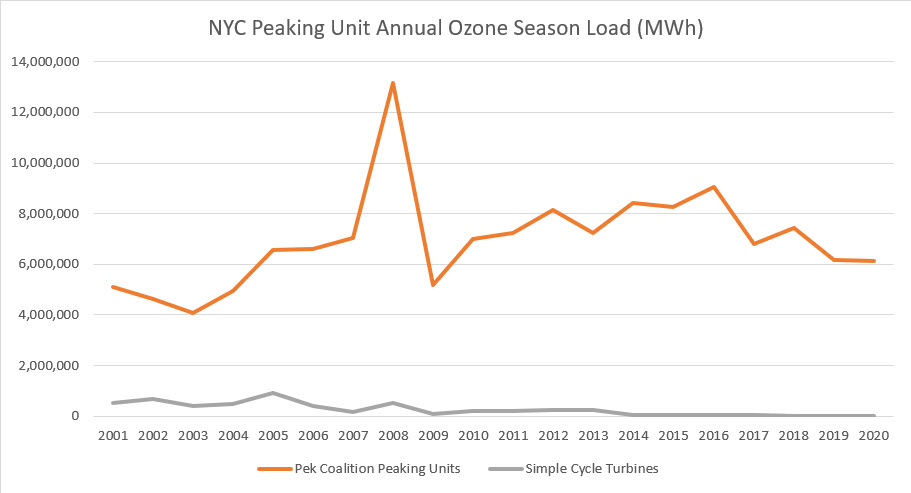
There is another nuance to the peaking units story. Because the primary concern with the combustion turbines that run so little is ozone attainment, they only are required to report data during the Ozone Season (May 1 to September 30). The NYC Peaking Unit Annual Ozone Season Load graph shows the trend of the simple cycle combustion turbine peaking unit and the Peak Coalition peaking unit ozone season load. Since 2001, the simple cycle turbines load trend is down and in 2020 the ozone season total energy produced was only 8,155 MWh compared to a peak over this period of 897,939 MWh in 2005. On the other hand, the Peak Coalition peaking units have only been trending down since 2017. Over that short a period the effects of weather may be the primary driver of any load changes.

The New York City Ozone Season Trends table categorizes the units as simple cycle turbines (the industry “peakers”), all the other turbines, boilers that provide electricity and steam boilers that provide steam.  In the last 20 years a number of combined cycle combustion turbines that are more efficient than the simple cycle turbines and the boilers.  In 2020, that category provided the most energy of any of the units considered displacing most of the simple cycle turbine output and a big chunk of the boilers producing electricity.  As shown in the table, in 2020 the “peakers” only generated 8,155 MWh and emitted 6,927 tons of CO2 and 28 tons of NOx.  The combined cycle turbines produced 3,968,562 MWh, 1,772,752 tons of CO2 and 103 tons of NOx and the boilers produced 2,172,185 MWh in 2020, 1,654,514 tons of CO2 and 752 tons of NOx in the 2020 Ozone Season.

Alternatives

I don’t think that many of the members of the power generation advisory panel really understand the electric system.  Although the simple cycle turbine peaking units have run less and less, completely eliminating them is still a significant undertaking.  Nonetheless, last year the Department of Environmental Conservation promulgated a new regulation that will shut them down on a schedule based on complete assurance that equally reliable options are available.  In order to eliminate the units in the Peak Coalition report is a much more difficult problem.  Unfortunately, to the ill-informed it is a simply a matter of political will.

The apparent preferred option is to use energy storage ultimately powered using renewables.  In December 2020, 74 Power Global and Con Edison announced the signing of a seven-year dispatch rights agreement for the development of a 100-megawatt battery storage project, the East River Energy Storage System, in Astoria, Queens.  The NRG Astoria Gas Turbine facility presently consists of 24 16MW simple cycle turbines is also located at the same location.  The East River Energy Storage System is rated to provide 4 hours at 100 MW capacity or 400 MWh.  On the other hand, those 24 16MW turbines can run all day if the need arises to produce 9,216 MWh or 23 times more energy. 

Unfortunately, that is not the end of the bad news for energy storage.  Last year I estimated the energy storage requirements of the CLCPA based on a NREL report Life Prediction Model for Grid-Connected Li-ion Battery Energy Storage System that describes an analysis of the life expectancy of lithium-ion energy storage systems.  The abstract of the report notes that “The lifetime of these batteries will vary depending on their thermal environment and how they are charged and discharged. To optimal utilization of a battery over its lifetime requires characterization of its performance degradation under different storage and cycling conditions.”   The report concludes: “Without active thermal management, 7 years lifetime is possible provided the battery is cycled within a restricted 47% DOD operating range. With active thermal management, 10 years lifetime is possible provided the battery is cycled within a restricted 54% operating range.”  If you use the 54% limit the 400 MWh of energy goes down to 216 MWh and the existing turbines can produce over 42 times as much energy in a day.

The mantra of the environmental justice advocates on the power generation advisory panel is that “smart planning” and renewables will be sufficient to replace fossil generation peaking plants.  In the absence of what is exactly meant by “smart planning” I assume that it will be similar to the New York Power Authority agreement to “assess how NYPA can transition its natural gas fired ‘peaker’ plants, six located in New York City and one on Long Island with a total capacity of 461 megawatts, to utilize clean energy technologies, such as battery storage and low to zero carbon emission resources and technologies, while continuing to meet the unique electricity reliability and resiliency requirements of New York City.”  Beyond the press release however, is a major technological challenge that if done wrong will threaten reliability. 

Moreover, the costs for this technology seem to be an afterthought.  The Energy Information Administration says the average utility scale battery system runs around $1.5 million per MWh of storage capacity. That works out to $600 million for the East River Energy Storage System.  NYC currently peaks at around 13,000 MW– just to keep the city running. I get the impression that one aspect of “smart” planning is to shave peaks but the CLCPA targets will require electrification across all sectors.  I don’t think that any peak shaving programs can do much to reduce the current summer peak and the peak will certainly shift to the winter when peak shaving and shifting of heating is unrealistic.  Assuming the same peak level and that the daily total peak above the baseline requires 104,000 MWhr, that means that 481 East River Energy Storage Systems operating at the NREL 54% limit would be needed to cover the peak at a cost of $289 billion.  Throw in the fact that the life expectancy is ten years and I submit this unaffordable.

NYC Solar

Even if you have enough energy storage, the mandates of the CLCPA require the use of solar and wind resources to provide that energy.  There are specific in-city generation requirements for New York City that have been implemented to ensure there is no repeat of blackouts that were caused by issues with the transmission and generation system.  It is not clear to me how this will be handled within the CLCPA construct but there is a clear need for in-city generation.  Clearly massive wind turbines are a non-starter within NYC so that leaves solar.  The problem is that a 1 MW solar PV power plant will require between 2.5 acres and 4 acres if all the space needed for accessories are required.  Assuming that panels generate five times their capacity a day 43.2 MW of solar panels can generate the 216 MWh of energy available from the East River Energy Storage System and that means a solar array of between 108 and 173 acres.  To get the 104,000 MWh needed for the entire NYC peak between 10 and 16 square miles of solar panels will be needed. 

Public Policy Concerns

I have previously described how the precautionary principle is driving the CLCPA based on the work of David Zaruk, an EU risk and science communications specialist, and author of the Risk Monger blog.  In a recent post, part of a series on the Western leadership’s response to the COVID-19 crisis, he described the current state of policy leadership that is apropos to this discussion: 

“The world of governance has evolved in the last two decades, redefining its tools and responsibilities to focus more on administration and being functionary (and less on leadership and being visionary). I have written on how this evolution towards policy-making based on more public engagement, participation and consultation has actually led to a decline in dialogue and empowerment. What is even more disturbing is how this nanny state approach, where our authorities promise a population they will be kept 100% safe in a zero-risk biosphere, has created a docilian population completely unable and unprepared to protect themselves.”

His explanation that managing policy has become more about managing public expectations with consultations and citizen panels driving decisions describes the Advisory Panels to the Climate Action Council.  He says now we have “millennial militants preaching purpose from the policy pulpit, listening to a closed group of activists and virtue signaling sustainability ideologues in narrowly restricted consultation channels”.  That is exactly what is happening on this panel in particular.  Facts and strategic vision were not core competences for the panel members.  Instead of what they know, their membership was determined by who they know.  The social justice concerns of many, including the most vocal, are more important than affordable and reliable power.  The focus on the risks of environmental justice impacts from these power plants while ignoring the ramifications if peaking power is not reliably available when it is needed most does not consider that a blackout will most likely impact environmental justice communities the most.

Conclusion

There are significant implementation issues trying to meet the CLCPA mandates in New York City.  Energy storage at the scale needed for any meaningful support to the NYC peak load problem has never been attempted.  The in-city generation requirements have to be reconciled with what could actually be available from solar within the City.  All indications are that the costs will be enormous. Importantly, I have only described the over-arching issues.  I am sure that there are many more details to be

reconciled to make this viable and there are as yet unaddressed feasibility issues.

I have previously shown that the Peak Coalition analysis of peaking plants misses the point of peaking plants and their environmental impacts.  The primary air quality health impacts are from ozone and inhalable particulates.  Both are secondary pollutants that are not directly emitted by the peaking power plants so do not affect local communities as alleged.  While nothing detracts from the need to retire the old, inefficient simple cycle turbines, replacing all the facilities targeted by the Peak Coalition is a mis-placed effort until replacement technologies that can maintain current levels of affordability and reliability are commercially available.  At this time that is simply not the case.

Climate Leadership and Community Protection Act Cumulative Environmental Impacts

On July 18, 2019 New York Governor Andrew Cuomo signed the Climate Leadership and Community Protection Act (CLCPA), which establishes targets for decreasing greenhouse gas emissions, increasing renewable electricity production, and improving energy efficiency.  It was described as the most ambitious and comprehensive climate and clean energy legislation in the country when Cuomo signed the legislation.  However, it is not clear that the cumulative environmental impacts of all the resources needed to meet the 2050 net-zero goal will be less than the purported environmental impacts of the climate change effects of New York emissions in part because the State has not evaluated the impacts of all the resources needed for those goals.

I have written extensively on implementation of the CLCPA closely because its implementation affects my future as a New Yorker.  I have described the law in general, evaluated its feasibility, estimated costs, described supporting regulations, listed the scoping plan strategies, summarized some of the meetings and complained that its advocates constantly confuse weather and climate.  The opinions expressed in this post do not reflect the position of any of my previous employers or any other company I have been associated with, these comments are mine alone.

Background

I have been doing environmental assessments for over 40 years and really worry about the environmental impacts of the CLCPA because there is no commitment to evaluate the cumulative impacts.  The problem is that while an individual industrial wind facility or solar facility may not have a notable environmental impact the cumulative impact of all the facilities necessary to provide enough power to meet the reliability needs of the state could have significant environmental impacts.  Because the State has established this goal it should be responsible for this analysis and not the applicants for individual facilities.

On June 24, 2020, DPS announced that they would be accepting comments on the Draft Supplemental Generic Environmental Impact Statement on the proposed Climate Leadership and Community Protection Act.  On September 30, 2020 DPS announced that they had accepted the Final Supplemental Generic Environmental Impact Statement on the proposed Climate Leadership and Community Protection Act (“CLCPA SGEIS”).  The Executive Summary explains that this is the fifth environmental impact analysis for various iterations of New York’s clean energy programs.  The statement explains that the action is “a continuation of previous initiatives analyzed in the Prior SEQRA Analyses, in addition to the increase in resources needed for implementation of the following CLCPA requirements:

      • 70% of electricity from renewable energy by 2030
      • 9,000 MW of offshore wind electricity by 2035
      • 6,000 MW of distributed photovoltaic solar generation by 2025.”

There are two problems however.  There are significant differences between 70% of electricity from renewable energy by 2030 and 100% by 2040.  The other problem is that their projections for the generation necessary for 2030 are outdated with more recent estimates coming in higher.  This post compares the resources modeled in this impact statement and the latest projections.

Comments

I have made the comment that a comprehensive cumulative environmental impact statement is needed for New York’s clean energy programs in a couple of venues including the Resource Adequacy proceeding and Accelerated Renewable Energy Growth and Community Benefit Act proposed regulation.  I prepared comments on the Draft Supplemental Generic Environmental Impact Statement for this CLCPA impact statement but ended up not submitting them. This post updates those unsubmitted comments.

In this post I consider the avian impact of the Bluestone Wind Project in Broome County New York to show impacts for a single facility.  It will have up to 33 turbines and have a capability of up to 124 MW covering 5,652 acres.  The “Cumulative Impacts Assessment” Appendix UU, which is document #752 on the NYSDPS-DMM-Matter Master website case #16-F-0559 in the Article 10 application for the facility.   Over the 30-year expected lifetime of the facility the analysis estimates that 85 Bald Eagles and 21 federally protected Eastern Golden Eagles will be killed.  The analysis assumes that impacts to bat species at the Facility would be similar to the average bat impacts reported at other wind energy projects in New York (average rate of 6.05 bats/MW/year) so approximately 868 bat deaths per year could be expected at the Facility.  However, the facility has committed to a mitigation curtailment that will stop operations during light wind speeds from July 1 to September 30 which they claim will reduce impacts 60% down to 347 bat deaths per year.

The cumulative impact analysis in this report references a Department of Energy site Projected growth of the Wind Industry.  They project that from 2020 to 2050, the projected 30-year life of the Facility, on-shore wind development in New York is estimated to increase from 1.75 gigawatts (GW) to 5.61 GW.  The next step is to see how that projection for on-shore wind development squares with more recent, NY climate policy specific projections for on-shore wind and the CLCPA SGEIS.

The Estimates of Land-Based Wind Resources table has 16 estimates of on-shore wind resources.  In 2019 there were 1,985 MW of installed wind capacity.  According to Exhibit 1-2, Summary of Environmental Resource Areas Analyzed in the Prior SEQRA Analyses, onshore wind impacts were last considered in the 2016 SEIS and in the CLCPA SGEIS were “not analyzed further”.  As a result, the 2016 impact statement estimates of the land-based wind capacity ,  4,000 MW in the base case and 5,905 MW in the high load case, represent the latest CLCPA EIS estimate.   In 2020 the New York Independent System Operator (NYISO) estimated land-based wind resources needed to meet the Climate Act 70×30 goal as part of its Congestion Assessment and Resource Integration Studies (CARIS) planning process.  They project that 6,476 MW will be needed, 571 MW more than the latest CLCPA EIS estimate, in 2030.  Importantly, in order to meet all the electrification needs of the Climate Act in 2050, much more land-based wind will be needed after 2030. On June 24, 2020 Energy plus Environmental Economics (E3) presented results of their emissions reductions pathway analyses to the New York Climate Action Council that included projections of land-based wind in 2030, 4,700 MW, which is less than the latest CLCPA EIS estimate high load case, but in 2050 they projected 9,000 MW in 2050, which is 3,095 MW more than the latest CLCPA EIS estimate high load case.

On June 15, 2020 the Brattle Group presented results from their report New York’s Evolution to a Zero Emission Power System that included five projections of land-based wind.  In their base case they project 9,700 MW in 2030 and 23,300 MW in 2040, 3,795 MW and 17,395 MW more than the latest CLCPA EIS estimate high load case respectively.  They also included two scenarios with different estimates of feasibility.  They noted that the DPS maximum feasible on-shore wind builds were 10,000 MW (4,095 MW greater than the latest CLCPA EIS estimate) and the NYSERDA maximum feasible on-shore wind builds were 8,000 MW (2,095 MW greater than the latest CLCPA EIS estimate).  The final scenario claimed used a National Renewable Energy Lab (NREL) technical potential on-shore wind capacity of 26,000 MW which is 20,095 MW greater than the latest CLCPA EIS estimate.  The Analysis Group Climate Change Impact Phase II Final Report for NYISO had another estimate for the NREL total technical potential of 35,200 MW which is 29,295 MW greater than the latest CLCPA EIS estimate.  That analysis incorporates all the load increases necessary to electrify other sectors to meet the CLCPA goals so I believe that this is the best estimate of the final resource requirement.  Because that capacity estimate is so much larger than the latest CLCPA EIS estimate I can only conclude that another environmental impact analysis is needed when the Climate Action Council finalizes its Scoping Plan.

It is concerning to me that an analysis done for NYSERDA on wind power and biodiversity by the New York Natural Heritage Program (NYNHP) and Nature Conservancy found that: “5,430 square kilometers (1.3 million acres) of land in New York that are both suitable for wind power development and avoid areas that are likely to have high biodiversity value. Using an estimate of 3.0 MW/square kilometers, this translates to a megawatt capacity estimate of 16,300 MW (± 9,000 MW) for New York’s terrestrial landscape.”  The Analysis Group projection of 35,200 MW exceeds this range and that suggests that wind turbines will have to be sited within areas of high biodiversity value.  It is absolutely necessary that there is a commitment to do a cumulative environmental impact statement evaluating the on-shore wind resources needed to meet the CLCPA goals.

Finally, I made estimated some New York Cumulative On-Shore Wind Impacts.  I calculated the land needed for development and compared that to agricultural land and high biodiversity land.  According to the latest CLCPA EIS, assuming a conservative range of land use requirements from NREL’s 2009 study of 30 to 141 acres per MW, total land use requirements for 4,000 MW of land-based wind under the base case PPA scenario (the latest CLCPA EIS estimate scenario which projects the lowest amount of land-based wind development) may require between 120,000 and 564,000 acres of land.  I calculated the totals for all the scenarios included in the previous table.  Based on a recent estimate of 8.79 million acres of agricultural lands in NYS, if agriculture lands hosted 100 percent of wind energy development projects, for all the projections between approximately 1.4 percent up to 56.5% percent of agriculture lands would have to be converted to wind energy development.  The fraction of suitable land compares the NYSERDA on wind power and biodiversity estimate of suitable land for wind development to the land needed to meet CLCPA requirements.  The fraction ranges from a miniscule 0.09 to a scary 3.82.  These unrefined estimates are only intended to make the point that a refined analysis is needed.  It is unlikely that wind development will take place on agricultural lands but solar energy development is much more likely there.  Wind will impact forests along ridge lines.

Circling back to the Bluestone Wind Project analysis that predicted eagle and bat deaths I also calculated the state-wide impacts using their numbers.  Annual deaths range from 91 to 804 Bald Eagles, 23 to 199 Eastern Gold Eagles, and 373 to 3,283 bats simply extrapolating their numbers state-wide.  Of course, those are crude numbers.  The population density of these species has to be mapped against the actual locations of potential wind farms for starters.  The actual methodology used to determine deaths also has to be checked and the bat deaths incorporate a mitigation curtailment that limits operations.

 Conclusion

I have always maintained that the biggest deficiency in the CLCPA was the lack of a feasibility study.  It is not clear to me that the ultimate problem of trying to supply the energy needs of an mostly electrified New York  electric system can be solved during a multi-day winter doldrum if the primary sources of electricity are wind and solar   The only way this might work will require extraordinary amounts of wind and solar development.  When there is an “official” estimate of those resources clearly a cumulative environmental impact analysis for those resources should be completed as soon as possible.

Ideally, preparations for that cumulative analysis should start now to determine a threshold for unacceptable environmental impacts.  For example, I am worried about eagles.  If you had told me 30 years ago that I would ever see a Bald Eagle from my home I would have been doubtful.  Now that has occurred and I am not willing to chance that environmental victory.  Because there are a limited number of eagles and their reproduction rates are low, I imagine that wildlife biologists could develop a criterion on the acceptable annual rate of state-wide eagle deaths from wind turbines.  There were 426 occupied bald eagle nest sites in New York in 2017. It is obvious that a more detailed projection of wind turbine impacts on this rare resource is needed.  The ultimate goal should be to refine the NYSERDA on wind power and biodiversity habitat sensitivity maps for the CLCPA resource development planning and siting process.

Comments on CLCPA Transportation Advisory Panel Implementation Strategies

The Climate Leadership and Community Protection Act (CLCPA) became effective on January 1, 2020 and establishes targets for decreasing greenhouse gas emissions, increasing renewable electricity production, and improving energy efficiency.  The law mandated the formation of the Climate Action Council to prepare a scoping plan to outline strategies to meet the targets.  This is one of a series of posts describing aspects of that process.  In particular, this post is my reaction to the Transportation Advisory Panel’s initial strategies.

I am very concerned about the impacts of the Climate Leadership and Community Protection Act (CLCPA) on energy system reliability and affordability.  There are very few advocates for the typical citizen of New York who has very little idea about the implications of the CLCPA on energy costs and personal choices. I am a retired electric utility meteorologist with nearly 40-years-experience analyzing the effects of meteorology on electric operations. I believe that gives me a relatively unique background to consider the potential quantitative effects of energy policies based on doing something about climate change.  The opinions expressed in this post do not reflect the position of any of my previous employers or any other company I have been associated with, these comments are mine alone.

Background

I have described the implementation requirements in a stand-alone document.  In brief, The CLCPA mandates that a scoping plan outlining the recommendations for attaining the statewide greenhouse gas emissions shall be prepared and approved by December 31, 2021.  The Climate Action Council and seven advisory panels, transportation, energy intensive and trade-exposed industries, land-use and local government, energy efficiency and housing, power generation, waste, and agriculture and forestry consisting of political appointees and supported by agency staff are charged with this responsibility.  Since the formation of the panels in the middle of 2020 they have been holding meetings and preparing strategies.  In brief, each advisory panel is expected to “Identify a range of emissions reductions, consistent with analysis and in consultation with the Climate Action Council, for the sector which contributes to meeting the statewide emission limits.”  They have been asked to present a list of recommendations for emissions reducing policies, programs or actions, for consideration by the Climate Action Council for inclusion in the Scoping Plan and to seek public input to inform the development of recommendations to the Council for consideration.  This post describes the comments that I plan to submit as part of that public process.

General Comments

My impression of these transportation strategies is that there is a dis-connect between their goals and reality.  Reality is that there are on the order of 9.4 million vehicles registered in New York State with 1.9 million in New York City.  According to the ChargeNY website on 12/2/2020 there were 58,856 electric vehicles or 0.6% of the total and more than half of those are plug in hybrid electric vehicles and supporting their future use is just more fossil fuel infrastructure so they will have to be banned.  One hundred years ago there was a choice between electrified public transit and personal automobiles and by 1920 the interurban and trolley network that covered much of the state was already in decline because of the convenience of personal transport.  I find it hard to imagine that the majority of people would be willing to make the sacrifice of giving up their car.

Strategy Comments

The first strategy “Transportation Electrification” proposes to adopt regulatory approaches and supporting policies to increase the sale of medium and heavy-duty zero emission vehicles to 30% by 2030 and the sale of light-duty zero emission vehicles to 100% by 2035, and require greater use of zero emission non-road vehicles.  This strategy is mostly wishful thinking.  The fact is that zero emission vehicles are not available with all the capabilities as currently available vehicles.  For example, the minivan offers enough room for all the kids and baggage can be used for hauling pretty big items.  It can be used to go 250 miles in any weather without the need for a long stop to re-charge.  Without an equivalent vehicle Christmas trips to the grandparents are a much more complicated endeavor.  Another example of a transportation element not addressed yet is recreational vehicles.  I own a motor coach, use it often and my experience suggests that an electrification mandate will kill the industry in NY.

The rationale for this strategy claims that zero emission vehicles save consumers money spent on fuels and maintenance neglects total costs.  Many people cannot afford new vehicles and there is a very limited used EV market.  Many people worry about the cost of replacement batteries for used cars.  The head of Toyota raised the issues of the energy loss inside the electric vehicle value chain and the depreciated costs of developing a massive electric vehicle support infrastructure for ten million vehicles.  I would add that the hidden environmental costs of the rare earth elements and other metals needed for electrification should also be addressed.  The car battery in each automobile weighs 1,000 pounds and fabrication requires digging up, moving and processing 250 tons of earth somewhere else – this CLCPA implementation mandate is going to cause massive environmental impact leakage.

The Clean Fuels strategy proposes to “Adopt a market-based approach and supporting policies to increase the availability and affordability of clean transportation fuels (renewable biofuels, green hydrogen, electricity) in New York”.  This strategy should address the environmental impacts of biofuels.    Hydrogen is nice in theory but because it has to be compressed or liquified for storage is impractical in reality.  Electrification has serious border issues if New York or even the Transportation Climate Initiative region continue to go down this path without the rest of continent following suit.

There are two components to the Public Transportation strategy:

      • Identify policies and programs that would double the availability/accessibility of upstate and downstate suburban public transportation services statewide by 2035 and
      • Identify policies and programs to support system reliability/network expansion projects identified by MTA in their twenty-year needs study.

As noted previously, there used to be an extensive public transit system in the state that died out where public needs could not be met.  The strategy claims there is “unparalleled support for public transportation based on NY being the least energy per capita for transportation purposes” overlooks the fact that is almost entirely due to New York City.  Even if you manage to double availability and accessibility in New York City that is an easy task relative to the rest of the state.  Current land use patterns preclude substantial increases in public transit services outside of metropolitan areas.  Consider that, for example, using public transit from the New York State Energy Research & Development Authority office building to the State Capitol is a 9.7 mile, 14 minute drive or a 46 minute bus ride that includes a one mile walk.  Of course, that does not include waiting time for the bus.  Rather than a vague plan with aspirational goals the strategy clearly needs to be in sufficient detail to explain what would be required to make this actually work.

The final strategy, Smart Growth and Transportation System Efficiency, also has two components:

      • Transportation-Oriented Development—Align roadway, residential and commercial development to be proximate and accessible to public transportation and consider holistic GHG emissions in smart growth developments;
      • Low-and Zero-Carbon Transportation Modes—Expand access to low-or zero-carbon transportation modes (biking, walking, carpooling) for first mile/last mile connections to transit and destinations.

While there certainly are areas where transit-oriented development can be done, to think it has widespread applicability outside the New York City metropolitan area is completely wishful thinking.  Advocates for this just have to admit that current land use patterns make this strategy useless.  The transportation modes component is another great theory proposed by someone who would not have to deal with impracticalities for anyone in rural areas and most suburban areas.  It boils down to the reality that anyone who has a remote car starter to deal with the inconvenience of a cold car is not going to use public transit in the winter.

Conclusion

I think that upon closer examination all of these strategies have flaws that make them unacceptable for the vast majority of people outside the echo chamber of transportation-related climate solutions ideology.  The only way these strategies can get started much less implemented is if the public does not catch on.  Experience shows that when the effects of these policies on transportation costs and personal choices become known to the general public that a backlash will occur.

Response to My Comments on the New York Value of Carbon Guidance

The Climate Leadership and Community Protection Act (CLCPA) mandates that the state establish a value of carbon for use in the implementation of the law.  On December 30, 2020 New York’s Department of Environmental Conservation (DEC) announced finalization of this guidance.  This post summarizes the final guidance and describes the response to comments on the draft guidance document.  In general, the guidance document and the responses all are consistent with the CLCPA narrative that climate change is an imminent, inevitable disaster that can only be averted by reducing greenhouse gas emissions.

I submitted comments because this law will affect the affordability and reliability of New York’s energy.   I am a retired electric generation utility meteorologist with nearly 40-years of experience analyzing the effects of environmental regulations on electric and gas operations.  I have written a series of posts on the feasibility, implications and consequences of this aspect of the law and another series of posts on carbon pricing initiatives.  The opinions expressed in this post do not reflect the position of any of my previous employers or any other company I have been associated with, these comments are mine alone.

Background

On July 18, 2019 New York Governor Andrew Cuomo signed CLCPA, which establishes targets for decreasing greenhouse gas emissions, increasing renewable electricity production, and improving energy efficiency.  It was described as the most ambitious and comprehensive climate and clean energy legislation in the country when Cuomo signed the legislation.  I have summarized the schedule, implementation components, and provide links to the legislation itself at CLCPA Summary Implementation Requirements.

The CLCPA requires the New York State Department of Environmental Conservation (DEC), in consultation with the New York State Energy Research and Development Authority (NYSERDA), to establish guidance for a value of carbon for use by State agencies. According to the DEC press release:

“The guidance is different than a regulation and does not propose a carbon price, fee, or compliance obligation. It is a metric that will be broadly applicable to all State agencies and authorities to demonstrate the global societal value of actions to reduce greenhouse gas emissions. The guidance establishes a value of carbon focused on the federal social cost of carbon and incorporates public comments DEC received when the draft guidance was proposed earlier this year, including recommending a lower central discount rate of two percent, which should be reported alongside a one and three percent discount rate for informational purposes. In some decision-making contexts, particularly those that have a history of valuing carbon, such as the New York electric industry, the guidance suggests that alternative approaches to valuing carbon may be more appropriate for both resource valuation and benefit-cost analyses.  Use of the lower central discount rate translates into a 2020 central value of carbon dioxide of $125 per ton; methane of $2,782 per ton; and nitrous oxide of $44,727 per ton.”

The Value of Carbon Guidance provides values for carbon dioxide, methane, and nitrous oxide for use by State agencies along with recommended guidelines for the use of these and other values by State entities. Four documents were made available:

In section §75-0113, Value of Carbon the CLCPA states that the “social cost of carbon shall serve as a monetary estimate of the value of not emitting a ton of greenhouse gas emissions” and that “As determined by the department, the social cost of carbon may be based on marginal greenhouse gas abatement costs or on the global economic, environmental, and social impacts of emitting a marginal ton of greenhouse gas emissions into the atmosphere, utilizing a range of appropriate discount rates, including a rate of zero.”  The law states that DEC “shall consider prior or existing estimates of the social cost of carbon issued or adopted by the federal government, appropriate international bodies, or other appropriate and reputable scientific organizations.”

Response to Comments

In general, a major point in my comments was that I believe the focus of the guidance is wrong.  According to the document:

“The purpose of this guidance is to aid State entities in decision making by establishing a monetary value of greenhouse gas emission reductions or increases that reflects global societal impacts. This guidance does not itself establish a price or fee on emissions, and the value of carbon presented here is not the only value that may be used by the State. Alternative methods for establishing a value of carbon may be used by State entities, including the Department, as needed to achieve the goals and requirements of the CLCPA as well as other State goals, such as to protect public safety, welfare, and the environment.”

The guidance does not recognize that the CLCPA has specific targets so the proper way to address social costs is through a cost efficiency approach.  The damages approach recommended in the guidance is an efficiency concept inappropriate when developing control measures.  The emphasis of the guidance is on state agency use and not for supporting the Climate Action Council scoping plan mandate.

DEC’s responses to comments are listed below with my italicized reply below each paragraph.

“The Department received comments from individuals, elected officials, municipal officials, environmental advocacy groups, community groups, academic and other nonprofit research institutions, and private businesses particularly those related to the electricity sector. Most commenters responded to DEC’s specific request for input on the selection of a central discount rate or commented on three other areas: the use of a range of discount rates, the application of other approaches such as marginal abatement, or technical details of the damages-based or marginal abatement approaches. As discussed in the Guidance, DEC is providing guidelines regarding the use of the damages-based approach to enable New York State agencies to use this tool, where needed. DEC is not seeking to develop guidelines for the use of other approaches, such as marginal abatement, at this time.”

My comments explained that there are other metrics that describe ‘equivalences’ between climate-changing species used to determine contributions to climate impacts.  Tol et al (2012) present a unifying framework that clarifies the relationships among four metrics establishing ‘equivalences’ among emissions of various species. Importantly, the framework distinguishes between cost benefits and cost effectiveness. This paper explains that once a cap is set, you should not use the social cost of carbon. The social cost of carbon is an efficiency concept. Establishing a price incentivizes society to develop the most efficient response to that price but does not guarantee specific emission levels. Once a specific target is established in a cap that violates the efficiency principle inherent in the social cost of carbon.  Instead, the cap requires that emissions are valued to the shadow price of the cap. There was no response to this argument.

 “The majority of commenters who responded to DEC’s request for feedback on the selection of a central discount rate support the lower of the two suggested values, i.e., 2% rather than the 2.5% that was previously established as the lower bound of discount rates by the federal government. Some of these commenters suggested that the central rate should be no higher than 2%. Other commenters requested a rate that is lower, such as zero or 1%, or suggested that the DEC should adopt higher rates that would be consistent with that previously used by other New York State agencies and the federal government.”

 A lower discount rate produces higher values which supports the narrative of the CLCPA and likely the majority of the commenters who have a vested interest in climate change catastrophes.  My argument that on a global basis using lower discount rates memorializes the status quo for the world’s poor was ignored.

“While DEC maintains that the public is best informed by reporting a range of discount rates, given the responses received, DEC has revised the Guidance to apply a central 2% discount rate. However, as many commenters pointed out, the damages-based approach is continually refined and improved and DEC will continue to consider incorporating new research. DEC will also consider additional ways to address uncertainty and intergenerational equity issues raised by the commenters, such as through a declining discount rate or the incorporation of a 95th percentile on the central discount rate, as the research continues to improve. While not specifically raised in the public comments, one issue with applying a non-standard discount rate, such as 2%, is that this affects the applicability of published analyses, because the analyses are unlikely to apply the same discount rate.”

I raised problems with damages-based approaches in my comments but one would not know that from this response. 

“Several commenters took issue with the use of a range of discount rates and stated a preference that DEC require all State entities to use one discount rate. DEC has revised the Guidance to clarify the initial intent of the Guidance. Namely, DEC’s guidance follows the federal government’s approach to using the damages-based value of carbon, under which agencies use the central rate, but also report the results for a higher and lower rate. DEC did not intend to suggest that State entities use any discount rate within the range. Instead, DEC suggests that, if State agencies apply a damages-based value of carbon as a part of their decision-making, they should use the 2% discount rate to estimate the value (as opposed to the federal government’s central rate of 3%) and also report the values estimated using the 1% and 3% discount rates. This enables the public to see the effect of the discount rate and, in the case of the 3% rate, compare their assessment to federal actions and previous State policies.”

I agree with the DEC response that the public should be able to see the effect of the discount rate.  The suggestion in my comments that the public should also be able to see the effect of the time horizon, the location of impacts, and equilibrium climate sensitivity was ignored.  I also argued that the one reference used to justify using a lower discount rate was inadequate and that additional justification was needed.  There were no changes to the document to respond to that.

“The remaining comments covered a diverse set of topics, including topics beyond the scope of the Guidance. DEC will use all relevant feedback in refining the Guidance and in developing future guidance. An example is to provide additional guidance on how to consider public health impacts and the social costs for co-pollutants. The CLCPA specifically refers to the social cost of emitting greenhouse gases into the atmosphere, but the Guidance does discuss how the damages-based approach can be used to assess other impacts and other pollutants. The Guidance is a complement to other, more standard methods used.”

Topics beyond the scope of the Guidance are ignored if they don’t fit the narrative.  I raised fundamental issues raised about the mis-use of the value of carbon when emission targets have been chosen and no response.  Instead, they highlight comments that claim the values are too low.  Honestly, if they want to provide New York’s citizens information rather than just propaganda they should describe both sides of the valuation issues, explain why they chose what that chose, and explain why only the negative externalities of fossil fuels are considered without any consideration of the benefits.

Conclusion

Because it appears that a primary goal of this process is to memorialize a value of carbon to justify agency actions, the public deserves to know how the real costs are balanced against the theorized cost benefits.  When CLCPA strategies are announced and cost savings are claimed the public deserves to know that the savings are based on global not New York benefits, savings out to 2300, do not represent the latest climate sensitivity science, and that no consensus exists on what approach or rate to use for discounting uncertain climate impacts over long time horizons.  Instead, the basis is buried in a technical document that does not even acknowledge that there are uncertainties and issues with basis for cost savings based on these values of carbon.

Furthermore, there are fundamental technical considerations overlooked or ignored by the guidance and response to comments. New York State CLCPA implementation is trying to choose between many expensive policy options while at the same time attempting to understand which one (or what mix) will be the least expensive and have the fewest negative impacts on the existing system. If good picks are made then state ratepayers will spend the least amount of a lot of money, but if they are wrong, we will be left with lots of negative outcomes and even higher costs for a long time.  A value of carbon approach that addressed that concern as its primary goal would be great support to address this problem.


Another Cautionary RGGI Tale from New York

The Regional Greenhouse Gas Initiative (RGGI) is likely to generate over $149 million in fiscal year 2021-2022 for New York State investments to support comprehensive strategies that best achieve the RGGI greenhouse gas emissions reduction goals pursuant to 21 NYCRR Part 507.  This post describes the comments I submitted for the New York RGGI Operating Plan Amendment for 2021.

I have been involved in the RGGI program process since its inception sometime in 2004.  I blog about the details of the RGGI program because very few seem to want to provide any independent review of the program. The opinions expressed in this post do not reflect the position of any of my previous employers or any other company I have been associated with, these comments are mine alone.

Background

RGGI is a market-based program to reduce greenhouse gas emissions. It is a cooperative effort among the states of Connecticut, Delaware, Maine, Maryland, Massachusetts, New Hampshire, New York, Rhode Island, and Vermont to cap and reduce CO2 emissions from the power sector.  According to a RGGI website: “The RGGI states issue CO2 allowances which are distributed almost entirely through regional auctions, resulting in proceeds for reinvestment in strategic energy and consumer programs. Programs funded with RGGI investments have spanned a wide range of consumers, providing benefits and improvements to private homes, local businesses, multi-family housing, industrial facilities, community buildings, retail customers, and more.”  Note that New Jersey has re-joined RGGI and Virginia will be joining in 2021.

On December 16, 2020 a stakeholder advisory group meeting was held to provide an overview of the draft operating plan amendment.  Meeting materials included the following:

The presentation provides an overview of the meeting.  The introduction of the operating plan describes New York’s RGGI approach.  Implementation responsibilities are shared by the New York Department of Environmental Conservation (DEC) and the New York State Energy Research and Development Authority (NYSERDA).

NYSERDA’s RGGI Operating Plan is reviewed and revised on an annual basis. The operating plan document represents the 2021 Operating Plan Amendment and provides program descriptions and funding levels for the April 2021-March 2024 timeframe.  NYSERDA regulations include a provision to annually convene a group of stakeholders representing a broad array of energy and environmental interests. This group advises NYSERDA regarding strategies to best utilize RGGI funds. NYSERDA holds an open meeting of the stakeholder group each year, inviting input on how to achieve greater scale of implementation, advance activities that realize benefits in disadvantaged communities, expand private investments and partnerships, and address barriers to program success.

The draft Amendment explains that New York State invests RGGI proceeds to support comprehensive strategies that best achieve the RGGI greenhouse gas emissions reduction goals pursuant to 21 NYCRR Part 507.  The programs in the portfolio of initiatives are designed to support the pursuit of the State’s greenhouse gas emissions reduction goals by:

      • Deploying commercially available energy efficiency and renewable energy technologies;
      • Building the State’s capacity for long-term carbon reduction;
      • Empowering New York communities to reduce carbon pollution, and transition to cleaner energy;
      • Stimulating entrepreneurship and growth of clean energy and carbon abatement companies in New York; and
      • Creating innovative financing to increase adoption of clean energy and carbon abatement in the State.

Proposed Programs

In my  comments , I evaluated the programs proposed for the draft Amendment. NYSERDA’s New York State Regional Greenhouse Gas Initiative-Funded Programs status reports were used to estimate the ability of these program to reduce CO2.  The latest report, Semiannual Status Report through December 31, 2019 includes a summary of expected cumulative annual program benefits.

Operating Plan Table 1 lists those programs that are funded going forward in the draft Amendment and includes annual program benefits for existing programs.  There are 18 proposed programs that have been allotted funds for the revised FY20-21 through FY23-24 budget years.  I classified them into five categories and provided summaries of the programs themselves in 2021 RGGI Operating Plan Program Descriptions.

The programs in the first two categories are expected to produce emission reductions.  Eight programs were funded before 2020 and have estimates of the cost to reduce CO2.  They are allocated $416.2 million or 69% of the budgeted funds and, based on the NYSERDA report estimates, could reduce CO2 emissions just over 807,000 tons.  This translates to a expected CO2 cost reduction efficiency of $516 per ton.  Two new programs are similar to exiting programs and using the overall cost efficiency for the existing programs could reduce CO2 emissions another78,431 tons.

The next two categories are existing and new programs that do not directly reduce CO2 emissions. There is one existing program and four existing administrative line items totaling $76.8 million or 13% of the total that do not directly reduce CO2 emissions. It is disappointing that two new proposed programs totaling $14 million or 2% of the total that will also not directly reduce CO2 emissions.  New York’s proportion of line items that do not directly reduce CO2 emissions is the highest of any RGGI state.

Finally, the draft amendment includes a program that will increase CO2 emissions.  The draft Amendment proposes to allocate $52.8 million or 9% of the total budget to the ChargeNY program that will promote plug-in electric vehicle (PEV) adoption by consumers across New York.

Environmental Justice

Clearly the operating amendment funding represents a lot of money.  The Operating Plan amendment for 2021 notes that:

“RGGI programs have and will continue, alongside other state programs, to contribute to economy-wide greenhouse gas emissions reductions and provide benefits to New York’s historically overburdened and underserved communities. NYSERDA’s CO2 Allowance Auction Program regulations reflect the provision of the Climate Leadership and Community Protection Act “that 40%, and no less than 35%, of the overall benefits from the investment of the [CO2 Allowance Auctions] proceeds” will be realized in disadvantaged communities.”

It is entirely appropriate that there should be an emphasis on environmental justice but I have concerns about the State’s approach.

Unfortunately, meeting that goal means even less emphasis on cost effectiveness.  I noted in my comments that the CLCPA and the draft Amendment emphasize support to disadvantaged communities.  Given that all other jurisdictions that have attempted to reduce GHG emissions have increased the cost of energy, it is likely that will be the case in New York too.  Therefore, I think there are two priorities to reduce the regressive impact on those who can least afford those increased costs.  Overall, the funding emphasis should be on the most cost-effective GHG reduction programs to lower overall costs.  The exception to that emphasis are programs that directly reduce costs for anyone, regardless of location, who is living in energy poverty or has a disproportionate energy burden.  I worry that the emphasis on disadvantaged communities will hurt energy paupers living outside of those communities, particularly those in rural areas.

A focus on reducing the energy burden of disadvantaged in general and in overburdened and underserved communities in particular is more appropriate than the state’s plans to fulfill a mandate for spending a particular amount in a particular way. In order to address the effect of climate change on dis-advantaged communities adapting and becoming more resilient to extreme weather rather than attempting to mitigate those impacts would also be more appropriate than funding wind and solar projects that have their own environmental consequences.

 Conclusion

The draft Amendment budget total covering fiscal years 2020 to 2024 is over $600 million and is projected to reduce annual CO2 emissions 807,024 tons for a cost efficiency of $744 per ton reduced.  Over 30% of the budget is apportioned to programs or line items that do not directly reduce CO2.

The cost reduction efficiency is $516 per ton for the programs that will directly reduce CO2.  The recently adopted Value of Carbon Guidance recommended a 2020 value of carbon dioxide of $53-421 per ton, with a central value of $125 per ton; a 2020 value of methane of $1,527-6,578 per ton, with a central value of $2,782 per ton; and a value of nitrous oxide of $19,084-140,766 per ton, with a central value of $44,727 per ton.  If we only consider the carbon dioxide values, the cost effectiveness exceeds the purported negative externality costs and that means that the RGGI operating plan programs do not meet this basic cost-benefit test.

Clearly the draft Amendments should put greater emphasis on investments with better cost effectiveness rates or develop programs to bring those costs down.  Moreover, if the costs of the emission reduction programs exceed the purported negative externality costs then it suggests that it would be more appropriate to invest the proceeds elsewhere.  Note that in the future the State is going to have to breakout expected methane and nitrous oxide emission reductions, if any, in order to reflect the full value of RGGI proceeds investments.

There is one final aspect of this that troubles me.  RGGI is an electric sector emissions reduction program.  New York State is already abusing the RGGI objectives with all the programs that produce no CO2 reductions.  I am sure that a detailed review of the programs would uncover funding that should be covered by existing programs and not with RGGI funds.  While it is understandable that RGGI funding will be used to meet the CLCPA dis-advantaged community mandates it will likely further dilute the effectiveness of future reductions.  Funding the ChargeNY program that will promote plug-in electric vehicle (PEV) adoption by consumers across New York will actually increase CO2 emissions and I recommended that those funds be re-allocated elsewhere.  The ultimate problem that the operating plan overlooks is at some point the sources affected by RGGI will be unable to lower their emissions.  In order to meet the RGGI cap zero-emission generating and reductions in load funded by the RGGI proceeds will be needed.  If all the money is distributed elsewhere problems will ensue.


Climate Leadership and Community Protection Act Potential Savings of Future Global Warming

On July 18, 2019 New York Governor Andrew Cuomo signed the Climate Leadership and Community Protection Act (CLCPA), which establishes targets for decreasing greenhouse gas emissions, increasing renewable electricity production, and improving energy efficiency.  It was described as the most ambitious and comprehensive climate and clean energy legislation in the country when Cuomo signed the legislation.  However, no one has shown what effect this law could actually have on global temperatures.  This post provides that information.

I am following the implementation of the CLCPA closely because its implementation affects my future as a New Yorker.  Given the cost impacts for other jurisdictions that have implemented renewable energy resources to meet targets at much less stringent levels, I am convinced that the costs in New York will be enormous and my analyses have supported that concern.  The opinions expressed in this post do not reflect the position of any of my previous employers or any other company I have been associated with, these comments are mine alone.

Analysis

For this analysis I simply adapted the calculations in Analysis of US and State-By-State Carbon Dioxide Emissions and Potential “Savings” In Future Global Temperature and Global Sea Level Rise[1]  to estimate the potential effect.  This analysis of U.S. and state by state carbon dioxide 2010 emissions relative to global emissions quantifies the relative numbers and the potential “savings” in future global temperature and global sea level rise.   These estimates are based on MAGICC: Model for the Assessment of Greenhouse-gas Induced Climate Change so they represent projected changes based on the Intergovernmental Panel on Climate Change estimates.  All I did in my calculation was to pro-rate the United States impacts by the ratio of different New York inventory emissions divided by United States emissions to determine the effects of a complete cessation of all New York’s emissions.

There is a fundamental assumption in this approach.  The emissions in the primary reference are based on Intergovernmental Panel on Climate Change (IPCC) methodologies.  In order for these estimates to be correct the emission inventories have to be calculated the same way.  New York’s CLCPA inventory only followed IPCC approaches when the results comported with the political narrative and differ when more “appropriate” numbers can be derived.  The largest issue in this regard is that the CLCPA inventory includes upstream emissions from the extraction and transport of fossil fuels so their inventories include emissions from outside the state.  Consequently, you cannot directly compare New York’s inventory to other jurisdictions because of the double counting of these emissions.  The CLCPA inventory also uses a global warming potential GWP) of 20 years whereas everyone else uses GWP of 100 years.  The CLCPA regulation does provide the GWP-100 emissions for comparison purposes and in the response to my comment about the upstream component I was assured that somebody else would address that problem some day some place.  In the meantime, we cannot directly compare inventories.

Next best thing is to provide all the inventory results for your information.  The official CLCPA 1990 emission inventory was recently promulgated in New York’s Part 496 regulation.  As shown in the CCPA Part 496 Potential “Savings” in Future Global Temperature I estimated the benefits of getting 1990 emissions to zero for four inventories.  I evaluated the CLCPA Part 496 inventories for all the greenhouse gases (CO2, CH4, N2O, PFCs, HFCs and SF6) included in the law and just CO2.  In order to compare the potential effects the way the rest of the world prepares inventories, I evaluated the CO2 and GHG inventories from Table S-1 in the last New York State Energy Research and Development Authority inventory.

Results

The table shows that for the CLCPA Part 496 inventories there would be a reduction, or a “savings,” of between approximately 0.0097°C and 0.0081°C by the year 2100.  To give you an idea of how small these temperature changes are consider changes with elevation and latitude.  Generally, temperature decreases three (3) degrees Fahrenheit for every 1,000-foot increase in elevation above sea level.  The projected temperature difference for all the greenhouse gases is the same as a 39-inch change or 32 inches if only the CO2 emissions are considered.  The general rule is that temperature changes three (3) degrees Fahrenheit for every 300-mile change in latitude at an elevation of sea level.  The projected temperature change is the same as a change in latitude of less than a mile.  The impacts calculated using inventories the way the rest of the world calculates them are even less.

The CLCPA should also be considered relative to the rest of the world.  According to the China Electricity Council, about 29.9 gigawatts of new coal power capacity was added in 2019 and a further 46 GW of coal-fired power plants are under construction.  If you assume that the new coal plants are super-critical units with an efficiency of 44% and have a capacity factor of 80%, the reductions provided by the CLCPA greenhouse gas inventory will be replaced by the added 2019 Chinese capacity in less than two years or four and a half years if the 2019 capacity and the units under construction are combined.  Recall that the CLCPA inventory is incompatible with IPCC methods.  When using the compatible NYSERDA inventories New York’s impact on global warming will be replaced by the added 2019 Chinese capacity in less than on year or two and a half years if the 2019 capacity and the units under construction are combined.

Conclusion

There is an obvious reason that New York has never provided an estimate of the impact of any of its greenhouse gas reduction initiatives on global warming.  The impacts are simply too small to be measured much less have an effect on any of the purported damages of greenhouse gas emissions.  In the context of global emissions New York’s efforts will be subsumed quickly by other countries that are morally obligated to provide the tangible benefits of affordable abundant energy to their citizens.  At this time those benefits are only possible using fossil fuels.  Until such time that there is a lower cost alternative to fossil fuels for those countries it is immoral to expect them to forgo those benefits because of marginal climate impacts as aptly explained by Dr. Bjorn Lomborg in his book “False Alarm: How Climate Change Panic Costs Us Trillions, Hurts the Poor, and Fails to Fix the Planet”.