
24 August 2020 New York Climate Action Council Meeting

On July 18, 2019, Governor Cuomo signed into law the Climate Leadership and Community Protection Act (“Climate Act”). It is among the most ambitious climate laws in the world and requires New York to reduce economy-wide greenhouse gas emissions 40 percent by 2030 and no less than 85 percent by 2050 from 1990 levels. The law creates a Climate Action Council (CAC) charged with developing a scoping plan of recommendations to meet these targets.  This post summarizes the third meeting of the Council.  Summaries of other meetings are available here.

I am following the implementation of the Climate Act closely because its implementation affects my future as a New Yorker.  Given the cost impacts for other jurisdictions that have implemented renewable energy resources to meet targets at much less stringent levels, I am convinced that the costs in New York will be enormous and my analyses have supported that concern.  The opinions expressed in this post do not reflect the position of any of my previous employers or any other company I have been associated with, these comments are mine alone.

According to the Climate Action Council website: “The New York State Climate Action Council is a 22-member committee that will prepare a Scoping Plan to achieve the State’s bold clean energy and climate agenda”.  The co-chairs and ten of the members are representatives of state agencies and authorities.  The remaining ten members were chosen by politicians. Advisory panels and the Just Transition Working Group will help develop the scoping plan.

The meetings provide insight to the direction of the massive energy transition required by the Climate Act.  The meetings are run formally with a role call at the beginning, approval of minutes, and votes on any decisions.  The following is a description of the meeting and my impressions.  Meeting materials are provided here:

Co-Chair Remarks and Reflections

These remarks start at the 10:20 mark in the meeting recording. The political nature of this meeting is nowhere more evident than in this agenda item which included five slides: Isaias: A call for resilience, Going Big on Large-Scale Renewables, Investing nearly $1 billion in energy efficiency for low- to moderate-income households, Cleaning New York’s vehicle fleets, and Ensuring climate justice.  Clearly these remarks are scripted for the co-chairs to read and are crafted to reflect well on Governor Cuomo’s energy agenda.

The meeting was held soon after the remnants of Isaias passed through the state and Co-Chair Doreen Harris said that: “As the Governor himself stated, the worst of this situation was avoidable”.  This slide concluded with a clarion call: “We must be better prepared and adapt/improve our overall resilience”.        As is usual for the Cuomo administration, the impacts of this weather event were attributed to climate change.  The reality is that even if it was possible to tease out the potential effect of climate change on the storm’s wind and rain impacts, the impacts without climate change would have caused power outage problems.  It is unclear how the worst of this situation could be avoided.  If your goal is to reduce power outages as much as possible then you could place power lines underground but those costs are on an order of magnitude greater than the costs of overhead wires.  There is no possibility that GHG emission reductions made in New York will affect power outages because the possible effect on global warming is immeasurable.

The next three slides glowingly described progress on the energy initiatives of New York.  The real meat of this meeting started with a description of the startup of the Climate Justice Working Group.  This is one of the support committees for the CAC.  This particular one will consult with the Council on climate justice.

Advisory Panels and Working Groups

In addition to the Climate Justice Working Group, the council has a mandate to convene advisory panels “requiring special expertise and, at a minimum, shall establish advisory panels on transportation, energy intensive and trade-exposed industries, land-use and local government, energy efficiency and housing, power generation, and agriculture and forestry”. The panels will provide “recommendations to the council on specific topics, in its preparation of the scoping plan, and interim updates to the scoping plan, and in fulfilling the council’s ongoing duties”.  The members for the mandated working groups were announced at this meeting.  I will not comment here on the members proposed.

The transition to a new energy system is complex and clearly special expertise is needed.  The concept that the CAC would need this support when defining the plan for the transition is obvious.  However, it is not clear who decided on the proposed membership.  Based on the discussions I got the impression that people were nominated either by members of the CAC or by other stakeholders.  It was also clear that some people who were nominated did not get included.  The promise by the co-chairs that someone would take another look does not give me confidence that everyone will be satisfied.

There is another procedural issue.  The Climate Act specifies that there will be “no more than five voting members” in each advisory panel.  The nominated members for the advisory panels were larger: transportation (15), energy intensive and trade-exposed industries (12), land-use and local government (10), energy efficiency and housing (13), power generation (14), and agriculture and forestry (17).  It appears that there is a wide variation in the backgrounds of the members and I suspect that will result in differing opinions for recommendations.  How that will play out with the voting member criterion is not clear.

The presentation discussed how the advisory panels are expected to operate and their work products.  Frankly, the commitments to do this work are so significant that my expectation is that the process support staff described will do most of the work.  For example, in the “next steps for the advisory panels” slide they have been asked to organize a meeting in the first half of September to develop a work plan that includes:

      • A Scope of Work, identifying topics and issues of the panel discussions, breakdown of sub-issues as needed, potential initial identification of needed research or analysis.
      • A timeline for conducting work and reaching recommendations. The timeline should include:
        • Projected schedule of meetings and public engagement opportunities and
        • Points of consultation with the Climate Justice and Just Transition working groups;
      • Identify any other processes or milestones that may inform the development and submission of recommendations.

Just getting something all down on paper for consideration of the work plan is more than I would expect any individual member to have the time or expertise to do.  Presumably agency staff will to that preparation work.  However the initial draft certainly guides the direction of the work plan.

The presentation also noted that the panels shall “seek public input to inform the development of recommendations to the Council for consideration”, “provide transparency by making meetings open to public viewing or/and publishing minutes of deliberations”, and make available information regarding advisory panel public meetings and comment opportunities on the climate.ny.gov webpage”.  While I hope they follow through on that promise, considering public input adds to the work load of panel members.  Moreover, there is no apparent mechanism with the CAC process to handle public input.  For example, there isn’t any reference to public input documentation.  Later in the meeting this issue was raised and Commissioner Seggos backed off public viewing for all meetings.

The timeline for the draft scoping plan is ambitious.  The work plans are supposed to be completed in mid-October.  Recommendations, development and outreach follow in five months so that the panels can make their proposals to the CAC in mid-March.  All the work is supposed to be integrated in three months for a target integrated draft in mid-June 2021.  Three months of draft review are followed by three months to “Prepare to issue draft scoping plan” ending in December 2021.

At the conclusion of this section of the meeting, after giving the CAC members a list without any documentation of the members other than their affiliation they were asked to approve the memberships.  I hope this rubber stamp approval approach is not a taste of what is to come in this process.

Discussion: Waste Management Decisions

The Climate Act does not specifically mandate an advisory panel for waste management even though it historically represents 8% of statewide emissions.  Commissioner Seggos from the Department of Environmental Conservation (DEC) proposed setting up a core team at DEC (air resources and material management) to operate like an advisory panel rather than setting up another advisory panel.  CAC members were worried that there would not be as much opportunity for public input.  I am not sure how much practical difference this will make because agency staff will do much of the work anyway.

CLCPA Implementation

A couple of progress reports on state activities were described.  Of more interest to me was the discussion of DEC’s proposed Part 496.  A key part of the Climate Act is defining the baseline 1990 emission inventory and I have posted a couple of times on it:  one post looked at the emissions report timing by looking at the effect of four key considerations imposed by the CLCPA, and another post discussed the implications of two key requirements in the Climate Act.

The presentation noted that upstream emissions from fossil fuels and using a 20-year Global Warming Potential as mandated by the Climate Act were responsible for most of the increase from the prior NYS GHG Inventory baseline: 236.19 million metric tons (MMT) CO2e to 401.38 MMT.  During the development of the regulation DEC assumed that the emission limits should be based on 1990 gross emissions not net emissions because the 2050 target is an 85% reduction and net zero goal.  DEC had to use a bottom up inventory for 1990 because there wasn’t a top down inventory available.  CAC member Robert Howarth said they should use top down.  DEC and NYSERDA are working on the annual inventories now.

Conclusion

I sensed that there was some frustration amongst the CAC members that they might not be able to manage what they see as their charge.  I sympathize with some of their concern because it is not clear how decisions will be made.  Nobody explicitly said how the members were chosen for the advisory panels but if I had to guess I would bet a lot of money that it was made by Cuomo’s minions.  Clearly putting the future of our energy system in the hands of people chosen more on political optics than their expertise is a recipe for problems.

On the other hand, some of the whining about lack of input was made by people with agendas.  That makes the situation even worse.  Decision making with an over emphasis based on environmental ideology is certain to end badly.  I will address this concern more in a future post.


Comments on the DEC Webinar on the CLCPA Value of Carbon

Governor Cuomo and the New York State Legislature passed the Climate Leadership and Community Protection Act (CLCPA) in 2019 and planning for the transition of New York’s energy system is underway.  Because I am convinced that the general public has no idea what is going on with this energy policy and the possible ramifications, I have been preparing posts on this process.  This post addresses a webinar (slides and recording) by DEC on the value of carbon and the comments I submitted about the webinar.

The Citizens Budget Commission has developed an overview of the CLCPA and its targets, Green in Perspective: 6 Facts to Help New Yorkers Understand the Climate Leadership and Community Protection Act, that provides good background information.  The CLCPA was described as the most ambitious and comprehensive climate and clean energy legislation in the country when Cuomo signed the legislation.  Unfortunately, the politicians that passed this law assumed that their political will was sufficient to make it happen and included no provision to determine whether it can work or how much it will cost.  I have written a series of posts on the feasibility, implications and consequences of this aspect of the law based on evaluation of data.

I am a retired electric utility meteorologist with nearly 40-years-experience analyzing the effects of meteorology on electric operations. I believe that gives me a relatively unique background to consider the potential quantitative effects of energy policies based on doing something about climate change.  My posts on New York energy policy are here.  The opinions expressed in this post do not reflect the position of any of my previous employers or any other company I have been associated with, these comments are mine alone.

Background

The Climate Action Council is charged with developing a scoping plan to implement the CLCPA requirements.  When developing the plan, they are supposed to take into account the “economic and social benefits of greenhouse gas emissions reductions” taking into account the value of carbon. In a previous post, I described the requirement, the social cost of carbon, and concerns I have about this parameter.

The law states that “The social cost of carbon shall serve as a monetary estimate of the value of not emitting a ton of greenhouse gas emissions”. The Social Cost of Carbon (SCC) is the present-day value of projected future net damages from emitting a ton of CO2 today.  The idea is that New York will calculate the dollar-value of the Climate Act’s effect on climate change due to changes in greenhouse gas emissions.

In order to fulfill their required response to this requirement the DEC is in the process of developing guidance to establish the social cost of carbon that will be used in New York.  The webinar presentation on July 24, 2020 provided the public an opportunity to learn and ask questions.  DEC noted that comments and questions can be sent to ClimateAct@dec.ny.gov and this post describes comments I submitted on August 6, 2020.

The automatic response I received when I submitted the comment was interesting.  The automatic reply stated: “Thank you for your message. Your message will be directed to the Climate Action Council or one of the Advisory Panels, as appropriate.”  I thought the message would be directed to the staff at DEC responsible for the webinar not the Climate Action Council.  This illustrates one of the problems I have with the CLCPA.  For all the talk about best available science and consultation with the public in CLCPA presentations, there isn’t any clear description of how public input will be considered, indication that public comments will be documented, or whether there will be responses to comments.

Comments Submitted

The webinar gave an overview of valuing carbon and included questions on specific topics.  I sent Comments on the DEC Guidance for Establishing a Value of Carbon Webinar to the email address listed on the DEC website.  I will summarize those comments below.

I had two general comments.  DEC has decided that the value of carbon will be established as guidance not as a regulation.  While I agree with that in general, it also means that DEC has no obligation to provide documentation responding to comments or justify the choice of the value used.  I also commented that given the importance of this parameter and its inherent complexity that the guidance document should include a layman’s summary that explains how the parameter is developed, used and provide the full range of potential values along with the justification for the value chosen.

I also called attention to the fact that the New York State Energy Research and Development Authority (NYSERDA) is mis-using the SCC in its press releases touting the benefits of their carbon reduction programs.  The CLCPA value of carbon is supposed to define the economic and social benefits of greenhouse gas emissions reductions so it is important that it be done correctly.  NYSERDA applies the SCC to the lifetime value of avoided carbon emissions.  However, the SCC is the present-day value of projected future net damages from emitting a ton of CO2 today so it should not be used with lifetime emissions.

One of the key considerations in calculating the SCC is the choice of the discount rate used.  The webinar attempted to explain how it is used but I believe a more general and more complete explanation is needed.  Another item for discussion is whether the state’s value of carbon should address global impacts or, for the sake of argument, just state-wide impacts.

The webinar presentation asked how the social costs of pollutants other than CO2 should be addressed.  I found a reference that I believe made a persuasive argument that using directly calculated societal values should be used.

Another question asked was “How can state agencies use the damages-based value of carbon?”.  The webinar slides explicitly stated “This is not a carbon price and will not impose any fees” but I think that will be the inevitable outcome at some date.  The webinar slides notes that the Federal government uses it in regulatory benefit-cost analyses and environmental reviews and I believe that it should be used the same way for the Climate Act.

Conclusion

The primary purpose of this post was to document my comments made on the value of carbon webinar.  The value chosen and the venues where it is used will have important implications for the CLCPA.  I will continue to monitor this and report on the social cost of carbon.

Climate Leadership and Community Protection Act 1990 Emissions Inventory Requirements

Updated 10/26/2020 to corrected error in 1990 data shown

In the summer of 2019 Governor Cuomo and the New York State Legislature passed the Climate Leadership and Community Protection Act (CLCPA) which was described as the most ambitious and comprehensive climate and clean energy legislation in the country when Cuomo signed the legislation.  On August 14 New York State Department of Environmental Conservation (DEC) Commissioner Basil Seggos released proposed regulations to support implementation of the CLCPA.  A key part of this regulation is defining the baseline 1990 emission inventory and this post expands on my initial inventory post and a second post on the emissions report timing by looking at the effect of four key considerations imposed by the CLCPA.

I am a retired air pollution meteorologist with nearly 40-years experience analyzing the effects of meteorology on electric operations. I believe that gives me a relatively unique background to consider the potential quantitative effects of energy policies based on doing something about climate change.  I have been following the implementation of the CLCPA and posting on it as it develops. The opinions expressed in this post do not reflect the position of any of my previous employers or any other company I have been associated with, these comments are mine alone.

Background

This 1990 emissions inventory is important because many of the targets of the CLCPA are based on reductions from this baseline.  For example, there is a target to reduce GHG emissions to 60 percent of 1990 emissions levels by 2030.  The CLCPA mandates specific requirements for the 1990 emission inventory that I am positive no legislator who voted for the law understood.  This post compares the proposed CLCPA 1990 emission inventory with the previous “official” New York greenhouse gas emission inventory was prepared by the New York State Energy Research and Development Authority (NYSERDA). 

Updated 10/26/2020: Correction to show that NYSERDA 1990 emissions were in Table S-2.  Previously used the 2016 numbers in Table S-1.

The Part 496 Regulatory Impact Statement (RIS) includes a section titled Key Requirements of the 1990 Emission Baseline section that explains the CLCPA mandates that required DEC to develop a new official inventory.   These requirements significantly affect the greenhouse gas (GHG) emission total for the State.  According to the latest edition of the NYSERDA GHG emission inventory (July 2019) Table S-1  Table S-2 New York State GHG Emissions 1990–2016 the New York State 1990 GHG emissions were 205.61  236.18 MMtCO2e. The proposed Part 496 regulation 1990 emissions inventory total is 401.38 MMtCO2e for an increase of 195.77 165.2 MMtCO2e. 

Summary of 1990 Emission Inventories

Regulatory Impact Statement Table 1 Inventory in GWP20.

SectorCO2CH4N2OPFCsHFCsSF6Total
Energy254.4370.121.31  4.00329.87
IPPU1.670.000.000.900.020.012.60
AFOLU0.0513.074.01   17.13
Waste3.0348.250.50   51.78
Total259.18131.455.830.900.024.01401.38

NYSERDA July 2019 Table S-2 Emission Inventory in GWP100

SectorCO2CH4N2OPFCsHFCsSF6Total
Energy208.96
IPPU3.99
AFOLU8.37
Waste   14.86
Total236.18

I will address the requirements and the effect on emissions in the following.

CLCPA Pollutants

The RIS states:

“The first requirement is that the greenhouse gases subject to the statewide emission limit include carbon dioxide (CO2), methane (CH4), nitrous oxide (N2O), perfluorocarbons (PFC), hydrofluorocarbons (HFC), and sulfur hexafluoride (SF6). As the CLCPA references the IPCC, the IPCC protocol for national greenhouse gas inventories is used as a foundation for determining which sources of these gases are included in the 1990 baseline. That protocol applies a sectoral inventory, or a categorization of emission sources based on the broad economic sectors of energy, industry, waste, agriculture, and other land use.” 

The NYSERDA July 2019 emission inventory included all these parameters so this had no effect on emissions.

According to the RIS:

“The second key requirement of the CLCPA relevant to this proposed rule is that it directs the Department to set greenhouse gases on a common scale using the carbon dioxide equivalence metric (CO2e) and the 20-year Global Warming Potential (GWP20) of each gas, which the Department derived from the IPCC Fifth Assessment Report (AR5). The IPCC protocol requires national governments apply a 100-year Global Warming Potential metric (GWP100) from the IPCC Fourth Assessment Report (AR4),5 and thus other government inventories more frequently utilize the GWP100 metric rather than GWP20 metric set forth in the CLCPA. While Part 496 uses the GWP20 metric derived from AR5, the Department provides an estimate of the 1990 baseline using both metrics below. This is for the purposes of comparing 1990 emission estimates with those of the previous State inventory, the inventory reports of other governments, and other references that use the more standard GWP100 metrics.”

The RIS provides a table with the GWP100 emissions so that a comparison of the two inventories is possible.  As shown below, the difference between the two is almost completely related to changes in methane (CH4) in the energy and waste sectors.  Note that this difference accounts for 46% of the total change in emissions between the proposed regulation and the July 2019 NYSERDA inventory.

Comparison of GWP20 and GWP100 Inventories (MMtCO2e)

Proposed Part 496 1990 Emissions Inventory (GWP20).

SectorCO2CH4N2OPFCsHFCsSF6Total
Energy254.4370.121.31  4.00329.87
IPPU1.670.000.000.900.020.012.60
AFOLU0.0513.074.01   17.13
Waste3.0348.250.50   51.78
Total259.18131.455.830.900.024.01401.38

Regulatory Impact Statement Table 2 Inventory in GWP100.

SectorCO2CH4N2OPFCsHFCsSF6Total
Energy254.4320.871.48  5.22282.00
IPPU1.670.000.001.350.020.013.05
AFOLU0.053.894.53   8.47
Waste3.0314.360.57   17.96
Total259.1839.126.581.350.025.22311.47

Difference GWP20 Inventory Minus GWP 100 Inventory

SectorCO2CH4N2OPFCsHFCsSF6Total
Energy0.0049.25-0.170.000.00-1.2247.86
IPPU0.000.000.00-0.450.000.00-0.45
AFOLU0.009.18-0.520.000.000.008.66
Waste0.0033.89-0.070.000.000.0033.82
Total0.0092.32-0.76-0.450.00-1.2289.89

The RIS notes that the “final two key requirements of the CLCPA set New York State apart from other governments in a way that makes it challenging to directly compare the statewide emission limits with the goals from other jurisdictions”.  The question that comes up is was this really necessary and my opinion is that the added burden dealing with this far out-weighs any benefits or needs.  Due to the lack of comprehensive documentation I was unable to tease out the individual effect of the requirement to include emissions located outside of New York vs the effect of the requirement to “establish regulatory limits based on a percentage of gross 1990 emissions as opposed to net emissions” but I can show what the effect of these considerations is on emissions.

The RIS explains that in the third requirement:

“The CLCPA establishes that the statewide emission limit, and therein the emission reduction requirements of the CLCPA, include certain emission sources that are located outside of the State borders. As mentioned above, ECL § 75-0101(13) defines statewide greenhouse gas emissions as including emissions associated with imported electricity and fossil fuels. The IPCC protocol for national governments do not include similar requirements to incorporate emissions produced outside of the relevant jurisdiction associated with energy imported into the jurisdiction. If comparing the 1990 baseline to other jurisdictions’ emission reports, the imported fuels and electricity sectors should be excluded. However, the statutory emission reduction requirements of the CLCPA include these sectors.”

The RIS describes the final key component: “The fourth and final key component of the CLCPA for purposes of this rulemaking is that the 100 percent net emission reduction goal, or a goal of attaining net zero emissions, is not part of the Legislature’s direction to the Department for promulgating the statewide emission limits. The directives to reduce statewide greenhouse gas emissions (1) 40 percent from 1990 levels by 2030, and (2) 85 percent from 1990 levels by 2050 (40×30 and 85×50) are set forth in ECL § 75-0107, which further directs the Department to establish these statewide greenhouse gas limits as a percentage of estimated 1990 emissions.”  In order to meet this requirement DEC concludes that it is necessary to “establish regulatory limits based on a percentage of gross 1990 emissions as opposed to net emissions”.  The inventory includes anthropogenic CO2 emissions resulting from the combustion of biomass and biofuels in the 1990 baseline but notes that this assumption may have to be adjusted.  For waste emissions, the Department proposes a separate approach to the issue of accounting for gross and net emissions and a separate approach for anthropogenic versus non-anthropogenic emissions.

Update 10/26/2020: Correction to show that NYSERDA 1990 emissions were in Table S-2.  Previously used the 2016 numbers.

The following table shows the differences between the proposed emissions inventory and the July 2019 NYSERDA inventory as a function of the upstream out-of-state emissions, the gross vs. net adjustment for waste emissions and the adjustment for anthropogenic CO2 emissions resulting from the combustion of biomass and biofuels.  The waste emissions adjustment is 5.15  3.10 MMtCO2e but I cannot differentiate exactly how much is due to either remaining factor.  However, I believe that because biomass burning is a relatively small component of overall emissions most of the approximate 100 75 MMtCO2e difference is due to upstream added emissions.

Comparison of RIS Table 2 GWP100 Inventory and NYSERDA July 2019 Table S-1 GWP100 Without Other Part 496 Inventory Adjustments (MMtCO2e)

Regulatory Impact Statement Table 2 Inventory in GWP100.

SectorCO2CH4N2OPFCsHFCsSF6Total
Energy254.4320.871.48  5.22282.00
IPPU1.670.000.001.350.020.013.05
AFOLU0.053.894.53   8.47
Waste3.0314.360.57   17.96
Total259.1839.126.581.350.025.22311.47

NYSERDA July 2019 Table S-2

SectorCO2CH4N2OPFCsHFCsSF6Total
Energy208.96
IPPU3.99
AFOLU8.37
Waste   14.86
Total236.18

Difference GWP100 Inventory Minus NYSERDA 2019 Inventory

SectorCO2CH4N2OPFCsHFCsSF6Total
Energy73.04
IPPU-0.94
AFOLU-0.10
Waste3.10
Total75.29

Update 10/26/2020: Correction to NYSERDA 1990 emissions in Table S-2. 

Discussion

The CLCPA also mandates specific requirements for the 1990 emission inventory that I am sure very few, if any, politicians who voted for the law understood.  The previous NYSERDA GHG inventory followed Intergovernmental Panel on Climate Change (IPCC) guidance for developing an emissions inventory.  Why wasn’t that good enough?  Instead the law includes specific language that requires the development of a revised inventory that has to rely on some speculative assumptions for some sectors, is inconsistent with everyone else making comparisons difficult, and leads to almost a doubling of emissions in the baseline year of 1990.

The previous 1990 New York GHG emission inventory was 205.61  236.18 MMtCO2e.  The proposed Part 496 regulation 1990 emissions inventory total is 401.38 MMtCO2e an increase of 195.77  165.2 MMtCO2e. 

One of the mandates specified that the global warming potential (GWP) had to be calculated over a 20-year time horizon.  The IPCC describes time horizons and the GWP[1] notes:

“The GWP has become the default metric for transferring emissions of different gases to a common scale; often called ‘CO2 equivalent emis­sions’ (e.g., Shine, 2009). It has usually been integrated over 20, 100 or 500 years consistent with Houghton et al. (1990). Note, however that Houghton et al. presented these time horizons as ‘candidates for discussion [that] should not be considered as having any special sig­nificance’. The GWP for a time horizon of 100 years was later adopted as a metric to implement the multi-gas approach embedded in the United Nations Framework Convention on Climate Change (UNFCCC) and made operational in the 1997 Kyoto Protocol. The choice of time horizon has a strong effect on the GWP values — and thus also on the calculated contributions of CO2 equivalent emissions by component, sector or nation. There is no scientific argument for selecting 100 years compared with other choices (Fuglestvedt et al., 2003; Shine, 2009). The choice of time horizon is a value judgement because it depends on the relative weight assigned to effects at different times.”

This boils down to the conclusion that the authors of this section of the CLCPA imposed their value judgements upon the state. 

The other mandate that makes this inventory unique is the requirement to include upstream out-of-state emissions.  The IPCC protocol for national governments do not include similar requirements to incorporate emissions produced outside of the relevant jurisdiction associated with energy imported into the jurisdiction.  There is no question that this requirement was deliberately included.

Conclusion

The 1990 GHG emission inventory proposed in DEC’s proposed Part 496, statewide emission limits had to establish a statewide greenhouse gas emissions limit as a percentage of 1990 emissions no later than one year after the effective date of the CLCPA.  As noted previously that deadline forced DEC to release the document with much less than the “best available” documentation required in the law. 

The two primary drivers for the doubling of the emissions inventory both add a little under 100 75 MMtCO2e to the 1990 inventory.   As I noted it is not obvious why the authors of the law included those requirements that they had to know would increase the 1990 baseline.  On one hand a higher baseline may mean that the politicians can more easily claim victory for the interim target in 2030.  On the other hand, making the inventory more expansive by adding upstream requirements and two other smaller impact mandates makes compliance harder.  Couple that with the global warming potential specification that increases methane emissions I suspect that the authors tried to use the law to make the use of out-of-state natural gas impossible sooner rather than later.

I believe it is only a matter of time until economic reality slams into the CLCPA.  New York’s war on natural gas is a war on the most economical fuel that has been responsible for the vast majority of CO2 reductions observed to date.  When these policies require the use of more expensive fuels the inevitable result will be significant price increases on energy costs that are already among the highest in the country.  When the Cuomo Administration can no longer hide those cost increases in utility rate cases, hidden fees, or programs that are taxes in all but name, the reckoning will come.


[1] Reference: Myhre, G., D. Shindell, F.-M. Bréon, W. Collins, J. Fuglestvedt, J. Huang, D. Koch, J.-F. Lamarque, D. Lee, B. Mendoza, T. Nakajima, A. Robock, G. Stephens, T. Takemura and H. Zhang, 2013: Anthropogenic and Natural Radiative Forc­ing. In: Climate Change 2013: The Physical Science Basis. Contribution of Working Group I to the Fifth Assessment Report of the Intergovernmental Panel on Climate Change [Stocker, T.F., D. Qin, G.-K. Plattner, M. Tignor, S.K. Allen, J. Boschung, A. Nauels, Y. Xia, V. Bex and P.M. Midgley (eds.)]. Cambridge University Press, Cambridge, United Kingdom and New York, NY, USA.

Climate Leadership and Community Protection Act Emissions Report Timing

In the summer of 2019 Governor Cuomo and the New York State Legislature passed the Climate Leadership and Community Protection Act (CLCPA) which was described as the most ambitious and comprehensive climate and clean energy legislation in the country when Cuomo signed the legislation.  I have maintained that this legislation is deeply flawed because it presumed that its aspirational targets could be met without doing a feasibility study, that is to say they put the cart before the horse.  Before I can prepare a post on the differences between the new emissions inventory and the old one I want to discuss another flaw in the structure of the act.

I am a retired air pollution meteorologist with nearly 40-years experience analyzing the effects of meteorology on electric operations. I believe that gives me a relatively unique background to consider the potential quantitative effects of energy policies based on doing something about climate change.  I have been following the implementation of the CLCPA and posting on it as it develops. The opinions expressed in this post do not reflect the position of any of my previous employers or any other company I have been associated with, these comments are mine alone.

CLCPA greenhouse gas emissions (GHG) reporting

In § 75-0105, the CLCPA mandates a statewide greenhouse gas emissions report.  No later than two years after the law was promulgated, and each year thereafter, the New York Department of Environmental Conservation (DEC) must issue a report on statewide greenhouse gas emissions from all greenhouse gas emission sources in the state. The report is required to “include an estimate of what the statewide greenhouse gas emissions level was in 1990”. It is supposed to be a “comprehensive evaluation” not only of direct emissions but also include an “estimate of greenhouse gas emissions associated with the generation of imported electricity and with the extraction and transmission of fossil fuels imported into the state”.  There are explicit requirements to ensure it is high quality: “The statewide greenhouse gas emissions report shall utilize best available science and methods of analysis, including the comparison and reconciliation of emission estimates from all sources, fuel consumption, field data, and peer-reviewed research” and “shall clearly explain the methodology and analysis used in the department’s determination of greenhouse gas emissions and shall include a detailed explanation of any changes in methodology or analysis, adjustments made to prior estimates, as needed, and any other information necessary to establish a scientifically credible account of change.  Finally, it requires DEC to hold at least two public meetings to seek public input regarding the methodology and analysis.

The next section in the CLCPA, § 75-0107, Statewide greenhouse gas emissions limits, mandates that “No later than one year after the effective date of this article, the department shall, pursuant to rules and regulations promulgated after at least one public hearing, establish a statewide greenhouse gas emissions limit as a percentage of 1990 emissions, as estimated pursuant to section 75-0105 of this article”.  There also is a requirement that “in order to ensure the most accurate determination feasible, the department shall utilize the best available scientific, technological, and economic information on greenhouse gas emissions and consult with the council, stakeholders, and the public in order to ensure that all emissions are accurately reflected in its determination of 1990 emissions levels”.

There is a contradiction in these two sections.  How can § 75-0107, Statewide greenhouse gas emissions limits, establish a limit estimated pursuant to § 75-0105 which is due later than this requirement?  Both sections mandate the use of the “best available” information and consultation with the public, but the timing requirements preclude that from happening.

In order to meet the requirements of § 75-0107 New York State Department of Environmental Conservation (DEC) Commissioner Basil Seggos released proposed regulation Part 496 to establish statewide greenhouse gas emission limits based on 1990 emissions on August 14,2020.  In my opinion, the process is not meeting the requirement to use the “best available” or consult with the public.  I show below that the description of the emission inventory methodology is less extensive than the previous NYS GHG emission inventory and much less comprehensive that the EPA inventory that I would define as the “best available”.  Consultation with the public is not possible until November. In order to meet the legislative mandate schedule, the rule has been officially proposed.  During the comment period, consultations with the public are forbidden and the only recourse is to comment on the regulation.  In my opinion, consultation with the public should be an iterative process with multiple opportunities to interact with the DEC and respond to comments by others.

Documentation

Up until this time the “official” New York greenhouse gas emission inventory was prepared by the New York State Energy Research and Development Authority (NYSERDA).  This inventory of greenhouse gas emissions in the state follows the standard Intergovernmental Panel on Climate Change (IPCC) protocol. The July 2019 edition is 73 pages long and there is an accompanying fact sheet and a 196 page supplement: New York State Oil and Gas Sector Methane Emissions Inventory.

In April 2020, the US Environmental Protection Agency its annual Inventory of U.S. Greenhouse Gas Emissions and Sinks: 1990-2018.  The complete report is 733 pages, has ten chapters and nine appendices.  In my opinion that sets the standard for the “best available” supporting information for an emissions inventory.

In order to meet the CLCPA deadline for an emission limit one year after promulgation, DEC was forced to propose Part 496, Statewide Greenhouse Gas Emission Limits.  That includes an emissions inventory for 1990 but the only documentation is in the Regulatory Impact Statement.  The section on needs and benefits includes a description of sectoral methods and results that comprises the entirety of the documentation for the 1990 emissions inventory.  The documentation is on the order of 20 pages so it clearly is not “best available”.

Stakeholder Input

According to the Regulatory Impact Statement:

“The Department conducted pre-proposal, stakeholder outreach starting the date on which the CLCPA went into effect, or January 1, 2020, through May 2020. This included two public webinars held on February 14 and 28, 2020 to discuss the scope and key considerations of this rulemaking as well as other presentations and meetings with various stakeholders, including members of the Climate Action Council, by request. For example, the Department presented to the Manufacturers Association of Central New York and the Air and Water Managers Association in May 2020 and participated in meetings with Covanta, National Fuel Gas, and natural gas transmission pipeline companies62 in April 2020. The Department also consulted with other State agencies and authorities, including NYSERDA, the Department of Transportation, the Department of Public Service, and the Department of Agriculture and Markets. The Department reviewed the feedback received in this stakeholder outreach as part of further developing Part 496.”

The Regulatory Impact Statement for proposed Part 496 explains that DEC worked with NYSERDA to incorporate the CLCPA requirements that differ from the IPCC protocol and conduct new analyses as needed for the rulemaking. They also noted that:

“Some of these analyses were also assisted by a NYSERDA consultant (Eastern Research Group, Inc) and subcontractor (Synapse Energy Economics, Inc) and reviewed by subject matter experts from the US Environmental Protection Agency, the US Department of Energy, the Environmental Defense Fund, and university partners. Additional stakeholder input is described later in this document. New analyses were not required in all cases, as the new requirements of the CLCPA do not completely differ from the methodology historically used by NYSERDA. As such, many components of the estimates provided here are the same or similar to the previous State inventory.”

One of the big changes in the proposed 1990 emissions inventory is how methane is handled.  A primary reference in the RIS is a Science article that was also published as an Environmental Defense Fund (EDF) report that claims “that in 2015, supply chain emissions were ∼60% higher than the U.S. Environmental Protection Agency inventory estimate”.  Given that the paper is cited as “proof” that the proposed bottom-up baseline is valid, it is inappropriate for New York policy to be reviewed by subject matter experts from EDF that were from the organization that published such an influential paper on the methane emissions.

I believe that an effective public stakeholder process has to be an iterative process including a DEC document for discussion, a DEC presentation of their rationale, a chance for the public to respond with questions and comments, a response to those comments that is available for the public to consider, and another chance to provide comments.  DEC held webinars that were very general in nature and offered little opportunity for technical questions.  Stakeholders responded with their thoughts but there was not another round of discussion.  Instead the inventory went into rule making and it is impossible to get answers to anything but general questions.  The rule-making process requires a public hearing but that won’t be interactive either.  It is only an opportunity to publicly submit comments which, frankly, can be done more effectively in written comments.

Conclusion

There are serious problems with the promulgation of an emissions standard based on an unvetted 1990 emission inventory.  There is no opportunity for meaningful comments based on a fully documented inventory.  The CLCPA inconsistency of the timing of the comprehensive statewide greenhouse gas emissions report that is issued a year after the emissions standard is required to be promulgated is an indictment of the political process that produced the CLCPA.  The rush to meet the schedule has over-ridden the alleged goal of using the “best available” inventory.

My fear that the CLCPA answer is already in the back of the book appears to be coming true.  The emission inventory is only one aspect of this massive transition.  If there is no opportunity for meaningful discourse for this element what hope is that there will be opportunities to fully evaluate other aspects of the rule.  Not only is the cart before the horse, the cart is fully loaded without the opportunity to examine its contents.

Climate Leadership and Community Protection Act 1990 Emissions Inventory

In the summer of 2019 Governor Cuomo and the New York State Legislature passed the Climate Leadership and Community Protection Act (CLCPA) which was described as the most ambitious and comprehensive climate and clean energy legislation in the country when Cuomo signed the legislation.  On August 14 New York State Department of Environmental Conservation (DEC) Commissioner Basil Seggos released proposed regulations to reduce greenhouse gas emission statewide and implement the CLCPA.  A key part of this regulation is defining the baseline 1990 emission inventory and this is a quick initial post about the inventory.

Up until this time the “official” New York greenhouse gas emission inventory was prepared by the New York State Energy Research and Development Authority (NYSERDA)  According to the latest edition of the NYSERDA GHG emission inventory Table S-2 New York State GHG Emissions 1990–2016 the New York State 1990 GHG emissions were 236.19 MMtCO2e.

The CLCPA mandates specific requirements for the 1990 emission inventory that I am positive no legislator who voted for the law understood.  The most impactful requirement was to specify that the global warming potential (GWP) be calculated over a 20-year time horizon.  The following section of the Intergovernmental Panel on Climate Change (IPCC) describes time horizons and the GWP.

Reference: Myhre, G., D. Shindell, F.-M. Bréon, W. Collins, J. Fuglestvedt, J. Huang, D. Koch, J.-F. Lamarque, D. Lee, B. Mendoza, T. Nakajima, A. Robock, G. Stephens, T. Takemura and H. Zhang, 2013: Anthropogenic and Natural Radiative Forc­ing. In: Climate Change 2013: The Physical Science Basis. Contribution of Working Group I to the Fifth Assessment Report of the Intergovernmental Panel on Climate Change [Stocker, T.F., D. Qin, G.-K. Plattner, M. Tignor, S.K. Allen, J. Boschung, A. Nauels, Y. Xia, V. Bex and P.M. Midgley (eds.)]. Cambridge University Press, Cambridge, United Kingdom and New York, NY, USA.

“The GWP has become the default metric for transferring emissions of different gases to a common scale; often called ‘CO2 equivalent emis­sions’ (e.g., Shine, 2009). It has usually been integrated over 20, 100 or 500 years consistent with Houghton et al. (1990). Note, however that Houghton et al. presented these time horizons as ‘candidates for discussion [that] should not be considered as having any special sig­nificance’. The GWP for a time horizon of 100 years was later adopted as a metric to implement the multi-gas approach embedded in the United Nations Framework Convention on Climate Change (UNFCCC) and made operational in the 1997 Kyoto Protocol. The choice of time horizon has a strong effect on the GWP values — and thus also on the calculated contributions of CO2 equivalent emissions by component, sector or nation. There is no scientific argument for selecting 100 years compared with other choices (Fuglestvedt et al., 2003; Shine, 2009). The choice of time horizon is a value judgement because it depends on the relative weight assigned to effects at different times. Other important choices include the background atmosphere on which the GWP calculations are superimposed, and the way indirect effects and feedbacks are included (see Section 8.7.1.4).”

According to the draft regulation released on August 14, § 496.4 Statewide Emission Limits (a) For the purposes of this Part, the estimated level of statewide greenhouse gas emissions in 1990 is 401.38 million metric tons of carbon dioxide equivalent, using a GWP20 as provided in the IPCC assessment report.

More to come on this topic.

Climate Leadership and Community Protection Act Implementation Risk Management

In the summer of 2019 Governor Cuomo and the New York State Legislature passed the Climate Leadership and Community Protection Act (Climate Act) and this summer the implementation process is in full swing.  This post addresses risk management concerns about the implementation process.

I am a retired electric utility meteorologist with nearly 40-years experience analyzing the effects of meteorology on electric operations. I believe that gives me a relatively unique background to consider the potential effects of energy policies related to doing “something” about climate change.  I have written a series of posts on the feasibility, implications and consequences of this aspect of the Climate Act.  The opinions expressed in this post do not reflect the position of any of my previous employers or any other company I have been associated with, these comments are mine alone.

Background

The Climate Act establishes a Climate Action Council at §75-0103 that will develop a scoping plan to implement the requirements of the law.  The Citizens Budget Commission developed an overview of the CLCPA targets in Green in Perspective: 6 Facts to Help New Yorkers Understand the Climate Leadership and Community Protection Act.  The current emphasis is implementation of plans to meet the requirement to reduce GHG emissions from electricity production by 70% in 2030 and eliminate them altogether by 2040.  In my opinion, the proponents of the Climate Act believe that meeting the aspirational goal of a carbon-free electric system by 2040 is simply a matter of political will.  I am not nearly as optimistic because every time I look at any aspect of that transition I find unexpected complications, unintended consequences, and ever higher costs.

The basis of this article is work by the Risk Monger, a blog “meant to challenge simplistic solutions to hard problems on environmental-health risks”. The author of the blog, David Zaruk, is an EU risk and science communications specialist since 2000, active in EU policy events and science in society questions of the use of the Precautionary Principle. He is a professor at Odisee University College where he lectures on Communications, Marketing, EU Lobbying and PR. In my opinion, he clearly explains the complexities of risk management and I recommend his work highly.  I found his work apropos to the Climate Act implementation process.

Precautionary Principle

The Precautionary Principle is a strategy to cope with possible risks where scientific understanding is incomplete.  Unfortunately, many rely on this idea that to be safe we have to eliminate all risks as a precaution.  Zaruk explains that the problem is that policy-makers and politicians have confused this uncertainty management tool with risk management.  The conclusion of a recent series of posts on the failures of risk management of the COVID-19 response, while fascinating on its own, also provides a cautionary tale relative to New York’s energy policy and implementation of the Climate Act.

New York’s Climate Act is generally driven by the precautionary principle approach.  New York is trying to remove the risks of climate change impacts despite our lack of complete knowledge about climate variations.  For example, the Regulatory Impact Statement (RIS) for proposed revisions to the Part 242 CO2 Budget Trading Program states that “Overwhelming scientific evidence confirms that a warming climate poses a serious threat to the environmental resources and public health of New York State”.  After pointing out that anthropogenic GHG emissions have increased and that ambient levels of CO2 are “higher than at any point in the past 800,000 years”, the RIS goes on to say “The large and persuasive body of research demonstrates through unequivocal evidence that the Earth’s lower atmosphere, oceans, and land surfaces are warming; sea level is rising; and snow cover, mountain glaciers, and Greenland and Antarctic ice sheets are shrinking”.  In order to confront those risks the Climate Act focuses on greenhouse gas emission reductions but does not include a process to ensure that their cure is not worse than the alleged disease.

Risk Monger’s Risk Management Approach

Zaruk outlines seven steps of risk management:

        1. Scenario Building – all options must be mapped out;
        2. Risk Assessment – collect and refine data and evidence;
        3. Risk Analysis – weigh data against benefits and consequences;
        4. Apply Risk Reduction Measures – identify vulnerable groups and reduce exposures on them;
        5. Risk Communication (Empowerment) – inform public of risks and how to protect themselves;
        6. As Low as Reasonably Achievable (ALARA) – reduce exposures to a reasonable level vis-à-vis social well-being; and
        7. Refine ALARA: continuous exposure reductions – continually lower exposure levels so as to ensure benefits at higher safety levels

If these steps fail, apply the precautionary principle – As benefits and social goods will be lost, this is the last step and should only be temporary

These seven steps are the basis for twelve strategies he proposes as an alternative policy approach for rational discussion.  He believes that using these risk management strategies would have provided a better solution to the COVID-19 crisis and I believe that it would be appropriate to consider his alternative with respect to the Climate Act.

Zaruk argues that the docilian mindset, demanding a world with zero-risk, helped drive a solution that caused economic and social collapse in Western economies trying to reduce the effect of the virus outbreak.  Unfortunately, as he points out, there are influential forces lobbying for even more precaution.  His strategies for better risk management are entirely appropriate to consider with respect to the transition to an energy system that eliminates the use of fossil fuels because of the risks to affordability and reliability.  In the next section I address his strategies in this context.

Risk Management Strategies

The Risk-Monger’s first strategy is to place precaution properly in risk management.  The Climate Act is taking the precautionary step to ban the use of fossil fuels for electric generation by 2040.  Zaruk argues that stopping an activity can have significant consequences so it is more appropriate to implement this kind of stringent policy at the end of the process when “our capacity to prevent harm has failed or the value of the benefits could not be justified”.  The fact is that there are undeniable benefits to fossil fuels and alternative technologies are not well developed which could cause reliability problems and increase costs.  The Climate Act targets put the “cart before the horse” by not evaluating the potential consequences of the alternatives before setting the targets.

Two other strategies are related.  He argues that setting up government risk management units to provide independent oversight and foresight about emerging issues has tremendous value and proposes to have an independent risk assessment process outside of the political process that can present their findings to the public without interference.  Zaruk notes that “While Churchill’s saying: ‘Scientists should be kept on tap, but not on top’ stands as a truism of modern democracies and accountability, it does not mean that political leaders can be allowed to try to hide facts or deny evidence by pressuring their advisers”.  Unfortunately, this is directly opposite of the actions of the Cuomo Administration.  In the summer of 2019 a group of retired Department of Public Service employees submitted a letter that stated “Until the current administration, Governors have generally respected the plain language of the Public Service Law (PSL), which … safeguards the mission of the DPS to serve not political interests but the public interest.”  Based on my private discussions with staff at different agencies, the Governor’s minions micro-manage every decision based on political ramifications. This mindset permeates the state effectively eliminating any criticisms by industry in general and the utility industry in particular.

Zaruk recommends a strategy to promote scenario building in the governance process:

“Contrary to common practice in policymaking today, it is not a sign of weakness to have a Plan B or consider alternative eventualities. Examining a multitude of scenarios allows a risk manager to prepare for any situation, avoid black swans and limit unforeseen consequences. In most cases it is common sense: you better reduce your exposure to risks if you can imagine a wide range of scenarios and likelihoods and suitably prepare for them. “

The Climate Act mandates a scoping plan to implement an energy transition to meet the aspirational goals to reduce GHG emissions.  To me a scoping plan implies that there is no question about feasibility and the plan is simply a matter of picking the components to assemble the plan.  I have my doubts about the feasibility of the Climate Act targets.  There is no question in my mind that in order to prepare for any situation, avoid black swans and limit unforeseen consequences that outreach to many disciplines is necessary.  For example, as a meteorologist, I have spent some time trying to determine renewable resource availability for long duration periods of low renewable resources (most notably a period of calm winds in the winter when solar is at a minimum).  One scenario that I think is necessary is to look short-term at solar resource availability using an existing representative data set.  There has been no indication that state planners are considering the use of that resource.  My expectation is that the scoping plan will develop a narrow set of options that will allegedly meet the targets of the Climate Act but will sacrifice current reliability standards that reflect many different scenarios.

There are two recommended strategies directly at odds with the Climate Act implementation process: ensure expertise lies at the foundation of risk management and bring in different sources of expertise.  Zaruk points out that the European Union had an independent chief scientific advisor but that when there were results that were not politically correct, activist lobbying led to the abolishment of the position.  The position offered the opportunity to double-check policies to make sure that it represents science in the public interest and not just science that represents the most vocal proponents.  He explains that “Risk management needs to be based on the best evidence, not the strongest political ideology but as precaution serves as an easy, expedient, blameless solution, the battle to undo its dominance will be challenging”.  Such a function would be useful in New York but in the current Administration is clearly a non-starter.

He goes on to explain the need for different sources of expertise by noting that “limiting your advice pool is how mistakes are made”.    He states:

“I can’t count how many times in 2020 I have heard people talk about “the” science as if you simply needed to put a question into a machine and the answer would come out. Science is complex, often contested and defines itself by a method of challenging its theories and paradigms. Only consensus-loving neophytes (and a Swedish teenager) would talk about “the” science as if it meant something certain. Part of the risk management process is to plan out scenarios based on the best available scientific voices at that time.”

The Climate Action Council mandated to develop the scoping plan to implement the Climate Act ignores the importance of expertise.  The Council has 22 voting members: 12 political appointees who head various agencies and the rest non-agency experts: two appointed by the governor, three each appointed by majority leaders of the Assembly and Senate and one each appointed by the minority leaders of the Assembly and Senate.  The ten at large members shall “include at all times individuals with expertise in issues relating to climate change mitigation and/or adaptation, such as environmental justice, labor, public health and regulated industries”. In my opinion, it is lunacy that the Council that is supposed to determine how the future energy system of the state is supposed to operate does not specify energy system expertise as a criterion.  The bottom line is that none of these 22 people have relevant expertise for choosing options for a reliable energy system.

The only hope for New York’s future energy system is the requirement that the “The council shall convene advisory panels requiring special expertise and, at a minimum, shall establish advisory panels on transportation, energy intensive and trade-exposed industries, land-use and local government, energy efficiency and housing, power generation, and agriculture and forestry”. The advisory panels are charged “to provide recommendations to the council on specific topics, in its preparation of the scoping plan, and interim updates to the scoping plan, and in fulfilling the council’s ongoing duties”.  My concern is that it is not clear how any of these panels can provide recommendations that are inconsistent with the agendas of the Council that is weighed so heavily for those who believe that the meeting the goals is simply a matter of political will.  The plan for the Climate Act is directly at odds with these risk management expertise strategies.

Zaruk states that the key to risk management is that we should not be aiming for safe, but rather safer.  He defines this step: “As Low as Reasonably Achievable (ALARA)” and includes a strategy to use ALARA as a return to risk realism.  He explains:

“This zero-risk mindset, this demand for total safety, is built on a false objective. We should not be aiming for safe, but rather safer. But what level of safer is safe enough? Like any situation with uncertainty, it depends on the circumstances, needs and realities. If you are dying of thirst in a desert, what level of water purity will you accept? This is always a question of what is reasonably achievable. The principle goal for risk managers is to reduce exposure to hazards (risks) to as low as reasonably achievable”.

He explains what goes in ALARA:

“Some say it is simply a cost-benefit analysis (and then they would add that you cannot put a price on a human life). Every risk is different (to everyone) and the variables affecting our reasoning range from resources, available equivalent alternatives, time to undesired consequences, public perception of the risk, traditional practices, accountability, trust relations and the public willingness to change certain lifestyle habits.”

My primary concern with the Climate Act is the risk to electric system reliability that will occur when the system has to rely on intermittent and diffuse renewable energy.  There is a related principle particularly applicable to the Climate Act.  The Pareto principle states that, for many events, roughly 80% of the effects come from 20% of the causes. The primary worry here, in the absence of using an ALARA strategy, is that 80% of the risks to the electric system will occur as the amount of fossil fuel use goes below 20% of the total.  As noted before, I expect the primary problem will be the need for dispatchable electric power when renewable resources are low (think a calm period in the winter when solar resources are weak).  The great advantage of fossil-fired power plants is dispatchability and the risks of losing this firm capacity must be evaluated.

He concludes this strategy as follows:

 “There is no one rule guiding risk management as ALARA. Each situation looks at what is reasonable and what is achievable. Dreamers and idealists want a world that is simply unachievable; pragmatists could probably achieve more. Continuous improvement is a key element to ALARA. It is not just to lower the risk to what is reasonably achievable, but to then push that exposure reduction even lower … continuously in an iterative, reasonable process.”

Zaruk also recommends some long-term strategies that are not directly applicable to Climate Act implementation but would serve New York’s policy process well.  They all relate to public education and I think the primary target should be politicians and policy making bureaucrats.  He suggests that we all need to accept that risk management is not about assuring 100% safe and that means we have to abandon the precautionary logic.  In order to manage the expertise necessary for risk assessment we need to develop a viable means for public consultation.  With that in place then we can create a community trust/communication mechanism.  All this can promote a risk resilient population.

Conclusion

I spend a lot of time writing about the oncoming train wreck of New York’s Climate Act.  I wrote this hoping someone, somewhere with some influence might pick up on the need to step back and assess the risks of trying to meet the aspirational goals.  Zaruk has much more influence but is frustrated by the fact that the precautionary principle is driving so much current policy.  His conclusion, after writing 15 articles on the response to COVID-19, is what I expect to be the likely outcome of the Climate Act on its present trajectory:

“I do not have the millions of euros of foundation-fed interests, the guru-led tribal passion or activist-driven fear-making machinery of the privileged zealots. What that crap-cash has bought them over the past two decades (relying on a misplaced precautionary policy tool) is expedience, irresponsibility and catastrophic risk management failure. And now as these relentless fundamentalists line up again at the public trough, we are facing economic collapse, famine and their insistence on even more precaution.”

Climate Leadership and Community Protection Act Value of Carbon

In the summer of 2019 Governor Cuomo and the New York State Legislature passed the Climate Leadership and Community Protection Act (Climate Act) and this summer the implementation process is in full swing.  I have written a series of posts on the feasibility, implications and consequences of this aspect of the law based on evaluation of data, but those posts are generally technically oriented.  A key component in this process is the Value of Carbon or Social Cost of Carbon which is supposed to place a price on emissions of greenhouse gases (GHG) relative to climate change impacts  Because the concept is complicated and important for the implementation and justification of the Climate Act and I have prepared this is a non-technical summary to explain to those outside the bubble of this process what this means.

I am a retired electric utility meteorologist with nearly 40-years experience analyzing the effects of meteorology on electric operations. I believe that gives me a relatively unique background to consider the potential effects of energy policies related to doing “something” about climate change.  The opinions expressed in this post do not reflect the position of any of my previous employers or any other company I have been associated with, these comments are mine alone.

Background

The Climate Act establishes a Climate Action Council at §75-0103 that will develop a scoping plan to implement the requirements of the law.  The Citizens Budget Commission developed an overview of the CLCPA targets in Green in Perspective: 6 Facts to Help New Yorkers Understand the Climate Leadership and Community Protection Act.  The current emphasis is implementation of plans to meet the requirement to reduce GHG emissions from electricity production by 70% in 2030 and eliminate them altogether by 2040. 

This post addresses section § 75-0113 in the law.  In that section the Climate Act explicitly mandates how the value of carbon will be determined:

  1. No later than one year after the effective date of this article, the department, in consultation with the New York state energy research and development authority, shall establish a social cost of carbon for use by state agencies, expressed in terms of dollars per ton of carbon dioxide equivalent.
  2. The social cost of carbon shall serve as a monetary estimate of the value of not emitting a ton of greenhouse gas emissions. As determined by the department, the social cost of carbon may be based on marginal greenhouse gas abatement costs or on the global economic, environmental, and social impacts of emitting a marginal ton of greenhouse gas emissions into the atmosphere, utilizing a range of appropriate discount rates, including a rate of zero.
  3. In developing the social cost of carbon, the department shall consider prior or existing estimates of the social cost of carbon issued or adopted by the federal government, appropriate international bodies, or other appropriate and reputable scientific organizations.

Value of Carbon

The law states that “The social cost of carbon shall serve as a monetary estimate of the value of not emitting a ton of greenhouse gas emissions”. The Social Cost of Carbon (SCC) is the present-day value of projected future net damages from emitting a ton of CO2 today.  The idea is that New York will calculate the dollar-value of the Climate Act’s effect on climate change due to changes in greenhouse gas emissions. 

What that means to the public is when the costs of the control strategies proposed to meet the Climate Act targets are announced they will be compared to the benefits calculated using this metric, and, presumably will show that the benefits out-weigh the costs.  For example, a recent report contains this paragraph:

“NYSERDA estimates that the proposed Tier 1 procurements, as set out in Section II.c.1 below, – from 2021 to 2026 – would lead to a levelized impact on electricity bills of less than 0.5% (or $0.35 per month for the typical residential customer). Taking into account the value of the avoided carbon emissions, these procurements are estimated to yield a net benefit of around $7.7 billion over the lifetime of the projects.”

The net benefit of $7.7 billion is certainly impressive, however, it is important to understand how the value was calculated in order to determine whether the alleged benefits are valid.  In the following I will interpret specific statements in the Climate Act.

According to the Climate Act: “As determined by the department, the social cost of carbon may be based on marginal greenhouse gas abatement costs or on the global economic, environmental, and social impacts of emitting a marginal ton of greenhouse gas emissions into the atmosphere, utilizing a range of appropriate discount rates, including a rate of zero”.  The department referred to is the New York State Department of Environmental Conservation.

The first SCC basis possibility would be “based on marginal GHG abatement costs”. In this application, the marginal cost measures the cost to reduce a ton of greenhouse gas.  Presumably the goal is to develop a Marginal Abatement Cost Curve which is “a succinct and straightforward tool for presenting carbon emissions abatement options relative to a baseline (typically a business-as-usual pathway)”. This curve “permits an easy to read visualization of various mitigation options or measures organized by a single, understandable metric: economic cost of emissions abatement”.  For each control option, a block with width equal to the amount of potential reductions and height equal to marginal cost of the option is prepared.  An example, based on the widely cited 2007 McKinsey & Company study and reproduced for the King County Strategic Climate Action Plan, is shown below combining various measures from different sectors.  Note that if there are sufficient savings from the energy efficiency measure, consider residential lighting in this example, then those benefits out-weigh the costs and the marginal abatement cost is negative.

The second Climate Act carbon value alternative is “the global economic, environmental, and social impacts of emitting a marginal ton of greenhouse gas emissions into the atmosphere and that refers to the SCC.

In order to estimate the SCC impact of today’s emissions it is necessary to estimate total CO2 emissions, model the purported impacts of those emissions and then assess the global economic damage from those impacts.  The future projected global economic damage is then converted to present value. Finally, the future damage is allocated to present day emissions on a per ton basis to get the SCC value.  The SCC is already used in New York to, for example, determine the value of “zero emission credits” which is a subsidy to generating nuclear facilities.

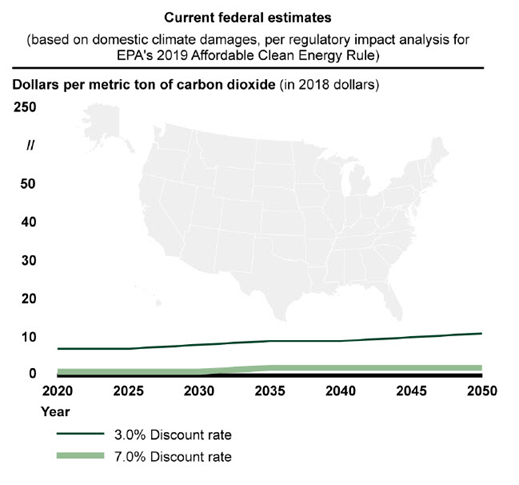
There are value-judgement choices in each step of the SCC calculation process.  As shown below different choices in only two of the many parameters lead to an Obama-era SCC value of $50 in 2020 vs. the current SCC value of $7 in 2020.  Needless to say the difference of over seven times in this value has an impact on cost benefit calculations.

To this point New York has used the Obama Administration’s SCC values developed by the Interagency Working Group on the Social Cost of Carbon (IWG).  In 2017, President Trump signed Executive Order 13783 which, among other actions, disbanded the IWG and stated that the estimates generated by the Interagency Working Group were not representative of government policy.  Currently Federal projects use SCC estimates based on the same approach as the IWG that differ in two aspects: the only damages that were considered were those in the United States and different values were used to convert to present costs. 

Figure 1: Prior and Current Federal Estimates of the Social Cost of Carbon Dioxide in 2018 U.S. Dollars, 2020-2050 from the recent GAO report show that changing just those two variables results in very different damage estimates.  As shown in the table below, at the common 3% discount rate, the prior federal estimate and the one currently used in New York was $50 but the current federal estimate is only $7. 

Prior and Current Federal Estimates of the Social Cost of Carbon, per Metric Ton, at a 3 Percent Discount Rate in 2018 U.S. Dollars

 
Year of emissionsPrior estimates (based on global climate change damages)Current estimates (based on domestic climate change damages)
2020$50$7
2030$60$8
2040$72$9
2050$82$11

Source: GAO analysis of data from the Interagency Working Group on Social Cost of Greenhouse Gases, EPA, and the United States Gross Domestic Product Price Index from the U.S. Department of Commerce, Bureau of Economic Analysis. | GAO-20-254

Initially, the social cost of carbon sounds like authoritative science.  However, the differences boil down to the value judgements used to choose the parameters used to determine the benefits of the Climate Act.  The previously mentioned NYSERDA claim that one particular aspect of the plan would lead to a levelized impact on electricity bills of less than 0.5% (or $0.35 per month for the typical residential customer) sounds great. In their words, “taking into account the value of the avoided carbon emissions, these procurements are estimated to yield a net benefit of around $7.7 billion over the lifetime of the projects”.  However, the electric bill cost is real, everyone is going to pay that and the social cost of carbon “benefit” value depends on the judgement of those developing the numbers.

Consider whether New York should address global impacts, nation-wide impacts, or for the sake of argument, just the benefits that would accrue to New Yorkers if their emissions are reduced.  There is no doubt that because there are global impacts that looking at global impacts should be considered but what value is that to a New Yorker already on the edge of energy poverty.  If the cost of energy goes up significantly, and other jurisdictions that tried to implement less ambitious GHG emissions reductions programs has seen significant increases, then those New Yorkers least able to afford energy increases will be hit hard.  Therefore, I think it is entirely appropriate to provide New Yorkers with benefits based on all three geographical coverages.

Another little recognized aspect of the SCC calculation methodology is that the costs are calculated far into the future.  Proponents argue that because most of the warming caused by carbon dioxide emissions persists for many years, changes in carbon dioxide emissions today may affect economic outcomes for centuries to come.  The GAO report notes: “To create a social cost of carbon estimate for emissions occurring in a given year, models use discounting to convert the projected monetized climate damages into a present value. This process involves reducing the damages in each future year by a percentage known as the discount rate”.   As the graphs show, a higher discount rate reduces future values to a greater degree than applying a lower discount rate. If we use a higher discount rate, then we are weighting today’s costs as more important than impacts hundreds of years in the future.  The emotional alternative is worded as leaving the world a better place for our grand-children by using a low discount rate.  Note that the Climate Act specifies using a discount rate of zero that will surely show very high social costs of carbon.  But remember that the impacts of climate change will become more evident much further in the future than our direct descendants so choosing a low discount rate that considers future impacts and current costs as equally significant not only means that our grandchildren will have to pay high prices now but won’t even see the benefits.

There is another aspect to paying now for potential damages far in the future.  The money spent today is not available to spend on projects that could alleviate future damages.  For example, if sea-level rise is a concern, then spending money today emulating the Dutch experience keeping the ocean out of their land would make more sense.  Similar arguments for many of the damages included due to climate change can also be made but are routinely ignored by proponents of a high SCC value.

Context

Finally, I want to point out that the SCC, as proposed for use in the Climate Act, has two basic flaws.  In general, there is no consideration of benefits of GHG emissions and, particular to our situation, it does not consider NY’s actions relative to the world’s actions.  The effect of the two items is related.

In most environmental impact assessments, a primary consideration is the direct consequence of the action.  In this case, if New York reduces its GHG emissions how will global warming be affected.  Prior to the passage of the Climate Act I calculated the potential change.  If the Climate Act were to stop emitting 218.1 million metric tons (1990 emissions) the projected global temperature rise would be reduced approximately 0.0032°C by the year 2050 and 0.0067°C by the year 2100.  In order to give you an idea of how small this temperature change consider changes with elevation and latitude.  Generally, temperature decreases three (3) degrees Fahrenheit for every 1,000-foot increase in elevation above sea level.  The projected temperature difference is the same as going down 27 inches.  The general rule is that temperature changes three (3) degrees Fahrenheit for every 300-mile change in latitude at an elevation of sea level.  The projected temperature change is the same as going south two thirds of a mile. 

Another aspect of environmental impact assessment is a discussion of trade-offs.  However, the social cost of carbon does not consider any of the benefits of carbon dioxide.  The “CO2 fertilization effect” — the fact that rising emissions are making plants grow better, is not considered.  The satellite data show that “there has been roughly a 14 per cent increase in the amount of green vegetation on the planet since 1982, that this has happened in all ecosystems, but especially in arid tropical areas, and that it is in large part due to man-made carbon dioxide emissions”.  More importantly, Alex Epstein in the Moral Case for Fossil Fuels makes a compelling case for using fossil fuels use because: “the cheap, plentiful, reliable energy we get from fossil fuels and other forms of cheap, plentiful, reliable energy combined with human ingenuity, gives us the ability to transform the world around us into a place that is far safer from any health hazards (man-made or natural), far safer from any climate change (man-made or natural), and far richer in resources now and in the future.”

The International Energy Agency claimed that world population without access to electricity fell below 1 billion in 2017.  In order to reduce that number further, improve access to more electricity, and reap the benefits of abundant, reliable of energy, developing countries are building fossil-fired power plants.  According to the China Electricity Council, about 29.9 gigawatts of new coal power capacity was added in 2019 and a further 46 GW of coal-fired power plants are under construction.  If you assume that the new coal plants are super-critical units with an efficiency of 44% and have a capacity factor of 80%, all the reductions provided by the Climate Act will be replaced by the added 2019 Chinese capacity in just over three years or less than an year and a quarter if the 2019 capacity and the units under construction are combined. If construction of all coal plants elsewhere were included, then the time to subsume New York reductions would be even less.

Conclusion

Up until this point the State of New York has thus far relied on a single value of the SCC.  While that may be necessary for use in calculating credits for emissions reductions, elsewhere, and particularly in the case of claimed benefits relative to the costs of the program, it is more appropriate to consider a range of values because of the massive uncertainties associated with this metric. 

The  comments on the SCC prepared by Dr. Richard Tol in a Minnesota Public Utilities Commission hearing on that state’s use of the SCC provide a technical discussion of potential problems with the SCC. Dr. Tol is Professor of the Economics of Climate Change at Vrije Universiteit Amsterdam and a Professor of Economics at the University of Sussex and has direct experience estimating the social cost of carbon.  He concludes: “In sum, the causal chain from carbon dioxide emission to social cost of carbon is long, complex and contingent on human decisions that are at least partly unrelated to climate policy. The social cost of carbon is, at least in part, also the social cost of underinvestment in infectious disease, the social cost of institutional failure in coastal countries, and so on.”

According to the National Academies, the present value of damages reflects society’s willingness to trade value in the future for value today.  The Climate Act mandates that the carbon value consider a zero discount rate that means that value in the future equals value today.  However, the fact that New York’s potential emission reductions will be subsumed by increases elsewhere means that the valuation arguments are theoretical and that in practice New York reductions are only symbolic.

The calculation and use of the SCC is complicated and subject to mis-interpretation.  Such is the case with NYSERDA’s claim noted earlier that “these procurements are estimated to yield a net benefit of around $7.7 billion over the lifetime of the projects”.  In response to my question about the calculation of lifetime benefits, Dr. Tol explained that the SCC should not be compared to lifetime savings or costs.  Therefore, the $7.7 billion net benefit claim is incorrect.

In conclusion, New Yorkers should be aware of the back story of the social cost of carbon benefits claimed to date for Climate Act projects when compared to the costs.  The costs to implement the Climate Act will be real changes to ratepayer bills.  The benefits claimed are based on numerous value judgements, ignoring world-wide emission increases that will subsume New York’s reductions, and, if lifetime benefits are claimed, are much higher than appropriate.  For all intents and purposes, today’s costs for the Climate Act will provide negligible benefits to those paying the bills.

NY Climate Act Implementation – Electric Generation De-Carbonization Pathways

On July 18, 2019, Governor Cuomo signed into law the Climate Leadership and Community Protection Act (Climate Act). It is among the most ambitious climate laws in the world and requires New York to reduce economy-wide greenhouse gas emissions 40 percent by 2030 and eliminate the use of fossil fuel for electricity production by 2040. New York’s politicians were sure that implementing these goals was simply a matter of political will so they offered no plan how it would be done.  On June 24, 2020 Energy plus Environmental Economics (E3) presented results of their emissions reductions pathway analyses to the New York Climate Action Council which gives the first inkling of what the law may suggest will be done.  This post analyzes the electric generation analysis approach.

I am following the implementation of the CLCPA closely because its implementation affects my future as a New Yorker.  Given the cost impacts for other jurisdictions that have implemented renewable energy resources to meet targets at much less stringent levels I am convinced that the costs in New York will be enormous and my analyses have supported that concern.  The opinions expressed in this post do not reflect the position of any of my previous employers or any other company I have been associated with, these comments are mine alone.

I did a post on the Pathways to Deep Decarbonization in New York State Presentation  that can be viewed on the video of the webinar.  The Pathways to Deep Decarbonization in New York State – Final Report  itself and two appendices: Appendix A: Methods and Data  and Appendix B: Literature Review of Economy-Wide Deep Decarbonization and Highly Renewable Energy Systems  were included in the meeting materials.  This post addresses electric generation in the final report and Appendix A.

E3 Modeling

The E3 analysis uses models to simulate which combinations of resources can be used to meet the Climate Act goals, how the transmission grid can provide those resources and the renewable capacity needed to maintain reliability.  I will address these three models below.

E3 used their PATHWAYS model to “create strategically designed scenarios for how the State can reach its 2030 and 2050 GHG goals. The model is built using ‘bottom-up’ data for all emissions produced and energy consumed within the State.   It identifies GHG reduction measures from transportation, buildings, industry, electricity, and other sectors, and captures interactions among measures to create a detailed picture of emissions reductions and costs through 2050”.  E3 notes “that as a ‘stock rollover’ model, PATHWAYS considers realistic timing of investments to replace appliances, vehicles, buildings, and other infrastructure. It pays special attention to the dynamics between electricity generation and new loads from transportation and buildings, as well as the role of low-carbon fuels such as advanced biofuels, hydrogen, and synthetic fuels”.

I believe there is a major problem with their “stock rollover” model.  As far as I can tell, it does not consider the readiness of the technology proposed.  The International Energy Agency (IEA) recently published “Special Report on Clean Energy Innovation” that notes:

“Without a major acceleration in clean energy innovation, net-zero emissions targets will not be achievable. The world has seen a proliferating number of pledges by numerous governments and companies to reach net-zero carbon dioxide (CO2) emissions in the coming decades as part of global efforts to meet long-term sustainability goals, such as the Paris Agreement on climate change. But there is a stark disconnect between these high-profile pledges and the current state of clean energy technology. While the technologies in use today can deliver a large amount of the emissions reductions called for by these goals, they are insufficient on their own to bring the world to net zero while ensuring energy systems remain secure – even with much stronger policies supporting them.”

I have shown that E3 ignored these limitations in its assessment of the technology needed to provide electricity when they claimed “Deep decarbonization in New York is feasible using existing technologies”.  That statement mis-characterizes the actual situation.  As IEA points out feasibility depends upon making all parts of the technological application process, what they call the value chain, commercially viable.  The fact is that for the E3 technologies proposed to address the winter peak problem, one or more aspects of commercial viability, availability limitations, or public perception make the E3 recommendations risky bets for future reliability and affordability.

In order to consider effects of the transmission grid on the de-carbonization effort, E3 used their RESOLVE model:

Our modeling approach also incorporates detailed electricity sector representation using E3’s RESOLVE model. RESOLVE is used to develop least-cost electricity generation portfolios that achieve New York’s policy goals, including 100% zero-emission electricity, while maintaining reliability.

For this study, RESOLVE was configured with six zones: two zones representing the upstate and downstate portions of the New York electricity system and four zones representing the external markets that interact with New York.

It is beyond the scope of my analysis to quantitatively determine whether this resolution is sufficient to represent the New York grid relative to the generation portfolios.  Qualitatively, however, the fact that New York City, which has specific transmission load constraints and a requirement for a minimum level of in-city generation, is lumped with Long Island suggests that this is a significant deficiency.

In my comments on the resource adequacy hearing and elsewhere I have argued that actual short-term meteorological data must be used to correctly characterize the renewable resource availability for New York in general and in areas downwind of the Great Lakes in particular. This is because the lakes create meso-scale features, most notably lake-effect snow and clouds, that can affect solar resources many miles from the lake shore. It is important that the solar and wind resources be evaluated based on geographically representative short-term data so that site-specific temporal effects can be included. E3 calculates the “effective load-carrying capability” which they define as the amount of “perfect capacity” that could be replaced or avoided with wind, solar, or storage while providing equivalent system reliability.

The values in this analysis were developed using E3’s reliability model, RECAP. The model assesses generation resource adequacy for a power system based on loss-of-load probability analysis but is inherently flawed for this application because it does not consider the observed renewable resource availability which can only be quantified by a detailed look at historical meteorological data such as I have proposed.

Electricity Demands

E3 correctly notes that it will be challenging to meet increased electricity demand due to electrification of vehicles and buildings while at the same time reducing, and eventually eliminating, GHG emissions while maintaining system reliability.  E3 predicts that electricity demand may increase by 65% to 80% depending on the “scale and timing of electrification”.  The electricity requirements depend upon how much of a role bio-fuels and synthetic fuels can play in replacing fossil fuels.  This analysis suffers from the lack of consideration of technical readiness for those technologies.  The IEA report lists very few bio-fuel and synthetic fuel technologies that have reached sizeable deployment and have all designs and underlying components at high technological readiness levels.

Peak Demands

The report explains that the transformation will “change the timing and magnitude of consumers’ electricity demands and create a “winter peaking” system in New York, owing to new demands from electric space heating”.  They go on to claim “Flexibility in electric vehicle charging patterns and building loads can significantly reduce peak demands and the need for new electric generating capacity. Flexible loads can serve a similar role to battery storage, shifting demand to times of high renewables output.”

“Figure 17 illustrates this evolution of the system peak—and the impacts of electric load flexibility over time”.  Because I think winter load is the greater future concern, I will discuss winter instead of summer information.  Figure 17 Annual summer and winter peak electricity demands shows how the peak electricity demand is expected to change.  I was unable to find the corresponding data for the annual summer and winter peak electricity demands portion shown in the figure but I estimate from the figure that the winter statewide peak load will be 24 GW in 2020 and in 2050 the peak load will be 35 GW with flex loads and 43 GW without flex loads.

The bottom portion of Figure 17 Average hourly loads by month is confusing at first glance.  It shows the average hourly load as it varies by each month.  E3 used their models to generate load shapes and develop their claim that there is 8 GW of peak load shaving available in 2050.  There is insufficient information to critique that claim but I am struck by the appearance of the 2020 and 2050 hourly load shapes.  In 2020 heating is a small component of load but in 2050 it will be much larger.  Consequently, I expect that the components of the load shape will change so I would expect some kind of change in the shape.  Instead it appears that the load is just larger and there is no change in the shape.  Importantly it is not clear why the load can be shaved.  Where do you shift the heating component that makes up the sharp increase early in the morning?  If you heat your home at 3:00 AM it will be cold by 7:00 AM during the peak.  Moreover, note that there does not appear to be as much flex load available at the peak later in the day that is roughly the same magnitude.  Consequently, I am not convinced of their arguments that 8 GW of load can be shaved off the winter peak.

Resource Portfolios

E3 claims that New York State has “access to diverse in-state renewable energy resources and zero-emissions technology options, as well as access to adjoining states, provinces, and regional transmission systems which offer additional options for zero-emissions energy supply”.  The E3 analysis used their RECAP model to determine “the new resources required to reliably meet electricity demand in buildings, transportation, and industry with 100% zero-emissions electricity for the upstate and downstate regions of New York”.

Although E3 claims that their analysis models the reliability contributions of intermittent and limited-duration resources, the fact that they did not use a comprehensive and more representative meteorological data set as input makes that claim weak in my opinion.  The worst-case reliability problem in the no-fossil-fuel future is very likely to be the worst-case wind and solar resource availability period not the peak load.  Unfortunately, it is possible that the winter conditions that create future peak loads may also exacerbate renewable resource availability so the two conditions may overlap.  I don’t think anyone has adequately addressed this issue yet.

E3 claims: Our analysis finds that New York can reliably meet growing electricity loads with 100% zero-emissions electricity by relying on a diverse mix of resources, including:

          • Onshore and offshore wind
          • Large-scale and distributed solar
          • In-state hydro and existing and new hydro imports from Quebec
          • Existing nuclear capacity
          • Existing and new combined cycles (CC) and combustion turbines (CT) utilizing zero-emissions biogas
          • New natural gas-fired combined cycles with carbon capture and sequestration (CC-CCS)

Eventually I will try to quantify the resources of each of these resources so that I can compare their projections with others.  The lack of data in this regard makes that task daunting.  I do want to make one observation.  Figure 18, Projected Installed Capacity (top) and Annual Electricity Generation (bottom), shows huge increases in bioenergy installed capacity in both scenarios.  However, note that the annual generation for those categories is small.  I cannot imagine a business case for developing that kind of capacity for such limited output so I believe it is likely that bioenergy will have to be heavily subsidized to make it available as they propose.

Transmission

E3 explains:

New investments in transmission will be needed to enable the delivery of 100% zero-emission electricity, including:

          • Local transmission upgrades to integrate new renewable resources
          • Additional transmission to deliver renewable resources from other regions, especially Quebec, into New York
          • Bulk transmission capacity from upstate New York to downstate load centers

Although New York has started the process of adding bulk transmission capacity it is not clear how much more will be needed.  I have yet to see anyone explain if any of the off-shore wind will be considered in-city generation for reliability purposes.  The DPS White Paper on CES procurements to implement the Climate Act includes a proposal for a Tier 4 procurement to encourage will directly extend financial support for renewable energy delivered into the New York City control zone but that discussion did not address in-city generation requirements.

 Firm Capacity

E3 explains that “Firm capacity is the amount of energy available for power production which can be guaranteed to be available at a given time. As the share of variable resources like wind and solar grows substantially, firm capacity resources will be needed to ensure year-round reliability, especially during periods of low renewables output.”

Firm capacity allows the system to have adequate resources available during prolonged periods of low renewable energy output. I agree with the E3 description that “The State’s need for firm resources would be most pronounced during winter periods of high demand for electrified heating and transportation and lower wind and solar output”.  E3 says that the hourly loads in their analysis are based on six years of historical weather 2007-2012.  I asked E3 what monitoring locations were used but never heard back.  I believe these data are from the National Weather Service climatological sites.  If that is the case they are not representative of the whole of New York and that NYS Mesonet data available from every county in the State should be used instead.

Conclusion

The first proposal to meet the Climate Act targets that was presented to the Climate Action Council can only be considered an overview.  The E3 analysis does not impress me.  While their models give the veneer of respectability to the projections, the reality is that the inherent over-simplifications of their models under-estimates the difficulties of the transition in New York and gives a false sense of security to their assurances that implementation will succeed.

Despite the limitations, the analysis does make important points.  I agree with their conclusion that the transition will “change the timing and magnitude of consumers’ electricity demands and create a “winter peaking” system in New York, owing to new demands from electric space heating”.  They point out that a multi-day period of low renewable energy availability will be a particular problem in the winter and state that: “Firm capacity is the amount of energy available for power production which can be guaranteed to be available at a given time. As the share of variable resources like wind and solar grows substantially, firm capacity resources will be needed to ensure year-round reliability, especially during periods of low renewables output.”

After their presentation to the Climate Action Council, members asked E3 about the use of renewable natural gas as one of the firm capacity resources.  Apparently, some believe that renewable natural gas is not a renewable energy resource according to the Climate Act.  Be that as it may, I suspect that E3 has found that without sufficient firm capacity resources the only alternative to maintain reliability will be extraordinary amounts of energy storage.  Energy storage is very expensive and E3 might have included renewable natural gas energy to limit energy storage use to keep the costs down.

Although E3 claims to bring “clear, unbiased analysis to the critical issues facing the energy industry today” I don’t think that is possible to be unbiased and work for the New York Climate Action Council.  New York’s Climate Act is predicated upon the belief that decarbonization is only a matter of political will.  Unfortunately, that belief is inconsistent with the firm capacity challenge for the winter peak.  It will be interesting to see how the Council deals with inconvenient issues that challenge the notion that this transition is not pushing the envelope of electric system reliability.

NY Climate Leadership and Community Protection Act “Benefits”

I was prompted to prepare this post while reading the White Paper on Clean Energy Standard Procurements to Implement New York’s Climate Leadership and Community Protection Act (white paper) prepared by the New York Department of Public Service (DPS) and the New York State Energy Research and Development Authority (NYSERDA) because that document claims a “net benefit of around $7.7 billion” over the lifetime of projects they believe are required to meet the goal that 70% of electric energy will be produced by renewable energy by 2030 (70 by 30).  Although I have written about the approach used by the State before I believe it is necessary to re-iterate my concerns in the current context.

I am a retired electric utility meteorologist with nearly 40-years experience analyzing the effects of meteorology on electric operations. I believe that gives me a relatively unique background to consider the potential quantitative effects of energy policies based on doing something about climate change.  The opinions expressed in this post do not reflect the position of any of my previous employers or any other company I have been associated with, these comments are mine alone.

Background

In the summer of 2019 the Governor Cuomo and the New York State Legislature passed the Climate Leadership and Community Protection Act (Climate Act) which was described as the most ambitious and comprehensive climate and clean energy legislation in the country when Cuomo signed the legislation.

The legislation includes not only the 70 by 30 requirement but also a mandate to eliminate all fossil fuel use in the electricity sector by 2040. I have written a series of posts on the feasibility, implications and consequences of this aspect of the law based on evaluation of data.

Unfortunately, the politicians that passed the Climate Act never bothered to figure out how it could be done.  Among problems to resolve are development of a plan for renewable resources and an implementation plan to pay for those resources.  The DPS has a mandate to establish a program whereby jurisdictional load serving entities (today’s jargon for what used to be called the electric utilities) secure renewable energy resources to serve the 70 by 30 target.  The white paper explains how they propose to do this.  It includes the following:

        • Description of the key provisions in the Climate Act relating to the 70 by 30, including the role of jurisdictional LSEs and the definition of renewable energy systems;
        • Projection of the quantity of renewable energy that must be deployed to achieve 70 by 30;
        • Establishes average annual procurement targets for different tiers in the existing procurement process;
        • Proposal for a new tier for the procurement process; and
        • Cost and benefit analysis.

The following quote from the cost and benefit analysis sparked my interest:

“NYSERDA estimates that the proposed Tier 1 procurements, as set out in Section II.c.1 below, – from 2021 to 2026 – would lead to a levelized impact on electricity bills of less than 0.5% (or $0.35 per month for the typical residential customer). Taking into account the value of the avoided carbon emissions, these procurements are estimated to yield a net benefit of around $7.7 billion over the lifetime of the projects.”

This post will show the fallacies in this benefit claim.

Social Cost of Carbon

It is New York State policy to calculate benefits of greenhouse gas emission reductions using the Social Cost of Carbon (SCC).  The SCC is the present-day value of projected future net damages from emitting a ton of CO2 today.  In order to estimate the impact of today’s emissions it is necessary to estimate total CO2 emissions, model the purported impacts of those emissions and then assess the global economic damage from those impacts.  The projected global economic damage is then discounted to the present value. Finally, the future damage is allocated to present day emissions on a per ton basis to get the SCC value.

I have previously argued that there are several technical reasons that the single value the State of New York has thus far relied on should not be used exclusively.  It is more appropriate to consider a range of values because of the massive uncertainties associated with this metric.  The  comments on the SCC prepared by Dr. Richard Tol in a Minnesota Public Utilities Commission hearing on that state’s use of the SCC better explain potential problems with the SCC.

Dr. Tol is Professor of the Economics of Climate Change at Vrije Universiteit Amsterdam and a Professor of Economics at the University of Sussex and has direct experience estimating the social cost of carbon.  In his testimony, Tol explains that there are differences between SCC and traditional damages cost methodologies: “The causal chain for the social cost of carbon is rather long, complex and contingent. In this way it is different from the traditional damages cost methodology for a pollutant like mercury or lead.”  He uses a couple of examples to explain that the many interactions between purported changes to the environment from a changed in the greenhouse effect due to a ton of CO2 depend upon assumptions every step of the way which makes it “rather difficult to the climate effects of CO2 emissions.”  He concludes: “In sum, the causal chain from carbon dioxide emission to social cost of carbon is long, complex and contingent on human decisions that are at least partly unrelated to climate policy. The social cost of carbon is, at least in part, also the social cost of underinvestment in infectious disease, the social cost of institutional failure in coastal countries, and so on.”

My biggest concern is that tweaking any one of many inputs to the SCC calculation radically change the results. New York uses the SCC values developed by the Obama administration. In 2017, President Trump signed Executive Order 13783 which modified two aspects of the calculation:  only considering damages occurring within the United States and employing discount rates of 3 percent and 7 percent for the use of this parameter in regulatory policy. The Obama values used global damage numbers and discount rates of 2.5 percent, 3 percent, and 5 percent. The difference between those two assumptions results in a SCC for domestic economic impacts at a 7 percent discount rate would be $2.20 in the year 2050, while the SCC for global economic impacts at a 2.5 percent discount rate would be $100.62. These changes reflect economic and policy judgements without advising the public what is happening.  When the costs hit the consumers, someone is going to have a lot of explaining to do.

Lifetime Benefits

Despite these issues, New York State uses the SCC without conditions to claim benefits from their proposed investments.  The white paper states “Taking into account the value of the avoided carbon emissions, these procurements are estimated to yield a net benefit of around $7.7 billion over the lifetime of the projects.”  NYSERDA regularly calculates benefits based on the lifetime of their projects.  This is a different approach than that used in air pollution control regulation cost reduction calculations.  In the Environmental Protection Agency’s Reasonably Available Control Technology rule when you calculate the cost effectiveness of a control program, the cost of the control system is divided by the annual emissions reduction to get the dollars per ton reduced.  There is no consideration of lifetimes.

If you are interested in the cost of the Climate Act, you need to know the annual reductions possible from technologies implemented to reduce emissions.  The Climate Act specifies reductions from 1990 annual emissions so the apples to apples comparison is the annual reduction.  On the other hand, in a NYSERDA energy efficiency program, the avoided energy saved by the efficiency program equates to money saved.  It seems reasonable to count the total savings to the ratepayer.

When it comes to the SCC, I believed that it was inappropriate to consider lifetime savings but could not find anything specific in the literature to validate my belief.  I contacted Dr. Tol and asked the following question:

There is a current proceeding where NYSERDA is claiming that their investments are cost-effective but they use life-time benefits.  I concede that the ratepayer cost-benefit calculation should consider the life-time avoided costs of energy and can see how that reasoning might also apply to the social cost of carbon.  However, in the following definition, SCC is the present-day value of projected future net damages from emitting a ton of CO2 today, I can interpret that to mean that you shouldn’t include the lifetime of the reduction.  Am I reading too much into that?

His response explains that the use of life-time savings or costs is inappropriate:

Dear Roger,

Apples with apples.

The Social Cost of Carbon of 2020 is indeed the net present benefit of reducing carbon dioxide emissions by one tonne in 2020.

It should be compared to the costs of reducing emissions in 2020.

The SCC should not be compared to life-time savings or life-time costs (unless the project life is one year).

stay healthy

Richard

Dr. Richard S.J. Tol MAE
Professor
Department of Economics, Room 281, Jubilee Building
University of Sussex, Falmer, Brighton BN1 9SL, UK

Conclusion

I am convinced that the majority of New York State ratepayers are unaware of the ramifications of the Climate Act and even if they know about it, it is unlikely that they know how the state calculates its claims that the costs will be out-weighed by the benefits.  In this instance, the quotation: “there are three kinds of falsehoods, lies, damned lies and statistics” could be modified to “there are three kinds of falsehoods, lies, damned lies and climate benefit estimates”.

This post explains that the SCC is a weak tool for climate policy.  I am most concerned that the SCC values are not robust because small changes in any of the large number of assumptions give contradictory results.  When used in policy making, like the Climate Act, the values chosen are politically expedient rather scientifically based.  The costs of the Climate Act will be enormous and I believe it is incumbent upon its advocates to explain their analyses and use of the SCC.

However, this post also shows that even if you accept the SCC as a valid approach and use the values chosen by New York, then the cost benefits claimed by NYSERDA, in general, and the white paper, in particular, are flawed because they rely on life-time benefits.  Today’s SCC is the net present benefit of reducing carbon dioxide emissions by one ton this year.  The SCC should not be compared to life-time savings or life-time costs.  As a result, the claim that the “procurements are estimated to yield a net benefit of around $7.7 billion over the lifetime of the projects” is wrong.


NY Climate Act Implementation – IEA Special Report on Clean Energy Innovation

Update July 6, 2020: I looked at the ETP Clean Energy Technology Guide in more detail and found their ratings for anerobic digesters.  I have modified the relevant section.

On July 18, 2019, Governor Cuomo signed into law the Climate Leadership and Community Protection Act (Climate Act). It is among the most ambitious climate laws in the world and requires New York to reduce economy-wide greenhouse gas emissions 40 percent by 2030 and eliminate the use of fossil fuel for electricity production by 2040. New York’s politicians were sure that implementing these goals was simply a matter of political will so they offered no plan how it would be done.  The International Energy Agency (IEA) recently published “Special Report on Clean Energy Innovation” that directly relates to this implementation effort that I believe should be required reading for New York’s Climate Action Council.

I am following the implementation of the CLCPA closely because its implementation affects my future as a New Yorker.  Given the cost impacts for other jurisdictions that have implemented renewable energy resources to meet targets at much less stringent levels I am convinced that the costs in New York will be enormous and my analyses have supported that concern.  The opinions expressed in this post do not reflect the position of any of my previous employers or any other company I have been associated with, these comments are mine alone.

On June 24, 2020 Energy plus Environmental Economics (E3) presented results of their emissions reductions pathway analyses to the New York Climate Action Council which gives the first inkling of what the law’s supporters acknowledge will have to be done.  I took issue with the presentation’s claim that “Deep decarbonization in New York is feasible using existing technologies” previously and in this post will highlight key points made in their Special Report on Clean Energy Innovation (“EIA Report”) that are relevant to New York’s Climate Act Implementation.

Introduction

New York’s Climate Act requires that the Climate Action Council prepare a plan for “net zero emissions in all sectors of the economy” in the following:

§ 75-0107. Statewide greenhouse gas emissions limits.

1. No later than one year after the effective date of this article, 24 the department shall, pursuant to rules and regulations promulgated after at least one public hearing, establish a statewide greenhouse gas emissions limit as a percentage of 1990 emissions, as estimated pursuant to section 75-0105 of this article, as follows:

a. 2030: 60% of 1990 emissions.

b. 2050: 15% of 1990 emissions.

§ 75-0103. New York state climate action council.

11. The council shall on or before two years of the effective date of this article, prepare and approve a scoping plan outlining the recommendations for attaining the statewide greenhouse gas emissions limits in accordance with the schedule established in section 75-0107 of this article, and for the reduction of emissions beyond eighty-five percent, net zero emissions in all sectors of the economy, which shall inform the state energy planning board’s adoption of a state energy plan in accordance with section 6-104 of the energy law. The first state energy plan issued subsequent to completion of the scoping plan required by this section shall incorporate the recommendations of the council.

The E3 presentation echoes the belief of the supporters of the Climate Act that achieving the net zero goal is essentially just a matter of political will.  However, the IEA report suggests that optimism is mis-placed:

“Without a major acceleration in clean energy innovation, net-zero emissions targets will not be achievable. The world has seen a proliferating number of pledges by numerous governments and companies to reach net-zero carbon dioxide (CO2) emissions in the coming decades as part of global efforts to meet long-term sustainability goals, such as the Paris Agreement on climate change. But there is a stark disconnect between these high-profile pledges and the current state of clean energy technology. While the technologies in use today can deliver a large amount of the emissions reductions called for by these goals, they are insufficient on their own to bring the world to net zero while ensuring energy systems remain secure – even with much stronger policies supporting them.”

Analysis

In order to focus my analysis on a manageable component of the Climate Act implementation plan I am going to address one component of the electric sector de-carbonization pathway.  E3 and I agree that the biggest problem for a de-carbonized electric system is going to be the winter peak when solar resources are low and the potential for a large high-pressure system could mean that wind resources are near zero for several days.  E3 claims the New York winter statewide peak load will be 24 GW in 2020 and in 2050 the peak load will be 35 GW with flex loads and 43 GW without flex loads when the added demands of electrifying transport and heating are added to the system. E3 offered a combination of five options to meet the challenge: large-scale hydro resources, renewable natural gas, synthetic fuels such as hydrogen, Carbon Capture Storage (CCS), and nuclear power.  I will look at these technologies with respect to the IEA report and feasibility in New York to determine if the 2040 de-carbonized electric system goal is realistic.

There are two technologies listed that are mature and have long histories of development: large-scale hydro resources and nuclear power.  However, New York needs additional resources to meet this demand challenge and I believe it is unlikely that either technology can be counted on in New York.  Although nuclear should be considered the fact that the completed nuclear power plant at Shoreham was never operated, the closing of one operational unit at Indian Point in 2020, and the planned closing of the last operational unit at Indian Point in 2021 suggests that new nuclear in New York is extremely unlikely.  I am comfortable saying that there are no significant sources of undeveloped hydro available much less permittable in New York.  There is a potential for Canadian hydro-power that will likely be considered.

The remaining three technologies are still in the “clean energy innovation pipeline” described in the IEA report.  IEA explains:

“Innovation is not the same as invention. After a new idea makes its way from the drawing board to the laboratory and out into the world, there are four key stages in the clean energy innovation pipeline. But this pathway to maturity can be long, and success is not guaranteed:

Prototype: A concept is developed into a design, and then into a prototype for a new device (e.g. a furnace that produces steel with pure hydrogen instead of coal).

Demonstration: The first examples of a new technology are introduced at the size of a full-scale commercial unit (e.g. a system that captures CO2 emissions from cement plants).

Early adoption: At this stage, there is still a cost and performance gap with established technologies, which policy attention must address (e.g. electric and hydrogen-powered cars).

Mature: As deployment progresses, the product moves into the mainstream as a common choice for new purchases (e.g. hydropower turbines).”

The EIA report notes that de-carbonization comes from four main technology approaches. These are the electrification of end-use sectors such as heating and transport; the application of carbon capture, utilization and storage; the use of low-carbon hydrogen and hydrogen-derived fuels; and the use of bioenergy. EIA explains that each of these areas faces challenges in making all parts of the technological application process, what they call the value chain, commercially viable in the sectors where reducing emissions is hardest.  The IEA report uses the technology readiness level (TRL) scale (complete description in Box 3.2 on page 67) to assess where a technology is on its journey from initial idea to market use.  Their evaluation of the TRL for different de-carbonization technologies is summarized in three figures: Figure 3.2 TRL of technologies along the low-carbon electricity value chain, Figure 3.3 TRL of technologies along the CO2 value chain, and Figure 3.4 TRL of technologies along the low-carbon hydrogen value chain.

Figure 3.2 notes that hydropower and nuclear are mature technologies.  While it is straying from my intent to discuss only those technologies proposed for the winter peak, it is interesting that solar PV, solar thermal, wind, and hydrogen from water electrolysis are all listed as an early adoption TRL. 

E3 claims that Carbon Capture Storage (CCS) can be used to address the winter peak.  The EIA report notes that capture, transport and utilization or storage of CO2 emissions as a successful decarbonization strategy hinges on the commercial availability of technologies at each stage of the process as well as on the development and expansion of CO2 transport and storage networks at a sizeable scale (Figure 3.3). In this instance I assume that E3 is referring to CCS combined with natural gas combustion.  According to the EIA report natural gas electricity production coupled with chemical absorption has a demonstration TRL.  The feasibility issue in New York may ultimately be storage because there is no oil production to enhance.  Storage in saline formations has an early adoption TRL but New York refused to allow propane storage because of its impact on community character so I would imagine this could not be permitted either.

E3 claims that “synthetic fuels such as hydrogen” can be used to address the winter peak. I am going to only consider hydrogen synthetic fuel production and that is covered in Figure 3.4.  The EIA report notes:

“The value chain for low-carbon hydrogen is not completely developed at commercial scale today. It comprises many technologies that are necessary to produce, transport, store and consume low-carbon hydrogen, each of them at a different stage of maturity and facing specific technical challenges (Figure 3.4)”. 

The pathway report only mentions the use of hydrogen but not how it would be used for the winter peak.  I assume that E3 proposes to use hydrogen production from electrolysis and that has an early adoption TRL.  In order to have it available for use during the winter peaks it will need to be shipped and stored.  The hydrogen infrastructure for pipelines and tanks are both rated as mature technologies.  If the hydrogen is supposed to be used for heating hydrogen boilers and fuel cells have an early adoption TRL but hydrogen-driven fuel cells only have a large prototype TRL.  If the hydrogen is supposed to be used to generate electricity then high-temperature fuel cells have an early adoption TRL and hydrogen-fired gas turbines have a large prototype TRL.

Updated July 6, 2020: E3 also proposes to use renewable natural gas from anerobic digesters to address the winter peak problem.  I could not find a category in these three figures that I think fits this technology in the EIA report.  The poster version of the technology guide rates biogas from a non-algae feedstock as “Commercial Operation In Relevant Environment – Solution is commercially available, needs evolutionary improvement to stay competitive”. There are questions about the collection and storage infrastructure needed to transport and store it for the winter peak demand as well as how much gas is available relative to the need for the winter peak.  

Conclusion

I believe that this report underscores my belief that the statement “Deep decarbonization in New York is feasible using existing technologies” mis-characterizes the actual situation.  As EIA points out feasibility depends upon making all parts of the technological application process, what they call the value chain, commercially viable.  The fact is that for the technologies proposed to address the winter peak problem, one or more aspects of commercial viability, availability limitations, or public perception make the E3 recommendations risky bets for future reliability and affordability.

I suggest that it would be better for the State to take a measured approach rather than the all-in approach currently envisioned.  The fact is that we don’t know what will work best for New York so it would be better to have a plan that could be adjusted as necessary.  The IEA proposes five innovation principles that I think would be appropriate for New York to incorporate in their Climate Act implementation process. 

For governments aiming to achieve net-zero emissions goals while maintaining energy security, these principles primarily address national policy challenges in the context of global needs, but are relevant to all policy makers and strategists concerned with energy technologies and transitions:

Prioritise, track and adjust. Review the processes for selecting technology portfolios for public support to ensure that they are rigorous, collective, flexible and aligned with local advantages.

Raise public R&D and market-led private innovation. Use a range of tools – from public research and development to market incentives – to expand funding according to the different technologies.

Address all links in the value chain. Look at the bigger picture to ensure that all components of key value chains are advancing evenly towards the next market application and exploiting spillovers.

Build enabling infrastructure. Mobilise private finance to help bridge the “valley of death” by sharing the investment risks of network enhancements and commercial-scale demonstrators.

Work globally for regional success. Co-operate to share best practices, experiences and resources to tackle urgent and global technology challenges, including via existing multilateral platforms.