Energy Efficiency & Housing Advisory Panel Enabling Strategies Submitted to Climate Action Council

On July 18, 2019 New York Governor Andrew Cuomo signed the Climate Leadership and Community Protection Act (CLCPA), which establishes targets for decreasing greenhouse gas emissions, increasing renewable electricity production, and improving energy efficiency.  According to a New York State Department of Environmental Conservation (DEC) bulletin dated May 10, 2021, the Advisory Panels to the Climate Action Council have all submitted recommendations for consideration in the Scoping Plan to achieve greenhouse gas (GHG) emissions reductions economy-wide.   My posts describing and commenting on the strategies are all available here. This post addresses the Energy Efficiency & Housing Advisory Panel enabling strategy recommendations.

I have written extensively on implementation of the CLCPA closely because I believe the solutions proposed will adversely affect reliability and affordability, will have worse impacts on the environment than the purported effects of climate change, and cannot measurably affect global warming when implemented.   I briefly summarized the schedule and implementation CLCPA Summary Implementation Requirements.  I have described the law in general, evaluated its feasibility, estimated costs, described supporting regulationssummarized some of the meetings and complained that its advocates constantly confuse weather and climate in other articles.  The opinions expressed in this post do not reflect the position of any of my previous employers or any other company I have been associated with, these comments are mine alone.

Energy Efficiency & Housing Emissions

Although the presentations all follow the same format the details differ.  One of the more important components of the presentations is the emissions estimates and they all include a graphic showing historical emissions in 1990, “preliminary draft” emissions for 2018, and their projections for 2030 and 2050.  The 1990 emissions were defined in the Department of Environmental Conservation’s Part 496 regulations but the sectors used in that regulation are not comparable to this advisory panel’s sector.  In the following graph 1990 emissions are 103 million metric tons (MMt) of carbon dioxide equivalent[1] (CO2e) and 2018 preliminary draft emissions are 115 MMt. 


[1] The amount of carbon dioxide by mass that would produce the same global warming impact as the given mass of another greenhouse gas over a specific time frame, as determined by the IPCC, and as provided in Section 496.5 of this Part.

There are two emission reduction targets in the CLCPA: 40% reduction in GHG emissions by 2030 and 85% reduction in GHG Emissions by 2050.   The projected total reductions emission reduction goals for this advisory panel don’t meet either target only projecting a 27% reduction from 1990 by 2030 and a reduction of 83% by 2050. 

This sector was the largest source of greenhouse gas (GHG) emissions in 2018 but there are two caveats.  The New York emission inventory includes upstream GHG emissions and the emission rates for methane are high so over half the emissions relative to combustion come from imported fossil fuels.  In a rational world that observation would suggest an analysis to see why such an illogical outcome is observed but in the CLCPA it is a feature not a possible flaw.  The other factor is that refrigerants are a large component of the total because the global warming potential for HFC is high. 

Energy Efficiency & Housing Strategies

According to the meeting presentation, the advisory panel proposed the following four mitigating strategies and six enabling strategies:

  • Mitigation strategy 1: Phase out fossil fuel use in buildings
  • Mitigation strategy 2: Require benchmarking
  • Mitigation strategy 3: Shift reliance on fossil gas to clean energy system
  • Mitigation strategy 4: Shift reliance on HFC use as refrigerant and in all products used in construction
  • Enabling strategy 1: Public financial incentives
  • Enabling strategy 2: Public and private low-cost financing
  • Enabling strategy 3: Workforce
  • Enabling strategy 4: Consumer education
  • Enabling strategy 5: Innovation
  • Enabling strategy 6: Embodied carbon

The recommendations themselves are available in a slide presentation.  I am not going to critique all these strategies because it would take far too long.  Instead, I will comment on some of the strategies with an emphasis on inconsistencies and implementation issues. 

There is no question that meeting the CLCPA goals for this sector will be a challenge.  The presentation explains that there are 6.2 million buildings in New York State: 4.9m single family homes, 250k multifamily buildings, and 370k commercial/institutional buildings.  The first mitigation strategy is to phase out fossil fuel use in buildings.  Obviously “Eliminating GHG emissions from New York’s building stock by 2050 will require broad, systemic changes”.

The Energy Efficiency and Housing presentation to the Climate Action Council presentation summarizes the first initiative to modify building codes and standards in this strategy in the following slide.  The plan is to amend the state codes for new construction, including additions and alterations, to require solar PV on “feasible” areas, grid-interactive electrical appliances, energy storage readiness, electric readiness for all appliance and electric vehicle readiness.  They propose to adopt these all-electric state codes for single family residences by 2025 and for multifamily and commercial buildings by 2030. The presentation notes that by 2030, more than 200,000 homes per year will be upgraded to all-electric and energy efficient standards.
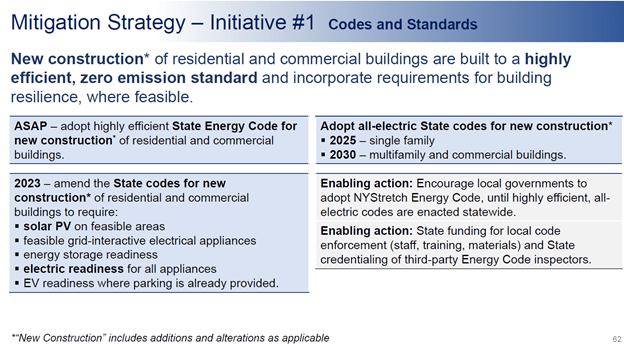
I suspect most people are like me and don’t understand what some of these terms mean and how it will affect my personal choices if I want to buy a new house or remodel my existing house in 2025. Solar panels will be required where “feasible” but feasibility is not defined.  Electric readiness means “The installation of electrical service and panel capacity, conduit, fixtures, and outlets for a future installation of electric equipment for space heating and cooling, hot-water, cooking, and laundry”.  This initiative proposes to prohibit (“at end of useful life”) gas or oil replacements of “heating, cooling and domestic hot water equipment” in single family homes by 2030 so it makes sense to install the electric infrastructure sooner.  Electric vehicle readiness is defined as the “installation of electrical service and panel capacity, conduit, fixtures, and outlets for a future installation of EV chargers”.  The transportation advisory panel has proposed that all new vehicles sold by 2030 will be electric vehicles so this is another consistent requirement. 

I was surprised that there was a requirement for energy storage readiness: “The installation of electrical service and panel capacity, conduit, fixtures, and outlets for a future installation of electric batteries”.  The biggest problem with solar energy is its intermittency and the advisory panel is proposing that homeowners help provide a solution by providing space for the batteries and footing the bill for the electrical service.  I suspect there will eventually be a requirement to install the batteries themselves but not to worry because the panel suggests that this will pay for itself by providing revenues.   The most intrusive aspect of this proposal is the requirement for grid-interactive electrical appliances “as feasible (e.g., batteries, hot water heaters)”.  For batteries the ability of the grid operator to call up your stored energy when needed makes sense but I am not comfortable having someone else decide when I can have hot water.  Moreover, heating and cooling appliances surely will eventually be grid-interactive too.  Proponents point out that capability would have helped reduce the impacts of the Texas February 2021 blackouts but cynics like me argue that the existing system does not need that capability because fossil fuels work better.

The presentation to the Climate Action Council notes that “Electrification of heating and hot water systems in nearly all buildings is a key strategy for building decarbonization and depends upon energy efficiency improvements in all buildings and 100% zero-emissions electricity by 2040 under the Climate Act”.  The second mitigation strategy sets benchmarking standards for building energy use.  New York State has a long history of support for energy efficiency.  I have long argued that the fatal flaw of the CLCPA is that it presumes that the targets are achievable despite the lack of a feasibility study to determine whether achieving the targets would adversely affect affordability and reliability.  In that context the question is where does the state stand vis-à-vis the energy efficiency needed for all-electric heating systems.  While converting to heat pumps is an overall energy use improvement, direct combustion on-site is more efficient actually warming homes because it provides hotter air.  The only way to be comfortable using heat pumps is to have an extremely well insulated building.

Also included in this initiative is another buried cost.  In particular, there are energy use disclosure requirements:

  • Starting in 2025-Require owners of all residential and commercial buildings to obtain and publicly disclose, as part of sale or lease listing of a building, housing unit, or commercial space, the prior-year energy consumption of the building, unit, or space (e.g., at least 12 consecutive months of energy bill data).
  • Starting in 2027–Require owners of single-family buildings to obtain and disclose an energy performance rating (e.g., a Home Energy Rating System (HERS) index) as part of sale listing.

The cost of these requirements will be borne by the owners.

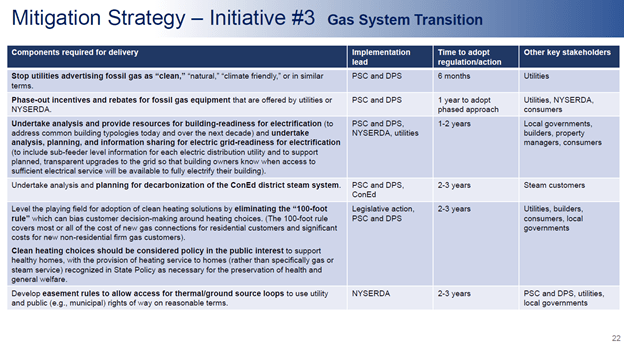
The third mitigation strategy initiative is entitled “Gas System Transition”.  I believe it is included because the advisory panel knows that weaning the public off natural gas will be a challenge because of its advantages.  This difficulty is illustrated in the following slide listing the components required for delivery.  The first component states “Stop utilities advertising fossil gas as “clean,” “natural,” “climate friendly,” or in similar terms”.  The problem with not calling it natural gas of course is that it is called natural gas because it is a naturally occurring gas.  Wherever a geologic formation that contains natural gas is exposed to the air, natural gas can be released to the atmosphere.  For example, western New York’s Eternal Flame Falls has a vent that seeps natural gas, and someone, sometime lit it off.  Does this panel propose to change the signage there too?
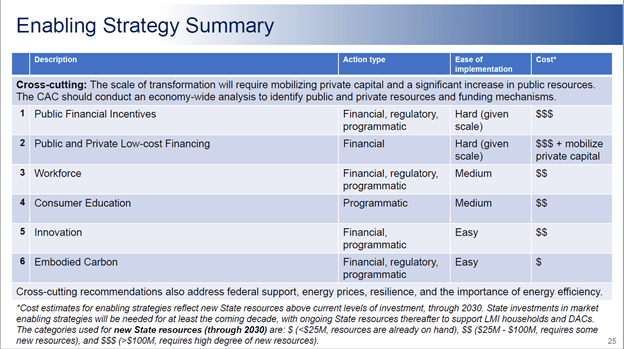
The panel recommends six enabling strategies as shown in the enabling strategy summary slide below.  All but one are financial actions and two address only financial incentives and low-cost financing.  While the panel apparently realizes that cost is a major issue for this conversion, it is not clear whether they understand that general support for environmental issues evaporates when the personal impacts to costs and individual choices are explained.  This is illustrated by recent events in Great Britain where the implementation process for a similar net-zero target is further advanced than in New York.  When the government threatened to ban gas boilers in existing homes by 2035 and to fine homeowners if they met that deadline, the blowback was immediate.  Within hours the government backtracked and said there wouldn’t be any fines.  It will be interesting to see what happens now that the curtain has been pulled aside and the public starts to see all the costs to meet net-zero targets. 
Conclusion

The presentation slides suggest the difficulties facing this sector’s reduction targets:

  • Eliminating GHG emissions from New York buildings by 2050 requires broad, systemic changes.
  • Behavior and practice change lead to decarbonization
  • Equitable transformation at this scale requires new resources.
  • Private capital investment focused on highly efficient buildings
  • Public incentives for early adoption
  • Public investments in building efficiency and electrification in low and middle income homes, affordable and public housing, and disadvantaged communities
  • Transformation at this scale and advancement of equity will require mobilizing private capital and a significant increase in public resources.
  • The CAC should conduct an economy-wide analysis to identify resources and funding mechanisms to address the Scoping Plan, holistically.
  • Advocate for Federal resources and policy support in the scoping plan.
  • Continue PSC attention to rate design and retail rates for electricity and gas.
  • Resilience is of critical importance. Amend State codes to enhance building-level resilience and grid reliability/resilience.
  • Support recommendations of the Adaptation and Resilience group.
  • Broad adoption of insulation/weatherization and energy efficiency in homes; increased funding for weatherization and energy efficiency in LMI homes; energy disclosures can inform future policy.

These are all aspirational gambits that on one hand are necessary but on the other hand are no means assured.  The comment stating resilience is of critical importance is a hollow gesture.  Fossil fuels provide more resilience in general and in the event of extreme weather such as an ice storm reliance on electric heat and renewable energy will have fatal consequences.  Importantly, the public gets that and I doubt will not willingly give up the capabilities of natural gas and fuel oil for heating.

One notable aspect of these recommendations is the inclusion of specific components that favor the interests of individual members of the advisory panel.  This is a common problem for all the advisory panels caused by the membership selection process.  For example, the gas system transition includes the following component: “Level the playing field for adoption of clean heating solutions by eliminating the “100-foot rule” which can bias customer decision-making around heating choices. (The 100-foot rule covers most or all of the cost of new gas connections for residential customers and significant costs for new non-residential firm gas customers).”  Given that all the clean heating solutions are directly subsidized and that when everything is electrified the distribution systems will likely have to be upgraded which represents an indirect subsidy, the “level the playing field” argument can only come from a vested interest blinded to the contradictions.

These panel recommendations and the facts that this sector has the highest emissions and the does not meet the projected targets is a problem for the CLCPA.  When I describe the limits on personal choices for energy use and added costs most people don’t accept that this could be possible.  I believe that public backlash will be similar to what has been observed in Great Britain when the implications and costs become readily known.  If the public response forces reconsideration of the enabling initiatives, then it will weaken the potential emission reduction strategies making achievement of the CLCPA targets that much more difficult.

Land Use & Local Government Advisory Panel Enabling Strategies Submitted to Climate Action Council

On July 18, 2019 New York Governor Andrew Cuomo signed the Climate Leadership and Community Protection Act (CLCPA), which establishes targets for decreasing greenhouse gas emissions, increasing renewable electricity production, and improving energy efficiency.  According to a New York State Department of Environmental Conservation (DEC) bulletin dated May 10, 2021, the Advisory Panels to the Climate Action Council have all submitted recommendations for consideration in the Scoping Plan to achieve greenhouse gas (GHG) emissions reductions economy-wide.   My posts describing and commenting on the strategies are all available here. This post addresses the Land Use & Local Government Advisory Panel enabling strategy recommendations.

I have written extensively on implementation of the CLCPA closely because I believe the solutions proposed will adversely affect reliability and affordability, will have worse impacts on the environment than the purported effects of climate change, and cannot measurably affect global warming when implemented.   I briefly summarized the schedule and implementation CLCPA Summary Implementation Requirements.  I have described the law in general, evaluated its feasibility, estimated costs, described supporting regulationssummarized some of the meetings and complained that its advocates constantly confuse weather and climate in other articles.  The opinions expressed in this post do not reflect the position of any of my previous employers or any other company I have been associated with, these comments are mine alone.

Land Use & Local Government Emissions

This panel did not propose any strategies to reduce emissions. 

Land Use & Local Government Strategies

According to the meeting slide presentation, this panel’s recommendations encompassed the following themes:

  • Promote efficient land use and smart growth that reduces vehicles mile traveled
  • Maximize natural carbon sequestration potential
  • Facilitating responsible siting and adoption of clean energy sources
  • Provide local governments the tools and resources to lead on climate
  • Commit to environmental justice, disadvantaged communities, and a just transition

After discussing each theme, the advisory panel presentation listed the following key strategies:

  • Expand availability of hands-on support and training for municipalities across a range of climate actions with a focus on increased support to small, resource-constrained, and underserved communities.
  • Develop a centralized portal that offers resources and information to assist communities in navigating, accessing and integrating state programs relative to sustainable community development and clean energy development.
  • Explore options to simplify local government enforcement of evolving building codes such as a statewide permitting system, a tool kit with templates and guidance to assist local building departments, support for implementation of shared services agreements, and third party inspections for the energy code.
  • Establish statewide policies that require consistent advancement on building decarbonization by adopting a highly efficient State Energy Code aligned with CLCPA goals as soon as possible, establishing energy benchmarking and performance standards for buildings, and creating innovative public benefit financing mechanisms.

More detail is available in the recommendations and you can listen to the presentation.   Note, however, that the recommendations are not the same as the key strategies and themes.  I will concentrate my comments on the presentation.

The efforts to reduce vehicle miles traveled overlap with the planning strategies from the Transportation Advisory Panel.  Guiding “future growth, redevelopment, and conservation at the multi-municipal scale through regional planning” sounds innocuous but when the planners recommend that all development occur where they want rather than where the public wants it to go, I suspect there will be friction.  I discussed transit-oriented development in my comments on the transportation panel concluding that while it might work outside of New York City elsewhere the development patterns preclude it from working.  In order to make these projects work they want to “empower local governments” by providing support and “align state funding priorities to prioritize smart growth”.  The smart growth illustrated was a “once-contaminated industrial site now being re-purposed to revitalize the Oswego waterfront with housing, retail and commercial space” (Climate Action Council Meeting Presentation May 10,2021).

This is supposed to illustrate a strategy to reduce vehicle miles traveled, but like so many of the enabling strategies it does not work out all the time.  Oswego is a beautiful location for much of the year and the picture shows one of those days.  Unfortunately, that is not true all year round and the following picture from one of my more memorable commutes to Oswego shows they can get clobbered by snow.   During those periods the idea that people would walk or bike to get groceries or go to work is absurd.  Bottom line you still need to have a car but in the best case you just use it less. 

Another theme was to maximize natural carbon sequestration potential.  They only discussed wetland sequestration and “blue carbon” which is carbon captured by ocean and coastal ecosystems.  The agriculture and forestry advisory panel had strategies for carbon sequestration in agricultural soils and forests.  This panel appears to me to cop out.  Wetlands and ocean and coastal ecosystems are already regulated so it is not clear how much additional planning is needed.  On the other hand, there is a looming issue vis-à-vis the space needed for all the solar panels and wind turbines.  Why land use and local government did not address this trade-off is not immediately obvious.

The next theme is facilitating responsible siting and adoption of clean energy sources.  Excuse my cynicism, but this theme appears to be the reason that the aforementioned tradeoff is not addressed in any meaningful way.  My impression of this theme is that it is not especially concerned with local concerns about renewable developments but more getting all the facilities built.  The strategy for guiding future growth states:

Develop criteria and incentives for regional entities and counties to identify priority development areas (including areas appropriate for clean energy siting) and priority conservation areas in consultation with local jurisdictions and communities. Priority Development Areas may include Brownfield Opportunity Areas, downtowns, central businesses districts, municipal centers, hamlets, former industrial districts, infill projects in developed areas, obsolete fossil fuel-based power plants, re-development/adaptive re-use of existing buildings, TOD/Equitable TOD, disadvantaged communities (as defined by the Climate Justice Working Group), dead/dying malls and vacant property clusters designated by land banks, among others. Priority Conservation Areas may include wetlands, riparian areas, forests, agricultural lands and other natural areas and working lands that preserve and restore vital habitats, landscape connectivity, biodiversity, natural water movement, local food security and passive recreation, among others.

This description seems oblivious to the fact that clean energy siting requires much more land than available at any of the priority development areas simply because wind and solar energy are diffuse and require large areas to collect it.  Throw in the incompatibility of wind turbines in developed areas and the result is there will be a conflict between the renewable energy development and the priority conservation areas.  This theme and the Guide Future Growth enabling strategy appear to willfully ignore this issue.

The two last themes are throwaways.  Not surprisingly they think local governments need the tools and resources to lead on climate.  One of the recommendations is for a dashboard “of community greenhouse gas emissions inventories to promote local climate action planning, monitor equity considerations, measure progress, and ensure data consistency at the county/municipality level”.  Years of trying to make numbers simple enough for a dashboard has made me complete distrust the value of such a system – it’s pretty but what is it for?  Finally, they propose to “Commit to environmental justice, disadvantaged communities, and a just transition”.

Conclusion

This panel is a specific requirement of the CLCPA but why?  Land use and local government policies don’t directly affect emissions.  On the other hand, those policies do affect implementation of the enabling strategies envisioned by the authors of the CLCPA.  I suspect that it was included to address the difficulties of permitting power generation facilities and all the other land use strategies necessary to meet the CLCPA targets of a 40% reduction in greenhouse gas emissions from 1990 levels by 2030 and an 85% reduction by 2050.

There is a major inconsistency in the enabling strategies vis-à-vis the agriculture and forestry enabling strategy to minizine the loss of farmlands and forests with their carbon sequestration potential versus the land needed to collect diffuse solar and wind energy necessary to meet the CLCPA targets.  Clearly, the land use and local government advisory panel should have addressed this as a priority.  It is a major flaw that it is mentioned only in passing. 

The other shortcoming and one that is consistent across all the enabling strategies is the recommendation for initiatives that work most of the time.  If you stop and think about it many personal choices incorporate some rare need such as people who buy pickups for the occasional big load.  For this panel the mixed-use development approach to reducing vehicle miles traveled was recommended.  However, there are very few locations where such a development is going to preclude the need for a car.  Residents may be using their cars less but the necessity of having a car minimizes the value of this strategy.

Transportation Advisory Panel Enabling Strategies Submitted to Climate Action Council

On July 18, 2019 New York Governor Andrew Cuomo signed the Climate Leadership and Community Protection Act (CLCPA), which establishes targets for decreasing greenhouse gas emissions, increasing renewable electricity production, and improving energy efficiency.  According to a New York State Department of Environmental Conservation (DEC) bulletin dated May 10, 2021, the Advisory Panels to the Climate Action Council have all submitted recommendations for consideration in the Scoping Plan to achieve greenhouse gas (GHG) emissions reductions economy-wide.   My posts describing and commenting on the strategies are all available here. This post addresses the Transportation Advisory Panel enabling strategy recommendations.

I have written extensively on implementation of the CLCPA closely because I believe the solutions proposed will adversely affect reliability and affordability, will have worse impacts on the environment than the purported effects of climate change, and cannot measurably affect global warming when implemented.   I briefly summarized the schedule and implementation CLCPA Summary Implementation Requirements.  I have described the law in general, evaluated its feasibility, estimated costs, described supporting regulationssummarized some of the meetings and complained that its advocates constantly confuse weather and climate in other articles.  The opinions expressed in this post do not reflect the position of any of my previous employers or any other company I have been associated with, these comments are mine alone.

Transportation Advisory Panel Emissions

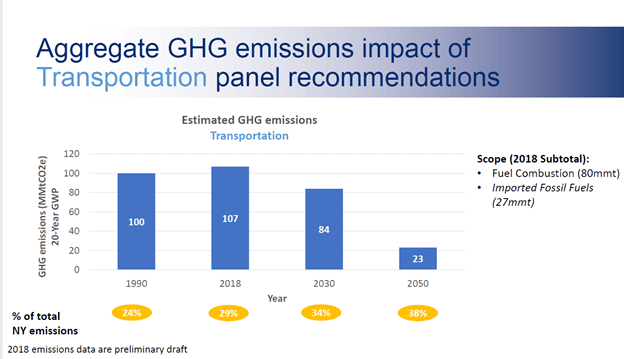
Although the presentations all follow the same format the details differ.  One of the more important components of the presentations is the emissions estimates and they all include a graphic showing historical emissions in 1990, “preliminary draft” emissions for 2018, and their projections for 2030 and 2050.  The 1990 emissions were defined in the Department of Environmental Conservation’s Part 496 regulations but the sectors used in that regulation are not comparable to this advisory panel’s sector.  In the following graph 1990 emissions are 100 million metric tons (MMt) of carbon dioxide equivalent[1] (CO2e) and 2018 preliminary draft emissions are 107 MMt.  Note that as other sectors decrease their emissions the relative percentage of transportation sector emissions to the total increases.


[1] The amount of carbon dioxide by mass that would produce the same global warming impact as the given mass of another greenhouse gas over a specific time frame, as determined by the IPCC, and as provided in Section 496.5 of this Part.

There are two emission reduction targets in the CLCPA: 40% reduction in GHG emissions by 2030 and 85% reduction in GHG Emissions by 2050.   The projected total reductions emission reduction goals for this advisory panel are a 16% reduction from 1990 by 2030 and a reduction of 77% by 2050. 

Transportation Advisory Panel Strategies

The meeting minutes will not be available until the June Climate Action Panel meeting.  According to the presentation, the advisory panel proposed the following enabling strategies:

  • Transition of vehicles/fleets to electric/zero-emission technologies.
  • Enhancing the availability, accessibility, reliability and affordability of public transportation.
  • Aligning and integrating transportation investments into land use/development to mitigate carbon emissions.
  • Implementing market-based strategies to impact travel decisions and finance investments in clean transportation.

The recommendations are available in a slide presentation.  I am not going to critique these strategies individually because it would take far too long.  Instead, I will comment on a few things with an emphasis on inconsistencies and implementation issues. 

The Transition to 100% zero-emission light duty vehicle sales enabling strategy exemplifies what I think is a major disconnect between the transportation planners and the public.  I have attended stakeholder meetings for the Transportation Climate Initiative and listened to the true believers explain that there are so many advantages to electric vehicles that if only the public understood everyone would buy into the technology.  However, even this strategy recognizes that “Lack of consumer awareness/interest and consumer concerns about technology & charging/fueling” are barriers to success.  The ultimate problem with all of the clean energy technologies is that they all only work most of the time.  Most of the time a light-duty electric vehicle might work well for me but several times a year I want to haul a big load in my mini-van several hundred miles and range anxiety is a very real concern.  My wife’s car is a regular sedan and again most of the time an electric vehicle would work.  However, several times a year we drive down to see my son’s family in Brooklyn.  The joke is that is takes four hours to get to the George Washington Bridge, another hour to get to Brooklyn and then an hour to park.  I do not foresee any time in the future when that trip will be a realistic option with an electric vehicle.  I am sure my personal reservations are similar to most people.

Another reservation mentioned in enabling solution is the “Potentially high cost of supporting charging and fueling infrastructure and Zero Emission Vehicle incentives”.  Under cost and funding considerations the strategy notes that “Nearly $1 billion in ratepayer and NYPA funding is already committed for EV charging station installations”.  I believe that this $1 billion charge to the ratepayer will be buried in bills so there is no direct accountability to this initiative.  While I do see electric charging stations around town, I don’t see a lot of them so this funding is no where near what is necessary to provide charging support in public spaces.  Moreover, what about the need to charge at home?  While the cost for a simple charger is not that great, a faster charger, which I understand is needed to completely charge a depleted battery, is much more expensive. 

The final reservation mentioned is that “Unmanaged charging could have significant costs for electric grid operators/ratepayers”.   I live in a development that is on the order of 60 years old.  It is very rare that there is a house with only one car and there are many homes with adult children living at home that have more.  The personal charging infrastructure is going to be a challenge and that much additional load, and don’t forget they want to electrify home heating too, is probably going to require upgrades to the local distribution system.    Again, it may work most of the time but when homeowners really need heat are they going to be able to charge their cars too.  Finally, the challenge for charging in a housing subdivision is small relative to charging at apartment buildings and other public spaces and that challenge is small relative to providing chargers for people who have to park on the street in cities.

Ronald Stein recently described California warning signs that agree with some of  my anecdotes about electric vehicles and highlight other issues:

One of the key components of these plans is anticipated benefits and impacts to disadvantaged communities.  For this mitigation strategy the strategy states:

Enhanced incentives for residents of disadvantaged communities are essential for faster ZEV adoption in disadvantaged communities. Incentives that support used ZEV purchases and EV charging at multifamily buildings can be especially effective at increasing ZEV adoption among underserved populations. Local ownership of EV charging stations and workforce development can support economic opportunities in disadvantaged communities.

I think this is another major disconnect between the members of the advisory panel and reality.  Many people in disadvantaged communities cannot afford a new vehicle whatever the incentive.  Another electric vehicle concern is the market for used cars relative to battery life.  The common perception is that replacing the batteries is a major cost not necessary in a conventional used car.  It is not clear how the CLCPA can subsidize new vehicle purchases, used vehicle purchases, and public EV charging support in disadvantaged communities and keep the option of personal mobility available.

There is another enabling mitigation strategy: “Transition to zero emission medium/heavy duty vehicles and non-road vehicles”.  The summary claims that the ease of implementation and cost is similar for this sector has the same emissions impact, ease of implementation, and cost as for light-duty vehicles.  I disagree with all three comparisons.  Diesel vehicle emissions are a primary cause of inhalable particulates in urban areas so eliminating those emissions has more value than a comparison only to GHG emissions which could be the same for light-duty vehicles and this sector.  Similar ease of implementation is absurd.  There are electric cars that are at least arguably competitive to regular cars.  There isn’t any similar level of technological availability for heavy duty trucks and given the limits of battery technology it is a very heavy lift to assume that a zero-emission technology will ever enable the same use of trucks as today.  If you don’t have the technology, how can you possibly project costs?  Furthermore, charging a fleet of medium or heavy-duty trucks is going to require a lot of energy at freight terminals and service centers so upgrades to the distribution system, likely including new substations, will be required at a significant cost.

From a personal standpoint the transportation initiative does not mention recreational vehicles.  Since my retirement I have traveled over 60,000 miles, visited 40 states and been on the road about 20% of the time with a motor coach.  I don’t see how that life-style will be possible in the net-zero world.  Anyone who has driven I-95 in the winter has noticed a steady stream of campers headed south.  Based on my experience many travel over 300 miles per day which I expect to be the limit of the electronic technology.  The batteries necessary for that operating range will undoubtedly reduce storage space which will not be popular.  Finally, there are very few campgrounds that have any apparent surplus of electricity.  Upgrading campgrounds is another hidden cost.

Improvements to public transportation are a big component of the enabling strategies: 

Identify implementable strategies to significantly enhance the availability; accessibility; reliability; and affordability of public transportation services with an emphasis on unserved/underserved communities.

A major problem with mass transit in all but the largest cities is that it is inconvenient.  Outside of New York City I believe that using public transit basically doubles travel time.  In the early 1900’s there was an extensive interurban trolley system in Upstate New York that basically met the proposed vision for the future.  In Syracuse you could go to Utica, Rochester, and Oswego on those systems.  They all failed by the 1930’s because even though folks had to drive on dirt roads with little heat in the winter and no cooling in the summer it was more convenient than taking a ride on a trolley.  To dream that people will willingly give up that convenience when many have remote car starters is magical thinking.

The enabling strategy becomes even more detached from reality when they include plans for transit-oriented development which is “the creation of compact, walkable, pedestrian-oriented, mixed-use communities centered around high-quality train systems”.  There may be some locations outside of New York City where this might work because high quality train, or rapid transit buses for that matter, can haul commuters to the city where there is a dense network of transit routes available that can take people to a variety of jobs.  Upstate cities have no similar concentration of transit-friendly jobs in the center cities so how can anyone expect that people would want to live in a community that actively discourages ownership and use of a personal vehicle that does not have easy access to work.

Ultimately, the goal of the public transit strategies is to reduce the need for personal automobiles.  There is a fundamental problem though because population density puts limits on transit system success.  If there aren’t enough people living along the transit service then revenues will be insufficient to make them viable.  In order to address there is a strategy to expand biking, walking, carpooling, ride-sharing, and micro-transit opportunities and another for automated vehicles for smart mobility.   The idea is that if there were a convenient option people would be willing to consider transferring from, for example, an express bus to an automated vehicle for locations too far to walk from the main stop.  Transferring between subway lines in New York City is only viable because of the frequency of service.  Scaling that concept down to upstate cities with less dense ridership is unlikely to succeed. 

Of course, the transit systems will have to be converted to zero-emission fleets too.  According to a friend in the business new diesel buses cost ~$500,00, a new compressed natural gas bus costs ~$550,000, and a new electric bus costs ~$1,000,000.  That does not include the cost of infrastructure which, especially for bus electrification, is a significant transition cost.  Furthermore, the enabling initiative suggests making public transit “more attractive, accessible and user-friendly” but adding options to provide those services can run another $60,000 per bus.

Most of the other advisory panels avoided much detail on funding mechanisms and just suggested that some form of government funding would be necessary.  This panel did address potential mechanisms but did not estimate costs.  The strategy for “financing and market-based policies” includes nine potential policies: facilitating private financing, cap & invest or carbon pricing, clean fuel standards, electrification freebates, curb pricing, congestion/variable/demand parking pricing, mileage-based user fees, tax increment financing/special assessment districts, and registration fees.  Note that this spring the Climate and Community Investment Act was proposed to, in large part, provide a funding mechanism for the CLCPA.  However, when asked about the potential to increase gasoline prices by 55 cents per gallon, the Governor Cuomo said: “You can’t do it that way. I understand the concept, and the concept, it makes sense. But how does it work? What’s the economic impact? You’d have to ask all those questions.”   I look forward to the scoping plan’s assessment of CLCPA costs because I don’t believe there is any way that the costs will be as low as 55 cents per gallon for the transportation enabling strategies.  When combined with all the other advisory panel strategies, costs will be extraordinary.

Conclusion

I have three concerns with the transportation enabling strategies: feasibility, affordability and reliability. 

According to preliminary data, the transportation sector was the second largest source of emissions in 2018.  The projected total emission reduction goals for this advisory panel are a 16% reduction from 1990 by 2030 compared to the CLCPA target of 40% and a reduction of 77% by 2050 compared to the goal of 85%.  I can only conclude that the failure to meet these goals means that the CLCPA targets are not feasible particularly because I suspect that the enabling initiatives over-estimate emission reduction effectiveness.

As noted above the costs were not included in the enabling strategies but considering the scope, they are sure to be large.  On May 24 and 25 2021 a European summit met to discuss their net-zero plans and observers expect that that they had to concede that these plans will be very expensive.  I expect the same affordability issues in New York.

The ultimate problem is that the proposed “solutions” only work most of the time and society expects energy options that work all the time.  One of the initiatives proposes to “Expand the availability of low carbon transportation modes (biking, walking, carpooling, ride-sharing, micro-transit) statewide” which is an example of the personal impacts of “it will work most of the time” thinking.  Biking and walking several months of the year is not only inconvenient but also dangerous whenever roads are covered with snow and ice.  Electric vehicles will work when the power is available but what happens when there is an ice storm blackout?  No heat and no way out are a dangerous combination.

New York Independent System Operator and the Climate Leadership and Community Protection Act

On July 18, 2019 New York Governor Andrew Cuomo signed the Climate Leadership and Community Protection Act (CLCPA), which establishes targets for decreasing greenhouse gas emissions, increasing renewable electricity production, and improving energy efficiency.  The Ney York Independent System Operator (NYISO) is the “organization responsible for managing New York’s electric grid and its competitive wholesale electric marketplace”.  This post addresses the relationship between the CLCPA and NYISO.

I have written extensively on implementation of the CLCPA closely because its implementation affects my future as a New Yorker.  I briefly summarized the schedule and implementation CLCPA Summary Implementation Requirements.  I have described the law in general, described the enabling strategies, evaluated its feasibility, estimated costs, described supporting regulationssummarized some of the meetings and complained that its advocates constantly confuse weather and climate in other articles.  The opinions expressed in this post do not reflect the position of any of my previous employers or any other company I have been associated with, these comments are mine alone.

Background

The NYISO Frequently Asked Questions webpage explains how the organization originated.  After the Northeast Blackout of 1965, New York’s seven investor-owned utility companies established the New York Power Pool (NYPP) to address the reliability problems exposed by the blackout.  The NYPP “balanced electricity supply and demand, maintained transmission voltage, monitored system contingencies, managed operating reserves, and dispatched generation”. In the 1990s New York’s electric system was de-regulated and the Federal Energy Regulatory Commission (FERC) recommended the formation of independent entities to manage energy transmission. “At the same time, the New York State Public Service Commission (PSC) established retail electric competition to allow customers to choose their electric supplier. The PSC supported the formation of competitive wholesale markets as the basis of retail choice, and approved restructuring plans by which utilities divested most of their power plants to competitive generation companies.”  In 1999, the NYISO was established to replace the NYPP.

The NYISO manages the electric system.  They have to balance the instantaneous supply of electricity between the generators and customers across the state.  In the de-regulated market electricity is supplied by multiple types of agreements between the suppliers and the NYISO.  Some of the power is contracted by purchase power agreement contracts, some by day-ahead auctions, and the rest by real-time auctions that cover any additional power needed.  They manage the supply of power and maintain the frequency across the state and with their connections to other operating systems.  In addition, the NYISO has to plan for future changes to the system.  At this time the biggest factor for change is the CLCPA. 

There are a few other relevant aspects in the NYISO description:

The NYISO is a not-for-profit, independent company unaffiliated with any state or federal agency or energy company. The NYISO is led by an independent Board of Directors. The NYISO’s federally-approved tariffs contain strict requirements for our Board of Directors and all employees to have no financial relationship with any of the companies that participate in our wholesale energy markets. The NYISO is dedicated to transparency in how we operate, the information we provide, and our role as an impartial system operator, planner, and broker of New York’s wholesale electricity markets.

The NYISO is accountable to both federal and state regulatory bodies and maintains compliance with nearly 1,000 reliability requirements. The NYISO’s independent Board of Directors collaborates with our stakeholders via a robust shared-governance process that facilitates input from interested stakeholders. The establishment of the NYISO created a system of shared governance that provides all market participants — from utility companies to electric generators — a voice in the operation and evolution of the marketplace.

Under the NYISO’s transparent, inclusive process, representatives from market participants have voting power to exercise responsibilities such as preparing the NYISO’s annual budget, reviewing and recommending candidates for Board vacancies, developing and adopting technical guidelines for operation of the bulk power system, and market design and system planning. NYISO stakeholders share responsibility with the NYISO Board to approve proposed changes to the NYISO’s governing documents, including its federally approved tariffs.

The NYISO’s description of their process and the very name suggest that they are independent of New York politics but that is not the case with the current administration.  In the following I will explain why I think that the NYISO is pulling its punches vis-à-vis the feasibility of the CLCPA.

NYISO and the Cuomo Administration

I am not an admirer of Governor Cuomo because my impression is that his administration has always been about his best interests.  Whenever any organization has disagreed with Cuomo’s energy agenda the response has been bluster and threats.  For example, when National Grid’s plan for natural gas supply in New York City contradicted Cuomo’s agenda, he threatened to revoke the operating license for National Grid if they did not comply with his plans.  Another example, is NRG Energy’s Dunkirk power plant which was deemed uneconomic and scheduled for closure.  For some political reason, Cuomo announced an agreement to repower the plant with natural gas.  In a de-regulated market making a grant to one facility to continue operations is sure to upset competitors and a lawsuit was filed.  In addition, certain rules have to be followed that include fee requirements and NRG decided to not pursue re-powering.  Cuomo’s response was to seek a PSC probe of the business decision.

This overt insistence on toeing the administration’s political agenda extends to all the agencies under his thumb.   The Department of Public Service (DPS) and Public Service Commission are supposed to be independent however this is not the case.  In the summer of 2019 a group of retired Department of Public Service employees submitted a letter that stated “Until the current administration, Governors have generally respected the plain language of the Public Service Law (PSL), which … safeguards the mission of the DPS to serve not political interests but the public interest.” The letter signed by fifteen retired department workers states: “Governor Andrew Cuomo, however, has not done so.”

Unfortunately, the NYISO is not immune to the Governor’s tactics. In a filing to the Public Service Commission, the NYISO noted that in order to meet Cuomo’s Clean Energy Standard, a predecessor regulation to the CLCPA, New York would have to install over 1,000 new miles of bulk transmission lines at great cost and effort which exposed one of the short-comings of the Governor’s clean energy agenda.  In response, Cuomo’s energy czar, Richard Kauffman, accused NYISO Director Brad Jones and his NYISO report as “misleading, incomplete, and grossly inaccurate…revealing an alarming lack of developed analysis into the imperative to address climate change…” Kauffman’s letter accused Jones of protecting fossil fuel generators and said that he was “dismayed by [Jones’] public comments.  

In this political climate it is not surprising that rather than standing up to the bully, the “independent” NYISO caved, Jones left, and was replaced by Rich Dewey.  Now the NYISO reports carefully word every document so as to not invoke the wrath of Cuomo’s bullies. 

NYISO Raison D’être

There is another aspect of the NYISO’s operations that colors their responses.  It is not surprising that the NYISO completely endorses the idea that wholesale electricity markets have the ability to solve any problems because that is the reason for their existence.  Unfortunately, I think some of their faith in market mechanisms is unwarranted.

I am not an expert on market design but I fear we are heading towards an energy crisis.  In a regulated market the Public Service Commission (PSC) tells the vertically integrated electric utilities to meet a specific mandate, the utilities develop a response, the PSC oversees their responses relative to reliability and affordability, and the necessary infrastructure gets built.  In New York’s de-regulated market, planners at the NYISO and various state agencies do the planning and then the NYISO and PSC develop “innovative market rules necessary to meet the objectives of the CLCPA” that they hope will engender market participants to build the necessary infrastructure. 

There are tremendous technological challenges converting from the current electric system to one dependent upon renewable energy sources and I am convinced that the only way unexpected kinks will be worked out is by trial and error.  The Texas electricity market design did not work well in February and I have no reason to expect that some new wrinkle introduced by relying on intermittent and diffuse renewable energy will only be resolved after the problem occurs. Robert Bradley recently explanation of what happened during the big freeze relative to the Texas electricity market and the difference between managed markets like New York’s wholesale electricity market and a “free market” supports my concern.

In addition, the problem may occur because the NYISO identifies a problem that the politicians who are running New York energy policy decide to ignore.  Of course, when it occurs the blame will be place on the NYISO.  In this regard Donn Dears book “The Looming Energy Crisis” provides a detailed description of potential problems that are a challenge to overcome and might require imposition of politically unpopular policies.  In the current political environment these issues are more likely than not.

Finally, I want to give an example where the market did not produce the obvious environmental solution.  New York State energy and environmental policy is more about optics than facts.  Nowhere is this more apparent than the recent spate of opinion pieces, reports, and even policy proposals related to peaking power plants.  In brief there are old simple cycle turbines in New York City that were built to provide reliable power during peak load periods.  However, there are old, inefficient and much dirtier than today’s technology.  In my opinion the continued operation of the old simple cycle turbines in New York City is the result of New York’s de-regulated market place.  I am absolutely sure that in a regulated environment the responsible utility would have made a case to the Department of Public Service that replacement with cleaner, more efficient generation was needed, the Department would have agreed,  and, after it was approved, the utility would have been guaranteed a reasonable return on their investment so the turbines would have been replaced.  However, in the de-regulated market there wasn’t a strong enough financial incentive to replace the old units.  Before I retired in 2010, I worked on two separate permit applications for new, efficient, and cleaner replacement power for one set of the old combustion turbines.  In both instances the permits were approved but the replacements were never built, apparently because the company decided that the business case was not strong enough to warrant the investment.  The fact is that sometimes the market signals are too weak to provide the desired result.

Conclusion

The point of this post is to document the importance of the NYISO but to also point out that their policies and recommendations are necessarily colored by their belief that markets are a viable solution to the challenges of the CLCPA energy transition and by the political climate of New York.  The NYISO has done a good job analyzing the challenges of the energy transition.  Unfortunately, many members of the CLCPA advisory panels and the Climate Action Council don’t understand, don’t want to understand, or choose to ignore the warnings in those analyses.  In my opinion, there are enough technical challenges in the transition that maintaining reliability will be a problem but the added challenge of designing some market mechanism to get the market to provide the resources necessary all but assures that reliability will become an issue. 

Finally, I sympathize with the NYISO position.  All their work not only has to fully explain the problems they identify but the wording has to pass a political optics text.  This means that all their reports have to toe the existential threat of climate change narrative without any suggestion that the potential risks to reliability, affordability, and environmental impacts of the proposed solutions far out-weigh the alleged impacts of climate change.  It is similar to the symbiotic relationship between the Egyptian plover and crocodile.  NYISO is performing a service to the state but you never know if the Cuomo crocodile is going to snap.

Energy-Intensive and Trade-Exposed Industries Advisory Panel Enabling Strategies Submitted to Climate Action Council

On July 18, 2019 New York Governor Andrew Cuomo signed the Climate Leadership and Community Protection Act (CLCPA), which establishes targets for decreasing greenhouse gas emissions, increasing renewable electricity production, and improving energy efficiency.  According to a New York State Department of Environmental Conservation (DEC) bulletin dated May 10, 2021, the Advisory Panels to the Climate Action Council have all submitted recommendations for consideration in the Scoping Plan to achieve greenhouse gas (GHG) emissions reductions economy-wide.   My posts describing and commenting on the strategies are all available here. This post briefly addresses the Energy-Intensive and Trade-Exposed Industries (EITE) Advisory Panel enabling strategy recommendations more for completeness than anything else.  Emissions are small, choices are few, and there is not much to see here.

I have written extensively on implementation of the CLCPA closely because its implementation affects my future as a New Yorker.  I briefly summarized the schedule and implementation CLCPA Summary Implementation Requirements.  I have described the law in general, evaluated its feasibility, estimated costs, described supporting regulationssummarized some of the meetings and complained that its advocates constantly confuse weather and climate in other articles.  The opinions expressed in this post do not reflect the position of any of my previous employers or any other company I have been associated with, these comments are mine alone.

Energy-Intensive and Trade-Exposed Industries Advisory Panel Emissions

Although the presentations all follow the same format the details differ.  One of the more important components of the presentations is the emissions estimates and they all include a graphic showing historical emissions in 1990, “preliminary draft” emissions for 2018, and their projections for 2030 and 2050. 

The 1990 emissions were defined in the Department of Environmental Conservation’s Part 496 regulations but the sectors used in that regulation are not comparable to this advisory panel’s sector.  In the following graph 1990 emissions are 33 million metric tons (MMt) of carbon dioxide equivalent[1] (CO2e) and 2018 preliminary draft emissions are 16 MMt.  Note the breakdown of the emissions by process, imported fossil fuels, and fuel combustions with the explanation at the bottom of the graph.  The inclusion of imported fossil fuels makes comparison of these data with other emissions estimates impossible. 

The projections for 2030 and 2050 show reductions that exceed the CLCPA targets.  In 2030 the projected emissions are 55% less than 1990 as opposed to a target of 40% and the 2050 emissions are 91% compared to the target of 85%.  In a previous post I noted that industrial energy use was 47% reduced and that reflected the loss of New York industry rather than any improvement in GHG emissions efficiency in operations. 


[1] The amount of carbon dioxide by mass that would produce the same global warming impact as the given mass of another greenhouse gas over a specific time frame, as determined by the IPCC, and as provided in Section 496.5 of this Part.

EITE Strategies

According to the meeting minutes, the advisory panel proposed the following enabling strategies:

  • Industrial sectors within the Advisory Panel scope total a small share (less than 4%) of the State emissions;
  • The “heterogeneous” nature of industry may result in a higher cost per ton of emissions reduced;
  • Energy-Intensive and Trade-Exposed industries are likely to represent a high share of industrial sector emissions. These industries are highly sensitive to increased energy costs, that often cannot be passed along, which could cause them to leave the State, resulting in leakage;
  • Emissions will decline with decarbonization of the Power Generation sector; near-term opportunities will likely focus on energy efficiency, while most deep carbonization opportunities will occur further into the future as new technologies become more viable.

A brief translation of these strategies.  This is a small and declining sector.  The “heterogeneous” nature of industry refers to the fact that there are many different sources so economy of scale is not going to reduce costs.  Clearly the unilateral transition off fossil fuels will increase relative energy costs and industries will have to leave to survive.  The final bullet basically says this sector needs a magical solution to produce emission reductions and remain viable within the state.

The recommendations are available in a slide presentation.  I am not going to critique these strategies individually there is so little to address.

The summary slide describing the strategies states:

Mitigation strategies: Directly reduce emissions and contribute to the achievement of the GHG emission limits or carbon sequestration needed to achieve net zero, where applicable:

1.Provide financial incentives and technical assistance for the decarbonization of EITE sectors

2.Create procurement incentives for business to capitalize on low-carbon economic opportunities

Enabling initiatives: No direct emissions benefit, but enable or magnify the mitigation strategies, enhance climate justice, or just transition. (Examples: outreach, education, and awareness; capacity building; workforce development; and research and development.)

3.Identify and support technological innovation to enable deep industrial decarbonization

4.Workforce development training to support Energy-Intensive and Trade Exposed (EITE) industries

5.Increase the available data on industrial GHG emissions to help prioritize efforts and monitor progress

6.Provide economic incentives to grow the green economy

In brief, the mitigation strategies consist of subsidies to provide GHG reductions and incentives, aka further subsidies, for companies to join the grifters already lined up to save the world as long as someone else is paying for it.  If there is an existential climate crisis why are there any initiatives with no emission reduction benefits?

Conclusion

This sector is a relatively small actor relative to total New York GHG emissions.  Reductions in the sector have exceeded the CLCPA targets but only because the sector has become much smaller.

It seems pretty obvious that this advisory panel was a political ploy to placate the industrial sector.  Unfortunately, there is not much that can be done to reduce emissions significantly or prevent the remaining industries from fleeing the state out of necessity.

Waste Advisory Panel Enabling Strategies Submitted to Climate Action Council

On July 18, 2019 New York Governor Andrew Cuomo signed the Climate Leadership and Community Protection Act (CLCPA), which establishes targets for decreasing greenhouse gas emissions, increasing renewable electricity production, and improving energy efficiency.  According to a New York State Department of Environmental Conservation (DEC) bulletin dated May 10, 2021, the Advisory Panels to the Climate Action Council have all submitted recommendations for consideration in the Scoping Plan to achieve greenhouse gas (GHG) emissions reductions economy-wide.   My posts describing and commenting on the strategies are all available here. This post addresses the Waste Advisory Panel enabling strategy recommendations.

I have written extensively on implementation of the CLCPA closely because its implementation affects my future as a New Yorker.  I briefly summarized the schedule and implementation CLCPA Summary Implementation Requirements.  I have described the law in general, evaluated its feasibility, estimated costs, described supporting regulationssummarized some of the meetings and complained that its advocates constantly confuse weather and climate in other articles.  The opinions expressed in this post do not reflect the position of any of my previous employers or any other company I have been associated with, these comments are mine alone.

Waste Emissions

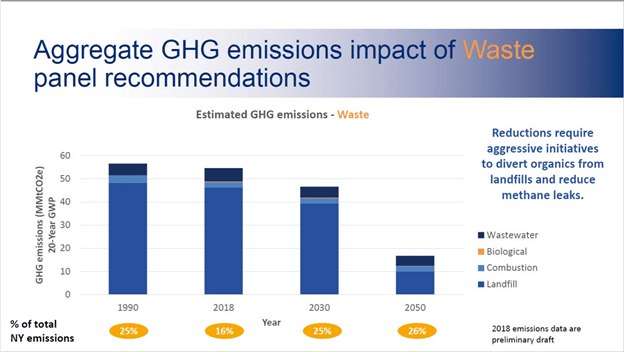
Although the presentations all follow the same format the details differ.  One of the more important components of the presentations is the emissions estimates and they all include a graphic showing historical emissions in 1990, “preliminary draft” emissions for 2018, and their projections for 2030 and 2050.  Most of the presentations added numbers to the slides so that it was not necessary to try to estimate the numbers.  Such is not the case with the Waste panel presentation. 

Moreover, there are problems with the data presented..  The 1990 emissions were defined in the Department of Environmental Conservation’s Part 496 regulations.  According to Part 496 the 1990 Waste greenhouse gas emissions in 1990 by IPCC sector in Global Warming Potential over a twenty-year time frame (GWP20) totaled 52.88 million metric tons (MMt) of carbon dioxide equivalent[1] (CO2e) broken down as 3.03 MMt of CO2, 49.35 MMt of CH4 and 0.5 MMt of N2O. However, in the following graph the total is well above half the range between 50 and 60.  Assuming that the wastewater component is not included in Part 496 brings the numbers close.  The bigger problem is the claim that waste is 25% of the total in 1990 and 16% of the total in 2018.  I guess the waste emissions in 1990 are 57 MMt and I know the 1990 Part 496 total emissions are 409 so that works out to 14%.  I guess the waste emissions in 2018 are 55 MMt and I estimated that the sum of emissions from all the sides in the advisory panel presentations total 377 MMt and that works out to 15% for the waste % of total NY emissions.  It could be a simple typo but in the absence of numbers in the graphic, readers do not know.


There are two emission reduction targets in the CLCPA: 40% reduction in GHG emissions by 2030 and 85% reduction in GHG Emissions by 2050.   The projected total reductions emission reduction goals for the Waste Advisory Panel are a 17.6% reduction from 1990 by 2030 and a reduction of 70.5% by 2050. 

Waste Strategies

According to the meeting minutes, the advisory panel proposed the following enabling strategies:

  • Reducing methane generating wastes from disposal in landfills and combustors;
  • Identifying and reducing fugitive emissions at waste and water resource recovery facilities;
  • Reducing the need for new consumer products;
  • Ensuring proper end-of-life materials management, with a focus on solid waste management hierarchy;
  • Supporting domestic recycling facilities and markets for recovered resources, by emphasizing the highest and best use for recycling end products; and
  • No promotion of new fossil fuel energy infrastructure.

The recommendations are available in a slide presentation.  I am not going to critique these strategies individually because it would take far too long.  Instead, I will comment on a few things with an emphasis on inconsistencies and implementation issues. 

Clearly landfills have to be the target for reductions because it is the largest source.  The plan is to achieve the “aggressive goals of Beyond Waste, the New York State Solid Waste Management Plan (e.g., 90% paper recycling and 65% food waste diversion by 2030)”.  This program was adopted 12/27/10 but beyond mentioning that meeting the goals was necessary there was no further mention of the plan in the presentation or recommendations.  Under the “Ease of implementation” category for Initiative #1: Organic Waste Reduction and Recycling, there is the following description: “Easy; The technologies exist, the challenges are financial (e.g., investment & end markets), behavioral, and logistical (e.g., siting, etc.)”.  During the question-and-answer period of the presentation Anne Reynolds asked about the status of the goals of the over ten year old Beyond Waste Program as a means of assessing how difficult achievement of the recommendations presented today might be and Ms. Rowland noted that “the State is roughly one-third of the way to 90% on the paper recycling and traditional recyclables, with significant work left to do on organics, as only about 2-3% is diverted.”  In my opinion, the financial, behavioral, and logistical challenges defined as “easy” are not.  Note that many of the recommended initiatives require legislative and regulatory action to make these “easy” changes.

There are folks involved with this process that have convinced themselves, contrary to the text of the law, that the zero-emissions mandate refers to all emissions and not just GHG emissions.  I suspect that they are disappointed that the panel projects no reduction projected from existing combustor facilities will be needed to handle municipal solid waste remaining after reduction, reuse, and recycling strategies.

The advisory panel process and the Climate Action Council meetings provide a window into the hopes and dreams of the segment of the population that is driving the concept that the existential crisis of climate change can be solved simply by ending fossil fuel use as quickly as possible.  The “no promotion of new fossil fuel energy infrastructure strategy” is the result of their concerns. Many of the most vocal people in this process are as passionate about this cause as they are clueless about the complexity of the energy systems and tradeoffs of their purported solutions. Renewable natural gas is a very good example of the resulting problem. 

According to EPA:

Renewable natural gas is a term used to describe biogas that has been upgraded for use in place of fossil natural gas. The biogas used to produce RNG comes from a variety of sources, including municipal solid waste landfills, digesters at water resource recovery facilities (wastewater treatment plants), livestock farms, food production facilities and organic waste management operations.

The ultimate problem replacing fossil fuels with renewable wind and solar energy is providing power during periods when both resources are near zero.  In their presentation to the Power Generation Advisory Panel on September 16, 2020 E3 included the following slide that notes that during these periods “firm, zero emission resources, such as bioenergy, synthesized fuels such as hydrogen, hydropower, carbon capture and sequestration, and nuclear generation could provide a number of benefits”.  In my opinion, those benefits include keeping the lights on.

In light of the critical need for these firm, zero-emissions resources and the fact that the methane emissions from municipal solid waste landfills, digesters at water resource recovery facilities, livestock farms, food production facilities and organic waste management operations are a major percentage of the total emissions, it only seems logical to address both problems by developing those resources.  However, there are passionate ideologues that don’t agree.  The meeting minutes note “concern regarding renewable natural gas, suggesting that there is a limited opportunity for it to contribute to Climate Act goals and believes that efforts in this area benefit the source without contributing additional environmental benefits”. Another member “expressed his concerns about how to move ahead with biogas if it is combusted as this would clearly increase net co-pollutants locally, and suggested the Council consider applications for biogas that would not be combusted (such as fuel cell technology at wastewater treatment plants)”.   Nonetheless the panel’s enabling initiatives included biogas recovery and agency staff argued for its use. 

Most of the other strategies proposed identifying leaks and eliminating them.  As part of New York’s irrational war on methane the new leak detection technology that has identified many new sources of methane is considered a rationale for eliminating the use of natural gas instead of an opportunity to make the source of energy that enabled most of the observed GHG reductions since 1990 even better.  Because the residence time of methane is on the order of 12 years eliminating leaks has much value.

There is another aspect to the leak issue related to the cluelessness of some panel members.  One of the other panels has a strategy that includes a public relations campaign to remove the label “natural” from natural gas because they allege that the name was chosen for advertising purposes.  They presume that if the public only understood it was not natural then they would not be so likely to use it.  The problem with that of course is that it is called natural gas because it is a naturally occurring gas.  Wherever a geologic formation that contains natural gas is exposed to the air, natural gas can be released to the atmosphere.  For example, western New York’s Eternal Flame Falls has a vent that seeps natural gas, and someone, sometime lit it off.  It remains to be seen if this natural vent will be sealed off in the name of climate change mitigation but the bigger issue is what to do about all the other sources of naturally-occurring methane.         

Conclusion

There are consistency issues with some of the numbers presented that I could not reconcile.  Using the numbers provided, this sector generates under 15% of the total New York GHG emissions but it is notable that the strategies are only expected to reduce emissions 18% in 2030 as opposed to the target of 40% and only 71% in 2050 as opposed to the target of 85%.  Clearly, this panel recognizes that there are limits to what can be achieved even though the results are disappointing.

Even though the enabling strategies do not meet the CLCPA targets, the results of the 2010 Beyond Waste, the New York State Solid Waste Management Plan suggest that even these strategies may be too optimistic “as only about 2-3%” of food waste is diverted as opposed to the 65% goal.  The concession that no reduction is projected from existing combustor facilities needed to handle municipal solid waste remaining after reduction, reuse, and recycling strategies also suggests these are aspirational strategies.

The ideologues involved in this process hinder rational mitigation approaches.  Collecting and using methane wherever possible not only addresses an emissions problem but also helps address a major concern related to reliability.  It is scary that irrational concerns about using renewable natural gas were not cut off as untenable at the outset.  Another example is not recognizing that natural gas leak detection technology advances are an opportunity to reduce emissions from the resource that has provided most of the recent co-pollutant and CO2 emission reductions rather than a reason to eliminate its use.

[1] The amount of carbon dioxide by mass that would produce the same global warming impact as the given mass of another greenhouse gas over a specific time frame, as determined by the IPCC, and as provided in Section 496.5 of this Part.

Agriculture and Forestry Advisory Panel Enabling Strategies Submitted to Climate Action Council

On July 18, 2019 New York Governor Andrew Cuomo signed the Climate Leadership and Community Protection Act (CLCPA), which establishes targets for decreasing greenhouse gas emissions, increasing renewable electricity production, and improving energy efficiency.  According to a New York State Department of Environmental Conservation (DEC) bulletin dated May 10, 2021, the Advisory Panels to the Climate Action Council have all submitted recommendations for consideration in the Scoping Plan to achieve greenhouse gas (GHG) emissions reductions economy-wide.   My posts describing and commenting on the strategies are all available here. This post addresses the Agriculture and Forestry strategy recommendations.

I have written extensively on implementation of the CLCPA closely because its implementation affects my future as a New Yorker.  In this post I will briefly summarize the schedule and implementation components but I provide more details at CLCPA Summary Implementation Requirements.  I have described the law in general, evaluated its feasibility, estimated costs, described supporting regulations,  summarized some of the meetings and complained that its advocates constantly confuse weather and climate.  The opinions expressed in this post do not reflect the position of any of my previous employers or any other company I have been associated with, these comments are mine alone.

Agriculture, Forestry and Other Land Use Emissions

According to Part 496 the 1990 Agriculture, Forestry and Other Land Use (AFOLU) greenhouse gas emissions in 1990 by IPCC in GWP20 totaled 17.13 million metric tons (MMt) of CO2e broken down as 0.05 MMt of CO2, 13.07 MMt of CH4 and 4.01 MMt of N2O. According to the presentation, in the 2018 preliminary draft emissions inventory there were a total of 24 MMt of CO2e.  In 1990 emissions from this sector were 4.2% of the state total and in 2018 they were 6.4%.

There are two emission reduction targets in the CLCPA: 40% reduction in GHG emissions by 2030 and 85% reduction in GHG Emissions by 2050.   The emission reduction goals for this advisory panel are a 15% reduction from current levels by 2030 and a reduction of 30% which is a return to 1990 levels by 2050.  There is an additional ambition of a 45% reduction by 2050.  Unfortunately, the panel estimates that emissions will be 20 MMt of CO2e in 2030 an increase of 3 MMt over 1990 emissions.  In 2050 two emission estimates are given that range from no change relative to 1990 to a 4 MMt of CO2e reduction in 2050 that is only a 24% decrease.

Note that the 85% reduction by 2050 target includes a goal to go net-zero.  In order to meet that goal this sector is supposed to increase carbon sequestration from the current level of 33 MMt of CO2e to 60 MMt of CO2e.  Included in the sequestration goal is for no net loss of forests from 1990 levels.  The pa

Agriculture and Forestry Strategies

According to the meeting minutes, the advisory panel proposed the following enabling strategies:

  • Agriculture: Agricultural Environmental Management (AEM) planning for climate mitigation/adaptation (“carbon farm planning”), benchmarking and monitoring of GHG mitigation, carbon sequestration and adaptation performance across applicable management areas of farms;
  • Avoided Land Conversion, bolstering local agricultural economies, and enhanced local       government planning for land conversion;
  • Forest Management: expanding funding for peer-reviewed climate and forest carbon research, developing and supporting workforce development and training programs, and developing forest- based outreach, education and marketing techniques;
  • Bioeconomy: expanding markets for sustainably-harvested durable wood products; sustainable biomass feedstock action plan for 2050 hard-to-decarbonize products; increasing market access for New York low-carbon products that achieve the climate and social justice goals of the Climate Act; financial and technical assistance for low-carbon product development; bio-based products research, development and demonstration; and net negative carbon dioxide removal.

I am not going to critique these strategies individually because it would take far too long.  Instead, I will comment on a few things with an emphasis on inconsistencies and implementation issues.  I made comments on the draft strategies and will note whether the panel addressed them.

One of the reasons that I don’t have time to critique the strategies is because the use of jargon would take so long to research.  For example, “carbon farm planning” is a new concept to me and the strategy recommendations did not explain what this means in this context.  An internet search finds this definition: “Carbon farming combines cutting-edge agricultural practices with the tools of ecological design to build healthy soil and profitable farms and ranches, as well as improving the rate at which carbon dioxide is removed from the atmosphere and converted to plant material and/or soil organic matter.”  Frankly trying to unravel what that means in the context of the CLCPA does not appeal.

The alternative manure management strategy is a mystery to me because § 75-0109, (2) (b) states “Include legally enforceable emissions limits, performance standards, or measures or other requirements to control emissions from greenhouse gas emission sources, with the exception of agricultural emissions from livestock.”  What is the point of alternative manure management if livestock emissions are exempt?  I made the comment and because there is no response to comments document, I have no idea what their rationale was to do this anyway. 

I agree that the enabling strategies of avoided forest conversion and avoided agricultural land conversion are important and should be included.  However, the CLCPA electric sector targets are going to require enormous amounts of solar and wind energy development.  I commented that this factor has to be addressed and it was not mentioned as an issue.  If there was a response to comments document then they would have had to explain why this was ignored.

Conclusion

This sector is a relatively small actor relative to total New York GHG emissions but it is notable that the strategies are expected to actually increase 2030 emissions from the 1990 baseline rather than reduce emissions consistent with the CLCPA target of a 40% reduction by 2030.  Clearly, this panel recognizes that there are limits to what can be achieved even though the results are disappointing.

There is a big flaw in two of the enabling strategies.  There is no recognition or plan to address the extraordinary buildout of wind generation projected by the Analysis Group – 35,200 MW compared to 5,905 MW in the last DPS impact statement that evaluated wind energy cumulative impacts. I extrapolated results from several projects to estimate the potential cumulative impacts and found that if all the wind projects are built on agricultural land, then between 12% and 56% of the agricultural lands will be covered with wind turbines.  Of course, it is more likely that wind turbines will be sited on ridge lines but that will affect forest land use.  Nonetheless that study also projected 39,262 MW of utility scale solar that will have to go somewhere.  The enabling strategies inexplicably do not address these potential impacts in their enabling strategies for avoided forest conversion and avoided agricultural land conversion.

Climate Leadership and Community Protection Act Advisory Panel GHG Emissions

On July 18, 2019 New York Governor Andrew Cuomo signed the Climate Leadership and Community Protection Act (CLCPA), which establishes targets for decreasing greenhouse gas emissions, increasing renewable electricity production, and improving energy efficiency.  According to a New York State Department of Environmental Conservation (DEC) bulletin dated May 10, 2021, the Advisory Panels to the Climate Action Council have all submitted recommendations for consideration in the Scoping Plan to achieve greenhouse gas (GHG) emissions reductions economy-wide.   Until this point, the State has not formally released its estimates of current GHG emissions but the strategies mention the GHG emissions for the baseline in 1990 and the most recent year, 2018, so we can estimate where New York stands.

I have written extensively on implementation of the CLCPA closely because its implementation affects my future as a New Yorker.  I summarized implementation details at CLCPA Summary Implementation Requirements.  I have described the law in general, evaluated its feasibility, estimated costs, described supporting regulations, listed the scoping plan strategies, summarized some of the meetings and complained that its advocates constantly confuse weather and climate.  The opinions expressed in this post do not reflect the position of any of my previous employers or any other company I have been associated with, these comments are mine alone.

Background

In late 2020, the New York Department of Environmental Conservation (DEC) adopted Part 496 that defined the emissions limits for the CLCPA.  That law sets targets based on 1990 emissions and the regulation developed the emission inventory for 1990.  This year DEC will start producing an annual summary of current emissions but they have not released anything for public comment yet. 

According to a New York State Department of Environmental Conservation (DEC) bulletin dated May 10, 2021, the Advisory Panels to the Climate Action Council have all submitted recommendations for consideration in the Scoping Plan to achieve greenhouse gas (GHG) emissions reductions economy-wide and this is a “critical milestone to advance New York’s nation-leading Climate Law”.  A recent post summarizes the status of the implementation program and includes links to the recommendations themselves.  Buried in the strategies is a slide that lists the 1990 emissions, the current 2018 emissions and makes projections for 2030 and 2050 after the proposed strategies are adopted.  This post summarizes the 2018 emissions.

Discussion

I am very familiar with emissions from the power generation sector and know that there have been significant reductions.  However, the CLCPA mandates unique methods to calculate emissions including a requirement to include upstream emissions from fossil fuel extraction and I have no particular expertise relative to emissions from other sectors so I was unsure where the state stands relative to the CLCPA emissions.

I extracted the emissions from the presentations for the agriculture and forestry, energy-intensive and trade-exposed industries, power generation, energy efficiency and housing, waste and transportation advisory panel strategies presented to the Climate Action Council.  In 1990 total GHG emissions were 409 million metric tons (MMt) of CO2e and according to these preliminary estimates there were 377 MMt of CO2e in 2018.  This represents a reduction of only 7.8%.

NY Greenhouse Gas Emissions (MMt CO2e) in GWP20 by Advisory Panel Strategy Estimate

Advisory Panel19902018Difference% Difference
Agriculture and Forestry1724741.2%
Energy-Intensive and Trade-Exposed Industries3316-17-51.5%
Power Generation10060-40-40.0%
Energy Efficiency & Housing1031151211.7%
Waste5655-1-1.8%
Transportation10010777.0%
Total409377-32-7.8%

Emissions were available in six categories.  Three went down and three went up between 1990 and 2018.  In order to determine the viability of the emission reduction programs it is instructive to look at why power generation and the energy-intensive & trade-exposed industries emissions went down. 

Power generation emissions represent the largest mass reduction.  In March 2021, the New York State Energy Research and Development Authority published Patterns and Trends – New York State Energy Profiles: 2003-2017 that is “a comprehensive storehouse of energy statistics and data on energy consumption, supply sources, and price and expenditure information for New York State”.  It includes information on the primary consumption of energy for electricity generation by different types of generation that explains why GHG emissions have gone down so much.  In 1990 relatively high CO2 emitting coal and residual oil facilities generated 42% of the energy but in 2017 they only provided 1% an overall reduction of 98%.  Total energy for electric generation went down only 4% so other sources picked up the slack.  Natural gas use went up 68%, nuclear went up 76% and net imports went up nearly five times and wind and solar only contributed 25% relative to the increase in natural gas use.

The industry and waste reductions are much smaller.  The Pattern and Trends document also has information on the primary consumption of energy for the industrial sector.  Energy use in the industrial sector was reduced 47%.  I believe that simply shows the loss of New York industry.  The waste reduction was too small to worry about.

Conclusion

There are two emission reduction targets in the CLCPA: 40% reduction in GHG emissions by 2030 and 85% Reduction in GHG Emissions by 2050.  As of 2018 New York emissions have only been reduced by 8%.  I think it is pretty obvious that the likelihood that the state can meet those targets is very low simply by looking at these numbers.

It gets worse though.  Consider the three main sources of replacement power that displaced coal and residual oil in the power generation sector that caused the biggest emission reductions since 1990.  Coal has been outlawed and residual oil is close to de minimus levels so no further reductions are possible by fuel switching.  Nuclear had a big increase in power but that benefit will evaporate with the inexplicable decision to shut down Indian Point.  It does not seem to be good policy to rely on imported power from both a reliability and economic impact of displaced jobs standpoint.  Also of note is that the fuel switching to natural gas that occurred was despite New York policy that outlawed the technology that made that an economic switch.  There is a massive technological challenge to get further reductions of emissions in the power generation sector necessary to meet the CLCPA targets and the costs will be enormous.

It gets even worse when you consider that getting reductions in the other sectors not only face technological challenges and affordability limits but also require significant changes to lifestyles and personal choices.  Consider transportation: electric vehicles and public transit must be adopted by a significant fraction of the so far unsuspecting public. 

It may just be me but I am beginning to suspect that the reason that the 2018 emission inventory has not been released is because of the implications of these numbers.  I cannot imagine any way to meet the 2030 CLCPA targets that would not risk massive political repercussions.  It is in the best interests of the state to repeal the CLCPA.

Climate Leadership and Community Protection Act Status 12 May 2021

On July 18, 2019 New York Governor Andrew Cuomo signed the Climate Leadership and Community Protection Act (CLCPA), which establishes targets for decreasing greenhouse gas emissions, increasing renewable electricity production, and improving energy efficiency.  According to a New York State Department of Environmental Conservation (DEC) bulletin dated May 10, 2021, the Advisory Panels to the Climate Action Council have all submitted recommendations for consideration in the Scoping Plan to achieve greenhouse gas (GHG) emissions reductions economy-wide and this is a “critical milestone to advance New York’s nation-leading Climate Law”.  This post summarizes the status of the implementation program and includes links to the recommendations themselves.

I have written extensively on implementation of the CLCPA closely because its implementation affects my future as a New Yorker.  In this post I will briefly summarize the schedule and implementation components but I provide more details at CLCPA Summary Implementation Requirements.  I have described the law in general, evaluated its feasibility, estimated costs, described supporting regulations, listed the scoping plan strategies, summarized some of the meetings and complained that its advocates constantly confuse weather and climate.  The opinions expressed in this post do not reflect the position of any of my previous employers or any other company I have been associated with, these comments are mine alone.

Background

The CLCPA establishes an implementation schedule for compliance with its targets.  In 2020 the law mandated that DEC establish the 2030 and 2050 statewide emission limits (Part 496) and determine a value of carbon for use by state agencies.  In addition, the Climate Action Council (CAC) had to be set up and start meeting.  According to the DEC bulletin:

The Climate Action Council is progressing according to the schedule included in the Climate Act and will now review the recommendations submitted by the seven advisory panels and the Just Transition Working Group to develop a draft Scoping Plan that will be released for public comment and the subject of six public hearings in 2022. The recommendations from the advisory panels, comprised of experts from across the State, will now be advanced into an integration analysis process, which will provide a cost-benefit assessment of the suite of strategies under consideration, accounting for the emissions reductions, job impacts, and health impacts of attaining the goals identified in the Climate Act. As required under the Climate Act, the final Scoping Plan will be posted online and delivered to the Governor and the Legislature in 2023, and DEC will release regulations to realize the emissions reductions from the plan’s strategies in 2024.

In order to “provide recommendations to the CAC on specific topics, in its preparation of the scoping plan, and interim updates to the scoping plan, and in fulfilling the council’s ongoing duties”, the CAC (§ 75-0103, 7) “shall convene advisory panels requiring special expertise and, at a minimum, shall establish advisory panels on transportation, energy intensive and trade-exposed industries, land-use and local government, energy efficiency and housing, power generation, and agriculture and forestry”.  Once the process started it became obvious that a waste was an issue so an additional panel was set up.

The recommendations will be submitted to New York State Energy Research & Development Authority consultants who will do the analysis work needed to prepare the draft scoping plan.  The CLCPA only notes that the draft scoping plan will be available next year, that there will be public hearings and that the final version is due during the year.  It will be interesting to see when the results of that work are released to the public and whether interim drafts are discussed with the advisory panels.

I will follow up with articles about the specific recommendations in future articles but in the meantime the presentations made describing the recommendations and the recommendations themselves are available:

Discussion

When I describe the recommendations in more detail in future articles, I will address specific issues related to implementation related to reliability, affordability, and environmental impacts.  In this status update I only want to raise some generic issues with the recommendation process to date.

My first concern is that the precautionary principle is driving the CLCPA recommendations.  Many members of the Advisory Panel and Climate Action Council want to eliminate risk.  For example, they maintain that the zero-emissions mandate of the CLCPA means that not only will there be no GHG emissions but no combustion emissions whatsoever.  Whether they don’t understand, don’t want to understand or understand but don’t care, the fact is that definition limits the technologies available to provide energy tremendously.  Coupled with the desire to use this law to address social justice concerns I worry that this will seriously risk current reliability standards.  As David Zaruk writes at the Risk Monger blog we have: “millennial militants preaching purpose from the policy pulpit, listening to a closed group of activists and virtue signaling sustainability ideologues in narrowly restricted consultation channels”.  The desire for no risk and addressing social justice concerns of many involved in the CLCPA process appears to over-ride the need for affordable and reliable power.

One of the common elements of the presentations was a claim that the advisory panels had an open process which considered public comments.  In 2010, New York prepared a similar Climate Action Plan that was intended to describe how the state could meet a GHG emissions reduction target of an 80% reduction target of 80% of 1990 levels by 2050.  In that process, it was possible for stakeholders to review the public comments submitted.  This process did not include any opportunity to see the comments submitted.  Moreover, it is not clear from the outside that members of the advisory panels were asked to review public comments and I am unaware of any support provided to them that included summaries of the public comments submitted.  I saw no indication whatsoever that any of my recommendations provided in comments were considered.  As a result, the claim that “we listened to care with every comment we received” is a hollow statement without proof.

The belief underpinning of the ideological agendas of many of the members of the advisory panels is that the transition to a zero-emissions energy system is simply a matter of political will.  I am convinced that many of the members simply don’t comprehend the technology issues that undermine that belief.  Worse, because they believe there are no barriers, then they also believe that the schedule can be accelerated.  As far as I could see none of the recommendations addressed logistical components of their recommendations in any detail.  For example in order to build the offshore wind facilities needed to meet the CLCA mandates “factories, ports, and ships required to make and deliver the turbines must first be planned, designed, funded, permitted, and constructed.”  As a result, the schedules in the recommendations are problematic and the suggestions that any aspects of the recommendations can be implemented immediately are absurd.

The biggest missing piece to the CLCPA story is the cost.  A 2017 study by economists at the University of Massachusetts-Amherst found that New York “will need an annual investment of about $31 billion per year in combined private and public spending to bring CO2 emissions down to 100 million tons by 2030.  I don’t expect that costs per ton reduced will improve so this is far less than what will be needed for the net-zero GHG emission target of the CLCPA.  Apparently we will have to wait until next year for cost estimates.

Conclusion

The “experts” who developed the advisory panel recommendations and the members of the Climate Action Council were all chosen because of who they knew rather than because of their expertise.  Worse most of them were chosen because their ideological biases conform to the Cuomo administration’s climate change green energy agenda.  Political interference in technology underpinning society rarely ends well and I have no doubts that this initiative will cause sky rocketing costs, catastrophic blackouts, and worse environmental impacts than the purported effects of climate change that the CLCPA is intended to prevent.  I will provide specific instances where their recommendations do not comport with reality in future articles.

Climate Leadership and Community Protection Act State of Climate Science

In response to the Biden administration’s “World Climate Summit” there have been multiple summaries of the state of climate science, the alleged impacts and purported solutions. This post summarizes relative articles in the context of the Climate Leadership and Community Protection Act’s likely effect on the alleged effects of global warming.

I am a retired electric utility meteorologist with 40 years-experience analyzing the effects of meteorology and climate on electric operations in general and impacts on electric service in particular.  The opinions expressed in my comments do not reflect the position of any of my previous employers or any other company I have been associated with, these comments are mine alone.

These comments consist of two parts.  In the first part I calculated the potential impact on global warming if New York were to achieve complete elimination of all greenhouse gas emissions.  In the second part I summarize information contradicting the notion of an on-going climate emergency that is the rationale for the Climate Leadership and Community Protection Act (CLCPA) emission reductions.  These comments show that New York’s potential effect on global warming is too small to measure and there is evidence that there is no climate emergency. 

Potential Impact on Global Warming

In this section I estimate how much CLCPA implementation might affect global warming itself.  This information has never been provided for any New York climate mitigation legislation or regulation.  For this analysis I adapted the calculations in Analysis of US and State-By-State Carbon Dioxide Emissions and Potential “Savings” In Future Global Temperature and Global Sea Level Rise[1]  to estimate the potential effect.  This analysis of U.S. and state by state carbon dioxide 2010 emissions relative to global emissions quantifies the relative numbers and the potential “savings” in future global temperature and global sea level rise.   These estimates are based on MAGICC: Model for the Assessment of Greenhouse-gas Induced Climate Change[2] so they represent projected changes based on the Intergovernmental Panel on Climate Change estimates.  All I did in my calculation was to pro-rate the United States impacts by the ratio of New York inventory emissions divided by United States emissions to determine the effects of a complete cessation of all New York’s emissions.

There is a fundamental assumption in this approach.  The emissions in the primary reference are based on Intergovernmental Panel on Climate Change (IPCC) methodologies.  In order for these estimates to be correct the emission inventories used have to be calculated the same way.  New York’s CLCPA inventory only followed IPCC approaches when the results comported with the political narrative and differ when more “appropriate” that is to say higher numbers can be derived.  I am not sure how much of a difference New York’s mandated requirement to use a 20-year global warming potential for its emission inventory affects these results that use emissions with a 100-year global warming potential.

In light of that uncertainty, I developed results for multiple inventories.  The official CLCPA 1990 emission inventory was recently promulgated in New York’s Part 496 regulation.  As shown in the impacts table I estimated the benefits of getting 1990 emissions to zero for four inventories.  I evaluated the CLCPA Part 496 inventories for all the greenhouse gases (CO2, CH4, N2O, PFCs, HFCs and SF6) included in the law and just CO2.  In order to compare the potential effects the way the rest of the world prepares inventories, I evaluated the CO2 and GHG inventories from Table S-1 in the last New York State Energy Research and Development Authority inventory. The impact table shows that for the CLCPA Part 496 inventories there would be a reduction, or a “savings,” of between approximately 0.0097°C and 0.0081°C by the year 2100.  I compared those reductions to observed changes in the environment and relative to emissions in the rest of the world in an earlier post

State of Science of a Climate Emergency

I base this section primarily on an article by Willis Eschenbach that lists many supposed reasons that there is a climate emergency.  He shows data that contradict many of those allegations.  For example, one rationale for a climate emergency is that there are increasing numbers of deaths from weather extremes but global deaths due to climate and weather-related events are decreasing a lot.


His post includes many figures that illustrate data that contradicts the political narrative.  Storminess has not gone up, and there’s been no increase in hurricane strength or frequency.  The Intergovernmental Panel on Climate Change (IPCC) says there’s only one chance in five (“low confidence”) that global droughts are increasing.  Nor have the “wet areas been getting wetter and the dry areas getting drier” because the scatterplot of rainfall trend shows no trend as shown below.

Eschenbach uses National Oceanic and Atmospheric Administration 12-month averages of the Palmer Z-index for the contiguous US to show that droughts in the US have been decreasing, not increasing.  He quotes work by Pielke that shows that global weather disaster losses as a percentage of assets at risk (global GDP) are decreasing, not increasing. 

Eschenbach explains that alarmists keep posting scary-looking graphs of the loss of polar ice that show the total mass of ice loss but ignore the reality that those losses are tiny fractions of the total ice. He points out that tide gauges show no increase in the rate of sea-level rise, and the claimed acceleration in satellite-measured sea level is merely an artifact of changing satellites.

He uses Berkeley Earth land only temperature anomaly data to show that land temperatures have already risen more than the dreaded 2°C, with no cataclysmic consequences. 

Another useful metric is to consider that the average temperature difference over the last two centuries is very small relative to temperature changes people know how to handle.  Lindzen plots the observed global warming against average temperature changes between 8:00 AM and 10:00 AM, sunrise to afternoon, winter to summer average, winter morning to summer afternoon, average coldest to warmest daily extremes, and all time coldest to hottest to show that people deal with far greater temperature changes than the observed changes on the order of several degrees that occurred during the time that human welfare increased the most in history or that allegedly in the future will create an emergency.

Eschenbach shows that climate models have routinely predicted far greater warming than has actually occurred.  He notes that “This should not surprise anyone—the intractability of climate predictions has long been recognized even by the IPCC, viz:

“In sum, a strategy must recognise what is possible. In climate research and modelling, we should recognise that we are dealing with a coupled non-linear chaotic system, and therefore that the long-term prediction of future climate states is not possible”

IPCC Third Assessment Report, The Scientific Basis 14 2 2 2, p.774”

Rud Istavan recently described a series of failed climate predictions that further undermines any confidence in the climate models used to predict a climate emergency.  Climate models predict specific features in the tropics that are not observed.  Advocates claim that the ability of climate models to hindcast past anomalies proves that they can be used to predict the future.  However, he explains that the models are tuned to match the historical observations.  He explains that when looking at all the climate models used that in absolute temperature terms, the “models varied by ~4C in the year 2000 (early in their tuning period), from about the observed ~15.5C global average”.  Clearly that wide a range suggests poor model performance.  He also describes the model estimates of the amount of warming due to a doubling of CO2 concentrations in the atmosphere, the “equilibrium climate sensitivity”:

Models reliably predict an ‘Equilibrium Climate Sensitivity’ (ECS) of about 3C. Again half true. They all do, but not ‘reliably’. Observational ECS using energy budget (and other) methods consistently show about 1.6-1.7C, about half of modeled. This is a big deal, since all the alarmist doomstering depends on a high ECS (or its close cousin TCR). At 1.6, there is no climate problem at all. At 3, there might or might not be. The model/observation discrepancy is so great that AR5 declined to produce a central estimate of ECS, an embarrassing omission.

The climate emergency is supposed to be driven by changes to in downwelling radiation at the surface from the increase in CO2.  Downwelling radiation had a radiative forcing of 505.2 W/m2 for the pre-industrial (1750) atmospheric concentration of 278 ppmv of CO2. Currently the CO2 concentration is 413 ppmv and the forcing is 507.5 W/m2.  If CO2 is doubled from the 1750 value to 556 ppmv the total forcing will be 509 W/m2.  Doubling the atmospheric CO2 concentration results in just a 1-2% perturbation to the Earth’s energy budget. This doubled-CO2 effect has less than 1/5th of the impact that the net effect of clouds. And yet we are told there is a climate emergency because that change in one variable, CO2, is predominantly responsible for altering global temperatures.

Lindzen and Happer write that “No scientist familiar with radiation transfer denies that more carbon dioxide is likely to cause some surface warming”. However, they go on to argue that “the warming would be small and benign” and explain that civilizations have flourished when temperatures have been warm and declined when they have been cold.  Moreover, additional CO2 will increase the productivity of agriculture and forestry and those benefits are documented in many studies.

Advocates claim that climate models are somehow enough different than weather forecast models that our personal experience with failed weather forecasts beyond several days is inapplicable.  However, short-range climate models have poor forecasting abilities.  For example, The Weather Channel here not long ago issued it’s winter outlook up through March:

Obviously, there is an issue with this forecast given the Texas weather in February.  Even if the seasonal averages turned out to be similar to this forecast, the fact that so much damage occurred means that the expectation that average climate projections preclude extreme contrary weather is erroneous.

Dr William Briggs recently published “The Climate Blame Game: Are We Really Causing Extreme Weather?”  that looks at the claims of a climate emergency in a slightly different way.  In particular he analyzed whether we can trust climate-change event attribution studies.  His summary states:

Claims made in so-called climate change event attribution studies suffer from gross over-certainties and cannot be trusted. The techniques used in these studies are in their infancy and do not warrant the trust put into them. These studies assume either (a) perfect forecasting models, or (b) known, uncertainty-free causes of climate change. Neither condition holds. Because of this, attribution claims are far too certain or are wrong. They should not be used in any policy decisions.

Conclusion

New York climate change legislation and regulation invariably list a whole host of reasons why there is a climate emergency.  This summary of the state of the science shows that the basis for their attribution claims is not fit for purpose.  Eschenbach summarizes the climate emergency fallacy as follows:

Finally, an “emergency” is defined in the dictionary as “a serious, unexpected, and often dangerous situation requiring immediate action.” Alarmists have been warning us over and over about the purported impending “emergency” for 50 years, so it is hardly “unexpected”. None of their endless predictions of imminent tragedy have come true, and despite decades of warning, no significant “immediate action” has been taken … so by definition, it can’t be an emergency. For five decades, we’ve been told every year that we only have five, ten, or twenty years before disaster … I mean, seriously, how can people still believe these serial failed doomcasters?  So before we spend trillions of dollars on an unachievable plan to totally redo the entire global energy supply, how about we wait until someone can actually let us in on the big secret—just where is this mysterious “CLIMATE EMERGENCY!!!”, and when did it start?

I also showed that the global warming impacts projected with the climate models being used to claim a climate emergency are simply too small to be measured much less have an effect on any of the purported damages of greenhouse gas emissions.  In the context of global emissions New York’s efforts will be subsumed quickly by emissions increases in other countries that are morally obligated to provide the tangible benefits of affordable, abundant energy to their citizens. 

The actions necessary to implement New York’s climate agenda have to be compared to the likelihood of climate change effects and potential for New York to change the purported impacts.  The rationale to make the changes does not stand up to scrutiny and the fact is that New York’s contribution to the alleged problem even if they were substantiated is so small to have any effect.  Advocates for the New York CLCPA have to be held accountable to these findings.

[1] http://scienceandpublicpolicy.org/images/stories/papers/originals/state_by_state.pdf

[2] http://www.magicc.org/