Three Hundred Posts

I wanted to mark the occasion of this, my 300th post, with a bit of retrospective since I started posting on this blog on January 11, 2017.

I am a retired electric utility meteorologist with over 40 years-experience analyzing the effects of meteorology on environmental impacts.  Over that time, I have dealt with a wide range of environmental issues and researched many relevant topics to New York’s environmental and energy sectors.  As part of that work, I had to document the results and potential impacts of many topics that I felt were important.  When I retired, I decided to write about some topics that I felt were not receiving much attention and started blogging.

There is a massive industry associated with environmental causes that produce many opportunities for articles critical of the environmentalist narrative.  Coupled with New York State’s Climate Leadership and Community Protection Act (CLCPA) it seems that every day there is something that I want to write about.  In addition, the current state of New York politics precludes meaningful criticisms from industry so I can say things that companies cannot.  Nonetheless I am always careful to note that the opinions expressed in my blog articles do not reflect the position of any of my previous employers or any other company I have been associated with, the comments are mine alone.

The goal in my blog is to describe environmental issues from a pragmatic viewpoint.  Pragmatic environmentalism is all about balancing the risks and benefits of both sides of issues.  Unfortunately, public perception is too often driven by scary one-sided stories that have to be rebutted by getting into details.  I have tried to show the complicated “other” side of environmental issues that gets overlooked during policy discussions too often. My background as a scientist and my earlier responsibilities to provide technical comments on new or revised regulations means that I tend to get bogged down in technical details that are, too be kind, pretty wonky.  I have tried to tone down the technical aspects but have not been entirely successful.

Although my posts cover a wide range of topics that interest me there are two primary topics covered.  Most of my articles (109) have addressed the CLCPA implementation process.  I truly believe that this “solution” will be far worse than the impacts of the problem they are trying to address and that does not consider the enormous costs.  I have also written 36 articles on the Regional Greenhouse Gas Initiative (RGGI).  This greenhouse gas control program is frequently described as a success but I have not been able to resist pointing out the flaws in that belief.

The final question I have asked myself is whether my obsession with this blog has been a success and to me success is having people read the blog.  According to the WordPress statistics, the views of the blog have been steadily increasing and there have been over 16,500 visitors.  There is an option for people to like a post and those have been going up.  Comments have been a bit of a disappointment especially because many of the comments are simply approvals of references to previous posts.  There are 53 people who follow the blog too.

Blog Statistics
YearViewsVisitorsLikesComments
20173,1832,162  
20182,8141,56145
20194,5592,4571413
20207,8734,2863752
20219,0796,0563132
Total27,50816,52286102

So where are the people coming from to find the blog.  Very early on Judith Curry included this blog on her blogroll and a large percentage of the visitors visited since then.  Tom Shepstone started reposting my articles at his Natural Gas Now blog starting 12/28/18 and he has spread my message in nearly 100 reposts.  My thanks to both of them for bringing visitors.

I have done some self-promotion as well.  I have also done blog posts for Judith’s site and Watts Up With That and there usually is a flurry of visitors after those posts.  Francis Menton posted blog articles on my articles about the CLCPA implementation process and both were re-printed on Watts Up With That.  The comments on my work in those posts dwarf the responses on the blog itself and I am sure the total views were larger too.  Most gratifying is the occasional contact from people whose work I respect offering advice, encouragement, and praise.  I have also heard that there are industry people who follow the blog.

The blog statistics note the number of people who visit based on internet searches.  Unfortunately, I don’t know what they are searching for.  I suspect it is a source of frustration to the state that when searching for specific CLCPA items my posts generally turn up.  Most popular article by far is one on the proposed rebuilding of Interstate 81 through Syracuse and I would love to know how nearly 3,000 people found it.

In the future, I plan to develop a simple summary of the issues with the CLCPA that I want to publicize as much as possible.  The layman’s version of that document will be backed up by plenty of technical documentation from the blog.  I am also trying to provide references to the work of others who agree with my concerns relative to the “solutions” for the existential climate crisis.

In conclusion this has been a rewarding experience for me.  I devoutly believe that it is important to keep busy during retirement and this blog keeps me busy.  Just when I get discouraged and think about quitting, some insane proposal or article comes up that provides more than enough incentive to keep writing.  My thanks to everyone who has read my work.

Climate Leadership and Community Protection Act Climate Justice Working Group

On July 18, 2019 New York Governor Andrew Cuomo signed the Climate Leadership and Community Protection Act (CLCPA), which establishes targets for decreasing greenhouse gas emissions, increasing renewable electricity production, and improving energy efficiency.  The CLCPA established a council, advisory panels and three working groups.  This is a background post on the Climate Justice Working Group which consults with the advisory panels that recommended enabling strategies to the Climate Action Council.

I have written extensively on implementation of the CLCPA because I believe the solutions proposed are not feasible with present technology, will adversely affect affordability and reliability, that wind and solar deployment will have worse impacts on the environment than the purported effects of climate change, and, at the end of the day, meeting the targets cannot measurably affect global warming when implemented.   I briefly summarized the schedule and implementation of the CLCPA.  I have described the law in general, evaluated its feasibility, estimated costs, described supporting regulationssummarized some of the meetings and complained that its advocates constantly confuse weather and climate in other articles.  The opinions expressed in this post do not reflect the position of any of my previous employers or any other company I have been associated with, these comments are mine alone.

Background

The CLCPA targets are ambitious: relative to a 1990 baseline there is a mandate for a 40% reduction in GHG emissions by 2030 and 85% reduction in GHG emissions by 2050 as well as a requirement for 100% carbon-free electricity by 2040.  There is no requirement for an assessment of technology and cost feasibility. In order to develop the plans to meet these targets the CLCPA set up ten groups to develop the plan to meet the greenhouse gas emission reduction targets of the law: the Climate Action Council, six advisory panels, and three working groups. 

The Climate Action Council  (§ 75-0103) consists of 22 members: 12 agency heads, 2 non-agency expert members appointed by the Governor, 6 members appointed by the majority leaders of the Senate and Assembly, and 2 members appointed by the minority members of the Senate and Assembly.  Given that 14 members are appointed by the Governor and six more members are appointed by the Democratic majority that passed the legislation there isn’t any pretense for unbiased recommendations.   

Climate Action Council Advisory Panels (§ 75-0103,  provide recommendations to the council on specific topics, in its preparation of the scoping plan, and interim updates to the scoping plan, and in fulfilling the council’s ongoing duties.  The law established advisory panels on transportation, energy intensive and trade-exposed industries, land-use and local government, energy efficiency and housing, power generation, and agriculture and forestry and another panel on waste was added last fall.  The panels are also supposed to provide input to the state energy planning board’s adoption of a state energy plan which will incorporate the recommendations of the council.  Ostensibly the members of these panels were supposed to be subject matter experts but the reality is that the majority of members did not understand the complexities of the subjects of their panel and were more interested with social justice concerns and their personal advocacy agendas. 

Consider, for example, the makeup of the power generation advisory panel.  Because electrification of everything is a key implementation strategy, it can be argued that this is the most important panel.  The CLCPA states that the “council shall convene advisory panels requiring special expertise”.  It is no simple matter understanding how the New York electric system works and I believe that it requires a hard science education or electric sector experience.  In my opinion, only five of the fourteen Power Generation panel members have the special expertise necessary.  The draft and final enabling initiatives produced by this panel have been described as showing that New York has no idea whatsoever how to “decarbonize” its electric grid.

The Council and the advisory panels were populated mostly by people with overt agendas for greenhouse gas mitigation means that the scoping plan for decarbonizing the NY system will be based more on ideology than reality.  Unfortunately, it gets worse because the CLCPA includes three working groups that make not attempts whatsoever to incorporate alternate considerations.  The Just Transition, Environmental Justice, and Climate Justice Working Groups were all included in the CLCPA to cater to specific political demographics with only peripheral consideration of the alleged goal to address the “existential” threat of climate change.

The first group, Just Transition Working Group (§ 75-0103), was included to appease organized labor because the closure of fossil-fired power plants will have direct effects on union jobs.  This panel is supposed to:

Prepare and publish recommendations to the council on how to address: issues and opportunities related to the energy-intensive and trade-exposed entities; workforce development for trade-exposed entities, disadvantaged communities and underrepresented segments of the population; measures to minimize the carbon leakage risk and minimize anti-competitiveness impacts of any potential carbon policies and energy sector mandates.

They are also charged with preparing a report that includes: the number of jobs created to counter climate change, which shall include but not be limited to the energy sector, building sector, transportation sector, and working lands sector; the projection of the inventory of jobs needed and the skills and training required to meet the demand of jobs to counter climate change; and workforce disruption due to community transitions from a low carbon economy.  Note that there is no explicit requirement to determine the number of jobs lost directly due to the CLCPA or indirectly when businesses have to flee the state because of higher energy costs.

This post addresses the other implementation working group, the Climate Justice Working Group (§ 75-0111).  The advisory panels are required to “coordinate with the climate justice working group”.  The draft scoping plan that outlines how the CLCPA targets will be achieved “shall be developed in consultation with the climate justice working group”.  Not surprisingly the final scoping plan has to also be “developed in consultation with the climate justice advisory group”.  The group is also responsible for defining “disadvantaged communities” and will meet annually thereafter to review the criteria and affected communities.

The final working group established by the CLCPA is a permanent organization.  The Environmental Justice Working Group (§ 75-0101).  During the implementation phase each advisory panel is required to coordinate with the environmental justice advisory group and both the draft and final scoping plan are to be developed in “consultation with the environmental justice advisory group”.

The Climate Justice and Environmental Justice working groups have explicit charges. As noted, they are both supposed to coordinate with the advisory panels during the development of the draft and final scoping plans.  The Department of Environmental Conservation (DEC) may establish an alternative compliance mechanism to be used by sources subject to greenhouse gas emissions limits to achieve net zero emission and are required to “consult with the council, the environmental justice advisory group, and the climate justice working group.   In addition, the Climate Justice working group has specific requirements. 

The CLCPA has an 85% emission reduction target but it also is “net zero”.  The emissions from the remaining 15% are supposed to be offset by §75-0101,10 “Greenhouse gas emission offset projects”.  These projects include: “natural carbon sinks including but not limited to afforestation, reforestation, or wetlands restoration; greening infrastructure; restoration and sustainable management of natural and urban forests or working lands, grasslands, coastal wetlands and sub-tidal habitats; efforts to reduce hydrofluorocarbon refrigerant, sulfur hexafluoride, and other ozone depleting substance releases; anaerobic digesters, where energy produced is directed toward localized use; and carbon capture and sequestration; ecosystem restoration”   The final type of emission offset projects are those recommended by the council in consultation with the climate justice working group that “provide public health and environmental benefits, and do not create burdens in disadvantaged communities”.

In order to engender support for the Climate Act, legislators included §75-0115, community air monitoring program.  This mandate requires DEC to prepare a program demonstrating community air programs in consultation with the climate justice working group.  It is currently fashionable for environmental justice advocates to claim that the current air monitoring network established by the Clean Air Act to protect human health is inadequate.  The “solution” is to do hyper-local air quality monitoring.  I wrote a post on this topic concluding that inadequate monitoring technology and quality control specifications make the results from these systems barely credible.

Nonetheless, the CLCPA includes a second associated mandate that requires DEC, in consultation with the climate justice working group, to develop a strategy to reduce emissions of toxic air contaminants and criteria air pollutants in disadvantaged communities affected by a high cumulative exposure burden.  I believe that the basis for this strategy will rely at least in part on the results from the community air monitoring program.  One of the primary targets of this campaign against sources in disadvantaged communities are peaking power plants and I have written a series of posts on this topic.  As far as I can tell, ozone and inhalable particulate health impacts provide the basis for the claims that these power plants are dis-proportionally affecting environmental justice communities.  The fact that both are secondary pollutants that do not directly affect the neighborhoods around these power plants has been ignored to date.

The point should be made that participation on these panels is a burdensome chore.  Over the past year, participants have had to endure many meetings and working sessions as well as reviewing information in preparation for the meetings.  Many of the participants work for companies that will directly benefit from the transition like renewable energy developers and many more work for non-governmental advocacy organizations whose primary purpose is to foist the clean energy transition on the public in the name of solving the “existential” crisis of climate change.  It is not immediately clear why environmental and social justice advocates would be willing to invest their time in this process.  Cynic that I am I believe that following the money is a primary motivator.

Section § 75-0117, Investment of funds of the CLCPA mandates that:

State agencies, authorities and entities, in consultation with the environmental justice working group and the climate action council, shall, to the extent practicable, invest or direct available and relevant programmatic resources in a manner designed to achieve a goal for disadvantaged communities to receive forty percent of overall benefits of spending on clean energy and energy efficiency programs, projects or investments in the areas of housing, workforce development, pollution reduction, low income energy assistance, energy, transportation and economic development, provided however, that disadvantaged communities shall receive no less than thirty-five percent of the overall benefits of spending on clean energy and energy efficiency programs, projects or investments and provided further that this section shall not alter funds already contracted or committed as of the effective date of this section.

The point has often been made that the 40% goal is the floor and that more is appropriate.  Of course, the primary discussion is just what programs should be funded and the Climate Justice Working Group is positioning itself to be the final arbiter of those decisions. 

Unfortunately, the reality is that the CLCPA is supposed to be a greenhouse gas mitigation program and that funding of any project that does not directly lead to emissions reductions dilutes the cost-effectiveness of the investments.  For example, the investments made with the proceeds of the Regional Greenhouse Gas Initiative have only been responsible for 5% of the observed reductions at a $858 per ton reduced rate because monies have been diverted like this mandate and because clean energy and efficiency programs are not very cost effective.  Coupled with the facts that mitigation efforts are going to be expensive and the CLCPA does not incorporate a funding mechanism, this mandate will make reaching the targets even more difficult.

Climate Justice Working Group

This section describes the specific mandates of the Climate Justice Working Group (§ 75-0111).

The climate justice working group has been created within DEC.  There are representatives from: environmental justice communities, DEC, the Department of Health, the New York State Energy and Research Development Authority, and the Department of Labor.  

Environmental justice community representatives shall be members of communities of color, low-income communities, and communities bearing disproportionate pollution and climate change burdens, or shall be representatives of community-based organizations with experience and a history of advocacy on environmental justice issues, and shall include at least three representatives from New York city communities, three representatives from rural communities, and three representatives from

upstate urban communities.

I think the biggest responsibility of the working group is to develop the criteria that define disadvantaged communities.  The working group is supposed to work with DEC and the departments of health and labor, the New York State Energy and Research Development Authority, and the environmental justice advisory group to “establish criteria to identify disadvantaged communities for the purposes of co-pollutant reductions, greenhouse gas emissions reductions, regulatory impact statements, and the allocation of investments”.

The CLCPA establishes guidelines for the disadvantaged communities criteria.  In general, there are supposed to be identified based on geographic, public health, environmental hazard, and socioeconomic criteria.  Of course, the devil is in the details but those criteria “shall include but are not limited” to:

  • Areas burdened by cumulative environmental pollution and other hazards that can lead to negative public health effects;
  • Areas with concentrations of people that are of low income, high unemployment, high rent burden, low levels of home ownership, low levels of educational attainment, or members of groups that have historically experienced discrimination on the basis of race or ethnicity; and
  • Areas vulnerable to the impacts of climate change such as flooding, storm surges, and urban heat island effects.

Once the draft guidelines are prepared there are requirements for hearings, a public comment period and “meaningful opportunities for public comment for all segments of the population that will be impacted by the criteria, including persons living in areas that may be identified as disadvantaged communities under the proposed criteria”.  Once the criteria have been established the group will meet no less than annually to review the criteria and methods used to identify disadvantaged communities.  They “may modify such methods to incorporate new data and scientific findings”. Finally the climate justice working group shall annually “review identities of disadvantaged communities and modify such identities as needed”.

Membership

I researched the background of the nine at large members and four members from state agencies and summarized that information here.  There is a significant spread of the quality of the at large members.  Several are nationally recognized experts on environmental justice issues.  Others have extensive experience advocating for environmental justice.  Those people all are working at well known organizations.  On the other hand, a few have little environmental justice background and seem to have been chosen to fulfill the geographical requirements.

With regards to the geographical requirements for three each representing New York City, Upstate Urban and Rural communities I don’t think rural disadvantaged communities are represented well.  In the first place two represent the Adirondacks.  That area is a special case with unique constraints for communities within the Adirondack State Park.  No one comes from the communities in Appalachia and I think the needs and interests of those disadvantaged communities should have been represented.

There is another important point.  While the background of many of the members is well suited for the charge to advise the Climate Action Council with respect to climate justice issues for disadvantaged communities, I did not see any member with appropriate technical education or experience to critique the technical enabling strategies of the advisory panels with one exception.  There are some members with planning experience that could provide meaningful comments to the land use and local government advisory panel.  As a result. I don’t think that technical criticisms from this working group on the advisory panel enabling strategy recommendations should carry much weight.

Conclusion

Similar to all the other panels and working groups, the membership of the Climate Justice Working Group is a mixed bag.  Some are clearly experts in their fields.  However, that does not necessarily mean that their opinions on all topics are meaningful.  Moreover, given that advocacy appears to have been a primary criterion for membership the passion for their “cause” should be considered in the context of society as a whole. 

At the time of this writing there isn’t much to draw any conclusions on the value of their recommendations.  They have commented on a couple of advisory panel enabling strategies which I will discuss in an upcoming post but they have not proposed criteria for the definition of disadvantaged communities.  Because at least 35 to 40% of the CLCPA project funding will be targeted to those communities that definition is important.  Cynically, I believe that designs on that funding is a prime driver of the rationale to become a member.
Update on Climate Leadership & Community Protection Act Emissions and the Value of Carbon

On July 18, 2019 New York Governor Andrew Cuomo signed the Climate Leadership and Community Protection Act (CLCPA), which establishes targets for decreasing greenhouse gas emissions, increasing renewable electricity production, and improving energy efficiency. Earlier this month I documented issues with the benefits calculations methodology that I expect will be used to show that the “benefits” of Greenhouse Gas emission reductions outweigh the costs.  The New York State Department of Environmental Conservation (DEC) recently updated their Value of Carbon guidance and this post describes the changes and, more importantly, the lack of one change I recommended.

I have written extensively on implementation of the CLCPA because I believe the solutions proposed will adversely affect reliability and affordability, will have worse impacts on the environment than the purported effects of climate change, and cannot measurably affect global warming when implemented.   I briefly summarized the schedule and implementation: CLCPA Summary Implementation Requirements.  I have described the law in general, evaluated its feasibility, estimated costs, described supporting regulationssummarized some of the meetings and complained that its advocates constantly confuse weather and climate in other articles.  The opinions expressed in this post do not reflect the position of any of my previous employers or any other company I have been associated with, these comments are mine alone.

Background

The DEC updates to their Value of Carbon Guidance are available at Value of Carbon Guidance and updated supplemental materials. The most notable change is that DEC settled on a 2 percent discount rate as the central value, but will also report impacts at one and three percent.  All calculated values are updated in the new version as a result of this action. 

In my previous post I noted that the Guidance includes a recommendation how to estimate emission reduction benefits for a plan or goal.  I believe that the guidance approach is wrong because it applies the social cost multiple times for each year of an emission reduction.  I submitted comments and recommended that the Guidance be revised.  When I reviewed the recent revisions, I noted that the there was no change to the guidance so I sent a follow up email asking whether my concern had been discussed.  My correspondence with DEC on this topic is available here

In brief my concern is that the Guidance section entitled “Estimating the emission reduction benefits of a plan or goal” includes the following example:

The net present value of the plan is equal to the cumulative benefit of the emission reductions that happened each year (adjusted for the discount rate). In other words, the value of carbon is applied to each year, based on the reduction from the no action case, 100,000 tons in this case. The Appendix provides the value of carbon for each year. For example, the social cost of carbon dioxide in 2021 at a 2% discount rate is $123 per metric ton. The value of the reductions in 2021 are equal to $123 times 5,000 metric tons, or $635,000; in 2022 $124 times 10,000 tons, etc. This calculation would be carried out for each year and for each discount rate of interest.

I explained that it is inappropriate to claim the benefits of the annual reduction over any lifetime or to compare it with avoided emissions.  Consider that in this example, if the reductions were all made in the first year the value would be 50,000 times $123 or $6,150,000, but the guidance approach estimates a value of $36,410,000 using this methodology. The social cost calculation sums projected benefits for every year subsequent to the year the reductions are made out to the year 2300.  Clearly, using cumulative values for this parameter is incorrect because it cumulatively counts those benefits repeatedly.  I also contacted social cost of carbon expert Dr. Richard Tol about the use of lifetime savings and he stated that “The SCC should not be compared to life-time savings or life-time costs (unless the project life is one year)”.  Note that Dr. Tol is using the social cost of carbon nomenclature rather than value of carbon label. 

I received the following response:

We did consider your comments and discussed them with NYSERDA and RFF. We ultimately decided to stay with the recommendation of applying the Value of Carbon as described in the guidance as that is consistent with how it is applied in benefit-cost analyses at the state and federal level. 

When applying the Value of Carbon, we are not looking at the lifetime benefits rather, we are looking at it in the context of the time frame for a proposed policy in comparison to a baseline. Our guidance provides examples of how this could be applied. For example, the first example application is a project that reduces emissions 5,000 metric tons a year over 10 years. In the second year you would multiply the Value of Carbon times 10,000 metric tons because although 5,000 metric tons were reduced the year before, emissions in year 2 are 10,000 metric tons lower compared to the baseline where no policy was implemented. You follow this same methodology for each year of the program and then take the net present value for each year to get the total net present value for the project. If you were to only use the marginal emissions reduction each year, you would be ignoring the difference from the baseline which is what a benefit-cost analysis is supposed to be comparing the policy to. 

The integration analysis will apply the Value of Carbon in a similar manner as it compares the policies under consideration in comparison with a baseline of no-action. 

Discussion

DEC believes that their comparison of policies under consideration relative to the no-action baseline is appropriate but they ignore the ultimate purpose of the value of carbon.  At the end of the day, it should be used to determine whether the control policies instituted to meet the reduction targets of the CLCPA provide social value by reducing GHG emissions at a control rate ($ per ton) that are less than the projected social costs. Instead, the integration analysis will compare not only the emission reductions per year but also the avoided emissions relative to a no-action baseline over the time frame of the policy. 

 The calculation of avoided emissions is a public relations ploy along the lines of the claim that an emissions reduction policy is equivalent to taking so certain number of cars off the road.  It may be a very nice number but what is it good for?  Consider, for example, the CLCPA target of a 40% reduction in greenhouse gas (GHG) emissions from 1990 levels by 2030.  In order to evaluate compliance with that target the state will calculate emissions in 2030 and compare them to 1990 levels.  Evaluation of the CLCPA targets includes no consideration whatsoever of avoided emissions or cumulative reductions.

More importantly, in the context of the value of carbon, it is absolutely incorrect to use avoided emissions or lifetime reductions.  DEC’s Value of Carbon guidance defines the social cost of carbon as:

An estimate, in dollars, of the present discounted value of the future damage caused by a metric ton increase in emissions into the atmosphere in that year or, equivalently, the benefits of reducing emissions by the same amount in that year. It is intended to provide a comprehensive measure of the net damages—that is, the monetized value of the net impacts—from global climate change that result from an additional ton of emissions.

Glaringly, there is no mention of avoided emissions or cumulative reductions.

Conclusion

If the societal benefits of GHG emission reductions are greater than the control costs for those reductions, then there is value in making the reductions.  If that is not the case then New York should re-think its mitigation targets and policies and concentrate on “no regrets” policies such as adaptation and resiliency investments.  If New York wants to make a contribution to climate change mitigation, then money should be invested in research and development to produce mitigation measures that are cheaper than the social costs.

It is obvious listening to the Climate Action Council meetings that the “plan” is to prove the value of the advisory panel emission reduction recommendations by calculating the social costs and comparing them to the reduction costs.  Obviously, this is “thimble and the pea” time and the CLCPA hucksters will be inflating the benefits at every opportunity and discounting the costs at the same time.  DEC’s response to my comment concluded that “The integration analysis will apply the Value of Carbon in a similar manner as it compares the policies under consideration in comparison with a baseline of no-action”.  In the first place the concept of a value on carbon is contrivance designed to justify mitigation policies. Secondly the DEC values of carbon proposed exceed the Federal values to further inflate the “benefits” by choosing assumptions that get higher values.  To top it all off, now we know that the CLCPA integration analysis will use the values of carbon incorrectly to further inflate the benefits.

Another theme in the Climate Action Council meetings is constant reference to their allegiance to the “science”.  In this instance the science says apply the value of carbon only to emission reductions and not to avoided emissions or cumulative emission reductions.  That fact is inconvenient so the real “science” is ignored. 

The Problem with Climate Innumeracy

I am a numbers guy and I am terrified by what appears to be the general perception that numbers don’t matter when it comes to an emotional issue or pre-conceived idea.  This post explains what I mean by numeracy and offers examples of the problems I worry about related to climate.

The opinions expressed in this post do not reflect the position of any of my previous employers or any other company I have been associated with, these comments are mine alone.

Meteorology

One of my responsibilities over my career was reporting data from meteorological monitoring stations to regulatory agencies primarily concerned with air pollution transport.  The first problem is that the monitors had to be located where they measured the wind speed and direction that represented the flow in the area.  Ideally the site had to be located in an open field with no nearby obstructions that could affect the wind direction.  Once the wind vane was up and running it was not enough to just report all the data collected.  There is a vital quality control check to make sure the data are realistic.  To do that I developed a program to review the data for oddities.  For example, if the wind direction did not vary at all for several hours that period would be flagged for further review.  If the temperature was below freezing and there was precipitation at the monitor then I would check the local weather station for freezing rain.  If that was observed then it was clearly appropriate to flag the data as missing and note in the data submitted to the regulatory agency that there was freezing rain.  The regulatory agency could easily check that decision and in the end, everyone was confident that the data submitted accurately represented the air pollution transport conditions in the area.

Emissions

Another responsibility of mine was to report data from continuous emissions monitoring systems (CEMS) from power plants.  Coming from my background it seemed logical that the data should be reviewed in a similar fashion as the meteorological data.  The problem is that there are physical relationships between weather parameters that make it much easier to flag problems.  Eventually I developed a system to review the data in a reproducible manner basically by looking for outliers and trends in the data.  My process flagged data that needed to be checked.  It was possible to compare the raw data against operating information and other information to see if the outlying data were just odd or incorrect.  The analysis did not say that the data were wrong only that they needed to be reviewed and validated. 

In some cases, the numbers were measured correctly but were not representative. For example, during startup and shutdown fuel combustion processes are inefficient and some pollutant levels are high.  However, if your concern is the long-term average you don’t want to weigh those short-term values too much because they bias the result.  The Environmental Protection Agency uncritically used the CEMS data[1] in a couple of instances and proposed inappropriate limits as a result.

Global Warming

I am irritated by those who make claims that climate change effects are being observed now whenever there is an extreme weather event or a new weather record and have documented instances where the message is incorrect.  In the first place, the message is never that there might be good news associated with warming and more CO2 but always it is a sign of imminent, inevitable Armageddon.  I could write many posts on examples of this but just want to make a point about temperature trends.  Recall that when setting up a meteorological sensor you have to consider whether it will make representative measurements.  When measuring temperature trends, a big concern is whether conditions around the sensor are changing and over long periods of time that is difficult.  In addition, changes to the observing methods or instruments themselves all affect the trend and have to be considered when evaluating the results.  Ultimately measuring temperature trends is not easy and picking and choosing trends has over-hyped the observed global warming.  Not considering the data correctly for the task at hand undermines the concept that CO2 is the control knob for climate change.

There is another major problem.  The National Oceanic and Atmospheric Administration publishes the “official” temperature trends and it has been shown that there is a very strong correlation between the average temperature adjustments (final vs. raw) and the atmospheric CO2 concentrations.  This is clear evidence that the adjustments to the temperature record are being made to match the CO2 is the control knob of climate theory.

https://realclimatescience.com/2020/10/alterations-to-the-us-temperature-record/

Conclusion

Data numeracy recognizes that irregularities need to be reviewed.  Inconsistent data patterns do not prove that there is a problem only that further review is necessary.  If the data are audited in an open and transparent manner then everyone can be confident in the result.  Sadly, too many people will not accept numerical results that run counter to their pre-conceived notions and biases. 

My personal experiences with data reporting were in regulatory contexts that in the big scheme of things don’t matter much.  But I think the data I submitted was unambiguous and believe that my results could withstand scrutiny.  On the other hand, the implications of global warming are a big deal because they are being used as the rationale to completely over-haul the entire energy system of New York and the world.  Unfortunately, much of the numerical evidence purportedly proving that global warming is occurring is ambiguous and the results do not standup to close scrutiny.  My concern is that when I have gone through the process to evaluate data to check a climate change impact and shown that the claim is not supported by the evidence it has not been uncommon that people reject the results.


[1] For example, an arithmetic average of mostly startup data was used to say that facilities were not using their air pollution equipment correctly.

Climate Leadership & Community Protection Act GHG Emissions and the Value of Carbon

On July 18, 2019 New York Governor Andrew Cuomo signed the Climate Leadership and Community Protection Act (CLCPA), which establishes targets for decreasing greenhouse gas emissions, increasing renewable electricity production, and improving energy efficiency. This post documents issues with the benefits calculations methodology that I expect will be used to show that the “benefits” outweigh the costs.

I have written extensively on implementation of the CLCPA because I believe the solutions proposed will adversely affect reliability and affordability, will have worse impacts on the environment than the purported effects of climate change, and cannot measurably affect global warming when implemented.   I briefly summarized the schedule and implementation: CLCPA Summary Implementation Requirements.  I have described the law in general, evaluated its feasibility, estimated costs, described supporting regulationssummarized some of the meetings and complained that its advocates constantly confuse weather and climate in other articles.  The opinions expressed in this post do not reflect the position of any of my previous employers or any other company I have been associated with, these comments are mine alone.

Background

According to a New York State Department of Environmental Conservation (DEC) bulletin dated May 10, 2021, the Advisory Panels to the Climate Action Council have all submitted recommendations for consideration in the Scoping Plan to achieve greenhouse gas (GHG) emissions reductions economy-wide. All these recommendations will be incorporated into the integration analysis which is a modeling effort by the State.  They will develop the scoping plan that outlines what is needed to meet the law’s requirements.  Once the scoping plan is accepted State agencies will implement codes and regulations.     My posts describing and commenting on the strategies are all available here.

Although no costs have been provided there have been discussions at Climate Action Council meetings that indicate that the Council is positioning itself to prove that their investments are “cost-effective”.

I will outline how the benefits analysis should be calculated and how the state is doing it.

Emissions

The first step is to define the emissions. The 1990 emissions were defined in the Department of Environmental Conservation’s Part 496 regulations.  GHG emission inventories have been developed for many years.  Prior to the CLCPA New York State followed the Inter-governmental Panel on Climate Change guidelines.  It makes a lot of sense to use those guidelines for consistency and inter-comparability.  However, the authors of the CLCPA chose to do things differently

According to the Revised Regulatory Impact Statement (RIS):

Under the CLCPA, statewide greenhouse gas emissions include both greenhouse gas emissions from all sources located within the state and certain sources that are located outside of the state that are associated with in-state energy consumption. In particular, the statute requires that statewide greenhouse emissions include both: (1) “the total annual emissions of greenhouse gases produced within the state from anthropogenic sources,” and (2) “greenhouse gases produced outside of the state that are associated with [a] the generation of electricity imported into the state and [b] the extraction and transmission of fossil fuels imported into the state.” ECL § 75-0101(13). Moreover, the CLCPA defines “carbon dioxide equivalent” as a measurement of global warming potential based on a twenty-year timeframe. ECL § 75-0101(2).

The RIS goes on to explain:

The Energy sector includes five (5) main categories: (a) Fuel Combustion, (b) Fugitive Emissions, (c) Electricity Transmission, (d) Imported Fuels, and (e) Imported Electricity. The latter two categories are not included in IPCC protocol or other governmental greenhouse gas inventories, but as described above are two key distinct requirements of the CLCPA for this rulemaking. These two categories represent an estimate of what may be referred to as the lifecycle, fuel cycle, or out-of-state upstream emissions associated with in-state energy demand and consumption.

The RIS explains the inclusion of a category for imported fuels:

The most significant difference between the 1990 baseline, as set forth in the CLCPA and developed for the proposed rule, and other governmental greenhouse gas inventories is the inclusion of emissions associated with “the extraction and transmission” of imported fossil fuels. Because of the novel nature of this CLCPA requirement, as compared to other standard governmental inventories following the IPCC protocol, the Department undertook an analysis of these emissions in collaboration with NYSERDA. This analysis considered emissions from extraction and processing (production) through transmission or transportation to the New York border, but did not include emissions from infrastructure construction and maintenance outside of the state or from the manufacture of equipment or facilities outside of the state. The fuels included are the same as those addressed in the in-state analysis, or coal, natural gas, distillate, diesel, residual fuel, jet fuel, kerosene, LPG, motor gasoline, and other petroleum fuels (lubricants, petroleum coke, and unspecified napthas).

The inclusion of these two categories adds to the baseline and any reduction benefits are increased.  Importantly, note that the lifecycle, fuel cycle, or out-of-state upstream emissions associated with wind and solar energy development are not included in any state analysis.

Value of Carbon

In section §75-0113, Value of Carbon the CLCPA states that the “social cost of carbon shall serve as a monetary estimate of the value of not emitting a ton of greenhouse gas emissions” and that “As determined by the department, the social cost of carbon may be based on marginal greenhouse gas abatement costs or on the global economic, environmental, and social impacts of emitting a marginal ton of greenhouse gas emissions into the atmosphere, utilizing a range of appropriate discount rates, including a rate of zero.”

The total monetary estimate of not emitting NY’s 1990 emissions is shown here for different years.  We don’t know when the emissions occurred or will occur so we need to consider a range.   If every ton is reduced in 2021, the value of carbon benefits at a 2% discount rate is $681,266 million.  If every ton is reduced in 2050, the value of carbon benefits at a 2% discount rate is $1,115,104 million.

Games New York Plays

In late February, 2021 I wrote to DEC and Climate Action Council about a problem with the New York State guidance document Establishing a Value of Carbon, Guidelines for Use by State Agencies (the “Guidance”). In particular the Guidance includes a recommendation how to estimate emission reduction benefits for a plan or goal.  I believe that the guidance approach is wrong because it applies the social cost multiple times for an emission reduction.  I recommended that the Guidance be revised.

In the Guidance section entitled “Estimating the emission reduction benefits of a plan or goal” an example is included:

The net present value of the plan is equal to the cumulative benefit of the emission reductions that happened each year (adjusted for the discount rate). In other words, the value of carbon is applied to each year, based on the reduction from the no action case, 100,000 tons in this case. The Appendix provides the value of carbon for each year. For example, the social cost of carbon dioxide in 2021 at a 2% discount rate is $127 per metric ton. The value of the reductions in 2021 are equal to $127 times 5,000 metric tons, or $635,000; in 2022 $129 times 10,000 tons, etc. This calculation would be carried out for each year and for each discount rate of interest.

The Integrated Working Group (IWG) damages approach value is the net present benefit of reducing carbon dioxide emissions by one ton.  The calculation methodology determines that value from the year of the reduction out to 2300.  It is inappropriate to claim the benefits of the annual reduction over any lifetime.  Consider that in this example, if the reductions were all made in the first year the value would be 50,000 times $127 or $6,350,000, but the guidance approach estimates a value of $37,715,000 using this methodology. 

I also argued that if 1990 emissions were reduced in 2021 the benefits of completely eliminating those emissions equals $681 billion.  If we assume that the emissions are reduced to zero in 2050 by reducing emissions each year by the same amount, the annual reduction times that year’s social cost sums to $886 billion. However, if the social costs are multiplied by the cumulative reductions the costs sum to $15,373 billion, nearly twice as much as summing the annual reduction values.  Furthermore, the cumulative reduction approach is over 23 times higher than if the reductions were all achieved in one year.  My final argument that it is inappropriate is: if the social costs were calculated out to 2300, then when do you stop calculating cumulative reductions for the social cost benefits for permanently retiring a source of greenhouse gas emissions?

New York’s record using this approach goes back to 2020.  The 2010 Climate Action Plan interim report calculated the cost per avoided emissions using cumulative emission reductions.  The Regional Greenhouse Gas Initiative (RGGI) and the New York State Energy Research & Development Authority (NYSERDA) reports on the investment proceeds from the RGGI tax both improperly use cumulative emission reductions.  The NYSERDA Clean Energy Dashboard also highlights values using cumulative emission reductions.  By the way I have submitted comments regarding this issue to RGGI and NYSERDA and no changes have been made to the reports. 

Conclusion

The use of cumulative emission reductions to claim more benefits is a common New York practice.  New York should include annual reductions in all its GHG emission reduction reports but does not. All emission reduction targets are set based on emissions at a certain time and never include cumulative values.  Social cost of carbon or other carbon reduction valuation schemes also consider reductions at a certain time and exclude cumulative values.  I have raised this issue with New York State agencies and aside from a “thank you we will look into it” from DEC there has been no response.

When the inevitable high costs of CLCPA implementation are released to the public, they will no doubt be couched in some sort of value of carbon benefit comparison.  Obviously, the fundamental problem is that the costs will be real and the benefits will be made up.  This post shows that even the contrived value of carbon arguments are insufficient, that the CLCPA mandates emission categories contrived to increase emissions, and that the state has systematically over-estimated GHG emission reduction benefits in this context for years.

Waste Advisory Panel Enabling Strategies Submitted to Climate Action Council

On July 18, 2019 New York Governor Andrew Cuomo signed the Climate Leadership and Community Protection Act (CLCPA), which establishes targets for decreasing greenhouse gas emissions, increasing renewable electricity production, and improving energy efficiency.  According to a New York State Department of Environmental Conservation (DEC) bulletin dated May 10, 2021, the Advisory Panels to the Climate Action Council have all submitted recommendations for consideration in the Scoping Plan to achieve greenhouse gas (GHG) emissions reductions economy-wide.   My posts describing and commenting on the strategies are all available here. This post addresses the Waste Advisory Panel enabling strategy recommendations.

I have written extensively on implementation of the CLCPA closely because its implementation affects my future as a New Yorker.  I briefly summarized the schedule and implementation CLCPA Summary Implementation Requirements.  I have described the law in general, evaluated its feasibility, estimated costs, described supporting regulationssummarized some of the meetings and complained that its advocates constantly confuse weather and climate in other articles.  The opinions expressed in this post do not reflect the position of any of my previous employers or any other company I have been associated with, these comments are mine alone.

Waste Emissions

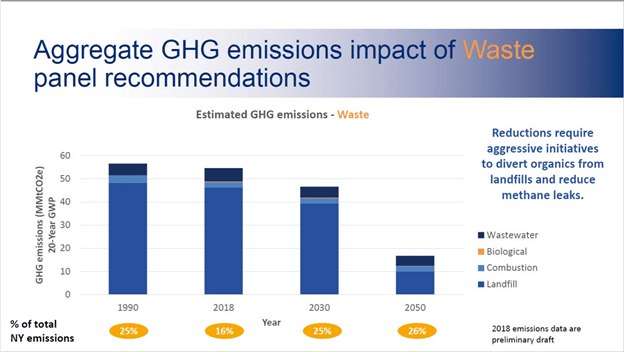
Although the presentations all follow the same format the details differ.  One of the more important components of the presentations is the emissions estimates and they all include a graphic showing historical emissions in 1990, “preliminary draft” emissions for 2018, and their projections for 2030 and 2050.  Most of the presentations added numbers to the slides so that it was not necessary to try to estimate the numbers.  Such is not the case with the Waste panel presentation. 

Moreover, there are problems with the data presented..  The 1990 emissions were defined in the Department of Environmental Conservation’s Part 496 regulations.  According to Part 496 the 1990 Waste greenhouse gas emissions in 1990 by IPCC sector in Global Warming Potential over a twenty-year time frame (GWP20) totaled 52.88 million metric tons (MMt) of carbon dioxide equivalent[1] (CO2e) broken down as 3.03 MMt of CO2, 49.35 MMt of CH4 and 0.5 MMt of N2O. However, in the following graph the total is well above half the range between 50 and 60.  Assuming that the wastewater component is not included in Part 496 brings the numbers close.  The bigger problem is the claim that waste is 25% of the total in 1990 and 16% of the total in 2018.  I guess the waste emissions in 1990 are 57 MMt and I know the 1990 Part 496 total emissions are 409 so that works out to 14%.  I guess the waste emissions in 2018 are 55 MMt and I estimated that the sum of emissions from all the sides in the advisory panel presentations total 377 MMt and that works out to 15% for the waste % of total NY emissions.  It could be a simple typo but in the absence of numbers in the graphic, readers do not know.


There are two emission reduction targets in the CLCPA: 40% reduction in GHG emissions by 2030 and 85% reduction in GHG Emissions by 2050.   The projected total reductions emission reduction goals for the Waste Advisory Panel are a 17.6% reduction from 1990 by 2030 and a reduction of 70.5% by 2050. 

Waste Strategies

According to the meeting minutes, the advisory panel proposed the following enabling strategies:

  • Reducing methane generating wastes from disposal in landfills and combustors;
  • Identifying and reducing fugitive emissions at waste and water resource recovery facilities;
  • Reducing the need for new consumer products;
  • Ensuring proper end-of-life materials management, with a focus on solid waste management hierarchy;
  • Supporting domestic recycling facilities and markets for recovered resources, by emphasizing the highest and best use for recycling end products; and
  • No promotion of new fossil fuel energy infrastructure.

The recommendations are available in a slide presentation.  I am not going to critique these strategies individually because it would take far too long.  Instead, I will comment on a few things with an emphasis on inconsistencies and implementation issues. 

Clearly landfills have to be the target for reductions because it is the largest source.  The plan is to achieve the “aggressive goals of Beyond Waste, the New York State Solid Waste Management Plan (e.g., 90% paper recycling and 65% food waste diversion by 2030)”.  This program was adopted 12/27/10 but beyond mentioning that meeting the goals was necessary there was no further mention of the plan in the presentation or recommendations.  Under the “Ease of implementation” category for Initiative #1: Organic Waste Reduction and Recycling, there is the following description: “Easy; The technologies exist, the challenges are financial (e.g., investment & end markets), behavioral, and logistical (e.g., siting, etc.)”.  During the question-and-answer period of the presentation Anne Reynolds asked about the status of the goals of the over ten year old Beyond Waste Program as a means of assessing how difficult achievement of the recommendations presented today might be and Ms. Rowland noted that “the State is roughly one-third of the way to 90% on the paper recycling and traditional recyclables, with significant work left to do on organics, as only about 2-3% is diverted.”  In my opinion, the financial, behavioral, and logistical challenges defined as “easy” are not.  Note that many of the recommended initiatives require legislative and regulatory action to make these “easy” changes.

There are folks involved with this process that have convinced themselves, contrary to the text of the law, that the zero-emissions mandate refers to all emissions and not just GHG emissions.  I suspect that they are disappointed that the panel projects no reduction projected from existing combustor facilities will be needed to handle municipal solid waste remaining after reduction, reuse, and recycling strategies.

The advisory panel process and the Climate Action Council meetings provide a window into the hopes and dreams of the segment of the population that is driving the concept that the existential crisis of climate change can be solved simply by ending fossil fuel use as quickly as possible.  The “no promotion of new fossil fuel energy infrastructure strategy” is the result of their concerns. Many of the most vocal people in this process are as passionate about this cause as they are clueless about the complexity of the energy systems and tradeoffs of their purported solutions. Renewable natural gas is a very good example of the resulting problem. 

According to EPA:

Renewable natural gas is a term used to describe biogas that has been upgraded for use in place of fossil natural gas. The biogas used to produce RNG comes from a variety of sources, including municipal solid waste landfills, digesters at water resource recovery facilities (wastewater treatment plants), livestock farms, food production facilities and organic waste management operations.

The ultimate problem replacing fossil fuels with renewable wind and solar energy is providing power during periods when both resources are near zero.  In their presentation to the Power Generation Advisory Panel on September 16, 2020 E3 included the following slide that notes that during these periods “firm, zero emission resources, such as bioenergy, synthesized fuels such as hydrogen, hydropower, carbon capture and sequestration, and nuclear generation could provide a number of benefits”.  In my opinion, those benefits include keeping the lights on.

In light of the critical need for these firm, zero-emissions resources and the fact that the methane emissions from municipal solid waste landfills, digesters at water resource recovery facilities, livestock farms, food production facilities and organic waste management operations are a major percentage of the total emissions, it only seems logical to address both problems by developing those resources.  However, there are passionate ideologues that don’t agree.  The meeting minutes note “concern regarding renewable natural gas, suggesting that there is a limited opportunity for it to contribute to Climate Act goals and believes that efforts in this area benefit the source without contributing additional environmental benefits”. Another member “expressed his concerns about how to move ahead with biogas if it is combusted as this would clearly increase net co-pollutants locally, and suggested the Council consider applications for biogas that would not be combusted (such as fuel cell technology at wastewater treatment plants)”.   Nonetheless the panel’s enabling initiatives included biogas recovery and agency staff argued for its use. 

Most of the other strategies proposed identifying leaks and eliminating them.  As part of New York’s irrational war on methane the new leak detection technology that has identified many new sources of methane is considered a rationale for eliminating the use of natural gas instead of an opportunity to make the source of energy that enabled most of the observed GHG reductions since 1990 even better.  Because the residence time of methane is on the order of 12 years eliminating leaks has much value.

There is another aspect to the leak issue related to the cluelessness of some panel members.  One of the other panels has a strategy that includes a public relations campaign to remove the label “natural” from natural gas because they allege that the name was chosen for advertising purposes.  They presume that if the public only understood it was not natural then they would not be so likely to use it.  The problem with that of course is that it is called natural gas because it is a naturally occurring gas.  Wherever a geologic formation that contains natural gas is exposed to the air, natural gas can be released to the atmosphere.  For example, western New York’s Eternal Flame Falls has a vent that seeps natural gas, and someone, sometime lit it off.  It remains to be seen if this natural vent will be sealed off in the name of climate change mitigation but the bigger issue is what to do about all the other sources of naturally-occurring methane.         

Conclusion

There are consistency issues with some of the numbers presented that I could not reconcile.  Using the numbers provided, this sector generates under 15% of the total New York GHG emissions but it is notable that the strategies are only expected to reduce emissions 18% in 2030 as opposed to the target of 40% and only 71% in 2050 as opposed to the target of 85%.  Clearly, this panel recognizes that there are limits to what can be achieved even though the results are disappointing.

Even though the enabling strategies do not meet the CLCPA targets, the results of the 2010 Beyond Waste, the New York State Solid Waste Management Plan suggest that even these strategies may be too optimistic “as only about 2-3%” of food waste is diverted as opposed to the 65% goal.  The concession that no reduction is projected from existing combustor facilities needed to handle municipal solid waste remaining after reduction, reuse, and recycling strategies also suggests these are aspirational strategies.

The ideologues involved in this process hinder rational mitigation approaches.  Collecting and using methane wherever possible not only addresses an emissions problem but also helps address a major concern related to reliability.  It is scary that irrational concerns about using renewable natural gas were not cut off as untenable at the outset.  Another example is not recognizing that natural gas leak detection technology advances are an opportunity to reduce emissions from the resource that has provided most of the recent co-pollutant and CO2 emission reductions rather than a reason to eliminate its use.

[1] The amount of carbon dioxide by mass that would produce the same global warming impact as the given mass of another greenhouse gas over a specific time frame, as determined by the IPCC, and as provided in Section 496.5 of this Part.

Community and Climate Investment Act Climate Pollution Fee

In the spring of 2021, the New York state Senate introduced the Climate and Community Investment Act (CCIA).  Coming on the heels of the Texas energy debacle one might think that politicians would not propose any changes to energy and environmental laws until the causes of that disaster were understood or would at least make implementation contingent upon feasibility studies to determine if the ambitious goals of this legislation don’t risk a similar outcome in New York. Such is not the case, however as I will show in this post

I have written extensively about implementation of the Climate Leadership and Community Protection Act (CLCPA) because I believe it will adversely affect affordability and reliability as well as create more environmental harm than good. The CCIA will make those impacts worse.  The opinions expressed in this post do not reflect the position of any of my previous employers or any other company I have been associated with, these comments are mine alone.

Background

The sponsor memo for this proposed regulation lists specific provisions in the proposed legislation.   I prepared an annotated version of the draft bill that includes internal links to the sections of the bill corresponding to those provisions.  The summary of Senate Bill S4264A states:

Enacts the climate and community investment act; prioritizes the allocation of public investments in disadvantaged communities; addresses climate change challenges through the expansion and growth of clean and renewable energy sources; adopts best value requirements for the solicitation, evaluation and award of renewable energy projects;  establishes a community just transition program; establishes a climate pollution fee and a household and small business energy rebate; and creates the climate and community investment authority.

This article discusses the climate pollution fee which is another name for carbon pricing.  In theory, this supposedly measures the cost of the accumulated damage for centuries to come from emitting a ton of carbon dioxide today.  According to Resources for the Future (RFF), carbon pricing is a climate policy approach that works by charging industrial sources for the tons of emissions of carbon dioxide (CO2) they emit.  The problem is that there is a large gap between the elegant theory of carbon pricing described by RFF and real world carbon pricing.  In theory applying a carbon price across the globe on all sectors could incentivize the market to find the most efficient solution to provide energy at the lowest cost and not unduly affect the public by using the revenues to replace existing taxes.  The reality of the CCIA climate pollution fee proposed is that it is in one limited area with the funding going to special interests. As a result, tt is a regressive tax and a prescription for potential leakage and misapplied price signals.

The CLCPA mandated that the Department of Environmental Conservation (DEC) stablish a value of carbon.  At the end of 2020 DEC published this guidance document.  The Value of Carbon Guidance provides values for carbon dioxide, methane, and nitrous oxide for use by State agencies along with recommended guidelines for the use of these and other values by State entities. The guidance Value of Carbon Guidance  document summarizes the methodology and rationale.  The recommended values are provided in the Appendix: Social Cost Values. The CCIA legislation shows no sign that the months long CLCPA process to develop an appropriate system for valuing carbon was considered, much less incorporated.

Discussion

In order to address the recognized problems of a climate or carbon pollution fee in just New York, the proposed regulation includes a border carbon adjustment fee.  The fee applies to any carbon-based fuel sold, used or brought in the state by an applicable entity.  Consequently, the logistical requirements to calculate border adjustments is a big effort. 

The premise of a climate pollution fee is that it will incorporate the future cost to society of CO2 emissions today.  The DEC Value of Carbon guidance bases its recommendations upon the work of the Federal Integrated Working Group (IWG) social costs of carbon.  Dr. David Kreutzer explains that:

Estimating the social cost of carbon is susceptible to political pressure and model-gaming. The assumptions in play—about unsupportable time horizons, exaggerated emissions projections, overly high estimates of carbon dioxide’s impact on warming, and others—are all too easily corrupted, resulting in wildly varying estimations.

In fact, reasonable assumptions can push the social cost of carbon negative (which implies that a policy of subsidies for carbon dioxide emissions is the answer). However, the single input that has the most potential to overstate the social cost of carbon is understating the discount rate.  The constant pressure to justify ever lower discount rates for social cost of carbon calculations is almost comical when it mistakes wealth for poverty.

It is worth noting that the DEC Value of Carbon guidance did not follow the IWG recommendation for the discount rate recommended choosing instead to pick a lower value.  The CCIA fee appears to use the IWG recommended discount rate of 3%.

The fee calculation methodology is complicated.  The price is adjusted by year and a newly defined environmental integrity metric.  That metric adjusts the price based on the state’s reductions relative to a defined trajectory.  For example, the 2021 statewide GHG emission target is set at 85% of the 2018 GHG emissions.  DEC has not released its draft emission inventory for years since 1990 but my money is on an increase since 2018 simply because the State closed down 1,070 MW of nuclear capacity in 2020 and is closing another 1,080 MW of nuclear capacity this year.  I estimate that the power needed to replace those facilities will generate over 8,000,000 tons of CO2.  The CLCPA Climate Action Council process is underway and I believe is charged with determining the appropriate reduction schedule.  It is very likely that the schedule in the proposed law will not be consistent with the CLCPA recommendation.

I have given up trying to figure out how the environmental integrity metric will affect the price because of its complexity.  Without a lot more work I cannot determine how the five-year metric using cumulative actual and target emission reductions could affect the differing adjustments to the carbon pollution fee.  My impression is that the methodology and values chosen will ensure that the maximum increase (10%) of the climate pollution fee is inevitable.

The last statewide GHG emissions inventory developed by the New York State Energy Research & Development Authority estimated that the total emissions in 2016 were 377 million metric tons of CO2e.  Assuming that emissions will be the same in 2022 when the proposed legislation starts applying the fee the annual fee will be over $16 billion.  The annual adjustments keep the fees about the same for five years or so but then the reductions in emissions reduce the fees collected.  Obviously when all the GHG emissions have been eliminated the fee will also be eliminated. 

My biggest problem with this proposed legislation is mandates for specific information that is already available elsewhere.  In order to determine the tax levy, the emissions must be known.  The regulation includes a section for the calculation of emission factors which when combined with electricity production data can be used to estimate emissions.  This is a flawed approach for those facilities that actually monitor and report their emissions.  Direct measurements are a more accurate methodology than this approach.  Moreover, the DEC and NYSERDA already have a process in place to calculate emissions.  Importantly, the New York Independent System Operator has proposed a carbon pricing scheme that includes a methodology to estimate emissions for its fees.  Both systems are incompatible with this law.

There is a section for exemptions and deductions.  In order to prevent double payments a source affected by 6 NYCRR Part 242 (the Regional Greenhouse Gas Initiative) can deduct “the amount it paid to purchase CO2 emission allowances”.  Exemptions for de minimis quantities of emissions are also allowed.

Emissions leakage refers to a situation where a policy in one jurisdiction moves the emissions out of that jurisdiction to a less restrictive one such that the total emissions are not actually reduced.  The CCIA law includes a mitigation policy that calls for studies of ways to reduce this effect.  Leakage has been a concern in the CLCPA implementation process so the scoping plan recommending policy measures to prevent emissions leakage is redundant except for the fact that the CLCPA evaluation has not included an explicit cost like the $16 billion annual CCIA fee.

The legislation creates funds within the authority including 33% for the “community just transition fund”, 30% for the “climate jobs and infrastructure fund”, 30% for the “low-income and small business and household energy rebate fund”, and 7% for the “worker community assurance fund”. 

Finally, the climate pollution fee includes a requirement for report on the implementation of the fund.  The report is supposed to include the total revenues, the effectiveness of the fee to reduce GHG emissions, the amount of leakage, and overviews of the benefits and costs.

Conclusion

Dr. Steven McKitrick evaluated carbon pricing policies in Canada and explained that “there may be many reasons to recommend carbon pricing as climate policy, but if it is implemented without diligently abiding by the principles that make it work, it will not work as planned, and the harm to the Canadian economy could well outweigh the benefits created by reducing our country’s already negligible level of global CO2 emissions”.  This is entirely analogous to New York and the CCIA.   Importantly he notes:

However, a beneficial outcome is not guaranteed: certain rules must be observed in order for carbon pricing to have its intended effect of achieving the optimal balance between emission reduction and economic growth. First and foremost, carbon pricing only works in the absence of any other emission regulations. If pricing is layered on top of an emission-regulating regime already in place (such as emission caps or feed-in-tariff programs), it will not only fail to produce the desired effects in terms of emission rationing, it will have distortionary effects that cause disproportionate damage in the economy. Carbon taxes are meant to replace all other climate-related regulation, while the revenue from the taxes should not be funnelled into substitute goods, like renewable power (pricing lets the market decide which of those substitutes are worth funding) but returned directly to taxpayers.

The CCIA violates all these rules.  New York has emissions regulations for Part 242 and the CLCPA that both mandate specific reductions.  The revenue from the climate pollution fees won’t even be used to support renewable energy development and only a small fraction will be returned to ratepayers.  This is simply a regressive tax that will dis-proportionally adversely affect those it purports to want to help.

Climate Leadership and Community Protection Act Lesson from the German Energiewende

The German Energiewende (“energy transition”) is often touted as an example for the Climate Leadership and Community Protection Act (CLCPA).  I agree but, as explained in a recent article Daniel Wetzel at German national daily Die Welt, the attempt to transition to green energy has shown that there are significant problems using today’s technology.

I have summarized the schedule, implementation components, and provide links to the legislation itself at CLCPA Summary Implementation Requirements.  I have written extensively in posts on implementation of the CLCPA because I  believe it will adversely affect affordability and reliability as well as create more environmental harm than good which affects my future as a New Yorker.  I have described the law in general, evaluated its feasibility, estimated costs, described supporting regulations, listed the scoping plan strategies, summarized some of the meetings and complained that its advocates constantly confuse weather and climate.  The opinions expressed in this post do not reflect the position of any of my previous employers or any other company I have been associated with, these comments are mine alone.

According to Clean Energy Wire’s guide to the Energiewende, “Germany’s experience offers valuable insights and can serve as an example on how to wean a major economy off fossil fuels, even for countries with their own unique conditions and challenges”.   However, a German Government Audit report warns that the Energiewende is causing higher costs, and that there is a real danger of electricity shortfalls.  Pierre Goslin summarizes the report in “Explosive” German Government Audit Report: “Energiewende” Has Become “A Danger to all Germany”.

Goslin reports:

The “Energiewende” (transition to green energies) has seen Germany recklessly rush into wildly fluctuating wind and solar energy without properly planning the grave impacts they would have on the power supply grid and prices.

The German auditors had already voiced harsh criticism three years earlier in another special report, whose main focus had been on the high cost of the Energiewende. The latest report now also includes “an explosive analysis” on power supply instability and the high probability of power shortfalls.

The report finds that not only have the costs spiraled out of control, but that the German federal government “does not have a sufficient view of the emerging, real dangers to the security of supply” and that “ever higher electricity prices” are to be feared in the current system.

German electricity are among the highest in the world, and there is still no end in sight for the cost spiral. One study found that another whopping 525 billon euros will be needed by 2025 to upgrade the power grid, according to Die Welt.

The development of green energies in Germany has gotten so bad that the Federal Audit Office sees the risk the Energiewende could “endanger Germany as a business location and overburden the financial sustainability of electricity-consuming companies and private households.”  “This can then ultimately jeopardize the social acceptance of the energy transition,” warned Scheller.

Die Welt characterizes the Government Audit report as “explosive” and a long overdue wake-up call. The auditors accuse the federal government of not having properly taken into account the consequences of the coal phase-out, making assumptions that seem “unrealistic or are outdated by current political and economic developments” and making overly optimistic assumptions on the future available wind and sun.

Advocates for the CLCPA believe that wind and solar provide an economic way to transition off fossil fuels.  David Wojick recently published an article that succinctly explains why that approach why one factor makes that a false assumption: the Minimum Backup Requirement (MBR).  Wojick explains that “The minimum backup requirement is how much generating capacity a system must have if it is to reliably produce the electricity we need when wind and solar don’t.”  I have written about this issue but was unable to simply describe it this well.

Michel at the Trust, yet Verify blog evaluated the potential effect of increased electricity production from intermittent energy sources in a post using a simple solar and wind capacity increase data analysis model and found that in Belgium in enormous amounts of over-building are required to cover periods with low wind and solar.  With help from Michel we did a similar analysis for New York and I found that even with unrealistic assumptions about the “best case” availability of solar and wind capacity, there are periods with significant deficits. In order to prove the extraordinary claim that solar and wind can replace existing fossil the State of New York, a similar type of analysis using actual data to estimate realistic energy production must be done. That is the only way to provide the extraordinary proof showing just how much energy storage will be required to prevent deficits.

Conclusion

The Government Audit report accuses the federal government of making assumptions that seem “unrealistic or are outdated by current political and economic developments” and making overly optimistic assumptions on the future availability of wind and sun available.  The draft plans for the CLCPA are going down that same path.  I believe the German results will also occur in New York.

Climate Leadership and Community Protection Act Off-shore Wind Resiliency

New York’s Climate Leadership and Community Protection Act (CLCPA) establishes targets for decreasing greenhouse gas emissions, increasing renewable electricity production, and improving energy efficiency. 

The CLCPA was described as the most ambitious and comprehensive climate and clean energy legislation in the country when Cuomo signed the legislation but there is one massive flaw.  The lawmakers who enacted this law presumed that the transition of the state’s energy system could be implemented by political will so did not include feasibility conditions in the targets or schedules.  This post is a short description of one aspect of the many implementation problems of this law.

I have summarized the schedule, implementation components, and provide links to the legislation itself at CLCPA Summary Implementation Requirements.  I have written extensively in posts on implementation of the CLCPA because I  believe it will adversely affect affordability and reliability as well as create more environmental harm than good which affects my future as a New Yorker.  I have described the law in general, evaluated its feasibility, estimated costs, described supporting regulations, listed the scoping plan strategies, summarized some of the meetings and complained that its advocates constantly confuse weather and climate.  The opinions expressed in this post do not reflect the position of any of my previous employers or any other company I have been associated with, these comments are mine alone.

One of the targets of the CLCPA is to develop 9,000 MW of offshore wind by 2035.  This is considered necessary because off-shore wind has a higher resource availability.  Importantly this is just the start of what is accepted as a much larger offshore wind capacity that eventually will be needed for the ultimate goal of a net-zero emissions economy in New York in 2050.  For example, the Brattle Group analysis for the NYISO, New York’s Evolution to a Zero Emission Power System, estimates that 25,000 MW of offshore wind will be needed in 2040.  This article considers resiliency of the offshore wind capacity needed for the CLCPA.

Tony Heller writing at  Real Climate Science does an amazing job digging up newspaper accounts of past weather events like this description of the “Greatest Cataclysm in American History”.   In that article he uses newspaper archives and other contemporaneous accounts to describe the extreme weather on March 27, 1913 when there was widespread flooding in Indiana and Ohio, a massive tornado hit Omaha, NE, and tornadic storms ranged east into Pennsylvania.  One can only imagine the hysterical cries of climate change impacts if this situation were to repeat itself today. 

I think that comparing the weather of the past to today is important to understand that natural variability causes most of the observed extreme weather observed.  Historical weather observations should also be used to evaluate plans for the future.  If we cannot plan for the past then we shouldn’t even try to plan for the future.  Heller recently described a 2014 report from the Swiss Reinsurance (Swiss Re) Company titled “The Big One, the East Coast’s USD 100 billion hurricane event” that is the impetus of this post.  In the report Swiss Re examines how the 1821 Norfolk and Long Island hurricane would impact the region today. 

The Swiss Re report’s introduction describes the storm:

Nearly 200 years ago, a powerful hurricane decimated the Mid-Atlantic and Northeast United States. Packing wind gusts of over 156 miles per hour, the Norfolk Long Island Hurricane of 1821 surged up the Eastern Seaboard creating chaos and wreaking havoc from the Outer Banks of North Carolina all the way up to the Boston metropolitan area. If this hurricane was measured by today’s standards, it would be a strong Category 4 storm — unlike anything the Mid-Atlantic and Northeast have recently seen or experienced.

In comparison, Hurricane Sandy, with its unique track, 1,000-mile-wide wind field, and low central pressure, pushed record-breaking storm surge into the New York and New Jersey coasts, destroying businesses, homes, and lives in a short 24-hour period. But for all the devastation and damage that Hurricane Sandy brought, its intensity at landfall, measured by 1-minute maximum sustained winds, was equivalent to a weak Category 1 hurricane. Other events in recent years (Irene, Isabel, Gloria, and Bob), while significant, weakened prior to landfall, coming onshore as either Category 1 or Category 2 hurricanes, and not the major hurricanes originally anticipated and feared.

The report states that “If the 1821 Hurricane were to happen today, it would cause 50% more damage than Sandy and potentially cause more than $100 billion in property losses stemming from storm surge and wind damage.”  I had never heard of this storm but I knew about the “Great Hurricane of 1938” which decimated Long Island and New England leaving over 700 dead.  The question is how would a hurricane similar to these storms New York’s proposed offshore wind facilities.

The New York State Energy Research and Development Authority Offshore Wind Projects site describes the current status of the program to reach the 9,000 MW target by 2035.  As of early 2021 there are five offshore wind projects in active development.  The following figure from the website shows where the projects from the first two offshore wind procurements are located.

I wondered whether a storm with the same track as the 1821 and 1938 hurricanes would affect these locations. The Swiss Re report reconstructed the storm track and wind field for the 1821 hurricane:

The New York City National Weather Service has a web page describing the Great Hurricane of 1938 that includes a wind field map developed by Dr. Isaac Ginis at the University of Rhode Island:

The answer to my question whether a storm similar to the 1821 and 1938 hurricanes would affect the five offshore wind projects is unequivocally yes.  The Forward of the Swiss Re report makes an important point regarding this threat:

It’s been two years since Hurricane Sandy reminded us that the Northeast United States is vulnerable to hurricanes, and for those still recovering from the storm’s aftermath, the trauma of the hurricane continues. Yet despite Sandy being the third largest hurricane loss on record, the majority of New York, New Jersey, and other Northeast residents did not experience how devastating a hurricane could be. For many of us Sandy is little more than a distant memory of a temporary inconvenience.

In the months following Sandy many experts told us that Hurricane Sandy was a very unusual event. It was unusual in terms of its westward storm track, its interaction with the jet stream, the high tide, and how it intermingled with the continental weather systems. They tell us that the probability of a similar storm taking the same perpendicular track as Sandy is at least one in 500 years.

Once in 500 years is misleading. Although Sandy was unusual in a meteorological sense, it wasn’t a particularly intense storm and lacked the widespread high winds and rainfall that can occur with a Northeast hurricane. It’s highly unlikely that we will see a hurricane with the same characteristics as Sandy. However it’s very likely (1 in 50 years) that we will see, and in fact, have seen, other hurricanes in the Northeast that would have caused economic damages equal to or greater than those caused by Hurricane Sandy if they were to occur today. Sandy is a harsh reminder of what greater event potentially awaits us.

Conclusion

The official story is that renewable energy like offshore wind will be more diversified and resilient than the current electrical system. Different types of fuels at existing power plants truly provide a redundant and flexible power system that can provide reliable electricity when needed.  In contrast wind and solar power which are utterly dependent upon the vagaries of weather cannot be called flexible and certainly are not dependable without additional energy storage and grid support services that markedly increase the cost.  The claim that wind and solar are less prone to massive outages is absurd given that every night with calm winds causes an outage of both of these generating resources.  

Unfortunately, resiliency in the event of extreme weather is an even bigger problem. There is no question that a hurricane with stronger winds than Sandy will go through the area where New York is developing offshore wind.  The fact that two hurricanes with winds well over 100 mph have passed over New York’s offshore wind development areas should be a major concern.  I worry that New York will invest billions in these resources, get to a point where they are necessary for reliability only to see one storm come through and knock out the resource for an extended period. 

Climate Leadership and Community Protection Act CLCPA Agriculture and Forestry Advisory Panel Strategies Comments

The Climate Leadership and Community Protection Act (CLCPA) became effective on January 1, 2020 and establishes targets for decreasing greenhouse gas emissions, increasing renewable electricity production, and improving energy efficiency.  The law mandated the formation of the Climate Action Council to prepare a scoping plan to outline strategies to meet the targets.  This is one of a series of posts describing aspects of that process.  This post is my reaction to the Agriculture and Forestry Advisory Panel’s initial strategies.

I am very concerned about the impacts of the Climate Leadership and Community Protection Act (CLCPA) on energy system reliability and affordability.  There are very few advocates for the typical citizen of New York who has very little idea about the implications of the CLCPA on energy costs and personal choices. I am a retired electric utility meteorologist with nearly 40-years-experience analyzing the effects of meteorology on electric operations. I believe that gives me a relatively unique background to consider the potential quantitative effects of energy policies based on doing something about climate change.  The opinions expressed in this post do not reflect the position of any of my previous employers or any other company I have been associated with, these comments are mine alone.

Background

I have described the implementation requirements in a stand-alone document.  In brief, The CLCPA mandates that a scoping plan outlining the recommendations for attaining the statewide greenhouse gas emissions shall be prepared and approved by December 31, 2021.  The Climate Action Council and seven advisory panels, transportation, energy intensive and trade-exposed industries, land-use and local government, energy efficiency and housing, power generation, waste, and agriculture and forestry consisting of political appointees and supported by agency staff are charged with this responsibility.  Since the formation of the panels in the middle of 2020 they have been holding meetings and preparing strategies.  Each advisory panel is expected to “Identify a range of emissions reductions, consistent with analysis and in consultation with the Climate Action Council, for the sector which contributes to meeting the statewide emission limits.”  They have been asked to present a list of recommendations for emissions reducing policies, programs or actions, for consideration by the Climate Action Council for inclusion in the Scoping Plan and to seek public input to inform the development of recommendations to the Council for consideration.  This post describes the comments that I plan to submit as part of that public process.

General Comments

There are major potential land use and environmental impact ramifications of the CLCPA on agriculture and forest lands.  I believe it is necessary to do a cumulative environmental impact assessment of the Scoping Plan’s projections for wind and solar development and I strongly recommend that this panel work with the land use panel to take the lead in developing a strategy to evaluate those impacts.

At the end of September 2020 the Department of Public Service released the  Final Supplemental Generic Environmental Impact Statement on the proposed Climate Leadership and Community Protection Act (“CLCPA SGEIS”).  Unfortunately, that analysis only evaluated the 70% reduction by 2030 target and did not even use the latest estimates for the wind and solar developments for that target.  Based on the projections by E3 in their presentation to the Power Generation Advisory Panel on September 16, 2020 and the Analysis Group September 10, 2020  presentation of draft recent observations as part of the New York Independent System Operator (NYISO) Climate Change Phase II Study significantly more wind and solar will be required than was analyzed in the CLCPA SGEIS process.  Because the capacity estimates from these analyses and others are so much larger than the latest CLCPA SGEIS estimate I believe that another environmental impact analysis is needed when the Climate Action Council finalizes its Scoping Plan.

I extrapolated results from several projects to estimate the potential cumulative impacts for the extraordinary buildout of wind generation projected by the Analysis Group – 35,200 MW compared to 5,905 MW in the last DPS impact statement that evaluated wind energy cumulative impacts.  If all the wind projects are built on agricultural land, then between 12% and 56% of the agricultural lands will be covered with wind turbines.  Of course, it is more likely that wind turbines will be sited on ridge lines but that will affect forest land use.  Nonetheless that study also projected 39,262 MW of utility scale solar that will have to go somewhere.  It is not just land use that will be affected.  The environmental impacts of this much wind generation could cause the deaths of between 91 and 804 bald eagles a year.

I recommend that the Agriculture and Forestry Advisory Panel develop a strategy that includes preparations for the cumulative analysis of the Scoping Plan recommended wind and solar development.  That process should start soon and determine a threshold for unacceptable environmental impacts.  For example, I am worried about eagles.  If you had told me 30 years ago that I would ever see a Bald Eagle from my home I would have been doubtful.  Now that has occurred and I am not willing to risk that environmental victory for the CLCPA goals.  Because there are a limited number of eagles and their reproduction rates are low, I imagine that wildlife biologists could develop a criterion on the acceptable annual rate of state-wide eagle deaths from wind turbines.  There were 426 occupied bald eagle nest sites in New York in 2017. It is obvious that a more detailed projection of wind turbine impacts on this rare resource is needed.  The ultimate goal should be to refine the NYSERDA  wind power and biodiversity habitat sensitivity maps for the CLCPA resource development planning and siting process.

Comments on Proposed Strategies

The Agriculture and Forestry advisory panel presented 12 strategies in six categories.  It is particularly relevant that the cumulative environmental impacts of all the large-scale renewable energy projects on land use be addressed by this panel.

There were two strategies in the livestock/dairy management category: alternative manure management and precision feed management.  It is not clear to me why these strategies to reduce methane from manure are included because § 75-0109, (2) (b) states “Include legally enforceable emissions limits, performance standards, or measures or other requirements to control emissions from greenhouse gas emission sources, with the exception of agricultural emissions from livestock.”  What is the point of alternative manure management if livestock emissions are exempt?  At the very least accounting for livestock emissions is going to be complicated.  If there are no enforceable emissions limits then should the emissions be included in the inventories?

It appears to me that the strategies in the soil health and nutrient management, nutrient (fertilizer) management and soil carbon sequestration, and agroforestry, silvopasture, alley cropping, and riparian forest buffers, categories are consistent with § 75-0103 (13) (d) “Measures to achieve long-term carbon sequestration and/or promote best management practices in land use, agriculture and forestry”.

I agree that the land conversions category strategies of agricultural protection and access and no net loss of forestland are important and should be included.  However, the CLCPA electric sector targets are going to require enormous amounts of solar and wind energy development.  This factor has to be addressed and it was over-looked in the mitigation strategy slides.  The Agriculture and Forestry and Power Generation Advisory Panels must determine how much agricultural land and forests will be taken out of production for solar and wind development sprawl

There were four forestry strategies: urban forestry, statewide afforestation/reforestation efforts, improved forest management, and increase manufacture and use of harvested wood products, and a strategy to support opportunities to substitute fossil fuels in the bioeconomy category.  I have one overall observation for these strategies.  I believe that the increased costs of energy induced by the CLCPA and the desire to backup electric heating is going to put a lot of pressure on forests as more people turn to wood-fired heating.  The mitigation strategy slides did not mention this issue and I think this Advisory Panel should address it.

Conclusion

I maintain that the fundamental problem with the CLCPA is the lack of a feasibility study.  It is not clear to me that the ultimate problem of trying to supply the energy needs of a mostly electrified New York electric energy system will work during a multi-day winter doldrum if the primary sources of electricity are wind and solar.  The only way this might work will require extraordinary amounts of wind and solar development.  When there is an “official” estimate of those resources clearly a cumulative environmental impact analysis for those resources should be completed as soon as possible.  This panel and the land use panel are in the best position to develop a strategy to address this problem.