Climate Act Integration Analysis Inhalable Particulate Health Benefits

Recent presentations on the integration analysis strategies to meet the  Climate Leadership and Community Protection Act (Climate Act) targets are providing insight into the impacts on personal choice and costs necessary to meet the so-called “net-zero” goals.  There is a lot of information in the presentations and it takes effort to unpack what they are saying, why they are saying it and how they came to their recommendations.  This post looks at one aspect of the alleged benefits of the Climate Act and its implications for the public.

I have written extensively on implementation of the CLCPA because I believe the ambitions for a zero-emissions economy outstrip available technology such that it will adversely affect reliability and affordability, will have worse impacts on the environment than the purported effects of climate change, and cannot measurably affect global warming when implemented.   The opinions expressed in this post do not reflect the position of any of my previous employers or any other company I have been associated with, these comments are mine alone.

Background

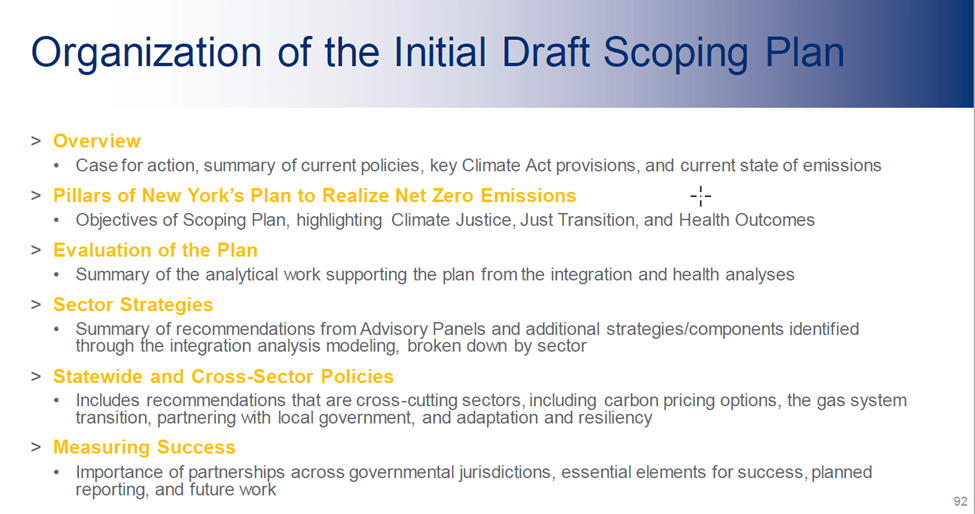
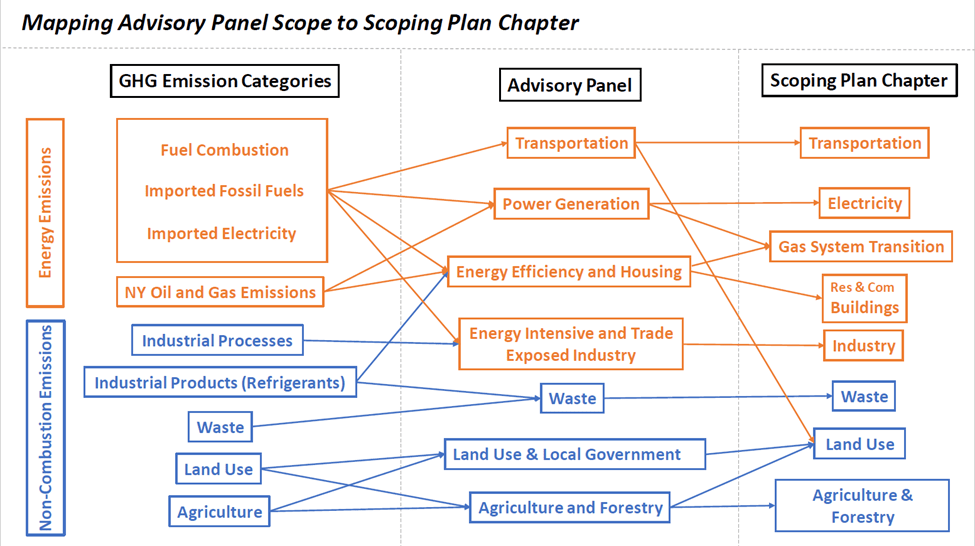
Implementation for the Climate Act implementation began soon after the law became effective in January 2020.  The law established the Climate Action Council whose charge was to develop a scoping plan to meet the targets.  The Council was supported by seven advisory panels who between late summer 2020 and spring 2021 developed strategies for the required emission reductions.  Over the summer they were turned into specific policies by the New York State Energy Research & Development Authority (NYSERDA) and its consultant by using an economy-wide energy model that quantifies emissions and costs. The results from the integration analysis are being incorporated into the draft scoping plan in October so that the scoping plan can be finalized by the Climate Action Council by the end of the year.  Next year the public and other stakeholders will get to comment on the scoping plan

In recent Climate Action Council meetings (October 1, 2021 and October 14, 2021), the initial results of the integration analysis were presented.  The analysis compares the model output for a reference case that estimates emissions and costs assuming no Climate Act policies with four scenarios that incorporate different emission reduction strategies.  The results presentation described specific recommended strategies and provided the first inkling of the costs and alleged benefits.  I am convinced that most New Yorkers have no idea what is included in the state’s plan to do “something” about climate change.  This article addresses the primary driver of the health benefits – inhalable particulates or PM2.5.

Claimed Inhalable ParticulateHealth Benefits

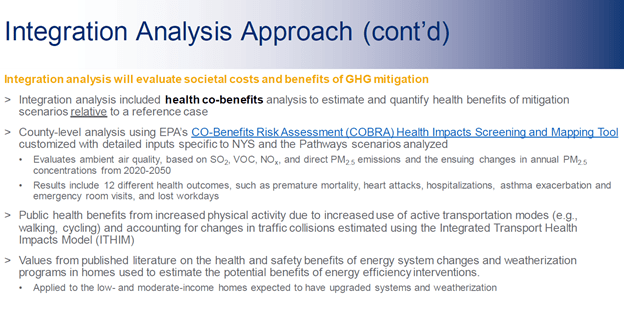
The integration analysis included health co-benefits analysis to estimate and quantify health benefits of mitigation scenarios relative to a reference case.  They did a county level analysis using EPA’s CO Benefits Risk Assessment (COBRA) Health Impacts Screening and Mapping Tool customized with detailed inputs specific to NYS and the pathways scenarios analyzed.  The model projects ambient air quality based on SO2, VOC, NOX , and direct PM2.5 emissions and the ensuing changes in annual PM2.5 concentrations from 2020 to 2050.  The results include 12 different health outcomes, such as premature mortality, heart attacks, hospitalizations, asthma exacerbation and emergency room visits, and lost workdays.

I cannot over-emphasize the point that modeling inhalable particulates air quality is a challenge.  In addition to direct PM2.5 emissions from a wide range of sources these particles also form as a byproduct of reactions in the atmosphere.  As a result, a large area that includes upwind sources has to be analyzed and that means transport becomes complicated.   As a result of these complexities and a lack of verification studies I am suspicious of the results.

The presentation on October 14, 2021 (meeting recording at 3:00:00) claimed that:

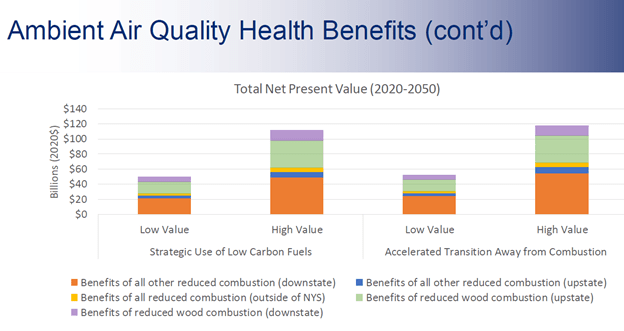
      • Decarbonization of New York can result in a substantial health benefit from improved air quality, on the order of $50 –$120 billion from 2020 to 2050 (based on reduced mortality and other health outcomes).
      • Benefits would be experienced throughout the state and downwind of the state in
      • neighboring states.
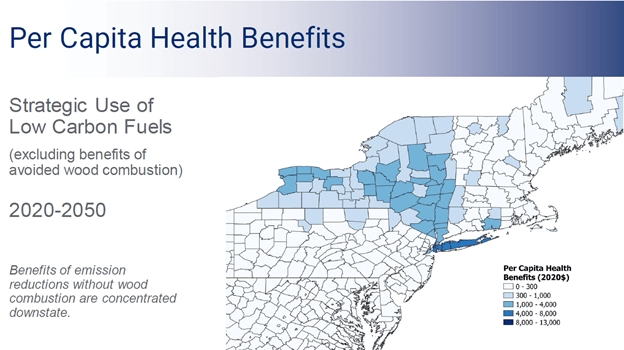
      • Benefits of reduced fossil fuel combustion are higher in urban areas due to both higher emissions and larger impacted population.
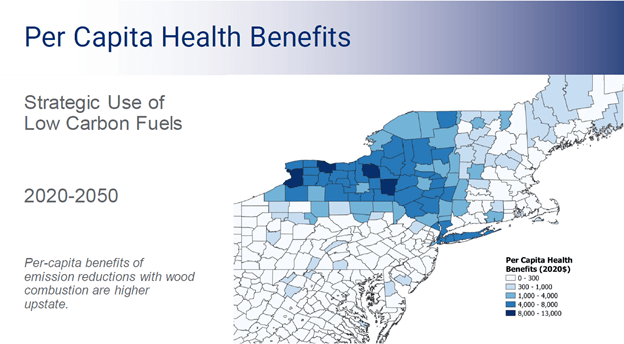
      • Benefits of reduced wood combustion are higher in upstate areas
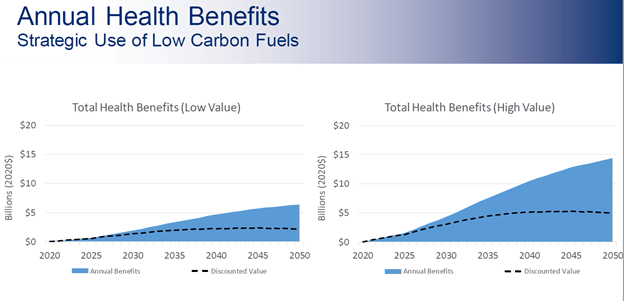
      • Annual benefits grow over time as pollution rates decrease.

The presentation also claimed that air quality improvements can avoid:

      • Tens of thousands premature deaths
      • Thousands of non-fatal heart attacks
      • Thousands of other hospitalizations
      • Thousands of asthma-related emergency room visits
      • Hundreds of thousands lost workdays

The integration analysis modeling monetizes the air quality improvements over the period 2020 to 2050 to come up with the $50 –$120 billion claimed health benefits.  The components of the benefits are described in the following slide (meeting recording at 3:06:43).  It shows that the two largest sources of benefits are coming from “benefits of all other reduced combustion (downstate)” and “benefits of reduced wood combustion (upstate)”.  The integration analysis develops strategies to meet the targets but it does not specify how regulations will be written to implement them.  In order to realize those benefits upstate home heating with wood has to be replaced by electrification and energy efficiency effectively banning wood heating.  Policy options could include a wood burning prohibition mandate or they could assume that their electrification and energy efficiency solutions are so wonderful that everyone will willingly convert.  Authors could also believe that the efficiency of wood-burning furnaces could be improved so much that the impacts will be reduced.  In practice, however, getting any combustion source “tuned” to minimize emissions is an operator challenge and I think it is unlikely that owners will take the time and effort to master that skill.

New York Inhalable Particulate Trends

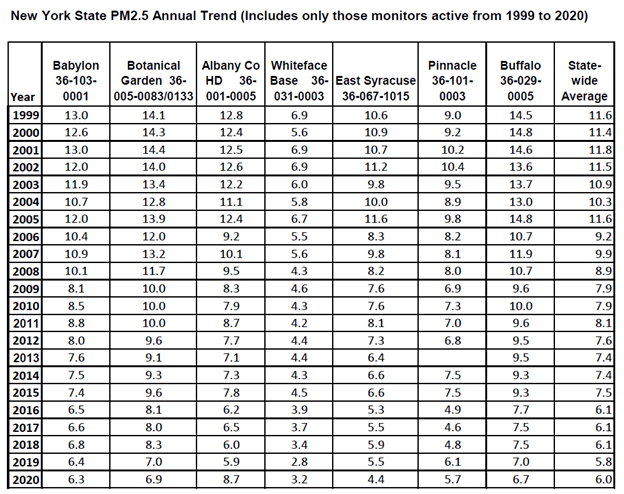
Over the past 30 years there has been a remarkable decline in SO2, VOC, NOX, and direct PM2.5 emissions and the observed annual average inhalable particulate concentrations at seven locations across the state have declined in response as shown below.  Inhalable particulate monitoring started in the late 1990’s but since 2000 the annual averages have dropped between 30% and 60%.  These reductions are mostly due to decreased SO2 and NOX emissions caused by the Acid Rain Program and ozone reduction programs.

New York State PM2.5 Trends

Inhalable Particulate Emissions and Benefits Projections

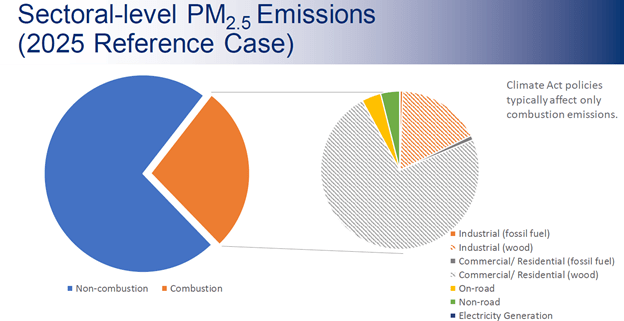
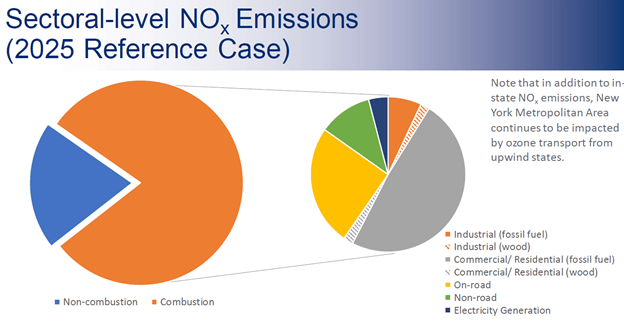
The integration analysis presentation (meeting recording at 3:08:26) includes the following slide that describes where the emissions are coming from that provide the alleged benefits.  The key point here is that the modeling projects that roughly three quarters of the expected inhalable particulate emissions in 2025 come from commercial and residential wood burning and industrial wood burning is another big chunk. According to Carl Mas “It is not that we are burning a lot of wood, it is that it is very dirty when it is burned”.

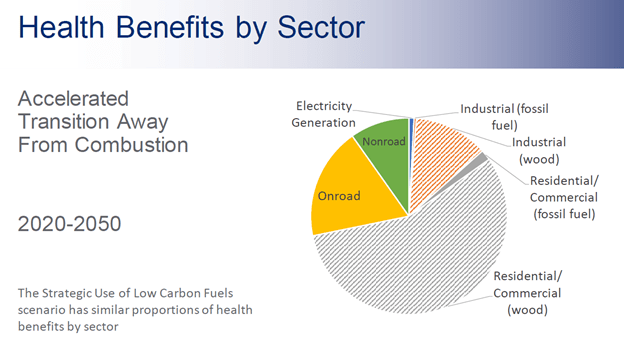
Not surprisingly, the projected health benefits by sector analysis comes to the conclusion that if there was no wood combustion there would be benefits.  This provides the benefit justification to offset the costs for the electrification, home energy efficiency, and wood stove energy efficiency strategies.

Inhalable Particulate Air Quality Projections

The integration analysis presentation (meeting recording at 3:17:42) presents the PM2.5 air quality projections that drive the benefits analysis.  Carl Mas claims that we are getting “deep” reductions of inhalable particulates across the whole state but the highest annual average value is no greater than 0.35 µg/m3. That is a pretty small concentration that I suspect, but could not document, is near the precision of the monitoring system.

It is also informative to compare the predicted decrease in inhalable particulate concentration resulting from the Climate Act strategies to the observed decrease from 2000 to 2020.  As shown in the following figure where I inserted the observed decreases from the seven PM2.5 ambient monitoring stations used before, all but one of the monitoring sites observed a PM2.5 decrease a factor of ten greater than the largest predicted reduction.  On average, the observed reduction between 2000 and 2020 was fifteen times greater than the predicted future decrease.

Discussion

The EPA’s relationship between inhalable particulates and health benefits, as exemplified by the COBRA model, has been used as the primary benefit-cost rationale for many air quality regulations.  At this time New York state is in compliance with the inhalable particulate national ambient air quality standard which is the legally enforceable mechanism to protect human health.  These projections claim that there is no threshold for health impacts and that there is a linear relationship between health impacts and ambient concentrations.  For example, in September, 2011 US EPA Administrator Lisa Jackson testified to Congress that fine particles kill hundreds of thousands of people in America every year, a claim based on EPA epidemiology and extrapolated projections.  However, Enstrom tested the validity of this relationship and found no effect of fine particulates.  Nonetheless, these results have been used for years to justify regulations and legislation and from the basis of these Climate Act benefits.

In order to convince me that the relationship used to predict these benefits is correct I need to see verification of the health benefits with a reduction in inhalable particulate concentrations.  In order to  do the verification correctly, the EPA Environmental Benefits Mapping and Analysis Program should be used.  That model uses similar health outcome predictions to COBRA but uses observed air quality changes as its input.  The linear model used to project the health benefits should show proportional impacts to the integration analysis projections.  If that relationship is correct then there should be observable reductions (on the order of 15 times great than the integration analysis predictions) in all the health outcomes used.

Conclusion

I do not accept the linear no-threshold model for air pollution health analysis mostly because the National Ambient Air Quality Standards are based on a threshold approach.  Consider this example as an illustration of my cynicism.  No one questions the fact that prolonged exposure to wood smoke can cause health problems.  I have no doubt that there are health studies that have conclusively shown that at high pollution levels people have contracted cancer.  For the sake of argument, assume that the health studies have found that wood smoke at a continuous dose of 100 ppm for one year causes cancer.  The linear no-threshold model can extrapolate that dose response down to 0.00019 ppm per minute.  Using that extrapolation relationship, if 5,256 people sitting around campfires were exposed to the 100-ppm dose for one minute then linear no-threshold models claim one of them will get cancer from that dose.  Anyone who has sat around a campfire probably has been downwind of the smoke and received a dose of wood smoke.  It does not matter what the actual health impact dose response rate is, if you extrapolate that down to the dose of people sitting around a campfire and multiply that by all the people sitting around campfires the linear no-threshold model predicts an impact.

Comparison of the observed reductions of inhalable particulate ambient concentrations since 2000 and the projected decreases expected due to the climate act suggests that NYSERDA could validate their health impact benefit claims.  They claim benefits by preventing tens of thousands premature deaths, thousands of non-fatal heart attacks, thousands of other hospitalizations, thousands of asthma-related emergency room visits, and hundreds of thousands lost workdays.  Using their linear relationship and an order of magnitude larger observed reduction of inhalable particulates then the relationship should show up.  I find it hard to believe that the reduction in inhalable particulates has actually prevented millions of lost workdays.

Finally, note that the integration analysis only presents strategy recommendation.  At the end of 2022 the scoping plan will be finalized and the next year NY agencies will have to develop implementing regulations.  In this example, will they actually prohibit wood burning to ensure that the greenhouse gas emission targets and the projected health benefits are realized?  Maybe they will just assume that their electrification and home heating energy efficiency programs will be so popular that everyone will convert willingly. I don’t think that will work given that many of the people that I know who use wood for heating, get the fuel from their own woodlots.  Electric options have to be significantly more expensive for them.  Finally note that they might believe that wood stove energy efficiency programs will improve performance and reduce inhalable particulate emissions.  I don’t think that is a realistic hope because maintaining efficiency is too difficult for typical home owners.

Climate Leadership & Community Protection Act Presentation to the New York Propane Gas Association October 2021

I gave a presentation titled “Climate Act – All Pain and No Gain” describing the New York Climate Leadership and Community Protection Act (Climate Act) to the New York Propane Gas Association Fall Conference on October 25, 2021.  This post summarizes the presentation because it gives a good overview of issues related to the Climate Act.

I have written extensively on implementation of the CLCPA because I believe the ambitions for a zero-emissions economy outstrip available technology such that it will adversely affect reliability and affordability, will have worse impacts on the environment than the purported effects of climate change, and cannot measurably affect global warming when implemented.   The opinions expressed in this post do not reflect the position of any of my previous employers or any other company I have been associated with, these comments are mine alone.

Background

According to their website the New York Propane Gas Association (NYPGA) is “a member-focused trade organization providing services that communicate, educate and promote the propane industry in New York”.  I led off the discussion of the Climate act with my overview presentation on the Climate Act. The second speaker, Richard Goldberg from Warm Thoughts Communications, described their plans to fight the Climate Act.   Finally, Assemblyman Phil Palmesano updated the group on the climate initiatives political situation in Albany.  I am only going to discuss my presentation in this post.

Presentation

Because the slides and annotated slides with references are available I will not go through every slide in the presentation.  Instead, I will highlight the points that I was trying to make and only include a few slides.  There were four main topics: an overview of the science, a summary of the Climate Act, a description why I think there is no gain from the Climate Act and an explanation why it is all pain.

For the science overview I used slides prepared by Dr. Judith Curry that she graciously allowed me to use.  One problem I had is that there is so much material that I could have presented it was difficult to pare down the content to fit the 30-minute time slot.  I only used the first three slides from Dr Curry’s presentation.  The first slide described the common perception of the climate crisis.  The second explained problems with the climate crisis narrative:

  • We’ve vastly oversimplified both the problem and its solutions
  • The complexity and uncertainty surrounding climate change is being kept away from the public and policy debates.
  • Rapid reductions in emissions are technologically and politically infeasible on a global scale

I also included her summary of the 97% climate science consensus and the disagreements about the current state of climate science:

  • How much of the recent warming has been caused by humans?
  • How much the planet will warm in the 21st century?
  • Whether warming is ‘dangerous’
  • And how we should respond to the warming to improve human well-being

My summary of the Climate Act used graphics from the New York agency publications.  I noted that the rationale for the Climate Act is that we need to do something to address the “the greatest threat facing life as we know it” but explained that I did not have time to demonstrate that this claim is an exaggeration, see this example of the material I would have used if I had time.  When I showed a list of the Climate Act targets, I explained that they were developed by motivated special interest authors and that the limits were set entirely to fit a political agenda with no thought of feasibility.

While I tried to avoid getting into the details of the greenhouse effect, I had to address a couple of points. I included a slide describing the greenhouse effect as background for the discussion of global warming potential (GWP) after a slide listing the six greenhouse gases covered by the Climate Act.  The GWP is used to intercompare the effects of different greenhouse gases.  It is a function of the gases’ ability to absorb radiation and their residence time in the atmosphere.  The Climate Act vilifies methane by using a 20-year GWP time scale whereas, everybody else uses a 100-year GWP time scale.  This triples the importance of methane in the accounting for all the gases.  However, if the Climate Act is really intended to address the potential for New York emissions to cause global warming this is inappropriate.  The actual effect of a greenhouse gas on global warming is a function not only of GWP but also observed atmospheric concentrations.  Because the concentration of methane is so low in the atmosphere, doubling the concentration will “change the outgoing forcing by less than one percent”.  In other words even if we control methane it will have not effect on global warming.

I included the following table that showed where the state currently stands relative to the 2030 goal of a 40% reduction of greenhouse gas emissions.  The data in the table were extracted from the advisory panel presentations and are a sum of all six greenhouse gases expressed in million metric tons of carbon dioxide equivalent – adjusted for the 20-year global warming potential.  In the most recent year of data (2018), emissions were only 8% less than 1990.  Getting an additional 32% by 2030 is an ambitious goal.  I also pointed out that Climate Act methane obsession increases residential, commercial, and waste sector emissions to nearly half the total in 2018.

My no gain for the Climate Act argument is that it will not have an effect on global warming. If the point is that we want to reduce global warming to reduce the effects we constantly hear about in the media, then perhaps it is time to re-think this approach.  I showed that if New York manages to eliminate all the 1990 emissions that we can only expect a reduction, or a “savings,” to global warming of approximately 0.0097°C by the year 2100.  Given that atmospheric temperature measurements only have a precision of 0.1°C that means we will never measure the change due to the Climate Act.  In addition, we will never perceive that reduction using the general rule of thumb for temperature change with elevation or latitude because the predicted temperature savings is equivalent to a vertical distance change of 39 inches or latitudinal distance change of 0.9 miles.  Most importantly emission increases elsewhere overwhelm any reductions New York can make.  For example, emissions from coal plants under construction and completed in China in 2019 will subsume the reductions of all of New York in less than two years. 
I also argued that there is a moral case for using fossil fuels that makes it very likely that fossil fuel will be the appropriate choice to provide reliable, affordable, and abundant electricity to the over 1.2 billion people in the world who don’t currently have it.  The following slides shows that even as CO2 emissions have gone up poverty has decreased, life expectancy has increased and population has increased.  Similar results for other parameters representing human well being show the same thing.

Why the Left Cancels Any Climate Questioning

My presentation went on to describe how the Climate Act implementation was set up and the current status.  I explained that the law established the Climate Action Council to develop a scoping plan to meet the targets.  It has 22 members and 14 members were appointed indirectly or directly by former Governor Cuomo.  Those members were chosen for political purposes rather than technical expertise.  Technical expertise was supposed to come from the advisory panels composed of people with expertise or direct involvement.  Unfortunately, direct involvement meant politically correct so technical expertise was short-changed.  The result was that the proposed strategies from the panels are more aspirational than practical.

I went on to explain that the strategy recommendations developed since last year have been turned into specific policies by the New York State Energy Research & Development Authority (NYSERDA) and its consultant by using an economy-wide energy model that quantifies emissions and costs. The results from the integration analysis are being incorporated into the draft scoping plan in October so that the scoping plan can be finalized by the Climate Action Council by the end of the year.  Next year the public and other stakeholders will get to comment on the scoping plan

In recent Climate Action Council meetings (October 1, 2021 and October 14, 2021), the initial results of the integration analysis were presented.  The analysis compares the model output for a reference case that estimates emissions and costs assuming no Climate Act policies with different scenarios that incorporate emission reduction strategies.  All of the analyses have common themes as shown in the following slide.  They will have major impacts to reliability, cost, and personal choice.  For the presentation I concentrated on the theme for “more rapid and widespread end-use electrification & efficiency” that translates into mandates for electrification of heating, cooking, and hot-water. 

Four scenarios are included in the integration analysis.  Scenario 1 incorporates recommendations by the Advisory Panels for potential reduction strategies that included ambitious actions but the emission reductions were only 34% by 2030 instead of the 40% target.  The remaining scenarios were designed to meet the 40% target at a minimum and include even more ambitious actions.  Scenario 2:  uses low carbon fuels (bioenergy and hydrogen) for combustion for difficult to electrify applications and for times of low renewable availability.  In order to placate the members of the Climate Action Council who believe that all forms of combustion are bad Scenario 3 reduces combustion as much as possible and accelerates electrification of buildings and transportation actions.  Scenario 4 was developed to respond to those on the Climate Action Council who think that more reductions faster are possible which pushes all the actions further.

At the October 1, 2021 Climate Action Council meeting new findings from the integration strategies were described.  The one I find most unsettling notes that meeting the targets will require: “unprecedented rate of adoption of novel and potentially disruptive technologies and measures”.  I explained that I did not know what a disruptive technology was so I had to look it up.  I found a reference that explained that disruptive technologies “significantly alter the way consumers, industries, or businesses operate” and a “disruptive technology is one that enters the mainstream and changes the way most people think or behave.”  However, that same reference notes that there are disadvantages: “New technology is typically untested and unrefined during its early stages and development can continue for years” and “innovations go through a period of problem-solving”.  The problem is that the Climate Act schedule precludes most testing and problem-solving for these technologies  For example, one of the low-carbon fuels proposed is green hydrogen produced by hydrolysis of water powered by wind and solar but the economic viability of this new technology is unclear.  Beyond the mere unproven mechanics of the process as a way to store intermittent wind and solar for later use, the logistics of deploying the technology as well as the environmental impacts have not been addressed.  The bottom line is that depending on disruptive technologies to meet the Climate Act goals is incredibly risky.

For this presentation I concentrated on the theme for “more rapid and widespread end-use electrification & efficiency” and specifically discussed the potential mandates for electrification of heating.  The silver bullet technology for home heating is the heat pump.  I explained that they are more efficient than combustion and they have the advantage that they can provide both cooling and heating.  I noted that they basically are refrigerators operated in reverse.  Instead of taking heat out of the refrigerator to cool it they take heat out of the environment to warm the house.  There are two types of heat pumps.  Ground-source heat pumps use energy in ground that does not vary as much but are more costly and more difficult to retrofit.  Air-source heat pumps are cheaper and can be retrofit more easily.  However, they use atmospheric energy so they require backup heating capability in New York because there is insufficient energy available outside when the temperatures go below zero deg. F.  I went back to the refrigerator analogy to make the point that refrigerators work well because they are insulated and well-sealed.  In order to work as well in a building, comparable insulation and building shell efficiencies are needed. Clearly that is unlikely in most homes.

I explained that the mitigation scenarios all have mandates for heat pump installations.  I extracted the heat pump strategies in the October 1, 2021 building sector descriptions for the following table.  The scenarios assume that all furnaces sold in 2035 will be heat pumps and include a transition of heat pump sales (77% to 80%) by 2029.  Note that this modeling does not propose how people will be coerced into those sales before the 2035 mandate.  The modeling also makes assumptions about the number of heat pumps in the system by 2035 and 2050.  Scenario 2 assumes 80% of the heat pumps installed are air source and Scenario 3 is a “lower share”.  Backup is mostly electric in Scenario 2 and is all electric in scenario 3.  It is interesting to note that only Scenario 3 admits that retirement before the end of useful life of fossil-fired furnaces is needed.  It is not clear how they would design a regulation to enforce that mandate.

I explained that there are three painful aspects of the Climate Act

  1. Strategies don’t work everywhere
  2. Strategies don’t work all the time
    1. In some cases that is just a nuisance
    2. In other cases, it could be dangerous
    3. Without significant revisions I think it could lead to catastrophe
  3. Real costs will be substantial and their purported benefits are unrealistic
    1. It is not possible to offset consumer costs with the benefits claimed

I gave three examples of Climate Act strategies that do not work everywhere.  One of the prominent buzz phrases in the advisory planning recommendations is “smart planning” which basically boils down to strategies that reduce energy use such that less generation is needed.  One prominent example is to combine residential, commercial, and retail in one location to reduce energy use.  For example, a smartly planned development could enable residents to walk to a grocery store rather than having to drive.  However, in order to work the population density has to be high enough to support the grocery store.  I don’t see how that strategy could work outside of New York City and its immediate suburbs.  A major strategy to reduce transportation emissions is to enhance public transit to enable people to reduce vehicle use but this also needs a minimum population density and is unlikely to ever be a viable alternative in rural areas.  Note that the Climate Action Council members who want to eliminate combustion sources would eliminate the use of wood burning for home heating.  I believe that would be a non-starter for many rural residents who use their wood lots to provide the energy for heating their homes.

I noted that there are three examples of Climate Act strategies that do not work all the time.  The second major strategy to reduce transportation emissions is to electrify vehicles.  I will admit that electric vehicles work well for limited applications but they have limitations relative to gas powered cars.  For example, I could use an electric vehicle for most of my local trips around Syracuse but I also use the car to visit family in Brooklyn.  I don’t think that is a viable option with an electric vehicle because I would have to stop en route to charge up the car and then compete with around a million other car owners to find a place to charge when in the city.  However, it is just a nuisance because I have the alternative of taking a train or flying down.

The Climate Act strategy to electrify home heating is more problematic.  While heat pumps have advantages, the inescapable fact is that air source heat pumps don’t work well in really cold weather when you need heat the most.  In my case, in order to ensure that I have sufficient heat when the temperature is below zero, I am going to have to have a backup radiant electric heat that is inconvenient and expensive.  When everyone in my neighborhood has been forced to install similar systems, we will have to hope that the local distribution system will be able to handle the extra load because trying to heat our houses with toasters is not energy efficient.  I also have to hope that my house service can handle the extra load at the time of critical need.  If I get this wrong, it is not only inconvenient but also dangerous.  I don’t think the odds of everyone getting this right are very high.

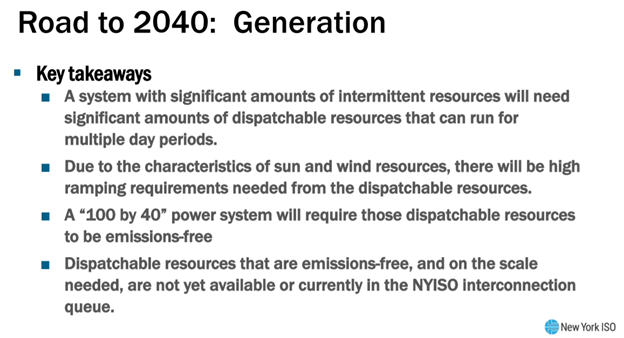
There is an even worse possibility.  The future electric system is going to depend on intermittent wind and solar energy to provide electricity.  If electric system planning gets this wrong the results could be catastrophic.  I have previously described this situation as the Ultimate Problem with the Climate Act.  In early 2020 a couple of analyses highlighted this issue as shown in the following slide.  In order to keep the lights on grid operators have to balance load and generation which is relatively easy when the majority of the generators can be dispatched to do the matching.  However, wind and solar are not dispatchable so it gets more complicated.  In their presentation to the Power Generation Advisory Panel on September 16, 2020,  E3 included a slide titled Electricity Supply – Firm Capacity that stated that: “The need for dispatchable resources is most pronounced during winter periods of high demand for electrified heating and transportation and lower wind and solar output”.  They noted that they had found multi-day periods with low wind and solar output as shown in the slide when the renewable resource energy was far less than the load needed.

In order to provide sufficient electrical energy to power the future grid when home heating and transportation loads are added to the electrical loads, we have to know the frequency, duration and intensity of the periods when there is low wind and solar output.  In February 2021, there was a disaster in Texas caused in part because the electrical system failed when it was needed most.  Energy problems were related to the fact that the Texas electricity market only pays for the power produced, nuclear and fossil generators were not sufficiently resilient to cold weather, and the cold weather was accompanied by light winds so wind resources were mostly useless.  In order to keep the grid operating they had rolling blackouts. 

Superstorm Sandy , often mentioned as a reason why we need to implement the Climate Act, killed 147 people and caused $70 billion in property damages.  The Texas energy debacle in February 2021 caused at least 151 deaths, property damage of $18 billion, and $50 billion for electricity over normal prices during the storm.  Note that because one aspect of smart planning is to increase the cost of electricity when load is highest, that prices will be highest when backup resistance heating is required so there will be similar increases in cost over normal prices.  If New York similarly mis-judges the availability of renewable resources similar impacts can be expected.   

There is an even more concerning issue.  If New York does its planning correctly the frequency, duration and intensity of low solar and wind output periods will be known and, assuming the disruptive technologies necessary do work as hoped, the electrical grid may be able to avoid a renewable resource reliability crisis.  However, those are predictable conditions.  What happens for a black swan event?  The projected amount of offshore wind resources in 2050 is 10% of the capacity and 20% of the energy.  What happens when a Category 4 hurricane hits the offshore wind farms?  That would have the potential to destroy a significant portion of New York’s electrical generating resources for years.  Maybe not at the same scale but an ice storm would also be problematic when everything is electrified.  Clearly anyone who claims that a wind and solar energy system is “resilient” is pushing the envelope for credibility.

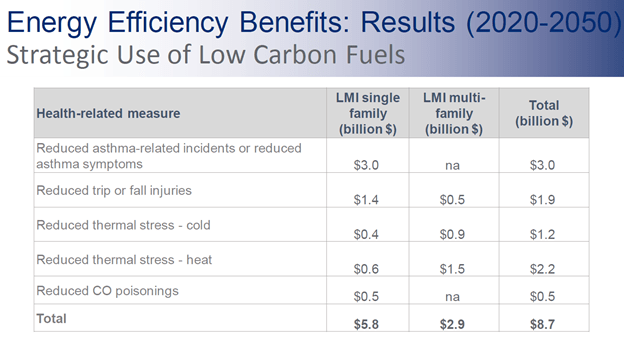
The final painful aspect of the Climate Act is the cost.  The first summary of costs and benefits was presented at the October 14, 2021 Climate Action Council Meeting and I provided my first impression here.  Costs in Scenario 2 are estimated to be $340 billion and if we start spending that in 2025 that is over $13 billion per year.  They claim that the cost of inaction exceeds the cost of action by more than $80 billion.  The basis for that claim is that improvements in air quality, increased active transportation, and energy efficiency interventions provide health benefits ranging from $160 – 170 billion and that reduced GHG emissions avoid economic impacts of damages caused by climate change equaling approximately $260 billion.

Conclusion

I concluded with five takeaways:

      • We’ve vastly oversimplified both the problem and its solutions
      • Over-reliance on technological innovation is incredibly risky
      • Strategies proposed don’t work all the time and you need them the most when they don’t work
      • Texas energy debacle was caused in part by over-reliance on renewables and costs were equivalent to the costs of superstorm Sandy
      • The bottom line is that the solutions don’t add up

I think the presentation was well received.  It was encouraging to talk to like-minded individuals because this is a hot button topic that I have found best to avoid because the true believers cannot be persuaded that there are issues and uncertainties associated with the science.  It is troubling that I see the same slavish devotion to the premise that renewable energy solutions can replace the existing system if we only have the political will.  On the other hand, now that we have specific policy recommendations, I am convinced that a list of what will be required will awaken the majority of New Yorkers to what is coming at them.  Then we can explain the fact that the ambitions for a zero-emissions economy are not affordable and increase energy reliability risks too much with available technology.  It is appropriate to call time out and determine a better course of action than the Climate Act.

Climate Leadership & Community Protection Act: Yet Another Industrial Solar Issue

I am starting to see more New Yorkers becoming aware of the impacts of New York’s Climate Leadership and Community Protection Act (CLCPA).  In order to meet the target of a 100% carbon-free electricity system by 2040, an enormous amount of solar power will have to be built.  I recently heard from Dan Steward, an agronomist and environmental planner in western New York who raised the issue of another unintended consequence after finding this blog.

I have written extensively on implementation of the CLCPA because I believe the solutions proposed will adversely affect reliability and affordability, will have worse impacts on the environment than the purported effects of climate change, and cannot measurably affect global warming when implemented.   The opinions expressed in this post do not reflect the position of any of my previous employers or any other company I have been associated with, these comments are mine alone.

Steward’s Concern

In brief, Dan notes that most farmers rent a significant portion of land for their operations, especially dairy farmers who use it to grow forage for their herds.   Farmers have always competed for the use of land:  there is a saying that the farmer who can farm the land most profitably is the one who will end up with it.  This is economics 101.  Farmers are now competing with solar developers with vast direct and indirect subsidies, offering land owners up to ten times the current agricultural annual lease rates.   This raises the concern that farmers will not have enough available farmland to support the investment they have made in facilities, livestock, or equipment.   At a minimum, it will raise the cost of land for New York farmers, making it harder to compete on the increasingly global food markets.

Dan explained that in the last year they have reviewed and commented on Notices of Intent for at least a half dozen industrial solar developments that convert farmland in agricultural districts in New York’s Chautauqua County.  He notes that although there are “guidelines” for developers to site solar on poorer, under-utilized soils, many of the project plans they have reviewed are planned for prime soils. 

He doesn’t think most farmers understand what is heading their way. He said: “New York State Ag and Markets, who does know, is doing very little to speak out against this travesty. This is just another unintended consequence of this ill-advised policy put forward by our “leaders.”

In the past large utility-scale solar projects would have gone through an extensive permitting process that includes a requirement to inform everyone who could be impacted by the project about the plan.  However in order to “ensure that renewable generation is sited in a timely and cost-effective manner” the state passed the Accelerated Renewable Energy Growth and Community Benefit Act (AREGCBA).  The AREGCBA has guidelines to site solar away from prime farmlands but, given the volume of applications, I doubt that permitting staff at the agencies has time to review applications to ensure that this guideline is applied.  Moreover, because the permitting requirements for notifications are so much less stringent so it is very possible that a developer could get an application approved before impacted farmers could object to the loss of the prime farmland they need to operate.

It gets worse.  Another guideline concerns decommissioning.  Developers are supposed to set-aside enough money so that when the solar development is decommissioned the land can be returned to its previous condition.  That challenge is markedly easier if the land is poorer quality or under-utilized but if the land used was prime farmland, it is much more difficult. 

There are a couple of concerns.  Given the state’s aggressive implementation policy and lack of stakeholder input in the permitting process, there is a good chance that insufficient funds will be set-aside for reclamation.  Dan is concerned about a situation where the developer declares bankruptcy without having a legitimate bond and then the landowner will let the property go back on taxes to the county without ever having decommissioned or restored the land.  He explained that:

When the question about who is responsible for decommissioning is posed at meetings or addressed in informational literature, it is stated that a land-owner should consult an attorney to protect themselves. However, in the situation I just described, it is the local taxpayers, neighbors and the county that will ultimately be left in possession of what is now basically a brownfield.

We the public have the risk, not the landowner. The landowner will have collected, according to reports, around $1,000 per acre annually. He has more than recouped the value of the land and has no incentive to engage in a costly clean up. I understand that bonding is supposed to play a role in these projects. I admit that I am not familiar with different forms of bonding and how they work. However…

This must be a common concern with these projects, but I have never heard it addressed definitively. Why does everyone need to get a lawyer to get an answer?

If you are interested in more information, Dan also passed on a video of the September 15, 2021 meeting of the Planning and Economic Development Committee of the Chautauqua County Legislature where these topics were discussed.

Cornell Analysis

In a similar vein, Max Zhang, professor in the Sibley School of Mechanical and Aerospace Engineering at Cornell recently published “Strategic Land Use Analysis for Solar Energy Development in New York State“. Unfortunately it is paywalled, but there is a summary of the article in Science Daily, Roadmap to expand NY solar energy, meet green goals. The study notes that:

So far, 40% of current solar energy capacity has been developed on agricultural land, the researchers found, while 84% of land identified as suitable for future solar development — about 140 gigawatts — is agricultural.

“Solar farms are already taking up agricultural land and it will likely take even more to achieve New York’s energy goals,” Zhang said. “For the solar-energy community, this is not a surprise. But for the agricultural community, this is a surprise.”

All this is consistent with Steward’s concerns.  Zhang’s analysis estimated the amount of solar needed for the CLCPA targets.

Under New York state’s 2019 Climate Leadership and Community Protection Act, the state must reach 70% renewable energy generation by 2030 — and 100% by 2040. Assuming no further offshore wind energy development beyond the current 9-gigawatt goal, the state will need 21.6 gigawatts of utility-scale solar energy capacity to reach that target.

However, Zhang did not have the results of the latest estimates of solar deployment.  On October 14, 2021 integration analyses were presented to the Climate Action Council that include the resources necessary to meet the CLCPA targets.  Scenario 2, “strategic use of fossil fuels”, projects that 64.6 GW of solar will need to be deployed.  That total includes both utility-scale facility and roof-top solar.  Assuming half is utility-scale solar that means we can expect 32.3 GW of industrial solar installations.  I have reviewed Article Ten solar facility applications and 11 included both the proposed capacity (MW) and area expected to be covered with equipment.  The average was 9.3 acres per MW so that means in order to meet the CLCPA targets 300,300 acres or 469 square miles of land will need to be covered with 32.3 GW of solar panels by 2050.

Zhang has a couple of suggestions to reduce negative impacts.  He suggests that “Keeping solar farms from becoming too concentrated in regions will likely help mitigate negative economic activity”. Overly concentrated development leads to agricultural land conversion which initiates “a negative, economic chain reaction for businesses that depend on farming”.  In an interview on his paper Zhang notes that  one strategy would be to use low quality land or consider dual-use (agrivoltaics) options.  He does note that there is an economic reason to use the higher quality land because it is flat and has already been cleared.

For the most part I agree with his analysis and statements.  However, I have to disagree with his interview statement that “solar PV is generally a benign technology.  In order to get the solar power to your home energy storage is required.  Processing to obtain the rare earth metals needed for solar and energy storage is anything but a benign impact.  In addition, the installation of the massive number of panels creates massive areas of impermeable surface which will increase stormwater runoff.  If not handled correctly serious problems will occur.

Past Experience

In no small part the reason for Dan’s cynicism is his past experience with other state renewable energy programs.  He cites the problematic wind turbines installed on the Thruway. Several years after installation they weren’t working and the State ended up suing the developer.  I could not find any reference to a resolution of the problem. 

Another example is the NYSERDA Solar Thermal Incentive Program.  Dan explains that:

Contractors were paid to install solar thermal panels on barn roofs. Most farmers paid nothing for them. However, there was no incentive to make them work. All of the farms I have talked to, including my brothers, that had them installed through this program have told me they never worked! The contractors took their money and got out of Dodge. Eventually they will need to be taken down at the farmer’s expense. Some may now have some equipment that has some value for other uses, but in most cases, little to no renewable energy hot water was produced. Stop in and ask a farm or two.

Western New York barn with thermal solar courtesy Dan Steward

Dan also mentions another renewable energy project that I remember from my days at Niagara Mohawk.  The idea was to plant stands of willows as a pilot project for renewable energy on agricultural land.  The plan was to burn the willow at the Dunkirk coal-fired power plant but when somebody did the math it turns out that the plant could have burned all the willow planted in such a short time that they could not justify getting the system setup to use the wood.  As a result, it was never harvested and it is not hard to find hundreds of acres of willow in Chautauqua and Cattaraugus County if you know where to look.  Of course, even if it had worked the plant is closed now so failure to use the resource was only a matter of time.

Conclusion When the people affected by the massive amounts of renewable energy development get a chance to make their concerns known, it turns out that there are legitimate concerns that should be addressed.  Unfortunately, the New York renewable energy siting process no longer mandates that their concerns should be heard even from peer-reviewed work such as Zhang’s.  As a result, I expect many unintended consequences to arise unless changes are made. Given that the history of previous renewable energy projects in New York does not have a particularly good record of success it is easy to presume that this will be the case this time too.

CLCPA Environmental Hypocrisy – Offshore Wind Cable Water Quality Impacts

This post discusses an example of New York’s Climate Leadership and Community Protection Act (CLCPA) environmental hypocrisy.  I describe an instance where infrastructure support projects will have a far greater environmental impact than similar but smaller impacts that were grounds for permit denials for fossil fuel infrastructure applications.  This example discusses underwater cables and pipelines.

I have written extensively on implementation of the CLCPA because I believe the solutions proposed will adversely affect reliability and affordability, will have worse impacts on the environment than the purported effects of climate change, and cannot measurably affect global warming when implemented.   The opinions expressed in this post do not reflect the position of any of my previous employers or any other company I have been associated with, these comments are mine alone.

New York Regulatory Decision for a Pipeline

On May 15, 2020 the New York Department of Environmental Conservation (DEC) announced the denial of the Water Quality Certification (WQC) the proposed North Easy Supply Enhancement (NESE) Project.

This project included a 26-inch diameter pipeline proposed by Transcontinental Gas Pipe Line Company LLC (Transco) that would transport natural gas from Pennsylvania through New Jersey, traveling underwater in the Raritan Bay and Lower New York Bay to approximately three miles offshore of the Rockaway Peninsula in Queens Borough. Approximately 23.5 miles of underwater pipeline will be installed, of which approximately 17.4 miles would be in New York State waters.

The DEC denial letter states that the application was denied, in part, because of:

Transco’s inability to demonstrate the Project’s compliance with all applicable water quality standards. To obtain a WQC from the Department, an applicant must, among other requirements, demonstrate compliance with State water quality standards. See 6 NYCRR § 608.9. Transco has not demonstrated that construction and operation of the Project would comply with applicable water quality standards. Because the Department lacks reasonable assurances that the Project would comply with applicable water quality standards, particularly without the use of a default 500-foot mixing zone for mercury and copper, the Department hereby denies the 2019 WQC Application.

The letter goes on to say:

Transco’s projections in the 2019 WQC Application are based on the presumed use of a default 500-foot mixing zone. But as the Department noted in its 2019 Denial, the Department maintains discretion to assign a smaller mixing zone or no mixing zone, based on its assessment of relevant factors including the nature of sediment contamination, the proximity of sensitive habitats, and other qualitative assessments. The Department has considered the Project in light of these criteria and has determined that the default 500-foot mixing zone is not appropriate at all locations proposed to be crossed by the Project. Without the use of a default mixing zone at all locations, the Project would not comply with all applicable water quality standards, and therefore, the Department is denying the 2019 WQC Application.

The DEC description of the permit denial states that:

Based on NYSDEC’s review of the May 17, 2019 WQC application for the NESE Project, including all supplemental materials, review of the over 16,000 public comments received, and review of the FEIS and other record materials associated with the NESE Project, NYSDEC has determined that the construction of the Project would likely have significant water quality impacts in New York State. This includes significant water quality impacts from the resuspension of sediments and other contaminants, including mercury and copper, particularly without the use of the discretionary default mixing zone in certain areas. The Project would cause impacts to habitats due to the disturbance of shellfish beds and other benthic resources. The water quality impacts would be especially problematic within the productive hard clam area located between milepost (MP) 14.2 to MP 19.7.

CLCPA Offshore Wind

At the October 14, 2021 CLCPA Climate Action Council  meeting Carl Mas from the New York State Energy Research & Development Authority (NYSERDA) presented results from the integration analysis.  At this time, he explained that an estimated 16,000 to 19,000 MW of offshore wind development will be required to meet the CLCPA targets.  One of the first offshore wind projects recently announced that they are pushing back the completion date for their 816 MW project to the end of 2026.  According to the article, “While Empire Wind does not plan to have its project generate power for the grid by the on meeting the 2025 deadline, the developer said it is prepared to make ‘substantial investments’ by that date in order to ease potential concerns on part of New York Independent System Operator. Among the investments, Empire Wind will build a substation at Gowanus, lay 40 nautical miles of submarine and underground interconnection cable circuits, and install an offshore collector substation in the New York Bight project site.”

Project Comparison

The NESE project proposed a 26-inch diameter pipeline traveling underwater in the Raritan Bay and Lower New York Bay to approximately three miles offshore of the Rockaway Peninsula in Queens Borough. Approximately 23.5 miles of underwater pipeline was planned and it was all outside of the inner New York Harbor.  The Empire wind project includes a 40 nautical mile underground cable from somewhere out in the New York Bight that will cross the location of the proposed NESE pipeline as it runs through the inner New York Harbor to Gowanus in Brooklyn.  Assuming that all the offshore wind projects will be about the same size indicates that at least 20 offshore wind projects with comparable underground cables will be required.

The New York Power Grid study identifies the transmission upgrades necessary to support the CLCPA targets.  It concludes that interconnecting 5,000 to 6,000 MW of offshore wind into New York City electric Zone J “should be feasible with sufficient planning and coordination to efficiently use scarce cable routing corridors through the New York Harbor and limited space at the points of interconnection substations. In addition to the planned cables, it would require siting four 1,300 MW cables and securing landing points in Zone J.”  Note, however, that this study analyzed the resources needed for 9,000 MW of offshore wind, far less than 16,000 to 19,000 MW the integration analysis indicates is necessary.

Based on this project comparison it appears to me that four transmission cables each 40 nautical miles long are needed just for 6,000 MW of offshore wind power into the New York City points of interconnection substations.  That is over seven times as much seafloor disturbance as the NESE pipeline that was rejected because of water quality concerns.  All four cables will have to cross the proposed location of the pipeline but rather than staying outside of New York Harbor they will all be located within the harbor.  The remainder of the offshore wind energy will land on Long Island but they will all have similar impacts.

Conclusion

Any rational comparison of the scope and impact of the underwater cables needed for the proposed offshore wind developments necessary to meet the CLCPA targets and the NESE pipeline must conclude that the offshore wind cable water quality impacts will far exceed those of the pipeline.  Obviously, the pipeline denial was a blatant politically motivated action to cater to the environmental activist community who demand the end of fossil fuel infrastructure without having any appreciation of importance of reliable energy.  The Cuomo administration made the calculated decision to appease this voting bloc rather than make an unpopular decision to guarantee reliable energy.  Of course, the politicians in charge now will deny any responsibility if the gas pipeline supply issues do cause energy reliability problems.

I don’t think New York politicians have figured out that it is impossible to always appease environmental activists.  For example, the NESE pipeline explicitly noted that “The water quality impacts would be especially problematic within the productive hard clam area located between milepost (MP) 14.2 to MP 19.7.”  I cannot imagine that everyone who raised that issue would give the offshore wind cables a pass to site the underground cables in the same locations.  However, given the expedited review process of renewable energy projects under the Accelerated Renewable Energy Growth and Community Benefit Act those folks may not be aware of the permitting application in time to comment.  Furthermore, the organizations that motivated their members to comment on the pipeline have such a focus against fossil fuels that I believe that they would willingly not notify their members of the underground cable water quality impacts because it is for a “good” cause.

Trust in meteorology has saved lives. Is the same possible for climate science?

This article was published at Watts Up With That on October 19, 2021

In a special to the Washington Post Oliver Uberti opines that “Trust in meteorology has saved lives. The same is possible for climate science”.  The former senior design editor for the National Geographic and co-author of three critically acclaimed books of maps and graphics does an excellent job tracing the history of weather forecasting and mapping.  Unfortunately he leaps to the conclusion that because meteorological forecasting has worked well and we now “have access to ample climate data and data visualization that gives us the knowledge to take bold actions”.

Uberti writes:

“The long history of weather forecasting and weather mapping shows that having access to good data can help us make better choices in our own lives. Trust in meteorology has made our communities, commutes and commerce safer — and the same is possible for climate science.”

I recommend reading most of the article.  He traces the history of weather observations and mapping from 1856 when the first director of the Smithsonian Institution, Joseph Henry, started posting the nation’s weather on a map at its headquarters.  Eventually he managed to persuade telegraph companies to transmit weather reports each day and eventually he managed to have 500 observers reporting.  However, the Civil War crippled the network.  Increase A. Lapham, a self-taught naturalist and scientist proposed a storm-warning service that was established under the U.S. Army Signal Office in 1870.  Even though the impetus was for a warning system, it was many years before the system actually made storm warning forecasts.  Uberti explains that eventually the importance of storm forecasting was realized, warnings made meaningful safety contributions, and combining science with good communications and visuals “helped the public better understand the weather shaping their lives and this enabled them to take action”.

Then Uberti goes off the rails:

“The 10 hottest years on record have occurred since Katrina inundated New Orleans in 2005. And as sea surface temperatures have risen, so have the number of tropical cyclones, as well as their size, force and saturation. In fact, many of the world’s costliest storms in terms of property damage have occurred since Katrina.”

“Two hundred years ago, a 10-day forecast would have seemed preposterous. Now we can predict if we’ll need an umbrella tomorrow or a snowplow next week. Imagine if we planned careers, bought homes, built infrastructure and passed policy based on 50-year forecasts as routinely as we plan our weeks by five-day ones.”

“Unlike our predecessors of the 19th or even 20th centuries, we have access to ample climate data and data visualization that give us the knowledge to take bold actions. What we do with that knowledge is a matter of political will. It may be too late to stop the coming storm, but we still have time to board our windows.”

It is amazing to me that authors like Uberti don’t see the obvious difference between the trust the public has in weather forecasts and misgivings about climate forecasts.  Weather forecasts have verified their skill over years of observations and can prove improvements over time.  Andy May’s recent article documenting that the Old Farmer’s Almanac has a better forecast record, for 230 years, than the Intergovernmental Panel on Climate Change (IPCC) has for 30 years suggests that there is little reason the general public should trust climate forecasts.  The post includes a couple of figures plotting IPPC climate model projections with observations that clearly disprove any notion of model skill. 

Sorry, the suggestion that passing policy based on 50-year climate science forecasts is somehow supported by the success of weather forecast models is mis-guided at best.

—————————————————————————————————————————————

Roger Caiazza blogs on New York energy and environmental issues at Pragmatic Environmentalist of New York.  This represents his opinion and not the opinion of any of his previous employers or any other company with which he has been associated.

Climate Leadership & Community Protection Act Integration Analysis: New Findings

At the October 1, 2021 meeting of New York’s Climate Leadership and Community Protection Act (CLCPA) Climate Action Council  Carl Mas from the New York State Energy Research & Development Authority (NYSERDA) described findings from the integration analysis.  These findings underscore the difficulties faced to meet the CLCPA targets.

I have written extensively on implementation of the CLCPA because I believe the solutions proposed will adversely affect reliability and affordability, will have worse impacts on the environment than the purported effects of climate change, and cannot measurably affect global warming when implemented.   The opinions expressed in this post do not reflect the position of any of my previous employers or any other company I have been associated with, these comments are mine alone.

Background

The Climate Action Council is responsible for submitting the Scoping Plan that will outline a plan to implement strategies to meet the ambitious targets of the CLCPA.  Of particular interest are the targets to reduce greenhouse gas emissions by 40% relative to the 1990 baseline and supply 70% or the electrical energy come from renewable resources by 2030 and by 2040 provide all electricity from zero-emissions sources.  Meeting these targets will require a transition of the entire New York energy system.

Last spring advisory panels submitted their recommendations to the Climate Action Council for strategies in seven sectors to meet the targets.  The Council and the advisory panels are composed of political appointees chosen more for their advocacy and politics than their expertise in the energy sector.  In order to address the lack of expertise and assemble a comprehensive strategy New York State Energy Research and Development Authority (NYSERDA) and their consultants are providing technical support by developing an integration analysis.

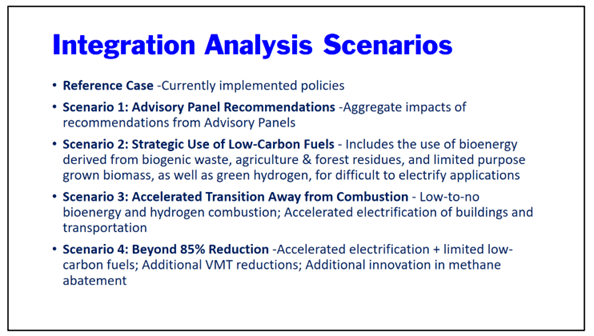
The integration analysis has developed a reference case and four scenarios that include specific strategies, emission estimates, and costs for Climate Action Council comment and discussion:

      • Reference Case
        • Currently implemented policies
      • Scenario 1: Advisory Panel Recommendations
        • Aggregate impacts of recommendations from Advisory Panels
        • Scenarios that meet or exceed GHG emission limits, achieve carbon neutrality by midcentury
      • Scenario 2: Strategic Use of Low-Carbon Fuels
        • Includes the use of bioenergy derived from biogenic waste, agriculture & forest residues, and limited purpose grown biomass, as well as green hydrogen, for difficult to electrify applications
      • Scenario 3: Accelerated Transition Away from Combustion
        • Low-to-no bioenergy and hydrogen combustion; Accelerated electrification of buildings and transportation
      • Scenario 4: Beyond 85% Reduction
        • Accelerated electrification limited low-carbon fuels; Additional VMT reductions; Additional innovation in methane abatement; Avoids direct air capture of CO2

According to the presentation in order to meet the targets, there are foundational themes across the scenarios based on findings from Advisory Panels and supporting analysis:

      • Zero emission power sector by 2040
      • Enhancement and expansion of transit & vehicle miles traveled reduction
      • More rapid and widespread end-use electrification & efficiency
      • Higher methane mitigation in agriculture and waste
      • End-use electric load flexibility reflective of high customer engagement and advanced techs

The schedule for the remainder of the year is ambitious.  The integration analysis will be incorporated into the draft scoping plan by the end of October and in November the Climate Action Council will discuss the strategies and provide feedback on the draft scoping plan.  The plan is to finalize scoping plan by the end of the year and next year put it out for public comment.

New Findings

I extracted the bullet points describing the new findings of the integration analysis from the October 1, 2021 Climate Action Council meeting presentation.  My reaction to these findings is shown in italics below.

  • Achievement of emissions reductions to meet state law requires action in all sectors, especially considering New York State’s novel emissions accounting

Novel emissions reporting refers to the emphasis on greenhouse gases other than CO2, particularly, methane and nitrous oxides.  Novel is another way of saying no other jurisdiction in the world has prepared an inventory of emissions with such an overt and flawed emphasis on natural gas.

      • Every sector will see high levels of transformation over the next decade and beyond, requiring critical investments in New York’s economy
  • Energy efficiency and end-use electrification will be essential parts of any Pathway that hits NYS Emissions Limits
      • In all scenarios modeled, zero emission vehicles and heat pumps become the majority of new purchases by the late 2020s, and fossil-emitting cars and appliances are no longer sold after 2035
      • 1 -2 million efficient homes electrified with heat pumps by 2030
          • In 2017 there were 7,302,710 occupied housing units in NYS
          • 2% or 820,554 used electricity for space heating
          • The fraction of heat pumps used is unknown but has to be small
          • To reach 1.5 million heat pump homes requires about 200,000 conversions per year
      • Approximately 3 million zero-emission vehicles (predominantly battery electric) by 2030
          • 1 million vehicle registrations on file in 2018 so 2030 is 27% EV
          • On 9/2/2021 there were 81,858 ZEVs on the road in NY, 0.9%
          • Over the last 12 months 2.15% of the new vehicles registered were electric vehicles and the greatest month was 4.36%
  • Unprecedented rate of adoption of novel and potentially disruptive technologies and measures

Disruptive technologies “significantly alter the way consumers, industries, or businesses operate”.  “To be considered disruptive, technology must be easily accessed by a majority of the population. Revolutionary inventions are often not disruptive because they’re too expensive for the common consumer. In many cases, it’s not until the technology is refined enough to become affordable that it’s considered disruptive to the market. A disruptive technology is one that enters the mainstream and changes the way most people think or behave.

Disadvantages of disruptive technologies:

          • “New technology is typically untested and unrefined during its early stages and development can continue for years.”
          • “Nearly all innovations go through a period of problem-solving.”
          • “It can take time for a disruptive technology to find its place in the marketplace.”

It is incredibly risky to be counting on novel and disruptive technologies to meet the CLCPA targets.

  • Consumer decision-making plays a large role, especially important for the purchase of new passenger vehicles and heating systems for homes and businesses through the next decade

The climate act implementation echo chamber has not addressed what will happen when there is an extended outage following an ice storm.  Many folks have a contingency plan for that kind of an event but see no reasonable alternatives when everything is electrified.

  • Substantially reduce vehicle miles traveled while increasing transportation access
    • Expansion of transit service structured around community needs
    • Smart growth inclusive of equitable transit-oriented development
    • Transportation demand management

I do not believe that the majority of New Yorkers are aware that the CLCPA will mandate these limitations on personal mobility.  The climate act implementation echo chamber has not explained how this will not have massive impacts to rural areas and the rural poor.

  • Wind, water, and sunlight power the majority of New York’s economy in 2050 in all Pathways
    • Even with aggressively managed load, electric consumption doubles and peak nearly doubles by 2050, and NYS becomes a winter peaking system by 2035.

Although the presentation mentions that the reliability standards are included in the scenarios it is not clear to me that is the case because there is so little documentation available.  Furthermore, I think it is likely that there will be new reliability rules that certainly have not been included.

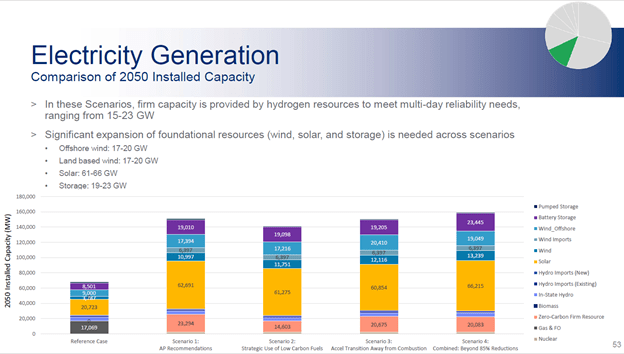
  • Offshore wind on the order of 20 GW, solar on the order of 60 GW, and 4-and 8-hour battery storage on the order of 20 GW by 2050

These are extraordinary numbers.  The largest integrated solar-powered battery will be at the Florida Power & Light Manatee Solar Energy Center rated at 409 MW, 900 MWh.  Note that the energy storage facility only provides two hours of storage so over 100 equivalent facilities will have to be built.

  • Firm, zero-emission resources, such as green hydrogen or long-duration storage, will play an important role to ensure a reliable electricity system beyond 2040

Long-duration storage does not exist today and green hydrogen has not been deployed at utility scale.  Moreover, as the hydrogen is produced it will have to be stored and transported to where it will be used which is no easy feat.

  • Low-carbon fuels such as bioenergy or hydrogen may play a critical role in helping to decarbonize sectors that are challenging to electrify
    • By 2030, initial market adoption of green hydrogen in the following applications: medium and heavy-duty vehicles, high-temperature industrial (sic).

For a technology not yet commercially available expecting any significant market adoption in this time frame is a stretch.

  • Additional promising end-use applications include district heating and non-road transportation such as aviation and rail.

In theory these fuels might work for these applications but the technology has not been proven.

  • Required transition to low-GWP refrigerants and enhanced refrigerant management by 2050

If these refrigerants and enhanced management were cost-effective,then they would be used now.

  • Large-scale carbon sequestration opportunities include lands and forests and negative emissions technologies
    • Protecting and growing New York’s forests is required for carbon neutrality

I get the impression but have not confirmed that one of the control strategies is to convert home heating with wood to electric.  The concept that people do that because they cannot afford alternatives and the probable increase in costs associated with this law suggests that more rather than less people will want to heat with wood.  It is not clear to me how the State would regulate a land owner’s use of wood for home heating.

  • Negative emissions technologies (e.g., direct air capture of CO2) may be required if the State cannot exceed 85% direct emissions reductions

This is an absurd statement because it presumes that the New York contribution to the total greenhouse gas levels in the atmosphere can be measured to the point where direct air capture could have an effect.  

  • Strategic land-use planning will be essential to balance needs
  • Necessary methane emissions mitigation in waste and agriculture will require transformative solutions
    • Diversion of organic waste, capture of fugitive methane emissions are key in waste sector

Easy to say but extremely difficult to implement in practice.

  • Alternative manure management and animal feeding practices are key in agriculture

If these practices were cost-effective farmers would be doing them today.  Apparently they are not using them so who pays for farmers to use them?

 Additional innovation will be required in areas such as carbon sequestration solutions, long-duration storage, flexible electric loads, low-GWP refrigerants, and animal feeding, in concert with Federal action (e.g. Earthshots)

Requiring “additional innovation” to ensure that the lights are on, homes are kept warm and people will be able to charge their mandated electric vehicles is extraordinarily risky.  If the risks associated with the effects of climate change that could be changed by New York emissions were compared to the risks of this policy causing a blackout, then I have no doubts that the integration analysis strategies would be rejected out of hand.

 For what it is worth, the Earthshot example refers to the Department of Energy’s “Energy Earthshots” that will “accelerate breakthroughs of more abundant, affordable, and reliable clean energy solutions within the decade”.  Even if they accomplish a breakthrough the CLCPA schedule is too aggressive to take advantage of it.

  • Largest three remaining sources of emissions in 2050: Landfills, aviation, and animal feeding

No comment.

Conclusion

Of particular concern is that the integration analysis acknowledges that disruptive technologies will be required to meet the CLCPA targets.  I explain that these technologies are typically untested and unrefined during early stages and development can continue for years.  These innovations go through a period of problem-solving.  Given that the electric system has a long history of revisions following blackouts to address reliability problems as they arose it is unrealistic to expect that similar problems will not arise in the future. 

In order to meet the CLCPA legal schedule there has been insufficient time to prepare the documentation necessary for stakeholders to evaluate the proposed strategies.  However, given the absolute need to try to avoid catastrophic problems the integration analysis scenarios have to be fully documented.  Climate Action Council meetings have included multiple member statements arguing that the law requires some of the more unrealistic proposals incorporated into the strategies.  The ultimate question for the Climate Act is what happens when stakeholders expose the reliability risks of those strategies.  Will the Hochul administration cave to the special interests or listen to those responsible for keeping the lights on.

Climate Leadership & Community Protection Act First Impression of Estimated Costs and Benefits

At the October 14, 2021 meeting of New York’s Climate Leadership and Community Protection Act (CLCPA) Climate Action Council  Carl Mas from the New York State Energy Research & Development Authority (NYSERDA) presented the first estimates of costs and benefits.  Not surprisingly they conjure up a way to claim that the benefits out weighed the costs.  This will be my first post on those claims.

I have written extensively on implementation of the CLCPA because I believe the solutions proposed will adversely affect reliability and affordability, will have worse impacts on the environment than the purported effects of climate change, and cannot measurably affect global warming when implemented.   The opinions expressed in this post do not reflect the position of any of my previous employers or any other company I have been associated with, these comments are mine alone.

Background

Since I wrote this post the presentation slide deck (available here) and meeting recording (available here) have been posted. 

The Climate Action Council is responsible for submitting the Scoping Plan that will outline a plan to implement strategies to meet the ambitious targets of the CLCPA.  Of particular interest are the targets to reduce greenhouse gas emissions by 40% relative to the 1990 baseline by 2030.  In 2030 70% or the electrical energy is supposed to come from renewable resources and by 2040 all electricity is supposed to come from zero-emissions sources.  The Council is composed of political appointees chosen more for their direct involvement in the CLCPA transition than their expertise in the energy sector so the New York State Energy Research and Development Authority (NYSERDA) is providing technical support by developing an integration analysis.

The October 14, 2021 Climate Action Council meeting included the following topics:

  • Overview of scenarios and recap of sectoral results
  • Costs and Benefits Analysis
  • Electric System Sensitivities
  • Air Quality and Health Effects
  • Update on Approach for Potential Carbon Pricing Analysis

There is fodder for multiple posts in this material but most will have to wait until another day.

Last spring advisory panels submitted their recommendations to the Climate Action Council for strategies in seven sectors to meet the targets.  NYSERDA and their consultants determined that those recommendations did not meet the targets and prepared an integration analysis to provide alternatives.  The following scenario overview lists three scenarios that meet or exceed the limits.  (For this post I will concentrate on Scenario 2: Strategic Use of Low-Carbon Fuels.)  The integration analysis will be incorporated into the draft scoping plan in October and in November the Climate Action Council will discuss the strategies and provide feedback on the draft scoping plan.  The plan is to finalize scoping plan by the end of the year and next year put it out for public comment.

October 1, 2021 Meeting Presentation

Societal Benefits

The focus of this post will be on the first mention of cost and benefit data at the October 14, 2021 Climate Action Council meeting.  As expected, they made up a way to claim that the benefits out-weigh the costs.  Readers should keep in mind that the costs are real.  Completely re-building the entire New York energy sector will cost enormous sums of money and, at first glance, estimates of several hundred billion for the complete transition are laughably low for the all-in costs.  On the other hand, estimates of benefits are heavily dependent upon value judgements and analysis assumptions to the point that there are such a wide range of possible outcomes that claiming a single value is fantasy.

According to the presentation the integration analysis approach will include three components as shown in the following slide captures.   The integration analysis will evaluate societal costs and benefits of greenhouse gas (GHG) mitigation for the different scenarios relative to a reference scenario.   The value of avoided GHG emissions will be calculated based on guidance provided by the Department of Environmental Conservation (DEC). The third component is an analysis of health co-benefits.  In the remainder of this post, I will focus on the alleged benefits.

Screen capture of slide presented at October 14, 2021 Climate Action Council meeting

According to the presentation the cost of inaction exceeds the cost of action by more than $80 billion.  For the Strategic Use of Low Carbon Fuels scenario the estimated costs are $340 billion and the benefits total $420 billion.

Screen capture of slide presented at October 14, 2021 Climate Action Council meeting

The benefits breakdown in the Strategic Use of Low Carbon Fuels scenario into two categories.  In the first there are $160 billion in benefits due to improvements in air quality, increased active transportation, and energy efficiency interventions in low- and moderate- income homes.  Reducing GHG emissions avoid social costs due to climate change to the tune of $260 billion.

Screen capture of slide presented at October 14, 2021 Climate Action Council meeting

Value of Avoided Carbon

I described problems with the DEC Value of Avoided Carbon Guidance in a couple of posts earlier this year.  In my first post I noted that the Guidance includes a recommendation how to estimate emission reduction benefits for a plan or goal.  I believe that the guidance approach is wrong because it applies the social cost multiple times for each year of an emission reduction.  In the second post I described how I  submitted comments on this topic to DEC and NYSERDA in February and followed up in June.  The response “We ultimately decided to stay with the recommendation of applying the Value of Carbon as described in the guidance as that is consistent with how it is applied in benefit-cost analyses at the state and federal level.”  I will just summarize my arguments and the effect on the estimated benefits here.

In section §75-0113, Value of Carbon the CLCPA states that the “social cost of carbon shall serve as a monetary estimate of the value of not emitting a ton of greenhouse gas emissions” and that “As determined by the department, the social cost of carbon may be based on marginal greenhouse gas abatement costs or on the global economic, environmental, and social impacts of emitting a marginal ton of greenhouse gas emissions into the atmosphere, utilizing a range of appropriate discount rates, including a rate of zero.”  The Social Cost of Carbon (SCC) is the present-day value of projected future net damages from emitting a ton of CO2 today. 

In my comments to DEC, I explained that it is inappropriate to claim the benefits of an annual reduction of a ton of greenhouse gas over any lifetime or to compare it with avoided emissions. . The social cost calculation that is the basis of their carbon valuation sums projected benefits for every year subsequent to the year the reductions are made out to the year 2300.  Clearly, using cumulative values for this parameter is incorrect because it cumulatively counts those benefits repeatedly.  I contacted social cost of carbon expert Dr. Richard Tol about the use of lifetime savings and he stated that “The SCC should not be compared to life-time savings or life-time costs (unless the project life is one year)”.  Note that Dr. Tol is using the social cost of carbon nomenclature rather than value of carbon label. 

The integration analysis claims reducing GHG emissions will provided societal benefits of avoided economic damages of $260 billion.  The correct value is much less.   DEC promulgated the 1990 baseline GHG emission inventory consistent with the CLCPA last year. According to §496.4 Statewide Greenhouse Gas Emission Limits (a) For the purposes of this Part, the estimated level of statewide greenhouse gas emissions in 1990 is 409.78 million metric tons of carbon dioxide equivalent, using a GWP20 as provided in Section 496.5 of this Part.  The DEC Value of Avoided Carbon Guidance recommends a social cost of $121 in 2020 and $172 in 2050.  If New York had magically eliminated all of the 409.78 million tons of GHG in 2020 the societal benefit of those reductions would have been $49.6 billion making the integration analysis 5.24 times too high.  If all the reductions occurred in 2050 the societal benefit would be $70.5 billion making the integration analysis 3.7 times too high.

Public Health Impacts

The health benefits of the strategic use of low carbon fuels scenarios total $160 billion.  While the health effects analysis considered multiple air pollutants and health benefits from energy efficiency the primary pollutant of concern is inhalable particulates or PM2.5.  I did a post on claims of inhalable particulates impacts in New York City last year.  The New York City Department of Health and Mental Hygiene’s (DOHMH) Air Pollution and the Health of New Yorkers report is often referenced and provides a typical and consistent health benefit estimate from inhalable particulates.  The DOHMOH report concludes: “Each year, PM2.5 pollution in [New York City] causes more than 3,000 deaths, 2,000 hospital admissions for lung and heart conditions, and approximately 6,000 emergency department visits for asthma in children and adults.”  These conclusions are for average air pollution levels in New York City as a whole over the period 2005-2007.

The DOHMOH report specified four scenarios for comparisons (DOHMOH Figure 4) and calculated health events that it attributed to citywide PM2.5 (DOHMOH Table 5).  Based on their results the report notes that:

Even a feasible, modest reduction (10%) in PM2.5 concentrations could prevent more than 300 premature deaths, 200 hospital admissions and 600 emergency department visits. Achieving the PlaNYC goal of “cleanest air of any big city” would result in even more substantial public health benefits.

Based on years of developing and using models I prefer observed results any time as opposed to model projections.  In this regard it is important to note that the NYS DEC air quality monitoring system has operated a PM2.5 monitor at the Botanical Garden in New York city since 1999 which provides inhalable particulate trends for New York City.  I compared the data from that site for the same period as this analysis relative to the most recent data available (Data from Figure 4. Baseline annual average PM2.5 levels in New York City). The Botanical Garden site had an annual average PM2.5 level of 13 µg/m3 for the same period as the report’s 13.9 µg/m3 “current conditions” city-wide average (my estimate based on their graph).  The important thing to note is that the latest available average (2018-2020) for a comparable three-year average at the Botanical Garden is 7.4 µg/m3 which represents a 43% decrease.  That is substantially lower than the PlaNYC goal of “cleanest air of any big city” scenario at an estimated city-wide average of 10.9 µg/m3

Until such time that the CLCPA Scoping Plan bases its inhalable particulate health benefits on the observed health outcome benefits observed from the reductions that have occurred, then I do not accept the health benefits suggested in the Integration Analysis.  If an analysis were done using actual data, I believe that the results would most likely show a much smaller benefit.  Note that the reduction in PM2.5 annual average concentrations in the Strategic Use of Low Carbon Fuels scenario predicts at most a reduction in PM 2.5 of 0.35 µg/m3.  The observed reduction in New York City since 2005-2007 is 5.6 µg/m3

Energy Efficiency

In the effort to prove that the costs of the New York transition to the CLCPA goals is out-weighed by benefits the integration analysis comes up with energy efficiency benefits.  I am not going to discuss this claim in detail so I provide the methodology slide below.

Screen capture of slide presented at October 14, 2021 Climate Action Council meeting

The following slide lists the health-related measures and I am leery of the claims.  They expect to reduce asthma-related incidents by increasing weatherization presumably to keep polluted ambient air out.  It is my understanding that asthma rates have increased even as pollution rates have gone down so this measure may have the perverse effect of increasing whatever is causing the observed asthma incidents.  I have no idea how this strategy can reduce trip or fall injuries.  Health benefits from reduced hot and cold thermal stress are claimed.  Note that increased costs of energy in England have forced lower-income residents to lower their thermostats thus increasing thermal stress from cold.  This is a likely outcome in New York.

Screen capture of slide presented at October 14, 2021 Climate Action Council meeting

Conclusion

I have no doubts that when I evaluate their costs for the transition that I will find markedly higher costs.  Even if estimated costs end up being reasonable, the incorrect valuation of the societal benefits of carbon reductions drops the benefits to no more than $70.5 billion. Coupled with their values for health effects benefits that reduces total benefits to $230.5 billion as opposed to costs of $340 billion. 

Moreover, the costs will be real but the benefits are something else again.  The social cost of carbon is the greater alleged benefit.  Because that represents the societal benefits of reducing a ton of carbon today totaled out to 2300 and the impacts of climate change are more expensive closer to 2300 that means that most of those alleged benefits will not accrue to this generation of New York residents, their children, their grandchildren, or even their great grandchildren.  In addition, I have major reservations with the alleged health benefits.

The bottom line is that CLCPA is not cost effective relative to societal benefits.

CLCPA “Winging It” is a Catastrophe Waiting to Happen

At the September 13, 2021 meeting of New York’s Climate Leadership and Community Protection Act (CLCPA) Climate Action Council a requirement to consider carbon reduction measures in other jurisdictions was discussed.  I agree that this is an important consideration and recently wrote that the European experience reflects not only high energy costs but there are troubling signs that reliability issues can occur even during periods when the electric system is not stressed due to high demand.  This post calls reader’s attention to Minister of Parliament Steve Baker’s recent article on the United Kingdom’s similar plans to reach net zero emissions.   

I have written extensively on implementation of the CLCPA because I believe the solutions proposed will adversely affect reliability and affordability, will have worse impacts on the environment than the purported effects of climate change, and cannot measurably affect global warming when implemented.   The opinions expressed in this post do not reflect the position of any of my previous employers or any other company I have been associated with, these comments are mine alone.

Background

Steve Baker is a Conservative MP and former Brexit Minister. He is a trustee of the Global Warming Policy Foundation (GWPF).  I wanted to include a description of the GWPF in this section but recent changes have made that difficult.  If you do an internet search for the GWPF, you will get a string of results all branding them as the “United Kingdom’s most high profile climate denier group” but won’t be able to find their own link without searching.   If you get to gwpf.com then you are redirected to Net Zero Watch.  GWPF has set up Net Zero Watch to “provide serious analysis of naïve and un-costed decarbonisation policies.”  They plan to “highlight the serious economic, societal and geopolitical impacts of poorly-considered policies, both domestically and internationally”.

Net Zero Watch has been setup to “highlight and discuss the serious implications of expensive and poorly considered climate change policies”.  A recent energy crisis in Europe foreshadows New York’s future under the CLCPA:

With our domestic shale gas resources sitting untapped under an absurd government ban, gas prices are going through the roof. Net Zero Watch will challenge the wild claims of green activists and policy advisers about this venerable and benign technology, which has brought US gas prices down to a small fraction of those here.  As this year’s weather has shown, our decision to phase out fossil fuels and nuclear power and to rely more and more on wind farms for our electricity supply has had dangerous consequences. We will campaign to put affordability and security of supply back at the centre of the energy debate, and we will expose the risky wishful thinking behind many claims about energy storage.

Baker’s description of the United Kingdom net-zero plan is entirely consistent with my impression of the CLCPA.  The following section quotes Steve Baker’s commentary in italics with my indented and unitalicized comments.  I don’t have many comments because one only has to substitute New York for UK and Albany for Westminster for the most part.

“Winging It” is a Catastrophe Waiting to Happen

The UK’s plans to decarbonise the economy are a classic example of the ancient political strategy of “winging it”. Hard though it is to credit that idea, it’s true; the “experts” in Westminster have been basing your future and mine on a plan that relies, to a very great extent, on a collective crossing of the fingers.

 The CLCPA experts in Albany rely on bureaucrats at the state agencies that have to tailor their results to meet the political agendas of their appointed directors to sustain their careers.

Governments of one shade or another, Whitehall bureaucrats, and their advisers in the Climate Change Committee have been working on such plans for well over a decade now, and it’s fair to say that they still have little or no idea how Net Zero can be achieved, beyond a vague idea that we should electrify everything and have lots of energy from windfarms.

 The description of the scenarios to meet the CLCPA targets at the October 1, 2021 meeting of the Climate Action Council is entirely consistent with this description.

 That’s no more than a starting point, of course. There are enormous practical difficulties (and eye-watering costs) to be dealt with, but such nitty-gritty issues seem of little interest to the experts in Westminster. “Things will become cheaper…” they say “….we’ll invent something”.

 Expert handwaving of this kind has been enough to convince the media and most politicians, but as the legendary physicist Richard Feynman once pointed out, Nature cannot be fooled, and it looks very much as Nature is going to lay her cards on the table this winter.

 One of the key problems is that we don’t have any way to store electricity on a large scale for when the wind isn’t blowing. That can be a few weeks in a normal year, or months in a bad one. The problem has always been there, and we have had no firm answer from the “experts”. We don’t have enough suitable sites for pumped hydro; batteries and hydrogen are far too expensive. As was pointed out in a letter to one of the national newspapers last week, enough batteries to see us through a wind lull lasting just ten days would cost £150,000 per household at current prices.

 There is no reason to believe that New York’s costs to maintain current reliability standards will differ much from the £150,000 per household or $204,000 per household.

 The Climate Change Committee says that we can get electricity through interconnectors from other countries when the wind doesn’t blow here. This is something of a “magic solution” for them, because they can simply claim that we’ll build as much interconnector capacity as we need. However, it again ignores the practical difficulties, such as the fact that if the wind isn’t blowing here, it probably isn’t blowing in most of western Europe either, so assuming (as the “experts” in Westminster do) that everyone follows us down the decarbonisation path, we are all going to get in a bidding war for the few megawatts of power that are left. There is also a national security problem with interconnectors, as was recently brought sharply into focus by French threats to cut the UK off if we didn’t play ball over fishing rights.

 To this point, the CLCPA scenarios avoid the use of imported power and, for the most part, we don’t have to worry about international security issues.  Note, however, that a key component for New York City is a transmission interconnection for hydropower  from Quebec.

 The CCC also says we can get a bit of power from gas-fired power stations equipped with carbon capture and storage (CCS). However, the practical problems are again fairly stark; nobody has yet made a success of CCS – a series of pilot projects have tested the waters on the easier ground of coal-fired power stations, and each has been closed as an economic failure; the power they produce is simply too expensive. And nobody has yet got the technology to work at all for gas-fired power stations.

 New York’s plans include CCS for concrete manufacturing but so far have downplayed its use for power generation.  All of the concerns listed are relevant and don’t note that a suitable location for sequestration is needed.  Incredibly there are members of the Climate Action Council that want to prohibit all forms of combustion which would preclude the use of CCS altogether.

 The other problem with planning for gas and CCS to deliver us from the perils of intermittency is that it appears unlikely we are going to have any cheap gas to feed them with – successive governments, egged on by the CCC, the renewables industry, and the green movement have told us we must “keep fossil fuels in the ground”.

 This was seen in part as a way to encourage the second part of the decarbonisation strategy, namely for people to “invent something”. In other words, if we have no gas and no way to balance the grid, well, someone will come up with some way to fix the problem. So we first made the electricity grid unwelcoming for gas-fired power stations, then we neutered the nascent shale gas industry with absurd regulations, and then we banned it completely.

 This is entirely consistent with New York’s CLCPA implementation.

 Which brings us to where we are today, with the whole country crossing its fingers and praying that someone will “invent something”, or at least find us a way to make it through the winter without the lights going out.

 For twenty years, the vested interests have had their say, and public relations have taken precedence over engineering and economics. But, to return to Professor Feynman, Mother Nature really cannot be fooled, and when she reveals her hand, the results are likely to be horrible.

 Is catastrophe coming? I fear so, unless ministers get a grip and liberate the private sector to go for gas, right now.

 New York’s problems are not so imminent largely because Pennsylvania went ahead with the natural gas fracking and now has an abundance of natural gas to sell to New York.  Nonetheless, National Grid has warned its customers in Central New York that natural gas bills could go up 31% because of increased demand and a global spike in prices.  I cannot help but wonder if New York had developed its natural gas resources if we would be seeing a similar price increase.

 Conclusion

The slow motion train wreck that is the future of New York energy under the CLCPA will only continue to a similar crisis unless it is repealed for all of the reasons shown in MP Steve Baker’s commentary.  To date “vested interests have had their say, and public relations have taken precedence over engineering and economics” but at some point, reality has to be addressed.  The fact is that today’s wind, solar and energy storage technology is not up to the role conceived by the authors of the CLCPA.

RGGI Third Program Review Listening Session 5 October 2021

The Regional Greenhouse Gas Initiative (RGGI) is a carbon dioxide control program in the Northeastern United States.  One aspect of the program is a program review that is a “comprehensive, periodic review of their CO2 budget trading programs, to consider successes, impacts, and design elements”.  This article describes the first listening session of the third RGGI program review.

I have been involved in the RGGI program process since its inception.  I blog about the details of the RGGI program because very few seem to want to provide any criticisms of the program. The opinions expressed in this post do not reflect the position of any of my previous employers or any other company I have been associated with, these comments are mine alone.

Background

RGGI is a market-based program to reduce greenhouse gas emissions. It is a cooperative effort among the states of Connecticut, Delaware, Maine, Maryland, Massachusetts, New Hampshire, New Jersey, New York, Rhode Island, Vermont, and Virginia to cap and reduce CO2 emissions from the power sector.  According to a RGGI website:

“The RGGI states issue CO2 allowances which are distributed almost entirely through regional auctions, resulting in proceeds for reinvestment in strategic energy and consumer programs. Programs funded with RGGI investments have spanned a wide range of consumers, providing benefits and improvements to private homes, local businesses, multi-family housing, industrial facilities, community buildings, retail customers, and more.” 

Proponents tout RGGI as a successful program because participating states have “cut carbon pollution from their power plants by more than half, improved public health by cutting dangerous air pollutants like soot and smog, invested more than $3 billion into their energy economies, and created tens of thousands of new job-years”.  Others have pointed out that RGGI was not the driving factor for the observed emission reductions.  My work supports that conclusion and points out that the cost-effectiveness of the investments from this carbon tax reduce CO2 emissions at a cost of $858 per ton which is far greater than the social cost of carbon metric.  In other words, RGGI investments not a cost-effective way to reduce CO2 emissions.

Third Program Review Listening Session 5 October 2021

The slides for the listening session and the meeting recording for the listening session give a good overview of what is planned.  Briefly the RGGI states are looking for input on the allowance cap, trajectory for changing the cap, allowance bank, compliance mechanisms and requirements, offsets, and “comment on how states can further address environmental justice and other equity concerns, including through program design and/or the use of RGGI auction proceeds to support underserved and/or otherwise affected communities.”

I posted an article that described my initial comments on the program review.  My comments recommend making no changes.  In the next few years, the RGGI allowance market will change to the unprecedented emissions trading situation in which the majority of the RGGI allowances are held by entities who purchased allowances for investment rather than compliance purposes.  No one knows how the market will react and the compliance mechanisms are working well as is so there is no need to change anything at this time.  I showed that RGGI investments only were directly responsible for less than 5% of the total observed reductions since RGGI began in 2009 the rest of the observed reductions occurred due to other factors, primarily fuel switching. Based on that observation, it appears to me that the goal of RGGI should be to balance the cap with emissions so that the allowance bank is only used for year-to-year variations in weather-related excess emissions.  Over time it may become necessary to adjust the emission reduction trajectory but that should be based on observations and not model projections.

The 5 October 2021 listening session consisted of three parts.  Presenters from RGGI and the RGGI states described the program and goals of the third program review in the first part.  They allocated time for questions and answers about the process and goals.  Finally, they offered stakeholders the opportunity to present oral comments.  The remainder of this post addresses those comments.

Ten people presented appropriate comments.  A couple of other people asked questions that were out of scope for the purpose of the meeting and I did not include their comments in this summary.  I classified the commenters into five categories.  The first category is “Little Green”.  There were two of these grass roots advocacy organizations which are usually non-profits, have small staff, address limited local and regional issues, and have not been around for a long time.  There were three commenters in the second category, “Green Analysis”.  These are consultants that have technical staff available to analyze environmental issues and policies.  The third category, “Green Legal”, had two commenters.  These are organizations that have lawyers who address environmental legal issues.  The fourth organization category is “Big Green”.  Both the National Resources Defense Council and the Environmental Defense Fund made comments.  These are large organizations that have advocates, scientists and lawyers, have been around for a long time and have large revenues and endowments.  Finally, there is a category for organizations that commented on RGGI solely because they are interested in the money available.  Only one commenter fit this description.

All of the commenters explicitly or implicitly claimed that RGGI has been a success.  Most of the commenters managed to request that future emissions reductions be “equitable” and that investments from auction proceeds consider disadvantaged communities.  Phelps Turner from the Conservation Law Foundation went so far as to suggest that 70% of the proceeds should be invested in disadvantaged communities.

Some commenters only addressed a single issue.  Paul R. from a land trust in Rhode Island argued that RGGI funds should be allocated to organizations like his so that they can set-aside land for carbon sequestration.  Laura H. from the Partnership for Policy Integrity wants the exclusion for biomass rescinded because the emissions from other pollutants than CO2 are high from these sources.  Kai S from the Green Energy Consumers Alliance wants revisions to the voluntary renewable energy credit market.  Nate B. from the Southern Environmental Law Center argued that vertically integrated utilities should be treated differently than non-regulated generating companies in the auction process.

Six of the commenters said that the emission caps should be tightened to reduce zero emissions by a date certain.  For example, Drew Stilson, from the Environmental Defense Fund said that the RGGI emissions cap should be updated to be in line with “what the science says is necessary to avoid the worst impacts of climate change”.  He said that emissions from the electricity sector must be reduced by  “at least 80% by 2030” because it is critical in “achieving the Biden Administration’s commitment to a 50% reduction across the economy by 2030”.  My impression is that most believe that RGGI state CO2 emissions should be zero by 2035.

Zero Emissions Trajectory

None of the commenters who advocated for a zero emissions cap by 2035 to satisfy a political target without any regulatory authority have any responsibilities for keeping the lights on. Easy for them to say and no personal consequences if their aspirational goals fail.  It appears that the emotional need to meet this target because their selected science says it is necessary over rides the common-sense question whether such a target is feasible. 

This section looks at an example zero-emissions cap by 2035.  Based on the third program review timeline I don’t think a revised cap could be implemented before 2024 which is appropriate because that is the start of a new compliance period. 

In my previous analysis I argued that continued fuel switching could produce zero-emissions from the more carbon intensive sources by 2030 so I calculated a linear reduction to zero out those emissions by 2030 from all but natural gas and “other fuel” sources.  For the zero emissions trajectory for the remaining sources by 2035, I calculated a similar trajectory of reduced heat input from those fuels and estimated an emissions trajectory to zero by 2035.  If RGGI were to make its emissions caps consistent with those trajectories then the total allocations from 2024 to 2035 cap would have to equal the cumulative emissions in the fuel source type trajectories over that period minus the allowance bank at the end of 2023. A revised cap that reduces the allowance bank and the allowance allocations is shown in the revised cap column of Table 1, Eleven-State RGGI Projected Emissions and Allowance Margin for Zero-Emissions By 2035 Scenario.  

Feasibility of Zero-Emissions by 2035

In order to eliminate natural gas-powered generation, a total of 118,815,096 MMBtu of replacement energy must be found to displace its use every year between 2024 and 2035.  Using the average of the last three years of EPA Clean Air Markets Division ratio data between heat input (MMBtu) and gross load (MWh) the natural gas displacement heat input is equivalent to 15,000,000 MWh.  The average of the last three years energy output at the now retired Indian Point unit 3 was 8,594,967 or 57% of the displaced natural gas energy output.  In 2020 New York had 1,985 MW of installed onshore wind energy that had a capacity factor of 25.2% and at that rate 6,780 MW (3.4 times) additional wind capacity would be needed to match the natural gas output.  For new onshore wind with a capacity factor of 35% 4,881 MW per year of new generation would have to be built.  Offshore wind with a capacity factor of 50% would only need to develop 3,417 MW but 8,543 MW of solar with a capacity factor of 20% would need 8,543 MW developed. 

In addition, the generation from natural gas and nuclear is dispatchable so comparing the energy output between them is apples to apples.  However, because wind or solar is not dispatchable a direct energy comparison is not appropriate which means that additional resource development and energy storage would also have to be included.  A recent presentation by the New York State Reliability Council described how the New York electric system is operated to maintain reliability and some of the challenges presented when renewable energy sources are increased significantly.  In my article on the presentation, I noted that the New York reserve margin will have to increase to over 100% relative to the current reserve margin of about 20%.  In other words, in order to ensure that current reliability standards are maintained the amounts listed in the previous paragraph would have to be doubled.

Conclusion

In my initial comments to RGGI on the third program review I made the point that the most important planning consideration to keep in mind is that CO2 control is different than sulfur dioxide, nitrogen oxides and particulate matter because there are no cost-effective retrofit controls available for existing facilities.  The data show that fuel switching has been the primary reason for the observed emission reductions in the RGGI states.  Once the facility has changed to a lower emitting fuel the only options at a power plant are to become more efficient and burn less fuel or stop operating all together.  While it is easy for the commenters to say that would be a good thing the reality is that the real impacts of a blackout caused by unavailable generating resources would be much greater than the alleged impacts of global warming.  I concluded that if it ever comes to the point that allowances are unavailable to operate that could threaten reliability, so it is imperative that RGGI never tighten the cap so low that affected sources are unable to operate due to unavailable allowances. 

With respect to the comments demanding that a zero-emissions trajectory by a certain date it is clear that they are ignoring the performance of RGGI to date.  In my initial comments I showed that the RGGI investments to date are only directly responsible for less than 5% of the total observed reductions since RGGI began in 2009.  Also note that the cumulative annual RGGI investments are $2,795,539,789 and that means that the cost per ton reduced is $857.74.    If the RGGI states have to rely on RGGI investments to make the annual 7,143,044 ton reduction needed, that cost per ton rate would mean an annual cost of $6.1 billion.

As the RGGI states embark on another program review process I hope that they will ignore the calls for emission caps consistent with an aspirational emissions reductions target.  It is also important that they consider the actual results of the program to date.  The fact is that any emissions trading approach for CO2 has to acknowledge that there are limited options for cost-effective reductions and that most of the observed RGGI state reductions have not been due to the RGGI program.  Because of the limited options available and relative ineffectiveness of RGGI investments it is absurd to establish the future emissions caps based on zero emissions by 2035.  That could only lead to reliability issues when affected sources run out of allowances to operate but are still needed to run to keep the lights on.

Reliability Goal of a Renewable-Dependent Electricity System

In early September 2021 I wrote an article, “Reliability Challenges in Meeting New York’s Climate Act Requirements”, that described a presentation made by the New York State Reliability Council (NYSRC) to the New York Climate Action Council.  In this post I describe a recent paper that analyzes synoptic-scale extreme reductions in wind and solar power energy resources that I think raises an important reliability question: when New York relies on fragile intermittent wind and solar energy resources is the current New York reliability goal to prevent a loss of load event due to resource adequacy of no more than once per ten years still appropriate.

I have written extensively on implementation of the CLCPA because I believe the solutions proposed will adversely affect reliability and affordability, will have worse impacts on the environment than the purported effects of climate change, and cannot measurably affect global warming when implemented.   The opinions expressed in this post do not reflect the position of any of my previous employers or any other company I have been associated with, these comments are mine alone.

Background

In my reliability challenge article, I explained that there is consensus that the future worst-case situation in New York will be a multi-day winter time wind lull when both wind and solar availabilities are low.  Coupled with increased electricity load in order to reduce emissions from transportation and heating, any analysis of future renewable energy resources that adequately addresses the worst-case renewable energy resource availability shows the required amounts of wind, solar and energy storage will have to be enormous.  Importantly, the NYSRC analysis indicates that in order to ensure reliability the installed reserve margin will have to be increase substantially above current levels to satisfy anticipated load and the intermittent nature of wind and solar resources.  The NYSRC presentation concludes that the state of New York appears to be headed down a transition path which will require reliance on technologies that do not currently exist in less than ten years.

Wind and Solar Droughts

Dr. Patrick Brown’s blog post describes his recent paper co-authored with David J. Farnham and Ken Caldeira entitled “Meteorology and climatology of historical weekly wind and solar power resource droughts over western North America in ERA5” (Brown et al., 2021).  His post explains that as wind and solar become more indispensable for providing electricity it is important that we understand the intensity, frequency, and duration of droughts of their availability.  In Brown et al., 2021 they use a meteorological database that covers 71 years from 1950 to 2020.  They compared estimated weekly solar and wind availability against cooling and heating degree days as a proxy for electrical load over that entire period. 

The following plot of the weekly values is of special interest.  The plot explanation states:

All weekly values from 1950 to 2020 (average over the western North America domain, Fig. 1) for power supplied by wind and solar resources (x and y axes respectively) and a proxy for power demanded via cooling degree days (color of dots). The mean seasonal cycle in wind and solar power is shown by the black loop (52 black dots for each week of the year). Drought weeks are indicated with black edge colors with wind droughts represented as circles, solar droughts represented as squares and compound wind and solar droughts represented as diamonds.

Of particular concern is the lower left quadrant which represents weeks where both wind and solar resources are lower than the annual mean of long-term availability.  Note that this quadrant is “mostly astronomical autumn. The mean wind & solar power given a wind + solar drought label shows that during a drought you can only expect around 40% of the solar resource and 65% of the wind resource.

There is an animation showing the degree to which there is persistence in time.  In the video each week is sequentially plotted since 1979 over a plot of the seasonal cycle.  As you watch the video keep in mind that you are watching the seasonal progression of plots.  While the majority of weeks with both wind and solar droughts are in autumn there are periods at the start of each year that appear to me to be among the most intense.  That is consistent with New York analyses that define the ultimate problem

that must be resolved to ensure reliability: firm capacity is needed to meet a multi-day period of low solar and wind resource availability during the winter. 

In their presentation to the Power Generation Advisory Panel on September 16, 2020 E3 included a slide titled Electricity Supply – Firm Capacity that states: “The need for dispatchable resources is most pronounced during winter periods of high demand for electrified heating and transportation and lower wind and solar output”.  The slide goes on to say: “As the share of intermittent resources like wind and solar grows substantially, some studies suggest that complementing with firm, zero emission resources, such as bioenergy, synthesized fuels such as hydrogen, hydropower, carbon capture and sequestration, and nuclear generation could provide a number of benefits.  Of particular interest is the graph of electric load and renewable generation because it shows that this problem may extend over multiple days.

Brown et al., 2021 is a promising approach for evaluating the long-term frequency of wind and solar droughts.  However, there are some limitations.  Obviously, the work has to be done for a New York centric domain.  In addition, because previous New York analyses by Energy + Environmental Economics  and The Analysis Group both identified problems on a multi-day basis it would be more appropriate to evaluate New York’s droughts on a daily basis. I strongly recommend that New York sponsor this analysis to determine the frequency and duration of renewable resource droughts. 

Because wind and solar are naturally intermittent the amount of energy storage needed to balance output must be determined.  The Brown et al., 2021 technique can also be used to identify periods that should be evaluated in more detail to determine the intensity of the droughts so that energy storage requirements can be determined.  This is important not only for grid planning but also for distributed energy resources (DER).  In theory DER can “generate smaller amounts of clean electricity closer to end-users, to increase energy efficiency, reduce carbon pollution, improve grid resiliency, and potentially curtail the need for costly transmission investments”.  However, unless they incorporate sufficient energy storage these resources won’t work when the system is stressed the most, so they may not be the panacea that advocates claim.

Reliability Planning

New York’s electric system is de-regulated so reliability planning is provided by the New York Independent System Operator, various state agencies and the NYSRC.  The NYSRC presentation describes the NYSRC and the Installed Reserve Margin (IRM) parameter.  The IRM is defined as the “minimum installed capacity margin above the estimated peak load to meet the Northeast Power Coordinating Council (NPCC) requirement that the probability of shedding load is not greater than one day in ten years”.   Load shedding occurs when the demand for electricity exceeds supply and grid operators have to turn power off for groups of customers in order to prevent the whole system from collapsing. 

To this point, reliability planning has been primarily focused on an electric system powered by conventional dispatchable generating resources. In that context resource obtainability is not particularly concerned with long-term availability of the resource because the resources are not intermittent.  That changes when the system becomes dependent upon wind and solar because there are short-term and long-term availability concerns.  It is in this context that the results from Brown et al., 2021 climatology becomes important and raises the question whether planning based on a ten-year metric is still appropriate in the future.  Using this approach, we can determine the frequency and duration of the expected worst case over ten years consistent with current IRM planning.  However, because we can consider a longer period, we can also consider the frequency and duration of droughts over the whole 70 years and get expected worst cases over other time periods.  If there is a marked difference over say the 30-year time period, it may be appropriate to expand the IRM planning period in order to prevent the probability of shedding load due to more severe drought.

Black Swan Events

To this point in this article, I have only addressed normal weather variability effects. During the preparation of this post, I came to believe that there is another reliability concern related to renewable resource adequacy that has to be addressed.  What happens to the electric system when unprecedented extreme weather cripples the relatively fragile renewable generating and transmission system?  These statistical outliers are described as a “black swan event”.

A Black Swan event is an event in human history that was unprecedented and unexpected at the point in time it occurred. However, after evaluating the surrounding context, domain experts (and in some cases even laymen) can usually conclude: “it was bound to happen”. Even though some parameters may differ (such as the event’s time, location, or specific type), it is likely that similar incidences have had similar effects in the past.

In this context the conclusion that “it was bound to happen” has to be discussed.  At an Our Energy Policy (OEP) panel discussion on New York State’s emerging offshore wind market, someone asked an off-shore wind industry expert whether wind turbines in New York would be able to withstand a Category 5 storm.  Clint Plummer the head of market strategies and new projects for Ørsted, the world’s largest owner, developer, and operator of offshore wind responded: “wind turbines are designed to withstand a Category 3 hurricane, and they have built into their permit applications an insurance fund that can pay for repairs in cases of catastrophic loss from a storm more severe”. He said “a Category 5 hurricane has a return period in excess of 100 years, while the design life of a wind farm is 30-35 years, so wind turbines are not designed to withstand a Category 5 storm because they are not expected to experience one”. “Anything less than that up to a certain speed is just a really good day for producing a lot of wind power,” he said.

In the October 1, 2021 Climate Action Council meeting presentation Carl Mas described the initial results of the integration analysis that will be used to develop the plan to implement changes to New York’s energy system to meet the CLCPA targets.  Four scenarios have been developed with different renewable resource, load reduction and sequestration strategies.  The new findings indicate that 20 GW of offshore wind resources will be necessary.  Assuming that New York builds the latest generation offshore wind turbine, e.g. the GE Haliade-X 12 MW turbine, that equates to over 1,600 turbines with 220 m or 722 foot rotors. 

However, hurricanes likely exceeding the threshold described by Ørsted expert Plummer have occurred in the area New York plans to build its offshore wind facilities.  In 1635 the “Great Colonial” Hurricane hit New York and New England and the “Great Storm of 1693” devastated Long Island. There were other hurricanes that made landfall in the Tri-State area – 1788 (left the Battery in ruins), 1821, 1893 (the second hurricane that year, different from the one that hit Halifax, Nova Scotia), 1944 (“Great Atlantic” hurricane), 1954 (Carol), and 1991 (Bob). The 1938 “Long Island Express” made landfall in Long Island as a Category 3 hurricane with sustained winds of 125 mph and wind gusts up to 150 mph bringing waves surging to 35 feet.  Given that part of the rationale for the CLCPA is that extreme weather events such as hurricanes are becoming more frequent and severe there should be no question that a contingency plan is necessary for the time that a hurricane inevitably affects, if not destroys, the New York offshore wind resource.  Moreover, should that not be a part of the reliability planning process?

Unfortunately, that is not the only extreme weather event that can have extreme consequences on a more fragile wind and solar electricity network.  I am particularly worried about ice storms.  On a local level it is not clear how the public will be able to survive a multi-day power outage caused by an ice storm when the CLCPA mandates electric heat and electric vehicles but the bigger reliability concern is that fact that ice storms can take out transmission lines.  For example, consider, the January 1998 North American ice storm:

The North American Ice Storm of 1998 (also known as Great Ice Storm of 1998) was a massive combination of five smaller successive ice storms in January 1998 that struck a relatively narrow swath of land from eastern Ontario to southern QuebecNew Brunswick and Nova Scotia in Canada, and bordering areas from northern New York to central Maine in the United States. It caused massive damage to trees and electrical infrastructure all over the area, leading to widespread long-term power outages. Millions were left in the dark for periods varying from days to several weeks, and in some instances, months. It led to 34 fatalities, a shutdown of activities in large cities like Montreal and Ottawa, and an unprecedented effort in reconstruction of the power grid. The ice storm led to the largest deployment of Canadian military personnel since the Korean War, with over 16,000 Canadian Forces personnel deployed, 12,000 in Quebec and 4,000 in Ontario at the height of the crisis.

New York Governor Kathy Hochul recently announced “two major green energy infrastructure projects to power New York City with wind, solar and hydropower projects from upstate New York and Canada”.  The press release claims that the combined project will deliver 18 million megawatt-hours of upstate and Canadian renewable energy per year.  Clean Power New York plans on over 20 wind and solar generation projects – all located in New York State – and a new 174-mile, underground transmission line. Champlain Hudson Power Express is a 338-mile underground power line from Quebec hydroelectric facilities to New York City.  The problem is that not all the associated infrastructure in these projects is underground and immune from ice storms.

Photo from 1TAC Survival Blog

Conclusion

The requirements for New York reliability planning will have to change for a future grid that relies on intermittent and diffuse wind and solar.  Current planning for the electric system is based on decades-long experience with a system powered primarily by sources that are dispatchable and includes sources that have on-site storage.  The potential for lack of source availability over days, weeks, and even months is not a serious concern today because the New York system has been diverse, redundant, and resilient to the vagaries of weather.

The CLCPA requirement for a zero-emissions electric system that relies on wind and solar energy resources changes the reliability planning requirements.  Previous analysis has highlighted the need to address multi-day wind lulls in the winter as a particular problem.  Brown et al., 2021 have developed a technique that can be used to determine the climatological frequency and duration of those periods of low wind and solar resource availability that clearly should be included in New York reliability planning.  Their analysis technique can also be used to identify the worst-case periods of wind and solar droughts so that more detailed resource availability analyses can estimate how much energy storage is needed not only for the electric grid but also the distributed energy resources proposed for the CLCPA.  This analysis is needed to prevent the kind of Texas February 2021 disaster from happening in New York.

The existing New York system has evolved over years of trial-and-error experience to the point where it is relatively resilient to extreme weather events.  While there have been exceptions, the possibility of widespread, weeks-long outages is extremely low.  However, because wind and solar resources are more fragile to wind and ice crippling damage than existing generating sources, the likelihood of the conditions that cause that level of damage should be determined.  Brown et al., 2021 can determine the occurrence of events over a 71-year period.  If, for example, their analysis suggests that the return period of a crippling event is one in thirty years, then should New York reliability planning incorporate a longer time horizon for its planning?

At this time, the off-shore wind strategy calls for 20 GW of development.  The ramifications of a Category 4 or greater hurricane destroying or significantly damaging those facilities should be at least be considered.  Repairing them will take months if not years and the ramifications if insufficient resources are available are immense. If nothing else the statements claiming that the future wind and solar dependent electric system will be more resilient should be toned down.