RGGI Third Program Review

The Regional Greenhouse Gas Initiative (RGGI) is a carbon dioxide control program in the Northeastern United States.  One aspect of the program is a program review that is a “comprehensive, periodic review of their CO2 budget trading programs, to consider successes, impacts, and design elements”.  This post describes my comments at the start of the third program review public participation process.

I have been involved in the RGGI program process since its inception.  I blog about the details of the RGGI program because very few seem to want to provide any criticisms of the program. The opinions expressed in this post do not reflect the position of any of my previous employers or any other company I have been associated with, these comments are mine alone.

Background

RGGI is a market-based program to reduce greenhouse gas emissions. It is a cooperative effort among the states of Connecticut, Delaware, Maine, Maryland, Massachusetts, New Hampshire, New Jersey, New York, Rhode Island, Vermont, and Virginia to cap and reduce CO2 emissions from the power sector.  According to a RGGI website:

“The RGGI states issue CO2 allowances which are distributed almost entirely through regional auctions, resulting in proceeds for reinvestment in strategic energy and consumer programs. Programs funded with RGGI investments have spanned a wide range of consumers, providing benefits and improvements to private homes, local businesses, multi-family housing, industrial facilities, community buildings, retail customers, and more.” 

Proponents tout RGGI as a successful program because participating states have “cut carbon pollution from their power plants by more than half, improved public health by cutting dangerous air pollutants like soot and smog, invested more than $3 billion into their energy economies, and created tens of thousands of new job-years”.  Others have pointed out that RGGI was not the driving factor for the observed emission reductions.  My work supports that conclusion and points out that the cost-effectiveness of the investments from this carbon tax reduce CO2 emissions at a cost of $858 per ton which is far greater than the social cost of carbon metric.  In other words, this is not a cost-effective way to reduce CO2 emissions.

Third Program Review

According to the program review link on the RGGI website:

The RGGI states completed the First Program Review in February 2013 and completed the Second Program Review in December 2017, resulting in the 2017 Model Rule. Now the states have initiated the Third Program Review to consider further updates to their programs.

On February 2, 2021, the RGGI states released a statement announcing the plan for the Third Program Review, and in Summer 2021 the states released a preliminary timeline for conducting the Third Program Review. Note that this timeline is subject to change and may be revised over time.

To support the Third Program Review, the states will:

      • Conduct technical analyses, including electricity sector modeling, to inform decision-making related to core Program Review topics, such as the regional CO2emission cap.
      • Solicit input from communities, affected groups, and the general public on the Program Review process and timeline, core topics and objectives, modeling assumptions and results, and other policy and design considerations.
      • Convene independent learning sessions with experts and other interested parties on key design elements.

Public participation is a key component of a successful Program Review. The RGGI states will conduct public engagement throughout Program Review, including periodic public meetings and accompanying open comment periods, to share updates and solicit public feedback.

RGGI has released a list of issues to be considered in its Topics for Public Discussion.  The RGGI states are seeking comments on the future size and reduction trajectory of the allowance caps and the allowance bank.  Comporting with the current fad they are also considering environmental justice and equity considerations.  The RGGI program includes auction mechanisms and they have asked for comments on them.  They also asked for comments on the compliance mechanism and the offset program.

In brief, my comments recommend making no changes.  In the next few years, the RGGI allowance market will change to the unprecedented emissions trading situation in which the majority of the RGGI allowances are held by entities who purchased allowances for investment rather than compliance purposes.  No one knows how the market will react and the compliance mechanisms are working well as is so there is no need to change anything at this time.  The purpose of this post is to describe why I believe changes to the allowance cap and reduction trajectory are unnecessary.

I have prepared a simple analysis that projects the margin between allowances available and emissions (Table 1) for a first cut estimate of the RGGI allowance market and compliance requirements.  I downloaded CO2 mass, heat input, and primary fuel use data from the EPA Clean Air Markets Division database from 2009 to 2020 for Acid Rain Program units rather than RGGI program units so that I could include data from New Jersey and Virginia. 

While Table 1 lists totals for five categories of fuel use: natural gas, coal, residual oil, diesel oil, and other fuels, it is instructive to look at a breakdown of the fuels over time.  Table 2 lists the CO2 mass, heat input and calculated CO2 rate (lbs/hr) by fuel category for the combined nine states that have been in RGGI since 2009, New Jersey and Virginia.  The final row lists the percentage change between the first three years of RGGI and the latest three years.  In nine-state RGGI CO2 mass is down 39%, heat input is down 28% and the CO2 rate is down 16%.  However, the fact that the CO2 rates for New Jersey and Virginia are down more than the RGGI states indicates that the economics of fuel switching to natural gas is the primary reason that CO2 emissions have decreased as observed in the RGGI region. 

Table 1 lists the allowance cap and adjusted cap from 2009 to 2030 in the first three data columns.  The observed CO2 mass and heat input totals for the five fuel categories are in the last columns.  Starting in 2021, the estimated total allowances available expected at the end of each year are listed.  The 2021 value is based on the latest Potomac Economics  report on the secondary market report.  From a compliance standpoint the key parameter is the margin between the allowances available and the emissions.  For each year subsequent to 2021 the allowances available equals the previous year allowances minus that year’s emissions plus the allowances from the adjusted cap through 2025 and unadjusted cap through 2030.

Based on the observation that fuel switching is the primary CO2 reduction methodology to date, the emission projection in the table forces coal, residual oil and diesel oil to go to zero by 2030.  The projected emissions are summed and the margin (difference between allowances available and emissions) is calculated.  Using these assumptions, the allowance bank and the margin continue to decrease suggesting that there will be no major upheavals in compliance strategies or allowance prices.  Of course, projecting future emissions is fraught with difficulties and uncertainties but this approach is probably conservative and actual reductions will likely be greater. 

It is also appropriate to review the emission reduction results of RGGI relative the Social Cost of Carbon (SCC) cost-effectiveness parameter.  I believe that the only reductions from RGGI that can be traced to the program are the reductions that result from direct investments of the RGGI auction proceeds. Information necessary to evaluate the performance of the RGGI investments is provided in the RGGI annual Investments of Proceeds updates.  In order to determine reduction efficiency, I had to sum the values in the previous reports because the reports only report lifetime benefits.  In order to account for future emission reductions against historical levels and to compare values with the SCC parameter, the annual reduction parameter must be used.  Table 3, Accumulated Annual RGGI Benefits, lists the sum of the annual avoided CO2 emissions generated by the RGGI investments from previous reports.  The total of the annual reductions is 2,259,203 tons while the difference between the baseline of 2006 to 2008 compared to 2019 emissions is 72,908,206 tons.  Therefore, the RGGI investments are only directly responsible for less than 5% of the total observed reductions since RGGI began in 2009.  Also note that the cumulative annual RGGI investments are $2,795,539,789 and that means that the cost per ton reduced is $857.74.

Based on comments in previous program reviews there will undoubtedly be calls to make the allowance cap “binding” that is to say force emission reductions to meet a particular emission reduction trajectory.  While the projections above do not reduce emissions as much as the arbitrary 3% reduction target from the previous program review, there are potential consequences if a more stringent reduction is mandated. 

The most important consideration to keep in mind is that CO2 control is different than sulfur dioxide, nitrogen oxides and particulate matter because there are no cost-effective controls available for existing facilities.  As the data show, fuel switching is the primary reason for the observed emission reductions but once the facility has changed to a lower emitting fuel the only options at a power plant is to become more efficient and burn less fuel or stop operating all together.  Fuel costs are a major factor affecting the price of generation so keeping that price as low as possible to improve competitiveness has always been a priority objective.  Consequently, it is unlikely that this could be a source of many future reductions. If it ever comes to the point that allowances are unavailable to operate that could threaten reliability, so it is imperative that RGGI never tighten the cap so low that affected sources are unable to operate due to unavailable allowances.

Theory suggests that as the market gets tighter that the allowance price will rise.  If the allowance price exceeds the Cost Containment Reserve trigger price, then allowances equal to 10% of the cap will be released to the market.  Because that is greater than the 3% reduction target, that suggests that discouraging a tight market supports greater emission reductions.

Conclusion

As the RGGI states embark on another program review process I hope that they will consider the actual results of the program to date.  RGGI has demonstrated that a cap-and-auction emissions trading program can be set up and work well.  However, the fact is that any emissions trading approach for CO2 has to acknowledge that there are limited options for cost-effective reductions.  I believe that political considerations have diluted the effectiveness of RGGI investments for emission reductions so that the investments are not cost effective relative to the social cost of carbon value of reductions. 

I believe that the goal of RGGI should be to balance the allowance cap with observed emissions so that the allowance bank is only used for year-to-year variations in weather-related excess emissions.  Over time as RGGI investments fund zero-emission energy sources it may become necessary to adjust the emission reduction trajectory but that should be based on observations and not model projections.  If this recommended approach is chosen then the RGGI program can continue to operate without threatening reliability and continue to produce revenues for the RGGI states.
New York City’s Plan to Combat Extreme Weather

This post was published at Watts Up With That on September 30, 2021

On September 27, 2021 New York City Mayor Bill de Blasio releasedThe New Normal: Combatting Storm-Related Extreme Weather in New York City,” billed as a “landmark report that provides New York City with a new blueprint to prepare for and respond to extreme weather”. I wholeheartedly support many of the initiatives proposed in the document but I disagree with the report’s arguments suggesting that absent climate change, initiatives to increase resiliency would not be appropriate.  Furthermore, given the enormous sums of money needed to address these issues I question whether it is appropriate to continue to spend any money on emissions reductions to ameliorate the alleged effects of climate change.

The report starts off claiming the devastation associated with the remnants of Hurricane Ida on September 1, 2021 was unprecedented: “it was a frightening lesson in our new reality: one in which even so-called “remnants” of storms, traveling from thousands of miles away, can be as ferocious and dangerous as those aimed directly at our city”.  The report goes on to say: “Increasingly, these extreme weather events are the new normal: part of an undeniable climate crisis that stretches across our entire nation, from droughts in the Southwest to raging wildfires on the West Coast. Climate change isn’t a far-off threat. It is here, it is real, and it is taking lives.”

New York governments have been claiming that most every recent extreme weather event is evidence of climate change for quite a while.  For example, before the most recent Climate Act implementation meeting I wrote a post predicting that Hurricane Ida impacts would be highlighted at the meeting and, surprising no one, that is exactly what happened at the meeting.  I have documented other instances where New Yorkers have confused climate change impacts with weather events here.

In my prediction post I noted that on August 22, 2021 tropical depression Henri made landfall in Rhode Island.  Although it had weakened from a hurricane and skirted New York, it dumped heavy rains from New Jersey to New England.   The region had a wet summer so the ground was already saturated.  As a result, the main impact was flooding.  Hurricane Ida struck the Louisiana coast on August 29, 2021.  I followed the forecasts of the remnants of Ida as it slogged north and the east out to sea in the New York City area.  Every forecaster was warning that heavy rains were likely in the New York City area and coupled with already saturated grounds that flooding was likely. 

Cliff Mass described the weather as it hit the area and noted that New York’s Central Park had a record of 3.15 inches in an hour.  He explained that hurricane remnants, known as extratropical cyclones, combine strong upward motions with large amounts of tropical moisture.  This combination causes heavy rains and flooding.  Moreover, Paul Homewood evaluated climate data and showed that that worse precipitation has been observed in the past

Sadly, there were big impacts associated with the storm.  The New York City report states that “For the first time in history, the National Weather Service (NWS) declared a flash flood emergency in New York City. The storm shattered the record for the most single-hour rainfall in our city, set only two weeks earlier by another extreme storm, Hurricane Henri. It flooded streets, subways, and homes. Most tragically, Ida took the lives of 13 New Yorkers.”

Dr. Cliff Mass defines the Golden Rule of Climate Extremes as: The more extreme a climate or weather record is, the greater the contribution of natural variability.  For example, he did an extensive analysis of this summer’s great Northwest heat wave and found that “ global warming only contributed a small about (1-2F) of the 30-40F heatwave and that proposed global warming amplification mechanisms (e.g., droughts, enhanced ridging/high pressure) cannot explain the severe heat event.”  Although he did not do a similar analysis of the New York City flooding, the analyses described above suggest a similar conclusion here.  Note, however, his description of the weather event made the point that we could and should improve forecasting and communications for this type of event because the deaths were preventable.

In this regard, the New York City report is encouraging.  The press release explains that the following new strategies are outlined in the report:

  • Educate, train, and acclimate New Yorkers to this new reality
  • Increase planning for the worst-case scenario in every instance
  • Accelerate upgrades to storm modeling, tracking, and alert systems
  • Broaden protection for inland communities, not only our coastlines
  • Protect basement and cellar occupants
  • Prioritize investments in low-income neighborhoods, immigrant communities, and communities of color
  • Re-imagine our sewage and drainage system, and rapidly increase green infrastructure and cloudburst solutions
  • Call on support from the state and federal government in further depending our reach

I will look at these strategies in more detail below.

Educating New Yorkers to be more weatherwise is a necessary first step in the public warning process.  In my opinion, many city folks are so insulated from the real world, including the weather, that they don’t bother to follow weather forecasts.  For the most part, that only creates inconveniences.  However, there are extreme weather events that can affect safety and they have to be aware of the consequences.  Given the importance of this requirement I will not quibble that those events have always happened and, even if the magical solutions to mitigate climate change are enacted, severe weather events will continue happen.

The planning for worst-case scenarios basically consists of setting up a “new senior position at City Hall, the Extreme Weather Coordinator”.  Hopefully they will work closely with the National Weather Service experts in the area of severe weather communications.  If the warnings are not credible then they will be ignored.

I am sure Dr. Mass would endorse the plan to “build state-of-the-art storm modeling, a new tiered alert system tailored to at-risk areas, and a modern tracking system that will monitor dangerous weather throughout the tri-state area and beyond”.   I agree that this is necessary and would be the first to support diverting some of the money poured into climate change research into a better warning system for weather events associated with the “new normal”.  This certainly is a “no regrets” option.

Three of the strategies are related.  Inland communities and basement occupants are threatened mostly because the sewage and drainage system is inadequate.  The report notes that “Completely recalibrating our sewers for storms like Ida would require a decades-long, potentially $100-billion investment dependent on federal funding”. However, it would reduce the severity of inland flooding, help prevent basement flooding, and reduce the health impacts associated with sewage overflows.

It seems that all environmental infrastructure projects proposed today have to include environmental justice commitments.  I doubt that anyone would object to requirements that mandate equitable investments.  However, given the amount of money needed to address all the resiliency problems it would be inappropriate to try to over-compensate low-income neighborhoods for past injustices.

Clearly it is beyond the capability of the city to fund everything that could be done.  Not surprisingly, the final strategy is to get more money from “our partners at the State and Federal level”.   In my opinion New York City is missing the obvious solution.

Even if greenhouse gas emissions affect global warming as alleged, there are problems with New York City’s support of greenhouse gas emission reduction mitigation projects.  In the first place, New York emissions reductions cannot possibly measurably affect global warming.  Paul Knappenberger’s Analysis of US and State-By-State Carbon Dioxide Emissions and Potential “Savings” In Future Global Temperature and Global Sea Level Rise used the Model for the Assessment of Greenhouse-gas Induced Climate Change which projects changes based in expected global warming based on admittedly old Intergovernmental Panel on Climate Change estimates.  I simply pro-rated his estimates of United States impacts by the ratio of New York greenhouse gas emissions divided by United States emissions to determine the effects of a complete cessation of all New York State’s emissions.  I found that there would be a reduction, or a “savings,” of between 0.0097°C and 0.0081°C by the year 2100.  To give you an idea of how small these temperature changes are consider changes with elevation and latitude.  Generally, temperature decreases three (3) degrees Fahrenheit for every 1,000-foot increase in elevation above sea level.  The projected temperature difference for all the greenhouse gases is the same as a 39-inch change.  The general rule is that temperature changes three (3) degrees Fahrenheit for every 300-mile change in latitude at sea level.  The projected temperature change is the same as a change in latitude of less than a mile. Given these small changes I believe that there could not possibly be an effect on extreme weather events from New York emission reductions.

In addition, New York’s potential emission reductions should be considered relative to the rest of the world.  According to the China Electricity Council, about 29.9 gigawatts of new coal power capacity was added in 2019 and a further 46 GW of coal-fired power plants are under construction.  If you assume that the new coal plants are super-critical units with an efficiency of 44% and have a capacity factor of 80%, eliminating all New York’s greenhouse gas emissions will be replaced by the added 2019 Chinese capacity in less than two years.

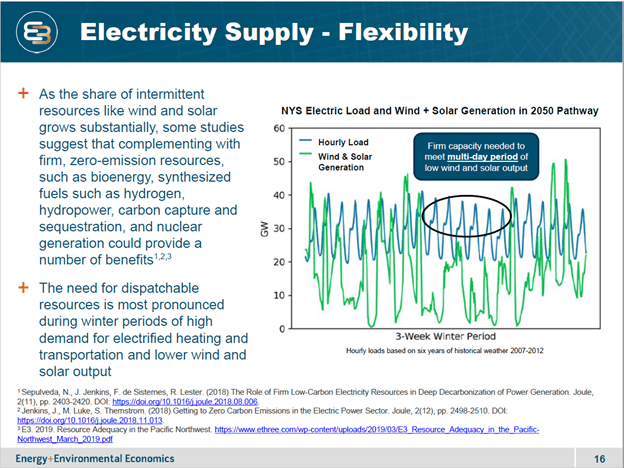
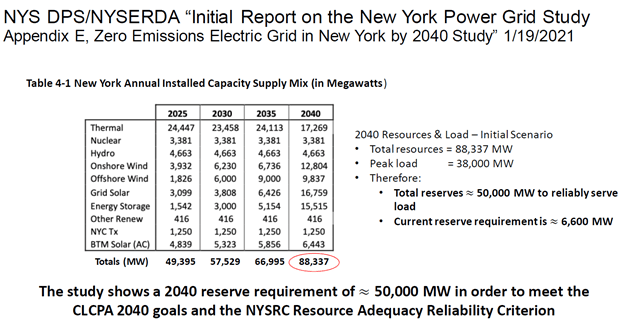
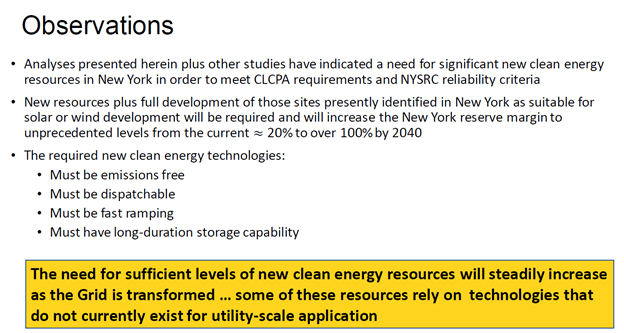
I think that the New York City New Normal report outlines useful strategies to address the problems of extreme weather.  I disagree that there is any “new” normal but the fact is that extreme weather always has happened and will always happen whatever mankind tries to do, makes planning a system to address these events a no regrets solution.  The biggest impediment to implementation is the enormous funding needed and I believe it is obvious that taking the money presently being thrown away on greenhouse gas emission reduction projects would be better served funding these strategies.  New York emissions cannot possibly be reduced enough to affect global warming and the alleged new normals of extreme weather even if there is a link between the two.  Given that it is a moral imperative that everyone should have access to abundant, reliable energy that can only be provided affordably with fossil fuels means that emission increases elsewhere are going to be greater than any possible New York emission reductions.  Finally, New York’s emphasis on wind and solar zero emissions resources for future emission reductions depends on technology that does not exist.  As a result, catastrophic blackouts with impacts equivalent to the extreme weather events are likely as a result of the mitigation efforts of New York.  It would be logical and safer to use emission reduction funds for the proposed strategies.

—————————————————————————————————————————————

Roger Caiazza blogs on New York energy and environmental issues at Pragmatic Environmentalist of New York.  This represents his opinion and not the opinion of any of his previous employers or any other company with which he has been associated.

The Climate Leadership & Community Protection Act’s Fundamental Flaw

The authors of New York’s Climate Leadership and Community Protection Act (CLCPA) Climate Action Council biased implementation of the law to vilify methane and nitrous oxides because they have the potential to warm the atmosphere more than an equivalent amount of  carbon dioxide.  This post explains why that rationale is incorrect and makes the CLCPA fundamentally flawed.

I have written extensively on implementation of the CLCPA because I believe the solutions proposed will adversely affect reliability and affordability, will have worse impacts on the environment than the purported effects of climate change, and cannot measurably affect global warming when implemented.   The opinions expressed in this post do not reflect the position of any of my previous employers or any other company I have been associated with, these comments are mine alone.

Background

Last year I published an article, Climate Leadership and Community Protection Act Methane Obsession that described how the irrational New York obsession against natural gas has resulted in a requirement in the CLCPA to develop an emissions inventory using a 20-year time horizon because methane has a greater potential to increase global warming.  As a result of this requirement and another mandate to include upstream emissions too, the baseline 1990 greenhouse gas emissions inventory nearly doubled.  I pointed out in that article that as a result of this approach, the implementation will have to focus on immediately reducing natural gas use despite its many advantages and crucial support to energy supplies.

My previous article noted that the methane obsession in the CLCPA law and its implementation strongly relies on the research of Professor Robert Howarth of Cornell University.  According to the Cornell Chronicle Howarth played a “key role” in drafting the law and now as a member of the Climate Action Council will “identify and make recommendations on regulatory measures and other state actions that will ensure the attainment of the statewide greenhouse gas emissions limits”.  Howarth is the David R. Atkinson Professor of Ecology and Environmental Biology at Cornell and his biography notes “My training was in oceanography, and much of my research still focuses on coastal marine ecosystems”.  Cornell Alumnus David Atkinson provided funds to establish and make permanent Cornell’s Center for Sustainability because he “realized that climate change is probably the biggest issue facing humanity”.  A recent paper of Howarth’s on methane emissions inventories was funded by the Park Foundation that has a long history of anti-natural gas fracking activism.  I make these points because it is clear that his funding sources support certain outcomes so supporting research is at the very least encouraged.  Moreover, nothing in his background suggests expertise in atmospheric radiation related to a thorough understanding of nuances associated with global warming theory.  If a dentist receiving money from the tobacco industry were to publish research that said smoking has health benefits, then his motives would be questioned and his claims scrutinized in great detail.  Despite an analogous background and other research contradicting his analyses Howarth’s research is unquestioned in the implementation process.

As mentioned previously, one of the mandates specified in the CLCPA is that the global warming potential (GWP) had to be calculated over a 20-year time horizon.  The Inter-governmental Panel on Climate Change describing time horizons and the GWP notes:

“The GWP has become the default metric for transferring emissions of different gases to a common scale; often called ‘CO2 equivalent emis­sions’ (e.g., Shine, 2009). It has usually been integrated over 20, 100 or 500 years consistent with Houghton et al. (1990). Note, however that Houghton et al. presented these time horizons as ‘candidates for discussion [that] should not be considered as having any special sig­nificance’. The GWP for a time horizon of 100 years was later adopted as a metric to implement the multi-gas approach embedded in the United Nations Framework Convention on Climate Change (UNFCCC) and made operational in the 1997 Kyoto Protocol. The choice of time horizon has a strong effect on the GWP values — and thus also on the calculated contributions of CO2 equivalent emissions by component, sector or nation. There is no scientific argument for selecting 100 years compared with other choices (Fuglestvedt et al., 2003; Shine, 2009). The choice of time horizon is a value judgement because it depends on the relative weight assigned to effects at different times.”

Reference: Myhre, G., D. Shindell, F.-M. Bréon, W. Collins, J. Fuglestvedt, J. Huang, D. Koch, J.-F. Lamarque, D. Lee, B. Mendoza, T. Nakajima, A. Robock, G. Stephens, T. Takemura and H. Zhang, 2013: Anthropogenic and Natural Radiative Forc­ing. In: Climate Change 2013: The Physical Science Basis. Contribution of Working Group I to the Fifth Assessment Report of the Intergovernmental Panel on Climate Change [Stocker, T.F., D. Qin, G.-K. Plattner, M. Tignor, S.K. Allen, J. Boschung, A. Nauels, Y. Xia, V. Bex and P.M. Midgley (eds.)]. Cambridge University Press, Cambridge, United Kingdom and New York, NY, USA.


Howarth and others argued that it was necessary for the CLCPA to use 20-year global warming potential (GWP) values because methane is estimated to be 28 to 36 greater than carbon dioxide for a 100-year time horizon but 84-87 GWP over a 20-year period.  Because of these high potentials they assumed that meant that the effect of methane on expected warming would be significant.

Earth’s Thermal Radiation

I was prompted to write this post because of Andy May’s excellent summarization of Wijngaarden and Happer’s important paper “Dependence of Earth’s Thermal Radiation on Five Most Abundant Greenhouse Gases”.  In my previous post on New York’s methane obsession, I noted that a report entitled “Methane and Climate” by the same two authors had concluded that “Proposals to place harsh restrictions on methane emissions because of warming fears are not justified by facts.”  However, Andy May’s analysis describes the greenhouse effect and the potential impact of methane so well that it also needs to be considered in the context of the CLCPA. The greenhouse effect is the basic rationale for the alleged existential threat of climate change because additional anthropogenic greenhouse gases, in the absence of any other processes, must warm the atmosphere.  Although this is a non-controversial scientific fact, the reality is that there are so many processes, conditions, caveats, and unknowns that it is impossible to precisely estimate how much warming can be expected with added greenhouse gas emissions.  May explains the basics and some of the complexities in his recent article and references his previous article on the greenhouse effect for even more discussion of the fundamental effect.

Thermodynamics in general and atmospheric thermodynamics have always given me a headache and I agree with May’s argument that no one really understands all the component complexities of it.  Fortunately, Wijngaarden and Happer (W&H) have evaluated the likely influence of greenhouse gases (CO2, H2O, CH4, N2O, and O3. using the HITRAN line-by-line molecular transmission and absorption database maintained at Harvard University to give us a better understanding of the atmospheric processes and effects of these gases. May writes:

HITRAN stands for high-resolution transmission molecular absorption. The database compiles spectroscopic parameters that computer programmers can use to model the transmission and emission of light in the atmosphere. W&H use the database to model a hypothetical mid-latitude temperature and GHG atmospheric profile to derive a representative climate sensitivity to doubling the gases. 

In layman’s terms this analysis considers the distribution and characteristics of greenhouse gases in the atmosphere to determine how much the climate could warm due to this process in isolation.

Verbatim Andy May Summary and Conclusions  (the following section is directly quoted)

“In summary, W&H have provided us with a detailed and accurate emissions model that shows only modest warming (2.2 to 2.3°C), inclusive of likely water vapor feedback, but not counting the feedback due to cloudiness changes. Both the magnitude and sign of net cloud feedback to surface warming are unknown. Lindzen has shown it is likely negative (cooling) in the tropics, but outside the tropics no one knows.”

“The water vapor feedback to surface warming is also very unclear, Ferenc Miskolczi (2014) has written:”

‘As long as the Earth has unlimited water supply (in the oceans) with its three phases permanently present in the atmosphere and two phases on the ground surface, the stability of the planetary climate will be controlled by the equations [see paper, page 19]. These two equations, together with the Clausius-Clapeyron equation, will regulate the transfer of the latent heat through the boundary layer in such a way that the net amount maintains the planetary radiative balance.’

“Miskolczi, and others have found that total water vapor in the atmosphere has gone down in the past 70 years, although this is questioned. The work by W&M on radiation emissions suggests that future warming due to GHGs will be modest. Speculation about the warming feedback due to clouds and changes in total water vapor is just that, speculation.”

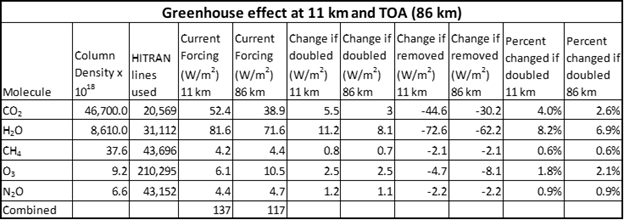
“The results of the study are summarized in Table 2.”

Table 2. Modeled parameters for each GHG in the W&H study. The current flux at 11 km and 86 km for each GHG are shown, then the values if they are doubled, and removed from the atmosphere, and finally the percentage change in forcing (W/m2) if the current concentration is doubled. Only CO2, H2O and O3 change significantly when doubled.

“Table 2 shows that the main GHGs are CO2, H2O and O3, doubling the methane or N2O concentration changes the outgoing forcing by less than one percent. Due to the properties of water vapor, its atmospheric concentration is very unlikely to double, but if it did, it would only increase the forcing by eight percent at 11 km. Doubling CO2 only increases the forcing by four percent at 11 km.”

“The combined current 11 km and 86 km forcing values in the table are not the sum of the individual values due to overlap. It is very clear from this table that all GHGs are saturated and adding to the current concentrations will make very little difference. Doubling CO2 will cause the stratosphere to cool about 10°C, but the changes in surface temperatures from this model are all less than 2.3°C, as shown in Table 1. This is much less than the preferred IPCC AR6 value of 3°C (IPCC, 2021, pp. TS-57). Considering that the current net effect of clouds is cooling and it seems likely that total water vapor in the atmosphere is decreasing or staying flat, these results suggest we have little to worry about regarding increasing GHGs.”

CLCPA Implications

One of the bigger problems implementing the CLCPA is developing strategies to reduce methane (CH4 and nitrous oxide (N2O) especially because of the unprecedented focus on those pollutants.  While there aren’t as many sources of either one or as much emitted by either one relative to CO2, the capability to control them is difficult.  So difficult that the apparent strategy is to ban their use.  With respect to methane that means eventually banning the use of natural gas for home heating, cooking and hot water despite its inherent advantages.  Similarly, the largest source of nitrous oxides emissions is from nitrogen fertilizer so reducing those emissions has unintended consequences.

The reason that methane and nitrous oxides are included in the CLCPA and used to justify changing the emissions calculation methodology to emphasize their importance is that the global warming potential for both pollutants are much higher than the warming potential of carbon dioxide.  If it can warm more then it most be more important according to this rationale.  The CLCPA emissions inventory is calculated differently than just about every other jurisdiction for this reason.

The Wijngaarden and Happer paper destroys this rationale.  Ultimately the CLCPA rationale is to mitigate global warming by reducing the emissions that have the potential to enhance the greenhouse effect itself.  Two characteristics of greenhouse gases determine the effect: the global warming potential and the concentration of the gases in the atmosphere.  Because the atmospheric concentrations of methane and nitrous oxides are so small doubling concentrations change the “outgoing forcing by less than one percent”.  In other words, doubling emissions or cutting emissions in half of methane and nitrous oxides will have no measurable effect on global warming itself. 

The Climate Action Council claims to “follow the science” but it is evident that the CLCPA science actually selectively follows the narrative supporting the agenda to electrify everything using unreliable and expensive renewable energy.  No where is this more evident in the use of the 20-year global warming potential emissions inventory that makes natural gas untenable.  If the state actually implements these restrictions, then people will freeze to death in the dark either slowly because they cannot afford the energy costs or quickly when there is an ice storm that knocks out power for days.  All because of flawed CLCPA reasoning best shown by the following analogy.  Methane is 86 times more powerful than carbon dioxide so it is necessary to frame the emissions inventory to address methane uses the same reasoning as a claim that because an ant can lift 86 times its own weight it is more powerful than a man who cannot lift as high a percentage of its weight.

Climate Leadership & Community Protection Act Lessons from Europe

At the September 13, 2021 meeting of New York’s Climate Leadership and Community Protection Act (CLCPA) Climate Action Council a requirement to consider carbon reduction measures in other jurisdictions was discussed.  I agree that this is an important consideration but I expect that the evaluation will consider the control measures themselves in isolation and ignore the ramifications observed of those measures.

I have written extensively on implementation of the CLCPA because I believe the solutions proposed will adversely affect reliability and affordability, will have worse impacts on the environment than the purported effects of climate change, and cannot measurably affect global warming when implemented.   The opinions expressed in this post do not reflect the position of any of my previous employers or any other company I have been associated with, these comments are mine alone.

Background

Since the spring of 2020 the Climate Action Council has been developing a scoping plan outlining recommendations to implement the CLCPA.  The goal is to complete a draft scoping plan by the end of 2021, take comments next year, revise the scoping plan, have the next state energy plan incorporate the scoping plan strategies, and then have state agencies develop the many regulations necessary.  A key component of the process will be the integration analysis. At the September 13, 2021 Climate Action Council meeting , it was noted that the Integration plan provides support for the scoping plan but it is not the same as the scoping plan as a whole.  “It is designed to assess the greenhouse gas reductions, benefits and costs of portfolios of measures state-wide so the implications of various policy recommendations can be understood.”  The report will be prepared by Energy & Environmental Economics (E3) under the guidance of the New York State Energy Research & Development Authority (NYSERDA).  It “combines a detailed accounting model of energy supplies and demands across the entire economy with an optimized capacity expansion model in the electric sector” to develop a mix of energy sources that will meet the CLCPA goals.  The scoping plan will also estimate total societal costs and benefits.  For further background, I have summarized the schedule, implementation components, and provide links to the legislation itself at CLCPA Summary Implementation Requirements.

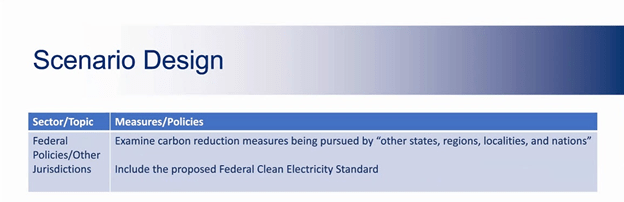
Carl Mas from NYSERDA led the discussion of the integration scenario planning process.  During his presentation he summarized feedback from the Climate Action Council.  At 1:43:40 in the video of the meeting he described the measures/policies first bullet, that notes that they will examine carbon reduction measures being pursued by “other states, regions, localities, and nations”.  He said that measures in other states and regions, “including Europe”, will be evaluated.  The purpose of this post is to point out that in addition to the measures themselves the observed outcomes should also be addressed.

Great Britain and Germany Electrical System Status

Great Britain and other European jurisdictions have similar greenhouse gas reduction policies in place.  In June 2019 Great Britain became the “first major economy to bring all greenhouse gas emissions to net zero by 2050”.  Germany has its Energiewende (energy transition) which will expand renewable energy resources and phase the electric sector out of fossil fuels to “reduce the energy sector’s emissions by 61 or 62 percent by 2030 compared to 1990”.  Implementation of both policies is further along than the New York CLCPA and the ramifications are becoming evident.

In September 2021 electricity prices reached record levels in the European and United Kingdom power markets.  The day-ahead electricity prices are triple of those a year ago.  Paul Homewood at the Not a Lot of People Know That blog writes:

The immediate trigger has been low wind speeds across much of Europe in the last few weeks, meaning reduced outputs of wind power. This has led to a shortage of power on the grid, and a consequent spiking of prices. This sort of thing occasionally happens in winter when demand is high, but is unheard of in summer months, indicating that something is going badly wrong.

European and United Kingdom Electricity Prices

https://www.catalyst-commercial.co.uk/works/september-2021-energy-market-brief/

I believe that the current problem can be traced to an increasing lack of diversity of electrical generation sources in the European and United Kingdom electrical systems.  In order to provide reliable electricity, electric operators must balance load with generation dispatching generating sources to meet load variations.  Dispatchability is a key attribute of the generators needed for reliable electricity.  Fossil-fired, nuclear, and hydro generating stations are the primary sources of dispatchable energy today.  Europe has been phasing out coal and nuclear generation so the percentage of dispatchable generation is decreasing.  In order to keep prices down the more types of dispatchable power that are available the better so that any upset in one source can be balanced by power from the other sources.  Nuclear and hydro generation has low fuel costs so those sources run as much as possible so the loss of coal capacity means that prices are strongly influenced by the availability and cost of natural gas. 

In addition, solar and wind resources have zero fuel costs so they run whenever the sun shining and the wind is blowing.  This results in less income for the dispatchable resources and is a factor in the loss of coal generation capacity shown in following graph.  This price structure also affects existing natural gas generation and makes the construction of new natural gas capacity a poor investment so new plants are not being built. The result is a long-term loss of dispatchable generation availability.  

Europe has reached the point where renewable resource availability can trigger price issues.  Recently there was a two-week wind lull at the same time there was a Europe-wide gas shortage.  As a result of the system needing sources that can only survive by charging very high prices for the short periods when their energy is needed, the electricity price spiked and  German electricity prices hit a new record high

Also note that short-term variations in solar resources caused German electric grid operators to disconnect several industrial companies from the grid to maintain the system:

The generation of electricity in Germany on this Saturday was downright chaotic. During the day, the solar systems generated a lot of electricity due to the almost optimal solar radiation. Between 1 p.m. and 2 p.m., the solar power reached a peak output of more than 30,000 megawatts. In the evening, the power generation of the solar systems collapsed drastically. Between 7 p.m. and 8 p.m., they delivered around 3,000 megawatts, just 10% of the output from the afternoon. However, the demand for electricity in the evening was almost unchanged at a good 50,000 megawatts. The network operators therefore had to call up all available reserves. But the output of the pumped storage power plants and the lignite power plants run up to their maximum load was not enough to compensate for the deficit between electricity demand and electricity generation. The still missing amount of electricity could not be compensated by importing electricity from abroad. Therefore, shortly before 8 p.m., loads were shed from larger, energy-intensive industrial plants, such as aluminum and copper smelters

Advocates for renewable energy often under-estimate the importance of reliable electricity to society.  Obviously, higher energy prices affect consumers but they also impact industrial activities and can force them to curtail operations.  As a result of the spike in prices, British fertilizer plants shut down, CO2 produced by the fertilizer plants became unavailable, and now there is the threat of food shortages because “The gas is critical to the production and transport of a range of products, from meat to bread, beer and fizzy drinks”.  The soaring energy prices have affected the viability of gas suppliers and taxpayers in Great Britain may have to bail them out.

The European crisis also underscores issues with imports.  The United Kingdom has become increasingly dependent on electricity imports from France and Ireland.  Issues with the undersea transmission line from France have reduced the amount that can be imported.  Ireland froze exports to the United Kingdom when they needed all the output from their wind farms for their own needs.  Worse, is the reliance of Europe on Russian exports of natural gas which could easily become a source of political blackmail.  The bottom line is that relying on imports introduces complications which can come back and cause problems.

Conclusion

The Climate Action Council reminded the analysts developing the CLCPA integration analysis that the law mandates review of actions being pursued by “other states, regions, localities, and nations”.  In the presentation Carl Mas summarized the planned response to feedback from the Climate Action Council.  His presentation said they would examine carbon reduction measures being pursued by other states and regions, “including Europe”.  I suspect that the response to this mandate will focus on the measures themselves and overlook the inconvenient fact that cost and reliability issues are occurring with greenhouse gas emission reduction targets similar to the CLCPA.

Based on the current trajectory of the CLCPA implementation process I believe the same things happening in Europe today will happen in New York.  The majority of the Climate Action Council members have insufficient technical background to fully appreciate the magnitude of the challenge converting the existing electrical system to one dependent upon intermittent renewable energy resources.  For example, while the claim that solar generating capacity may be cheaper than natural gas fired power plants may be true the problem is that the claim only covers part of the cost of providing reliable electricity to homes and businesses.  When the total costs necessary to provide electricity when and where needed is added the cost is much higher as reflected by the long-term trend in European electricity prices.  Over dependence upon intermittent resources reliant on the vagaries of weather also affect shorter term price as shown by the September price spikes.  It also appears that increased energy use during cold weather this winter could be a problem in Europe unless it is mild due to the surging gas and electricity prices.  The European experience also shows that there are significant ramifications to high energy costs that should be addressed by the CLCPA.

The European experience reflects not only high energy costs but there are troubling signs that reliability issues can occur even during periods when the electric system is not stressed due to high demand.  Germany had to shut down power to major industrial facilities without warning in August because of solar variability.  The fact that the September wind lull during a period generally considered low load demand caused grid operators to call on rarely used coal generators suggests that continued retirements of the dispatchable resources at the same time more wind facilities are added will eventually cause insurmountable problems because when a high-pressure system causes calm winds it does so over a very large area so all the wind facilities in an area as small as Great Britain will all lose power at the same time.  Someday the over-reliance on wind energy and loss of dispatchable resources will cause a grid crisis in Great Britain and New York will fare no differently if the state goes down the same path.

The CLCPA attempt to reduce greenhouse gas emissions ignores the observed risks and impacts of a transition to an electrical system reliant on renewable energy in a quixotic quest to reduce the impacts of the imaginary existential threat of climate change.  This cannot end well unless the state accepts the lessons from Europe and radically revises the schedule and targets of the CLCPA until a feasible plan to address the problems identified is developed.

Finally, given the importance of what is happening in Europe I recommend an article on the same topic at Manhattan Contrarian.

Forecast Verification for the New York Climate Action Council Meeting

On September 4, 2021 I predicted that at the next meeting of New York’s Climate Leadership and Community Protection Act (CLCPA) Climate Action Council the recent flooding in lower New York State would be described as evidence that climate change is a reality and that the actions of the Council will fight these kinds of disasters.  This post notes that for the record the Co-Chair “remarks and reflections” included a slide on the recent flooding.

I have written extensively on implementation of the CLCPA because I believe the solutions proposed will adversely affect reliability and affordability, will have worse impacts on the environment than the purported effects of climate change, and cannot measurably affect global warming when implemented.   The opinions expressed in this post do not reflect the position of any of my previous employers or any other company I have been associated with, these comments are mine alone.

Background

Since the spring of 2020 the Climate Action Council has been developing a scoping plan outlining recommendations to implement the CLCPA.  The goal is to make the recommendations by the end of 2021 and have the next state energy plan incorporate their recommendations.  A key component of the process will be the integration analysis prepared by Energy & Environmental Economics (E3) that “combines a detailed accounting model of energy supplies and demands across the entire economy with an optimized capacity expansion model in the electric sector” to develop a mix of energy sources that will meet the CLCPA goals.  The plan will also estimate total societal costs and benefits.  For further background, I have summarized the schedule, implementation components, and provide links to the legislation itself at CLCPA Summary Implementation Requirements.

A common feature in the Climate Action Council meetings has been a “reflection” in the opening remarks by the co-chairs that brags about recent implementation actions and includes an argument that additional implementation is needed to address the latest extreme weather event.  My forecast was correct because the meeting included the following slide describing the recent New York flood events (At 8:25 in the Meeting Recording).

Discussion

The immediate response after the flooding from the usual suspects was that climate change was involved despite the fact that worse precipitation has been observed in the past.  As noted in the last post the mis-perception between climate and weather is so common that I have developed a page that explains the difference between weather and climate and includes articles debunking similar claims. 

In the previous post I concluded that flooding caused by heavy rainfall following a previous storm is much more an example of extreme weather than a climate change driven event.  The need to implement mitigation measures as part of the CLCPA is mis-guided because it diverts resources from improvements to weather forecasting, extreme weather warning communications, and resiliency adaptation measures.  Those improvements could provide tangible benefits even if the climate change alarm proves to be over rated.  On the other hand, expecting any extreme weather benefits from emission mitigation measures by New York State are doomed simply because world-wide emissions continue to increase at a greater pace than New York reductions can ever hope to slow down much less reverse.

The remarks and reflections also noted that the latest report from the Intergovernmental Panel on Climate Change had come out since the last meeting.  The director of the Department of Environmental Conservation, Basil Seggos, described the stark warnings of the report at 7:25 of the video.  Not surprisingly, there was no recognition that the high carbon pathway that gives the catastrophic predictions is based on emissions that are implausibly high because recent International Energy Agency estimates are 30% less than that IPCC scenario.  Furthermore, Dr Judith Curry writes that “The extreme tail risks from global warming, associated with very high emissions and high climate sensitivity, have shrunk and are now regarded as unlikely if not implausible.”  Nonetheless, NY policy makers continue to emphasize projections based on the high emissions and high climate sensitivity scenarios.

Conclusion

The CLCPA implementation process continues to portray any extreme weather event as “proof” of global warming driving climate change.  However, New York agencies ignore the difference between weather and climate.  A climatological average is defined as a 30-year average.  In 1954 three hurricanes and in 1955 two hurricanes hit the Atlantic coast north of South Carolina.  If that were to happen today, the alarmists would be screaming that this is definitive proof of a changing climate.  It happened over 66 years ago and has not happened again through two climatological averaging periods.  That indicates if anything, a tendency for fewer hurricanes.  I conclude that describing the flooding caused by the remnants of hurricane Ida as proof of climate change is an example of not letting a crisis go to waste and not letting the facts get in the way of a good story.

RGGI Secondary Allowance Market in the Fifth Compliance Period

The Regional Greenhouse Gas Initiative is a carbon dioxide control program in the Northeastern United States.  Starting in January 2009 the program is now in its fifth three-year compliance period.  This technical post explains why the ownership of allowances held in this compliance period will be unique and how that may be a problem.

I have been involved in the RGGI program process since its inception.  I blog about the details of the RGGI program because very few seem to want to provide any criticisms of the program. The opinions expressed in this post do not reflect the position of any of my previous employers or any other company I have been associated with, these comments are mine alone.

Background

RGGI is a market-based program to reduce greenhouse gas emissions. It is a cooperative effort among the states of Connecticut, Delaware, Maine, Maryland, Massachusetts, New Hampshire, New Jersey, New York, Rhode Island, Vermont, and Virginia to cap and reduce CO2 emissions from the power sector.  According to a RGGI website:

“The RGGI states issue CO2 allowances which are distributed almost entirely through regional auctions, resulting in proceeds for reinvestment in strategic energy and consumer programs. Programs funded with RGGI investments have spanned a wide range of consumers, providing benefits and improvements to private homes, local businesses, multi-family housing, industrial facilities, community buildings, retail customers, and more.” 

Proponents tout RGGI as a successful program because participating states have “cut carbon pollution from their power plants by more than half, improved public health by cutting dangerous air pollutants like soot and smog, invested more than $3 billion into their energy economies, and created tens of thousands of new job-years”.  Others have pointed out that RGGI was not the driving factor for the observed emission reductions.  My work supports that point and points out that the cost-effectiveness of the investments from this carbon tax reduce CO2 emissions at a cost of $858 per ton which is far greater than the social cost of carbon metric.  In other words, this is not a cost-effective way to reduce CO2 emissions.

I first became involved with emissions trading pollution control programs at the beginning of the Acid Rain program in 1995.  That program introduced a system of allowance trading that uses market-based incentives to reduce pollution.  The Acid Rain Program is considered a success because it delivered greater emissions reductions at a lower cost than expected.  I think the success caused a problem inasmuch as nowadays emissions trading programs of any form are considered the best approach whatever the circumstances.  First and foremost, trading programs for CO2 have fewer control options.  In the Acid Rain Program there were compliance options such as add-on controls at the affected sources and more fuel-switching options than are available to reduce CO2 emissions.  For existing sources the main control approaches are fuel switching and running less.  Also, with respect to RGGI the idea that a “little” tweak to auction the allowances rather than award them based on past operations presumed that RGGI would get similar results.

Rather than awarding allowances to affected sources the RGGI allowances are made available at quarterly auctions.  Anyone who meets the financial requirements is eligible to participate in the auctions.  Affected sources are required to surrender allowances equal to half their annual emissions at the end of the first and second years of the compliance period and then surrender allowances to cover the rest of their emissions in the compliance period at the end of the third year.  When allowances are awarded to affected sources the excess allowances after reconciliation are surplus and affected sources are confident that they can be sold or traded without impacting compliance.  Thus, the allowance bank in these systems is primarily allowances that have been earned because the affected sources developed a control strategy that exceeded the cap requirements.  Selling all the allowances in auctions enables investors with no compliance obligations to play the market.  That is a big and mostly unacknowledged difference.

I believe there is a major gap between the academic theory how emissions trading works and reality.  Academics believe that the affected sources treat allowances as a storable commodity and a profit center.  However, the reality is that affected sources treat allowances as a compliance instrument and very few companies buy and sell allowances for profit.  Moreover, it is the nature of the generation business today to have a very short-sighted business plan.  As a result, I believe that affected sources only purchase allowances on an expected need basis mostly at the auctions, but also from the market.  Note that this approach means that the size of the banked allowance pool at affected sources is small and used for short-term compliance goals.  At this time the bulk of the current allowance bank consists of allowances purchased by investors without compliance obligations.

During the development of the RGGI rules the possibility that entities could cause anti-competitive behavior was discussed.  In response, RGGI has an independent auditor (Potomac Economics) checking to see if that has been observed and evaluating other aspects of the market (reports here).  In the Environmental Protection Agency market-based pollution control programs there is complete transparency and the ownership of all allowances is available.  However, in RGGI only the independent auditor knows the identity of auction bidders and allowance holders.  In the remainder of this post, I explain why the majority of allowances held by investors rather than affected sources in this compliance period will be unique and how that may be a problem.

Secondary Market Report Allowance Holdings

A couple of months after each auction Potomac Economics prepares a report on the secondary market.  The most recent report on the secondary market summarizes the allowance status of the CO2 allowance holdings at the end of the second quarter of 2021:

  • There were 143 million CO2 allowances in circulation.
  • Compliance-oriented entities held approximately 52 million of the allowances in circulation (36 percent).
  • Approximately 61 million of the allowances in circulation (43 percent) are believed to be held for compliance purposes.

The RGGI market monitor, Potomac Economics, only describes three categories for allowance owners.  Figure 1 from their recent report describes the relationship between the three categories they use.

Figure 1: Classifications of Participant Firms in the RGGI Marketplace

The Potomac Economics description of firms participating in the RGGI market states:

  • Compliance-oriented entities are compliance entities that appear to acquire and hold allowances primarily to satisfy their compliance obligations.
  • Investors with Compliance Obligations are firms that have compliance obligations, but which hold a number of allowances that exceeds their estimated compliance obligations by a margin suggesting they also buy for re-sale or some other investment purpose. These firms often transfer significant quantities of allowances to unaffiliated firms.
  • Investors without Compliance Obligations are firms without any compliance obligations.

These three categories form the basis for two overlapping groups.

  • Compliance Entities – All firms with compliance obligations[1], and their affiliates[2]. Combines the first and second of the above categories.
  • Investors – All firms which are assessed to be purchasing primarily for investment rather than compliance purposes. Combines the second and third of the above categories.

[1] Before New Jersey announced on June 17, 2019 that it would participate in RGGI beginning in January 2020, firms owning Budget Sources in New Jersey but not in currently Participating States were not treated as compliance entities. However, since the announcement, such firms are treated as compliance entities in our reports.

[2] Affiliates are firms that: (i) have a parent-subsidiary relationship with a compliance entity, (ii) are subsidiaries of a parent company that has a large interest in a compliance entity, (iii) have substantial control over the operation of a budget source and/or responsibility for acquiring RGGI allowances to satisfy its compliance obligations.

The assessment of whether a compliance entity holds a number of allowances that exceeds its compliance obligations by a margin that suggests they are also buying for re-sale or some other investment purpose is based on: (a) the entity’s forecasted share of the total compliance obligations for the entire RGGI footprint through 2026, (b) the total number of allowances in circulation, and (c) consideration of the pattern of the entity’s allowance transfers to unaffiliated firms versus affiliated firms. Since the designation of a compliance entity as an investor is based on a review of its transactions and holdings, the designation of a particular firm may change over time as more information becomes available. Therefore, some of the quantities in this report may not match previous reports because of changes in the classification of particular firms.

The number of allowances that are believed to be held for compliance purposes includes 100 percent of the allowances held by compliance-oriented entities and a portion of allowances held by other compliance entities (i.e., entities with compliance obligations that are not included in the compliance-oriented category).

The anonymity of the allowance holders raises a couple of issues.  In the first place, the classification of the owners is subjective and has not been independently reviewed so the classifications might not reflect the likely behavior of the owners.  There also is the possibility of another category of allowance holders.  Potomac Economics presumes that the all the allowances are held by investors who would be willing to sell their holdings if the price was right.  However, if there are owners who regard the RGGI allowances as carbon offsets they would not be willing to sell at any price.  Given the opaque ownership information I have no idea whether there could be enough offset holders to affect the market.

Projected Allowance Holdings

In the fifth RGGI compliance period allowance holdings ownership will become an issue.  In order to illustrate possible scenarios, I estimated the allowances that might be held by entities holding them for compliance purposes and investors with no compliance obligations through the end of the compliance period in 2023.  RGGI does not provide a consolidated source for the allowances in circulation data listed in the Potomac Economics reports.  Because I have been unable to replicate the numbers and the discussion of the calculations is so complicated, I have prepared a documentation report if anyone is inclined to find out how the following numbers were derived.

In brief, I used the second quarter 2021 Potomac Economics allowances in circulation and allowances held for compliance purposes combined with the auction for the third quarter 2021 report that provided an update of the allowances in held for compliance purposes.  For the rest of the auctions, I used the estimated adjusted allowance allocations.  The biggest question mark is the number of allowances that are allocated to states but not put in the allowance auctions.  There are CO2 emissions data available for the first two quarters of 2021 and I used those data to project future emissions.

I prepared three scenarios of the status of the number of allowances available to entities with compliance obligations at the end of 2023.  In all the scenarios I assume that all the auctioned allowances are purchased by compliance entities.  The first scenario assumes constant emissions consistent with the first two quarters of 2021 and allowances allocated to auctions are reduced consistent with the ratio of total allowances available to allowances auctioned in 2020.  In that scenario compliance entities will have to purchase 20 million allowances from investors without compliance obligations to meet their compliance requirements in the fifth compliance period.  The second scenario assumes that all the allowances allocated to each year are auctioned off with the same emission assumption.  In that case, the compliance entities will have to purchase 6 million allowances from investors without compliance obligations to meet their compliance requirements.  Of course, projecting future emissions is difficult but important to the results.  The third scenario reduced emissions in 2022 and 2023 by 3%, consistent with the allowance allocation reductions.  In that scenario compliance entities still have to purchase nearly 19 million allowances for investors without compliance obligations to meet their compliance requirements.

Cost Containment Reserve

There are factors that could significantly change the allocation results.  Additional allowances can be added to the auctions.  The RGGI states have established a Cost Containment Reserve (CCR), consisting of a quantity of allowances in addition to the cap which are held in reserve. These are sold if allowance prices exceed predefined price levels, so that the CCR will only trigger if emission reduction costs are higher than projected. The CCR is replenished at the start of each calendar year.  The CCR trigger price is $13.00 in 2021 and will increase by 7% per year thereafter. The size of the CCR is 10% of the regional cap each year.  If the auction price triggers the CCR in 2021 then an additional 11,976,778 allowances will be added.  In 2022 11,617,475 allowances and in 2023 11,268,951 allowances will be added if the CCT trigger price is exceeded.  Of course, if additional states join the program, then the allowance allocations will increase.  Finally, if investors without compliance obligations purchase allowances that makes it that much more difficult for affected sources to purchase allowances needed for compliance.

Discussion

In the background section I explained that the allowance bank in the RGGI cap-and-auction program is different than the allowance bank in traditional cap-and-trade programs.  At this time 54% of the allowances in the bank are held by investors without compliance obligations.  If the CCR is not triggered, at the end of the fifth compliance period it is likely that the affected sources will have to obtain allowances from entities who purchased the allowances as an investment.  This is unprecedented.

During the development of the implementing RGGI regulations the Integrated Planning Model was used to predict how the market would act.  One of the bigger problems with the model results is that the model had perfect foresight.  It knew how many allowances would be needed for its estimates of emissions and projected that affected sources would rationally act in their best interests with that information by, for example, purchasing allowances early to cover shortfalls later in subsequent compliance periods.  However, affected sources don’t know what their future emissions will be and don’t purchase allowances except on a shorter time horizon.  Throw in the vested interests of investors and we cannot possibly expect that the market will behave “perfectly” as predicted in the model.

One other aspect of the modeling that was not addressed was the relationship between compliance entities and investors without compliance obligations.  No market-based pollution control program has ever reached the point where non-compliance investors owned most of the banked allowances.  Table 1 estimates when affected sources that keep allowances in hand to cover emissions will need to go to the investors.  It starts adding allowances and emissions to the current allowance ownership categories but does not include the allowances surrendered to meet 50% compliance obligation at the end of the first and second years.  Using the assumptions of Scenario 1, the margin between emissions and total allowances for compliance obligations category indicates that affected sources will have to rely on non-compliance entities starting in 2022. 

Table 1: Fifth Compliance Period Projected Allowances and Emissions – Scenario 1
  AllowancesAllowances forConstantCompliance
YearQuarterin CirculationCompliance PurposesEmissionsMargin
2021Q2143.061.049.911.1
2021Q3165.976.374.91.4
2021Q4188.699.099.9-1.0
2022Q1210.5120.9124.9-4.0
2022Q2232.5142.9149.9-7.0
2022Q3254.5164.9174.9-10.0
2022Q4276.5186.9199.9-13.1
2023Q1297.8208.2224.9-16.8
2023Q2319.1229.5249.9-20.4
2023Q3340.4250.8274.9-24.1
2023Q4361.7272.1299.9-27.8

I think that the investors without compliance obligations are in for a windfall.  At some point it is inevitable that affected sources are going to have to purchase allowances from these investors. It is naïve to expect that their selling price will be anything less than near the CCR trigger price because those investors don’t have to sell until their price is met but affected sources will have to buy whatever the cost.  This will reduce societal benefits.  For example, consider the Quarter 3 2021 auction. The closing price for 22,911,423 allowances was $9.30. which earned the RGGI states $213,076,234 which will be invested for “reinvestment in strategic energy and consumer programs”.  Compliance Entities purchased 52 percent of the allowances sold so non-compliance entities ended up with 10,997,483 allowances.  At the end of the fifth compliance period if the allowance market price is $14.85, just under the CCR trigger of $14.88, and compliance entities have to purchase allowances for compliance then the profit for the investors would be $61,036,031. None of those funds will go toward strategic energy and consumer programs.

It will be fascinating to see how this plays out.  I expect that allowance prices will increase when this ownership shift occurs but will they increase enough to trigger the CCR and add allowances to the system?  If allowances are added to circulation, it will delay the leverage that investors without compliance obligations have on affected sources who need allowances to operate.  At this time, it appears to be extremely unlikely that the CCR will be triggered in 2021.  Given the large gap in prices it might not even be triggered in 2022 but given that affected sources will have to go to the market to purchase allowances necessary to cover emissions triggering the CCR is more likely.  I frankly will be surprised if the CCR is not triggered in 2023.  If that happens allowance prices will be over $14.88, 11,268,951 allowances will be added to circulation, and, assuming emissions decrease by 3% per year, the allowances available to the affected sources would approximately equal the compliance obligation.

The biggest unknown in all this is future emissions.  The primary CO2 reduction mechanism is fuel switching and the original nine states in RGGI have already switched fuels at many sites.  I have no experience with Virginia’s emissions so there might be a possibility of significant fuel switching and lower emissions.  In New York the retirement of 2000 MW of nuclear generating capacity will surely increase state CO2 emissions.  The important takeaway is that the worst-case situation is if there are insufficient allowances that affected sources will be unable to run.  In theory, when there is a shortage of allowances the prices will go up and trigger additional allowances from the CCR.

Conclusion

This post explains that RGGI is approaching the situation where the majority of allowances will be held by investors rather than affected sources.  Speaking as an investor, I purchased allowances in auction 40 in June 2018 and sold them earlier this year when I needed the money, I would certainly be setting an “ask” price close to the CCR trigger price.  Investors who have held on to them for this long can afford to wait a couple of more years when affected sources will have to purchase allowances.  As long as quarterly emissions exceed the allowances available it is only a matter of time until that occurs.  This is a problem because consumers will end up paying the allowance costs that get incorporated into the electric system bid costs but they will not reap any benefits on the difference between the auction cost and the sales cost.

The opaqueness of the RGGI allowance bank makes it necessary to rely on the market monitor to tell us the categories of the allowance holders.  The expectation for all three categories, compliance entities, investors with compliance obligations and investors without compliance obligations, is that allowances will be sold at the right price.  However, if there are owners who regard the RGGI allowances as carbon offsets they would not be willing to sell at any price.  It is not clear that there are any allowance holders in this category but it is possible.  Another question is whether carbon offset allowance holders would have an impact on RGGI emissions.  In my opinion that is unlikely because the scarcity of allowances would drive up the price and trigger the release of additional allowances. 

Climate Leadership & Community Protection Act 2030 Electric System Target Feasibility

On August 29, 2021 I posted an article, CLCPA Electric System Targets, that discussed the politics behind the 2030 electric system target that requires a minimum of seventy percent of the state wide electric generation to be provided by renewable energy systems.  I argued that because the definition of renewable energy systems excludes nuclear and renewable natural gas (e.g., methane capture from landfills, farm manure digesters, and other organic sources) that meeting that target was impossible.  However, I did not provide evidence for that claim.  This article documents why I believe it is impossible.

I have written extensively on implementation of the CLCPA because I believe the solutions proposed will adversely affect reliability and affordability, will have worse impacts on the environment than the purported effects of climate change, and cannot measurably affect global warming when implemented.   The opinions expressed in this post do not reflect the position of any of my previous employers or any other company I have been associated with, these comments are mine alone.

Background

The previous article completely documents the target and relevant definitions but here is the simple version.  § 66-p, 1 (b) states that (b) “renewable energy systems” means systems that “generate electricity or thermal energy through use of the following technologies: solar thermal, photovoltaics, on land and offshore wind, hydroelectric, geothermal electric, geothermal ground source heat, tidal energy, wave energy, ocean thermal, and fuel cells which do not utilize a fossil fuel resource in the process of generating electricity”.  The target is defined in § 66-p, 2 (a) as “a minimum of seventy percent of the state wide electric generation secured by jurisdictional load serving entities to meet the electrical energy requirements of all end-use customers in New York state in two thousand thirty shall be generated by renewable energy systems”.

Future Electric System Projections

I looked at feasibility of the 2030 target earlier but I had the mistaken impression that nuclear was included as part of the 70% allowable energy sources.  The premise of my impossibility argument is that the current renewable energy sources distribution from the New York State Energy Research and Development Authority (NYSERDA) Patterns and Trends – New York State Energy Profiles: 2003-2017 report is so small that it is unreasonable to expect that it can be raised to 70% in ten years even if nuclear is included.  Table 1 combines data from the NYSERDA patterns and trends document and the New York Independent System Operator (NYISO) Gold Book for the last three years.  In 2020 the CLCPA renewable energy sources contributed only 24% of the electrical energy system generation (Table 1).  This article will look at a couple of refined projections made for the future electric system under the CLCPA.

The first study is the Initial Report on the New York Power Grid Study as described in Appendix E: Zero-Emissions Electric Grid in New York by 2040 Study (“Zero-Emissions Study”).  It is not surprising that this analysis prepared in part by New York Department of Public Service and NYSERDA staff claimed that “there are feasible pathways to meeting the CLCPA targets” because state policy takes it as a given that CLCPA targets are only a matter of political will.  However, upon closer examination using alternate reasonable alternate assumptions the target is unlikely to be achieved.

Table 2 compares the assumptions in the initial scenario of the Zero-Emissions Study with alternative assumptions.  The New York Independent System Operator (NYISO) Gold Book includes estimates of future load in Table I-1b: Summary of NYCA Baseline Annual Energy Forecasts – GWh.  In this table the baseline annual energy forecast is 145,960 GWh but that includes a reduction of behind the meter solar PV 8,013 GWh.  Because the Zero-Emissions Study includes estimates for this parameter it should be added to the annual forecast to make the 2030 expected load 153,973 GWh.  That makes the renewable energy resources percentage of the total smaller.  The Table 2 alternative assumes the same capacity for distributed behind the meter solar, utility-scale solar, and onshore wind but bases the capacity factors on observed data rather than the “NREL Wind Toolkit and National Solar Radiance database”.  Land-based wind capacity factors averaged 25% over the last five years.  Assuming that all the additional wind capacity developed between now and 2030 meets the NREL 34.6% capacity factor and that all the existing wind capacity continues to operate at 25% the more appropriate combined New York capacity factor should be 31.5% thus reducing the expected energy produced.  The latest Gold Book includes data that indicates that grid solar in New York has a capacity factor of 17.6%.  With respect to grid solar in Table 2 that raises the energy produced.  However, the Zero-Emissions Study assumes that distributed solar will have the same capacity factor as utility-scale solar and that is not supportable.  The NYSERDA New York Solar Study lists different capacity factors for three different classes of distributed solar – all lower than the utility-scale value.  For the alternative I conservatively used the highest value of the three.  As a result of all these alternative assumptions the alternate renewable energy resources percentage is 67.1%.

The second analysis was done by Energy and Environmental Economics, Inc. (E3) for NYSERDA in the spring of 2020.  E3 described their analysis in Pathways to Deep Decarbonization in New York State – Final Report [PDF]. E3 used their RESOLVE model to model the electric sector:

Our modeling approach also incorporates detailed electricity sector representation using E3’s RESOLVE model. RESOLVE is used to develop least-cost electricity generation portfolios that achieve New York’s policy goals, including 100% zero-emission electricity, while maintaining reliability.

When the report was released, I analyzed the approach and concluded that: “While their models give the veneer of respectability to the projections, the reality is that the inherent over-simplifications of their models under-estimates the difficulties of the transition in New York and gives a false sense of security to their assurances that implementation will succeed”.  Of particular concern relative to the electric system feasibility is how they handled renewable resource availability.  In the following slide they point out that firm capacity is needed to meet a multi-day period of low wind and solar output in the winter.  In my analysis I argued that actual short-term meteorological data must be used to correctly characterize the renewable resource availability for New York in general and in areas downwind of the Great Lakes in particular. This is because the lakes create meso-scale features, most notably lake-effect snow and clouds, that can affect solar resources many miles from the lake shore.  At the time I asked E3 how they calculated renewable resource availability but they never responded.  The key point is that the ultimate estimate of the electric system generating resources necessary to ensure reliable electricity availability at all times must be able to handle this worst-case situation.  It is not clear to me that the projections in their decarbonization pathway address this in their estimates of resources needed.

I extracted the data in Table 3 from their Supplementary Workbook [XLS] dated October 10, 2020.  I estimate that this analysis projects that renewable energy resources will only total 67.6% instead of 70%.  Even so I think their estimate is high.  My biggest concern is that there are no firm, zero-emissions resources listed for 2030 and I think some will be needed to meet the worst-case period they highlight as a concern.  There also are consistency issues relative to the other estimates.  E3 handled imports differently.  That is good because it does give a renewable energy resource estimate for imported hydropower but it causes the total imports to become negative.  I don’t know how battery storage should be handled relative to the CLCPA definitions so I just lumped it into the renewable energy resources category. 

In addition to the problem that both studies did not prove that their renewable energy resources solution adequately addressed the critical reliability problem of a multi-day period of low wind and solar, both studies presume that the projections for future renewable energy resources can be built on a schedule that ensures that they are available in 2030.  The Accelerated Renewable Energy Growth and Community Benefit Act is supposed to expedite renewable energy development but that does not preclude the possibility of litigation on specific projects or other holdups in the permitting process. In the case of offshore wind, I believe that delays are inevitable because the infrastructure to support building the turbines has to be developed first and those developments are also subject to permitting and construction delays.  Finally, there is a real possibility that the availability of the critical minerals and metals needed for these renewable technologies could slow implementation and increase costs. 

Conclusion

In general, the feasibility approach in the analyses described here is to simply estimate future load and then calculate the energy resources necessary to match that load.  There are multiple issues with these analyses.  First, and foremost, the emphasis appears to be on annual comparisons but the critical reliability issue is a multi-day period in the winter when wind and solar resource availability is low but the load requirements for universal electrified heating and transportation are high and must be met to ensure the safety and health of New York residents.  It is not clear that any of the projections adequately addressed this requirement.  In addition, I don’t think that the projections included the necessary resources needed to provide ancillary transmission grid services as I described in a post on one of the studies.  Finally, I am sure that the studies did not incorporate the resources needed to maintain New York State Reliability Council requirements.  Therefore, these projections under-estimate the resources needed to provide reliable electricity.

The Zero-Emissions Study and the E3 decarbonization pathways analysis both can claim that their approaches achieve the goal that the electric system use 70% renewable energy resources in 2030.  Based on this analysis I think their assumptions about renewable resource availability are overly optimistic.  The practical reality is that time constraints on permitting, procurement, construction and development of supporting infrastructure will most likely delay implementation of the ambitious proposed resource development.  Further compounding the viability of the proposed resources are the New York State Reliability Council requirements and the need for ancillary grid transmission services.  When all these factors are considered, I believe that it will be impossible to meet the 2030 target without endangering reliability.

Prediction for the New York Climate Action Council’s Next Meeting

In New York’s Climate Leadership and Community Protection Act (CLCPA) the Climate Action Council is required to prepare and approve a scoping plan outlining the recommendations for attaining the statewide greenhouse gas emissions limits in accordance with the schedule of the law.  I predict that at their next meeting the recent flooding in lower New York State will be described as evidence that climate change is a reality and that the actions of the Council will fight these kinds of disasters.  This post explains why the rationale is wrong and the proposed solution hurts rather than helps the flooding problems.

I have written extensively on implementation of the CLCPA because I believe the solutions proposed will adversely affect reliability and affordability, will have worse impacts on the environment than the purported effects of climate change, and cannot measurably affect global warming when implemented.   The opinions expressed in this post do not reflect the position of any of my previous employers or any other company I have been associated with, these comments are mine alone.

Background

Since the spring of 2020 the Climate Action Council has been developing a scoping plan outlining recommendations to implement the CLCPA.  The goal is to make the recommendations by the end of 2021 and have the next state energy plan incorporate their recommendations.  A key component of the process will be the integration analysis prepared by Energy & Environmental Economics (E3) that “combines a detailed accounting model of energy supplies and demands across the entire economy with an optimized capacity expansion model in the electric sector” to develop a mix of energy sources that will meet the CLCPA goals.  The plan will also estimate total societal costs and benefits.  For further background, I have summarized the schedule, implementation components, and provide links to the legislation itself at CLCPA Summary Implementation Requirements.

A common feature in the Climate Action Council meetings has been a “reflection” in the opening remarks by the co-chairs that brags about recent implementation actions and includes an argument that additional implementation is needed to address the latest extreme weather event.  Given that history I have no doubt that the next meeting will describe the flooding effects of hurricane Henri and the remnants of hurricane Ida and imply that the CLCPA will reduce if not eliminate those effects in the future.  That claim as well as all the other similar claims in the past is baloney.

New York Flooding

On August 22, 2021 tropical depression Henri made landfall in Rhode Island.  Although it had weakened from a hurricane and skirted New York, it dumped heavy rains from New Jersey to New England.   The region had a wet summer so the ground was already saturated.  As a result, the main impact was flooding.  Hurricane Ida struck the Louisiana coast on August 29, 2021 sixteen years to the day after Hurricane Katrina devastated New Orleans.  Although there was widespread devastation, the levees in New Orleans held and the loss of life was much less in Louisiana.

I followed the forecasts of the remnants of Ida as it slogged north and the east out to sea.  Every forecaster was warning that heavy rains were likely in the New York City area and coupled with already saturated grounds that flooding was likely.  Cliff Mass described the weather as it hit the area and noting that New York’s Central Park had a record of 3.15 inches in an hour.  He explains that hurricane remnants, known as extratropical cyclones, combine strong upward motions with large amounts of tropical moisture.  This combination causes heavy rains and flooding.  Tragically, dozens of people were killed in New York and New Jersey as a result of this flooding.

The immediate response from the usual suspects was that climate change was involved despite the fact that worse precipitation has been observed in the past.  I believe that this will also be the response by the Climate Action Council co-chairs at the next meeting.  This is such a common response that I have developed a page that explains the difference between weather and climate and includes article debunking similar claims.  In this case however, I want to respond differently.  In particular, I want to discuss what the best approach would be to prevent a reoccurrence of the deaths and devastation in New York City.

Discussion

As I mentioned before this was a very well forecasted event with some caveats.  Cliff Mass notes that there were warnings out for heavy precipitation but that there some issues with “intensity and position”. He goes on to argue that a larger number of finer resolution weather prediction ensembles could be used to develop better probabilistic/uncertainty predictions.  I think those models could also be improved by incorporating higher density observations into the models.  All those revisions could improve the forecasts if implemented.

However, the fact is that the forecasts were ignored.  In my opinion, many New York City residents are so divorced from weather impacts (they simply are not outside for long periods that much) that they don’t pay attention to weather forecasts unless it is an extreme event.  Consequently, the idea that a forecast for heavy rain means that they should monitor the weather situation, i.e., check the weather forecast frequently in that situation, is not common practice.  As a result, communication practices have to be changed to ensure that people stay off the roads and get out of low-lying basement apartments when this kind of forecast is made.

The good news vis-à-vis Ida was that the levee resilience measures installed in Louisiana since Katrina worked well enough to prevent a re-occurrence of that disaster.  If there were other levees that failed it is clear that additional strengthening is needed.  The bigger problem there is the extensive damage to the electric system.  Clearly more needs to be done to strengthen the resiliency of the electric transmission and distribution system.

After super storm Sandy In New York City extensive upgrades were made to prevent damage from storm surges.  However, given that the subways still flooded, more still needs to be done to prevent water damage to that system.  Given the extreme amount of rain it probably is not possible to engineer a system to prevent all the many water issues but it certainly is time to update what could be done.  In addition to infrastructure improvements developing an improved warning system would be useful.  For example, during such an event if people knew that the GPS driving direction systems were being updated with flooding information, they could use them to steer clear of problem areas.

All of the aforementioned resiliency measures require investments of time and money.  However, they all can provide benefits to reduce impacts of future storms.  One of the key points to understand about extreme weather and climate change is that climate change impacts are smaller than the effects of natural variability.  As a result, it is ludicrous to expect that extreme weather will stop occurring even if climate change mitigation measures reduce global warming and the alleged effects on extreme weather.  The most likely future scenario for weather is more extreme weather and that means that adapting to the effects of extreme weather is a no regrets approach.

More importantly the fact is that beyond New York and the United States fossil fuel emissions are increasing at a rate that is many times greater than New York’s emissions.  Consequently, even if New York mitigation efforts do reduce emissions there will be no impacts on the world’s weather because of increased emissions elsewhere. 

Conclusion

The next meeting of the Climate Action Council will be on Monday, September 13, 2021 at 2:00 p.m. ET.  The meeting agenda includes a welcome item that I predict will mention the flooding in New York City as a sign that climate change is a reality and we need to fight it. 

In actuality the observed heavy rainfall following a previous storm is much more an example of extreme weather than a climate change driven event.  The need to do something about it as part of the CLCPA is mis-guided because it diverts resources from improvements to weather forecasting, extreme weather warning communications, and resiliency adaptation measures.  Those improvements could provide tangible benefits in any event.  On the other hand, expecting any extreme weather benefits from emission mitigation measures by New York State are doomed simply because world-wide emissions continue to increase at a greater pace than New York reductions can ever hope to slow down much less reverse.

Reliability Challenges in Meeting New York’s Climate Act Requirements

This post was published at Watts Up With That on  September 2, 2021

On July 18, 2019 former New York Governor Andrew Cuomo signed the Climate Leadership and Community Protection Act “Climate Act”), which establishes targets for decreasing greenhouse gas emissions, increasing renewable electricity production, and improving energy efficiency.  Over the last year recommendations have been developed by panels of politically chosen representatives for consideration for a Scoping Plan to achieve greenhouse gas (GHG) emissions reductions economy-wide.   On August 2, 2021, the New York State Energy Research and Development Authority (NYSERDA) held a Reliability Planning Speaker Session that provides some interesting insights regarding reliability planning for electric systems dominated by renewable energy generation.

Background

Reliability planning in New York is prioritized because there is a long history of blackouts in New York State in general and New York City in particular.  After a blackout in July 2019 AMNY published a brief history of blackouts in New York City.  In every case after blackouts in 1959, 1961 1965, 1977, 2003, and 2012 new requirements for infrastructure and operating rules were implemented to prevent future reoccurrences.  Reliability planning is a constant concern for the electrical system professionals who operate the system and are responsible for keeping the lights on.  With all due respect to the professionals who are trying to develop a reliable system that incorporates large amounts of intermittent and diffuse wind and solar generation, the track record for blackouts indicates that historically not all the problems could be anticipated and that retrospective reliability improvements were the norm.

Over the past year the electric system professionals have looked on the Climate Act transition process and recommendations with increasing concern because it is clear that many of the appointed representatives do not understand the particular reliability requirements of New York.  After a year and many comments, the State finally responded with an overview briefing presentation on those requirements to the people who are supposed to guide the transition plan.  The speaker session (recording here) included presentations from six organizations with varying levels of reliability background, experience, and responsibilities:

  • New York State Reliability Council (NYSRC) – Mayer Sasson, Steve Whitley, & Roger Clayton
  • New York Independent System Operator (NYISO) – Zach Smith
  • Utility Consultation Group – Margaret Janzen (National Grid) and Ryan Hawthorne (Central Hudson)
  • New York State Department of Public Service (DPS) – Tammy Mitchell
  • Vote Solar – Stephan Roundtree
  • New York Department of State Utility Intervention Unit – Erin Hogan

In a post on my blog I did an overview of all the presentations.  The warning in five of the six presentations was similar: it will not be enough to depend on today’s technology to develop a reliable electric system with net-zero emissions.  A “large quantity of installed dispatchable energy resources is needed in a small number of hours” and it “must be able to come on line quickly, and be flexible enough to meet rapid, steep ramping needs”.  That technology does not exist for utility-scale applications.  Unfortunately, in order to cater to the environmental zealots involved in the process a presentation from Vote Solar who claimed “integrating renewables into the grid while maintaining reliability is possible, and in fact cost effective” was included.  That presentation was based on the report, “Why Local Solar for All Costs Less”, that is fatally flawed because it relies on annual estimates of renewable resource availability and does not address worst case conditions.

NYSRC Presentation

The presentation by the New York State Reliability Council succinctly describes the organization, how the New York electric system is operated to maintain reliability and some of the challenges presented when renewable energy sources are increased significantly.  It was so well done I thought it would be of interest to readers here.

New York’s electric system is de-regulated so reliability planning is provided by the New York Independent System Operator, various state agencies and the NYSRC.  The introduction describes the NYSRC and the Installed Reserve Margin (IRM) parameter.  The IRM is defined as the “minimum installed capacity margin above the estimated peak load to meet the Northeast Power Coordinating Council (NPCC) requirement that the probability of shedding load is not greater than one day in ten years”.   Load shedding occurs when the demand for electricity exceeds supply and grid operators have to turn power off for groups of customers in order to prevent the whole system from collapsing.  Note that one of the lessons learned from previous blackouts was that New York City has to maintain a significant amount of in-city generation availability to prevent blackouts.  The NYSRC has specific rules in this regard.

The next slide described how the system is operated reliably. Note that in addition to the short-term operation of the system that longer term planning is also required.  In order to address the one in ten-year criteria of the IRM, planning has to address new generation and transmission resource development that can take ten years to get built.

The slide titled “Operating the future system reliably” explained that as the mix of generation resources changes, planning and operations will also have to change.  A point of emphasis is that “Limited fuel diversity and over dependence on energy limited resources is a risk to reliability”.  In the past New York boasted a truly diverse fueled electric system with significant coal, residual oil, natural gas, hydro and nuclear resources.  There were significant resources available from sources that could store fuel on-site and could operate with more than one fuel.  However, the state has banned the use of coal and residual oil has become so expensive that its use has dropped precipitously.  The conclusion in the slide that additional dispatchable and sustainable energy resources to manage the substantially different system in order to maintain reliability refers, in part, to the New York City requirements for in-city capacity.  Presently, for example, that means facilities must be able to burn oil when natural gas is unavailable. 

The next slide (not shown here) re-emphasizes the importance of the IRM which turns out to be a future challenge when there are significant increases in renewable resources.  This is illustrated in the slide titled “Solar impact on resource adequacy”.  The slide shows the diurnal variation of load vs solar generation also known as the “duck curve”.  Typical discussions of the duck curve focus on the operational challenge resulting from the loss of solar generation at the same time the load is high.  This slide addresses the changes in the reserve requirements with the addition of 26,000 MW of new solar generation in New York.  Because of the enormous variation in available energy from solar, adding that amount of solar generation would raise the reserve requirement to approximately 22,000 MW as compared to the current reserve requirement of 6,600 MW.  It also means that the state can only retire 4,000 MW of current resources.

The Climate Act has an electric system target of zero emissions in 2040.  The Department of Public Service (DPS) and New York State Energy Research & Development Authority (NYSERDA) have made a preliminary estimate of the resources needed to meet that goal as shown below.  The key numbers from this slide are that they expect to need 88,337 MW in 2040 for an expected load of 38,000 MW.  In order to meet that load and with a loss of load expectation no greater than once in ten years the NYSRC estimates that the total reserves will be approximately 50,000 MW.

The presentation observes that the New York reserve margin will have to increase to over 100% relative to the current reserve margin of about 20%.  The estimates of resources needed to meet the Climate Act targets have not incorporated this issue so they under-estimate the resources needed significantly.  In addition, the new technologies have to be zero emissions and meet the characteristics of fossil fuels (dispatchable, fast-ramping, and long duration storage).  The presentation notes that “these resources rely on technologies that do not currently exist for utility-scale applications”.

Conclusions

I recommend reading the session presentation and listening as it gives a good overview of reliability issues facing New York or any other jurisdiction in the transition to net-zero.  One caveat is to not waste your time reading the Vote Solar presentation because it is based on fatally flawed analysis.

There is consensus that the future worst-case situation in New York will be a multi-day winter time wind lull when both wind and solar availabilities are low.  Coupled with increased electricity load in order to reduce emissions from transportation and heating, any analysis of future renewable energy resources that adequately addresses the worst-case renewable energy resource availability shows the required amounts of wind, solar and energy storage will have to be enormous.  Importantly, the NYSRC analysis indicates that in order to ensure reliability the installed reserve margin will have to be added to the total needed to balance anticipated load.  While the focus of the highlighted presentation was New York, I believe that similar problems will become evident at any other jurisdiction that attempts to develop a net zero emissions electricity system. 

The NYSRC conclusion that the state of New York appears to be headed down a transition path which will require reliance on technologies that do currently exist in less than ten years should be a wake-up call.  The ultimate question is whether the proposed transition plan will address the issues raised by the professionals or cater to the naïve dreams of the politically chosen members of the transition program. I fear New York consumers will be lab rats for a politically motivated virtue signaling empty gesture that is going to cost enormous sums of money, and, in the event of a major blackout, cause much more harm than good.

—————————————————————————————————————————————

Roger Caiazza blogs on New York energy and environmental issues at Pragmatic Environmentalist of New York.  He has  written extensively on implementation of the Climate Act because the solutions proposed will adversely affect reliability and affordability, will have worse impacts on the environment than the purported effects of climate change, and cannot measurably affect global warming when implemented.   This represents his opinion and not the opinion of any of his previous employers or any other company with which he has been associated.

Climate Leadership & Community Protection Act Electric System Targets

On July 18, 2019 former New York Governor Andrew Cuomo signed the Climate Leadership and Community Protection Act (CLCPA), which establishes targets for decreasing greenhouse gas emissions, increasing renewable electricity production, and improving energy efficiency.  I have been posting articles about the feasibility of the CLCPA targets and got the following comment in response to my post CLCPA Feasibility Relative to NYSERDA Patterns and Trends: “Please provide a cross reference to the fact that CLCPA includes nuclear power as acceptable form of renewable energy”.  This post provides a more complete discussion than my reply.

I have written extensively on implementation of the CLCPA because I believe the solutions proposed will adversely affect reliability and affordability, will have worse impacts on the environment than the purported effects of climate change, and cannot measurably affect global warming when implemented.   The opinions expressed in this post do not reflect the position of any of my previous employers or any other company I have been associated with, these comments are mine alone.

When I started researching this comment request, I was confident that the legislation actually listed nuclear as a renewable energy system.  However, when I researched it, I found out I was wrong.  Subsequently I discussed this with colleagues who are more attuned to New York policy and legislative considerations than I am.  As is usual with any aspect of the CLCPA whenever you start to dig into the details there are complicating nuances.

Climate Change Regulations

There are three implementing regulations for the CLCPA legislation that became effective on January 1, 2020.  Article 75 – Climate Change was added to the New York Environmental Conservation Law. 

§ 66-p. Establishment of a renewable energy program was added to the New York Public Service law.  Finally, § 54-1523. Climate adaptation and mitigation projects was added to the Environmental Protection Act.

For the purposes of this article the relevant regulation is § 66-p. “Establishment of a renewable energy program”.  The pertinent amended language reads:

§ 66-p. Establishment of a renewable energy program.

1. As used in this section:

(a) “jurisdictional load serving entity” means any entity subject to the jurisdiction of the commission that secures energy to serve the electrical energy requirements of end-use customers in New York state;

(b) “renewable energy systems” means systems that generate electricity or thermal energy through use of the following technologies: solar thermal, photovoltaics, on land and offshore wind, hydroelectric, geothermal electric, geothermal ground source heat, tidal energy, wave energy, ocean thermal, and fuel cells which do not utilize a fossil fuel resource in the process of generating electricity.

2. No later than June thirtieth, two thousand twenty-one, the commission shall establish a program to require that:

(a) a minimum of seventy percent of the state wide electric generation secured by jurisdictional load serving entities to meet the electrical energy requirements of all end-use customers in New York state in two thousand thirty shall be generated by renewable energy systems; and

(b) that by the year two thousand forty (collectively, the “targets”) the statewide electrical demand system will be zero emissions. In establishing such program, the commission shall consider and where applicable formulate the program to address impacts of the program on safe and adequate electric service in the state under reasonably foreseeable conditions. The commission may, in designing the program, modify the obligations of jurisdictional load serving entities and/or the targets upon consideration of the factors described in this subdivision.

The renewable energy systems definition clearly excludes nuclear.  My colleagues all agreed that was a deliberate choice.  It also excludes renewable natural gas that is to say methane from landfills and other organic sources.  That also was a deliberate design choice by the “anti-natural gas in any form” zealots who drafted the regulation.

The first electric system target in the public service law mandates 70% renewable energy by 2030.  Clearly the intent was that 70% of the electric energy has to come from the defined renewable energy systems.  Note that the 2040 100% Carbon-free Electricity target is for a different set of energy sources.  Also note that there is a lifeline such that the Public Service Commission can modify the obligations to meet the target if there are issues with “safe and adequate electric service”.

Discussion

 In my conversation with colleagues who are more conversant about environmental policy in New York, I explained that my work suggests that meeting the 2030 target is impossible with 70% solar thermal, photovoltaics, on land and offshore wind, hydroelectric, geothermal electric, geothermal ground source heat, tidal energy, wave energy, ocean thermal, and fuel cells which do not utilize a fossil fuel resource in the process of generating electricity resources. A forthcoming post will delve into the numbers but for the moment trust that assessment.

The first policy question that comes up is the rationale behind the overly ambitious 2030 target.  Ultimately the decision on that target was made by a few key individuals with former Governor Cuomo at the top.  The first possibility is that the authors didn’t understand the magnitude of the effort needed and inadvertently chose an impossible target for the decision makers.  Given the rhetoric that meeting the “climate change challenge is only a matter of political will” it is possible that they actually believe it.  The second possibility is that political optics were the primary rationale despite recognition that the targets were overly ambitious. Given that we are talking about targets that are nine years away, cynics might wonder if this was the case with the presumption that the decision makers would be out of office by then or that the voters would have forgotten who passed the legislation.

The second policy question is what happens when it becomes obvious that the targets cannot be met.  This question arises on several time frames for the 2030 target.  The first time it comes up is in in the current planning phase.  Preliminary modeling of all advisory panel recommendations to the Climate Action Council which includes all sectors of the economy indicates the collective recommendations fail to meet the near- and long-term emission reduction targets.  The integration analysis presumably has to increase the emission reduction strategies until the plan meets the targets and that comes out later this year.  There is a requirement for an on-going assessment of the status of emissions reductions relative to the targets so the question can come up once the strategies are implemented.  Finally, in 2031 we will know for sure whether the 70% target was achieved.

What happens when it does become obvious that the target cannot be met? The 2040 target includes the language that the PSC may “modify the obligations of jurisdictional load serving entities and/or the targets” but it is not clear to me that allows changes for the 2030 target.  The politicians who put the state in this bind could argue that these are just goals but the environmental advocates and renewable energy grifters have already started flatly stating that this is the law and that it must be enforced.  While there are certainly legal constraints on litigation for this, there seem to be many lawyers willing to push the envelope on legal standing when it comes to suing deep pocket fossil fuel companies for alleged impacts of climate change.  As a result, I suspect that failure to meet the targets will result in litigation.

There is another aspect of this that is relevant.  The CLCPA did not incorporate any funding mechanism and it is wildly optimistic to think that the targets can be met without additional funding.  The last legislative session considered the Climate and Community Investment Act (CCIA) that was intended to fund many aspects of the CLCPA.  Once the costs and direct consumer impacts in the CCIA were estimated by some observers (there is yet to be an estimate of costs by the state agencies) there was a groundswell of disapproval, many legislators backed off support, and the legislation did not pass.  Every indication is that next legislative session this bill or something similar will be back.  The environmental community and environmental justice activists are going to be pushing for passage but will have to overcome the obvious problem of costs.

Conclusion

As I will show in a future post, there is no way that New York can expect to meet the 2030 target for 70% of the electric system energy requirements powered by the defined renewable energy systems of the CLCPA.  In my original assessments of feasibility, I had the mistakenly believed that nuclear power could be used to help meet the 2030 target because that was the only way the state could come close but it turns out I was wrong.  Nuclear is an acceptable source for the 2040 zero emissions electric system but cannot be used for the 2030 goal.  It is a sign of the times that there are activists that want to shut down the upstate nuclear units as well and that will make the 2040 target more difficult. This post clarifies the definitions and addresses possible reasons why the legislation was drafted to make that distinction.  I don’t believe there is any rationale for this that puts the authors of the legislation or the politicians that approved the law in a good light: they either knew and didn’t care or didn’t bother to check feasibility.

I am not sure whether there will be consequences for this particular aspect of the abominable CLCPA.  As the implementation requirements are defined and impossibility of meeting this target becomes evident, I don’t see how this can continue to be a blind spot for New Yorkers.  Hopefully the public will catch on soon that the costs for this virtue-signaling action will be significant and that New York’s contribution to global warming is so small that anything we do cannot have a measurable effect on the alleged warming from GHG emissions.  If that does not end the nonsensical implementation, maybe when the legal requirements to mandate use of electric vehicles or ban the use of natural gas for home heating, cooking and hot-water will initiate protests.  Unfortunately, many in industry agree with me that it might take a catastrophic blackout with impacts comparable to the Texas blackout in February 2021 to finally motivate voters to demand the repeal of the CLCPA.