Climate Leadership and Community Protection Act Deep Carbonization Workshop

On December 8, 2020, the New York State Energy Research & Development Authority (NYSERDA) and the New York State Department of Environmental Conservation (DEC) hosted the “Deep Decarbonization Workshop”.  Given the enormous challenges ahead of New York trying to transition the electric energy system to be completely free of fossil-fired generation by 2040 I naively assumed that the workshop would focus on decarbonization technologies that could be used to help New York achieve its ambitious Climate Leadership and Community Protection Act (CLCPA) goals.  Instead, with one exception, it was an infomercial for solutions that ignored New York’s specific needs and any limitations of the technologies described.

Background

On July 18, 2019 New York Governor Andrew Cuomo signed the Climate Leadership and Community Protection Act (CLCPA), which establishes targets for decreasing greenhouse gas emissions, increasing renewable electricity production, and improving energy efficiency.  It was described as the most ambitious and comprehensive climate and clean energy legislation in the country when Cuomo signed the legislation.  I have summarized the schedule, implementation components, and provide links to the legislation itself at CLCPA Summary Implementation Requirements.

The CLCPA mandates that a scoping plan outlining the recommendations for attaining the statewide greenhouse gas emissions shall be prepared and approved by December 31, 2021.  The Climate Action Council and seven advisory panels: transportation, energy intensive and trade-exposed industries, land-use and local government, energy efficiency and housing, power generation, waste, and agriculture and forestry consisting political appointees and supported by agency staff are charged with this responsibility. 

Many of these political appointees were chosen to satisfy particular constituencies rather than for their technical expertise.  I maintain that it would be appropriate for them all to be given an overview of how the energy system, in general, and the electric system, in particular work.  Without that foundational knowledge I fear that their strategy recommendations will either not be grounded in reality or not be effective solutions.  Against that backdrop I hoped the workshop would address this need.

Instead, ”The workshop will feature presentations from nationally renowned technical experts such as the keynote speaker, Saul Griffith, a distinguished energy systems expert, inventor, entrepreneur, and engineer. Mr. Griffith, along with other experts, will discuss the opportunities and challenges around innovative climate solutions such as carbon capture; utilization and storage; green-hydrogen; hydrofluorocarbon replacements and process chemicals; and long-duration storage. The workshop will also feature a roundtable discussion with leading environmental justice advocates across New York State to explore how innovation in decarbonization can help advance environmental justice priorities.”

The CLCPA is the embodiment of the idea that political will can implement policies to meet stringent greenhouse gas reduction targets.  I believe many of the appointees accept that without question.  If anything, this workshop further misled those people.  Nothing in the workshop suggested that there might not be readily available proven technologies capable of replacing fossil fuels, much less the possibility that nothing exists today to solve the multi-day winter doldrum problem. This post briefly describes the presentations and missing context relative to the CLCPA.

Keynote Presentation

Saul Griffith set the tone of the workshop in his keynote presentation. His 15-minute presentation featured 53 slides so you can imagine his carnival barker schtick.  Don’t get me wrong the guy is brilliant. According to the Rewiring America website: “As Founder and Chief Scientist at Otherlab, an independent R&D lab, Saul Griffith helps government agencies and Fortune 500 companies understand energy infrastructure and deep decarbonization. He’s been a principal investigator and project lead on federally-funded research projects for agencies including NASA, Defense Advanced Research Projects Agency (DARPA), Advanced Research Projects Agency–Energy (ARPA-e), National Science Foundation and United States Special Operations Command (SOCOM). He was awarded the MacArthur “Genius Grant” in 2007.”

Unfortunately, his spiel is unrealistic magical thinking.  The underlying premise of his presentation was that a commitment to electrification and decarbonization makes it substantially easier to meet our energy demands.  He claims that 25% of our primary energy needs can be eliminated using distributed renewable energy generation because it reduces energy losses in production and transmission.

He goes on to claim that electrification of heating using heat pumps for homes, offices and some industry eliminates 6-7% more.  He illustrated how that is supposed to work in the following slide.

I will end my description of his presentation with this comment.  Griffith is from Australia and lives in the San Francisco area.  He is not familiar with the Upstate New York winter reality.  Here is my house in a typical winter.  His proposed plan is never going to work here.  By the way it usually is this cloudy and the snow was not particularly deep in this picture.  I can tell because I did not clean the snow off the roof.  One other issue with our winters is the occasional ice storm.  What do these people think will happen when there is no electricity for extended periods? 

Long Duration Storage

Scott Litzelman from U.S. Department of Energy – Advanced Research Projects Agency – Energy gave the most relevant presentation “Long-Duration Energy Storage as a Decarbonization Enabler”.  The organizers should have explained the connection between this resource and the E3 analysis Pathways to Deep Decarbonization in New York State – Final Report . E3 has explained that Firm capacity is the amount of energy available for power production which can be guaranteed to be available at a given time. As the share of variable resources like wind and solar grows substantially, firm capacity resources will be needed to ensure year-round reliability, especially during periods of low renewables output.”   While it should be obvious that long-duration storage is needed for firm capacity resources I don’t think that all of the political appointees recognize the enormity of the particular challenge in New York.  The workshop squandered what would have been a perfect opportunity to make the point that if they cannot solve that problem this won’t work.

The presentation itself was pretty technical.  For the Climate Action Council and Advisory Panel members the presentation should have addressed the specifics of New York’s targets.  More importantly, there was no discussion whether the technologies discussed might be ready to be deployed in time for use to meet the CLCPA targets.

Hydrogen

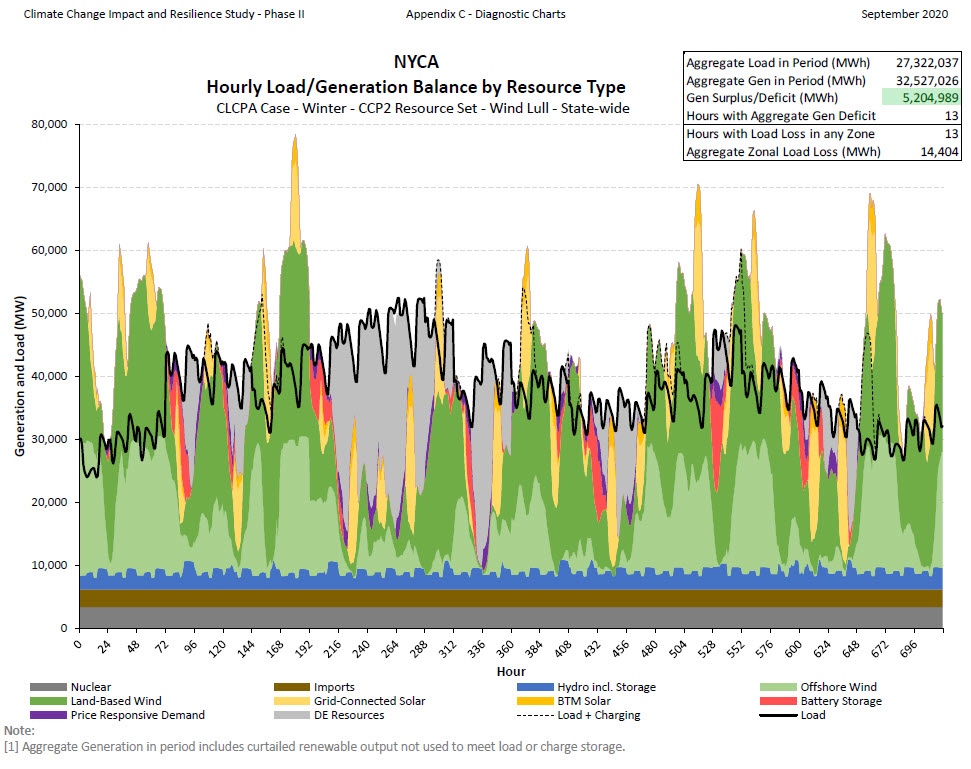
Sunita Satyapal, Director- Hydrogen Program, U.S. Department of Energy, presentation “U.S. Department of Energy Hydrogen and Fuel Cell Technologies Office and Global Perspectives” was a pep talk for a hydrogen economy.  For example, he claimed that there has been a 25-fold increase in deployment in the last decade of electrolyzers that produce hydrogen.  Whether the world-wide deployment of 25 MW in 2019 offers hope or not was not discussed.  Just for context, On September 10, 2020 the Analysis Group presented a discussion of draft recent observations as part of the New York Independent System Operator (NYISO) Climate Change Phase II Study.  Their analysis included a generic resource that I think is the biggest problem for the CLCPA.  They call this resource the Dispatchable & Emissions-Free Resource.  It was “included to maintain reliability during the highest load hours of each modeling period” to “provide the majority of energy on the peak winter hour during the CLCPA load scenario”.  Their analysis shows that this category makes up 19% (32,137 MW) of the total capacity for their projected CLCPA load scenario.  Clearly hydrogen deployment with a world-wide deployment of 25 MW has a long way to go to provide any meaningful support to the CLCPA.  The rest of the presentation described many potential hydrogen technologies but completely ignored the context of the implementation needs for the CLCPA.  Completely ignored were the significant technological issues with hydrogen and the weak economic case.

Dr. S. Julio Friedmann, Center on Global Energy Policy, Columbia University gave a presentation entitled “Circular Carbon Economy with Carbon Capture, Carbon to Value, and CO2 Removal”.  His circular carbon economy consists of four components: reducing CO2 emissions, reusing CO2 where possible, recycling CO2 by altering their composition, and removing CO2 after it is produced.  The emphasis was on carbon capture and sequestration (CCS) in different forms.  He claimed there are 20 operating plants that are storing 35 million tons of CO2 per year worldwide.  He also claimed that the science and technology is well established.  According to the International Energy Agency there were 33 giga tons of CO2 emissions in 2019.  In other words, CCS is treating about one thousandth of the world’s emissions.  Again, there was no discussion of CCS in the context of New York.  Importantly, for it to be viable in New York there have to be locations where it can be stored but that issue was not discussed.

The final presentation, “Keeping cool without warming the planet (alt: heat pumps that don’t heat the globe), Climate Friendly Alternatives for High GWP Hydrofluorocarbons”, was presented by Kristen N. Taddonio, Senior Climate & Energy Advisor, Institute for Governance & Sustainable Development.  According to her, hydrofluorocarbons (HFC) have high global warming potential, climate friendly HFC alternatives can avoid up to 0.5 °C of warming and combining energy efficiency can avoid another 0.5 °C of warming.  I accept that there are climate friendly alternatives but am a little leery of the claims that 1 °C of warming can be avoided.  Just how much warming are they expecting?  More importantly is the New York context.  New York’s CLCPA 1990 emission inventory only has a total of 0.05 million metric tons global warming potential of HFC (less than 0.1% of the total) and the latest NYSERDA inventory has 10.37 million metric tons global warming potential of HFC which is less than 5% of the total.  We will have to wait to see what the current emission inventory fraction of HFC will be but I have no reason to believe it will be a significant fraction of the total emissions inventory. 

Conclusion

The CLCPA deep de-carbonization workshop wasted a perfect opportunity to bring some reality to the implementation challenges to: reduce greenhouse gas emissions 40% from the 1990 baseline by 2030, produce all electricity from zero-emission sources by 2040, and reach net-zero by 2050.  Based on my observations of panel discussions I believe many of the individuals charged with the responsibility for developing the scoping plan to implement strategies to meet those goals do not understand the enormity of this task.  A workshop to explain how energy systems work and quantify how much energy is needed and where to provide reliable power would give the panel members a common basis. 

Instead, the workshop mostly reinforced the notion that CLCPA targets will be met because of the political will of the State.  Long-duration energy storage is the key need and the presentation provided some hope in this regard.  Unfortunately, the presentation did not address the availability or applicability to New York so it is not clear if there is a viable solution to this critical requirement in the timeframe needed.  The keynote, hydrogen, and carbon sequestration presentations all sound great superficially but no context relative to the New York needs was given and they all have serious technological or implementation issues.  The hydrofluorocarbon presentation showed that there may be a solution to address this greenhouse gas but there was no mention of the fact that this is not a big deal for New York.

Finally, the workshop included an environmental justice representative roundtable discussion.  I did not listen to that, there are no slides from it and no recording has been posted. 

Climate Leadership and Community Protection Act Implementation Strategies Overview

On July 18, 2019 New York Governor Andrew Cuomo signed the Climate Leadership and Community Protection Act (CLCPA), which establishes targets for decreasing greenhouse gas emissions, increasing renewable electricity production, and improving energy efficiency.  It was described as the most ambitious and comprehensive climate and clean energy legislation in the country when Cuomo signed the legislation.  In the past year strategies to implement this legislation have started to take shape and this post summarizes the strategies presented to the Climate Action Council at the last two meetings in 2020.  This is an overview post that puts the strategy material in one place. I will address the specific advisory panel strategies as time permits.

I am following the implementation of the CLCPA closely because its implementation affects my future as a New Yorker.  Given the cost impacts for other jurisdictions that have implemented renewable energy resources to meet targets at much less stringent levels, I am convinced that the costs in New York will be enormous and my analyses have supported that concern.  The opinions expressed in this post do not reflect the position of any of my previous employers or any other company I have been associated with, these comments are mine alone.

Background

I have summarized the schedule, implementation components, and provide links to the legislation itself at CLCPA Summary Implementation Requirements.  Section § 75-0103 in the CLCPA establishes the New York state Climate Action Council (CAC). The CAC is charged with planning responsibility:

“The council shall on or before two years of the effective date of this article, prepare and approve a scoping plan outlining the recommendations for attaining the statewide greenhouse gas emissions limits in accordance with the schedule established in section 75-0107 of this article, and for the reduction of emissions beyond eighty-five percent, net zero emissions in all sectors of the economy, which shall inform the state energy planning board’s adoption of a state energy plan in accordance with section 6-104 of the energy law. The first state energy plan issued subsequent to completion of the scoping plan required by this section shall incorporate the recommendations of the council. “

In order to “provide recommendations to the council on specific topics, in its preparation of the scoping plan, and interim updates to the scoping plan, and in fulfilling the council’s ongoing duties”, the CAC (§ 75-0103, 7) “shall convene advisory panels requiring special expertise and, at a minimum, shall establish advisory panels on transportation, energy intensive and trade-exposed industries, land-use and local government, energy efficiency and housing, power generation, and agriculture and forestry”.

CLCPA implementation was proscribed by the legislation.   In order to “provide recommendations to the council on specific topics, in its preparation of the scoping plan, and interim updates to the scoping plan, and in fulfilling the council’s ongoing duties”, the CAC (§ 75-0103, 7) “shall convene advisory panels requiring special expertise and, at a minimum, shall establish advisory panels on transportation, energy intensive and trade-exposed industries, land-use and local government, energy efficiency and housing, power generation, and agriculture and forestry”.  Once the process started it became clear that another panel covering waste would be needed.

Strategies

During the last two Climate Action Council meetings the transportation, energy intensive and trade-exposed industries, land-use and local government, energy efficiency and housing, power generation, and agriculture and forestry advisory panels presented their strategies. Each strategy was presented in a slide that listed the rationale, equity considerations, potential implementation challenges, issues to explore, and additional thoughts. The waste panel started late and did not present a strategy in the same format.

In the following I list the strategies for each panel and link to an extracted copy of their presentation to the Climate Action Council.  You can also listen to their presentations and get the meeting power point slides for the 24 November 2020 and 15 December 2020 meetings where these strategies were presented.

Land Use and Local Government Advisory Panel

This advisory panel presented ten strategies from three subgroups.

      • Land Use Strategies
          • Promote and facilitate county and inter-municipal smart growth planning efforts, including focusing development in priority growth centers
          • Build capacity at the regional level and provide support to municipalities to promote smart growth, facilitate clean energy siting, and reduce vehicle miles traveled
          • Promote coordinated regional approaches to meet climate goals while integrating transportation, housing, and land conservation needs
          • Streamline and incentivize Smart Growth project review
          • Coordinate State planning funds/activities/entities to ensure that transportation, housing, and conservation actions are not in conflict and achieve VMT, clean energy, and equity goals
      • Clean Energy Strategies
          • Establish statewide higher energy codes, benchmarking, building performance mandates, and PACE Financing to avoid a patchwork of policies.
          • Encourage local governments to initiate CCA programs and community campaigns to increase local access to clean energy products and services.
          • Overcome legal, financial, regulatory, and technical barriers to greening municipal building, facilities, and fleets
      • Adaptation and Resilience Strategies
          • Develop policies, programs and resources to reduce risks associated with acute climate hazards
          • Seek to ensure State and local investments assess climate change and resiliency impacts of projects

Energy Efficiency and Housing

This advisory panel presented 16 strategies in six categories.

      • Mandates that require energy efficiency improvements and on-site emissions in building and appliance with dates as market signal
          • Expand State energy & building codes (w/date signals) -> transition to electrification & building efficiency;
          • Modify State Appliance Standards (e.g. ban fossil fuel appliances sale/install.). Consider building performance standards for large buildings to meet 2050 & interim targets –focus on onsite emissions.
      • Financing and incentives for building efficiency and electrification at scale
          • Inducing market/behavioral change (e.g. taxes, registration fees, carbon levies) that incentivize market providers (owners, developers, lenders etc.) & residents to reduce emissions & transition to electrification;
          • Shift lenders to quantify energy efficiency in single/multifamily/commercial (e.g. underwriting to savings);
          • Financial incentives for owners, developers and residents (e.g. cash incentives, pay as you save, low-interest financing, more agile of existing programs to get to 2050 and interim targets, etc), with emphasis on LMI.
      • Training and education of building decarbonization to improve behavior and operations for health and comfort and build workforce (enabling strategy)
          • Workforce development to provide skilled pros to design, build, operate, & enforce decarbonized building stock;
          • Education -owners, developers, design professionals and other stakeholders: resources on capital planning, all-electric buildings, electrification-ready, etc. Mandatory energy performance disclosures & building consumption data (public facing); certified product declarations for materials/equipment; etc.
          • Education-residents/businesses: performance, econ., environmental quality, O&M for low-carbon tech.
      • Technology innovation and demonstration to drive better performance, reduce costs, and increase customer confidence
          • R&D to improve cost/performance of solutions for all-electric buildings (e.g., cold climate heat pumps, geothermal, etc.)
          • R&D & demon. for hard-to-electrify buildings (e.g., on district steam, steam-heated, hydronic distribution) & advance scalable solutions & potential cost reductions (e.g., community geothermal, industrialized fabric/modular, virtual tools);
          • De-risking demos to help critical customer groups who make lack access to resources/info (e.g., coops/condos);
          • Approaches to reducing embodied carbon (e.g. new tech to reduce GHG emissions from materials/construction/transp.)
      • Resilience and climate adaptation strategies for all-electric building, hazard mitigation planning and building retrofits
          • Supporting/coordinating improved resiliency solutions for all-electric building & resilient spaces for vulnerable pops.;
          • Grid and transmission resilience and independence;
          • Electrification paired with supplemental heating sources;
          • Improving building stock to withstand the impacts of climate change.

Agriculture and Forestry

This advisory panel presented 12 strategies in six categories.

      • Livestock/Dairy Management
          • Alternative Manure Management
          • Precision Feed Management
      • Soil Health and Nutrient Management
          • Nutrient (Fertilizer) Management
    • Soil Carbon Sequestration
      • Agroforestry
          • Silvopasture, Alley Cropping, and Riparian Forest Buffers
      • Land Conversions
          • Agricultural Protection and Access
          • No Net Loss of Forestland
      • Forestry:
          • Urban Forestry
          • Statewide Afforestation/Reforestation Efforts
          • Improved Forest Management
          • Increase Manufacture and Use of Harvested Wood Products
      • Bioeconomy
          • Support opportunities to substitute fossil fuels

Transportation

This advisory panel presented six strategies in four categories.

      • Transportation Electrification
          • Adopt regulatory approaches and supporting policies to increase the sale of M/HD ZEVs to 30% by 2030 and the sale of LD ZEVs to 100% by 2035, and require greater use of ZEV non-road vehicles.
      • Clean Fuels
          • Adopt a market-based approach and supporting policies to increase the availability and affordability of clean transportation fuels (renewable biofuels, green hydrogen, electricity) in NYS.
      • Public Transportation
          • Identify policies and programs that would double the availability/accessibility of upstate and downstate suburban public transportation services statewide by 2035;
    • Identify policies and programs to support system reliability/network expansion projects identified by MTA in their twenty-year needs study.
      • Smart Growth and Transportation System Efficiency
          • Transportation-Oriented Development—Align roadway, residential and commercial development to be proximate and accessible to public transportation and consider holistic GHG emissions in smart growth developments;
          • Low-and Zero-Carbon Transportation Modes—Expand access to low-or zero-carbon transportation modes (biking, walking, carpooling) for first mile/last mile connections to transit and destinations.

Power Generation

This panel presented ten strategies in four categories

      • Equity
          • Community Impact–Develop recommendations to identify and proactively address community impacts relating to health concerns, access to renewables and energy efficiency, and siting
          • Access and Affordability for all (Enabling) –Develop recommendations to ensure New Yorkers have access and can afford to participate meaningfully in NYS’s clean energy future
          • Workforce Development (Enabling) –Develop recommendations to enable an equitable clean energy workforce
      • Barriers
          • Clean Energy Siting
          • Energy Delivery & Hosting Capacity
      • Solutions for the Future
          • Technology and Research Needs
          • Market Solutions –Maximize the market participation of different technologies in a way that adds to system efficiency & send correct price signals to resources over time
      • Resource Mix
          • Growth of renewable generation and Energy Efficiency
          • Effectively Transitioning away from Fossil Fuel Energy Generation
          • Deploying Energy Storage and Distributed Energy Resources (DERs)

Energy-Intensive and Trade-Exposed Industries

This panel presented 12 strategies in six categories.

      • Provide financial incentives and technical assistance for the decarbonization of the EIETE sectors
          • Provide technical assistance to help identify economically viable decarbonization pathways and to provide comprehensive energy management planning
          • Provide financial incentives for decarbonization projects
          • Refer economic assistance recipients to resources that will result in lower-emitting projects
          • Leverage low-cost hydropower to provide support for industry
      • Create incentives for business to capitalize on low-carbon economy opportunities
          • Create preferential standards for the public procurement of low-carbon building materials
      • Identify and support technological innovations to enable deep industrial decarbonization
          • Develop a comprehensive Innovation Roadmap to address knowledge gaps and to guide key priorities for deep decarbonization investment in the areas of carbon-tech, low-carbon fuels, and carbon removal
          • R&D funding for early stage decarbonization technologies
          • Demonstration pilot funding for high impact solutions in coordination with private market
          • Identify potential for innovation clusters to leverage supply chains and infrastructure for novel solutions
      • Workforce development training to support energy-intensive and trade-exposed industries
          • Provide workforce development on existing and new innovative emission reduction technologies that effect EITE industries
      • Increase the available data on industrial GHG emissions to help prioritize efforts and monitor progress
          • Expand the universe of industrial facilities that are required to report on their GHG emissions.
      • Provide economic incentives to grow the green economy
          • Leverage the State’s climate policies to develop an in-state supply chain of green economy companies by engaging in business development discussions and offering incentives through programs such as NYSTAR, NY Ventures and Excelsior Tax Credits.

Summary

Now the implementation work begins.  There is an enormous amount of information in these strategies.  In the first place consider that the six advisory panels presented a total of 66 strategies in 29 categories:

        • Land Use and Local Government Advisory Panel: ten strategies in three categories
        • Energy Efficiency and Housing: 16 strategies in six categories.
        • Agriculture and Forestry: 12 strategies in six categories.
        • Transportation: six strategies in four categories
        • Power Generation: ten strategies in four categories
        • Energy-Intensive and Trade-Exposed Industries: 12 strategies in six categories.

Given that many strategies I believe the first task is to start to rank the importance of the strategies.  But in order to do that the Climate Action Council has to establish its priorities.  Is it to maintain reliability and affordability of the energy supply, is it meet the CLCPA emission reduction targets, or is it equity for all?

Someone, somewhere will need to summarize these strategies so they can be ranked by the importance criteria established by the Council.  Despite the massive amount of information there still are many things missing.   For example, technological feasibility, GHG reduction potential, and most importantly to me, costs are all will be needed.  Stay tuned.

Response to My Comments on Part 496 – Climate Leadership and Community Protection Act 1990 Emissions Baseline

In late October 2020 I submitted personal comments on the New York Department of Environmental Conservation (DEC) proposed Part 496 that defined the emissions limits for the Climate Leadership and Community Protection Act (CLCPA).  That law sets targets based on 1990 emissions and this regulation developed the emission inventory for 1990.  The rule was recently adopted and the regulatory package included a document that assessed public comments.  This post follows up on the post on my comments and describes their response to my comments.  It is relevant to CLCPA implementation because the DEC did not respond to my primary objective – monitoring data do not support the emphasis on methane emissions in the inventory and the CLCPA.

I am following the implementation of the CLCPA closely because it affects my future as a New Yorker.  If DEC gets the 1990 baseline wrong it will be all the more difficult to get to the aggressive CLCPA targets.  The opinions expressed in this post do not reflect the position of any of my previous employers or any other company I have been associated with, these comments are mine alone.

Background

This 1990 emissions inventory is important because many of the targets of the CLCPA are based on reductions from this baseline.  For example, there is a target to reduce GHG emissions to 60 percent of 1990 emissions levels by 2030.  The CLCPA includes specific requirements for the 1990 emission inventory that I am positive no legislator who voted for the law understood.  

The law mandates an aggressive schedule for developing this inventory.  The CLCPA 1990 baseline is supposed to be set by the end of 2020 but the first statewide greenhouse gas emissions report isn’t due until 2021.  The statewide emissions report is defined as a “comprehensive evaluation of the inventory best available science and methods of analysis, including the comparison and reconciliation of emission estimates from all sources, fuel consumption, field data, and peer-reviewed research”.  It “shall clearly explain the methodology and analysis used in the department’s determination of greenhouse gas emissions and shall include a detailed explanation of any changes in methodology or analysis, adjustments made to prior estimates, as needed, and any other information necessary to establish a scientifically credible account of change”.  The 1990 baseline for the statewide GHG emission limits has similar quality requirements: “In order to ensure the most accurate determination feasible, the department shall utilize the best available scientific, technological, and economic information on greenhouse gas emissions and consult with the council, stakeholders, and the public in order to ensure that all emissions are accurately reflected in its determination of 1990 emissions levels”.

I compared the proposed Part 496 1990 emission inventory with the previous “official” New York greenhouse gas emission inventory that was prepared by the New York State Energy Research and Development Authority (NYSERDA) in two earlier posts.  The Part 496 Regulatory Impact Statement (RIS) includes a section titled Key Requirements of the 1990 Emission Baseline section that explains the CLCPA mandates that required DEC to develop a new official inventory.   These requirements significantly affect the greenhouse gas (GHG) emission total for the State.  According to the latest edition of the NYSERDA GHG emission inventory (July 2019) Table S-2 New York State GHG Emissions 1990–2016 the New York State 1990 GHG emissions were 236.18 MMtCO2e The proposed Part 496 regulation 1990 emissions inventory total is 401.38 MMtCO2e for an increase of 165.2 MMtCO2e.  When the draft Part 496 regulation came out, I described the differences between these two inventories.

Summary of 1990 Emission Inventories   
Final Rule Regulatory Impact Statement Table 1 Inventory in GWP20.
SectorCO2CH4N2OPFCsHFCsSF6Total
Energy259.9671.761.32  4.00337.04
IPPU1.76  0.900.050.012.72
AFOLU0.0513.074.01   17.13
Waste3.0349.350.50   52.88
Total264.80134.195.830.900.054.01409.77
        
NYSERDA July 2019 Table S-2 Emission Inventory in GWP100
SectorCO2CH4N2OPFCsHFCsSF6Total
Energy168.84 3.120.83   172.80
IPPU1.16   0.349.48 0.17 11.15
AFOLU 4.51 4.25   8.86
Waste 12.2 0.61    12.80
Total170 19.835.790.349.480.17205.61

Response to Comments

To its credit New York State requires that DEC respond to comments on proposed regulations.  Unfortunately, too often the answer is in the back of the book and this is considered just a formality.  In my opinion this was the case with the response to my  comment Part 496.  I consolidated and annotated all the responses to my comments in DEC response to Caiazza Comments.  I will just highlight a few of my concerns with their responses.

For a variety of reasons DEC dismissed my comments suggesting that the documentation was inadequate. I claim that in order to “utilize the best available scientific, technological, and economic information on greenhouse gas emissions and consult with the council, stakeholders, and the public in order to ensure that all emissions are accurately reflected in its determination of 1990 emissions levels”, that DEC must document each value listed in the inventory with the emission factor, activity factors or throughput, and the reference and rationale for each.  DEC claims that they provided the information.  I maintain that it is impossible to replicate their numbers with the information provided because the references are so vague that it is impossible to trace the necessary information back to the references provided.

It is particularly troubling to me that the response to comments does not address changes to the draft and final inventory.  As shown below there were substantive changes to the CO2 and CH4 emissions.   As it stands now the council, stakeholders and public just have to accept the numbers without explanation – hardly a hallmark of “best available scientific, technological, and economic information” required by the CLCPA.  Clearly, if there was adequate documentation he derivation of each number and the differences could be easily explained. 

Difference Between the Proposed Total Statewide Greenhouse Gas Emissions in 1990 by IPCC Sector and Gas, in GWP20 and the Final Emissions

SectorCO2CH4N2OPFCsHFCsSF6Total
Energy5.531.640.010007.17
IPPU0.090000.0300.12
AFOLU0000000
Waste01.100001.1
Total5.622.74000.0308.39

My over-arching comment was that there was too much of an emphasis on methane.  DEC summarized my comment as follows: “Some commenters suggested additional or alternative emission limits, including interim limits to maintain momentum or targets that recognize the long-term impacts of GHGs. Otherwise, the law over-emphasizes the role of methane or under-emphasizes the role of carbon dioxide by applying the 20-year rather than the more standard 100-year GWP.”   DEC evaded a direct response by correctly noting that the CLCPA required consideration of the upstream emissions and the 20-year GWP.  The authors of the CLCPA deliberately included those provisions as part of New York’s irrational war against natural gas.  While this accounts for much of the differences between the two inventories, the state’s choice of emission factors also contributes. DEC did not directly respond to a critical question about their inventory.

I have been involved with emissions inventories for over 45 years.   One thing I learned early on was that however much time and effort is spent on an emission inventory the ultimate check on any emissions inventory is comparison of the inventory estimate with observed ambient monitoring.  If there is a high quality, long-term monitoring network that measures the pollutant in the inventory and those measurements do not reflect the trend in the inventory then the inventory is wrong.

Lan et al., 2019 evaluated data from the National Oceanic and Atmospheric Administration Global Greenhouse Gas Reference Network and determined trends for 2006–2015.  This covers the period when the primary target of the CLCPA upstream emissions requirement, Pennsylvania shale-gas production, increased tremendously.  According to the plain language summary for the report: “In the past decade, natural gas production in the United States has increased by ~46%. Methane emissions associated with oil and natural gas productions have raised concerns since methane is a potent greenhouse gas with the second largest influence on global warming. Recent studies show conflicting results regarding whether methane emissions from oil and gas operations have been increased in the United States. Based on long‐term and well‐calibrated measurements, we find that (i) there is no large increase of total methane emissions in the United States in the past decade; (ii) there is a modest increase in oil and gas methane emissions, but this increase is much lower than some previous studies suggest; and (iii) the assumption of a time‐constant relationship between methane and ethane emissions has resulted in major overestimation of an oil and gas emissions trend in some previous studies.”

As a result of the fact that the relevant high quality, long-term monitoring network does not show a trend consistent with the Part 496 presumption that a big source of methane is from Pennsylvania natural gas extraction, I believe that unequivocally shows these calculations of methane emissions from shale gas are invalid.

Conclusion

The CLCPA mandates that the law will be implemented using “best” science.  Part 496 does not meet that condition.  Francis Menton explains the exposition of the scientific method from physicist Richard Feynman’s classic series of recorded lectures: “[W]e compute the consequences of the [hypothesis], to see what, if this is right, if this law we guess is right, to see what it would imply and then we compare the computation results to nature or we say compare to experiment or experience, compare it directly with observations to see if it works.  If it disagrees with experiment, it’s wrong.  In that simple statement is the key to science. . . . “

I found references that directly contradicted the Part 496 methane emissions and, more importantly, a citation that found that the observed monitoring observations of methane do not support the inflated values used in the inventory.  It disagrees, it’s wrong, so the Part 496 inventory fails a basic tenet of science.  DEC’s response to comments did not address this issue.

My Comments on the Cross State Air Pollution Rule Update December 2020

This post describes the comments I submitted to the Environmental Protection Agency (EPA) on their latest proposed revision to the Cross State Air Pollution Rule.  I have only posted once since Thanksgiving because I was called out of retirement to help the Environmental Energy Alliance of New York (EEANY) develop their comments on this rule-making but despite all the time I spent on them I was unable to include everything I thought was important.  So, I submitted my own comments.  This is a simple description.  I have prepared  a detailed summary of my comments on updated Cross State Air Pollution Rule that provides more details.

I am a mostly retired air quality meteorologist who was involved in continuous emissions monitoring system compliance reporting at the start of the Acid Rain Program, regulatory analysis of all the subsequent cap and trade programs affecting New York, and several regional ozone modeling efforts.  I was asked to help develop the EEANY comments on this rule because I was the primary author for the last iteration of their comments.  I submitted the comments to expand on some of their arguments and to address additional issues not in their purview.  The opinions expressed in this post and in my comments do not reflect the position of EEANY, any other of my previous employers or any other company I have been associated with, they represent my personal opinion.

Background

CSAPR was promulgated to address Ozone air quality which is the most intractable air quality problem in the United States.  Despite years of effort, ozone regularly exceeds the national ambient air quality standard.  It is formed in a photo-chemical reaction from nitrogen oxides (NOx,) created in any combustion process, and volatile organic compounds, basically anything with an odor.  As a result, there are many sources, both man-made and natural, that must be considered on a regional scale, which complicates the transport and dispersion of the pollution, in order to develop a control program to limit ozone.  Because the pollution crosses state lines this has become a controversy between states.  In the eastern US, the conditions conducive to ozone formation (Hazy, hot and humid heat waves) also drive-up energy demand and increase emissions from the electric generating sector.

This specific rule was amended because a court ruled that previous attempts still do not reduce observed levels of ozone enough.  According to EPA the rule works as follows:

EPA sets a pollution limit (emission budget) for each of the states covered by CSAPR.  Authorizations to emit pollution, known as allowances, are allocated to affected sources based on these state emissions budgets. The rule provides flexibility to affected sources, allowing sources in each state to determine their own compliance path. This includes adding or operating control technologies, upgrading or improving controls, switching fuels, and using allowances. Sources can buy and sell allowances and bank (save) allowances for future use as long as each source holds enough allowances to account for its emissions by the end of the compliance period.

In the proposed rule, like any other emissions trading program, each affected source is required to submit one allowance for each ton emitted during the trading season.  In CSAPR EPA set a cap for each state and then allocated allowances amongst the affected sources.  There is another complicating aspect of the rule related to interstate pollution.  In order to limit a state’s contributions to downwind exceedances the proposed program includes assurance levels that act as a cap on a state’s NOx emissions during the Ozone Season.  The assurance level equals the allowance allocation plus the variability limit that accounts for the year-to-year differences due to weather, electric demand and disruptions.   If a state exceeds their assurance level then sources that exceed their assurance levels within that state will be assessed a 3-to-1 allowance surrender for each ton emitted above the  assurance level.

My concern and that of the EEANY member companies is that the proposed New York emission budget is so limited and New York sources have such limited opportunities for further reductions that the sources will be forced to rely on the market for the allowances needed to operate throughout the ozone season.  However, there are aspects of the proposed rule that are unprecedented and, especially since the program is not finalized but will start on May 1, 2021, that mean that the market may not be as liquid as EPA assumes.  In the following I will explain these issues from a New York-centric position.

Comments

NYS Electric Generating Units (EGUs) have made significant reductions in NOx emissions as shown in the New York State Ozone Season NOx and Operating Parameters Trends table.  There are two implications to the current observed NOx emissions rates in New York.  Firstly, because emissions are so low the pollution control costs for any further reductions will be very high.  Secondly, there may not be many more reductions possible no the matter the cost.  As a result, it is important that EPA allocate the appropriate number of allowances to New York.

The CSAPR update rule is a cap-and-trade air or emissions trading pollution control program.  The first phase in any such program is to establish how many allowances are to be allocated.  In this rule EPA used a three-step methodology:

      1. Determine a future baseline that represents the current emissions levels with adjustments for retirements and new sources,
      2. Factor in additional mitigation controls that adjust the baseline to account for reductions available at a specified cost threshold, and
      3. Account for shifts in generation caused by the baseline adjustments and additional controls.

My biggest problem with EPA’s methodology is that EPA does not account for the retirement of nuclear generation.  When the last unit at the Indian Point nuclear generating station retires before the 2021 ozone season that means that 12% of the state’s generation will have to be replaced compared to the baseline that EPA used.  In the short term that means replacing zero-NOx emitting generation with generation that does emit NOx.  The EEANY comments explain that nuclear retirements in the 12-state trading system mean that the baseline should be adjusted.  EEANY shows that the authors of the rule did not understand the implications of the metric used to determine whether further controls are possible at their chosen cost threshold so that means EPA over-estimates potential NOx reductions.  EEANY proposed specific recommendations and suggestions for baseline and control technology changes and suggested incorporating a safety valve to offer a compliance pathway in the face of the uncertainties.

My Comments

EEANY discussed potential issues with the emissions trading market.  I included a description of several broad aspects of cap-and-trade programs to expand on the arguments for improving the chances of market success.  Despite the success of all previous EPA cap and trade programs there are aspects of the proposed action that are unprecedented and could conceivably threaten the viability of this trading program.  My comments illustrated the potential impact of the proposed allocations on New York by way of examples.

In my comments I developed an example ozone season emissions scenario to test the EPA allocations that were based on 2019 emissions.  I simply used the preliminary emission estimates from the 2020 ozone season.  Indian Point Unit 2 retired in April 2020 so last summer’s emissions reflect the additional generation needed to replace that retired energy.  In order to account for the retirement of Indian Point Unit 3 I prorated 2020 ozone season emissions by the ratio of generation produced by Indian Point 3 to the total ozone season generation in 2020. That adds 512 tons of NOx to the baseline.  The preliminary 2020 Ozone Season data available from EPA Clean Air Markets Division air markets program data website is 3,563 tons and would be projected to be 4,075 tons when the replacement power emissions are added.

The next step in the projection is to determine how many allowances are available.  EPA proposes a New York emissions budget of 3,137 tons.  The variability limit is 659 tons.  Recall that is supposed to account for year-to-year differences due to weather, electric demand and disruptions and that if state-wide emissions are greater than the sum of the budget and variability limit, or assurance level, that EPA imposes penalties.  The 5% set-aside for New Sources affects this projection in two ways.  Firstly, 157 tons are taken from the budget and not available to existing sources.  Secondly, in this example, the 94 tons emitted by the new sources in New York during 2020 are covered by this set-aside.  The allowances at the beginning of the ozone season equal the emissions budget plus the allowance bank or variability limit less the 157-ton new source set-aside. As a result, there will be 3,639 allowances available at the start of the Ozone Season on May 1, 2021.

In my example I compared 2020 adjusted emissions to the allowances available.  EPA acknowledges that affected sources set aside a contingency to account for monitoring problems and for sources that have to purchase allowances for compliance. I believe a minimum of 2.5% or 102 tons of the 4,075 emissions expected is appropriate for this contingency.  The correct emissions to compare relative to the 3,659 allowances available is the 2020 adjusted emissions plus the contingency buffer minus the 2020 new source emissions or 4,083 tons.  Note that the difference between the total set-aside and the emissions (63 tons) flows back into New York’s available allowance pool but not until after reconciliation so that means that the allowances available for New York sources are effectively reduced by 63 tons in this example.

The allowance margin represents the difference between emissions and allowances.  The difference between the available allowances and effective emissions is -444.  The negative number means that New York State will have to obtain allowances from the market to meet its compliance obligations and monitoring contingency.  Importantly, because the emissions in this example are 279 tons greater than the assurance level two additional allowances for each excess ton would have to be surrendered for compliance for a total of 558 additional allowances meaning that a total of 4,641allowances would be needed to cover the emissions, the CEMS contingency buffer, and the compliance assurance penalty.  In this example New York sources would have to go outside the state for 1,002 allowances for compliance.

In my comments I included a second example that calculated the numbers on a unit-by-unit basis and then determined the allowances need for each facility.  There are 70 CSAPR Group 3 facilities in New York.  In the analogous example case only 31 of the facilities would be able to comply with the proposed allocations.  Seven facilities would be able to comply without exceeding their assurance levels but 32 facilities would be required to surrender additional allowances.  I concluded that New York facilities would have to get 2,534 allowances from the market.

Unquestionably market-based emissions trading programs have been a success to date.  However, past success does not necessarily ensure future success.  I think market certainty is a primary driver for success and believe that the proposed program has enough uncertainty that success is not assured.

 A successful emissions trading program has a robust and liquid allowance market that allows affected sources to operate as needed while meeting the emissions reductions. There are several conditions that lead to a successful program.  I believe the most important key to success is the ability for some sources to be able to over control.  Sources that can install cost-effective controls and reduce emissions below their allowance allocations, can sell excess allowances to sources with more expensive compliance options. In order for that to work the cap has to be set so that over-control is possible.  In addition, in order to be able to use the allowances produced by sources who can over control, the market must be mature enough that those sources have enough market certainty that they are willing to generate those allowances and sell them.  Most programs have included a substantial time period between the final rule promulgation and start of the program that included credit for early reductions such that additional allowances were generated. Finally, the market must be large enough that other trading considerations don’t influence the market.  Many of the states in the affected region are de-regulated so generating companies compete with each other.  It is not unreasonable to expect that might influence a decision to sell allowances.

The proposed rule may not meet all these conditions.  EEANY’s comments showed that unless the baseline includes an adjustment for nuclear retirements it will be set so low that NY generators who have few remaining options to make further reductions will have to rely on the market to match historic operations.  EEANY also described issues with EPA’s assumptions for potential SCR optimization that mean that even meeting the proposed allocation levels may not be possible.  The short time between promulgation and the start of the trading program prevents any early reductions.  In my comments I described other factors affecting trading decisions.  In my comments I explained that there is a disconnect between market-based program theory and industry reality that leads regulators and academics to believe that emissions trading will be driven by economic considerations.  I believe there are regulatory, corporate, and personal reasons for an affected source to treat allowances as a compliance mechanism rather than a commodity for potential sales profit as presumed by market theory.  I described several other practical issues with emissions trading why the program in the proposed rule may not be as successful as past programs.

I also explained that EPA’s proposed allocations reduce the 12-state baseline, allocations and allowance bank for the five-month Ozone Season in an attempt to reduce emissions are fatally flawed. Ozone exceedances are an episodic feature associated with high energy demand lasting no more than several days and there is no guarantee that emissions during the episode are lowered sufficiently to reduce ozone during episodes using a seasonal trading program.  As it stands a higher emitting unit will incorporate a high price for their energy produced reflecting the scarcity of allowances.  As a result, the unit will not be called on to provide power unless the price is high and because high prices occur when demand is high the higher emitting units will still operate during ozone episodes.  In my opinion the only way to address the episodic nature of ozone episodes with a cap-and-trade program is to have a trading program over a time period consistent with the problem.

There is one final aspect of all this that needs to be mentioned.  The electric generation sector is not the only source of ozone precursor emissions.  Emissions from this sector are an easy target because the ultimate costs to the consumer are buried in utility bills so regulators can “hide” from the ramifications of the added costs.  On the other hand, motor vehicle exhaust is a major source of pre-cursors but any limitations on mobile sources directly impact the public so regulators could not deny their culpability.  My point is that even with all realistic electric sector reductions, that there still is no guarantee that the ozone levels will get below the national ambient air quality standard limits.

Conclusion

Despite the success of cap-and-trade air pollution control programs to date, it is inappropriate to expect that future programs will necessarily succeed as well if the reasons for past success are not considered.  The proposed EPA CSAPR trading programs does not consider those factors in its allowance allocations and schedule.

I have concerns about the level of the cap.  New York State has a remarkable record reducing NOX emissions and has a new regulation that will further reduce emissions with new limits on its peaking units.  Nonetheless, EPA’s proposed cap requires half the state’s facilities to rely on trading to meet their compliance requirements if future emissions equal 2020 emissions.  No sources in New York can over-control and provide sufficient allowances for state compliance which means that the inter-state trading is required and that means that the compliance assurance penalty is a concern.  EPA’s proposed baseline does not account for the fixed increase in emissions due to nuclear retirements over and above the inter-annual variability due to weather, demand or disruptions.  In New York the loss of 12% of the state’s nuclear generation means that this will definitely impact future emissions. The theory of cap-and-trade markets does not recognize the reality of industry practices that all lead to the inescapable conclusion that mark liquidity is a real concern in the proposed program.

Therefore, it would be prudent for EPA to revise the baselines to account for nuclear retirements and correct the SCR optimization reductions for new allocations and variability limits.  Furthermore, because of the aggressive schedule a safety valve which allows the use of Group 2 allowances is a reasonable backstop in the event of unexpected developments.  If adjustments are not made to the allowances available and weather, demand or disruptions increase NOx emissions, then there could be situations where the only compliance option available is to limit operations.


Climate Leadership and Community Protection Act Wind Power Economics Warning

A summary description of two reports prepared by Gordon Hughes, School of Economics, University of Edinburgh, Wind Power Economics – Rhetoric and Reality for the Renewable Energy Foundation should be required reading for anyone associated with implementation of New York’s Climate Leadership and Community Protection Act.  Professor Hughes has evaluated the wind industry performance in the United Kingdom and Denmark.  His findings are directly related to New York’s plans and should be considered in the implementation process.

My thanks to the Stop These Things blog where the article, Starry-Eyed Dreams v Economic Reality: Why The Wind Industry’s Numbers Can Never Stack Up, alerted me to these analyses.  I am following the implementation of the CLCPA closely because its implementation affects my future as a New Yorker.   The opinions expressed in this post do not reflect the position of any of my previous employers or any other company I have been associated with, these comments are mine alone.

Background

On July 18, 2019 New York Governor Andrew Cuomo signed the Climate Leadership and Community Protection Act (CLCPA), which establishes targets for decreasing greenhouse gas emissions, increasing renewable electricity production, and improving energy efficiency.  I have summarized the schedule, implementation components, and provide links to the legislation itself at CLCPA Summary Implementation Requirements.  In this instance the relevant targets are 70% renewable energy for electric production by 2030 and 100% carbon-free electricity by 2040.  Incredibly, at the same time the State is mandating the shutdown of 2,000 MW of existing nuclear generating capacity.  The bottom line is that wind and solar are projected to provide most of the carbon-free electricity.

Off-shore wind is a prominent part of the CLCPA.  The press conference when Governor Cuomo signed the legislation announcing the “most ambitious and comprehensive climate and clean energy legislation in the country” lead not with that news but with the news that the state had “executed the nation’s largest offshore wind agreement and the single largest renewable energy procurement by any state in U.S. history – nearly 1,700 megawatts -with the selection of two offshore wind projects”.  The legislation itself mandates 9,000 MW of offshore wind by 2035.  At this time the Climate Action Council is developing the Scoping Plan that will outline “recommendations for attaining the statewide greenhouse gas emissions limits in accordance with the schedule established” by the law.  Estimates of the wind resources necessary have not been published yet.

The New York Independent System Operator (NYISO) is doing its own evaluation of the resources needed for the CLCPA.  On September 10, 2020 the Analysis Group presented a discussion of draft recent observations as part of the NYISO Climate Change Phase II Study.  That work etimates that the state will have to develop all the technically feasible wind resource potential projected by the National Renewable Energy Laboratory: 35,200 MW of onshore wind and 21,063 MW of offshore wind.

Wind Power Economics Approach

Professor Hughes presentation describes two  new reports he prepared for the Renewable Energy Foundation:

Wind Power Costs in the United Kingdom  – and

The Performance of Wind Power in Denmark

Professor Hill’s main academic field is applied statistics and economics, but much of his work has been on the interface between economics and engineering. He has written or co-written several studies of adaptation to climate change.

His presentation explains that both European policymakers and investors have “accepted the claims

of dramatic improvements in costs and performance made by wind operators for new

projects now and in the future”.   However, he points out that “Unfortunately, the propensity of both governments and companies to understate the costs and overstate the performance of new projects has a history that is long and inglorious.”

The presentation explains that he did not rely on the claims made by wind proponents.  Instead: “My starting point is the actual data reported by companies in their accounts over the last two decades. This is possible because the standard commercial arrangement is that solar, wind and other projects are operated via legal entities known as Special Purpose Vehicles whose accounts are usually audited and are filed with Companies House. I have collected data for more than 350 SPVs responsible for wind projects that have filed accounts since 2005. The dataset is unique and provides the basis for a detailed analysis of the actual costs of wind power.”

I believe that this is the appropriate approach to evaluate the potential of wind energy.  Observations always trump projections.  It would be foolhardy for New York to dive into an electric system that depends on wind energy without checking to see if there is water in the pool be evaluating what has happened elsewhere.

Using the wind project accounting documents, Professor Hughes developed data that provides the basis for a unique and detailed analysis of the actual costs of wind power.  Contrary to the narrative, he shows that the capital expenses have increased over time rather than decreased.  He explained that this is due to installations in increasingly more difficult locations and building bigger turbines.  Unfortunately, that is not the worst news.  The operating expenses also increased over time due for both onshore and offshore projects. 

Offshore wind operating expense is a particular issue.  Using data from 6,400 turbines in Denmark he found (His Figure 6 below) that the reliability of 2+ MW turbines, like the ones proposed for New York offshore wind, deteriorates over time so that risk of failure increases sharply once they have been operating more than ten years.  In both Denmark and Great Britain, the new generation of these larger turbines were accompanied by steep learning curves for organizations that had experience with smaller turbines.  New York proposes to skip the smaller turbine step which does not portend well. 

Finally note that there was a distinct decline in load factor with age.  The high capacity factors claimed by the offshore wind developers were not maintained over ten years.  As output decreases the operating expense ratio becomes less favorable.  He notes that:

“If wind farms do not receive offtake prices that are higher than the market price – or very much higher in the case of offshore wind – their expected revenues will not cover opex costs after 12 or 15 years. Operators will either cease production or drastically cut operating costs leading to closure within a relatively short period. There is no way out of this trap because opex costs are linked to reliability; the decline in reliability with age means that high opex costs must be incurred to maintain production. The consequence is that the assumption made by BEIS and many investors that the expected operating life of new wind farms will be 25 or 30 years is completely at odds with the underlying economic reality. Few modern wind turbines operate for more than 20 years and many offshore wind turbines are likely to be decommissioned before they reach an age of 20 years.”

I am not surprised by these results.  Offshore conditions are not friendly to any machinery, particularly electronics.  The tips of wind turbine blades are going to be going pretty fast relatively close to the water so there will be direct erosion effects.  Salt water is corrosive so all the electronics have to be protected.  The massive rotors have to spin on bearings that must also be protected but still allowed to rotate.  Finally, these are all chronic problems.  What happens when a major hurricane like the 1938 “Long Island Express” brings sustained winds of 121 miles per hour to New York’s offshore wind facilities?

Wind Power Economics Conclusions

I provide italicized context and commentary on the general lessons provided by Professor Hughes in the following:

In stark terms a significant portion of wind output is expensive to produce and of no value in terms of its contribution to national wellbeing. Other than sheer ignorance there is no excuse for policymakers tolerating, let along promoting, this outcome.  I will conclude with some general lessons from the study:

  1. Stop pretending! The projections of the costs of achieving Net Zero put out by government bodies and many others rely on cost estimates that are just wishful thinking. They have no basis in actual experience and a realistic appraisal of trends in costs. As a very broad brush calculation the cost of meeting the Net Zero target by 2050 is much more likely to be 10+% of annual GDP than the claimed 1-2% of GDP.
    1. Great Britain became the first major economy to pass a  net zero emissions law by 2030 so their target is even more ambitious than the CLCPA.  New York is smaller, 54,555 square miles, than Great Britain 80,823 square miles.  New York’s GDP is $1.44 trillion USD and Great Britain is $2.87 trillion USD but the GDP per capita for New York is $72,742 compared to Great Britain’s $42,202.
  2. Accelerating arbitrary targets is very expensive. If the Government persists with the goal of building 30 GW of extra offshore wind capacity by 2030 the costs discussed here are likely to be significant under-estimates. This will be reinforced by the adoption of similar targets elsewhere in NW Europe. The offshore wind sector does not have the capacity to build new projects at a rate of 3 to 4 times the last decade. Any familiarity with the history of offshore oil & gas and other energy projects tells us that the consequence will be a gold rush. It is plausible to assume that capex and opex costs will rise by a minimum of 20% and probably closer to 50% above the already high costs that we observe in the audited accounts. 
    1. New York has to build its offshore wind support infrastructure from scratch.  Even though the goal of 9 GW by 2035 is smaller there is a similar concern about the buildout of projects.  Given that projected costs have always been lower than the actual costs only time will tell for New York implementation.
  3. Bailouts of wind farms and financial institutions are inevitable. The Government is creating a situation in which it will have no option other than to bail out failed and failing projects simply to ensure continuity of electricity supply. There will be a game of pass the parcel over how the losses will be distributed but ultimately they will fall largely on taxpayers and energy customers. Any business investor outside the renewable energy sector should plan on the basis that electricity prices in 2030 will be 3-4 times in real terms what they are today.
    1. There is no reason to expect that the New York situation will be any different.
  4. Remember that not everyone has the same priorities. The UK and the EU are very minor bit players in what happens about climate change. The outcome will depend on choices made in China, the US and India. Focusing on China and India, they are only interested in options that are consistent with both economic growth and other environmental goals. Offshore wind is expensive and of limited interest in most of Asia.
    1. New York is also a minor bit plyer in what happens about climate change. 
  5. As a rich country, the UK can afford Net Zero by 2050 at the aggregate level. However, it will mean allocating the proceeds of 10 or 15 years of economic growth to that single goal. Past experience shows that the UK’s political system cannot handle the structural and redistributive consequences of following that path. A strategy that acknowledges the real economic costs and difficulties of trying to make the transition too quickly is much more likely to be accepted and implemented.
    1. I have no reason to expect a different outcome for New York.

Conclusion

Professor Hughes has prepared an important warning for New York.  While I have little hope that the lessons will be heeded, I hope that they are at least considered during the implementation of the rule.  I will submit a comment to the Generation Advisory Panel alerting them to this work.

I conclude with his summary:

“The theme of my talk is the disparity between predictions about the future costs and performance of wind power (especially offshore wind) – the Rhetoric – and the actual evidence that is available on what it costs to build and operate wind farms and the amount of power they produce over their lifetime – the Reality. The reality of what will happen to the costs of key renewable energy and other low carbon technologies is critical. The UK Government’s strategy for meeting its Net Zero target at an affordable cost rests on the core assumption that the costs of wind power have fallen – and will continue to fall. There is, however, a major problem with all of the projections produced by official agencies, academics and other organisations. Put bluntly, they are the product of wishful thinking applied to notional projects in the future with little or no connection to commercial reality.”

My Comments on the New York Value of Carbon Guidance Document

The Climate Leadership and Community Protection Act (CLCPA) mandates that the state establish a value of carbon for use in the implementation of the law.  This post describes my comments  on the draft guidance document “Establishing a Value of Carbon, Guidelines for Use by State Agencies” document released on October 29, 2020.  I submitted comments because this law will affect the affordability and reliability of New York’s energy.

I am a retired electric generation utility meteorologist with nearly 40-years of experience analyzing the effects of environmental regulations on electric and gas operations.  I have written a series of posts on the feasibility, implications and consequences of this aspect of the law and another series of posts on carbon pricing initiatives.  The opinions expressed in this post do not reflect the position of any of my previous employers or any other company I have been associated with, these comments are mine alone.

Background

On July 18, 2019 New York Governor Andrew Cuomo signed CLCPA, which establishes targets for decreasing greenhouse gas emissions, increasing renewable electricity production, and improving energy efficiency.  It was described as the most ambitious and comprehensive climate and clean energy legislation in the country when Cuomo signed the legislation.  I have summarized the schedule, implementation components, and provide links to the legislation itself at CLCPA Summary Implementation Requirements.

The CLCPA requires the New York State Department of Environmental Conservation (DEC), in consultation with the New York State Energy Research and Development Authority (NYSERDA), to establish a value of carbon for use by State agencies. The Draft Value of Carbon Guidance provides values for carbon dioxide, methane, and nitrous oxide for use by State agencies along with recommended guidelines for the use of these and other values by State entities.  Three documents were made available:

In section §75-0113, Value of Carbon the CLCPA states that the “social cost of carbon shall serve as a monetary estimate of the value of not emitting a ton of greenhouse gas emissions” and that “As determined by the department, the social cost of carbon may be based on marginal greenhouse gas abatement costs or on the global economic, environmental, and social impacts of emitting a marginal ton of greenhouse gas emissions into the atmosphere, utilizing a range of appropriate discount rates, including a rate of zero.”  The law states that DEC “shall consider prior or existing estimates of the social cost of carbon issued or adopted by the federal government, appropriate international bodies, or other appropriate and reputable scientific organizations.”

My comments explain why I think the focus of the guidance is wrong.  The guidance does not recognize that when the CLCPA chose specific targets that the proper way to address social costs is through a cost efficiency approach.  The damages approach recommended in the guidance is an efficiency concept.  DEC emphasized use of their proposed values “that can be used by State entities to aid decision- making and used as a tool for the State to demonstrate the global societal value of actions to reduce greenhouse gas emissions.”  The emphasis was clearly on state agency use and not for meeting the CLCPA targets and less on providing guidelines for state agencies.

Guidance Comments

An overview of the Value of Carbon Guidance was presented Maureen Leddy at the 24 November 2020 Climate Action Council Meeting. I will annotate the Value of Carbon Guidance slides  below with excerpts from the comments I submitted.

The first slide is titled “Value of Carbon Reduction” and notes that the “CLCPA requires DEC, in coordination with NYSERDA, to establish a Value of Carbon as an evaluation tool for agency decision making”.  The lists the following requirements:

        • Describe damages and marginal abatement cost approaches
        • Consider a range of discount rates, including zero
        • Consider the social cost of carbon in other jurisdictions
        • Provide values for non-C02 greenhouse gases

I think the guidance ultimately provides cost effectiveness justification for the CLCPA.  As a result, I believe that the document should explain the concept of the social cost approach targeted for the general public.  Blastland et al. (2020) describe an approach for evidence communication that I suggested would be an appropriate template for the public primer.  The authors suggest that communications should offer “balance, not false balance”.  I argued that this is a major short-coming in the guidance and supporting memo documents because the full range of opinions on social cost methodologies was not included.

My comments addressed technical aspects of the damages and marginal abatement cost approaches.  The biggest problem with their description and the recommendation to use the damages approach is that they ignored the concept that once a cap is set, you should not use the damages approach exemplified by the social cost of carbon. The social cost of carbon is an efficiency concept. Establishing a price incentivizes society to develop the most efficient response to that price but does not guarantee specific emission levels. Once a specific target is established in a cap that violates the efficiency principle inherent in the social cost of carbon.  I pointed out that in its recent review of the federal IWG social cost of carbon, the U.S. Government Accountability Office referred to the marginal abatement cost approach as a type of “target-consistent approach” to valuing emissions, which reflects the fact that this approach establishes a value that depends in part on the relevant emission reduction target.

Also included in the first slide was the target timeline of milestones to meet CLCPA deadline

Milestone Date
Stakeholder conference July 2020
Public comment period ends November 27, 2020
Final released (CLCPA requirement) January 1,2021

I pointed out that the time between the end of the public comment period and the final release date was very short given the importance of the document.  Importantly the implication that the document was required by the CLCPA is based on a mis-reading of the law that states it was supposed to be released “No later than one year after the effective date of this article”.  The law was signed in July 2019 so this should have been released back in July 2020.  Because the date has been missed delaying release long enough for full evaluation and response is appropriate.


The second slide, “Draft Value of Carbon Guidance” stated that the proposed guidance:

      • Provides background on different ways to value greenhouse gas emissions reductions
        • Damages approach and marginal abatement cost
      • Recommends the U.S. Interagency Working Group’s (IWG) damages-based value of carbon, also referred to as the social cost of carbon, as appropriate for most agency decision making
      • Considers a range of discount rates, including zero
        • Recommends 1%-3% ($421-$53per ton of C02 in 2020 dollars)
        • Seeking comment on central value of 2% or 2.5% ($125 or $79 per ton of CO2 in 2020 dollars)
      • Discusses how to value non-CO2 greenhouse gases
        • Values are provided for CO2, N02 and CH4, as per IWG
        • Values for other gases will be added as the research evolves
        • CLCPA20-yr GWP does not change these values
      • Details specific considerations for State agencies on how to use a damages-based approach

I think part of the rationale is that the IWG damages-based value of carbon is a more established concept and that more information would have to be developed to use the marginal abatement approach.  The guidance touts the IWG as the best approach but then goes on to ignore the recommendations of the IWG when it comes to the choice of the discount value.  I argued that they did not provide sufficient justification to recommend the changes proposed.

The guidance document recommends that the non-CO2 greenhouse gases be valued individually.  I agree with that approach but I pointed out that there are ramifications to that relative to methane.  Carbon dioxide is long-lived and accumulates over time because it stays in the atmosphere.  Methane is a short-lived (10 to 12 years) pollutant that lasts in the atmosphere less.  Because the CLCPA targets set a hard cap on methane emissions twelve years after the cap limit is reached the impact of methane on warming is done.  It stands to reason that the economic impact on aspects of the economy, such as energy use, health, and agriculture, projected from these climatic changes is also done.  I suggested that the social cost impacts needed to be revised to reflect that reality.

There is a basic problem with the way the guidance document is framed.  While it is valuable that State agencies have guidance on how to use a damages approach, it is even more important to provide support for the CLCPA implementation process.  The use of the damages approach over the marginal abatement cost approach handicaps CLCPA implementation of the most cost-effective strategies.

The second slide also stated that “This guidance is not a regulation and does not set a carbon price nor impose any fees.”  This caveat has been included in every DEC document on the value of carbon but the reality is that the guidance will be used to set a carbon price for the imposition of fees if the New York Independent System Operator Carbon Price proposal is implemented.  I would expect that it would be also used if New York joins the Transportation Climate Initiative.

The third slide, DEC Draft Value of Carbon Guidance, basically repeated all the points made in previous slides.  Two points do need to be addressed:

      • State agencies may utilize the Value of Carbon to aid many forms of decision-making related to permitting, environmental review, rulemakings, funding, procurement, etc.
      • Guidance does not create a price, fee, or compliance obligation.

It is not clear that if the value of carbon is used in decision-making related to permitting how that cannot be considered a compliance obligation.  Maybe it is just intended to “prove” that the actions can be justified because the costs may be less than the social costs calculated using the recommended values.  That may also explain why the IWG recommended values which yield lower social costs are not recommended.

I specifically suggested that the guidance document incorporate the Blastland et al., (2020) simple tip to display information in a table rather than stating them in the text to address the implications of the assumptions used to develop the recommended values of carbon.  I suggested that a table be included that lists the effects of assumptions on the social cost values.  My comments addressed the effects of location of benefits (guidance benefits are primarily global and not New York specific), time horizon (the benefits extend out to 2300), the sensitivity of the climate to greenhouse gases (IWG estimates do not use the most recent modeled estimates of the sensitivity), and the discount rate.  Of those parameters only the differences in discount rates were discussed.  However, the underlying ramifications of the discount rate choice were not explained.

Finally, I recommended that the evaluation of carbon pricing policies in Canada by McKitrick (2016) be considered.  He explains that “there may be many reasons to recommend carbon pricing as climate policy, but if it is implemented without diligently abiding by the principles that make it work, it will not work as planned, and the harm to the Canadian economy could well outweigh the benefits created by reducing our country’s already negligible level of global CO2 emissions”.  Clearly this is entirely relevant to New York.  Importantly he notes:

“However, a beneficial outcome is not guaranteed: certain rules must be observed in order for carbon pricing to have its intended effect of achieving the optimal balance between emission reduction and economic growth. First and foremost, carbon pricing only works in the absence of any other emission regulations. If pricing is layered on top of an emission-regulating regime already in place (such as emission caps or feed-in-tariff programs), it will not only fail to produce the desired effects in terms of emission rationing, it will have distortionary effects that cause disproportionate damage in the economy. Carbon taxes are meant to replace all other climate-related regulation, while the revenue from the taxes should not be funnelled into substitute goods, like renewable power (pricing lets the market decide which of those substitutes are worth funding) but returned directly to taxpayers.”

Conclusion

Because it appears that a primary goal of this process is to memorialize a value of carbon to justify agency actions, the public deserves to know how the real costs are balanced against the theorized cost benefits.  When CLCPA strategies are announced and cost savings are claimed the public deserves to know that the savings are based on global not New York benefits, savings out to 2300, and do not represent the latest climate sensitivity science.  If the total costs are close to the purported benefits this may be acceptable but I have no doubt that the total costs per ton will far exceed even these conjured values.

Furthermore, there are fundamental technical considerations overlooked or ignored by the guidance. New York State CLCPA implementation is trying to choose between many expensive policy options while at the same time attempting to understand which one (or what mix) will be the least expensive and have the fewest negative impacts on the existing system. If good picks are made then state ratepayers will spend the least amount of a lot of money, but if they are wrong, we will be left with lots of negative outcomes and even higher costs for a long time.  Picking the correct value of carbon metric and values is critical to doing this right.  A comprehensive response to comments justifying the choices made is an integral part of doing this right.

My comments on the FERC Carbon Pricing Policy

Earlier I described the Federal Energy Regulatory Commission (FERC) technical conference regarding Carbon Pricing in Organized Wholesale Electricity Markets held on September 30, 2020.  On October 15, 2020 FERC proposed a policy statement to “clarify that it has jurisdiction over organized wholesale electric market rules that incorporate a state-determined carbon price in those markets. I also described the proposed policy statement that seeks to encourage regional electric market operators to explore and consider the benefits of establishing such rules.”

The post on the policy statement mentioned that I intended to personally comment on the concerns I raised in my personal blog post on the FERC technical conference.   I submitted comments as a private citizen.  The technical conference convinced FERC commissioners that carbon-pricing was an “efficient” market-based tool but nobody asked and no one proved that they work.  In my opinion the first rule of efficient policy is that it works.  I believe that those who support carbon pricing on theoretical economic grounds are overlooking or are unaware of practical issues I have raised.  Cynic that I am, I think the primary value to FERC and the RTO/ISO operators is that the carbon price makes their lives easier.  That it will have significant impacts on consumers and not do anything for the climate is somebody else’s problem.

In order to determine whether any carbon pricing proposal will affect the justness and reasonableness of rates I argued that the Commission must consider whether the proposal will reduce carbon dioxide emissions at a cost below some standard of reasonableness.  There is a cost where the abatement costs exceed any estimates of the cost impacts of CO2 on the climate.  Despite its flaws the Social Cost of Carbon (SCC), the present-day value of projected future net damages from emitting a ton of CO2 today, is a widely used metric to establish a reasonable value.  Because my primary concern is New York’s Climate Leadership and Community Protection Act (CLCPA) I proposed using New York’s proposal to use the Interagency Working Group 2016 estimates that translate into a 2020 value of carbon dioxide of $53-421 per ton, with a central value of $79-125 per ton”.

The FERC notice of the proposed policy statement on Carbon Pricing in Organized Wholesale Electric Markets states that “We agree that proposals to incorporate a state-determined carbon price in RTO/ISO markets could, if properly designed and implemented, significantly improve the efficiency of those markets”.  I argued that there are practical reasons why it is impossible to properly design and implement a carbon pricing scheme that will affect efficiency of those markets in the best interests of the public.

Carbon pricing is a climate policy approach that charges sources for the tons of carbon dioxide that they emit.  A Resources for the Future (RFF) summary lists several attributes that they claim makes carbon pricing more attractive than other potential policies to reduce carbon dioxide emissions:

      • Carbon pricing allows emitters to choose the most efficient method to reduce emissions.
      • An economy-wide carbon price applies a uniform price on CO₂ emissions regardless of the source.
      • A carbon price encourages individuals and businesses to reduce their carbon emissions more than conventional regulations.
      • A carbon price creates a new revenue stream that can be used in a number of ways.

I compared those attributes to the real-world of carbon pricing.

RFF states that “carbon pricing allows emitters to choose the most efficient method to reduce emissions”.  In the context of power plants under FERC jurisdiction this is mostly irrelevant.  In the first place, there are no cost-effective add-on controls for CO2 reductions, so fossil-fired electrical generators only have limited options.  For an individual power plant operator, the only effective approach is to switch to a lower emitting fuel.  Power plants can also be replaced in whole or part by alternative generation, but the business model of most de-regulated generating companies precludes the option to develop replacement generation. I have shown that in RGGI the market participants don’t behave as expected by economic market theory so the markets don’t necessarily behave as the economists think they should.  As a result, all the modeling and laboratory testing economic results “proving” market efficiency should be viewed cynically.  I believe that even though carbon pricing advocates have convinced themselves that somehow carbon pricing is different than a tax, the reality is that because of the limited options for compliance any carbon price is treated just like a tax by electric generating operators.  Because energy taxes are inherently regressive, the carbon price result is not in the best interest of low-income ratepayers.

There is another aspect to carbon emissions reductions that is relevant to FERC.  In order to replace firm, dispatchable fossil-fired capacity the total costs to make in-kind replacement with renewable wind and solar have to be included.  No one at the technical conference addressed how a carbon price signal for generators would lead to the development of the transmission and ancillary grid support services necessary to support intermittent and diffuse wind and solar generation.  An electric system carbon price requires any generator that emits CO2 to include a carbon price in their bid which serves to provide the non-emitting generators with more revenue.  However, solar and wind generators are not paying the full cost to get the power from the generator to consumers when and where it is needed.  Because solar and wind are intermittent, as renewables become a larger share of electric production energy storage or energy now provided by traditional generating sources will be needed but there is no carbon price revenue stream for energy storage.  Because solar and wind are diffuse, transmission resources are needed but solar and wind do not directly provide grid services like traditional electric generating stations.  Energy storage systems could provide that support but they are not subsidized by the increased cost to emitting generators.  When the carbon pricing proposal simply increases the cost of the energy generated, I think that approach will lead to cost shifting where the total costs of fossil fuel alternatives have to be directly or indirectly subsidized by the public.

RFF and the economists at the FERC Technical Conference all agree that an economy-wide carbon price that applies a uniform price on CO₂ emissions, regardless of the source, is the ideal solution.  On the other hand, speakers at the conference admitted that this ideal implementation was unlikely.  Pollution leakage refers to the situation where a pollution reduction policy simply moves the pollution around the globe rather than actually reducing it. Economic leakage is a problem where the increased costs inside the control area leads to business leaving for non-affected areas.  There also is an economic leakage effect in electric systems where a carbon policy in one jurisdiction may affect the dispatch order and increase costs to consumers in another jurisdiction.  As a result, work arounds are necessary to address leakage which complicates the implementation and may lead to unintended consequences.

RFF’s third attribute stated that ‘A carbon price encourages individuals and businesses to reduce their carbon emissions more than conventional regulations”.   There are several problems with this ideal.  In a situation where there is a specific target like New York’s CLCPA 2040 target for zero emissions from the electric sector, it is necessary to consider the total costs and then the necessary carbon price. In order for a carbon price to effectuate this change the carbon price has to equal the cost of the conversion divided by the total tons emitted over the implementation period.  I conservatively estimated the cost for New York to meet the state’s goal of a zero-emissions electric sector by 2040 as $620 per ton.  The cost for converting the country by 2035 as has been proposed would be much higher because the number of years in the implementation period is shorter and the reduction costs themselves would be higher because New York’s starting point for emissions is relatively lower.  Recall that the highest social cost of carbon value that New York is considering is no more than $421 per ton.

The second problem is that individuals and businesses also have limited opportunities to reduce carbon emissions.  One commentator points out that “The only logical reason for a carbon tax is to reduce emissions. Such a tax might help to reduce energy consumption, but only at punitive levels, because energy demand is so inelastic. Therefore, the real intention is to make fossil fuels so expensive that renewables can eventually become competitive, along with carbon capture and sequestration, hydrogen heating etc.”

In order for a carbon price to be more effective than conventional regulation the funds received will have to be spent effectively.   I have evaluated the results of the investments made by regulatory agencies to date in RGGI measured as the cost per ton reduced.  The RGGI states have been investing investments of RGGI proceeds since 2008 but their investments to date are only directly responsible for less than 5% of the total observed reductions.  Furthermore, from the start of the program in 2009 through 2017, RGGI has invested $2,527,635,414 and reduced annual CO2 emissions 2,818,775 tons.  The resulting cost efficiency, $897 per ton reduced, far exceeds the range of SCC values representing the value of reducing CO2 today to prevent damages in the future.

Theory says that the carbon price alone can incentivize lower emitting energy production and that the market choices will be more efficient than government-mandated choices. Ultimately the market signal question is whether the SCC value is sufficient to incentivize the market to invest in zero GHG emitting generation resources.  There is no sign that RGGI motivated the market to act and it is not clear that the carbon pricing schemes proposed under the purview of FERC will provide enough incentive either.

The final RFF attribute stated that “A carbon price creates a new revenue stream that can be used in a number of ways.”  This attribute is more of a concern on the value of the approach than a direct impact on the electric generation sector.  The revenue stream from a carbon pricing stream could be very large.  In the classical theory of carbon pricing those revenues are re-distributed to offset other taxes so that the consumers come out whole.  In practice all or part of the revenues have usually been diverted away from direct consumer rebates to fund carbon reduction programs. If carbon reduction programs are dependent upon a continuing revenue stream there is a fundamental problem.  As CO2 is reduced revenues decrease and eventually either the carbon price has to increase to a very high level or the revenues used to fund mitigation programs will be insufficient to make further reductions.

Conclusion

In order to convince me that carbon pricing has a hope of working in the US electricity market I would need to see an estimate of the cost to convert the nation’s electric system to zero emissions and combine that with recent emissions to develop a cost per ton for the transition.   I believe that the cost for converting the country by 2035 would be much higher than any estimate of the social cost of carbon.

If the estimated emissions reduction cost per ton is higher than the social cost of carbon, then the costs to mitigate climate change effects are greater than the alleged impacts.  A rational alternative response would be to invest in research and development to produce cheaper zero emissions electric generating resources and finance adaptation measures until such time that cost-effective zero-emission resources are available.  I asked if FERC does not hold the States to this just and reasonable standard then who will?

I concluded that RTO/ISO market rules that incorporate a state-determined carbon price in RTO/ISO markets cannot be just and reasonable for the rate payers whatever the value to the RTO/ISO market operators.  I note that among the advocates for carbon pricing at the Technical Conference were RTO/ISO operators who apparently believe that carbon pricing will make their regulatory responsibilities easier.  However, a carbon price will have significant impacts on consumers and not cost effectively reduce CO2 emissions.

Accelerated Renewable Energy Growth and Community Benefit Act Draft Standards and Conditions Comments

This post summarizes the comments I submitted on the draft regulations proposed by the New York Office of Renewable Energy Siting to implement the Accelerated Renewable Energy Growth and Community Benefit Act.  This is part of the Climate Leadership and Community Protection Act which mandates that New York electric system generation be zero-emissions by 2040.  In order to meet that requirement, the state envisions a vast build out of wind and solar generation.

I am following the implementation of New York’s climate mitigation efforts closely because its implementation affects my future as a New Yorker.  One environmental success story in the past 20 years is the resurgence of the bald eagle population.  It was not that long ago that a highlight of a trip to Alaska was seeing bald eagles and the thought of seeing one locally unimaginable.  Now, while it still remains a thrill, I routinely see them from my backyard or driving along the I-90.  As show below I fear that this proposed rule threatens New York’s bald eagle population.  The opinions expressed in this post do not reflect the position of any of my previous employers or any other company I have been associated with, these comments are mine alone.

Background

On July 18, 2019 New York Governor Andrew Cuomo signed the Climate Leadership and Community Protection Act (CLCPA), which establishes targets for decreasing greenhouse gas emissions, increasing renewable electricity production, and improving energy efficiency.  It was described as the most ambitious and comprehensive climate and clean energy legislation in the country when Cuomo signed the legislation.  I have summarized the schedule, implementation components, and provide links to the legislation itself at CLCPA Summary Implementation Requirements.  In early April 2020, NYS passed the Accelerated Renewable Energy Growth and Community Benefit Act (AREGCBA) as part of the 2020-21 state budget.  This legislation is intended to ensure that renewable generation is sited in a timely and cost-effective manner.   I previously discussed my concerns that these laws do not include feasibility studies to determine whether this can work.

AREGCBA established the Office of Renewable Energy Siting which according to their website has the following objectives:

      • Establish a first-of-its-kind Office of Renewable Energy Siting to implement the timely consolidated review and permitting of major renewable energy facilities in a single forum that takes into consideration local laws, public health and safety, environmental, social and economic factors pertinent to the decision to permit such facilities.
      • Streamline and expedite the siting of major renewable energy projects and associated transmission facilities to help achieve the State’s clean energy and climate goals, while maintaining the State’s strong environmental and public participation standards.
      • Ensure that renewable energy projects deliver economic benefits to the local communities where they are built.

The Office of Renewable Energy Siting (ORES), housed within the Department of State, will “consolidate the environmental review of major renewable energy facilities and provide a single forum to ensure that siting decisions are predictable, responsible, and delivered in a timely manner along with opportunities for input from local communities”.  All large-scale, renewable energy projects 25 megawatts or larger will be required to obtain a siting permit from the Office of Renewable Energy Siting for new construction or expansion. ORES has the authority to issue a single permit for the construction of major renewable energy facilities from both a state and local law perspective, but applicants will still be required to obtain any approvals necessary under federal law, including federally-delegated permits.

New York’s Article Ten process defines the permitting requirements for all large-scale electric generating new construction or expansion and was previously used for renewable projects.  It includes extensive and time-consuming public notification and participation requirements.  The 2011 revisions to the Article Ten law were intended to speed things up but were largely ineffective in that regard.  The AREGCBA application requirements are intended to primarily speed the process up.  ORES has 60 days from the date of its receipt of a permit application to make a completeness determination. An application will not be complete without proof of consultation with the host municipalities and communities but the public notification requirements are much reduced relative to Article Ten. After a completeness determination, draft permit conditions will be issued by the Office of Renewable Energy Siting for public comment. The Office of Renewable Energy Siting must issue a final decision on the siting permit within one year of the date on which the application is deemed complete and within 6 months if the facility is proposed to be located on brownfield, former commercial or industrial, landfill, former power plant, and abandoned or underutilized sites.

Shortcoming Comments

My comments addressed three shortcomings in the proposed regulation.  The greatest deficiency of the CLCPA and AREGCBA is the failure to consider the cumulative environmental impact of the wind and solar resources necessary to replace the fossil-fired electric generating capacity of New York.  Recent studies indicate that the National Renewable Energy Lab projected total technical potential land-based wind capacity of 35,000 MW will be needed.  Assuming three MW wind turbines that means 10,000 turbines!  Unless a cumulative impact analysis is done by the Office of Renewable Energy Siting the public welfare and environment could be threatened.

I am particularly concerned about bald eagles.  There are actions necessary within a quarter of a mile from a bald eagle nest but to assume that will eliminate interactions with the birds who must fly further than that on a routine basis is a stretch.  While some argue that on an individual or even facility basis that most environmental impacts are generally acceptable, the impact of 10,000 turbines is different.  As it stands there is nothing to say that wind farms could surround the Montezuma National Wildlife Refuge as long as there are more than a quarter mile away.

It may be a misunderstanding on my part but I did not see any provision to require applicants to provide capability information in the applications.  It is not enough to just say that there will be 10 three MW turbines for a total of 30 MW, applicants also need to provide the expected energy (MWh) output.  That information is absolutely necessary so I argued it should be specified.  I don’t think it is appropriate to short-change local participation and environmental issues for renewable facilities that will not provide renewable energy credit to New York so I recommended that if a facility cannot prove that the renewable energy credits generated by the facility will be used to meet New York’s goals that they be required to go through the existing Article Ten process.

Inadequacy Comments

I raised issues with this accelerated approval schedule.  I don’t think that there are enough safeguards in place to ensure that locally affected residents will be notified of the project early on in the process.  It is particularly troubling that the law includes deadlines for the agency staff reviewing the applications.  If they don’t respond on time the submittals are deemed complete.  ORES is a new organization and has no staff, procedures, or operating history.  Moreover, it is entirely likely that there will be many applications to process.  I recommended that a safety valve be included if the reviewing staff is over-whelmed.

I raised a couple of concerns about communications and references.  There is a discussion of the impact of wind turbines on weather radars.  My primary concern with 10,000 wind turbines is that false echoes from turbines across the landscape will make accurate tracking of the relatively small, low-level, and possibly intense lake-effect snow bands in downwind areas more difficult and affect the safety of local residents.  This issue should be addressed and not simply ignored.  I pointed out that the most recent  World Health Organization Guideline on community noise was not used  The fact that more recent guidance is not being used is disappointing.  That the more recent guidance inconveniently indicates that more restrictive limits on wind turbines are necessary to protect public health and welfare suggests that this may have been more than a simple oversight.

Conclusion

I cannot over-emphasize my belief that the lack of a cumulative environmental impact analysis is a danger to the environment of New York.  The number of wind turbines and solar panels needed to meet the CLCPA goals is staggering.  The idea that 10,000 wind turbines might not have an environmental impact that deserves analysis is absurd.

Overall, I do not think this regulation as proposed is in the best interests of anyone near a proposed renewable energy facility.  Without the thorough public participation requirements of Article Ten and with the threat of over-ruling any home rule limits on renewable energy development, the AREGCBA result may be New York’s first climate refugees.  The first Dutch climate refugees are a fact because local residents cannot cope with the noise of wind farms.

Climate Leadership and Community Protection Act Energy Efficiency Citizen Science

One of the reasons we have a dog is that I cannot avoid the need to take him out for a walk every day.  I don’t take along an audio system so the walk is a time for reflection and observation.  This morning’s observation is that when the frost is on the roofs you can tell who has good insulation and who doesn’t.  That lead to the thought that maybe I could do a “study” to determine how many houses in our neighborhood appear to be energy efficient and how many are not.  One of the primary presumptions of the Climate Leadership and Community Protection Act Energy Efficiency and Housing Advisory Panel is that the deep de-carbonization goals can be met by reductions in energy service demand by more efficient building shell and weatherization measures.  Those measures have been targeted for years so I have always wondered how many homes still could be updated to get the biggest demand reductions for the investments.

Background

On July 18, 2019 New York Governor Andrew Cuomo signed the Climate Leadership and Community Protection Act (CLCPA), which establishes targets for decreasing greenhouse gas emissions, increasing renewable electricity production, and improving energy efficiency.  It was described as the most ambitious and comprehensive climate and clean energy legislation in the country when Cuomo signed the legislation.  I have summarized the schedule, implementation components, and provide links to the legislation itself at CLCPA Summary Implementation Requirements

I am following the implementation of the CLCPA closely because its implementation affects my future as a New Yorker.  Given the cost impacts for other jurisdictions that have implemented renewable energy resources to meet targets at much less stringent levels, I am convinced that the costs in New York will be enormous and my analyses have supported that concern.  The opinions expressed in this post do not reflect the position of any of my previous employers or any other company I have been associated with, these comments are mine alone.

Energy Efficiency and Housing Advisory Panel

The Climate Action Council (CAC) is charged with preparing a scoping plan to achieve the goals of the CLCPA.  The CLCPA mandates that in order to “provide recommendations to the council on specific topics, in its preparation of the scoping plan, and interim updates to the scoping plan, and in fulfilling the council’s ongoing duties”, the CAC (§ 75-0103, 7) “shall convene advisory panels requiring special expertise and, at a minimum, shall establish advisory panels on transportation, energy intensive and trade-exposed industries, land-use and local government, energy efficiency and housing, power generation, and agriculture and forestry”.  Since the start of the implementation process the CAC realized that another advisory panel specifically addressing waste was appropriate.  You can follow the progress of this work at the State’s Climate Act webpage.

The Energy Efficiency and Housing Advisory Panel is, in my opinion, doing the best job addressing issues associated with their objective to “develop recommendations specific to the buildings sector for emissions reducing policies, programs, or actions that contribute to achieving the statewide emissions reductions established in the CLCPA, for consideration by the Climate Action Council for inclusion in the Scoping Plan”.  The Panel’s target is to “develop buildings sector-focused recommendations for emission-reducing policies and actions to achieve approximately 31-39% emission reduction in buildings by 2030 (and 85-93% emission reduction by 2050), from 2016 levels”.  (As an aside, these emission rate targets are subject to refinement because the CLCPA has its own unique emissions accounting approach and they have not made up the numbers yet.)

The following slide is an overview of the residential housing sector profile of New York prepared by the New York State Energy Research and Development Authority (NYSERDA).  It was included in the Energy Efficiency and Housing panel presentation on October 16, 2020.

Citizen Science Survey

The hypothesis of this citizen science experiment is that it is possible to categorize building shell and weatherization effectiveness by comparing the appearance of frost on the roofs of similar homes to give a first order estimate of the potential for additional energy savings in this sector.

The following picture illustrates the difference between one home that appears to have better weatherization and insulation than another home.  This photo was taken at 8:09 AM on November 13, 2020.  A New York State Mesonet meteorological monitoring site several miles south showed that the temperature went below freezing about 9:00 PM the previous evening and that the temperature went above freezing around 7:00 AM.  By the time I got home around 8:15 AM there was a noticeable difference in the frost on my own home due to melting.  I categorize the house on the left as one that has inadequate insulation and weatherization.  Note that the entire roof is mostly frost free.  You can see under the roof over the garage and the area along the eaves has frost.  The house on the right appears to have adequate insulation and weatherization.  The entire roof has an even layer of frost.

One of the notable things about this survey was there was a third category as shown in the following picture.  My assistant Gus points to the one-story section of the house that has much less frost than the two-story section.  My own home showed  two different frost patterns too.  Unfortunately, I did not take a picture of my house because the frost had melted too much but the frost-free zone is located over my front porch.  I did not put insulation there because it was not enclosed but the roof pattern shows that something should be done there to improve the house energy efficiency.

The homes in this neighborhood were all built in the 1960’s which puts them right in the middle of the central age sector of the NYSERDA residential building survey shown above.  We surveyed 70 home roofs this morning.  Seven homes were in the inadequate insulation and weatherization category with roofs that were generally frost-free, 35 additional homes had uneven patterns of frost that indicate that improvements could be made to the insulation and weatherization, and the remaining homes had an even pattern of frost that indicates adequate insulation and weatherization.

Conclusion

I have the impression that advocates for insulation and weatherization to reduce home energy use base their estimates of future improvements from a baseline of uninsulated homes.  Ever since we purchased our first home in 1977 there have been many state and federal programs subsidizing insulation and weatherization.  For my home we meet the insulation standards for the attic, the exterior walls have been insulated, all the windows and doors have been upgraded, and we had a company come and do a leak check.  They noted the problem with porch, put in a barrier and resolved a couple of other issues.  Nonetheless, there still is an issue that needs to be addressed but the relative benefit for the cost will mean a small incremental reduction in energy usage.

These survey results suggest that there are limits on the potential energy savings reductions because many home owners have already implemented insulation and weatherization measures.  Only 10% of the homes in this neighborhood appear to have large potential reduction where the investments will produce the greatest reductions.  Half of the homes apparently could use more measures to improve energy efficiency but those investments will not have as large a cost benefit ratio.  It may be that there is a reason that there isn’t as much insulation in the roof.  For example, the house in the last picture may have cathedral ceilings which are much costly to insulate.  This problem occurred over the garages of most of the homes in this neighborhood with this problem showed up and that is another more complicated and costly problem to resolve.  For the remaining 40% of the homes, any further energy efficiency improvements will likely show much less potential for reductions at much higher costs.

Finally, I want to suggest that this is a methodology that shows promise for quick, broad survey results of actual energy efficiency potential.  The visual appearance of residential homes clearly indicates the insulation and weatherization standards.  Importantly, it is not just frost that could be used as the visual marker..  Light snow probably is a better indicator because frost patterns can be influenced by over-hanging trees.  Another indicator is icicles.  Moreover, this is simple enough that anyone can collect the data.  All you need is a camera, a car and the right conditions to target homes that could provide the greatest energy efficiency improvements.