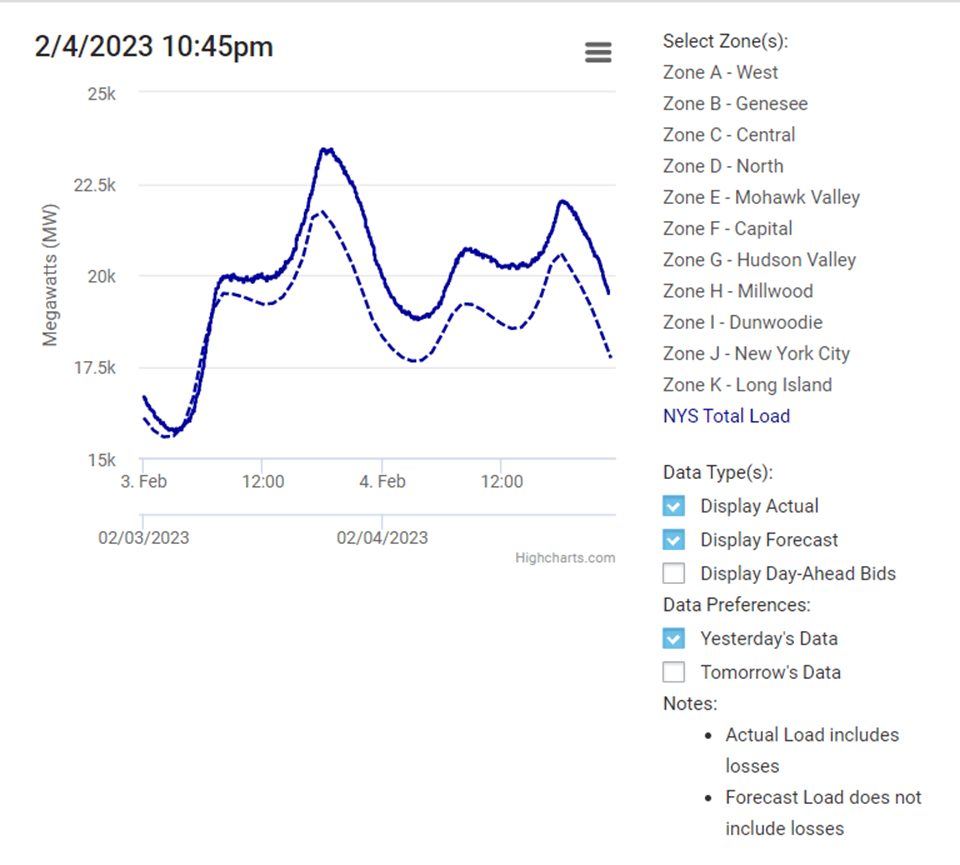
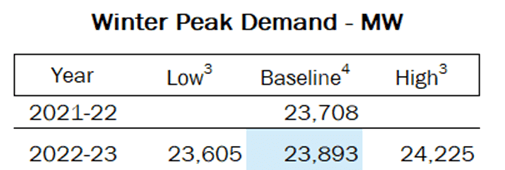
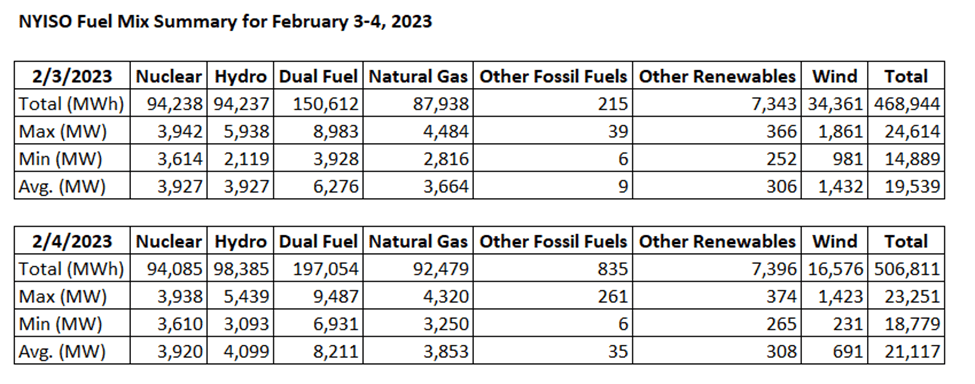
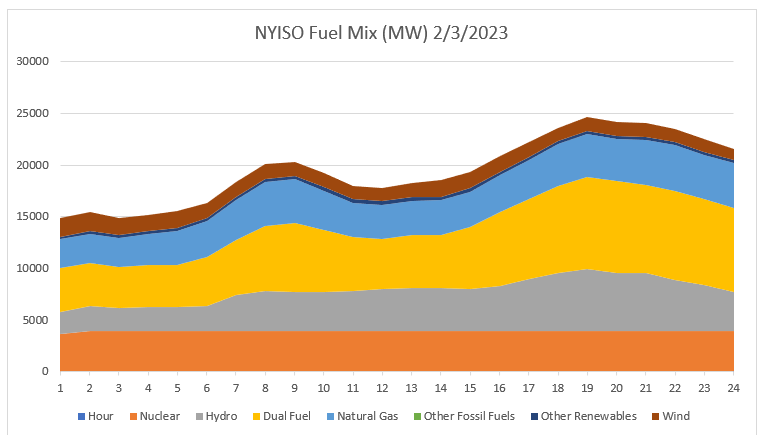
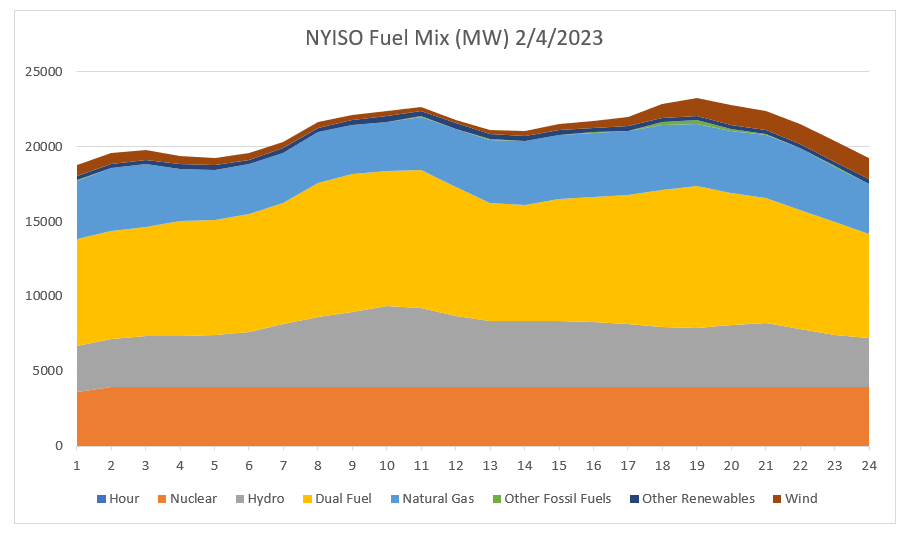
One of the difficulties associated with describing the challenge of the Climate Leadership & Community Protection Act (Climate Act) is that many of the concepts are difficult to describe to the general public. Tyler Duren writing at Zero Hedge published an article, The Renewable Intermittency Challenge, that did a good job introducing the challenges associated with intermittency. This post expands upon his article because I think he underestimates the difficulty of a solution.
I have been following the Climate Act since it was first proposed. I submitted comments on the Climate Act implementation plan and have written over 300 articles about New York’s net-zero transition because I believe the ambitions for a zero-emissions economy embodied in the Climate Act outstrip available renewable technology such that the net-zero transition will do more harm than good. The opinions expressed in this post do not reflect the position of any of my previous employers or any other company I have been associated with, these comments are mine alone.
Climate Act Background
The Climate Leadership & Community Protection Act (Climate Act) established a New York “Net Zero” target (85% reduction and 15% offset of emissions) by 2050 and an interim 2030 target of a 40% reduction by 2030. The Climate Action Council is responsible for preparing the Scoping Plan that outlines how to “achieve the State’s bold clean energy and climate agenda.” In brief, that plan is to electrify everything possible and power the electric gride with zero-emissions generating resources by 2040. The Integration Analysis prepared by the New York State Energy Research and Development Authority (NYSERDA) and its consultants quantifies the impact of the electrification strategies. That material was used to write a Draft Scoping Plan. After a year-long review the Scoping Plan recommendations were finalized at the end of 2022. In 2023 the Scoping Plan recommendations are supposed to be implemented through regulation and legislation.
Over many years New York electric planners have developed modeling procedures that project the resource adequacy necessary to maintain current reliability standards that keep the lights on when needed the most. The current reliability procedures were developed for generation resources that can be turned on, ramped up, ramped down, and turned off as needed, have well understood forced outage rates, and do not necessarily stop operating all at the same time. Wind and solar resources do not have any of those characteristics which makes future reliability planning much more difficult. This post looks at the problem of intermittency.
Intermittency Challenge
All quotations below are from the article The Renewable Intermittency Challenge. To be fair my criticisms of this work are based on the presumption that intermittency is a significant problem when the energy system is intended to get to a net-zero target. Author Tyler Duren introduces the challenge by giving an overview of the electric system:
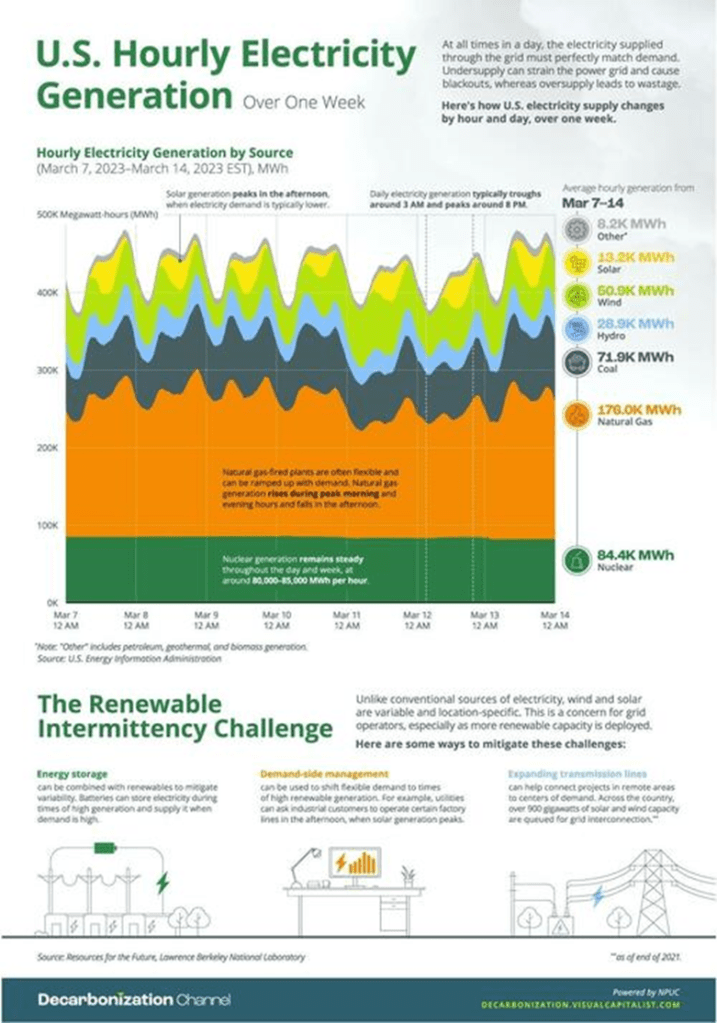
The U.S. has a dynamic electricity mix, with a range of energy sources generating electricity at different times of the day.
At all times, the amount of electricity generated must match demand in order to keep the power grid in balance, which leads to cyclical patterns in daily and weekly electricity generation.
It may difficult to read the summary of the renewable intermittency challenge in the previous figure. It says “Unlike conventional sources of electricity, wind and solar are variable and location-specific. This is a concern for grid operators, especially as more renewable capacity is deployed”. I agree with this description.
Duren goes on to explain that the electric load is met with three types of power plants. He describes daily load cycles and the use of these power plants. In my opinion, some peaking power plants are not normally used for daily load variations. Some of these units only are operated at times of high loads like an extended period of hot weather and high loads.
The Three Types of Power Plants
Before diving in, it’s important to distinguish between the three main types of power plants in the U.S. electricity mix:
Base load plants generally run at full or near-full capacity and are used to meet the base load or the minimum amount of electricity demanded at all times. These are typically coal-fired or nuclear power plants. If regionally available, geothermal and hydropower plants can also be used as baseload sources.
Peak load or peaking power plants are typically dispatchable and can be ramped up quickly during periods of high demand. These plants usually operate at maximum capacity only for a few hours a day and include gas-fired and pumped-storage hydropower plants.
Intermediate load plants are used during the transitory hours between base load and peak load demand. Intermittent renewable sources like wind and solar (without battery storage) are suitable for intermediate use, along with other sources.
This simplistic overview did not explain the difficulties facing a system that relies on intermittent wind and solar. In an article co-authored with Russel Schussler we explained some of the issues with peaking power when most of the energy is supplied by wind and solar.
Duren goes on to show how electricity generation meets load on an hourly basis.
Zooming In: The U.S. Hourly Electricity Mix
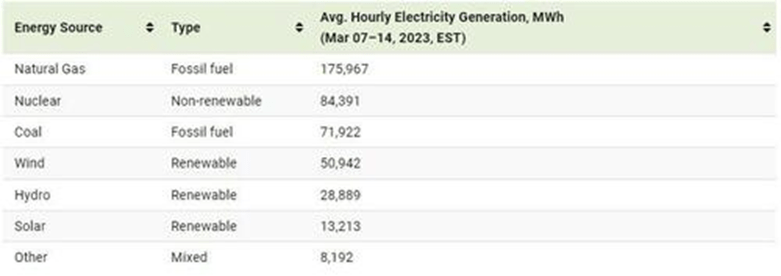
With that context, the table below provides an overview of average hourly electricity generation by source for the week of March 7–March 14, 2023, in the Eastern Time Zone.
It’s worth noting that while this is representative of a typical week of electricity generation, these patterns can change with seasons. For example, in the month of June, electricity demand usually peaks around 5 PM, when solar generation is still high, unlike in March.
Natural gas is the country’s largest source of electricity, with gas-fired plants generating an average of 176,000 MWh of electricity per hour throughout the week outlined above. The dispatchable nature of natural gas is evident in the chart, with gas-fired generation falling in the wee hours and rising during business hours.
Meanwhile, nuclear electricity generation remains steady throughout the given days and week, ranging between 80,000–85,000 MWh per hour. Nuclear plants are designed to operate for long durations (1.5 to 2 years) before refueling and require less maintenance, allowing them to provide reliable baseload energy.
On the other hand, wind and solar generation tend to see large fluctuations throughout the week. For example, during the week of March 07–14, wind generation ranged between 26,875 MWh and 77,185 MWh per hour, based on wind speeds. Solar generation had stronger extremes, often reaching zero or net-negative at night and rising to over 40,000 MWh in the afternoon.
Because wind and solar are often variable and location-specific, integrating them into the grid can pose challenges for grid operators, who rely on forecasts to keep electricity supply and demand in balance. So, what are some ways to solve these problems?
Duren suggests that these challenges can be solved. His suggestions will be the focus of the remainder of this post. Rafe Champion describes the issue of wind droughts that undermines the ability of these solutions to work in a system that relies heavily on wind and solar. If the renewables are only intended to augment the existing system much of the following discussion is appropriate. However, the only reason to install wind and solar is to mitigate climate change which requires a net-zero solution so I do not believe there is any reason to consider limited penetration of renewables.
Solving the Renewable Intermittency Challenge
As more renewable capacity is deployed, here are three ways to make the transition smoother.
Energy storage systems can be combined with renewables to mitigate variability. Batteries can store electricity during times of high generation (for example, in the afternoon for solar), and supply it during periods of peak demand.
Demand-side management can be used to shift flexible demand to times of high renewable generation. For instance, utilities can collaborate with their industrial customers to ensure that certain factory lines only run in the afternoon, when solar generation peaks.
Expanding transmission lines can help connect high-quality solar and wind resources in remote regions to centers of demand. In fact, as of the end of 2021, over 900 gigawatts of solar and wind capacity (notably more than the country’s current renewable capacity) were queued for grid interconnection.
Energy Storage
Duren makes a common mistake when describing the electric system. He only talks about average conditions. His description of energy storage systems only addresses daily variations: “Batteries can store electricity during times of high generation (for example, in the afternoon for solar), and supply it during periods of peak demand.” The bigger problem is that wind and, to a lesser extent, solar can also be subject to longer periods of reduced output that complicates energy storage requirements. In a net-zero electric system I believe that wind droughts are a fatal flaw because existing energy storage technology is too limited and too expensive.
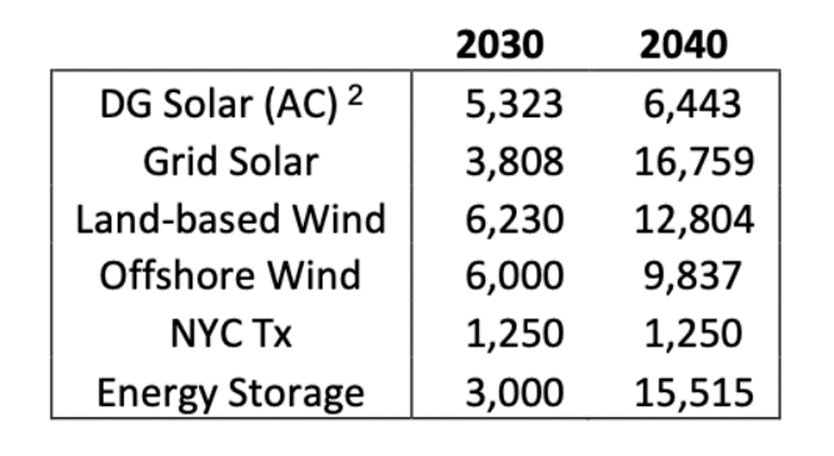
Francis Menton writing at the Manhattan Contrarian described work by Bill Ponton that addressed energy storage requirements for the Climate Act transition plan over longer time periods than a day. They evaluated “Initial Report on the New York Power Grid Study” which includes the following table of how much wind, solar and storage capacity needed to meet the net-zero transition targets of the Climate Act .
Menton describes the energy storage provisions:
But far more absurd is the provision in this Report for prospective energy storage. Note the numbers in the table above — 3 GW in 2030 and 15.5 GW in 2040. As usual they leave out the duration of the batteries. But Ponton wrote to the lead author of the Report from the Brattle Group, a guy named Hannes Pfeifenberger, to get the information. Result:
I asked one of the principal authors of the NY Power Grid study report, Hannes Pfeifenberger, how did he intend to balance fluctuations in wind power and he stated that the biggest factor was 17 GW of battery storage with a maximum duration of 6-hr, totaling 102 GWh. His response is surprising. I calculated that with wind power capacity of 84 GW, there was 59,851 GWH of wind energy curtailed and 48,071 GWH of gas turbine energy used. In theory, the curtailed wind energy could be stored and then subsequently discharged to substitute for the energy provided by the gas turbines, but would require energy storage of 12,000 GWH.
102 GWh versus 12,000 GWh. So, as usual with the studies we can find for places like New York and California, they’re off on the storage requirement by a factor of more than 100.
I have tried to make my own estimates of energy storage requirements and they are the same order of magnitude as described here. The main point is that Duren does not address this problem at all.
Demand-Side Management
Simplistic evaluations of net-zero transition programs also suggest that reducing load through programs like demand-side management can be a viable solution. There are two issues. The first is that net-zero programs refer to the entire economy and emission reductions from transportation and residential heating, hot water, and cooking, rely on electrification which necessarily increases load. This is a particular problem when loads are highest. Duren writes that “Demand-side management can be used to shift flexible demand to times of high renewable generation. For instance, utilities can collaborate with their industrial customers to ensure that certain factory lines only run in the afternoon, when solar generation peaks.” There is a limited amount of load shifting possible when temperatures are coldest, electric vehicle charging and battery capabilities are lowered, and everyone needs electricity to keep warm.
Expanding Transmission Capabilities
Another favorite solution of naïve energy analysts is predicated on the concept that the wind is always blowing somewhere. Duren writes: “Expanding transmission lines can help connect high-quality solar and wind resources in remote regions to centers of demand. In fact, as of the end of 2021, over 900 gigawatts of solar and wind capacity (notably more than the country’s current renewable capacity) were queued for grid interconnection.” In general that is true and that might work for a net-zero electric system on average. Unfortunately, the coldest and hottest weather, and thus the highest load, is strongly correlated with high pressure systems that also have the lowest wind resources.
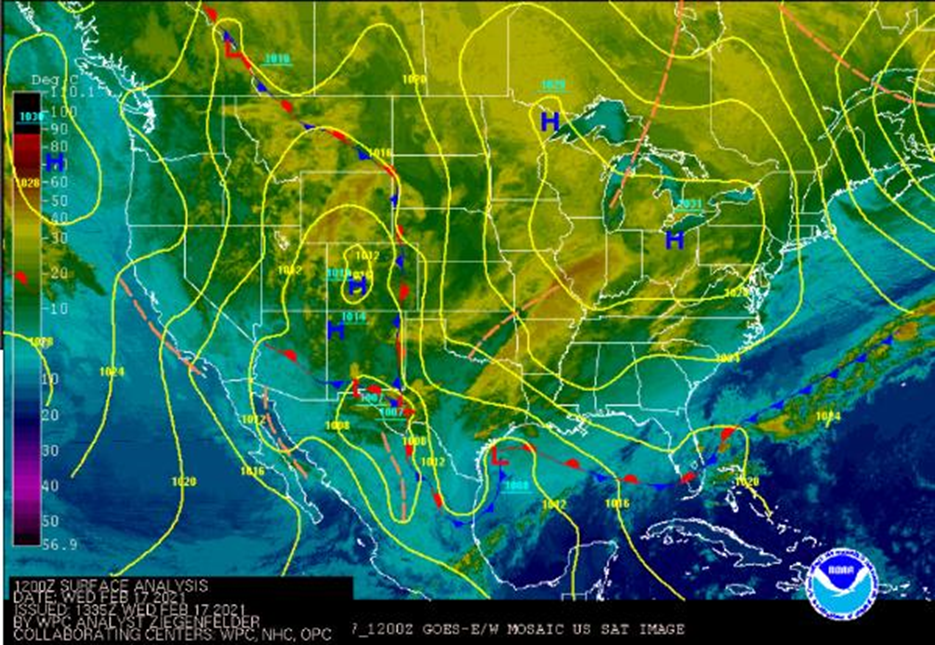
In a presentation describing my skeptical concerns about the Climate Act I addressed this problem in detail. In brief, consider the following weather map of February 17, 2021 during the period of the Great Texas Freeze. This event was associated with an intensely cold polar vortex huge high-pressure system. Remember that winds are higher when the isobars are close together. On this day there are light winds from New York to the southeast, west, and north including the proposed New York offshore wind development area. There are packed isobars in northeastern New England, in the western Great Plains, and central Gulf Coast where wind resources would be plentiful. For New York to guarantee wind energy availability from those locations, wind turbines and the transmission lines between New York and those locations would have to be dedicated for our use. Otherwise, jurisdictions in between would claim those resources for their own use during these high energy demand days. It is unreasonable to expect that this could possibly be an economic solution.
Conclusion
I liked the introduction of Duren’s article. He gives a good overview of the balancing act necessary to constantly match generating resources with the load. The graphics illustrate his points well too. He does not explicitly address net zero targets and that avoids addressing the problem that what works for today’s systems will not work when the system relies on intermittent renewables. In the context of a net-zero electric system that eliminates fossil-fired generation, I do not believe his conclusion that there are readily available solutions that address the intermittency challenge is correct.
If the future electric system has to rely on weather-dependent resources, then the question of worst-case availability has to be addressed. Analyses done to date in New York State have all shown that there are wind lulls in the winter that are difficult to address using existing energy storage technology. The Integration Analysis and the New York Independent System Operator Resource Outlook analyses of future resource requirements have both concluded that the solutions recommended by Duren are inadequate and a new dispatchable emissions-free resource (DEFR) must be developed to address the wind lull intermittency problem. The Resource Outlook notes “The lead time necessary for research, development, permitting, and construction of DEFR supply will require action well in advance of 2040 if state policy mandates under the CLCPA are to be achieved”.
In addition to the challenge of developing an entirely new resource, in order to determine the resource capabilities necessary for the worst-case, a comprehensive analysis of wind and solar resource availability is needed. If that analysis does not get the right resource availability, then there will not be enough energy available to supply everyone who needs it during the worst conditions. If either of these challenges is not met adequately, people will freeze to death in the dark.
A couple of recent articles caught my attention as very good summaries of the challenges of the Climate Leadership & Community Protection Act (Climate Act) transition plan to achieve net zero by 2050. I provide summaries with extensive quotes but I recommend readers take the time to go to the original articles and read the whole thing.
I have been following the Climate Act since it was first proposed. I submitted comments on the Climate Act implementation plan and written over 300 articles about New York’s net-zero transition because I believe the ambitions for a zero-emissions economy embodied in the Climate Act outstrip available renewable technology such that the net-zero transition will do more harm than good. The opinions expressed in this post do not reflect the position of any of my previous employers or any other company I have been associated with, these comments are mine alone.
Climate Act Background
The Climate Act established a New York “Net Zero” target (85% reduction and 15% offset of emissions) by 2050. The Climate Action Council is responsible for preparing the Scoping Plan that outlines how to “achieve the State’s bold clean energy and climate agenda.” In brief, that plan is to electrify everything possible and power the electric gride with zero-emissions generating resources by 2040. The Integration Analysis prepared by the New York State Energy Research and Development Authority (NYSERDA) and its consultants quantifies the impact of the electrification strategies. That material was used to write a Draft Scoping Plan. After a year-long review the Scoping Plan recommendations were finalized at the end of 2022. In 2023 the Scoping Plan recommendations are supposed to be implemented through regulation and legislation.
The New York official Climate Act webpage describes the Scoping Plan as the “framework for how New York will reduce greenhouse gas emissions and achieve net-zero emissions, increase renewable energy use, and ensure all communities equitably benefit in the clean energy transition”. It has also been aptly described as “a true masterpiece in how to hide what is important under an avalanche of words designed to make people never want to read it”. Importantly, the basis of the document, the Integration Analysis, does not provide enough detail to determine if the conglomeration of control strategies that they have cobbled together will actually work together as proposed in general, and, in particular, on the arbitrary schedule mandated by the Climate Act.
New York GHG emissions are less than one half of one percent of global emissions and global emissions have been increasing on average by more than one half of one percent per year since 1990. This does not mean that New York State should not do something, but it certainly eviscerates any claims that we do not have time to fully evaluate what has been recommended in the Scoping Plan framework.
Francis Menton writing at the Manhattan Contrarian and Arnold Wallenstein writing at Utility Dive both argue that there are fundamental flaws in the transition plan that will add costs and reduce reliability. However, in the land of Albany politics the disconnect between aspirations and reality is not apparent.
Samar Khurshid writing at the Gotham Gazette wrote a good overview of the current status of the 2023 implementation push entitled Major Climate and Energy Policies Being Decided in Albany State Budget Negotiations. He quoted Senator Pete Harckham, a Westchester Democrat who chairs the Senate’s Committee on Environmental Conservation, as saying:
“Consumers are eventually going to be paying less on their utility bills, because energy will be less expensive,” he added. “We’ll lower our health care costs and we’ll be creating 130,000 high-paying union jobs. So there are a lot of upsides to this as we go forward.”
The idea that utility bills will go down is so incredibly out of touch that I can only attribute that belief as religious dogma. The only way someone can believe that is if they do not understand the difference between power and energy. In brief, you pay for energy so the comparison metric should be energy produced by wind and solar. It does not matter if wind and solar provide cheaper power than a fossil plant. Because those resources are intermittent it is necessary to backup them up when the wind is not blowing and the sun is not shining. When the costs to provide reliable energy are included New York will find, just like every other jurisdiction that has attempted this transition, that the costs are enormous. Enough from me the rest of the post summarizes the opinions of two others who share my view.
Menton on the Climate Act Transition Plan
Francis Menton is a retired attorney and author of the Manhattan Contrarian blog where over the he has published well over 1000 articles on issues of public policy. Close to one-third of the posts at Manhattan Contrarian deal with the subject of climate change broadly defined, including such topics as the application of the formal scientific method to what passes for climate “science” in today’s academia, and evaluation of the potential costs and practical difficulties of attempting to replace our current energy systems with intermittent wind and solar electricity generation. He is a board member and current President of the American Friends of the Global Warming Policy Foundation.
In his article, New York Goes Full Central Planning For The Electricity Sector, Menton writes that the only option considered in the Climate Act transition is full speed ahead. There hasn’t been a feasibility study or consideration of a demonstration project so there is no clue whether this will work or not. In his article he reviews a document that supposedly gives more detail as to how New York is going to accomplish the net zero transition.
Let me start with a few thoughts on the Con Edison Report. It is lots of verbiage and plenty of charts and graphs. And it is more or less exactly what you would expect if you think for say, one minute, about what position Con Edison might take. As a deeply regulated entity, they are completely required to affirm the directives and applaud the wisdom of their government overlords. But more than that, they are clearly salivating over the prospect of getting to make billions of dollars of new investments, all of which will earn a guaranteed, regulated rate of return for their investors — and if we are really, really lucky, the end result will be that we get the exact same electricity for much higher cost. If we aren’t so lucky, we will get much less reliable electricity for the much higher cost. The cost factor is played down throughout the Report, and we never get any meaningful quantification.
But all the verbiage and charts and graphs mainly have the purpose of obscuring the fact that Con Ed does not take responsibility for making sure that there is enough electricity availability to supply customer demand on the grid. That’s somebody else’s job.
To set the tone, here is a quote from page 1:
[W]e are committed to being the next-generation, clean energy company that our customers deserve and expect. We will play a critical role in delivering on the ambitious climate and clean energy goals set by New York State and New York City, including reaching net-zero greenhouse gas (GHG) emissions by 2050. In addition, the need for safe, reliable, and secure energy infrastructure remains paramount.
OK, where in there did you say that you take responsibility for there being enough electricity to meet demand?
Cost barely gets mentioned in the introductory section. It finally turns up in the last paragraph.
Here’s how they spin it:
We recognize this transition to a net-zero GHG emissions energy system will require significant investment. We seek to make investments that achieve the goals of this transition as cost- effectively as possible, which necessitates growing our electric system while maintaining our gas and steam systems to achieve clean energy goals.
In other words, whoo-boy is there a lot of money for us to make here!
He goes on to discuss that Con Ed does not take responsibility to build the things necessary they only offer support for “interconnection” and “balance.” Then he addresses energy storage and note that Con Ed does not make the proper delineation between power and energy.
And how about the trillions of dollars worth of energy storage that will be needed when the sun doesn’t shine and the wind doesn’t blow? See if you can decode this word salad:
“We have developed plans to build the necessary electric transmission and distribution infrastructure by 2050 to . . . [d]evelop and facilitate up to 12.6 GW of energy storage through direct utility investments and customer programs at customer and utility scales.”
Where even to start? “12.6 GW” of storage? They don’t even know the correct units to discuss this issue. If these are four-hour duration lithium ion batteries (unspecified, but what else could they be talking about?), that will give you 50.4 GWh of storage — enough to cover New York State for a couple of hours at most of low sun and wind. Competent calculations indicate a storage requirement of more like 20 to 30 days of storage to deal with the seasonality of the sun and wind. So this is at best a small fraction of one percent of what will be needed to back up the solar/wind grid of the future.
But what does Con Ed care? They’re not actually saying here that they are taking responsibility for making the new system work, let alone even providing the batteries themselves. They’re only saying that they have “developed plans” to “facilitate” the storage, which could occur either through “utility investments” or “customer programs.” In other words, I guess, hey sucker, use your electric car battery to power the house when the grid goes down.
Arnold Wallenstein on the Climate Act Transition Plan
Arnold R. Wallenstein is a Boston-based attorney who represents independent power producers in New York and other states and is the principal member of the EnergyLawGroup.org. Wallenstein explains in New York’s plan for transforming its electricity generation will reduce reliability at extreme cost that there are obstacles to meeting the ambitious schedule of the Climate Act net-zero transition. He explains why he thinks the transition plan is doomed to failure:
The Climate Action Council projects current electric load in New York to triple by 2040 due to the electrification of transportation and 100% building electrification. By 2040, when all electricity generation must be zero emissions, NYISO, the independent New York grid operator, states that at least 95 GW of new generation must be developed to make up for generation plant retirements and increased electrical demand. This goal is unrealistic and unachievable because the state only added 12.9 GW over the last 23 years, and it is highly unlikely that 95 GW of new generation capacity will be added in 17 years due to state permitting and grid interconnection delays.
The Climate Action Council’s final Scoping Plan also reveals that New York will need 15 GW to 45 GW of new “zero emission dispatchable electric generation” by 2040 to meet increased electric demand and maintain electric system reliability. This is emission-free electric generation that can be dispatched, i.e., turned on, by NYISO at night or stormy conditions when there is no solar radiation or during calm wind conditions. But the Scoping Plan also admits that this 15 GW – 45 GW target “cannot be currently met” with existing technologies.
This dire prediction is confirmed by NYISO, which has issued reports stating that the New York grid may experience as much as a 10% deficiency, and possibly more, in generation capacity by 2040, and will require 32 GW of new zero-emission dispatchable generation by 2040 — which would almost double the current New York grid’s 37 GW generation capacity. NYISO also warns that such zero-emission dispatchable generation technologies “are not commercially available.” Electricity shortages will occur if these new emission-free generation plants do not materialize in time as hoped for by the state. Hope is not an action plan to solve electric reliability deficits.
Electric power deficiency is already starting to occur. A report just issued on April 14 by NYISO points out that New York City and the Lower Hudson Valley may have electric reliability problems and generation shortages starting in 2025 due to generation plant retirements caused by the New York Department of Environmental Conservation shutdown of NOx producing peaker plants and if there are extreme weather events, worsening through 2032, where there may a 600 MW generation deficiency in New York City and environs.
The Climate Action Council’s climate plan — if fully implemented by the state as is currently being debated in the legislature — risks placing New York in an electricity shortage that could result in blackouts and brownouts. The New York grid operator pointed out that if existing gas-fired electric generation is shut before new resources come on line, there is a risk that NYISO will not be able to provide a reliable electric system.
NYISO also said fossil fuel generators — natural gas and oil-fired — will be needed to maintain reliability until non-emitting dispatchable resources can effectively replace the fossil-fired generation plants to provide grid reliability as a back up to intermittent, weather-dependent renewable energy resources. NYISO also predicts than in 2040 when fossil-fueled generators are shut down by state’s climate law, zero-emissions dispatchable generation, which doesn’t yet exist, will still be required to supply 10% or more of New York’s electricity, depending on how many megawatts of new renewable and “dispatchable” emission-free generation is actually operational by 2040.
These warnings of future electric deficiencies are echoed by the New York State Electric Reliability Council and the North American Electric Reliability Corp., the entities tasked with monitoring electric reliability in New York as well as the U.S.
Blackouts during cold winter months can cost lives. When Texas experienced an unprecedented freeze in 2021 between 246 (direct) and 700 (indirect) people died because of power outages. Similarly, many people died in Buffalo’s Christmas 2022 blizzard. That cannot be allowed to happen in New York because of a poorly designed climate plan.
If that wasn’t enough, the cost to implement New York’s climate plan may be stratospheric: authoritative commentators, including the Empire Center for Public Policy, have suggested New York taxpayers and ratepayers will pay $340 billion to $500 billion to transition the New York electric system to primarily relying on solar and wind power supplemented by battery storage.
But no overall cost analysis was provided by the State’s Climate Action Council.
Gavin Donohue, CEO of the Independent Power Producers of New York, refused to vote for the climate plan, and said it would take pure “magic” to make the plan work.
And how much will this costly plan contribute to reduction of greenhouse gases: only 0.4% of global GHG emissions according to recent commentators.
A reliable supply of electricity that can be generated at all times during cold nights and low wind conditions is absolutely essential to our modern economy and our standard of living. The state’s climate plan’s proposed radical changes to the New York electricity generation sector should not be fully implemented by the state until it can guarantee that there will be adequate generation at all times. This means keeping in service some natural gas-fired generation which can quickly ramp up when solar and wind plants are not operating. NYISO warns that with even with increased renewable energy generation by 2040, “at least 17,000 MW of existing fossil generation must be retained to reliably serve forecasted demand.”
Conclusion
The difference between these articles that clearly are based in reality and Harckham’s statement that “Consumers are eventually going to be paying less on their utility bills, because energy will be less expensive” could not be starker. The innumeracy of anyone who thinks that intermittent wind and solar power can ever be cheaper is astounding because the numbers are so straight-forward. It must be that they simply don’t want to hear anything that runs contrary to their cherished narrative. At what point will they concede the risks of this insane policy.
Both authors echo my concerns about the lack of adequate feasibility planning to maintain current reliability standards and the absence of a complete accounting of the costs. This blog is dedicated to the idea that environmental regulation should concentrate on tradeoffs and consideration of all the impacts. Both authors argue that this pragmatic approach is not a characteristic of the Climate Act transition. I agree with Wallenstein that “the New York Climate Action Council’s climate plan, if carried out as intended, will probably not be able to supply New York state with a reliable supply of electricity. And it will cost New York taxpayers and utility customers (i.e., everyone) hundreds of billions of dollars to create a less reliable electric system than New York now enjoys.”
This is a guest post by Mark Stevens, a regular reader at this blog. Mark is a retired science and technology teacher from Long Island. He has put together a good overview of issues associated with Long Island wind power.
The stampede to build offshore wind turbines to replace fossil fuel generation is loaded with concerns that have not been thought through or been resolved.
1- There is no climate crisis: thousands of scientists and meteorologists around the world have published studies that LOCAL extreme events are caused by cyclical weather (decades, centuries, millennia): solar activity, ocean cycles, cosmic ray intensity, volcanic activity (surface and undersea), orbital cycles and planetary cycles to name some. CO2 is NOT causing global warming. In fact, its role is trivial and it is enabling record plant, forest, and crop production. Sea level rise is often due to land subsidence (sinking). There is record polar ice, polar bears are flourishing, and the earth has cooled over the last decade. Coral reefs are fine and Pacific Islands are increasing in area. United Nations Intergovernmental Panel on Climate Change (IPCC) doom and gloom reports have been crying for decades that the end of the planet is here; the reports use faulty input data, have extreme projections divorced from reality, and are written by people with political and career agenda.
2- The call to close reliable, cost-effective fossil and nuclear power plants will lead to blackouts and higher costs. In 2021 New York onshore wind nameplate capacity output was 22% and utility-scale solar nameplate capacity was 18%. Although the Scoping Plan claims higher values in the future, the sun does not always shine and the wind does not always blow. The wind turbines need 10 times more steel, concrete and rare earths (foreign sourced) than conventional power. Mining and refining the massive amounts of copper, aluminum, rare earths and steel disrupts the environment and emits many times more CO2 than the manufacture of conventional generation. They shut down in weather extremes (Texas and N. Carolina) and have a significantly shorter life in the harsh marine environment. End-of-life disposal of giant turbine blades is expensive and difficult.
3- Thousands of miles of redundant new transmission cables and towers must be built (increasing pollution emissions) and billions spent in backup battery power when the unreliables (renewable wind and solar) fail. Several battery storage facilities have ignited in unquenchable, toxic fires. Fossil plants must be constantly running anyway for spinning reserves when unreliable wind and solar fail. Starting and stopping loads increases emissions in the fossil-fueled generators.
4- The recent mass deaths of whales and dolphins from New England to Mid-Atlantic is directly correlated with offshore wind site surveys. Seismic surveys, machine gun sonar, pile driving, blasting and other construction sounds are greatly amplified and transmitted underwater to mammals like whales and dolphins. They become deaf, have nervous system infections, and get disoriented which facilitate beaching and ship collisions. Even if it turns out that the mapping activities are not the cause, construction activities are different and there are no plans to evaluate those concerns before construction begins.
5- The massive turbines create subsonic sounds which are vastly amplified via underwater transmission and injure whales’ and dolphins’ hearing.
6- The huge turbine blades kill thousands of sea and land birds, including Bald Eagles and bats each year.
7- The turbine blades weighing hundreds of tons, are not recyclable and pose a massive disposal problem.
8- Wind and solar require hundreds of times more seabed and land area than the equivalent fossil generation. This area is forever damaged for natural purposes.
9- Europe and the UK, especially Germany, have embraced wind and solar for years. The power delivery has been so poor that they are reopening many coal power plants. The price of electricity has increased 600% rendering Europe’s industry non-competitive and many factories have shuttered.
10- If unreliables (wind and solar power) were so good, they would not need hundreds of billions of taxpayer subsidy dollars shoved into foreign and domestic companies.
11- With Russia, China, India and other countries opening hundreds of fossil fuel and nuclear plants, a zero-emission New York State will have NO measurable effect on global pollution.
12- The Governor’s plan to electrify heating, cooking and vehicles in New York will require quantities of electricity and backup storage that will be impossible to obtain and afford. Europe has tried it resulting in electricity costs so high and unreliable that businesses and manufacturing have closed and many must choose between heating and buying food. Before our leaders see the disaster, they caused, we can only work toward reversing this coming disaster.
13- Fossil and nuclear power plants must remain open and running (spinning reserves) to plug the frequent gaps in solar and wind generation. There is little or no emissions reduction and rates shoot up to pay for both systems of generation.
14- The Unreliables (wind and solar) industry, foreign and domestic, have spent millions lobbying for these projects. Gore, Kerry, Bloomberg and others have made billions trading carbon credits and investing in “green” companies. Foreign and domestic wind and solar companies are making a windfall in government taxpayer subsidies. They will get rich while we burn candles.
The plan for New York’s Climate Leadership & Community Protection Act (Climate Act) net zero transition is to electrify everything possible using wind and solar generating resources. My primary concern is the reliability risks associated with the transition of the electric grid that took decades to develop based on dispatchable generating resources to one that depends upon intermittent and diffuse wind and solar by 2040. This blog post highlights articles that reinforce my fear that the reliability of any electric grid that relies on wind and solar is fatally flawed.
I submitted comments on the Climate Act implementation plan and have written over 300 articles about New York’s net-zero transition because I believe the ambitions for a zero-emissions economy embodied in the Climate Act outstrip available renewable technology such that the net-zero transition will do more harm than good. The opinions expressed in this post do not reflect the position of any of my previous employers or any other company I have been associated with, these comments are mine alone.
Climate Act Background
The Climate Act established a New York “Net Zero” target (85% reduction and 15% offset of emissions) by 2050. The Climate Action Council is responsible for preparing the Scoping Plan that outlines how to “achieve the State’s bold clean energy and climate agenda.” In brief, that plan is to electrify everything possible and power the electric gride with zero-emissions generating resources by 2040. The Integration Analysis prepared by the New York State Energy Research and Development Authority (NYSERDA) and its consultants quantifies the impact of the electrification strategies. That material was used to write a Draft Scoping Plan. After a year-long review the Scoping Plan recommendations were finalized at the end of 2022. In 2023 the Scoping Plan recommendations are supposed to be implemented through regulation and legislation.
Australian Renewables Integration
Chris Morris – a semi-retired power station engineer from New Zealand, and Russ Schussler – an electrical System Planning Engineer, have written a series of three articles about the unfolding disaster in Australia as they implement a net-zero electric grid.
The first article explains what they are doing in Australia and what is happening to their electric grid. Although there are significant differences between the Australian electric system and the North American system, there are proposals that will reduce those differences. In particular, the Biden Administration plan to eliminate fossil fuels as a form of energy generation in the U.S. by 2035 with targets of 80% renewable energy generation by 2030 and 100% carbon-free electricity five years later, will inevitably lead to the same problems already observed.
The authors explain that:
Wind and solar, the unreliables, are now a significant part of the current NEM generation but the backbone is still coal – over 60% of the energy. Wind is less than 15% and grid solar 5%.
They note that “There is also the significant presence of domestic PV”. Importantly. they found that: “even at those levels, the intermittency and unpredictability has had major detrimental impacts on power stability.” In particular, they state:
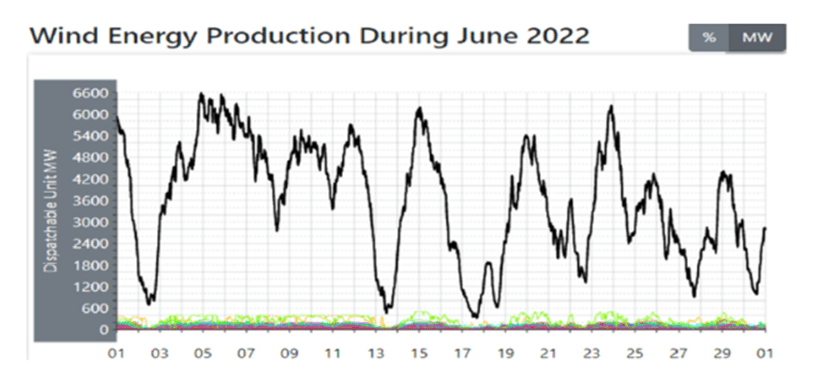
Management of the grid on a day-to-day basis depends on reliable generation and dispatchability. The renewables offer neither. For wind, there is often the mantra that the wind is blowing somewhere. The actual data does not back that up. A skeptic has for a number of years compiled the daily wind generation on the NEM. The results are revealing. The graph shown below is for just one month, June 2022. There is a synchronicity in the output of all the windfarms. To cope with the drop in those declines from wind, that is a lot of power that needs to be quickly ramped up. If the wind isn’t blowing and it is night-time, where will the energy to make up the dip come from? The mainstay 400MW+ coal units that form the background of the energy supply can take three days to get to full load if cold.
I maintain that current wind, solar, and energy storage technology is inadequate to support an electric system that can maintain current standards of reliability. The second article describes some of the innovations that are being tried in the Australian transition and note that they hype about “success” does not match reality. Both authors are engineers and describe some issues associated with the required new technologies. For example, there is a tendency to dismiss identified problems because there is a project or work by academics that claims industry changing innovations are just around the corner. They show that these “claims are often overblown or misunderstood”.
Advocates make claims about the penetration of wind and solar resources in components of the grid without admitting that the numbers they cite are only possible because of support from outside the component traditional generating resources. One major problem with wind and solar is that fossil-fired, nuclear, and hydro generating units produce electricity by spinning turbines that are synchronized to run at 3600 revolutions per minute. That inherent characteristic provides necessary support to the transmission system. Wind and solar generators are asynchronous and do not provide that service. The authors explain the ramifications:
Not too long ago many pointed towards Germany as showing how a grid could accommodate high levels of renewables. This was a very misleading picture. The physics of the grid do not care who owns what. Synchronous resources from a neighbor’s generators provide support across the European grid, despite differences in language and nationality. Electricity flows quickly, approaching the speed of light, over every potential path to support all parts of the system regardless of who owns what. The German component is supported by conventional generation from neighboring systems including coal resources in Poland.
The article goes on to evaluate specific claims about the South Australian component of the grid related to synchronous power. It turns out that in South Australia they have installed “synchronous condensers to maintain the grid without their synchronous gas generating units”. When anyone claims that wind and solar are cheaper than natural gas units, they are not incorporating the cost of some technology like synchronous condensers necessary to keep the lights on.
Schussler has previously explained that there are two major problem areas with the net zero transition: getting energy from renewables instead of fossil fuels and having the grid work with intermittent asynchronous renewable resources. Clearly if we are to have a working system it is necessary to address them together. As it stands now the emphasis in Australia and New York for that matter, has been on the first problem. The authors note “It is mind-boggling that an entity committed to an energy transition would seek to maximize efforts in regard to changing energy resources while hoping a miracle will occur allowing that energy to be delivered in an economic and reliable manner.” They go on to say (their emphasis included):
It is simple to take out coal, if you don’t care what happens next. It is going to be incredibly difficult, if at all possible, to enable the replacement. Significant roles will be demanded from all resources but that may not be enough. A lot of attention needs to be paid when baseload generation comes off, and a lot of challenges without practical solutions will likely emerge. A lot of needed things needed don’t exist yet and may not ever exist. The energy system may be unrecognizable, maybe because it will no longer resembles an economic and reliable power system.
The third article discusses other ancillary services that are necessary to keep the electric system operating reliably and then goes on to see how the grid is being impacted by increasing levels of wind and solar resource deployment. I am not going to describe their concerns about reactive power, frequency control, & inertia, reserves, load shedding, system functions during frequency excursions except to note that all these issues were ignored in the Scoping Plan. If you are interested in reliability issues, I recommend the article. The authors conclude:
The above is a simplified explanation of what is needed for reliable grid operation. Proponents of renewable energy do not want to discuss concerns of this sort, particularly the costs involved. When forced to address these issues, they rely on magical thinking, advocating for technologies that either do not yet exist or have not yet been proven to work reliably on a grid. The known solutions are expensive, but the renewable sector doesn’t want to pay for them – their mantra remains that renewables are cheaper than fossil fuels so the others should pay for them – hiding the expense. Add in the costs from the needed system support requirements described above, then renewables are significantly more expensive (and less reliable) than conventional generation. The extra costs of renewables support are being paid for a deteriorating quality of electricity supply. That is why there is a new industry adage – Cheap renewables are very expensive.
Futility of Wind Power
Francis Menton writing at the Manhattan Contrarian describes a new report by Bill Ponton that explores the effects and costs of continuing increases in generation of electricity from wind titled “The Cost of Increasing UK Wind Power Capacity: A Reality Check.” . This analysis addresses what I call the ultimate problem of an electric grid relying on wind and solar. The variability of those two resources is so great that there are huge issues trying to plan and develop the resources needed for periods when both resources are weak or nonexistent.
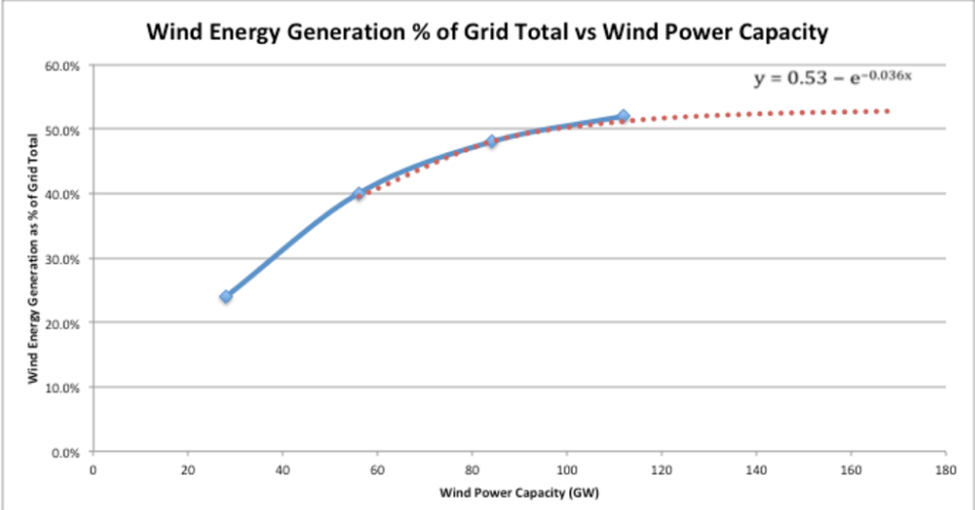
Ponton examines the relationship between energy generation and power capacity for wind resources. This is the same issue mentioned in the first article described above. In particular, advocates claim that all that needs to be done is to have the political will to build enough renewable generation capacity. What they don’t consider is just how much would be needed. In Ponton’s analysis he increases the wind generation capacity for every hour in a record of generation and load for 2022. He finds that because the wind lulls cover so many facilities that doubling the generation capacity does not double the percent of UK electricity from wind from 24% to 48%, but only to 40%. He then goes on to triple and quadruple the wind resource capacity to produce the following graph:
Note that the percent of generation from wind approaches a limit asymptotically. The percentage of electricity generated from wind deployment in any scenario still experience rapidly slowing increases as more wind capacity is added, and will approach a limit asymptotically. Menton points out that “This means that each incremental addition of wind generation capacity produces electricity that is more and more costly, with the costs accelerating rapidly after the tripling of existing capacity.” Menton promises that he will follow up with more results from the Ponton report so stay tuned.
Conclusion
All of these articles raise significant reliability concerns that were ignored in the Scoping Plan. Morris and Schussler believe it is “most likely that costs will increase significantly and reliability will degrade considerably” even if Australians do a great job of implementing all the planned changes. I agree with their conclusion that “Higher energy costs will hurt their consumers and industry while moving manufacturing and industry away from Australia to areas with cheaper (fossil fuel based) energy. The end result may cause far greater environmental harm.” If New York fails to heed these warning the result will be the same.
Richard Ellenbogen frequently copies me on emails that address various issues associated with New York’s Climate Leadership and Community Protection Act (Climate Act). I asked his permission to present his analysis explaining why New York’s building decarbonization push it is going to fail, just as Germany’s has, and will drive up state GHG emissions and raise utility costs for decades. He has consolidated all of his material on this topic in one document and has included recommendations for an alternative approach.
I have published other articles by Ellenbogen because he truly cares about the environment and the environmental performance record of his business shows that he is walking the walk. Ellenbogen is the President of Allied Converters that manufactures food packaging. His facility is about 55,000 square feet and does a lot of manufacturing with heat to seal the bags, all electrically driven. The facility has solar panels and uses co-generation. He explains:
In 2008, the average energy cost per square foot for a commercial facility in Westchester was $1.80. We were at 16% of that 12 years later and even with the increases, we are at 62% of that 14 years later. That has been done while having a carbon footprint 30% – 40% lower than the utility system. The $1.80 per foot also included commercial office space and our operation is far more energy intensive than an office. We use energy extremely efficiently and as a result, our bills are much lower than everyone else.
Ellenbogen on Building Decarbonization
While it is being proposed with good intentions, NY State’s building decarbonization push is going to fail, just as Germany’s has, and will drive up state GHG emissions and raise utility costs for decades. The analysis to justify that conclusion follows. While there is new material included, a portion is a synopsis of prior emails but as NY State gets closer to committing energy suicide, I felt obligated to put it all in one document. As it is written, the state’s energy plan is going to be the fossil fuel company’s best friend. NY State is adopting a “Chicken Little” approach to energy policy. It is so focused on the acorn of fossil fuels and a belief that the sky is falling that it is ignoring science in the process. As a result, the state will fall victim to the fox of energy failures, high GHG emissions, and incredibly high utility rates that are going to eat NY State citizens and businesses. For those who declare that NY State must exhibit “Climate Leadership”, this policy isn’t that. It is copying a failed policy from Germany. For those not interested in the minutiae of the reasoning, the figure headlines and the final recommendations will give an accurate picture of the problems.
There is a way to get about a 44% GHG reduction in NY State while also having enough generation to support the system without imposing extremely high costs on the state’s residents and businesses. It can be implemented in one-quarter the time of the state’s current plan using a combination of improved fossil fuel plants and renewables, while replacing old gas equipment with newer gas equipment that won’t require an entire rewiring of NY State.
In lieu of doing something that will actually work, the state’s plan will face the following issues:
1 – Cost – Trillions of Dollars
First of all, the cost of the project will not be anywhere near as inexpensive as the $200 billion figure that is being thrown around. Going through all of the figures, it will be at least $600 billion for the electrification portion, before adding storage and renewable generation to the totals. For anyone that doubts that, the cost of a single 400 mile cable from Quebec to NY City has now risen to $6 billion and try to name a single infrastructure project in NY State that has come in on budget. The Champlain Hudson Power Express Cable was projected to cost $2 billion in 2013. That cost is now up to $6 billion, a 232% increase in inflation adjusted dollars. Does anyone seriously believe that the entire state can be rewired for less than 100 times that cost? If you add in storage costs at the present cost of Lithium Ion Batteries, the cost rises to approximately $4 trillion plus the cost of the renewable generation. Even if you could get a 75% reduction in storage costs using a different technology, the total cost will be well over $1.5 trillion and much of that will depend on the usable life of the new storage. At present, battery storage only lasts 10 years. Pumped Storage would likely be much more cost effective but where in NY State can a utility site a large reservoir. Also, based upon Con Ed’s experience with Storm King Mountain between 1960 and 1980, no utility will even try to build a pumped storage facility.
2 – Logistics – Size of Project and Lack of Labor will result in it requiring Over 60 Years – Policy is going to create situations where the mandates cannot be fulfilled
There are 112,000 miles of roads in NY State. Of those, about 22,000 miles are major highways and likely don’t have electric distribution lines on them, leaving about 90,000 miles of distribution lines that were designed and sized for an era where onsite heating was delivered from fossil fuels or wood. The vast majority of the transformers and conductors will not handle a tripling of the electric load during the during the winter. If you eliminate 18,000 miles (20%) for areas upstate that are already using electric heat, that leaves 72,000 miles of distribution network to be rewired. 8,000 of those miles are in NY City where a substantial portion of the infrastructure is buried and the costs will be higher still.
When I did the utility project with Con Ed back in 2010 where we demonstrated that we could reduce transmission loads and line losses using reactive power correction on the local distribution system, I added power monitoring devices to four transformers. On hot days during the summer, three of the four transformers where the project was executed were operating at or near their capacity on a hot summer day. If heat pumps are added to the system, the winter time load on a cold day will be substantially higher than the summer time load on a hot day. That is not my speculation. The NYISO has determined that NY State will need an additional 25 Gigawatts of generation to support heat pumps in NY State. during the winter. Winter peaks are expected to exceed summer peaks starting in the early 2030’s.
As a result, a substantial portion of that 90,000 miles will need to be rewired to support onsite electrification. Using an existing project in California as a reference, PG&E has been required to bury 10,000 miles of high voltage transmission lines in the fire prone areas. In 2022, they replaced 71 miles of cable. By 2025, they expect to increase that to a rate of 1200 miles per year. That doesn’t include replacing transformers or services to people’s homes which would be required to electrify onsite heating. Even larger conductors will have to be added in rural areas of NY State where they expect to interconnect large solar arrays so that the projects don’t keep getting canceled because of interconnection costs. While replacing overhead lines would take less time than burying them, replacing old equipment with higher capacity equipment for the larger heating loads and the additional time needed to increase the service sizes into people’s homes would about offset the time difference.
At 1200 miles per year, rewiring 72,000 miles of distribution lines in NY state will take 60 years to upgrade. They have been burying larger electric and gas services in New Rochelle to support the extra 9,000 units of housing that they are building here and the roads have been like a slalom course for about 4 years to fix about 10 miles of services so the 60 years is not an unrealistic estimate. NY City may take even longer to rewire and that is 40% of the state’s population. What is going to happen to the people that cannot replace their gas equipment in areas where the service has not been upgraded to support the higher electric loads imposed on the system by NY State policy ?
3 – Bad Science Is Driving Initiatives – Results Will be Far worse than Estimated and It will add Enormous Costs On the Backs of the State’s Citizens
I have read extensively about the PAF (Population Attributable Fraction) technique that was used as the analytical tool to do the analysis for the recent paper about gas stoves and childhood asthma. A slide from an upcoming PowerPoint that I will be presenting is below. The caption at the bottom of the slide was copied from the introduction of a paper discussing PAF by people that developed an improvement to PAF. However, the improved version needs very specific data directed at the variables involved, and not 30 – 40 year old data that was not asking the necessary questions from a time when the focus on health issues was very different. Every PAF study with multiple variables warns of bias in the study and questionable results, whether it is from sugar intake and type 2 diabetes to comorbidities and Covid. Asthma falls into the multiple variable category. Risk factors can include tree pollen, second hand smoke, proximity to large emission sources such as factories or power plants, pet dander, vehicle exhaust, nutrition, and yes, even gas stoves, among others. But unless all of the data on the other variables was collected in the survey, PAF will return garbage, even in the updated format proposed by the authors of the PAF improvement. Thus, the conclusions of the gas stove report have no validity.
Another issue never explained by the authors of the gas stove study is why the top ten states for cases of asthma in the US are all 80% electric stoves and the top eight states for childhood asthma are 80% electric stoves. If gas stoves were that large of a factor, at least one of the five states that is primarily gas stoves would appear higher on those lists. The conclusions of the study could possibly be correct, but no one could be sure because the study was so poorly conceived, conducted, and analyzed. It certainly should not be used as the basis for a public policy affecting 19.5 million people that is going to add an additional $72 billion in costs onto the backs of the state’s utility customers. Results that will be at least 95% – 98% as effective can be obtained at a fraction of that cost using other techniques.
4 – Existing Transmission and Distribution System Will Not Support Installation of Large scale Renewable Generation – Too Many Resources are Being Wasted on Projects that will Yield No Environmental Benefits. Not Enough is being spent On Grid Infrastructure to support renewables and vehicle electrification.
Another major issue, and one that is severely impacting the installation of renewables is the fact that the state’s utility system is wired backwards for what policy makers are trying to do with it. The utility system was wired to have large sources of generation distributing energy outward from a few locations. Now, the state is trying to site large generation sources in remote locations where the infrastructure won’t support it. As a result, renewable generation installers are faced with long transmission line runs to interconnect into the system, making the projects non-cost effective. The projects are being cancelled and as a result, NY State is falling well behind in their installation schedule that was already insufficient to fulfill the state’s requirements.
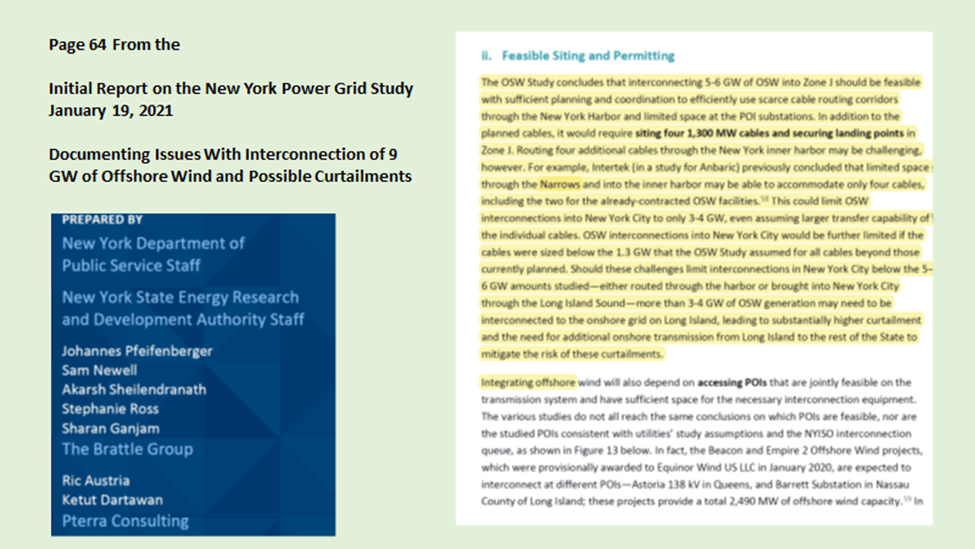
This is also apparent with regard to the 9 GW of offshore wind. There is a major concern about the availability of space to run the cables to interconnect the energy to where it is needed. One possibility is running the cables across Long Island in an environment where every infrastructure project is faced with lawsuits. As a result, even if they can build the 9 GW of Atlantic Wind, they may only be able to interconnect about 6 GW to where it is needed. That is clearly shown in another slide from the upcoming PowerPoint documenting a critical page in a NY State Power Grid report, below. Transferring renewable generation installation projects to NYPA may increase the rate of installation slightly but the node analyses will still have to be done that takes five years at present and the transmission lines will still have to be installed so the price will not be reduced.
5 – Air Source Heat Pumps On a System Not Fully Supported By Renewable Generation Will Not Reduce GHG. There are not Enough Drillers to install Ground Source Heat Pumps, which actually work, in any time frame that will yield significant results.
As is clearly documented in the slide below, putting electric onsite heating into buildings that are not fully supported by renewables just shifts the load to existing generating plants. In Germany, heat pump installation, primarily air source, exceeds gas combustion installation. However, despite installing massive amounts of renewable generation, while their household carbon emissions have declined by 28% since 1999, their utility system carbon emissions only declined by 3.4%. While they closed nuclear plants, they actually installed more Gigawatt hours of renewables. They should have seen a large GHG decrease, but heat pumps running on a system that uses fossil fuel generation add marginal additional load to the fossil fuel plants with higher emissions than an efficient gas boiler/furnace.
Germany is playing “Whack-A-Mole” with its building emissions and NY State is about to do the same thing. They beat down the emissions in one place and they pop up somewhere else. That chart was copied from a Yale publication “Can Germany revive its stalled energy transition?” published in about 2018. Based upon events 4 years later, the answer has been a resounding “NO” Even prior to the war in Ukraine, Germany was reopening coal plants. After the war started and they lost their gas supply, they opened even more coal plants and there were news articles about people across Europe stealing firewood, cutting down trees, and burning anything that they could find to stay warm. That will be the future of NY State with the proposed policies. Germany has been exceedingly lucky this year with a relatively warm winter, however they recently signed an agreement with Qatar to import 20 million metric tons of Liquid Natural Gas over the next ten years.
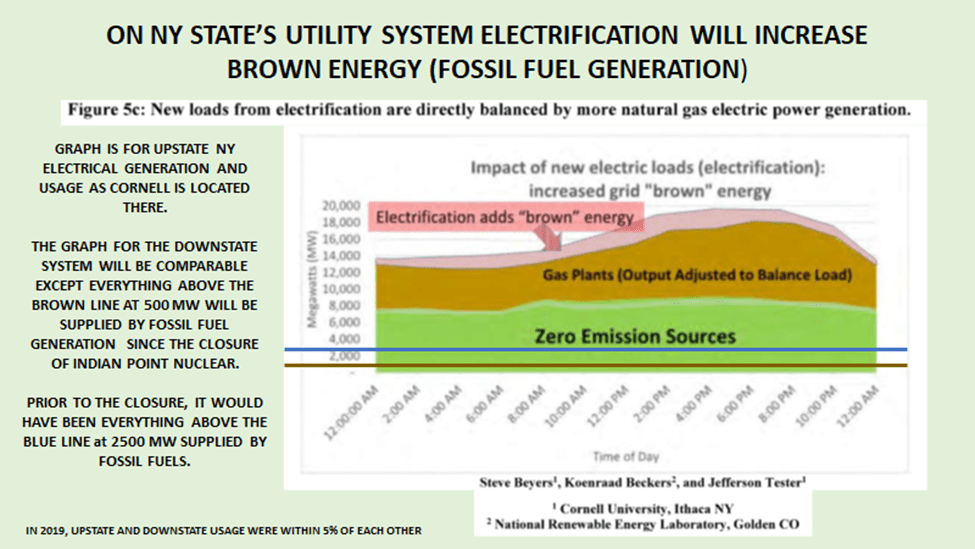
As the chart shown below from a Cornell Geothermal report clearly show, all additional load added to the system is supported by fossil fuel generation. Blue and Brown lines were added after to explain the difference between the upstate and downstate generation sources which in 2019 were within 5% of each other. However, in terms of zero emissions sources, they were worlds apart. The downstate system is almost entirely supplied by fossil fuels.
6 – Battery Storage is being added to the System Prematurely. The batteries will wear out at least 50 years before the state has enough renewable generation to charge them. As a result, they will be charged with fossil fuel generation with a 15% – 20% higher carbon footprint than the actual generation.
As all marginal generation in NY State is provided by fossil fuel generation, all new battery systems that are added will increase fossil fuel generation by a minimum of 15% related to that stored energy as 15% of the battery’s energy is lost in the Charge/Discharge cycle. The batteries will need to be replaced after about 10 years, well before the system will be supported by renewable generation. This is great news for Elon Musk, but not that good for the taxpayers and utility customers in NY State. The following slide was also borrowed from the same report.
7 – An Energy “Shell Game” is Being Used to Make the New Micron Technology Facility Appear Greener than it Actually Will Be under CLCPA rules. However, it could be made far “Greener” in reality by siting a combined cycle generating plant next to the Micron Facility. Nuclear generation would be better still, but that would take far longer to build and would have much higher upfront costs.
The New Micron Technology Facility in Clay, NY will eventually use more energy than the state of Vermont. NY State and NYPA have said that they will provide 140 Megawatts of NY Hydro to the plant. For lack of a better word, that policy is a farce. All of the NY State Hydro has been allocated for years. If they allocate it to the Micron Facility, those customers that are currently using it will then effectively be using fossil fuels. They want Micron to use all renewable energy. From Where? A solar array that could generate enough energy to support that facility would occupy 100 square miles. They want Micron the buy Carbon Credits. From whom? NY State’s two largest neighbors to the south and west, Pennsylvania and Ohio, average 1.5% renewable energy. If NY State has to import energy from either of those states to support the Micron facility, it will all be from fossil fuel generation, gas or coal fired, at a lower efficiency than a combined cycle generator. The import of energy from long distances to the Micron Site will increase transmission line losses by approximately 350 Gigawatts compared with a generator on-site. The new rules are going to make the Micron facility less energy efficient, more polluting, and also increase Micron’s operational costs while imposing environmental costs on the state. Forcing Micron to buy Carbon Credits does nothing to help the environment. It literally papers over the problem while raising Micron’s costs and doing nothing tangible to reduce greenhouse gas emissions.
8 – Renewable Generation Installation Rates are Insufficient to Support NY State’s Plan
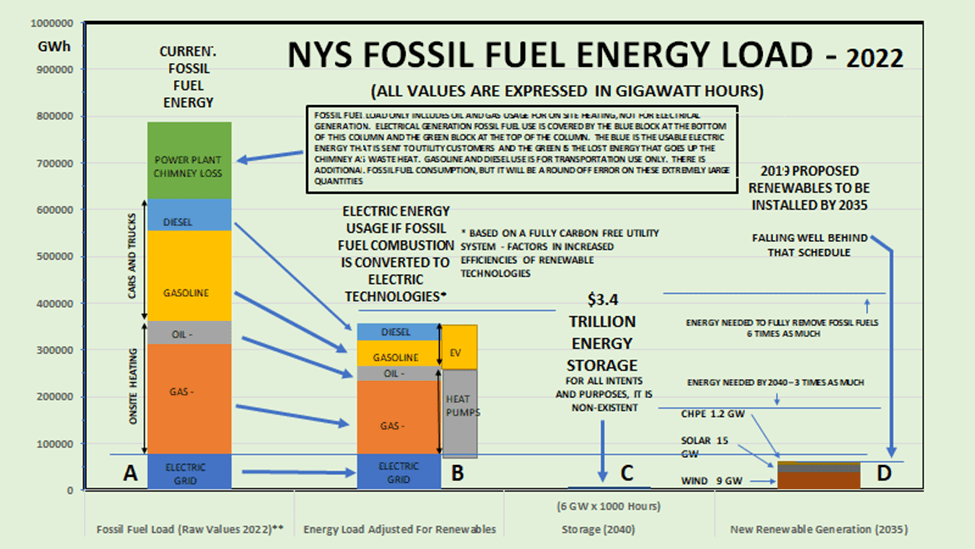
Even prior to many of the recent cancellations of renewable generation projects, NY State was not going to have enough renewable generation installed for about 60 years. Prior to the cancellations, NY State was going to be at least 120,000 Gigawatt hours short of what it would need to support the system on all renewables by 2035 as is shown in the slide below. With onsite fossil fuel combustion about to be banned in new building and replacement equipment banned after 2035, while EV’s are mandated for all sales after 2035, the system load is going to grow far more rapidly than the expansion of renewable generation resulting in an energy shortfall. Beyond the transmission issues facing the Atlantic Wind projects mentioned earlier, the Jones Act is going to slow the rate of installation for offshore wind by limiting the number of jack ships that will be available. While NY State is short on land, money, and grid capacity, the one thing that NY State has in abundance is lawyers so that any renewable project will be faced with years of NIMBY lawsuits and the resulting delays.
Just because California tried it that doesn’t mean that NY State should. California has a Mediterranean climate and is 20 degrees warmer in the winter so the orange and gray “energy blocks” in the fossil fuel column A on the chart below are much smaller. If NY State had the same climate as California, it would eliminate a need for about 150,000 Gigawatt hours of renewable generation on the future system. Keep in mind that California is having difficulty keeping the lights on without the albatross of onsite heating around their neck.
Four columns on the chart above are labeled A,B,C,D and are referred to in the conclusion.
“A” is the Existing Fossil Fuel Consumption in NY State. “B” is the Electric Load if all of that was converted to electric technologies on a fully GHG free generation system. “C” is 6 GW of 1000 hour storage as mentioned in the NY State Energy Storage report. Current cost using Lithium-Ion batteries, $3.4 Trillion. NY State is betting on technologies that don’t exist commercially yet and at present, have shorter lifespans than the 10 years of Lithium-Ion. “D” was the projected renewable installation for 2035 estimated in 2019 using figures provided by NY State. With solar projects being canceled, in 2023 that is an overly optimistic estimate.
Even if all of the existing fossil fuel generation remained static and no fossil fuel plants are closed, the additional load being mandated is going to outstrip the rate of renewable installation. As NY State is not allowed to build any new fossil fuel generation, one of two things will happen as a result of the energy shortfalls shown in the slide above. NY State citizens will be without lights and heat, or NY State will have to import large amounts of fossil fuel generation from out of state, just as California has had to do. When the neighboring states don’t have it available, NY State will have to impose rolling blackouts just as California now does, only the blackouts will occur on the coldest days of winter which will be far more deadly than the hot days during the California summer.
If Climate Change is truly the existential crisis that the authors of the CLCPA claim it to be, and if the recent UN report about the need to halve atmospheric carbon within 10 years is true, then NY State’s 60 – 70 year plan that is going to increase carbon emissions for at least the first 30 years needs some rethinking.
Keep in mind that NY States total GHG emissions are 350 million metric tons annually. Worldwide GHG emissions increased in 2021 by 2 billion metric tons, 40% of that from increased coal combustion in China, India, Germany, Japan, and other countries. So, the increase in worldwide GHG emissions in 2021 was six times NY State’s total annual emissions.
Because of the above fact, it is apparent that the rate of Climate Change is not in the purview of NY State policy makers. As resources are limited, instead of wasting money on building electrification that will yield no holistic improvements in GHG emissions, resources should be used to harden infrastructure against the inevitable negative effects of Climate Change, whether that is on grid infrastructure or flood mitigation. The most expensive and severe impacts of Sandy were on the underground infrastructure of NY City and along the Hudson River. Venice type barriers might be considered for under the Verrazano and the Triborough Bridges, however that will never happen if the state wastes $600 billion on an electrification plan with no positive upside.
A Better Plan –
The following, if executed properly could result in the energy chart, below, where the right hand column actually can supply NY State’s energy needs at a fraction of the cost of the current plan while also reducing fossil fuel energy use and the associated GHG emissions by 44%. However, people will have to allow techniques that don’t meet the current standard of ideological purity in NY State.
By eliminating the push to electrify buildings, the energy savings and carbon reductions will actually be greater than what the CLCPA will yield in practice. This alternative plan will need far less labor and storage resources. Existing resources can be allocated to grid infrastructure to support renewable installation and vehicle electrification. Vehicle electrification is the fastest way to improve GHG emissions. Eliminating storage requirements will reduce battery demand and costs, making EV’s cheaper.
All is not Doom and Gloom
What can be done to reduce GHG emissions considering the state’s lack of financial resources and the lack of sufficient renewable generation for at least seven decades? The following is a list of ten ideas that can be implemented relatively quickly that will help to rapidly lower GHG without breaking the piggy bank while also slowing or reversing the increase in utility bills
Do not electrify buildings that run on natural gas – while it will reduce GHG at the building, it will increase it as much at the generating plants while forcing residents and the utilities to incur enormous rewiring costs. There will be no reduction in current fossil fuel energy, Column A in the New York Fossil Fuel Energy Load figure. Also, the gas stove analysis that was done recently was mathematically flawed and should not be used to set public policy.
Focus heat pump efforts on locations that use oil heat or that use radiant electric heat. Those locations will see a significant reduction of GHG and heat pumps will reduce grid load when compared to radiant electric heat.
Focus resources on expanding grid infrastructure. This will reduce the cost of installing solar in Upstate locations and reduce the number of system cancellations allowing the state to increase the proposed renewable generating resources, Column D in the New York Fossil Fuel Energy Load figure.
Increasing grid infrastructure will also help with the installation of chargers for the electric vehicle wave that is about to arrive, with or without the state mandate.
Do not install large amounts of battery storage until there is sufficient renewable generation to support the storage. It will increase current fossil fuel energy (Column A in the New York Fossil Fuel Energy Load figure) while incurring an enormous capital outlay and starving other projects of funding. They will also decay well before sufficient renewable generation is installed.
Replace older generating plants with higher efficiency combined cycle natural gas generating plants. The state will need the energy to support the EV’s and the newer plants are far more efficient. It will lower Column A, reduce gas usage and put downward pressure on the commodity price.
Place an emphasis on hydrogen injection into natural gas combustion plants. It will decrease gas usage and increase combustion temperatures which reduces NOx emissions and lowers current fossil fuel energy, Column A. It will greatly lower GHG emissions related to those generating plants
Focus available natural gas resources on combined heat and power systems. It will reduce the utility bills for the system owners while also reducing requirements for grid infrastructure. Allow multiple building to form micro-grids to utilize the thermal output and increase the generation capacity. It will greatly reduce Column A
Allow Micron Technolgies to build a combined cycle plant the size of Cricket Valley Energy Center on their property. The Micron facility will use more energy than the state of Vermont. Instead of letting them be “green” on paper by buying carbon credits, let them be green in reality with high efficiency generation and have lower energy costs to make them more competitive and able to recoup the $5 billion rebate without faking it. That will eliminate the increase in column a related to the facility.
Figure out how the utilities can interconnect the 9 GW of offshore wind because at the moment, no one is certain how to do it. There is limited space for underwater cables. Without that, energy curtailments will occur and impede the increase of column d, unless they use the alternative idea which is to run transmission lines across Long Island.
Ellenbogen Conclusion
Ellenbogen Follow Up
The next day Ellenbogen followed up with another email with this warning.
In a speech to the British Parliament in 1948, Winston Churchill said, ‘Those who do not learn history are doomed to repeat it”.
As a conclusion to my email of yesterday, March 28, the following should serve as a warning to those proposing the current NY State Energy plan and expensive projects that are going to raise utility rates but do little for the environment.
The statement above by Churchill not only applies to NY State following Germany’s failed energy program. It also applies to something that happened just across Lake Ontario, much closer to home.
In 2009, Ontario, Canada passed the Green Energy Act. Ontario has a similar population distribution to NY State with large population centers to the south and more rural areas to the north. Hardships were incurred by the more rural areas in the building of renewable generation and sending the energy to the wealthier, more densely populated southern areas. In reading some articles on the subject, it was portrayed as a class war. The act might have survived that issue, except energy costs skyrocketed along with the perceived injustices and the combination led to the repeal of the Act after only 10 years. The Green Energy Act from 2009 is available here and an article documenting the repeal is here.
As I documented above, the state’s energy policies are going to cost trillions of dollars with far fewer carbon emission reductions than could otherwise be obtained at a far lower cost. Hundreds of square miles of solar arrays and wind farms are going to have to be built in rural areas that are already exhibiting a substantial resistance to the projects. The 2019 repeal of the act gave municipalities the right to control what energy projects could be built within their borders, just the opposite of NY State’s proposed legislation.
The quest for the perfect will be anything but and the inevitable voter rebellion that is going to occur in the not-too-distant future is going to leave the state with massive debt, extremely high utility costs, and little to no GHG reduction to show for it. In the interim, a decade will have passed where functional, inexpensive programs could be implemented that will actually reduce GHG in the real world, as opposed to the current program that only might work in Mark Zuckerberg’s fantasy Metaverse. It certainly hasn’t worked in any cold climate on Earth where it has been tried.
Utility customers are already feeling enormous amounts of pain. I have been receiving emails of late from politicians excoriating Con Ed for raising rates, however most of the increase is needed to comply with the mandates of the CLCPA. The increases are due to terrible policy and not utility rate gouging. As a clear example of how upside down this policy is, it actually has me defending Con Ed after they said some rather nasty things about me in a tariff hearing 12 years ago. I have a long memory and no love for Con Ed but this energy policy is going to end up turning the state’s utilities into piñatas through no fault of their own.
The utility rate increases are going to be far worse going forward as the costs documented in my email of yesterday are not figments of my imagination. The plan will not be sustainable. The state can’t borrow its way out of trillions of dollars of costs in an effort to subsidize utility rate payers to ease the pain that will be caused by this.
Beyond the actual costs, there is going to be a huge opportunity cost in terms of lost time imposed by the CLCPA that prevents working solutions from being executed, along with a souring of popular attitudes towards any future programs to reduce GHG.
In their overreach for an unrealistic fantasy, they are going to achieve nothing. Unfortunately, as bad as that is, that situation will be the best-case scenario. The worst-case scenario will be that they continue to push forward, ignoring utility customers pain, still achieving no GHG reductions, while creating energy shortages that result in loss of life.
The current energy policy has no long-term positive outcomes.
Caiazza Concluded Remarks
I could quibble with a few numbers and my take is slightly different for a few aspects but I am in complete agreement that this cannot possibly work. The biggest flaw in the Hochul Administration’s net-zero transition plan is the lack of a feasibility analysis. In 2018 I wrote the following.
We’re choosing between as yet undefined but surely expensive options trying to understand which one (or what mix) will be the least expensive. Unfortunately we don’t know but we need to start now because we’ve been told that we have to make reductions by 2030. If we make a good pick then we’ll spend the least amount of a lot of money and will be left with the fewest negative outcomes, but if we get it wrong, we will be left with many more negative outcomes and even higher costs for a long time.
Since then, the only thing I would change is that it is not just about the money, the possibility of catastrophic reliability outcomes must be considered because present wind, solar, and energy storage technology must be coupled with other ill-defined and speculative resources in order to work reliably. Clearly the first step and priority should be a feasibility analysis before anymore time and money is spent on this.
This blog post highlights an article and report that address New York’s Climate Leadership & Community Protection Act (Climate Act). I am highlighting them here because they make good points in ways that I think clearly show the futility of the Climate Act.
I submitted comments on the Climate Act implementation plan and have written over 300 articles about New York’s net-zero transition because I believe the ambitions for a zero-emissions economy embodied in the Climate Act outstrip available renewable technology such that the net-zero transition will do more harm than good. The opinions expressed in this post do not reflect the position of any of my previous employers or any other company I have been associated with, these comments are mine alone.
Climate Act Background
The Climate Act established a New York “Net Zero” target (85% reduction and 15% offset of emissions) by 2050. The Climate Action Council is responsible for preparing the Scoping Plan that outlines how to “achieve the State’s bold clean energy and climate agenda.” In brief, that plan is to electrify everything possible and power the electric gride with zero-emissions generating resources by 2040. The Integration Analysis prepared by the New York State Energy Research and Development Authority (NYSERDA) and its consultants quantifies the impact of the electrification strategies. That material was used to write a Draft Scoping Plan. After a year-long review the Scoping Plan recommendations were finalized at the end of 2022. In 2023 the Scoping Plan recommendations are supposed to be implemented through regulation and legislation.
Francis Menton writing at the Manhattan Contrarian blog wrote an excellent story about New York’s budget proposals that includes a section on energy policy. He described the Empire Center’s just released Next New York report that offers “counter-proposals in the major policy areas: public safety, K-12 education, Medicaid and healthcare, energy, transportation and transit, housing, and so forth”.
Menton’s article addressed energy policy. The energy section of the Next New York report, titled “Heading off New York’s Home-Made Energy Crisis,” begins at page 69, and was written by the Empire Center’s energy guru, James Hanley. The following is a direct quote from the Menton’s article :
I guess it’s fair to say at this point that we do have an “energy crisis” in New York, but the key word is “home-made.” Everything about energy in New York that could remotely be called a “crisis” is entirely the creation of our politicians. There is no rational reason why energy policy should even be a significant political issue in New York. We have a perfectly good, functional energy system. By far the larger part of it — the non-electrified part, including nearly all transportation, industry, agriculture, and home heat outside the large cities — came into being through private initiative and works with little to no input or interference from politicians and bureaucrats. The other, smaller part — the electrified portion plus urban natural gas distribution — has historically been subject to substantial government regulation, but until quite recently the whole point of the regulation was only to prevent the monopoly utilities from raising their rates to a point of overcharging the customers.
Then our politicians got the idea that there was an imperative to address and solve “climate change” through the device of a politically-directed total re-do of the energy system into something that has never previously been tried nor proven to work. (Don’t get me started on the question of how a place like New York, with a fraction of 1% of world greenhouse gas emissions, is supposed to be able to affect “climate change” by using less fossil fuels, when the places that emit the large majority of world GHGs, like China and India, are adding new coal power plants as fast as they can build them.).
At pages 69-75 of the Report, Hanley provides a brief history of how this subject of reducing GHG emissions got a toe-hold in New York and then rapidly metastasized. Governors Pataki and Paterson began the game in the 90s and 00s, with things like a “renewable portfolio standard” and joining the Regional Greenhouse Gas Initiative (2005). Andrew Cuomo (first elected Governor in 2010) ramped things up by blocking fracking in the extensive Marcellus Shale that underlies a large part of the state, and by having his environmental bureaucrats block natural gas pipelines on bogus “water quality” concerns. But the full suppression of fossil fuels and the wind/solar mania did not really take full control in New York until 2019, when the progressive Democrats finally took both houses of the State Legislature. They used that control to pass something called the Climate Leadership and Community Protection Act (CLCPA), which was then signed by Cuomo. Suddenly, we are on a crash program to get rid of all fossil fuels, electrify everything, and depend completely on the wind and sun for the generation of our energy. Hanley:
The CLCPA’s overarching goal is an 85 percent reduction in greenhouse gas emissions and a net-zero state economy by 2050. Intermediate steps on the way include 6,000 megawatts of installed solar and 185 trillion BTU savings in energy efficiency by 2025, 70 percent renewable energy production and 3,000 megawatts of battery storage by 2030, 9,000 megawatts of offshore wind production by 2035 and 100 percent zero-emissions electricity production by 2040.
I believe that I have used terms like “ridiculous,” “preposterous,” “incompetent,” and “irresponsible” to characterize the legally-mandated goals to which the CLCPA commits our state. Hanley is much more gentle in his use of words:
To say the CLCPA’s goals are ambitious is an understatement, and yet they will not be adequate to provide the state with sufficient clean energy to ensure the continuing reliability of the electrical grid. One place where Hanley makes a real contribution to the debate is by producing a chart, based on data from the federal Energy Information Administration and Department of Energy, that makes the absurdity of the CLCPA goals apparent:
In the eleven years from 2010 to 2020, the percent of New York’s electricity coming from “renewables” inched up from about 22% to about 28%. But most of that 6% increase came from that blue line, “hydro,” aka almost entirely the Niagara Falls power plant, going from about 18% to about 22% of state electricity production. Meanwhile, in that 11 year period when everyone was starting to obsess about wind and solar and federal subsidies ramped up dramatically, the percent of electricity from wind (the orange line near the bottom of the graph) went all the way from about 2% to about 4%. And the percent from solar remained a barely-perceptible 1% or so, represented by a gray line that is so close to the x-axis of the graph that you can barely see it next to the brown line representing wood.
And then supposedly the percent of electricity from renewables takes off like the blade of a hockey stick in 2020 and gets to 70% by 2030. Unmentioned is that we don’t have another Niagara Falls. Therefore this whole increase now has to come from wind and solar. Oh, and we’re already two years in since the data in Hanley’s graph. How much of this has happened so far? Almost none.
Meanwhile the consumption of electricity is supposedly going to double or so, due to the electrification of automobiles and home heating.
I’ll throw in a few figures from research of my own to further illustrate the absurdity. According to EIA data here, New York’s electricity consumption in 2021 was 141,423,778 MWh. If that doubles from electrification of automobiles and heating, then we’ll need about 280 million MWh in a year. Per Hanley’s summary of the CLCPA above, the state authorities are calling for adding 6000 MW of solar and 9000 MW of offshore wind by 2035. At highly optimistic capacity factors of 25% for solar and 40% for wind, here’s what that will get you:
6000 x 0.25 x 8760 + 9000 x 0.40 x 8760 = 44,676,000 MWh
In other words, as ambitious as the plans for wind and solar may be, even if all gets built this will provide less than a sixth of the electricity that will be needed. And with wind and solar generation, such electricity as gets generated will come at random times that could include long weeks of no wind and almost no sun in the dead of winter.
But meanwhile they are proceeding apace to shut down the existing natural gas capacity.
Hanley concludes his section of the Report with a series of highly sensible recommendations, like ending the fracking ban, ending the pipeline moratorium, and scaling back renewable energy subsidies and tax credits. I actually think we will likely be better off going full speed ahead on the innumerate nonsense and running hard into the green energy wall.
Conclusion
The demand that we do something as quickly as possible does not square with reality. New York GHG emissions are less than one half a percent of global GHG emissions and global GHG emissions have been increasing by more than one half a percent per year. Anything we do will be replaced by global GHG emission increases in less than a year. That does not mean that we should not do something but it does mean that we should take the time to do “something” that it does not do more harm than good. Menton and Hanley show that the proposed implementation timeframe is extraordinarily risky and unlikely. Their concerns must be addressed or the reliability and affordability of New York electricity will be unacceptably at risk.
The demand for compliance certainty inherent in the cap and invest proposed plan exacerbates the risks and impacts. In my last post on the cap and invest program proposal I noted that developing sufficient zero-emissions renewable energy to displace enough fossil-fired electric generation to meet the mandated emissions targets would be a challenge. Both Hanley and Menton clearly show that the expectation that New York State can convert the electric energy system to meet the 2030 goal of 70% renewable energy is a dream and that meeting the emissions targets is a stretch. Of particular concern is that the cap and invest approach includes penalties when those targets are not met. Affected sources are going to err on the side of caution relative to their compliance obligations. These results and that outlook increase the chance of an artificial energy shortage.
I have published three previous articles about New York Independent System Operator (NYISO) analyses related to New York’s Climate Leadership and Community Protection Act (Climate Act). This post describes their new webpage that summarizes their activities “to design and implement the operations, planning and market enhancements necessary for the grid in transition.” It does a good job explaining some of the issues associated with a net-zero transition. The only thing left is to get New York policy makers to listen.
This is another article about the Climate Act implementation plan that I have written because I believe the ambitions for a zero-emissions economy embodied in the Climate Act outstrip available renewable technology such that the net-zero transition will do more harm than good. The opinions expressed in this post do not reflect the position of any of my previous employers or any other company I have been associated with, these comments are mine alone.
Background
The implementation plan for New York’s Climate Act “Net Zero” target (85% reduction and 15% offset of emissions) by 2050 is underway. At the end of 2022 the Climate Action Council completed a Scoping Plan that makes recommends strategies to meet the targets. The Hochul Administration is developing regulations and proposing legislation to respond to those recommendations in 2023.
Unfortunately, the Scoping Plan is just a conglomeration of control strategies that are projected to provide the emission reductions required. The Plan did not do any feasibility analyses or address any “what if” questions raised by the NYISO. I have written three posts that described issues raised by NYISO, The first post (New York Climate Act: Is Anyone Listening to the Experts?) described the NYISO 2021-2030 Comprehensive Reliability Plan (CRP) report (appendices). The difficulties raised in the report are so large that I raised the question whether any policy maker in New York was listening to this expert opinion. The second post (New York Climate Act: What the Experts are Saying Now) highlighted results shown in a draft presentation for the 2021-2040 System & Resource Outlook that all but admitted meeting the net-zero goals of the Climate Act are impossible on the mandated schedule. The third article described the final version of the 2021-2040 System & Resource Outlook. It shows that in order to minimize the storage and renewable over-build requirements that a Dispatchable Emissions-Free Resource (DEFR) is needed but goes on to point out that DEFRs such as hydrogen, renewable natural gas, and small modular nuclear reactors are not commercially viable today. “DEFRs will require committed public and private investment in research and development efforts to identify the most efficient and cost-effective technologies with a view towards the development and eventual adoption of commercially viable resources.”
The NYISO oversees system reliability and the competitive electric market in New York. They are responsible for “keeping the lights on for New Yorkers by managing today’s energy flows and by planning the grid far into the future.” Frankly, with regards to the Climate Act transition they are in a very difficult position because New York’s Climate Act was written by climate activists who had a very poor understanding of the challenges of a transition to a zero-emissions grid. There are two options for the future. If the State comes to its senses and takes the work done by the NYISO to heart and chooses a path consistent with their recommendations, then NYISO will be characterized as obstructionists who just don’t understand that academics know better than anyone in the industry. If the State ignores their warnings and there is a catastrophic blackout, then they will be blamed for improperly implementing the vision of the academics. Either way they will be scapegoats.
Information for Policy Makers
The new website (pdf copy) is obviously designed to try to explain the complexities of electric system operations and planning for a non-technical audience. The documentation has three main sections: “Planning for Reliability”, “Wholesale Electric Markets”, and “Our Independence and Transparency”. Because the information is a useful overview, I will summarize each section below.
The Planning for Reliability section explains that the NYISO is responsible not only for the real-time matching of generation with load operations for the electric system, but also “planning far into the future to make sure the electric system and its interrelated components can meet customer demand.” The introduction concludes: “The acceleration of New York’s transition to a zero-emission grid is creating a system of new, intermittent generation, which benefits the environment but can make it more challenging to keep the system reliable.” So how does the website describe the challenges?
They explain that wind and solar are not dispatchable resources and are intermittent so energy storage is needed. They point out that the current energy technology is limited. The website goes on to explain:
The grid will always need sufficient flexible and dispatchable resources to balance variations in wind and solar resource output. These resources need to be long-duration, dispatchable, and emission-free. Essentially, they must have the attributes of fossil generators (responding quickly to rapid system changes) without the emissions. Such resources are not currently commercially available and may not be for many years.
This is a wind-up to make the point that:
The retirement of fossil-based resources is outpacing the development of new renewable-based resources and other dispatchable, emissions-free resources. The effect is that reliability margins will thin to concerning levels beginning in 2023, highlighting the need for a careful transition that maintains grid reliability and resilience.
I am a bit disappointed with this description. In order to really emphasize the risk involved it is necessary to understand the current reliability standards are the result of decades of experience and evaluation. The resulting standards have done a good job preventing blackouts. However, in the future there are potential issues because the standards are based on the presumption that the system is static. The unprecedented introduction of significant amounts of new intermittent and non-dispatchable resources changes things a lot. I don’t think this discussion explains how much riskier planning is becoming as a result.
This section also points out the importance of transmission. The fact is that New York City will never be able to produce enough electricity from in-City wind and solar so the power necessary will have to be transmitted from elsewhere. They are constraints on this transmission regionally and also locally where upgrades are needed to get the power from newly developed wind and solar projects. The website explains the transmission planning process and concludes: “A historic level of investment in the transmission system is currently underway, with projects that will deliver more clean energy to consumers while enhancing grid resilience and reliability”.
The website raises a little discussed aspect of the transition process. There is an interconnection procedure where the NYISIO determines if a proposed new resource will have reliability issues and whether transmission system upgrades are needed to address them. The website brags about the transparency of their process but does not bring up another uncertainty. In particular, the interconnection hardware for intermittent resources must be able to differentiate between power fluctuations caused by variable wind, for example, and transient power changes in the grid. If they don’t handle this correctly problems ensue. For example, the 2022 Odessa Texas disturbance illustrates the “need for immediate industry action to ensure reliable operation of the bulk power system with the ever-increasing penetrations of inverter-based resources”.
This section of the website concludes with a description of the planning process and “NYISO’s role in identifying system needs, and finding solutions, is part of the process of planning for the grid of the future.”
The next section, Wholesale Electric Markets, gives an overview of competitive wholesale electric markets. It is not surprising that they extoll the virtues of market-based solutions including consumer benefits because that is the basis for their existence. Nevertheless, it also is a useful overview of how the markets work.
In order to match the generation with the load the NYISO has three markets: the energy market, ancillary service market, and capacity market.
These three markets work together. In simple terms:
Energy markets secure resources to supply the demand on a minute-to-minute basis.
Ancillary service markets procure a variety of additional services to protect the electric system and balance supply and demand to meet system needs instantaneously.
Capacity markets provide incentives to generation resources to maintain additional energy reserves over a longer period. Through the capacity market, we determine how much capacity is needed to meet the expected peak demand for the year plus a margin of additional resources to call on, if necessary.
According to the NYISO website the wholesale market can support New York’s Climate Act goals. It states:
Competitive, wholesale markets can help with the transition to a zero-emission grid by sending the right economic signals to developers to invest in new technologies in the right geographic area to best serve the grid. These markets leverage competition to keep electricity as cost-effective and efficient for New Yorkers as possible, and to help make sure there are adequate resources in place in the future.
I disagree with the implication of the statements that “Competitive markets have over time created pressure on the generating fleet to switch to newer, more efficient generation plants” and “Since 2000, electric generators that primarily combust natural gas increased from less than 50% to more than 60% of the generating capacity in the state”. This is the same argument that proponents of the Regional Greenhouse Gas Initiative make when they argue that emissions have come down significantly and insinuate that the emissions trading system was a primary factor in the emission reductions. The price of natural gas came down so much relative to other fuels that the generating fleet would have switched to newer, more efficient generating plants with or without the RGGI program. I believe that the conversions would have happened even without competitive markets.
I am disappointed with the following explanation how the market can support the Climate Act:
Additionally, the NYISO has implemented market enhancements to support climate goals and to position the NYISO as a national leader in competitive wholesale electricity markets. Through engagement with stakeholders and regulators, new market rules for energy storage integration, participation in our wholesale electricity markets by distributed energy resources, and new ancillary services products support reliability and minimize costs for consumers. Market rules that incentivize investment in resources that can respond rapidly to changing conditions will be essential for maintaining reliability of the grid of the future.
In my opinion, the transformation of the electric system that was built up over decades using dispatchable synchronous generating resources into a system that relies on a significant amount of intermittent, asynchronous generating resources is an enormous challenge. NYISO planners have to not only attempt to anticipate all the effects of all these changes to the electric grid but also try to design market rules that provide the resources needed. The addition of the market component should have been highlighted as a significant additional challenge to get a system that works.
The final portion of this section discussed electricity prices in the NYISO region.
The Our Independence and Transparency section explains how the NYISO was formed and how it operates. It provides a concise overview of the regulatory and reliability organization oversight requirements for any independent system operator. There is a description of the governance policies and budgeting.
They also emphasize their independence but there is some backstory here. At one point in the previous Mario Cuomo Administration, the current chairman of the New York State Energy Research & Development Authority, Richard Kauffman was Cuomo’s energy czar. In a filing to the Public Service Commission, the NYISO noted that in order to meet Cuomo’s Clean Energy Standard, a predecessor regulation to the Climate Act, New York would have to install over 1,000 new miles of bulk transmission lines at great cost and effort. In response, , Richard Kauffman, accused NYISO Director Brad Jones and his NYISO report as “misleading, incomplete, and grossly inaccurate…revealing an alarming lack of developed analysis into the imperative to address climate change…” Kauffman’s letter accused Jones of protecting fossil fuel generators and said that he was “dismayed by [Jones’] public comments. Not long after that Jones left and ever since comments have been much more guarded. Kaufmann also authored a commentary for The Hill about a “carbon bubble” that claimed that government intervention will be necessary if the market response to climate change is delayed too long. In this political climate it is not surprising that all NYISO planning reports are carefully worded to not antagonize the Administration. In my opinion, however, the Administration needs to hear the unvarnished truth.
Discussion
The title for this webpage says it is information for policy makers. New York climate policy is driven by the Climate Act’s Climate Action Council. That body consists of 22 members that were chosen by ideology not expertise. Their contribution to the Climate Act implementation was the Scoping Plan that was approved last December. The Council only paid lip service to any pretense of addressing reliability concerns with the NYISO so even if this document had been available at the start of the Scoping Plan development process I doubt that the majority of the members would have read it, much less acted on the recommendations.
This year the Hochul Administration is pushing to implement the recommendations of the Scoping Plan either by new legislation or by proposing new regulations. When pressed about the lack of feasibility analyses in the Scoping Plan the Climate Action Council has said those concerns would be addressed in the regulatory process. I imagine the policy makers who are responsible for the new legislation and regulations are the target audience. Unfortunately, I fear their minds are already made up and the issues raised here will be ignored.
The summary for policy makers has several key messages that New York policy makers need to consider as they develop legislation and regulations. The state should not shutdown existing fossil-fuel generators until sufficient clean energy resource are available. A new resource is needed but is not ready for use and may not be available for “many” years so an emphasis on developing that resource must be a priority. Because New York’s fossil resources are retiring faster than new resources are coming on line there already are concerns about the reliability margin. Unprecedented upgrades to the transmission system will be required to get the power from wind and solar projects to New York City where it is needed the most.
Conclusion
I think this is a very useful overview of policy issues that the NYISO is considering relative to the implementation of the Climate Act. However, I am not optimistic that the target audience will consider these issues as implementation proceeds. In the political climate of Albany it is not clear how to get policy makers to consider the risks of ignoring the issues raised.
Gov. Kathy Hochul’s proposed budget for fiscal year 2024 includes billions of dollars for climate-related funding but climate activists are not satisfied. This post highlights things they want to implement in the Climate Leadership and Community Protection Act (Climate Act). I also want to point out that these are only the acknowledged parts of the funding because there are major costs buried in the utility costs that won’t be counted by the Governor.
This is another article about the Climate Act implementation plan that I have written because I believe the ambitions for a zero-emissions economy embodied in the Climate Act outstrip available renewable technology such that the net-zero transition will do more harm than good. The opinions expressed in this post do not reflect the position of any of my previous employers or any other company I have been associated with, these comments are mine alone.
Even with its billions of dollars in climate-related funding, policy experts said Gov. Kathy Hochul’s proposed budget for fiscal year 2024 needs more vigor to meet the urgency of the climate emergency.
The article mentioned that the budget package includes specific items that will add costs. There is a proposal for a cap and invest program. To my knowledge the Hochul Administration has not admitted how much this is expected to cost. The Executive Budget would also add 231 new staff positions at the DEC to enact and enforce regulations for climate laws. The article notes that “The budget is sprinkled with incentives such as $200 million to start EmPower Plus, a program from the state’s energy research and development authority that will provide 200,000 low-income residents with free energy-efficiency solutions for their homes, such as insulation, electrification and energy-saving appliances.” I was not surprised by the statement in the introductory paragraph because I think costs will be enormous.
What did catch my attention were the comments by Julie Tighe, president of the New York League of Conservation Voters. “We know ultimately it’s going to take a lot more money to do that,” Tighe said. “It’s a good down payment to make sure that we’re starting to take action and helping people who are least able to afford it.” I want readers to know her vision:
The governor’s budget also includes big-ticket items like more than $9 billion for mass transit improvements, a historic amount that’s 10% more than last year. But the state continues to invest record amounts on infrastructure for modes of transportation that are responsible for 28% of the state’s greenhouse gas emissions, such as roads and bridges. Tighe contends that massive counterinvestments are needed to get New Yorkers to stop driving and use cleaner forms of transportation that are also affordable and viable alternatives.
“We can’t drive our way out of the climate crisis,” Tighe said. “We need people to take mass transit. We need people to be taking e-bikes and walking more and using regular bikes.”
An organization that is located at 30 Broad Street in New York City has mass transit options. For those of us that live in upstate New York public transit options are limited and e-bikes, walking and regular bikes are not a credible option in the winter even if there are no distance limitations.
It has been educational to watch the gas ban messaging unfold. The Gothamist explains:
The executive budget, for example, features a controversial gas ban for new buildings, except it doesn’t go as far as some state legislators and environmental experts think it could. The All-Electric Building Act — a state bill currently stalled in the Senate’s finance committee — would prohibit the use of fossil fuels in newly constructed buildings and require those structures to rely completely on the electrical grid on a faster timeline than the governor is recommending.
Hochul’s version also comes with many exemptions and later deadlines for switching from gas to electric in homes and buildings. Buildings are the state’s largest climate polluters, responsible for 32% of total greenhouse gas emissions. Experts have called the electrification of buildings “low-hanging fruit” when it comes to making an impact in mitigating global warming.
That sums up the climate activist position. But the reality is that they are a small, albeit loud, constituency. I suspect that the majority of those currently using gas want to continue using it. In response to concerns raised by those folks, there also has been a flurry of news articles worried that “misinformation is spreading about Governor Kathy Hochul’s plans with a phase-out of fossil fuel systems.” James Hanley eviscerates the Administration response to the gas stove ban:
As the old Marx Brothers joke goes, “Who are you going to believe, me or your own eyes?”
Doreen Harris, president and CEO of the New York State Energy Research and Development Authority, told lawmakers that she was setting the record straight, and that “We are not taking away gas stoves, as one example of perhaps misinformation we need to correct.”
But the Climate Action Council that she Co-Chaired produced a Climate Leadership and Community Protection Act (CLCPA) Scoping Plan – which she voted to approve – that says the state will in fact be taking away gas stoves.
It’s right there on page 190, in the chapter on buildings, for all the world to read.
So where’s the misinformation?
Indeed, where is the misinformation? My position is that much of the misinformation is coming from the Hochul Administration. Most of this is political gamesmanship where the exact wording of the legislative or regulatory proposal allows some wiggle room when confronted with an inconvenient question. In the instance of the gas stove ban she falls back on claiming that she only wants to ban gas in new homes and moves on before the Scoping Plan reference can be brought up. The biggest item of the Administration’s overt misinformation is the ultimate cost to get to the Climate Act target of net-zero by 2050. The Administration claim in the Scoping Plan is that the “costs of inaction are more than the costs of action”. Aside from the biases and exaggerations of the alleged benefits, the official line consistently ignores the caveat that the Scoping Plan costs only include the costs of the Climate Act itself and not the costs of “already implemented” programs that are necessary to get to net-zero by 2050. The already implemented programs include the following:
Growth in housing units, population, commercial square footage, and GDP
Federal appliance standards
Economic fuel switching
New York State bioheat mandate
Estimate of New Efficiency, New York Energy Efficiency achieved by funded programs: HCR+NYPA, DPS (IOUs), LIPA, NYSERDA CEF (assumes market transformation maintains level of efficiency and electrification post-2025)
Funded building electrification (4% HP stock share by 2030)
Corporate Average Fuel Economy (CAFE) standards
Zero-emission vehicle mandate (8% LDV ZEV stock share by 2030)
Clean Energy Standard (70×30), including technology carveouts: (6 GW of behind-the-meter solar by 2025, 3 GW of battery storage by 2030, 9 GW of offshore wind by 2035, 1.25 GW of Tier 4 renewables by 2030)
Needless to say when the costs of these programs are added to the Climate Act program costs, the costs of the actions necessary to get to the Climate Act net-zero by 2050 target far exceed the costs of inaction. Nonetheless, the climate activists want more funding:
“The governor’s budget proposal is lacking when it comes to ambitious climate funding,” said Elizabeth Moran, a New York policy advocate with EarthJustice, a nonprofit public interest environmental law organization. “There’s some funding there, but it’s far from what we know is needed.”
When it comes to carbon emissions from buildings, Hochul has planted some long-awaited policies in her budget, including a mandate for all-electric new construction that includes a few exemptions, such as commercial kitchens.
But the timeline is delayed relative to other state proposals and some local laws. For smaller buildings, Hochul’s plan would take effect in 2026. That differs from the All-Electric Building Act, which calls for the electrification of new smaller buildings by 2024. Likewise, New York City’s Local Law 97 wants to electrify any new building larger than 25,000 square feet by next year.
Hochul’s plan would delay this regulation for new commercial buildings until 2029. The All-Electric Building Act calls for implementation by July 2027. Facilities such as laundromats and hospitals would not be required to comply. Fossil fuels will continue to be used in backup generators.
I am opposed to any “all-electric” legislation or regulation because of safety: what happens when there is an extended electric outage? The article notes that the Adminstration tries to get around this by saying “fossil fuels will contine to be used in backup generators”. What is the percentage of fossil fuel sales for backup gnerators sold by suppliers? My guess is that it is a small fraction, at most 10%, of their sales. Is there any scenario where those suppliers will be able to remain viable when they lose 90% of their business?
Another example of the desires of climate activists is an accelerated schedule. It can be argued that the state’s leading climate activist is Robert W. Howarth, Ph.D., the David R. Atkinson Professor of Ecology & Environmental Biology at Cornell University. In his statement supporting his vote to approve the Scoping Plan, he reiterated his claim that he played a key role in the drafting of the Climate Act, developed the irrational methane requirements, and credited one politician for getting the Act passed. The article noted his desire and others that the phase-in should speed up:
Dr. Robert Howarth, a member of the Climate Action Council, said there is no reason to wait to require electric appliances in new construction, especially when they will have to be replaced in the case of heating and hot water, when laws take effect. Howarth said following the new regulations could save homeowners money in the long run while also cutting emissions faster. More than a third of building emissions come directly from natural gas use in cooking, heating and hot water. And a year does make a difference when the total leaks nationwide from turned-off gas stoves add up to the annual carbon dioxide emissions from half a million cars.
To speed up the transition, more incentives and assistance for homeowners in the budget could go a long way, said Dr. Gernot Wagner, a climate economist at Columbia Business School. Even homeowners who don’t qualify may also switch to electric as a result of wider adoption. The proposed $200 million for the EmPower program is a drop in the bucket when there are more than 7.5 million households in the state, and Tighe said assistance is needed for other homeowners, even large building owners, especially since New York is the country’s No. 1 user of heating oil.
Under Hochul’s proposal, new buildings can’t have cooking appliances that use fossil fuels such as natural gas. Existing buildings won’t be required to swap their gas stoves for electric models, even when purchasing replacements. By 2030, the governor would ban fossil fuel-powered heating or hot water equipment in homes.
The author of this article did not pick up on the fact that the Scoping Plan recommends that existing buildings will have to replace any fossil-fired appliance with an electric appliance starting in 2035. By then it will be somebody else’s problem and Hochul will be long gone.
Governor Hochul’s Executive Budget – Energy
The Gothamist article discussed two aspects of the electric energy system. Apparently because there isn’t enough interest by the private sector to build the infrastructure necessary for the net-zero transition, the Executive Budget proposed letting the public power operator get involved:
The Hochul is empowering the New York Power Authority to develop, finance, construct, own, operate and maintain renewable energy projects. This move will ensure that enough zero-emissions power sources are built. The governor is calling for the phaseout of electricity production from gas-fired peaker plants by 2035, and wants to support the training of a green power workforce.
The private sector and customers have traditionally shouldered the cost of renewable energy projects. They’re handled outside of the budget, mostly through renewable energy credits.
I have no opinion on the value of this approach but picking and choosing when the State depends on the market for electricity supply seems to be a slippery slope. The other aspect concerns transmission projects:
“The state budget does not include funding for transmission infrastructure,” said Jason Gough, deputy communications director for the governor’s office. “Utilities typically pay for the cost of power infrastructure, including transmission lines. These costs are passed to utility ratepayers through the delivery charge for electric service.”
Let me translate Gough’s comments. “These costs are passed to utility ratepayers through the delivery charge for electric service” means “The costs of the Administration’s policies that we won’t let the utility companies itemize for their ratepayers, are passed on so that the ratepayers will vent their anger at the utility companies rather than the Administration”. The next press release will say “The utility bill increase is not our fault, it is greedy industry’s fault.”
The article goes on:
But transmission lines and other infrastructure are needed to bring clean power to the downstate grid, which is mostly dependent on fossil fuels. New York City doesn’t have the space, Tighe said, to build enough solar and wind power. The absence of direct funding for this key infrastructure could hinder the city in reaching its goal of a zero-emission grid.
“New York City needs a lot more power lines going toward the city in order to enable the sort of clean energy transition, the rapid transition that is necessary now,” Wagner said. “Transmission is the biggest bottleneck to decarbonize New York state.”
Several days ago, I wrote about the hidden costs for this infrastructure. The New York Public Services Commission recently approved rate increases for this purpose in case 20-E-0197. The transmission upgrade projects will cost $4.4 billion to support 3.5 GW of renewable energy or $1.26 billion per GW. An additional 2.8 GW is expected by 2025 and another 4.1 GW by 2030 according to Scenario 2 of the Scoping Plan. At that rate, ratepayers will be on the hook for a total of $13.05 billion through 2030. It is disappointing to me that Upstate ratepayers are on the hook for bill impacts up to and exceeding twice the bill impacts of Con Ed ratepayers who need Upstate power to reach the goal of a zero-emission grid. If the Hochul Administration would stop pandering to her political base and have the courage to be responsible for these costs then they should be spread equitably over all the state.
The Gothamist article describes proposed policies for transportation:
Public transportation will receive a big boost in the proposed budget. The MTA could get around $8 billion, a 10% increase. The funds will address the revenue deficit incurred as a result of a drop in ridership during the pandemic. But Moran said additional financial support is needed for faster fleet electrification, and more of it.
For individual vehicle electrification, the DOT expects to receive $175 million from the federal government as part of the Infrastructure Investment and Jobs Act over the next five years to build fast charging stations along New York’s interstate highways.
Hochul has also included congestion pricing as a revenue stream to help fund the ailing transportation authority. Tighe applauded the measure as a “good incentive for people to stop driving in Manhattan.”
The governor’s proposal also wants to fund mass transit outside of New York City. It includes nearly $1 billion for non-MTA public transportation, including some bus electrification and rehabilitation of upstate light rail.
Affordability is important in making public transportation a viable alternative to driving, Tighe said.
As noted previously, climate activists are big proponents of public transit. Unfortunately, that is only a solution in urban areas. None of these proposals benefit rural Upstate New York.
Cleaner modes of transportation require more funding to substantially reduce emissions, Wagner said. New bike lanes and the expansion of car-free pedestrian areas would make an impact on reaching goals and encourage these commuting modes, he added. The budget proposal doesn’t specify how much money will go to these environmentally friendly travel alternatives, and there are no direct amounts either. But these projects can be funded through the state DOT’s small umbrella programs such as the Transportation Alternatives Program and clean air funding initiatives.
Other climate activist strategy favorites are bike lanes and pedestrian areas. One of the issues with these green solutions is that they don’t work all the time but the activists demand complete compliance. In the winter bike lanes in many parts of the state are dangerous and pedestrian areas challenging. Winter is also a reason that many Upstaters are reluctant to depend completely on battery electric vehicles.
“Is this [budget] going to set us on a completely different path commensurate with the challenge? No,” said Wagner. “It is doing a lot of good things. Not to be ungrateful, but I thought we all recognized that we are in a climate crisis here.”
New York’s Greenhouse Gas (GHG) emissions are less than one half one percent of global emissions and since 1990 global GHG emissions have increased by more than one half a percent per year. That does not mean that we should not do something but it does mean that even if there is a climate crisis New York cannot do anything about it alone. We must make sure that we are not doing more harm than good with the net-zero implementation.
Discussion
This is just a part of the legislative initiatives to meet the Climate Act targets. There are many member items also up for consideration. In addition, there are also regulatory initiatives. For example, the Department of Environmental Conservation is promulgating Part 218: Advanced Clean Cars II (ACC II) as part of the reckless push for all electric transportation. The emergency/proposed rulemaking will incorporate the State of California’s Advanced Clean Cars II (ACC II) regulation into New York’s existing rules.
My overarching problem with all these initiatives to meet the recommendations of the Scoping Plan is that the Integration Analysis that provided the background for the Plan did not include a feasibility analysis. The Integration Analysis is simply a list of potential control strategies with estimated emission reductions that when combined together provide the controlled emissions appropriate for the emission targets. There was no consideration of “what if and how about” questions like how are all the people who live in homes that have to park on the street going to be able to charge their cars? What if the magical solution necessary to keep the lights on called dispatchable emissions-free resources is not available on the schedule of the Climate Act. The Hochul Administration has not given consumers the expected costs or addressed the question what happens after everything is electrified and there is an ice storm.
Consider the feasibility of just one control strategy component. The article notes that NYSDOT expects funding of $175 million from the federal government as part of the Infrastructure Investment and Jobs Act over the next five years to build fast charging stations along New York’s interstate highways.. A gas station fuel pump costs about $20,000 and can serve a customer in less than six minutes. A 50-kilowatt fast DC charger costs about $100,000 and can serve an EV customer in about 30 minutes. The gas pump can serve five times as many customers for one-fifth of the capital cost of a high-speed charger. Think about the feasibility issues. The $175 million can only fund 1,750 fast chargers. The closest NYS Thruway service center to my home has ten automotive fuel pumps but is a small service center. Consider what would be needed to maintain the same level of refueling capacity. The service center would need 50 charging stations to provide the same amount of refueling capacity and I suspect that would blow through the $175 million for the 27 service centers on the NYS Thruway. The space available and energy needed for those chargers means physical upgrades are needed at the service centers. Throw in the fact that for a long time it will be necessary to provide gasoline too. Finally, the NYS Thruway is just under 500 miles and the total NYS interstate mileage is 1730 miles so the $175 million would provide recharging support for less than half the interstate mileage. The implementation logistics for this component of the electric vehicle requirement appear unrealistics so the onus should be on the State to prove that this can work. They have not done this for any of the control strategies included in the Scoping Plan.
If any reader has concerns similar to mine, I encourage you to contact your elected officials and demand answers to these “what if” and “how about” questions before they vote on or support any legislation related to the Climate Act. There are opportunities to comment on regulations. A virtual hearing is scheduled for March 1, 2023 at 1 pm for Part 218: Advanced Clean Cars II (ACC II). The comment deadline is 5 pm, Monday, March 6, 2023. Written comments may be submitted to NYSDEC, 625 Broadway, Albany, NY 12233-3254, ATTN: James Clyne, P.E., or by e-mail to air.regs@dec.ny.gov.
Conclusion
Climate activists like Robert Howarth and Julie Tighe are pushing the state down a road towards a canyon without a bridge. Howarth’s arguments that Mark Jacobson’s academic analysis of wind, water, and solar energy is proof that a net-zero transition is cost-effective and possible is misplaced. The reality is that the Climate Act is promoting a system with less stability, robustness, and reliability that will undoubtedly raise costs a lot.
It is not only the disconnect relative to technical limitations but the attitude of the activists that disappoints. Tighe said: “We can’t drive our way out of the climate crisis” relegating everyone in the State who must rely on driving because they have no viable alternative to second class citizenship. This is no less demeaning than Marie Antoinette’s infamous “Let them eat cake”. Unfortunately, it can only get worse. Now there are climate scientists who are arguing for rationing to fight climate change.
If the Hochual Administration wants to solve their alleged climate crisis then they have to come up with a solution that provides the developing world with the prosperity and quality of life that comes with abundant and cheap energy. It is immoral to deny them that right because the best adaptation strategies for extereme weather require prosperous societies. The onus is on New York to provide them with affordable emissions-free energy technology or get out of the way. At home, the only means left to avoid the Climate Act stampede that will destroy our existing reliable and affordable energy system is to speak up now and vote anyone who supports this out of office before the we go over the cliff.
The Climate Leadership and Community Protection Act (Climate Act) includes a target for a 40% reduction of greenhouse gas (GHG) emissions from 1990 levels by 2030. This post describes the latest New York State (NYS) GHG emission inventories and some implications.
This is another article about Climate Act implementation activities that I have written because I believe the ambitions for a zero-emissions economy embodied in the Climate Act outstrip available renewable technology such that the net-zero transition will do more harm than good. The opinions expressed in this post do not reflect the position of any of my previous employers or any other company I have been associated with, these comments are mine alone.
NYS Electric Generating Unit Emissions
According to the Environmental Protection Agency (EPA): “Emissions trading, sometimes referred to as ‘cap and trade’ or ‘allowance trading,’ is an approach to reducing pollution that has been used successfully to protect human health and the environment.” One of the requirements for such a program is a monitoring system that consistently and accurately measures the emissions. NYS electric generating units are in different emissions trading systems and have developed an accurate measuring system that relies on continuous emissions monitoring systems that record pollution levels that are reported to EPA.
The only GHG monitored and reported to EPA is CO2. In 2022 the units that report to EPA emitted 30.7 million short tons. The NYS GHG inventory reports emissions as million metric tons and the 2022 emissions were 27.8 million metric tons. As shown in the following table NYS emissions had been trending down until 2019 as generation from coal and oil was displaced by generation from natural gas. The last three years the effect of the shutdown of the Indian Point nuclear generating station and the loss of its zero-emissions capacity have become evident. Since 2019 CO2 emissions have increased 5.8 million tons or 23%.
NYS GHG Emissions
At the end of 2022 the New York State Department of Environmental Conservation (DEC) released the 2022 statewide GHG emissions report (2022 GHG Report). I published an overview post of this greenhouse gas (GHG) inventory last year that described the games played using that inventory to “prove” that there are societal benefits for the emission reduction programs needed to meet the Climate Act targets.
New York State greenhouse gas (GHG) emissions accounting it includes upstream emissions and is biased against methane. Obviously if upstream emissions are included then the total increases but at the same time it makes the inventory incompatible with everybody else’s inventory. There are two methane effects. Global warming potential (GWP) weighs the radiative forcing of a gas against that of carbon dioxide over a specified time frame so that it is possible to compare the effects of different gases. The values used by New York are compare the effect on a molecular basis not on the basis of the gases in the atmosphere so the numbers are biased. Almost all jurisdictions use a 100-year GWP time horizon but the Climate Act mandates the use of the 20-year GWP which increases carbon dioxide equivalent values. In addition, I believe the State is using higher emission estimates for methane production, transport, and processing. As a result, NY GHG emission inventory estimates are nearly double values determined by other jurisdictions.
The 2022 GHG Report includes the following documents:
In order to calculate all the emissions in New York and estimate the upstream emissions it took DEC, the New York State Energy Research & Development Authority (NYSERDA) and consultants two years to produce the reports. This article is concerned only with electricity generation especially as it relates to overall emission trends and emissions data could be used for a market-based control program.
2020 GHG Emissions
Table ES.2 in the Summary Report presents emissions for different sectors. Electric generation emissions are listed as electric power fuel combustion, imported electricity, and as part of imported fossil fuels. In 2020, GHG gas emissions from electric power fuel combustion totaled 22.12 million metric tons of carbon dioxide equivalent (mmt CO2e) using a 20-year global warming potential. Imported electricity totaled 7.81 mmt CO2e. Fuel combustion and imported electricity emissions were primarily CO2. The Table ES.2 imported fossil fuel value shown covers all fossil fuel used in other sectors. I found another source that breaks out the electric upstream emissions that I used to calculate emissions.
When I first started looking at the electric sector numbers, I compared the State numbers to the emissions reported by the generating companies to EPA. The reported 2020 EPA numbers were 24.4 mmt CO2e but the 2022 GHG Report electric sector emissions were 52.3 mmt CO2e. The 2022 GHG Report Sectoral Report 1: Energy chapter on electricity generation does not provide much detail but references a NYSERDA report: Technical Documentation: Estimating Energy Sector Greenhouse Gas Emissions Under New York State’s Climate Leadership and Community Protection Act that does provide details. I provide more details on the calculation methodology here. The following table combines Table 28 electric sector emissions by fuel type in that document with EPA Clean Air Markets Division emissions data. In Table ES.2 above the total imported fossil fuel emissions in 2020 were 94.08 mmt CO2e and in the NYSERDA technical documentation the upstream emissions are 21.7 mmt CO2e. New York’s biased accounting methodology doubles electric sector emissions from the emissions reported to EPA. The claim that upstream emissions are on the order of direct emissions is not credible.
NYS GHG Emissions Data
The 2020 GHG Report includes a sectoral report covering the energy sector. The results section notes:
The most significant emission reduction in this report was the decrease in fuel combustion emissions in the electricity sector from 1990 to current by over 60%. This is related to the transition away from fuels with higher combustion emissions to those with lower combustion emissions; as natural gas usage has increased, the use of coal and petroleum fuels such as residual fuel oil has declined. As described in NYSERDA (2022a), the emissions from the extraction, processing, transmission, and distribution of these fuels have not followed the same pattern.
I also evaluated the data used in the report. It is available along with just about everything else at the NYS data website. This is part of the Open NY initiative described as:
Open NY is the award-winning initiative of policies, programs and tools that provide public access to digital data for collaboration and analysis. Empowering the public and government with data for the digital age.
Everything may be there but it is not easy to use.
The data used in the 2020 GHG emissions report are available. I have developed a spreadsheet (documentation) that simplifies the use of the data for more refined evaluation.
One finding in my evaluation is that there are changes in the total emissions reported relative to last year’s inventory. The spreadsheet lists all the differences. Importantly there is a difference between the regulatory Part 496 1990 baseline emissions of 409.78 million metric tons and this inventory that says 1990 emissions were 404.26 and last year’s baseline emissions were 402.54. Recall that Part 496 determines the 2030 emissions limit, 245.87 million metric tons and 2050 emission limit, 61.47 million metric tons as percentages of the baseline. At some point DEC will have to address these differences.
Another interesting result is the distribution of emissions by economic sector as shown in the following figure. Overall emissions have been going down since the mid-2000’s. The electric sector reductions have been the primary cause. As noted previously electric sector emissions were decreasing over time until 2019 but started increasing since then.
Projected 2021 and 2022 NYS GHG Emissions
In order to determine where NYS stands relative to the 2030 target currently, it is necessary to combine the EPA and NYS datasets. The 2020 GHG Report notes that the pandemic shutdowns affected 2020 emissions. In order to project 2021 emissions, I used the average of the years 2016-2020 for all sectors except electricity and for 2022 I used the average of 2017-2021 excluding 2020.
Because the electric sector emissions include upstream and imported electricity emissions, I had to do something more refined. The direct emissions used the EPA reported emissions. The upstream and imported electricity emissions are in Table 28: electric sector emissions by fuel type of the NYSERDA (2022a) technical documentation. I took the average of the 2019 and 2020 data for the imported component. The upstream emissions are related to the direct emissions. I assumed that relationship was equal to the ratio of the 2019 and 2020 average EPA emissions to the out-of-state upstream emissions. Using these assumptions, I project that the 2022 emissions increase to levels not seen since 2018.
Discussion
The Climate Act includes a target for a 40% reduction of greenhouse gas (GHG) emissions from 1990 levels by 2030. The NYS Part 496 1990 baseline emissions are 404.26 mmt CO2e. The total 2020 NYS emissions were 344.85 mmt CO2e which is a 15% reduction from the baseline. The 2030 limit is 245.9 CO2e which will require a further 29% reduction.
I looked at alternative emission reduction trajectories to get to the 2030 limit. The following table estimates the emissions needed to meet the targets from starting points in 2018 to 2022. Using the observed 2020 emissions noted above would require a 2.96% reduction per year. Using the projected 2021 emissions (381.00 mmt CO2e) the annual reduction rate would be 3.94%. Similarly, for 2022 because the emissions have gone up the annual reduction rate would have to be 4.52%. Even if the 2022 emissions turn out to equal the 2020 emissions the annual reduction rate would have to be 3.59%.
Because of the variation of weather-related fuel usage GHG emissions have quite a bit of interannual variability (on the order of 3%). My impression is that the annual reduction rates required to meet the 2030 target will be a significant challenge. It is not clear what will happen if anyone of many issues causes delays in the implementation compliance trajectory.
There is another aspect of these data that is relevant with respect to the proposed cap and invest program. The electric generating sector has developed a verifiable emissions reporting system that provides compliance data two months after the end of the year. That system uses traceable direct measurements. The 2020 GHG emissions report that represents the “official” compliance reporting by the DEC takes two years to produce. It uses fuel use data, emission factors, and many assumptions in a process that is anything but open and transparent. There have been three iterations of NYS GHG emission inventories and the historical data has changed in each subsequent iteration. That approach does not meet the EPA emissions trading system recommendation for a timely, consistent, and accurate emissions reporting system.
Conclusion
There are a few takeaway points with these data. The EPA electric generating unit emissions for 2022 increase over past years because of the NYS decision to shut down 2,000 MW of zero-emissions generating capacity at Indian Point. Clearly, if the net-zero transition is to succeed then maintaining and expanding the state’s nuclear resources is necessary. The data also show that the emission reduction trajectory is ambitious and, I believe, unlikely to be met.
The Climate Act GHG emission reporting requirements double the electric sector emissions over the direct measurements used by EPA. The reporting system developed for EPA gets the results in two months but the reporting system used to generate the Climate Act GHG emissions takes two years. One of the arguments used by the Climate Action Council to justify the proposal for a cap and invest market-based control program was that the Regional Greenhouse Gas Initiative (RGGI) trading system was a successful model that could be used. RGGI uses the EPA reporting data to provide timely, consistent, and accurate data for compliance requirements. There is no favorable comparison between the EPA system and the Climate Act reporting system. The reality that the NYS GHG emissions reporting data are incompatible with any emissions trading system is just one of the practical problems that the cap and invest proposal must address before it can be implemented.
This past Friday and Saturday (February 3-4 2023) there was a brief shot intensely cold air to the Northeast US. This post includes a couple of descriptions of the implications of this weather event relative to the Climate Leadership and Community Protection Act (Climate Act) and I present some data describing the event.
This is another article about the Climate Act implementation plan that I have written because I believe the ambitions for a zero-emissions economy embodied in the Climate Act outstrip available renewable technology such that the net-zero transition will do more harm than good. The opinions expressed in this post do not reflect the position of any of my previous employers or any other company I have been associated with, these comments are mine alone.
I am Thankful – Mark Stevens
Mark is a regular reader at this blog and has contributed several recent items for posting. He is a retired science and technology teacher from Long Island. His email to me this weekend is a perfect introduction to the issues raised by this weather event.
It was 3 degrees F Saturday morning with a wind chill of -3 degrees. All night the north wind raged, rattling “sealed” windows and doors but still blowing frigid air through them. I did everything I could: raise the boiler’s temperature, cover the big expanse of glass on the patio doors windows, pull the shades. I even added an electric heater in the room my tropical parrot resides so he doesn’t get a fatal pneumonia.
The possibility of a power failure crossed my mind with the overhead wires, high winds, many surrounding trees, and almost monthly power interruptions in the past. It would be an absolutely worst-case scenario if the power went out tonight. Frozen pipes next? I have a backup generator but the thought of going out in the howling cold night, fueling it, hooking it up, starting it, and monitoring the systems wasn’t that appealing.
But LIPA’s tree trimming maintenance and generation/distribution system upkeep allowed the power to stay on through the night and into the next day as I write this. We’re cozy, comfortable and safe. This kind of cold can kill.
I’m thankful we have a reliable, cost-effective electrical generation and distribution system. I’m thankful I have a natural gas-fired boiler that works 24/7 keeping me and my family safe and alive. I am thankful that I don’t rely on intermittent, expensive wind and solar generation as electricity sources that can fail at any time leaving me without power. I’m grateful I don’t have to rely on “backup” battery power that is grossly inadequate, expensive, highly polluting to manufacture and can cause a non-extinguishable toxic gas fire. I pray it does not change.
What’s Keeping the Heat On – James Hanley
James is a Fellow at the Empire Center. His post yesterday is a great overview of the problem facing New York as it continues the implementation of the Climate Act.
As another Arctic blast hits the Northeast and temperatures plunge, more energy is needed to keep New Yorkers warm. Where is that energy coming from?
A lot of it comes from natural gas, but there’s a big supply problem. Because of the state’s ban on fracking and its refusal to allow new and upgraded natural gas infrastructure, not enough gas can get to power plants to generate the electricity needed to keep the lights and heat on in everyone’s houses during times of extreme demand.
What gas is available gets bid up to eye-wateringly high prices. It’s hard to speak meaningfully of an average price for natural gas because the market is volatile, but the 2022 high price in Pennsylvania was $12.95 per million British thermal units (mmbtu). According to one energy industry source, during last Christmas’s cold snap, the price in New York hit $100 per mmbtu.
That translated into an electricity price of nearly 90 cents per kilowatt hour, compared to the average New York price of 19 cents.
That assumes the power plant can even get the gas it needs to operate. With such severe gas shortages, some natural gas-fired plants had to shut down for lack of fuel. What gets burned to take their place – fuel oil – is not only expensive, but also much dirtier and producing more carbon dioxide than natural gas.
So, ironically, because New York has limited the supply of the much cleaner burning natural gas in order to prevent pollution and CO2, the power industry has no choice at times but to spew more pollution into disadvantaged communities and add more carbon to the atmosphere.
The hope is that renewables will one day suffice to supply the electricity we need to heat our homes on a day like this. That hope is irresponsible, because wind and solar aren’t reliable and there is no available “clean” backup power source.
Below is a graph from the New York Independent System Operator’s (NYISO) real-time dashboard, showing fuel use on February 2 into the early hours of February 3. On what was otherwise a reasonably good day for wind power (the light green line), we can see it declining in the early hours of February 3 as the cold front moved in, while the use of dual fuel generators (the top line), which can burn fuel oil, dramatically increased. Building more wind turbines has limited effect – as the wind drops across the state, all the turbines decrease in output.
NYISO has repeatedly warned – and the Climate Action Council’s Scoping Plan admits – that wind and solar will not be sufficient. New York will need between 25 and 45 gigawatts of dispatchable power – power that unlike wind and sun, but like natural gas, fuel oil, and hydro, can be turned on and off at will.
To comply with the Climate Leadership and Community Protection Act (CLCPA), these sources are supposed to be emissions free, leading NYISO to coin the ugly acronym DEFRs – dispatchable emissions-free resources. But they coined that term because they can’t identify any source that meets that standard and is currently available at utility scale and a commercially competitive price.
This means that for the foreseeable future, fossil fuels will be the only proven source of dispatchable backup to keep the heat and lights on during weather that is killingly cold. Since New York no longer has any coal plants, that can be oil – which is more polluting and has higher carbon content – or natural gas.
The CLCPA has a clear goal of eliminating all greenhouse gas emitting power production by 2040, which would mean shutting down all natural gas-fired power plants. But it also provides a path for keeping open those plants that are necessary to ensure a reliable electrical supply. That path, however, faces considerable political opposition.
New York will soon be forced to make a choice: plunging forward with shutting down natural gas-fired power plants, risking rolling blackouts during extreme cold, or moving forward more slowly on its emissions goals, but keeping the heat on. There is no third way.
The Numbers
The past two days were ideally suited to staying inside. I am a numbers guy so I spent time the last several days watching the weather and the electric system using two different resources. The go to resource for weather observations in New York is the NYS Mesonet At UAlbany. I watched the arctic air come into the region and then tracked the event over time. The NYISO Real-Time Dashboard is a fascinating link into the New York electricity market. I suspected correctly that this weather would cause a spike in electric load and I could see that play out over the period.
The weather data presented here is all from the NYS Mesonet at the University of Albany. The following graph lists the last seven days of temperature, dew point temperature, and solar irradiance data at Elbridge, NY which is near my home. Note that at the time I write this it is February 5 at 8:00 AM and that corresponds to 05/13 or 1300 universal coordinated time or Greenwich mean time, the standard for meteorological observations. On the night of February 2 the temperature (red) was around 38oF about 7:00 PM EST or 0000 UTC. Then the front came through and the temperature plunged overnight and during the day before briefly leveling out a few degrees above zero until nightfall when it dropped down to 7 or so below.
The next graph is for the same time period but shows the wind speed, wind gusts, and pressure. Frontal passage was accompanied with a dip in the station pressure. The pressure gradient was strong for most of the period so winds were steady slightly above 10 mph with gusts peaking at 38 mph.
The NYISO Real-Time Dashboard has two relevant graphical displays: the load and real-time fuel mix. The following graph shows the actual and forecast New York total load on February 3-4 (all times are EST). It is noteworthy that the actual loads on both days were significantly higher than forecast loads. The load peaked on 2/3 at 6:50 PM at 23,447 MW and at 6:10 PM on 2/4 at 21,990 MW.
The real-time fuel mix data shows how the existing fleet met the peak loads during this weather event. The following table lists the daily statistics for the different fuel types. The fuel-mix categories are Nuclear; Hydro, including pumped storage; Dual Fuel, units that burn natural gas and other fossil fuels; Natural Gas only; Other Fossil Fuels, units that burn oil only; Other Renewables are facilities that produce power from solar, energy storage resources, methane, refuse or wood; and Wind (at this time exclusively land-based wind).
The graphs show how important the fossil fuel units are to keeping the lights on. One notable feature of the fuel type data on 2/3 is that the wind generation was not very high even though winds across the state were quite high. I believe this is because wind turbines don’t provide optimal power if the winds are too light or too strong. The strong winds on this date apparently affected the wind production so even on a windy day New York’s land based wind provided only 65% of the maximum potential capability.
On 2/4/2023 the wind resource was affected by light winds. On this date New York’s land based wind provided only 32% of the maximum potential capability.
Conclusion
Stevens explains how important it is for our safety and well-being to have fossil fuels available during extremely cold weather. Hanley showed that natural gas played an important role keeping the lights on during this arctic blast and described some of the uncertainty associated with the planned net-zero transition. My contribution was to provide more documentation for the weather, resulting electric load peak, and the contribution of different fuels to meeting that peak. I am going to follow up on this post with a deeper dive into the resource availability and implications to the Scoping Plan recommendations for generating resource allocations.
Hanley’s conclusion is spot on:
New York will soon be forced to make a choice: plunging forward with shutting down natural gas-fired power plants, risking rolling blackouts during extreme cold, or moving forward more slowly on its emissions goals, but keeping the heat on. There is no third way.