Commentary on Recent Articles April 8, 2025

This is an update of articles that I have read that I want to mention but only have time to summarize briefly.  I have also included links to some other items of interest.  Previous commentaries are available here

My primary focus lately has been New York’s Climate Leadership & Community Protection Act (Climate Act).  I have been following the it since it was first proposed and most of the articles described below are related to the net-zero transition. My opinions expressed in this article do not reflect the position of any of my previous employers or any other company I have been associated with, these comments are mine alone.

Interactive Renewables Map

The New York State Office of Renewable Energy Siting and Electric Transmission (ORES) and the Department of Public Service (DPS) have a new interactive map  of solar and wind project siting status.  Here are the total capacity and the land covered by renewable energy sprawl.
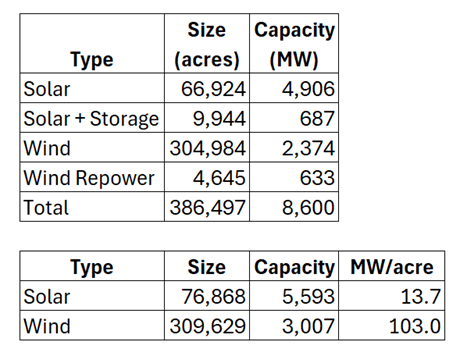
It gets worse.  The following table lists the expected sprawl (acres covered)  in 2040 when all the wind and solar resources are built for projections made by the New York Independent System Operator (NYISO) and the Integration Analysis (IA).

Solar Net-Metering

An interview in the Express Tribune describes hidden costs of solar energy

The current net metering system allows solar users to sell excess electricity back to the grid at rates that do not account for the full costs of electricity generation, distribution, and infrastructure maintenance. Unlike large-scale renewable energy projects that are directly integrated into the grid, individual net-metered solar users contribute less to grid upkeep, shifting the financial burden onto traditional grid customers and utilities.

The More You Add the Worse It Gets

Bjorn Lomborg explains that Adding more solar and wind to the energy supply pushes up the price of electricity for consumers and businesses.  He goes on to explain:

In Germany, electricity costs 43 cents per kWh—much more than twice the Canadian cost, and more than three-times the Chinese price. Germany has installed so much solar and wind that on sunny and windy days, renewable energy satisfies close to 70 per cent of Germany’s needs—a fact the press eagerly reports. But the press hardly mentions dark and still days, when these renewables deliver almost nothing. Twice in the past couple of months, when it was cloudy and nearly windless, solar and wind delivered less than 4 per cent of the daily power Germany needed.

Current battery technology is insufficient. Germany’s entire battery storage runs out in about 20 minutes. That leaves more than 23 hours of energy powered mostly by fossil fuels. Last month, with cloudy skies and nearly no wind, Germany faced the costliest power prices since the energy crisis caused by Russia’s invasion of Ukraine in 2022, with wholesale prices reaching a staggering $1.40 per kWh.

Lessons from California

Like many New Yorkers I worry that too many New York politicians aspire to follow California’s lead on issues.  Joel Klotkin describes the cost of California climate politics.  Tom Shepstone summarized the article.  I found this quote especially pertinent:

In embracing the catastrophism that defines climate change as an existential threat to life on the planet, Newsom has left behind the old progressive notion of focusing on materially improving people’s lives by embracing inherently uncertain computer models predicting danger.

In California, experts from what Bjorn Lomborg, a leading skeptic of climate catastrophism, calls “the climate industrial complex” provide the justification for staggeringly expensive, socially regressive mandates based on the conjured models; the state mandates GHG reductions but leaves implementation in the hands of state agencies closely aligned with the green lobby.

As far as I can see this situation is playing out in New York as well.  The whole article is worth a read.

A Mystery Solved

Michael Mann is the mainstream media’s go to person when they want to further the existential threat of climate change narrative because he is the author of the infamous hockey stick graph.  In a recent article I explained that his lawsuit aimed at critics of his work had come back to bite him. Stephen McIntyre is a retired mining engineer who got interested in the numbers associated with the hockey stick and discovered that Mann concealed adverse verification statistics that proved that his conclusions were wrong.  Watts Up With That published an article combining McIntyre’s “Substack, Russiagate and Other Analysis” that primarily addressed his analysis of the portion of the Mann trial that addressed Mann’s supposed loss of grants due to the people criticizing his work.

In 2009 Mann received grants totaling $2.5 million under the 2009 Obama “stimulus” bill – the so-called American Recovery and Reinvestment Act (ARRA).  The article explains:

The American Recovery and Reinvestment Act (ARRA) was passed on February 17, 2009, in the first month of the Obama presidency, and had a total budget of $831 billion – about the same, allowing for inflation, as the $893 billion budget of Biden’s so-called Inflation Reduction Act in 2022. Approximately $3.1 billion of ARRA funding was allocated to the National Science Foundation (NSF).

In an interesting recent Jon Stewart podcast (link at 44 minutes), Ezra Klein noted the total failure of the ARRA program to deliver anything on its signature promises: high-speed rail, “smart” grid or interoperable electronic health care records.

That certainly does not portend well for the Inflation Reduction Act.

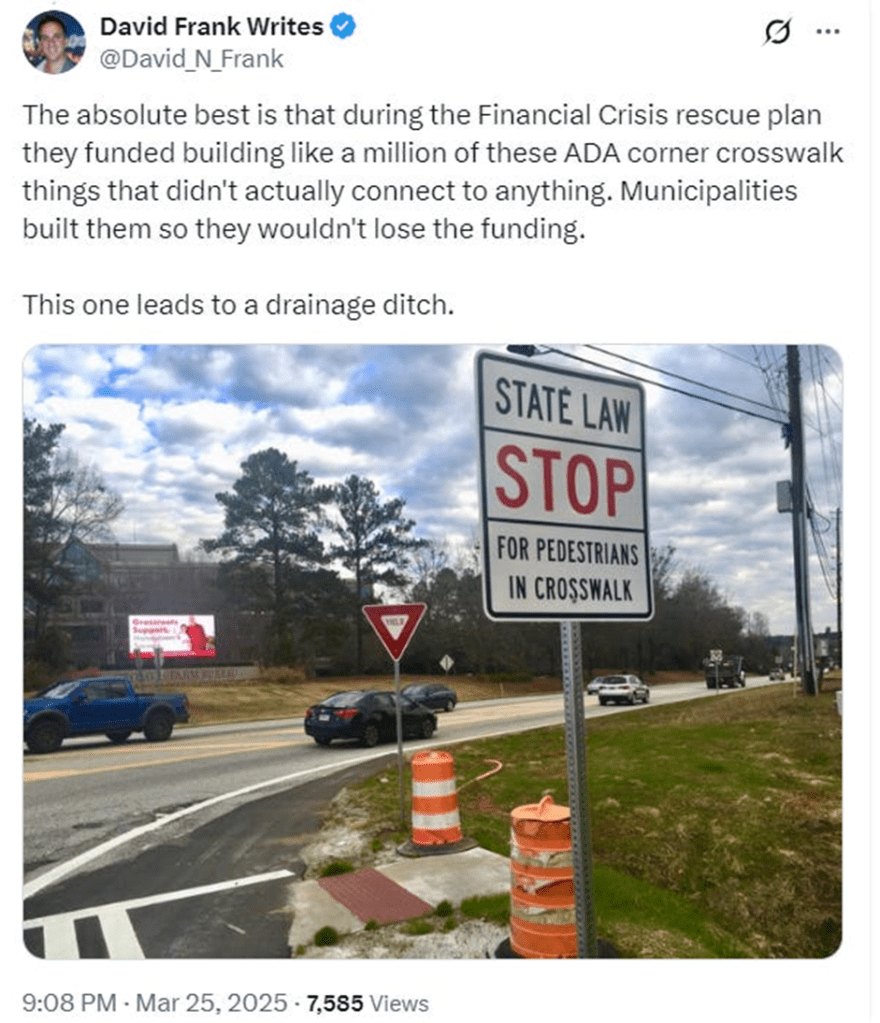
The article then explained one mystery that has bothered me for years.  Have you noticed the ADA compliant crosswalks that do not connect to anything when new traffic signals are installed?  It turns out that ARRA (link) did succeed in building thousands of “ADA corner crosswalk things that didn’t actually connect to anything”. 
Commentary on Recent Articles  March 29, 2025

This is an update of articles that I have read that I want to mention but only have time to summarize briefly.  I have also included links to some other items of interest.  Previous commentaries are available here

My primary focus lately has been New York’s Climate Leadership & Community Protection Act (Climate Act).  I have been following the it since it was first proposed and most of the articles described below are related to the net-zero transition. My opinions expressed in this article do not reflect the position of any of my previous employers or any other company I have been associated with, these comments are mine alone.

As a pragmatic environmentalist I cannot over-emphasize the necessity of tradeoffs between environmental impacts and other societal benefits.  New York’s energy policies offer two examples that ignore tradeoffs in an poorly considered appeal to ill-informed but politically powerful constituents.  The first example is the premature shutdown of two nuclear power plants – the completed but never run Shoreham plant on Long Island and Indian Point, and the second is the political decision to ban fracking in New York.  In my opinion, the best energy plan approach would be to embrace both natural gas and nuclear power.

What Might Be

David Catalfamo notes that ten years ago  “New York’s leaders turned their backs on upstate communities, banning fracking in a purely political move that had nothing to do with science”.  He points out that the decision at the time was because of uncertainties.  Since then, it has been demonstrated that the water contamination and air quality risks are manageable, the technology has evolved to further mitigate concerns, and that New York’s ban on fracking resulted in a massive lost economic opportunity.  He notes that:

While Pennsylvania added 100,000+ jobs and billions in tax revenue, upstate New York withered. The wealth didn’t disappear—it just went next door.

New York State is in desperate need for revenue to rebuild roads, fund transit, and support public services.    He concludes that New York can provide funding and join the rest of the country or stay stuck in the mistakes of 2014.

Combine Natural Gas and Nuclear

Jim Willis of Marcellus Drilling News argues that the urgent need for electric energy brought on by data centers and energy-intense manufacturing proposals could be addressed by combining natural gas and nuclear in new ways.  He references a new article that suggests that using small modular reactors and a different kind of gas fired power plant (reciprocating natural gas generator) offer advantages that make them a good choice for this application.

Green Energy Makes You Poorer

Sadly New York is going down a different path that will not end well.  Ron Klutz describes a post by Matt Ridley that explains How the Green Energy Transition Makes You Poorer.  Ridley cites a United Kingdom analysis that the net-zero transition there will reduce the GDP by 10% by 2030 if it succeeds.  Giving up all the fossil fuel infrastructure strands so many assets that will be an expensive economic disaster. 

The problem is simple:

If the new technologies are more efficient than the old ones, fine. LED light bulbs use about 90% less electricity than incandescent bulbs did. So yes, it does make sense to throw out your old bulbs before they expire, stranding those assets, to save electricity and money. Is the same true of a wind farm or a heat pump? No, they are demonstrably more expensive and less reliable at producing the same electricity as the devices they are replacing. They are worse, not better.

Ridley concludes:

Electricity is not an end in itself; it is a means to an end, an essential input allowing us to do the one and only thing that does, really does, represent growth—achieving more output with less input.  Right now, the Net Zero transition is doing the very opposite

Battery Backlash

Robert Bryce has put together a Global Battery Rejection Database that “shows 52 communities from California to Australia have rejected battery projects. The fire at Vistra’s Moss Landing site will ignite even more opposition.”

Wind Farm Decision

The lawyer who successfully battled a massive Nebraska wind farm development describes the legal approach used.  A news story explains:

A federal judge has dismissed most of a lawsuit filed by North Fork Wind against Knox County, Nebraska, after the county changed its zoning regulations, effectively halting development of a proposed 600-megawatt wind farm. U.S. District Court Judge John Gerrard ruled that North Fork Wind had not proven that Knox County’s new setback requirements and other regulations had interfered with its contracts or violated its constitutional rights to due process and equal protection. However, the judge did allow the company to proceed with a Fifth Amendment claim, arguing that the county’s actions amounted to an unlawful taking of property.

New York Climate Superfund

Ed Reid explains why the Climate Change Superfund bill is lawfare.  He notes that “An appropriate topic for any discussion of lawfare, whether lawsuits alleging violation of existing laws or legislation leading to new law, is the issue of standards of evidence.“  Then he points out that alleged extreme weather of concern claims are inconsistent with the IPCC Sixth Assessment Report (AR6, Chapter 12) that “indicates no linkage between global warming and climate change and the frequency and intensity of extreme weather events with the exception of heatwaves, which are affected by increasing average temperatures.”  Not surprisingly, the law is the subject of a lawsuit filed by 22 states based on constitutional grounds.

Vermont Cap and Invest Impacts

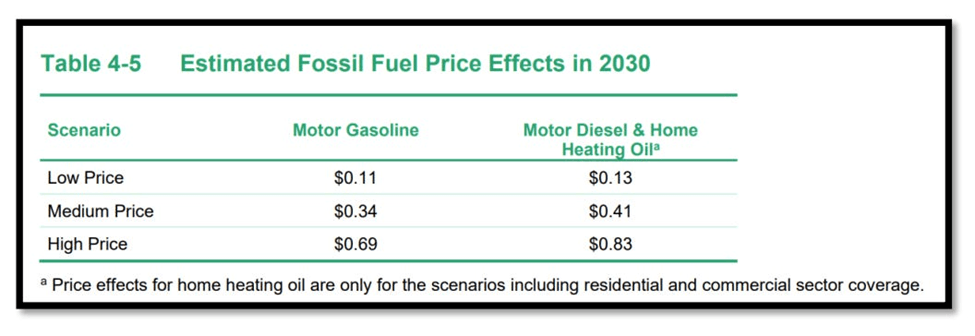
Robert Roper describes the Treasurer’s Report on their version of a cap and invest program.  The estimated costs are shown below.  Note that the Report concludes that the only way to get to the targets is the high price scenario.

It gets worse.  The high price scenario includes the mandate for “full reinvestment”.  Roper explains:

What does “full reinvestment” mean? It means that all the money collected from this fuel tax must be spent on greenhouse gas reduction measures. No money collected can be redistributed to lower income Vermonters as a safety net to mitigate the cost impacts of the program. In other words, the GWSA screws poor, rural Vermonters. Hard. Especially and royally.

Videos

Commentary on Recent Articles  March 17, 2025

This is an update of articles that I have read that I want to mention but only have time to summarize briefly.  Previous commentaries are available here

My primary focus lately has been New York’s Climate Leadership & Community Protection Act (Climate Act).  I have been following the it since it was first proposed and most of the articles described below are related to the net-zero transition. My opinions expressed in this article do not reflect the position of any of my previous employers or any other company I have been associated with, these comments are mine alone.

EPA Deregulatory Action

Alex Epstein breaks down the regulations that the Trump Administration is going to reconsider.  Despite the constant drumbeat in the media the American environment is in pretty good shape.  In my opinion all the rules mentioned represent overreach and will have larger negative impacts than positive benefits.  However, I don’t think that there will be many changes for the affected companies.  I suspect the presumption will be why make investments when another administration can just undo them all.  Absent overwhelming evidence of the impact of the overreach policies, like a catastrophic blackout, I do not know what would change public opinion enough to satisfy investors that reliable power is a necessary investment and regulators to change policies to prioritize reducing reliability risks.

Endangerment Finding was Politically Motivated

One of the deregulatory actions described by Epstein included the endangerment finding that claimed that a trace gas necessary for human life needed to be regulated.  Kevin Killough notes that the “Emails obtained through FOIA requests suggest the procedure Obama’s EPA used to come to its endangerment finding was informed by people who wanted to regulate greenhouse gases as a pollutant no matter what and came to a predetermined conclusion on behalf of a “progressive” national policy.”  For all the talk about science driving Progressive policy the reality is that the climate change transition proponents could have cared less about the science.

Reality or Waste

Collin Kinniburgh describes the tradeoffs for New York gas utilities replacing ancient natural gas pipelines against the Climate Act electrification transition.  Utilities say the spending is necessary to maintain “public safety and world class reliable service,” as well as reduce greenhouse gas emissions from the leaky pipes.  Naturally the electrification advocates who have no skin in the game if people freeze to death or go broke due to higher costs, argue that it is a waste of money because the infrastructure will be made obsolete by the Climate Act.  I hope that the companies are simply acknowledging the fact that when the costs become evident that the political winds driving the conversion will stall.  In addition, I believe that keeping natural gas infrastructure is a pragmatic tradeoff.  It is not only that an electric system dependent upon wind, solar, and short-term energy storage has not been shown to be able to provide electric power as reliably as it is today, but the State has yet to confront the consequences of a long duration blackout due to, for example, an ice storm, on an all-electric residential system.  Natural gas capabilities can save lives during those events.

Climate Fact Check

This summary serves as a fact check on the top false claims made about climate change by the media in February 2025. Debunked media claims include claims that greenhouse gases threaten public health, Atlantic Ocean losing circulation, adjusting temperature data is science, earth’s thermostat is rising, and glaciers shrinking faster than ever.  In each instance, the fact checks cite rebuttal information.

Wind Power and Eagles

David Wojick raises the important point that almost every wind project in America has a permit to kill a certain number of eagles per year. The article points out that “Estimates suggest that wind farms kill at least 150,000 birds annually in the U.S. alone”.  It goes on to explain why that is probably a low-ball estimate because scavengers quickly remove the dead birds.  Compounding the problem eagles “reproduce slowly so even a small number of deaths can have devastating impacts on populations”.  In New York the last cumulative environmental impact that should have addressed this issue was completed before the Scoping Plan was published.  The Scoping Plan projects that 16,690 MW of land-based wind will be needed in 2050.  The Alle-Catt Wind Energy Center is a proposed 340-megawatt (MW) wind power generation facility in Allegany, Cattaraugus, and Wyoming Counties targeted to begin construction in 2025 that will use 2.9 MW wind turbines. Using that size turbine means there will be 5,755 Eagle Cuisinarts built. There is no estimate how many eagles could be legally killed each year when that many are deployed but there are only 1,000 Bald Eagles in the state.  Have we lived to see Bald Eagles return to New York only to kill them off in this mad attempt to control the weather?

Oh the Calamity

This article really deserves more attention because it includes every green narrative talking point about the evils of natural gas pipelines.  I simply do not have the time or the stomach to deal with rebutting it.  Fair warning here is a link to an article from City Limit describing how critics argue that the approval of a major gas pipeline running through much of upstate New York shows how the state’s commitment to its climate goals is waning.  Vinny Gambini sums it up.

Electricity Bills are Going Up

The Journal News reports that 1.3 million New Yorkers are in utility arrears, and ratepayers, advocates and lawmakers are all recommending action amid their frustration.  What is absolutely necessary for understanding why the electricity bills are going up is a clear, transparent, and well documented description of the costs, emission reductions, realistic implementation schedules, and expected revenue streams for the strategies proposed to meet the Climate Act mandates.  The utility companies are burying many costs imposed on them by the lawmakers.

Energy Choices Review

Thomas Shepstone describes a new report out by ARC Research does a beautiful job setting out a rationale discission of energy issues against the shrill cries of climate cultists. It’s titled “The Choices We Face, Energy for the 21st Century: A Declaration of Guiding Principles.”  Authors Mike Mills and Dr. Scott Tinker argue that the transition away from fossil fuels is driven by climate policy concerns and make the point that: “Notwithstanding the certainties and uncertainties around climate issues, the principles of the physics of energy are independent of climate science.”    They go on to argue: “Because energy is foundational for civilization, as a guide for framing civil dialogue and deep thinking around the energy-environment balance, we propose herein nine energy principles, three each in three domains—Economics, Politics, and Science and Technology.”   The guiding principles are:

  • Lifting up those in poverty to alleviate suffering and promote human dignity requires more energy.
  • Human flourishing requires more energy that is less expensive and more reliable, not less energy that is more expensive and less reliable.
  • In the pursuit of flourishing, humans continually invent new products and services, all of which necessarily use energy.
  • Energy security is a top priority for global leaders, revealed in their actions, if not always their words.
  • When wealthy economies export energy production, they impose environmental impacts on less-wealthy nations.
  • Government mandates and/or excessive intrusion in markets stifles energy innovation, options, and freedoms.
  • Capturing and delivering energy to society is about inventing, building, and perfecting technologies based on what physics and engineering allow.
  • All society-scale energy systems have environmental trade-offs.
  • The energy available in nature itself is fundamentally unlimited.

This is a useful summary of what New York energy policy should be discussing instead of its monomaniacal concentration on aspirational climate change mitigation.

Commentary on Recent Articles  March 9, 2025

This is an update of articles that I have read that and want to mention but only have time to summarize briefly.  I have also included links to some other items of interest.  Previous commentaries are available here

I have been following the Climate Leadership & Community Protection Act (Climate Act) since it was first proposed and most of the articles described below are related to the net-zero transition.  I have devoted a lot of time to the Climate Act because I believe the ambitions for a zero-emissions economy embodied in the Climate Act outstrip available renewable technology such that the net-zero transition will do more harm than good. The opinions expressed in this article do not reflect the position of any of my previous employers or any other company I have been associated with, these comments are mine alone.

Alex Epstein

Epstein recently published two great articles.  The first proposed a solution to America’s electricity crisis.  The post included a video of his spoken testimony and Q&A, along with his prepared remarks, for a House Oversight Committee’s hearing on “Leading the Charge: Opportunities to Strengthen America’s Energy Reliability.” He described five damaging restrictions on reliable power that need to change:

  1. End criminalization of nuclear power
  2. End forced shutdowns of fossil fuel plants
  3. End onerous permitting processes
  4. End electricity market rules that devalue reliability
  5. End subsidies for unreliable power

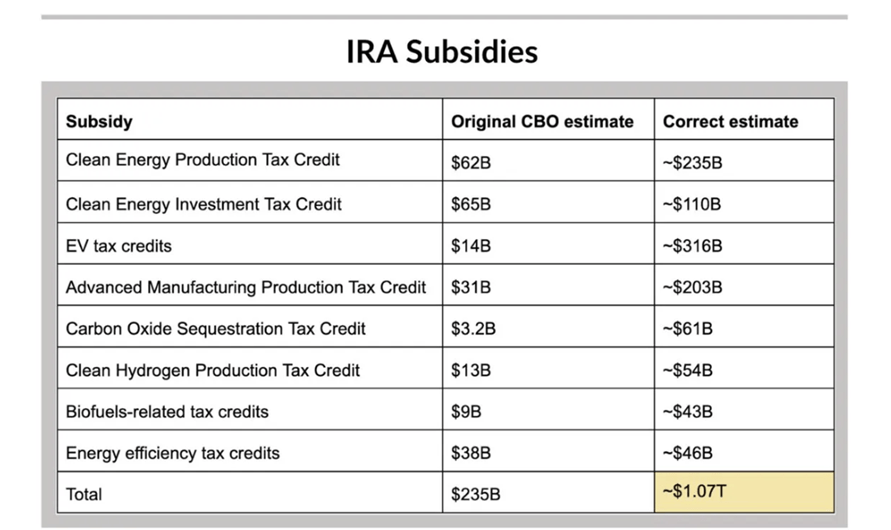
In his second article he described the Full cost of IRA subsidies.  He described eight subsidies that increase the debt, increase the cost of living, prevent productive business and jobs from being created, and increase corruption.

Offshore Wind

There are signs that the offshore wind grift is running out of steam.  The entire clean energy sector is in trouble.  Charles Rotter notes that Nishant Gupta, founder and chief investment officer at London-based Kanou Capital LLP, didn’t mince words when describing the dire state of solar, wind, hydrogen, and fuel cell investments.

“The whole sector… is dead for now,” Gupta stated plainly​. This marks a turning point—when even those inside the financial world, who have long played along with the green energy narrative, admit that the numbers simply don’t add up.

It’s no secret that the clean energy sector has been in trouble. Over the past year, the S&P Global Clean Energy Index has plummeted by 20%, while the broader S&P 500 has gained 16%​. That’s a devastating underperformance, especially in an industry that was supposed to be on the cusp of taking over the world.

Gupta cites several reasons for the industry’s collapse, including high interest rates, supply chain struggles, and what he calls “political headwinds” in the U.S. The latter is a reference to the Biden administration’s green agenda losing steam, and with the Trump administration poised to undo climate-focused regulations, green investors are panicking​.

In simple terms, the entire “green energy revolution” has been built on a foundation of government intervention rather than market fundamentals. Now, as subsidies and mandates run into reality, the industry is showing just how weak it really is.

The offshore wind industry is not doing itself any favors too.  Recall that last summer a wind turbine failed at the Vineyard Wind industrial offshore wind complex near Nantucket, MA.  One of the problems was that the company did not alert the locals about the problem.  One would think that they would have learned that it is always best to explain what is going on sooner rather than later.  The turbine that broke up was hit by lightning and there was no notification.  Such actions will not engender public support.

Climate Science Dishonesty

Roger Pielke, Jr. frequently comments on the undeniable issues of scientific integrity in climate science.  In his latest article on the topic he describes an investigation by Sveriges Radio (Swedish public radio)   into multiple exaggerations and falsehoods about climate change that have been promoted by the United Nations.  Examples included Sea Level Rise Misinformation, adolescent deaths due to climate change, women and children are more likely to die because of climate change, and there are increases in weather disasters.  Pielke concludes:

The climate science community has a poor track record of addressing misinformation associated with those promoting climate change as a political agenda. This has been called noble cause corruption. If the United Nations is among those promoting such misinformation, we should not be surprised if the credibility of IPCC — which sits under the UN — becomes called into question, fairly or unfairly.

You can listen to the Swedish Radio report in English here — highly recommended, excellent and rare reporting on climate.

CO2 as the Control Knob for Climate

I have been thinking about writing an article about the drivers of climate change.  The popular narrative and the rationale of all GHG emission reduction programs is that the greenhouse effect is the primary reason for climate change so that reducing emissions will reduce climate changes.  There is no question that increasing greenhouse gas emissions will result in warming within the atmosphere but the associated caveats and impacts of this driver relative to all the other drivers suggests that emission reductions could just as easily have no discernable effect on global warming.  Two articles illustrate the implications.             

Andy May and Tom Shula consider the roles of energy, water vapor, and convection in the earth’s atmosphere argue that the greenhouse effect is a minor driver.  However, note that WUWT editors are skeptical:

We find aspects of the CO₂ thermalization theory presented in this article to be inconsistent with well-established experimental and empirical evidence. As Richard Feynman famously stated, “It doesn’t matter how beautiful your theory is, it doesn’t matter how smart you are. If it doesn’t agree with experiment, it’s wrong.”

Extensive laboratory spectroscopy and direct atmospheric observations confirm that CO₂ plays a role in radiative heat transfer, and while water vapor is indeed the dominant greenhouse gas, the claim that CO₂’s effects are negligible does not align with measured data. That said, scientific inquiry thrives on scrutiny and debate, and we encourage readers to critically evaluate all perspectives in light of experimental validation and real-world measurements. Anthony has written primer on Carbon Dioxide Saturation in the Atmosphere also worth reading, as it describes how the logarithmic effect of CO₂ versus temperature will continue to lessen its impact even as atmospheric CO₂ concentrations increase.

Roy Spencer points out that if the greenhouse gas warming needs to be addressed then it would be appropriate to regulate the most potent greenhouse gas – water vapor.  Burning any fuel produces water vapor resulting in local impacts as well as increased global warming.  However, this aspect of the greenhouse effect is ignored.  He notes:

The climate scientists who publish papers about the supposed dangers of greenhouse gas emissions make sure to exclude water vapor from their concerns, claiming CO2 is the thermostat that controls climate. I have commented extensively on the sleight of hand before. The vast majority of climate scientists believe CO2 controls temperature, and then temperature controls water vapor. CO2 is the forcing, water vapor is the feedback. But this argument (as I have addressed for many years) is just circular reasoning. The amount of water vapor in the atmosphere (did I forget to mention it’s our main greenhouse gas?) is partially controlled by precipitation processes we don’t even understand yet. The climate modelers simply tune their models to remove water vapor (through precipitation processes) in an arbitrary and controlled way that has no basis in the underlying physics, which are not yet well understood. Often, these simplifying assumptions translate into assuming relative humidity always remains constant.

Clearly frustrated he describes why he believes that water vapor is not regulated:

Clearly it’s not because water vapor is “necessary” to the functioning of the Earth system, since CO2 is necessary for life on Earth to exist. Which brings me back to my question, is the EPA really trying to help us when it comes to climate-related regulation?

I’m increasingly convinced that science has been hijacked in an effort to (among other motives) shake down the energy industry. This has been planned since the 1980s. It makes no difference that human flourishing depends upon energy sources which are abundant and affordable. It doesn’t matter how many people are killed in the process of Saving the Earth. The law demands regulation, and that’s all that matters.

I have evidence. In the early 1990s I was at the White House visiting Al Gore’s environmental advisor, Bob Watson, a ex-NASA stratospheric chemist who was just coming off the successful establishment of the Montreal Protocol on Substances that Deplete the Ozone Layer. He told me (as close as I can recall), “We succeeded in regulating ozone-depleting chemicals, and carbon dioxide is next“.

Keep in mind this was in the early days of the IPCC, which was tasked to determine whether humans were changing the climate with greenhouse gas emissions. Their work was just getting started, including the scientists who would assist the process. But the regulatory goal had (wink, wink, nod, nod) already been established.

So, I don’t believe the EPA is actually trying to help Americans when it comes to climate regulation. I’m sure many of their programs (waste cleanup, helping with the Flint, MI water problem, and some others) are laudable and defensible.

But when it comes to regulation related to global climate (or even local climate, as the government tries to pack even more people into small spaces, e.g. with “15 minute cities“), my experience increasingly tells me no one in the political, policy, regulatory, legal, or environmental advocacy, side of this business really cares about the global climate. Otherwise, they would admit their regulation (unlike, say, regulating the precursors to ground-level ozone pollution in cities) will have no measurable impact. They wouldn’t be trying to pack people into urban environments which we know are 5-10 deg. F hotter than their rural surroundings.

It’s all just an excuse for more power and vested interests.

Commentary on Recent Articles February 22, 2025

This is an update of articles that I have read that I want to mention but only have time to summarize briefly.  I have also included links to some other items of interest.  Previous commentaries are available here

I have been following the Climate Leadership & Community Protection Act (Climate Act) since it was first proposed and most of the articles described below are related to the net-zero transition.  I have devoted a lot of time to the Climate Act because I believe the ambitions for a zero-emissions economy embodied in the Climate Act outstrip available renewable technology such that the net-zero transition will do more harm than good. The opinions expressed in this article do not reflect the position of any of my previous employers or any other company I have been associated with, these comments are mine alone.

All Goal and No Plan

Ed Reid explains that UN Framework Convention on Climate Change Conference of the Parties 21 (COP21) in Paris, France produced the Paris Accords, a non-binding agreement under which the participating nations agreed to take actions necessary to achieve a goal of Net Zero CO2 emissions by 2050.  Since then, Reid notes:

It has become increasingly clear that, while the developed nations adopted the Net Zero by 2050 goal, none of them have developed a detailed plan to achieve the goal, nor have any of them analyzed in detail the cost of achieving the goal. Also, none of them has demonstrated that the transition to renewable generation they are pursuing would lead to a stable, reliable and economical energy economy. In spending hundreds of billions of dollars in pursuit of the goal without a plan or a demonstration, they have clearly “put the cart before the horse”.

 New York has joined the developed nations because this description is perfectly apt for the Climate Act.  It is truly “All goal and no plan”.

What Does No More Fossil Fuels Mean?

Ronald Stein regularly writes articles about energy illiteracy with a focus on the role of crude oil in society. Whenever I read one of his articles I wonder if the folks who demand that we stop using fossil fuels understand the implications.  In a recent piece he argues that over the last 200 years, world population has grown from 1 to 8 billion “because of the more than 6,000 products and different fuels that did not exist before the 1800s.”    He sums up:

Policymakers have no comprehension that crude oil is virtually never used to generate electricity, but when manufactured into those petrochemicals that are the basis of more than 6,000 products, it is the basis for virtually all the products that support hospitals, medical equipment, appliances, electronics, transportation, telecommunications, heating and ventilating, and communications systems.

Bugged by Wind Turbines

Chris Morrison describes the “Devastating Ecological Carnage Wrought by Wind Turbines”.  It is not just the birds but also flying insects – tons of insects.  Work in Germany found that each turbine killed 40 million each during the growing season. 

Recent work from researchers at the University of Wyoming suggests that moths, butterflies, beetles, flies and true bugs may be the most vulnerable to the giant revolving blades. Wind turbines create vortices, sucking in wildlife and causing problems for both bats and large birds such as eagles. “The vast amount of avian and insect deaths at the hands of wind turbines is disastrous in and of itself, from a conservation and ecological standpoint,” states Heartland.

Morrison sums up noting that “the loss of insects is particularly disastrous since they are decomposers, crop pollinators and a crucial basis of the entire food chain.”

Affordability is not the only risk of politicians dictating energy policy.  As I was finalizing this draft, I found an article by Robert Bradley that explains why doing the transition right is necessary.  The article is a retrospective on the Great Texas Blackout that describes how politicians are wrecking electric grid reliability.

It was not so much the story of freak weather triggering a market failure writ large. It was a classic application of the political economy of government intervention: the seen and the unseen, expert/regulatory failure, and unintended consequences.

I recommend the article highly.

NY Climate Superfund Lawsuit

ABC News reports that Twenty-two states sued New York on Thursday, contending that a new law forcing a small group of major energy producers to pay $75 billion into a fund to cover climate change damage is unconstitutional.

According to a statement, West Virginia Attorney General JB McCuskey led the coalition of states against New York’s Climate Change Superfund Act, which requires payments for damage allegedly done from 2000 to 2018.

The law requires major fossil fuel companies to pay into the fund over the next quarter-century based on their past gas emissions.

“This lawsuit is to ensure that these misguided policies, being forced from one state onto the entire nation, will not lead America into the doldrums of an energy crisis, allowing China, India and Russia to overtake our energy independence,” McCuskey said in a release.

“This law is unconstitutional, and I am proud to lead this coalition of attorneys general and brave private energy companies and industry groups in our fight to protect against this overreach,” McCuskey added. “If we allow New York to get away with this, it will only be a matter of time before other states follow suit – wrecking our nation’s power grid.”

I cannot imagine that anyone is surprised that this act of New York Progressive Democrat political grandstanding would not produce this pushback. 

EPA Funding Mismanagement

In my December 8, 2024 commentary I described a Project Veritas report that EPA is getting money out for climate change things before the Trump Administration comes in.  The money quote was from  Brent Efron, Special Advisor for Implementation, Environmental Protection Agency: “Now it’s how to get the money out as fast as possible before they [Trump Administration] come in … it’s like we’re on the Titanic and we’re throwing gold bars off the edge.”

Jo Nova describes a New York Post article with Trump appointee EPA Administrator Lee Zeldin who describes the most egregious example of waste uncovered so far: “It’s extremely concerning that an organization that reported just $100 in revenue in 2023 was chosen to receive $2 billion,” EPA Administrator Lee Zeldin told the outlet, referring to Power Forward Communities’ latest tax filings. “That’s 20 million times the organization’s reported revenue.”

Thomas Shepstone notes:

How could someone set up a non-profit NGO and then almost immediately grab $2 billion Greenhouse Gas Reduction Fund grant from taxpayers? That it happened under the thoroughly corrupt administration of Joe Biden explains most of it, of course. The suggestion in this Climate Change Dispatch story is that it all had to do with the influence of Stacey Abrams, a hero of the left.

He goes on to describe the NGO: Power Forward Communities is a 501(c)(3) NGO set up in 2023 with but $100 in assets according to its 990 return.  He describes the five NGOs that he brought together.  In every instance, the top officers of the organizations were paid enormous salaries.  For example, one NGO collected $51,568,253, and it paid its CEO $1,045,416.

Shepstone concludes and I concur:

What is unmistakably clear from the above is simply this: the $2 billion in supposed climate expenditures made with our descendants’ taxes is nothing more than a gigantic green grift. Simply put, NGOs are corrupting everything about our government. They need to be denied any government funding whatsoever if we ever hope to regain control over our republic.

If you thought that such an egregious misuse of funding would be embarrassing for environmental advocates, then you would be wrong.  Inside Climate News describes Zeldin’s efforts to claw back the money:

Environmental advocates said Zeldin was unfairly smearing the Greenhouse Gas Reduction Fund, or “green bank,” program, on which EPA worked for more than a year with the Treasury Department to design a standard financial agent arrangement—the kind the government has used many times before to collect and distribute funds.

Commentary on Recent Articles February 9, 2025

This is an update of articles that I have read that I want to mention but only have time to summarize.  I have also included links to some other items of interest.  Previous commentaries are available here

I have been following the New York  Climate Leadership & Community Protection Act (Climate Act) since it was first proposed and most of the articles described below are related to the net-zero transition.  I have devoted a lot of time to the Climate Act because I believe the ambitions for a zero-emissions economy embodied in the Climate Act outstrip available renewable technology such that the net-zero transition will do more harm than good. The opinions expressed in this article do not reflect the position of any of my previous employers or any other organization I have been associated with, these comments are mine alone.

Videos

  • Mike Rowe’s podcast interviews Alex Epstein to talk about the greatest climate myths and misconceptions.
  • John Robson from Climate Discussion Nexus describes the origin of the LA fires.
  • Matthew Wielicki notes that alarmists blame every weather event on climate change and explains why this is erroneous in a Prager University video.

Ill Wind

Robert Bryce notes that wind energy projects are taking a hammering.  He notes that:

A few days ago, Jason Grumet, the head of the American Clean Power Association (annual revenue: $62.3 million), told Heatmap News that “probably more than half” of all new wind projects under development in the US could be killed due to President Trump’s executive order requiring a “comprehensive assessment” of federal permitting. Heatmap explained that Trump’s policies pose “a potential existential threat to the industry’s future. Just don’t expect everyone to say it out loud.

This has big ramifications for New York State’s net-zero transition efforts.  The NY plan calls for zero emissions from the electric sector by 2040.  State 2040 capacity (MW) projections call for 12% onshore wind, 12% offshore wind and 36% solar.  State energy generation (GWh) projections call for 17% onshore wind, 22% offshore wind, and 30% solar.  Solar in New York in the winter is a horrible resource due to latitude and the fact that a large portion of the state is affected by lake-effect clouds and snow that reduce solar irradiance.  Solar cannot be expanded to cover the lack of wind development so now what?

Bryce also published an article noting that:

The bad news for offshore wind keeps coming. On Monday, New Jersey canceled plans for another offshore wind solicitation, citing Shell’s decision to abandon the Atlantic Shores wind project “as well as uncertainty driven by federal actions and permitting.” Recall that New Jersey has some of the most ambitious offshore wind plans of any state on the Eastern Seaboard. And now, all those plans appear headed for Davy Jones’ Locker. But it’s not just New Jersey. This week, Danish wind giant Ørsted said it was slashing its planned investments through 2030 by 25% due to its beleaguered US offshore projects and said it would take a “stricter, more value-focused approach to capital allocation.” The same day Ørsted made its announcement, Equinor, Norway’s state-owned oil company, said it was slashing its renewable energy targets and increasing its focus on… wait for it…oil and gas production.

Vermont Insanity

Mark Whitworth describes Vermont’s Global Warming Solutions Act (GWSA). Incredibly it includes an extraordinary requirement that not even New York has incorporated.  Whitworth explains the essence of the GWSA;\: “I’m gonna flap my arms and fly over the Statehouse dome. And if I should fail, I will punch myself in the face.”  He goes on:

The “flap my arms and fly” portion of the GWSA is a set of unachievable carbon emissions reduction targets. The “punch myself in the face” part is the GWSA’s invitation to sue Vermont at taxpayer expense when the unachievable targets are not met. We will then face the prospect of a judge ordering the Secretary of Vermont’s Agency of Natural Resources to make rules that accomplish the impossible. It won’t be pretty.

Just like in New York proponents of the law established aspirational targets that cannot be met.  New York does not have an explicit mandate for a lawsuit funded by the state if the targets are not met.  However, on November 2, 2021, New York voters approved an Amendment to the State Constitution’s Bill of Rights providing that: “Each person shall have the right to clean air and water, and to a healthful environment.”  In those sixteen words, “the right to a healthy environment was, for the first time, cloaked in constitutional protection in New York and deemed the equivalent to the sixteen current constitutional guarantees in the state Bill of Rights.”  There is no doubt in my mind that someone will sue when New York’s targets are not met citing this amendment.

Oil Merits

Meredith Angwin describes the importance of oil generation in New England.  Everything she says is relevant to New York too.  Her article is notable also because it nicely describes how generating plants are dispatched.  She explains why even though natural gas is cheaper than oil, there are times when oil must be burned because natural gas is simply not available.  Green energy proponents look at this situation and argue that it proves the desirability of wind, solar, and energy storage but always ignore a key point.  They claim that these weather-dependent resources increase resiliency, but the resources invariably fail to show up when needed the most so that won’t work.  Angwin concludes “we need to think about being overly dependent upon any one fuel”. 

Natural Variability

Jamie Jessop explains that two natural climate drivers were the primary drivers of the recent global temperature peak.  The world warmed because of the Hunga Tonga undersea volcano that injected water vapor in the upper atmosphere, then some more because of a strong El Nino. She notes that “The effect of both natural events is now fading rapidly.”  Now we are at an inflection point.  If the climate models are correct such that the alarmists screeching about an existential threat has some basis, then temperatures will cool to a plateau maintaining or even accelerating the long-term warming trend. 

On the other hand, if “nature is in control of our climate”, then two climate cycles will cause global temperatures to fall.  According to Perplexity AI: “The Atlantic Multidecadal Oscillation (AMO) and Pacific Decadal Oscillation (PDO) are two important climate cycles that significantly influence global weather patterns and temperatures.”  Jessup concludes:

If you’re not a natural climate change denier and you consider that a positive AMO plus PDO has contributed significantly to global warming since 1950, then you might expect the globe to cool significantly in the coming decades. In that case, the end of the Era of Global Boiling might turn out to be the far more significant end of the era of global warming – which will mean that the climate crisis loons will be trying to convince us all that warming really means cooling (because AMOC shutdown or something).

CO2 Cannot Explain Current Warming

Matthew Wielicki explains that because during the last interglacial period global temperatures were significantly warmer than today but CO₂ levels were much lower CO₂ levels cannot be the primary driver of global warming.

This glaring inconsistency should give pause to anyone who accepts the idea that CO₂ is the sole or even primary climate control knob. If CO₂ is truly the driving force behind global temperature, why was it hotter 120,000 years ago when CO₂ was only 275-280 ppm? Why have climate models consistently failed to accurately recreate past climate conditions? If climate models cannot reliably reproduce known historical warm periods like the Eemian, how can we trust their projections for the future? These discrepancies highlight fundamental flaws in the assumptions underpinning climate modeling, raising serious doubts about their ability to predict long-term climate trends with precision.

In his article he explains that natural factors such as orbital shifts, solar insolation, ocean circulation, and long-term feedback mechanisms have played a much greater role in shaping past climate changes than CO₂. This is completely consistent with Jamie Jessup’s article mentioned above and I think his explanation is readable.  Wielicki concludes “Ignoring these factors in today’s climate debate is not just bad science; it’s deliberate deception.”

Commentary on Recent Articles January 26, 2025

This is an update of articles that I have read that I want to mention but only have time to summarize briefly.  I have also included links to some other items of interest.  Previous commentaries are available here

I have been following the Climate Leadership & Community Protection Act (Climate Act) since it was first proposed and most of the articles described below are related to the net-zero transition.  I have devoted a lot of time to the Climate Act because I believe the ambitions for a zero-emissions economy embodied in the Climate Act outstrip available renewable technology such that the net-zero transition will do more harm than good. The opinions expressed in this article do not reflect the position of any of my previous employers or any other company I have been associated with, these comments are mine alone.

How to Think About Climate

William Happer gave a talk entitled How to Think About Climate at the National Leadership Symposium at Hillsdale College on February 19, 2021.  A video of the presentation is available and Watts Up With That published a transcript with illustrations recently.  Dr. Happer is professor Emeritus in the Department of Physics at Princeton University.  He is a specialist in modern optics, optical and radiofrequency spectroscopy of atoms and molecules, radiation propagation in the atmosphere, and spin-polarized atoms and nuclei.  Activists claim that he is not a climate scientist but he is an expert in atmospheric radiation propagation, you know the physics of the greenhouse effect.  It is well worth your time to read or listen to this talk because it is an excellent summary of the science and the politics of the climate change crusade.

He concludes with two takeaways:

So, the takeaway message is that policies that slow CO2 emissions are based on flawed computer models which exaggerate warming by factors of two or three, probably more. That is message number one. So, why do we give up our freedoms, why do we give up our automobiles, why do we give up a beefsteak because of this model that does not work?

Takeaway message number two is that if you really look into it, more CO2 actually benefits the world. So, why are we demonizing this beneficial molecule that is making plants grow better, that is giving us slightly less harsh winters, a slightly longer growing season? Why is that a pollutant? It is not a pollutant at all, and we should have the courage to do nothing about CO2 emissions. Nothing needs to be done.

Endangerment Finding

Francis Menton did an excellent review of the EPA Endangerment Finding of 2009.  He explains that this declared that CO2 was a pollutant which gave the EPA the mandate to regulate CO2 making it the basis of all the EPA regulations limiting emissions.  Menton described litigation associated with the Finding that was intended to rescind the finding that CO2 was a “danger” to human health and welfare.  Unfortunately, the first Trump Administration ignored the litigation, and it was dismissed.

The good news highlighted in his article is that among the blizzard of Executive Orders signed by Trump was “Unleashing American Energy.”

There is a large amount of important material in this EO. In overall summary, it directs the reversal of all of the Biden administration efforts to restrict and suppress the production and development of America’s energy resources. But one provision, I would argue, is important above all the rest. That is Section 6(f), which directs a reconsideration of the so-called Endangerment Finding (EF) of December 2009. That provision of the EO reads as follows:

(f)  Within 30 days of the date of this order, the Administrator of the EPA, in collaboration with the heads of any other relevant agencies, shall submit joint recommendations to the Director of OMB on the legality and continuing applicability of the Administrator’s findings, “Endangerment and Cause or Contribute Findings for Greenhouse Gases Under Section 202(a) of the Clean Air Act,” Final Rule, 74 FR 66496 (December 15, 2009).

Menton concludes: “If the EF is rescinded with a well-reasoned regulatory action, the courts will have little to no ability to stop the Trump roll-back of all the Obama/Biden restrictions on fossil fuels and energy transition.”  Needless to say I think that would be an enormous victory.

The scourge of prosocial censorship

John Ridgway describes a recent research paper published in The Proceedings of the National Academy of Sciences argued that both self-censorship and the prosocial censorship of colleagues are commonplace within the sciences — and the problem is only getting worse. 

Ridgway explains that prosocial censorship is a “form of censorship in which work is rejected, and individuals cancelled, not because the work is substandard or flawed, but because it threatens to undermine a cherished ideology or someone else’s concept of societal safety and harmony. Such censorship is never portrayed as such, of course; the reason given is always that the individual(s) concerned were peddling substandard work leading to harmful misinformation.”

He provides multiple examples of experts in their field who fell from grace by publishing something that gatekeepers felt was inappropriate.  He describes the range of this cancellation of individuals and describes climate skeptics like me.

Somewhere in the middle are the concerns harboured by the climate sceptic. Whilst we understand that science is not supposed to operate by consensus, we would, nevertheless, like to believe that an emergent consensus is the result of a developing common knowledge, rather than the result of social engineering enabled by prosocial censorship

For my part I fear the science is getting lost in the pursuit of the climate change religion.

Green Hydrogen

The Climate Act Scoping Plan proposed to use “green” hydrogen to provide the needed dispatchable emission-free resource (DEFR) required to backup wind and solar during extended periods of low resource availability.  Vijay Jayaraj explained that the “miracle” of green hydrogen is becoming a faded mirage.  He explains:

Green hydrogen start-ups are shuttering operations, major projects are being shelved, and investors are retreating from what was once seen as the next frontier in “renewable” energy. This shouldn’t come as a surprise to anyone whose attention to fundamentals has not been diverted by the extravagant claims of promoters.

The latest analyses predict that green hydrogen prices are likely to remain stubbornly high for decades. The goal of achieving production costs below $2 per kilogram – the threshold for competitiveness with fossil fuels – remains far out of reach. In most parts of the world, the economics simply do not add up.  The reasons are multifaceted. One of the fundamental flaws of green hydrogen is its reliance on wind and solar energy that is expensive, intermittent and unreliable.  The entire green hydrogen cycle is also inherently inefficient. 

Broken record time – Why is New York pushing ahead without a solution to DEFR when the placeholder technology is clearly a non-starter?

Data Tampering

Tony Heller at Real Climate Science compares historical newspaper clippings for extreme weather events to recent weather events and invariably finds that there were events similar if not more extreme than the “unprecedented” events that the make today’s front page.  He also tracks what can only be called malfeasance at the National Oceanic and Atmospheric Administration National Centers for Environmental Information.  In his latest example he looks at the U.S. Historical Climatology Network (USHCN) data.  These data are “used to quantify national and regional-scale temperature changes in the contiguous United States (CONUS). The dataset provides adjustments for systematic, non-climatic changes that bias temperature trends of monthly temperature records of long-term COOP stations. USHCN is a designated subset of the NOAA Cooperative Observer Program (COOP) Network, with sites selected according to their spatial coverage, record length, data completeness, and historical stability.” 

The issue is the adjustments to the USHCN (United States Historical Climatology Network) RAW temperatures.  These are “unadjusted temperature measurements collected from a network of high-quality weather stations across the contiguous United States.”  According to my Perplexity AI query these are the key points about USHCN RAW temperatures:

  • They represent original, unaltered temperature measurements from weather stations.
  • The raw data may contain biases due to factors such as changes in station location, instrumentation, or observation times.
  • The number of active raw data stations has been decreasing rapidly since 2005.
  • Raw temperatures are used as a baseline for comparison with adjusted or “final” temperatures in climate studies.
  • The raw data are flagged for possible quality issues but are not adjusted for these potential biases.

Tony Heller compared the original, unaltered RAW temperatures in this animated graph: USHCN RAW Tampering 2-13-2024 To 1-12-2025.  Data since 2007 are markedly higher.  The only reason I can think of is that the average values are affected by the choice of active stations used.  If stations with lower temperatures are excluded then the average will get higher.  If the result fits the narrative of dangerous warming all the better.

Be sure to click this link to see the malfeasance: USHCN-RAW-(MEASURED)-MONTHLY-TMAX-minus-Average-Maximum-Temperature (2)

Dunkelflaute

Timera Energy published a piece, Impact of German Dunkelflaute on flex asset value that examines the impact of Dunkelflaute  or “dark doldrums”, referring to multi-day periods of low wind & solar resource periods on baseload prices, price volatility, and the value of flexible power assets. These are the periods where we expect that dispatchable emissions-free resources will be needed.  Timera Energy provides consulting services to energy companies, investment funds, banks & utilities.  I am not going to even attempt to explain their analysis of Dunkelflaute opportunities.

I mention this because these consultants are salivating over possibility that there will be “clear price signals” that spell opportunities for profits.  Not mentioned when they discussed “the longer-duration storage solutions to bridge more sustained dips in renewable energy and storage output” was the fact that the technology does not exist.  I cannot tell you how this issue will haunt you if this headlong rush over the green energy cliff is not halted, but I am sure that it will hit your wallet and the reliability of your electric supply.

New York State Climate Superfund

Last December Governor Hochul signed the “Climate Superfund” legislation to” bolster New York’s efforts to protect and restore the environment by requiring large fossil fuel companies to pay for critical projects that protect New Yorkers.”  A commentary by Scott Axelson and Michael Dee in the Jamestown Post Journal examines a few of the absurd claims made by Superfund supporters.  After debunking those claims the authors conclude:

Who will actually bear the cost of the Superfund? It will always be working people of NYS who bear the burden. Our cost of living will soar, and more jobs will move from NYS to more enlightened states that have not fallen for climate catastrophism.

One question for the Governor: Will your Superfund pay for the disposal of millions of tons of toxic and non-recyclable waste from Wind, Solar, and Battery Farms? Why do you ignore the massive environmental damage caused by “Green Energy”?

Instead of vilifying fossil fuels, we should be turning our attention to the greedy politicians who created the Superfund to extort our hard-earned money to benefit their wealthy friends in the Legal industry.

Commentary on Recent Articles January 12, 2025

This is an update of articles that I have read that I want to mention but only have time to summarize briefly.  I have also included links to some other items of interest.  Previous commentaries are available here

I have been following the Climate Leadership & Community Protection Act (Climate Act) since it was first proposed and most of the articles described below are related to the net-zero transition.  I have devoted a lot of time to the Climate Act because I believe the ambitions for a zero-emissions economy embodied in the Climate Act outstrip available renewable technology such that the net-zero transition will do more harm than good. The opinions expressed in this article do not reflect the position of any of my previous employers or any other company I have been associated with, these comments are mine alone.

Videos

Mark Mills – Electric Vehicle Myths

John Robson  comments on key items from the latest Climate Discussion Nexus weekly “Wednesday Wakeup” newsletter.

Hochul Hypocrisy

Governor Hochul has taken at least 30 flights aboard private jets since 2021.  I am sure that she can argue why that was necessary for convenience or effective use of her time,  However, this is the same person pushing policies that will force me to use electric vehicles that are neither convenient or effective for me.  At some point this kind of thing has to catch up with her.

Prospect for Nuclear Power in Japan

Doomberg is a great source of energy-related content but articles are behind a paywall.  Nonetheless, I wanted to point out that a recent article pointed out that Japan will release its Seventh Strategic Energy Plan (SEP)  that will “address energy mix targets, sector-specific plans, energy efficiency measures, decarbonization targets, and international collaboration agendas.”  The point of the article was that despite all the issues Japan has had with nuclear energy, there is a good chance that the upcoming plan will return to nuclear power development which will “also shape public-private investment initiatives, with vast sums of money directed toward achieving the country’s collective energy goals that could have an outsized impact on the global nuclear power sector.”

One thing that struck me in the article was that following the Fukushima meltdown  “citizens were asked to participate in massive efficiency drives” and that likely represents a reasonable maximum for energy efficiency improvements. Eyeballing a graph I estimate that Japan reduced demand by only 13%. Climate Act proponents who want to minimize new generating resources and despise nuclear development are claiming their “smart grid” fantasy will result in energy efficiency improvements much larger than 13%. I don’t think these results support their beliefs.

In comments to the Doomberg article JohnS’s Newsletter included a link to his article How the US can make nuclear energy cheap again.  The article explains why nuclear power became expensive in the US:

Nuclear power in the early 1970s was the cheapest form of electricity. The US was on a fast track to a rapid transition to this emission-free source of energy. Instead, it was stopped by excessive regulation, regulation applied retroactively to plants under construction, opposition by activist groups, inflation during the 1970s, cheap natural gas, and faith in solar and wind power as a superior alternative. However, as the difficulties of relying on intermittent energy are becoming clearer, interest in nuclear energy is once again on the rise.

The article argues that cheaper nuclear generation should be possible with standardization and modularization.  If a single design is used that incorporates many modules that can be built in an assembly line someplace costs should come down.  I would add that permitting a standard design would be easier too.  One of the points made in the article is that the nuclear development industry in the United States must be rebuilt. His analysis concludes that it is possible to build nuclear generation with an expected lifespan of 80 years that would be close to natural gas development and far cheaper than the firm, dispatchable cost of wind and solar.  If you want a deep dive into the prospects of nuclear development I recommend this article.

LA Fires

Here are some articles related to the LA fires.  Given the enormity of the destruction this is going to have ramifications across the country. 

A media advisory from AccuWeather estimates the total damage and economic loss from the fires will be between $135-$150 billion.  This estimate includes “the damage and destruction of thousands of homes and businesses, damage to utilities and infrastructure, the financial impact of evacuation orders for more than 100,000 people, the long-term cost of rebuilding or relocation for people in densely populated areas whose homes were destroyed, anticipated cleanup and recovery costs, emergency shelter expenses, as well as immediate and long-term health care costs for people who were injured or exposed to unhealthy air quality from wildfire smoke.”

I am disappointed that climate ideologues have used this tragedy as an opportunity to publicize their narrative that every extreme weather event proves that there is an existential climate crisis.  Mainstream media outlets parrot their claims.  Craig Rucker argues that “if the media was doing its job, reporters would vet these claims by following up with, how meaningful was the climate change impact on this event?”   I recommend four articles on the LA fires that explain why the impact of climate change was minimal and how misallocation of resources exacerbated the problems:

Patrick T. Brown published an overview article describing the causes and potential solutions to the disaster.

Earlier Patrick T. Brown described the meteorological factors like the Santa Ana winds that drive fire behavior.  He concludes that climate change plays a marginal role compared to solutions like fire management and ignition prevention.

Chris Martz evaluated all the Santa Ana fires in Southern California over 70 years and finds that humans caused them all.  The primary problems are human activities and poor land management.

Rober Bryce notes that the Los Angeles Department of Water and Power’s latest annual report is a 59-page paean to the gods of sustainability, solar energy, “green” hydrogen, decarbonization, diversity, equity, and, of course, the “clean energy transition.”  Those programs are described in great detail but “the report contains precisely one paragraph on wildfire mitigation.”

Anthony Watts’ makes the same arguments that concern me the most.  The media focus on climate change ignores the real drivers of damages related to extreme weather.

Ultimately the problem with the misplaced media focus is that California’s obsession with climate change siphons resources from actionable solutions that would have mitigated the effects of this tragedy. I submit that the political emphasis on climate change policies are based on the massive misconception that fixing the weather is a simple matter of just stopping the use of fossil fuels and replacing them with renewables that will be cheaper, more resilient, and more secure.  The experience of European countries that are further along in their renewable energy transition programs proves that the transition will be more expensive, less resilient, and will create major reliability risks.

Yet Another Warning Sign in Great Britain

A recent cold snap in Great Britain is a prime example of the resiliency threats to a reliable electric energy system.  Tallbloke’s Talkshop notes that the UK has experienced a “particularly long cold spell”  Paul Homewood notes that load peaked so high that reserves were low even with all the natural gas units working flat out and using 9 GW of interconnections to Europe.  He raises the salient point that “demand for electricity will start to rise rapidly as we transition to heat pumps and EVs”.  At the same time there are no plans to build any new natural gas fired units.  They are coming to grips with the fact that wind and solar will be no help for these wintertime peaks but have not proposed solutions.

Wind Incidents

Bud’s Offshore Energy (BOE) provides a great resource for wind turbine incidents:

Given the absence of industry and government data on wind turbine incidents, Scotland Against Spin (SAS) has done yeoman’s work in filling the void. SAS gathers information from press reports and official releases. A PDF of the latest SAS update summary (through 2024) is available.  You can view their complete incident compilation (324 pages) here. Kudos to SAS for their diligence.

Be sure to see the introductory text at the top of the attached table. Some key points:

  • The table includes all documented cases of wind turbine incidents which could be found and confirmed through press reports or official information releases.
  • SAS believes that this compendium of accident information may be the most comprehensive available anywhere.
  • SAS believes their table is only the “tip of the iceberg” in terms of numbers of accidents and their frequency:
    • On 11 March 2011 the Daily Telegraph reported that RenewableUK confirmed that there had been 1500 wind turbine incidents in the UK alone in the previous 5 years.
    • In July 2019 EnergyVoice and the Press and Journal reported a total of 81 cases where workers had been injured on the UK’s windfarms since 2014. SAS data includes only 15 of these (<19%).
    • In February 2021, the industry publication Wind Power Engineering and Development admitted to 865 offshore accidents during 2019. SAS data include only 4 of these (<0.5%).
    • SAS includes other examples supporting their “tip of the iceberg” claim.

Although SAS is committed to reforming the Scottish government’s wind energy policy, their incident data summaries are credible. It’s disappointing that the wind industry is unwilling to publish comprehensive incident data that would help protect lives and the environment, and improve the performance of all participants.

Commentary on Recent Articles December 8, 2024

This is an update of articles that I have read that I want to mention but only have time to provide a brief summary.  I have also included links to some other items of interest.  Previous commentaries are available here

I have been following the Climate Leadership & Community Protection Act (Climate Act) since it was first proposed and most of the articles described below are related to the net-zero transition.  I have devoted a lot of time to the Climate Act because I believe the ambitions for a zero-emissions economy embodied in the Climate Act outstrip available renewable technology such that the net-zero transition will do more harm than good. The opinions expressed in this article do not reflect the position of any of my previous employers or any other company I have been associated with, these comments are mine alone.

California Transition

Ron Stein describes Governor Newsom’s “obliviousness to the reality that the so-called energy transition is only an electricity transition”.  California is further down the road than New York so this problem is not evident in New York yet.  Stein explains:

Governor Newsom has no comprehension that wind turbines and solar panels can only generate electricity occasionally. Wind turbines and solar panels cannot make any of the more than 6,000 products now made from crude oil, or fuels for all forms of transportation.  The Governor does not comprehend that wind turbines and solar panels are themselves 100% made from the products from oil derivatives manufactured from crude oil! Further, electricity CANNOT exist without crude oil as all the parts and components of every electricity generation system (coal, natural gas, nuclear, hydro, wind, and solar) are also made from the oil derivatives manufactured from oil.

He concludes that “It is appalling that wealthy California, with its ‘green mandates,’ continues to burden its residents with humongous costs to transition to just electricity and support unethical, immoral, and hypocritical actions to obtain exotic minerals and metals from poorer developing countries to achieve that electricity transition.”  New York is headed down the same path.

Carbon Credit Markets

Recall that New York hopes to reach “net-zero” by 2050 and that means that carbon credits will be needed.

Carbon credits are created from projects that avoid the generation of GHG emissions or that remove GHGs from the atmosphere. These projects include “nature-based solutions,” such as reforestation and regenerative agriculture efforts, and “engineered solutions,” such as combusting methane emitted from landfills to generate electricity and direct air capture.

Many climate activists including the most vocal Climate Act proponents insist upon stringent limits on the use of these credits in New York.  I believe they oppose all but the “nature-based” solutions and want stringent limits on those. 

Irina Slav has a knack for making me laugh when she describes idiotic climate transition policies.  In this post she describes the latest climate policy meeting (the Conference of Parties) created a global carbon market.  In theory this would enable countries around the world will be able to buy and sell carbon credits. 

Could they have put it in an even more needlessly complicated way? Probably, but they must have been in a hurry to make their contribution to global carbon market efforts, as in, subvert these efforts by arguing one side of the carbon trading equation is actually a trick and it should not be included in said equation until we make it a lot more complicated because it is clearly nowhere near complicated enough. We all know what sort of people like to make things complicated, don’t we? That’s right — the smart, confident erudites who work to make the world a better place for all of us with no thought of personal gain.

Many of the loudest voices in Climate Act debates are the erudites mentioned by Slav.

CO2 and Temperature

Thomas Shepstone describes an analysis by William Kininmonth, the former head of Australia’s National Climate Centre, that asks the question whether CO2 is really raising temperatures. He published the short paper raising and answering a key question: Does warm air warm the oceans or do warm oceans warm the air.  Kinimonth points out that the air temperature in the tropics is regulated by the temperature of the ocean.  He argues that the only physical mechanism for increasing concentration of atmospheric carbon dioxide to impact on tropical ocean temperature is through an increase in temperatures due to the greenhouse effect.  He concludes that “Recent global warming has its origins in ocean warming, is natural, and has nothing to do with changing atmospheric carbon dioxide concentrations.” 

This issue is one of the reasons why I am skeptical of the claims that observed warming is caused by GHG emission.  I don’t know why anyone would expect that warmer air over oceans would heat the water. Last time I boiled water I made sure the heat source was under the pan. On the other hand, changes in cloud cover and the amount of sunlight reaching the ocean sure as heck could warm the oceans. Cycles in cloud cover are not understood nor are the natural ocean cycles. Given that we do not understand natural variability claiming GHG changes are causing warming is baloney.

Weather is Not Climate

Weather is not climate – two examples.  The first example of the mainstream media mistakenly claiming an extreme weather event is caused by climate change was written by Dr. Cliff Mass.  He is a fellow of the American Meteorological Society and professor of Atmospheric Sciences at the University of Washington.  He explained that when the press has reached out to him for comments about the recent extreme weather events in the Pacific NW, he refuted their claims that bomb cyclones and atmospheric rivers have become either more frequent or more powerful. “The data just doesn’t support such claims.”   

Roger Pielke, Jr. describes an instance where the Washington Post pushes the same narrative that extreme weather events are incontrovertibly exacerbated by climate change.  His article includes quotes from the Intergovernmental Panel on Climate Change (IPCC) that say there is no evidence of trends and then presents data supporting that conclusion.  He also shows how the choice of data used can lead to a different answer.  He notes:

The Post’s reporting reminds us that there is a lot of misinformation out there related to climate, and hurricanes in particular. With The Washington Post and an IPCC author apparently willing to misrepresent what the IPCC concluded on hurricanes in service of a political hit, it can be very difficult for curious non-experts to know what’s what.

Follow the Money

Daniel Greenfield points out that the 2024 United Nations Climate Change Conference of Parties 29th edition held in Baku was all about money. 

In accordance with demands from Azerbaijan, Saudi Arabia and other Muslim oil states, COP29, as the UN conference is known, didn’t actually agree to move away from oil and gas.

It did however agree to give third world countries a whole lot of money.

The Biden-Harris administration had started out by offering $200 billion to third world kleptocracies. Azerbaijan demanded $250 billion. The Saudis called for a $500 billion payout. Eventually a deal was set at $300 billion: far short of the $1.3 trillion the third worlders wanted.

He concludes that “COP29 has demonstrated that the only purpose of the UN climate conferences is wealth redistribution from the first world to the third.”

In another example, Project Veritas notes that EPA is getting money out for climate change things before the Trump Administration comes in.  Key Quotes from Brent Efron, Special Advisor for Implementation, Environmental Protection Agency:

“Now it’s how to get the money out as fast as possible before they [Trump Administration] come in … it’s like we’re on the Titanic and we’re throwing gold bars off the edge.”

“Over the last year we’ve given out $50 billion dollars for climate things…so to go work for one of these places would be really cool.”

“We gave them [nonprofits] the money because… it was an insurance policy against Trump winning. Because they aren’t [a government agency], they’re safer from Republicans taking the money away.”

The Physics of Net Zero

Richard Lyon describes the underlying reason why Great Britain cannot run on “renewable energy”.  I think he does a good job giving examples of the concepts that he uses to make his argument that even though there is a massive quantity of wind and solar energy available it does not matter.  “But while energy quantity is necessary, it’s not sufficient.”  He explains that to do work we need a change in energy from one place to another. It might be the difference in gravitational energy between the top of a hill and the bottom. Or in chemical energy between a battery and a toy.  He notes that the energy gradient is created by a difference in energy density and defines energy density as the amount of energy stored per unit of “stuff”.  He concludes that “It’s this energy density that limits the usefulness of an energy source.”  Through the use of examples he explains an important physical reality that shows that no jurisdiction can ever run on renewable energy.

Commentary on Recent Articles November 28, 2024

This is an update of articles that I have read that I want to mention but only have time to provide a brief summary.  I have also included links to some other items of interest.  Previous commentaries are available here

I have been following the Climate Leadership & Community Protection Act (Climate Act) since it was first proposed and most of the articles described below are related to the net-zero transition.  I have devoted a lot of time to the Climate Act because I believe the ambitions for a zero-emissions economy embodied in the Climate Act outstrip available renewable technology such that the net-zero transition will do more harm than good. The opinions expressed in this article do not reflect the position of any of my previous employers or any other company I have been associated with, these comments are mine alone.

Northeast Wildfires

Under the category of yet another instance where those who do not understand the difference between weather and climate the recent wildfires in New York and New Jersey are being blamed on climate change.  In brief, climate is what you expect, and weather is what you get.  In the context of climate because wildfires have occurred many times in the past the observed wildfires are due to weather.  A post at Climate Realism documents the history of wildfires in New Jersey,  provides a reference to the New York wildfire data, and shows that the trend of national wildfire data “shows the acreage lost to wildfires in the United States has declined sharply since the early part of the 20th century.”

Climate Scam Terminology

Chris Martz interprets climate terminology in this post.  He argues that anthropogenic global warming is not a “hoax” or “scam” because there is a legitimate underlying scientific basis.  He points out that there is general agreement on the following points:

Global mean surface temperature (GMST) has risen about 1.2°C since 1850. The warming since 1980 is about as equal in magnitude and rate as the early 20th century warming from 1910 to 1945. In general, it has been warming for >250 years.

Burning of coal, oil and natural gas for energy has increased atmospheric carbon dioxide (CO₂) levels by ~51% since 1850. We know this because there is an isotopic fingerprint in the decrease of C13/C12 ratios. While this is not uniquely indicative of anthropogenic origin, it is a pretty solid indicator.

Earth’s average surface temperature is a function of energy gain versus energy loss. Given there is a radiation spectrum on CO₂ in the infrared (IR) band of the electromagnetic (EM) spectrum, all else constant, adding more of it to the atmosphere should reduce the rate of cooling by emission of IR to space. In effect, it induces a cooling tendency in the stratosphere and a warming tendency in the troposphere. This has in fact been observed.

However, he explains that there is no agreement on how much of the observed warming is man-made, the equilibrium climate sensitivity, whether warming is dangerous or beneficial, and the best measures for adaptation and mitigation.

For what it is worth I concur with the three points of agreement.  I also believe his conclusion is correct, especially his description of the real scam below:

So, there is in fact a legitimate scientific basis behind global warming theory. The basics are pretty well understood; the devil is in the details and the science is far from settled.

The case isn’t closed. That book remains wide open on the table.

However, what is indeed a scam is the push for “Net Zero” CO₂ emissions by 2050.

A legitimate scientific issue has become captive of a Malthusian religion by power-hungry elected officials and unelected bureaucrats. Climate policy is an anti-capitalist, anti-human movement. These people push for one-world governance where you are told what you can and cannot eat, what appliances you can and cannot buy, where you can or cannot travel and want to force us to adopt a carbon credit cap and trade system in a cashless society. The policy is the scam, not the basic underlying scientific theory. 

Home-Based Battery Storage Fantasy

One of the “solutions” of clean energy fanatics is that we don’t need to rely on utility-scale energy storage or need to make transmission upgrades if grid operators can tap into electric vehicle batteries and home storage batteries.  The Manhattan Institute rightly calls that electricity “magical thinking.”

Jonathan Lesser eviscerates a recent article in the Conversation that makes such a claim.  He argues that the need for more solar and wind means that transmission will be needed to get that energy to where it is needed, and local distribution networks will have to be upgraded when everything is electrified if using home batteries is to work.  Then he estimates how much this magical solution would cost – on the order of $3 trillion just for the batteries.  His conclusion is right on the money:

Ignoring physical and economic realities may be fashionable, but reality always wins in the long run. The electric grid and its components form a complex system which most of us take for granted, which enable misleading claims regarding the simplicity of electrifying everything and powering it all almost exclusively with wind, solar, and batteries. Electric utilities and planners can provide a public service by explaining why this scenario, given today’s technology, isn’t possible.

Disinformation Censorship

Charles Rotter addresses a big concern of mine. 

In yet another chilling example of Orwellian overreach, the G20 Summit in Brazil has unveiled a new international effort to stifle dissent under the banner of “fighting disinformation.” This latest scheme, dubbed the Global Initiative for Information Integrity on Climate Change, is spearheaded by the United Nations and UNESCO. With a financial war chest provided by nations like the United Kingdom, France, and Sweden, this initiative isn’t about “truth” or “science”—it’s about control.

I agree with his description:

Let’s call this what it is: a blatant attempt to silence anyone questioning the so-called climate crisis narrative. Under the guise of combating “misinformation,” these global bureaucracies aim to crush free thought and erase critical voices from the public square. This isn’t just an attack on skeptics—it’s an assault on open discourse itself.

Ron Clutz published a related article “Misinformation” Means “Shut Up”.  Clutz excerpts an article by Daniel B. Klein that reveals the power play currently destroying our civil discourse.  There is a quote defining disinformation as meaning:

‘Shut up, peasant.’ It’s a bullet aimed at killing the conversation. It’s loaded with hostility to reason, evidence, debate and all the stuff that makes our democracy great.

When the Climate Act Scoping Plan was being discussed misinformation accusations were thrown about whenever advocates responded to things they did not want to hear.  Don’t be surprised when you hear it used again when experts inevitably point out the Climate Act wind, solar, and energy storage approach is impossible.

Energy Transitions Don’t Happen on Command

Bud’s Offshore Energy explains why many who think it might be possible to transition to zero carbon understand that a politically motivated schedule is a disaster waiting to happen.  He includes graphics by Bjorn Lomborg and Alex Epstein that show the energy transition is not happening according to plan. 

Videos

Gerard Holland lays out the staggering cost of renewable energy at Alliance for Responsible Citizenship Australia.  Rich Ellenbogen notes:

The video is about 14 minutes long and it is well worth watching.  It discusses the staggering costs of the energy transition in Australia.  If the video sounds familiar, it is because he is bringing up the same issues that we have been beating the drum on, except he is primarily discussing costs.  The reason for the cost discussion is because of Australia’s incredibly favorable renewable landscape.  Their technical issues are a fraction of those that NY State will face.  In NY State, we will not only have the economic hurdles that he mentions but we will also have an incredibly challenging technical landscape to address also. The speaker claims a cost of $95,000 per person.  Because of the higher population densities and the lower capacity factors for the energy in NY State, it will cost far more to site, install, and wire the transmission for the renewable generation.  In addition, Holland notes that the burden of the costs will disproportionately be on the backs of the poor.  The same will be true in NY State and that is already occurring but that is what the CLCPA is doing in the name of “Climate Justice

Debate: Is Decarbonization Worth the Cost  

Note that this link takes you to the end of the video.   I had intended to do a post on this debate, but other issues prevented that.  Tom Shepstone summarized the debate here.  The closing statements of the debaters is worth a listen.  Four key points from those that argue the decarbonization is worth the cost: we can’t do 100% as net-zero programs like the Climate Act demand, we need to do research, we must learn adaptation, and decarbonization using nuclear works.