

In the past couple of weeks there has been a flurry of offshore wind related news. This post consolidates several of the important items. Climate Change Dispatch describes an analysis that implicates offshore wind surveys with whale deaths. Bud’s Offshore Energy has posted numerous articles describing the recent Nantucket offshore wind turbine failure and David Wojick explains the risk implications to further development.
I have followed the Climate Act since it was first proposed, submitted comments on the Climate Act implementation plan, and have written over 400 articles about New York’s net-zero transition. The opinions expressed in this article do not reflect the position of any of my previous employers or any other company I have been associated with, these comments are mine alone.
Overview
The Climate Act established a New York “Net Zero” target (85% reduction in GHG emissions and 15% offset of emissions) by 2050. It includes an interim 2030 reduction target of a 40% reduction by 2030 and a requirement that all electricity generated be “zero-emissions” resources by 2040. The Climate Action Council (CAC) was responsible for preparing the Scoping Plan that outlined how to “achieve the State’s bold clean energy and climate agenda.” The Integration Analysis prepared by the New York State Energy Research and Development Authority (NYSERDA) and its consultants quantifies the impact of the electrification strategies used to reduce greenhouse gas emissions. That material was used to develop the Draft Scoping Plan outline of strategies. After a year-long review, the Scoping Plan was finalized at the end of 2022. Since then, the State has been trying to implement the Scoping Plan recommendations through regulations, Public Service Commission orders, and legislation.
Offshore wind developments are a key decarbonization strategy. There is a target of 9,000 MW of offshore wind by 2035. However, there are overlooked risks to this strategy has described here.
Offshore Wind Impact on Whales
Climate Change Dispatch reports that a recent study finds that offshore wind survey vessels are causing whale deaths. The article explains:
Apostolos Gerasoulis, a Rutgers professor emeritus of computer science who co-created the search engine that powers Ask.com developed a software system dubbed Luna to identify any relationship between the dead whales and offshore wind survey vessels. He loaded NOAA data on whale deaths, the zigzag courses of survey ships, and even wave action into his computer system. Luna revealed patterns that Gerasoulis believes point to offshore wind survey vessels as the cause of the whale deaths.
Luna generates maps of the U.S. East Coast and plots the locations of offshore wind farms; the deaths of whales, dolphins, and porpoises; and the routes taken by various survey ships. The central region, including New York, New Jersey, and Rhode Island, had minimal survey traffic before 2016. After [2016], survey vessel traffic was an average of 50,300 miles per year, double the amount of the southern region. The number of humpback whale deaths also doubled, to 10.625 per year.
‘When comparing the south and central regions after offshore wind surveying started, the averages show an almost linear increase in humpback whale deaths – doubling the traffic results in doubling the whale deaths.”
Nantucket Wind Turbine Blade Failure
Bud’s Offshore Energy (BOE) blog covers “Energy Production, Safety, Pollution Prevention, and More” topics with an emphasis on offshore projects. In the last couple of weeks he has posted 12 articles about the wind turbine blade failure off Nantucket. I have briefly summarized them below.
On July 17 he described the Vineyard Wind turbine blade incident. He noted:
On Saturday night (7/13) the Coast Guard warned Mariners as follows: “Coast Guard received a report of 03 floating debris 10 meters by 2 meters in the vicinity of approximately 26 NM SE of Marthas Vineyard and 22 NM SW of Nantucket in position 40 59.559N 070 25.404W. All marines are requested to use extreme caution while transiting the area.“
On Monday (7/15), Vineyard Wind confirmed that a turbine blade incident occurred on 7/13: “On Saturday evening, Vineyard Wind experienced blade damage on a wind turbine in its offshore development area. No personnel or third parties were in the vicinity of the turbine at the time, and all employees of Vineyard Wind and its contractors are safe and secure.”
On 7/16, Vineyard Wind issued another statement advising that they were deploying teams to Nantucket to clean up debris from the incident.
BOE followed up with another post on July 17 Vineyard Wind operations shut down. He noted that “Late Tuesday afternoon, the Bureau of Safety and Environmental Enforcement (BSEE) said all operations are shut down until further notice.” “A team of BSEE experts is onsite to work closely with Vineyard Wind on an analysis of the cause of the incident and next steps,” the agency said in a statement.
He also described the risks to marine mammals in Debris poses a significant risk to marine mammals. He said that the debris is a particular concern for baleen whales, like the endangered right whale, which filter large amounts of water. Per NOAA:
Marine Mammals: Many species of marine mammals have also been confirmed to eat marine debris. A review by Kühn and van Franeker found that 69 species of marine mammals have been found to ingest debris – that’s 56% of all marine mammals! This includes 44 species of odontocetes (toothed whales), manatees, and multiple seal species. Marine mammals are highly protected, which can make it difficult to research them. Most research on marine mammals takes place after an animal dies, making it difficult to understand what marine debris live animals eat. However, we do know that because baleen whales filter extremely large amounts of water while feeding, they may get plastic debris entangled in their baleen plates.
On July 19 BOE described Vineyard Wind: regulatory observations. He made the following observations:
Vineyard Wind statement (7/18):
- “This morning, a significant part of the remaining GE Vernova blade detached from the turbine. Maritime crews were onsite overnight preparing to respond to this development, though current weather conditions create a difficult working environment.”
- “We are staying apprised of GE Vernova’s efforts to manage the situation, including the removal and recovery of the remaining blade attached to the turbine.”
- Staying apprised? As operator, Vineyard Wind is fully responsible. This is their situation to manage.
- BSEE has ordered Vineyard Wind to suspend power production and wind turbine generator construction.
- Kudos to BSEE for their decisive and timely action. They need to better understand what happened before allowing operations and construction to continue.
- Imagine the pressure on the regulator if the project was providing a significant portion of the region’s electricity.
- BSEE’s comment that there has been “no harm to any marine resources or mammals from the incident” is premature given the extensive marine debris and the associated risks to mammals.
What about the CVA?
- The regulations at 30 CFR § 285.707-712 assign important responsibilities to Certified Verification Agents (CVAs), independent third parties with established technical expertise. These responsibilities include detailed reviews of the design, fabrication, and installation plans.
- Oddly, the CVA’s “Statement of Qualifications” and “Scope of Work and Verification Plan” have been redacted in their entirety from Vineyard Wind’s Construction and Operations Plan (COP) (see Appendix I-C and I-D).
- Who was the CVA and why was that important information redacted?
- Were any of the CVA requirements waived per 258.705?
- Will BOEM, the lessor and Federal wind program manager, be making a statement? Will they be reassessing their COP review procedures?
- BOEM should temper their over-the-top promotion of offshore wind. The complete shutdown of the first utility scale offshore wind farm heightens public concerns about the intermittency of this power source, and the need for reliable backup sources.
On July 22 BOE discussed financial implications in: Vineyard Wind’s financial assurance waiver cites robust insurance policies, proven technology, and guaranteed electricity sales. He posted an excerpt from the BOEM letter waiving the“pay as you build” financial assurance requirement for the Vineyard Wind project.
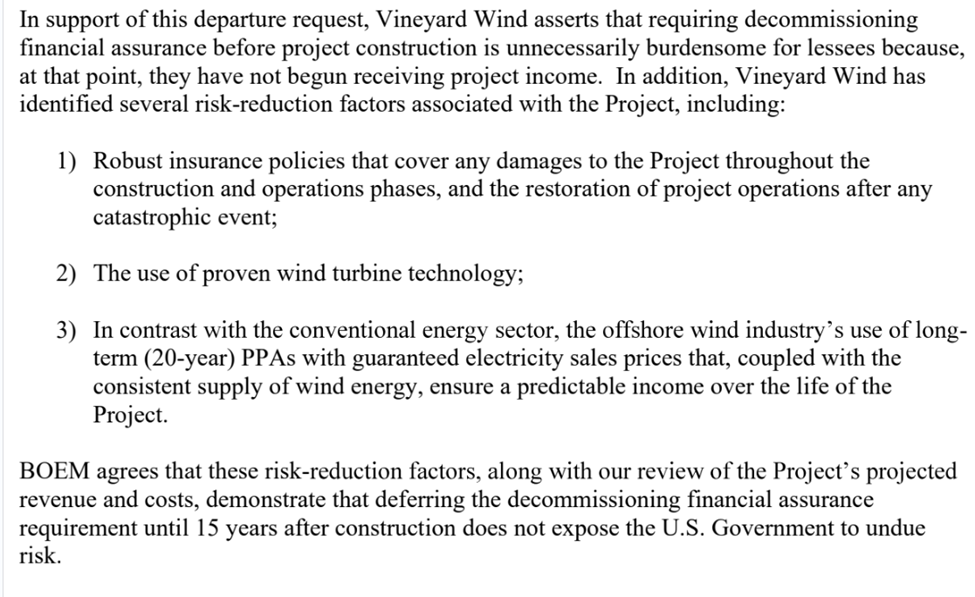
The post included BOE’s comments on the three factors listed in the excerpt:
- Factor 1: Those “robust insurance policies” may soon be tested given the costs associated with the turbine blade incident and potential law suits. (The notice pasted below informs that Nantucket officials will meet on Tuesday to consider litigation. A question for attorneys is the extent to which Nantucket is compromised by their good “Good Neighbor Agreement” with Vineyard Wind. That agreement essentially calls on Nantucket to promote the Vineyard Wind projects in return for payments that seem modest relative to the economic benefits from tourism and fishing.)
- Factor 2: To the extent that GE Vernova Haliade-X 13 megawatt turbines are proven technology (and that is very much in doubt), the use of proven technology doesn’t prevent premature abandonment associated with unexpected incidents.
- Factor 3: Reliable power generation and predictable long-term income remain to be demonstrated.
On July 23, 2024 BOE posed the question: Should wind leasing and development be paused until the Vineyard Wind investigation is completed?:
The Vineyard Wind turbine incident, which littered Nantucket beaches, has also tarnished the US offshore wind program. BSEE has prudently halted Vineyard Wind operations and construction pending an investigation into the blade failure.
Offshore wind development is structure rich, so public confidence in the design of turbines and support platforms is critical. BOEM lists 37 active wind leases on the US OCS. Most of these leases have not yet reached the construction phase. A hold on the approval of any Construction and Operations Plans would seem to be appropriate pending completion of the Vineyard Wind investigations.
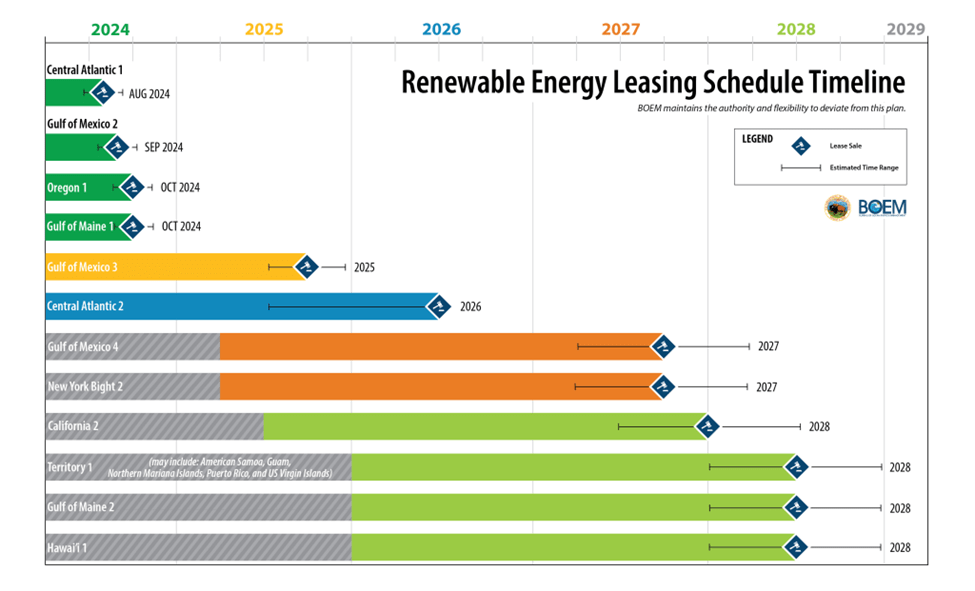
Per the leasing schedule below, BOEM intends to hold 4 wind sales during the remainder of 2024, all within a 3 month period. Only 1 sale is scheduled for each of the following 2 years. Deferring the 2024 sales until the investigations are complete would assist potential lessees by ensuring that the issues of concern were fully understood.
Unfortunately, BOEM’s failure to conduct a 2024 oil and gas lease sale has boxed in the wind program. The Inflation Reduction Act prohibits BOEM from issuing wind leases unless an oil and gas sale has been held within the previous year. Lease Sale 261 was held on 12/20/23 meaning that no wind leases may be issued after 12/20/24. BOEM has compressed the wind leasing schedule, presumably to beat the legislative deadline. It would have been better for both the oil and gas and the wind programs if at least one oil and gas sale had been held in 2024 as has been customary since the 1950s.
In another post, Aquinnah (Gay Head, Martha’s Vineyard) tribe calls for moratorium on offshore wind development, on July 23, 2024 BOE noted that “In the aftermath of a broken turbine blade off their coast, the Wampanoag Tribe of Gay Head (Aquinnah) is calling for a moratorium on all offshore wind development in the United States until further research can be done on the impact of wind farm construction.” He explained that a letter to BSEE Director Kevin Slighm from Aquinnah brought up the following points Wampanoag chairwoman Cheryl Andrews-Maltais brought up the following points:
- expressed “strong concerns and outrage” over the fractured Vineyard Wind turbine blade and the debris that washed ashore on Nantucket.
- said the foam and fiberglass debris have “potential negative and adverse impact[s]” on the environment, marine life, and human health.
- said fragments in the water pose a threat to shellfish, which are a crucial part of both the marine food web and also ingested by humans.
- commented that the potential contamination of shellfish with fiberglass and other materials could have severe consequences for human consumption and public health.
- criticized the lack of communication from federal officials to the tribe.
- called for an “immediate stoppage” of offshore wind construction in U.S. waters until they can be evaluated for microfractures and other damages.
On July 24, BOE provided a link to the initial assessment of the damage in Initial environmental assessment of Vineyard Wind blade debris. He noted that “GE Vernova retained Arcadis US, Inc., to perform an initial assessment of environmental considerations associated with the presence of the blade debris in the water and along the shoreline and linked to a Nantucket Current article on the assessment.
In the July 25 post, BOE described the developer’s excuse for the failure and the decision by the Nantucket Select Board to renegotiate their “Good Neighbor Agreement” with Vineyard Wind.
Quotes from Nantucket Current article (emphasis added):
“While we continue to work to finalize our root cause analysis, our investigation to date indicates that the affected blade experienced a manufacturing deviation,” said GE Vernova CEO Scott Strazik. “We have not identified information indicating an engineering design flaw in the blade or information of a connection with the blade event we experienced at an offshore wind project in the UK, which was caused by an installation error out at sea. We are working with urgency to scrutinize our operations across offshore wind. Pace matters here. But we are going to be thorough, instead of rushed.”
“It’s been 11 days since the event, and just to reinforce from the start, we have no indications of an engineering design flaw,” Strazik said. “We have identified a material deviation or a manufacturing deviation in one of our factories that, through the inspection or quality assurance process, we should have identified. Because of that, we’re going to use our existing data and reinspect all of the blades we’ve made for offshore wind. For context, this factory in Gaspé, Canada where the material deviation existed we’ve made about 150 blades.
On July 26 BOE observed that the wind turbine company GE Vernova stock has taken a hit. The Vineyard Wind turbine blade incident, the main reason for the sharp decline in their stock value in mid-July, is described as follows:
VINEYARD WIND OFFSHORE WIND FARM. We are the manufacturer and supplier of turbines and blades and the installation contractor for Vineyard Wind 1 offshore wind farm in the Atlantic Ocean (Vineyard Wind), at which we have installed 24 of 62 Haliade-X 220m wind turbines to date. Subsequent to the period covered by this report, a wind turbine blade event occurred at Vineyard Wind. Debris from the blade was released into the Atlantic Ocean and some has washed ashore on nearby beaches. On July 15, 2024, the U.S. Bureau of Safety and Environmental Enforcement (BSEE) issued a suspension order to cease power production and the installation of new wind turbines at the project site, pending an investigation of the event. As of the date of the filing of this report, we are currently engaged in a root cause analysis of the incident. We do not have an indication as to when BSEE will modify or lift its suspension order. Under our contractual arrangement with the developer of Vineyard Wind, we may receive claims for damages, including liquidated damages for delayed completion, and other incremental or remedial costs. These amounts could be significant and adversely affect our cash collection timelines and contract profitability. We are currently unable to reasonably estimate what impact the event, any potential claims, or the related BSEE order would have on our financial position, results of operations and cash flows.
He also noted that GE is also being sued by American Electric Power (AEP) for breach of contract and breach of warranty on turbine purchases for wind projects in Oklahoma:
“Within only two to three years of commercial operation, the GE wind turbine generators have exhibited numerous material defects on major components and experienced several complete failures, at least one turbine blade liberation event, and other deficiencies,”
On July 29 BOE described a new Order from BSEE to Vineyard Wind:
“The order comes as the bureau continues its oversight and investigation into the July 13, 2024, turbine generator blade failure. The order continues to prohibit Vineyard Wind 1 from generating electricity from any of the facilities or building any additional wind turbine generator towers, nacelles, or blades. This order also requires Vineyard Wind 1 to submit to BSEE an analysis of the risk to personnel and mitigation measures developed prior to personnel boarding any facility. Vineyard Wind 1 is not restricted from performing other activities besides those specifically directed for suspension or additional analysis. For example, Vineyard Wind 1 is still permitted to install inter-array cables and conduct surveys outside of the damaged turbine’s safety exclusion zone.”
On July 30, 2024 BOE complimented the Nantucket Current for their coverage of the incident. He quoted a a recent Current article (emphasis added):
“The technology may not be new, but the size and scale of the Haliade-X turbine is novel for the offshore wind industry. And these jumbo-sized turbines have only recently been installed in just two locations in the world within the last year – at Vineyard Wind off Nantucket, and the Dogger Bank Wind Farm off the northeast coast of England. The Haliade-X turbine blades – which are supposed to have at least a 25-year lifespan – have suffered failures in both locations.“
“At the Dogger Bank Wind Farm – which is being completed in three sections which combined will make up the largest offshore wind farm in the world – the first GE Vernova Haliade-X turbine was installed in the fall of 2023 and began producing power on Oct. 10. But little is known about the blade failure that occurred just months later during the first week of May 2024. The damaged blade was disclosed by Dogger Bank’s owners – SSE Renewables, Equinor, and Vårgrønn – a week after the incident. In a statement, the companies said only that “damage was sustained to a single blade on an installed turbine at Dogger Bank A offshore wind farm.”
“One reason the turbine blade incident at the Dogger Bank may not have generated more attention at the time is that the wind farm is located 100 miles off the coast of England, rather than just the 15 miles in the case of Vineyard Wind and Nantucket. If any debris was generated, it would have a far wider area to disperse in before nearing land – if it made it that far at all.“
Risk of Offshore Wind Turbine Failure is Serious
David Wojick described the implications of the Nantucket failure on the development of Virginia’s offshore wind project. In his article Wojick provides background information:
In this article, I present some technical background on that risk. The facility will be one of the world’s biggest, with 176 enormous turbines. It is just getting started with pile driving, so no turbine blades have been installed to date. This is an opportune time to undertake caution.
The Nantucket turbines are made by GE, and they are the world’s largest in operation today at 13 MW, each driven by three huge 107-meter-long blades. That is 351 feet for those of us who do not speak metric. The Virginia turbines will be even bigger at 14 MW with 108 meters (354+ feet) long. They are made by Siemens Gamesa, or SG for short.
The GE turbines and blades have been in production for going on two years, so have some operational experience. The SG turbines and blades just came into production so there is no experience with them. One could say they are being beta tested off Virginia.
This newness in itself is a great concern. At three blades each, there are an incredible 528 blades with a combined length of over 57,000 meters (187,000 feet or 35 miles) of blades. To take first production blades to these huge lengths is surely very risky.
For context consider that the Nantucket Current article referenced by BOEM noted that:
- The Haliade-X turbine is the same one Orsted – a partner in Vineyard Wind – is planning to use for offshore wind farms slated for the waters off New Jersey and Maryland.
- GE Vernova has allegedly refused to acknowledge responsibility for repairing the damaged turbines and generators in Oklahoma.
- Land-based turbines have come apart in Sweden, Germany, Lithuania, Cypress, Brazil, and the US (and presumably elsewhere).
With respect to New York, there are two New York projects that plan to use large turbines. Equinor’s Empire Wind 810 MW project provides comprehensive wind turbine information:
Vestas is the preferred supplier for wind turbine generators for Empire Wind. Vestas will deliver 138 V236-15MW wind turbine generators with a total generating capacity of around 2GW.
- 15 MW capacity
- 774 feet rotor diameter
- 886 feet high tip height
- 463,000 sqf swept area
On the other hand the 924 MW Sunrise Wind project developed by Ørsted and Eversource does not provide readily accessible turbine information. I could not find what kind of turbines are planned or any details on their characteristics.
Wojick goes on to explain some of the problems with these immense turbine blades.
Now let’s look at the blade stress physics just a bit, as it is amazing. SG has a quick look on their website, saying this:
“The rotational forces found in offshore wind turbines in operation put IMMENSE STRAIN ON THE BLADES and the rest of the wind turbine structure. (Emphasis added) At a tip speed of approximately 90 meters per second – equivalent to 324 kilometers per hour! (201 mph!) – and a projected lifetime of more than 25 years, high-quality and innovative design is imperative. For a 108-meter-long blade, the rotational forces are around a staggering 80 million newton meters, and the strain on the blades and the structure is intense! To put this into perspective, the force pulling on a human shoulder while spinning a 1 kg object around in an outstretched arm is only about 10 newton meters!”
Wojick sums up:
In summary, we have a newly huge blade, subject to immense stresses, made for the first time in an unusual way with a new composition and never tested in a hurricane. The high novelty risk to Virginia is obvious.
Conclusion
As noted by Robert Bryce the offshore wind scandal is even worse than you think. These recent articles all reinforce his argument that it is time to pause the hurried rush to deploy offshore wind turbines.
I have no doubts that the proposed offshore wind development will have enormous impacts on whales and other mammals. The big green environmental organizations are abandoning whales in general and the remaining North American Right Whales in particular. Bryce quotes an opponent of offshore wind: “What is Big Wind going to say when they kill the last whale? ‘Sorry’?”
Red flag warnings abound for New York’s offshore wind development using these unproven huge wind turbines. Wojick states the obvious “A sound engineering approach would be to build a few and see how they did over time.” He also points out that the existing turbines of this size are in Europe where the dangers of hurricanes are not present.
BOE provides a great concluding statement:
Greater transparency regarding turbine incidents, both in the US and internationally, is clearly needed. As we have learned from decades of experience with the oil and gas industry, most companies prefer reporting systems (if any) that protect details and information about the responsible parties from public disclosure. It’s the responsibility of the regulators to make sure that incident data and investigation reports are timely, complete, and publicly available. This is made more difficult by the promotional role that government agencies have assumed for offshore wind.

 Pragmatic Environmentalist of New York