The New York State Public Service Commission (PSC) recently initiated an “Order initiating a process regarding the zero-emissions target” that will “identify innovative technologies to ensure reliability of a zero-emissions electric grid”. Implementation of the Climate Leadership & Community Protection Act (Climate Act) started soon after the law was passed at the end of 2019. It was recognized early that “as renewable resources and storage facilities are added to the State’s energy supply, additional clean-energy resources capable of responding to fluctuating conditions might be needed to maintain the reliability of the electric grid” but here we are three and half years later finally getting around to address this critical requirement. This post summarizes the proceeding, gives an overview of the questions raised by the PSC, and describes the comments I submitted.
I have been following the Climate Act since it was first proposed. I submitted comments on the Climate Act implementation plan and have written over 300 articles about New York’s net-zero transition. I have extensive experience with meteorological aspects of electric generation because I have worked in the sector as a meteorologist for over four decades. I have devoted a lot of time to the Climate Act and the issues raised in this proceeding because I believe the ambitions for a zero-emissions economy embodied in the Climate Act outstrip available renewable technology such that the net-zero transition will do more harm than good. I represent the Environmental Energy Alliance of New York on the New York State Reliability Council Extreme Weather Working Group. The opinions expressed in this article do not reflect the position of the Alliance, the Reliability Council, the Extreme Weather Working Group, any of my previous employers or any other company I have been associated with, these comments are mine alone.
Climate Act Background
The Climate Act established a New York “Net Zero” target (85% reduction and 15% offset of emissions) by 2050 and an interim 2030 target of a 40% reduction by 2030. The Climate Action Council is responsible for preparing the Scoping Plan that outlines how to “achieve the State’s bold clean energy and climate agenda.” In brief, that plan is to electrify everything possible and power the electric grid with zero-emissions generating resources by 2040. The Integration Analysis prepared by the New York State Energy Research and Development Authority (NYSERDA) and its consultants quantifies the impact of the electrification strategies. That material was used to write a Draft Scoping Plan. After a year-long review the Scoping Plan recommendations were finalized at the end of 2022. In 2023 the Scoping Plan recommendations are supposed to be implemented through regulation and legislation. The zero emissions analysis is part of that effort.
Overview of Process
The press release describes the process to “identify innovative technologies to ensure reliability of a zero-emissions electric grid”:
The New York State Public Service Commission (Commission) has initiated a process to examine the need for resources to ensure the reliability of the 2040 zero-emissions electric grid mandated by the Climate Leadership and Community Protection Act, or Climate Act.
“The Commission’s action reaffirms efforts to ensure New York has the needed clean-energy resources to replace existing fossil fuel-fired power plants,” said Commission Chair Rory M. Christian. “I am proud that New York continues to lead by advancing important clean energy initiatives, such as the one commenced today.”
The Climate Act, passed by the State Legislature in 2019, directs the Commission to establish, among other things, a program to ensure that by 2030, at least 70 percent of electric load is served by renewable energy, and that by 2040, there are zero emissions associated with electrical demand in the State. The initiative will help deliver on the Climate Act zero-emissions electric grid mandate and will enable the necessary types of clean energy to reach all New Yorkers. The Commission’s decision follows a substantial climate package announced by Governor Kathy Hochul in the FY24 enacted State Budget that will advance sustainable buildings, clean energy, and an affordable Cap-and-Invest program.
Today’s action recognizes that as renewable resources and storage facilities are added to the State’s energy supply, additional clean-energy resources capable of responding to fluctuating conditions might be needed to maintain the reliability of the electric grid. The Commission’s work to meet the Climate Act targets must include exploration of technologies that can support reliability once fossil generation has been removed from the system. The order initiates a process to identify technologies that can close the anticipated gap between the capabilities of existing renewable energy technologies and future system reliability needs. Within the order, the Commission asks stakeholders a series of important questions, including how to define ‘zero-emissions’ for purposes of the zero emissions by 2040 target, and whether that definition should include cutting edge technologies such as advanced nuclear, long duration energy storage, green hydrogen, and demand response. The order further elicits feedback from stakeholders on how to best design a zero-emissions by 2040 program, consistent with the Climate Act’s requirement of delivering substantial benefits to disadvantaged communities and New York State’s electric grid reliability rules, while also leveraging other state and federal efforts to research, develop, and deploy zero-emission resources.
After a 60-day public comment period, Commission staff will convene at least one technical conference to examine a series of issues and questions raised in this important proceeding. The Commission may take additional actions on zero-emission resources based on the information obtained through those processes.
Questions Asked
I have included the questions asked with some brief commentary. I chose to only address one question related to my expertise and one short-coming in the Proceeding. The Commission wants answers to “assist the Commission in determining what, if any, subsequent actions should be taken, which may include refinements to existing policies or establishing new policies.”
Question 1: How should the term “zero emissions,” as used under PSL §66-p(2)(b), be defined?
It has taken three and a half years to define what qualifies as “zero emissions” and address the problems associated with this resource. Given its importance this should have been an immediate and high priority for the Climate Action Council. The Order notes:
Following enactment of the CLCPA, the Commission issued the Order Adopting Modifications to the Clean Energy Standard, which aligns the existing Clean Energy Standard (CES) with the CLCPA renewable energy targets.
The pathway established by the CES Modification Order focuses on options for procuring sufficient renewable energy resources to meet CLCPA requirements. However, several studies indicate that renewable energy resources may not be capable of meeting the full range of electric system reliability needs that will arise as fossil generation is replaced. These studies suggest that there is a gap between the capabilities of existing renewable energy technology and expected future system reliability requirements. The Independent Power Producers of New York, Inc., New York State Building and Construction Trades Council, and New York State AFL-CIO (Petitioners) also raised this issue in a petition filed in this proceeding on August 18, 2021 (Zero Emissions Petition or Petition).
I did not provide any comments on this question.
Question 2: Should the term “zero emissions” be construed to include some or all of the following types of resources, such as advanced nuclear (Gen III+ or Gen IV), long-duration storage, green hydrogen, renewable natural gas, carbon capture and sequestration, virtual power plants, distributed energy resources, or demand response resources? What other resource types should be included?
If I were to respond to this question, I would simply say the only one of these resources that has a realistic chance of providing the services necessary is advanced nuclear. That answer is obvious to anyone who has looked at the other options pragmatically. I do not believe that a state that shut down 2,000 MW of operating nuclear will ever pivot to nuclear so I am not going to dilute my comments by stating the obvious.
Question 3: How should a program to achieve the Zero-Emission by 2040 Target address existing and newly constructed nuclear energy resources. Should the program be limited to specific types of nuclear energy technologies and exclude others?
It is obvious that keeping existing nuclear in operation as long as it is safe should be a priority but this is New York. Responding to the specific types of nuclear question is beyond my existing knowledge and I do not have time to research a response.
Question 4: Should new measures adopted to pursue compliance with the Zero-Emission by 2040 Target focus exclusively on generation and resource adequacy, or should they also encompass a broader set of technologies that could be integrated into the transmission or distribution system segments, or installed and operated behind-the- meter?
Responding to this is beyond my existing knowledge and I do not have time to research a response. My impression is that the broader technologies being considered are all magical solutions that are only being included to appease the green energy advocates. They may play a role but it will be inconsequential.
Question 5: Should any program to achieve the Zero-Emission by 2040 Target specify subcategories of energy resources based on particular characteristics, such as ramp rates, the duration of their operational availability, or their emissions profile with respect to local pollutants?
I am sure that New York’s reliability experts will address the technical aspects of the energy resources needed. I am not qualified to do so. My comments do address the duration of the operational availability of this resource.
Question 6: What role does technology innovation need to play to meet the CLCPA’s Zero-Emission by 2040 Target?
Given that the Commission by way of this proceeding, the New York Independent System Operator (NYISO), and the New York State Reliability Council (NYSRC) all agree that there is no commercially available resource available that meets the need identified for dispatchable emissions free generation, I would say that technology innovation is an obvious prerequisite to the 2040 target. My comments address the reliability and affordability implications of the technological innovations needed.
Question 7: Should life cycle emissions impacts be considered when characterizing energy resources? If so, how?
It would be inappropriate for me to respond to this question because my comments would be unprofessional. I doubt that something along the lines of the following would be considered: “Why would the State want to start becoming unbiased in its consideration of energy resources now? All of the possible life cycle impacts of fossil sources are included and none of the life cycle impacts of wind and solar are considered. When there was no obvious characterization methodology for fossil fuel impacts available, they just made something up – so do the same.”
Question 8: Given that the feedstocks and other resources required to produce renewable natural gas are limited and will be in demand in other sectors of New York’s economy, how should this fuel be considered in the context of this proceeding?
This question answers itself. There will never be enough renewable natural gas available to provide a meaningful contribution. On the other hand, there are instances where emission reductions will be required and the capture and use of renewable natural gas makes sense.
Question 9: In what ways might a program to meet the Zero-Emission by 2040 Target require reexamination and possibly revision of different tiers of the Clean Energy Standard? Should one or more of the policy approaches that have been used to implement the CES be considered to meet the Zero-Emission by 2040 Target?
Responding to this is beyond my existing knowledge and I do not have time to research a response.
Question 10: What is necessary to align a program to meet the Zero- Emission by 2040 Target with the priority of just transition embedded within the CLCPA?
The Just Transition rubric is a political construct. I pride myself on pragmatic comments that balance impacts, costs, and benefits. Those are not considerations that will be included in the just transition priorities so I did not submit a response to this question.
Question 11: How might the benefits of a program to meet the Zero- Emission by 2040 Target be measured for the purpose of ensuring that, consistent with PSL §66-p(7), it delivers “substantial benefits” to Disadvantaged Communities?
The substantial benefits to Disadvantaged Community rubric is another political construct. It is disappointing that the State has so far ignored the benefits of a reliable and affordable electric grid relative to the alleged benefits and significant affordability and reliability risks to Disadvantaged Communities.
Question 12: NYISO has adopted an effective load carrying capacity (ELCC) rubric and treatment of Zones J and K as load pockets with special resource adequacy requirements. How should these constructs and other NYISO market rules inform design of a program meant to support the development and deployment of resources capable of achieving a zero emissions grid?
Responding to this is beyond my existing knowledge and I do not have time to research a response.
Question 13: What additional studies, if any, should the Commission undertake with respect to the development and deployment of resources capable of achieving a zero emissions grid?
In the following section I describe my response to this comment.
Question 14: Given that New York is not the only jurisdiction investigating options and opportunities for the research, development, and deployment of new technologies capable of achieving a zero emissions grid, how should the State seek to coordinate with and otherwise draw upon efforts that are underway elsewhere?
This is another question that answers itself. Given the challenges we need all the help we can get. How to do that is beyond my pay grade.
My Comments
My comments addressed two concerns: duration of the operational availability of the zero-emissions resources and the need to address the feasibility and affordability conditions in New York Public Service Law § 66-p (4). “Establishment of a renewable energy program”.
In order to determine whether any of the innovative technologies to “ensure reliability of a zero-emissions electric grid” are adequate it is necessary to determine how much energy they can provide relative to the amount needed in the worst case. I have been whining about the ultimate problem in the Integration Analysis for nearly three years. On September 16, 2020 In their presentation to the Power Generation Advisory Panel E3 included a slide titled Electricity Supply – Firm Capacity. Their presentation states: “As the share of intermittent resources like wind and solar grows substantially, some studies suggest that complementing with firm, zero emission resources, such as bioenergy, synthesized fuels such as hydrogen, hydropower, carbon capture and sequestration, and nuclear generation could provide a number of benefits.” Those are the zero-emissions resources addressed by the Proceeding. Of particular interest is the graph of electric load and renewable generation because it shows that this problem may extend over multiple days.
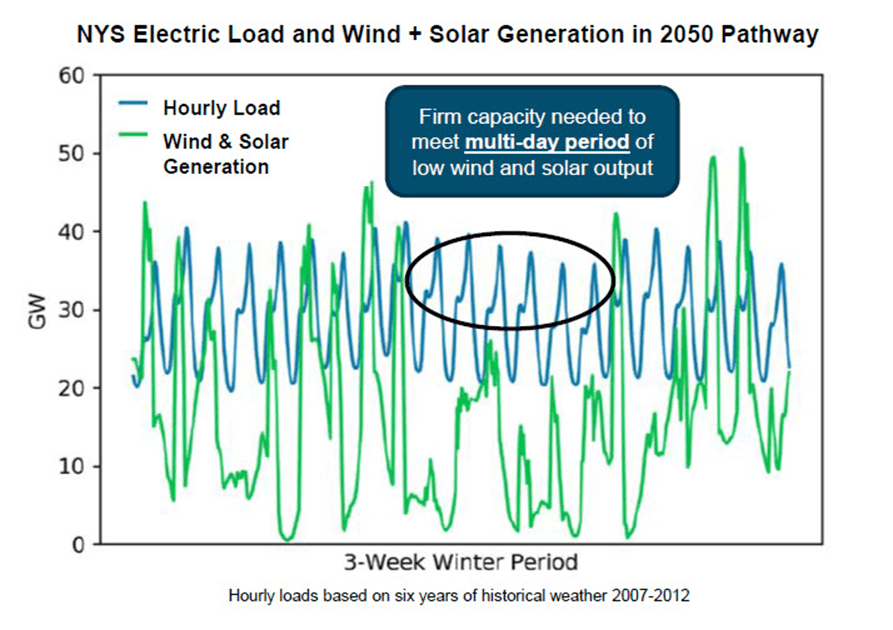
My comments explained that in New York the winter solar resource is poor because the days are short, the irradiance is low because the sun is low in the sky, and clouds and snow-covered panels contribute to low solar resource availability. If there is a period of low winds, then the zero-emissions resource is needed to provide an economically viable resource solution. Note that the magnitude of the zero emissions resource needed to address this issue will be a significant percentage of system peak load and that the technology (green hydrogen, long-term battery, etc.) does not presently exist for utility scale application.
I also pointed out that the reliability concern is exacerbated for several reasons. The future peak load will be in winter because the primary decarbonization strategy is electrification. During extreme cold weather periods, natural gas used at power plants is diverted to other users and power plants must switch to oil. There are fewer plants that have dual-fuel capability and over an extended event or a series of events the oil in storage could be depleted. Finally, the coldest periods are also associated with wind lull periods because extreme cold is associated with large high-pressure systems that suppress wind resources.
If there are insufficient generating resources available to serve peak loads, then a disastrous blackout will result. In February 2021, the Texas grid was unable to provide support load and resulted in as many as seven hundred deaths and billions in damages. I stated that this proceeding must ensure that this situation does not happen in New York.
I described the NYISO resource adequacy planning process in my comments. It has developed over many years and provides reliability planning projections based on the current mix of electric generating resources. One of the important characteristics of the current system is that there is insignificant correlation between the unavailability of generating resources. I believe that one of the significant findings of the New York State Reliability Council (NYSRC) Extreme Weather Working Group (EWWG) will be the observed correlation of the frequency and duration of low-wind episodes across the entire state, including the offshore wind development areas. I emphasized that this finding must be considered in future planning.
I have no doubt that these issues will eventually be addressed in the resource adequacy planning process and the reliability standards for the electric system. However, in order to determine how to do this it is necessary to understand the worst case. In order to determine how large the DEFR capacity needs to be, the State must know how much energy was available for low renewable resource episodes of different lengths. The EWWG is addressing this issue. However, because of its importance I believe a more extensive analysis and possibly independent analysis by different organizations would be appropriate. It is too important to rely on a single analysis of the expected worst-case availability. Therefore, I recommend this study be addressed as part of this Proceeding.
My comments on this topic recommended what should be included in a worst-case analysis. The most important aspect of any such analysis is to use as long an analysis period as possible. Fortunately, meteorological reanalysis data generated by modern weather forecast models but using original observations since 1950 are available for this application. The analysis should identify potential periods of low wind and solar availability and their frequency and duration. Once worst case periods are identified, modeling that projects the specific resource availability during the worst periods should be performed. That information can be used for future resource planning.
My second comment addresses the feasibility and affordability conditions in New York Public Service Law § 66 “Establishment of a renewable energy program”. The Hochul Administration has not acknowledged that there is a “safety valve” if the implementation does not work out as imagined in the Scoping Plan.
Specifically, New York Public Service Law § 66-p (4) states: “The commission may temporarily suspend or modify the obligations under such program provided that the commission, after conducting a hearing as provided in section twenty of this chapter, makes a finding that the program impedes the provision of safe and adequate electric service; the program is likely to impair existing obligations and agreements; and/or that there is a significant increase in arrears or service disconnections that the commission determines is related to the program”. The plain reading of that is that if implementation cannot feasibly maintain reliability standards or adversely affects affordability can “temporarily suspend or modify the obligations” of the Climate Act.
In my opinion, if the Climate Action Council had spent time looking at overarching issues rather than getting bogged down in arguments about wording and the pet concerns of its members then this would have been addressed. In this instance, they should have defined the reliability obligations, and affordability conditions for the commission. They could have specified the metrics to be used and the limits at which it would be appropriate to pause implementation. Because the Climate Action Council failed to provide recommendations, I commented that the Commission must establish those criteria.
Once the criteria are established then they can be used as a test for the acceptability of the proposed zero emissions resources. As part of the process a feasibility analysis for each resource to determine the technological risks for the resource and potential costs must be prepared. If the analysis projects that the § 66-p (4) criteria will be exceeded then the resource should not be considered.
Finally, I noted that my primary problem with the Climate Act is the mandate to go to zero without consideration of tradeoffs. In this instance that mandate precludes an obvious solution. New York’s oil-fired steam-electric generating stations could be used to provide the dispatchable generation needed for the worst-case extremes. The facilities have on-site storage, significant capacity availability, and experience operating units that run rarely. The units could be kept on-line, used for testing, training, and to be available for use in these extreme events. The extreme events are easily forecasted days in advance so the units can be brought on-line to be available as needed. I suspect that the cost to maintain those facilities will be far less than the cost of any zero-emission resource. Overall, the emissions and air quality impacts will be far less of an issue than the ramifications of a blackout. I recommended that this option be considered as part of this Proceeding.
Conclusion
This proceeding puts to rest the myth that the technology necessary for the electric system transition is available today. In order to meet the 2040 “zero emissions” electric generating resource requirement, this zero emissions resource is needed.
My comments were confined to two overarching issues that must be resolved in order to evaluate New York’s “zero-emissions” resources. The energy that the resource needs to provide to replace wind and solar resources during low availability periods must be known in order to determine how much will be needed. I recommended that an analysis that uses as long a period as possible be included as part of the Proceeding. My other concern is that the acceptability of zero-emissions resources should be based on well-defined standards of reliability feasibility and affordability. I recommended that the Proceeding define these criteria.
This is a necessary component of the net-zero transition. Unfortunately the need for this Proceeding has been known since the implementation began and it should have been part of the discussions of the Climate Action Council in 2020.

 Pragmatic Environmentalist of New York