On August 1, 2023 the New York State Comptroller’s Office released Renewable Electricity in New York State Review and Prospects (“Comptroller Report”) that addressed progress and prospects for attaining New York’s Climate Leadership & Community Protection Act (Climate Act) 2040 mandate for a zero-emissions electric grid. This post discusses the findings of that report.
I have been following the Climate Act since it was first proposed, submitted comments on the Climate Act implementation plan, and have written over 350 articles about New York’s net-zero transition. I have devoted a lot of time to the Climate Act because I believe the ambitions for a zero-emissions economy embodied in the Climate Act outstrip available renewable technology such that the net-zero transition will do more harm than good. The opinions expressed in this post do not reflect the position of any of my previous employers or any other company I have been associated with, these comments are mine alone.
Climate Act Background
The Climate Act established a New York “Net Zero” target (85% reduction and 15% offset of emissions) by 2050. It includes an interim 2030 reduction target of a 40% reduction by 2030 and a requirement that all electricity generated be “zero-emissions” by 2040. The Climate Action Council is responsible for preparing the Scoping Plan that outlines how to “achieve the State’s bold clean energy and climate agenda.” In brief, that plan is to electrify everything possible and power the electric grid with zero-emissions generating resources. The Integration Analysis prepared by the New York State Energy Research and Development Authority (NYSERDA) and its consultants quantifies the impact of the electrification strategies. That material was used to write a Draft Scoping Plan. After a year-long review the Scoping Plan recommendations were finalized at the end of 2022. In 2023 the Scoping Plan recommendations are supposed to be implemented through regulation and legislation.
Annotated Press Release
The press release DiNapoli: State Needs to Supercharge Efforts to Meet Renewable Electricity Goals is as good a place as any to discuss the report. In this section I will comment on the points made.
My overarching concern with the Comptroller Report is that it underestimates the technological challenges of the net-zero transition. That is entirely consistent with the Scoping Plan and the beliefs that the politicians who dreamed up the Climate Act and the ideologues who controlled the Climate Action Council can develop rational energy policy. The introduction basically says all we must do is try harder:
New York state will have to take multiple steps to increase renewable electricity generation to achieve the objectives of the Climate Leadership and Community Protection Act (Climate Act). Success will also require state agencies to consistently and proactively identify and address problems, continue streamlining permit and interconnection study procedures, and develop the necessary infrastructure to connect renewable projects to the grid and New Yorkers’ homes, according to a report issued today by State Comptroller Thomas P. DiNapoli.
“New York State has rightly pursued an aggressive campaign to reduce greenhouse gas emissions to limit the most dangerous impacts of climate change,” DiNapoli said. “New York’s energy goals are attainable, but require careful attention and management to address challenges, meet ambitious deadlines and avoid future pitfalls.”
My first thought when I heard that the Comptroller had issued this report was why in the world did he get involved. The definition of comptroller, a public official who audits government accounts and sometimes certifies expenditures, wasn’t much help. The responsibilities listed on State Comptroller website includes “Providing independent fiscal oversight on State, New York City and local finances” which I suppose could provide justification.
Fiscal oversight means numbers and the report quotes New York Independent System Operator numbers:
DiNapoli’s report found that renewable generators in New York would need to produce an additional 78,073-gigawatt hours above 2022 levels, an increase of over 200%, to reach the Climate Act’s 2030 goal of 70% renewable electricity consumption. The analysis is based on projections from the New York Independent System Operator (NYISO).
NYISO has also projected that the state would need to add 20 gigawatts of installed renewable capacity by 2030, which is triple the 2022 capacity of approximately 6.5 gigawatts. In the last 20 years, New York added 12.9 gigawatts of total electric generation, including both fossil fuel and renewable sources.
The press release discusses the actions taken to try to meet the targets:
The state has taken steps to address these challenges:
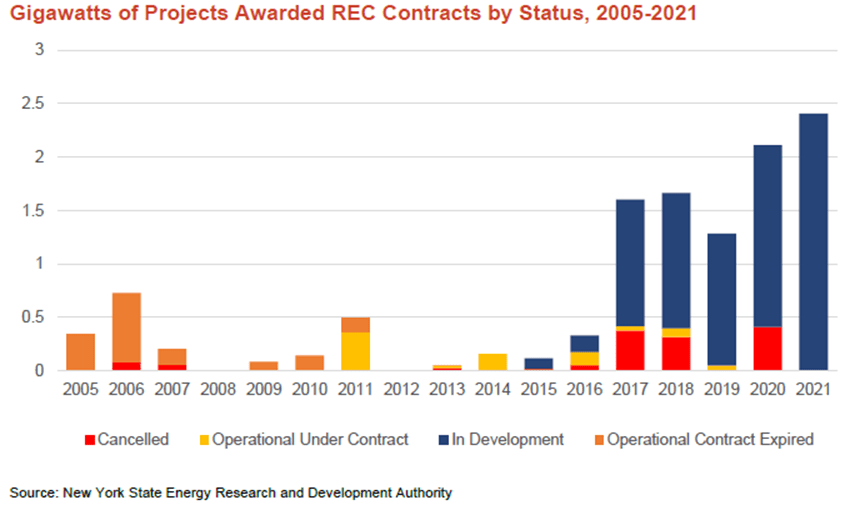
- Increased and consistent funding under the state’s Clean Energy Standard facilitated increases in the development of renewable electricity generation. Between 2017 and 2021, at least 1,100 megawatts of projects came under contract annually, compared to between 0 and 726 megawatts annually in the preceding years.
- The Department of State’s Office of Renewable Energy Siting (ORES) was formed to streamline the permitting process, and the NYISO has also been improving the interconnection process to bring renewable electricity generation projects online more quickly. Continuing to improve the renewable electric project permitting and interconnection processes to allow for timely approvals, while ensuring community responsiveness and project impacts are mitigated, is critical to achieving the Climate Act goals.
The solutions proposed here are supposed to be a good thing. I am not impressed. Increased and consistent funding translates to throw more and more money at it without a plan that defines what the affordability tolerance level is. ORES is a gift to the renewable energy developers that circumvents environmental protections, home rule, and anything else that could slow down much less stop renewable development. Here is a new flash to the Albany bureaucrats – not all projects deserve to be built. ORES has no responsible solar siting requirements in place so solar developers routinely exceed the Department of Agriculture and Markets guidelines for protection of prime farmlands. My solar development scorecard found that prime farmland comprises 21% of the project area of 18 utility-scale solar project permitted applications which is double the Ag and Markets guideline.
The following paragraph talks about the transmission requirements. All the points raised are legitimate and there are few technological barriers to development. It is just a matter of cost and no one has owned up to the expected costs. The subsequent paragraph acknowledges the problem and implies the problem can be resolved can be resolved if the state wishes hard enough to hold down the costs.
The state will also face challenges given the volume and scale of new projects. The transmission capacity for connecting upstate regions to New York City is limited and renewable facilities in some upstate regions are already being forced to curtail generation due to transmission constraints. Significant new electric transmission infrastructure is needed to allow for the transmission of renewable electricity to customers throughout the state, including interconnect offshore wind projects and additional export capacity from Long Island, and bulk transmission connecting New York City and Long Island to upstate.
The costs of incentives to encourage renewable siting and the costs of transmission projects approved by the Public Service Commission are borne almost exclusively by New York’s utility customers. The state should make every effort to clearly identify how these costs will affect consumer electric bills and must hold down these costs to the state’s electric customers.
The final section of the press release explains “where New York ranks”. It is not clear how relevant the numbers are vis-à-vis Climate Act implementation or why the 2022 data presented in the report were not used. Also conspicuous by its absence is where New York ranks relative to global emissions. Clearly, acknowledging that New York GHG emissions are less than one half of one percent of global emissions and global emissions have been increasing on average by more than one half of one percent per year since 1990 is not a fact that the Comptroller wants to acknowledge lest someone ask what is the point?
In 2020, New York produced 124,912 gigawatt hours of renewable energy, ranking 6th in the nation. This figure includes both renewable fuels, such as biodiesel, and renewable electricity sources, including hydropower, solar, and wind. New York was 3rd in the nation after Washington and Oregon in the generation of hydroelectric power, 10th in generation of solar electricity, and 18th in generation of electricity with wind.
As of 2022, approximately 29% of the electricity generated in the state came from renewable sources. Of this renewable generation, roughly 75% came from hydroelectric generation, with the remaining 25% primarily split between wind and solar.
Report Topics Not Included in Press Release
The press release was not an exhaustive summation of the contents of the Comptroller Report. The report also addressed the renewable energy goals,
The Comptroller Report notes that:
The State’s renewable electric generation averaged 20 percent of total electric generation between 2005 and 2016. Since then, the share grew to approximately 29 percent of State generation in 2022. To reach the CLCPA goal of 70 percent in 2030, renewable generators in New York would need to produce an additional 78,073 gigawatt hours above 2022 production levels, an increase of over 200 percent.
It goes on to describe the New York Independent System Operator 2021-2040 System & Resource Outlook projections for the renewable energy needed. It concludes that the State will have to increase the rate at which renewable electricity projects are permitted and approved for interconnection to the State electric grid.
This leads into a more detailed explanation of the challenges to meet the Climate Act goals.
There are three interrelated processes that play a role in the development of renewable electric generation resources in New York, and the State has faced challenges in each of these processes. These processes work on a parallel basis and project developers do not need to have completed any of the processes before they can enter one of the other processes.
Two of them, permitting and grid interconnection, are required for any all-new sources of generation.
- Incentives – Through various programs, particularly renewable energy certificates, incentives are provided to stimulate the market and ensure that there are enough renewable electric generation projects to meet State goals.
- Permitting and Siting – The permitting process is intended to ensure that projects are sited in areas and under conditions consistent with State and local laws and regulations.
- Interconnection – The interconnection process is intended to ensure that there is sufficient electric transmission and distribution infrastructure to move the electricity generated by the facilities to consumers and that electric service reliability standards are met.
The State faced three key challenges that hindered its progress: inconsistent provision of incentives; project cancellations; and lengthy project timelines due to delays in siting and operationalization.
In the discussion of the inconsistent provision of incentives the report stated that “New York State has used two basic approaches to incentivize the development of renewable electricity generation: contracts for the purchase of renewable energy certificates (RECs) from project developers proposing to build large scale facilities that sell electricity into the State grid; and incentives to reduce the cost of installing small facilities sited behind a customer meter that primarily generate electricity for the customer’s use, but also sell unused electricity into the distribution grid (BTM solar).”
The BTM solar incentive was cited as a success because distributed solar generation has grown steadily. They claim that “the total combined capacity of complete projects and those in the pipeline for all years was approximately 7.1 gigawatts” as the result of increased funding commitments. I don’t think the authors of the report understand that the electric energy planning commitment to providing reliable power at all times is hindered by this program. There is no question that distributed solar generation reduce load requirements, but it creates operating challenges including short, steep changes in load that must be balanced, an oversupply risk when all the solar is operating at peak rates, and decreases resiliency when less resources are operating and available to automatically adjust electricity production to maintain grid reliability. When the costs to address those problems are considered it is clear that success is limited.
The Comptroller Report argues that the RECs program has had mixed results. Each REC represents a megawatt hour of electricity sold into the State’s electric grid. To date: “Most, but not all, of the large-scale renewable electricity generators that move through the permitting and interconnection processes are recipients of REC contracts.” However, an analysis by the Comptroller’s Office shows a lot of variation in the projects that have had contracts:
Funding commitments under the State’s CES increased dramatically, resulting in a significant increase in the projects under contract, as shown in Figure 5. Whereas the last procurement under the RPS in 2016 carried a commitment of $360 million, the funding commitment for the 2017 procurement was approximately $1.4 billion.
The Comptroller Report seems to be surprised by the number of project cancellations:
Between 2005 and April 2023, 28 projects totaling 1.3 gigawatts were canceled—an amount equal to 11.3 percent of capacity under contract during those years—with the largest amount of capacity canceled in 2017, 2018 and 2020. In these years, canceled projects represented 20.4 percent of contracted capacity. Projects may be canceled for a variety of reasons including opposition to the project, changes in the finances of the developer, or unforeseen costs for transmission needed for grid integration.
The report notes that facilities that are operating but have lost their REC subsidies “could potentially enter into long term contracts with consumers outside of the State, which could prevent their generation from counting toward State goals.” However, there is no mention of the operating facilities that already are under contract out-of-state. Robert Bryce reviewed data published by the Department of Energy and the New England Power Pool and found that “of the nearly 4 million megawatt-hours of wind energy produced in New York in 2018, the state exported 1.2 million megawatt-hours, or 30 percent, to New England. Furthermore, the Cassadaga Wind Project that was commissioned in 2021 produces power that was procured through the New England Clean Energy request for proposals’ in 2016 for a group of seven New England utilities. Note that I have never seen an acknowledgement of this in any of the Scoping Plan documentation.
Two additional considerations are mentioned. Getting the power from the wind and solar facilities to where it is needed is described:
New electric transmission and distribution capacity will be needed to connect the new renewable electric generation required to meet the CLCPA goals to the grid. Transmission capacity connecting upstate regions to New York City is limited and renewable facilities in some upstate regions are already being forced to curtail generation due to transmission constraints.
The other issue is affordability. The report notes: “The costs of incentivizing renewable electricity development and transmission upgrades are borne almost exclusively by New York’s utility customers through a charge per kilowatt hour of electricity consumed.” The RECs described earlier are funded by the ratepayers. In addition, the investments necessary to develop the transmission upgrades are buried in the rate cases. The document suggests without justification that this problem will be addressed by existing programs.
Conclusion
Not surprisingly this political document proposes political solutions. The acknowledged problems of the timeline can be resolved if “the projects currently under contract to sell RECs to the State and the projects in the NYISO’s interconnection queue are able to move through the interconnection and construction process and needed transmission and distribution infrastructure is completed in a timely way, the CLCPA’s goal of generating 70 percent of the State’s electricity with renewable technologies appears to be in reach.” The Comptroller’s Report falls back on the it is only a matter of political will faith-based creed. Reality is very likely to make that impossible.
In addition to political will, the report suggests that we can resolve issues by throwing more money at projects. The State’s prior poor performance is chalked up to inconsistent funding commitments. At the same time, it acknowledges that “mechanisms to hold down the cost of meeting its goals on the State’s electric consumers” are necessary.
Against the background that New York’s contribution to global GHG emissions is less than the rate of increase in global emissions my frustration is unbounded. Is it too much to ask Albany politicians to document the expected costs, the potential risks to reliable energy, and the environmental tradeoffs of the net zero transition called for in the Climate Act?

 Pragmatic Environmentalist of New York