

I recently wrote about the reality disconnect between climate activists and the need for new technology to meet the net-zero ambitions of New York’s Climate Leadership & Community Protection Act (Climate Act). I mentioned a few possible reasons why climate advocates ignore anything that does not fit their narrative that climate change is an existential threat and the energy transition away from fossil fuels will be painless, save money, and solve the threat of climate change. David Zaruk, writing at the Risk Monger blog, has started a series of articles that offers great insight into an overarching motive for supporters of the Climate Act. This post describes his introduction with Climate Act examples.
I have followed the Climate Act since it was first proposed, submitted comments on the Climate Act implementation plan, and have written over 380 articles about New York’s net-zero transition. The opinions expressed in this post do not reflect the position of any of my previous employers or any other organization I have been associated with, these comments are mine alone.
Overview
The Climate Act established a New York “Net Zero” target (85% reduction in GHG emissions and 15% offset of emissions) by 2050. It includes an interim 2030 reduction target of a 40% reduction by 2030 and a requirement that all electricity generated be “zero-emissions” by 2040. The Climate Action Council (CAC) is responsible for preparing the Scoping Plan that outlines how to “achieve the State’s bold clean energy and climate agenda.” In brief, that plan is to electrify everything possible using zero-emissions electricity. The Integration Analysis prepared by the New York State Energy Research and Development Authority (NYSERDA) and its consultants quantifies the impact of the electrification strategies. That material was used to develop the Draft Scoping Plan outline of strategies. After a year-long review, the Scoping Plan was finalized at the end of 2022. In 2023 the Scoping Plan recommendations are supposed to be implemented through regulation, PSC orders, and legislation.
David Zaruk writes at the Risk Monger, a blog “meant to challenge simplistic solutions to hard problems on environmental-health risks”. He is an EU risk and science communications specialist since 2000, active in European Union (EU) policy events and science in society questions of the use of the Precautionary Principle. He is a professor at Odisee University College where he lectures on Communications, Marketing, EU Lobbying and Public Relations. In my opinion, he clearly explains the complexities of risk management and I recommend his work highly.
I recently described the reality disconnect between climate activists and the need for new technology to meet the net-zero ambitions of the Climate Act. I wondered what would it take for them to change their minds given that their belief that no new technology is only possible if you don’t read the Integration Analysis details, you believe that the New York Independent System Operator (NYISO) is a shill for fossil fuel interests, so their reports are biased, and think that the New York Public Service Commission does not understand the electric system. Instead, they believe a couple of academics. I postulated that when the problems described by NYISO cause a blackout that the activists would get it. Zaruk’s description of righteous risks suggests that facts do not matter when the cause is morally and emotionally justified.
Righteous Risks
Zaruk describes these risks as follows in his introductory post:
A righteous risk is a threat of harm to societal well-being that arises when decisions are based solely on widely-shared moral perceptions, social virtues and ethical ideals. This value-based policy approach does not consider facts or data in a consistent manner with certain actors, reinforced by social media tribes, imposing their ideals upon others. Righteous zealots (particularly environmental activists, naturopaths and food puritans) are more intensively forcing their moral dogma upon the policy process. Such value-based regulations are righteous risks that have become a growing threat to entrepreneurs and researchers whose innovations may challenge their traditional ethical norms. In attacking agricultural practices, food choices, energy use, nicotine alternatives and transportation choices, when the righteous feel they have virtue on their side, their reasoning and decision-making become hazardous to others.
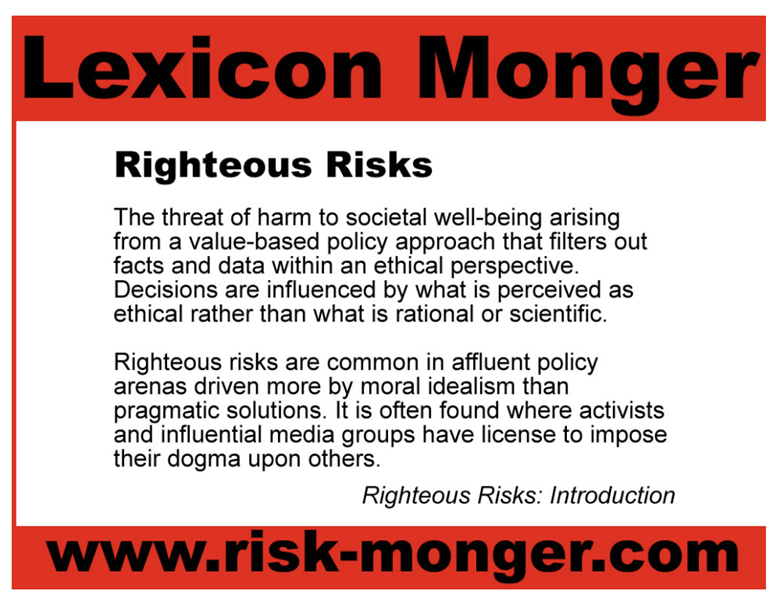
He writes that this series will “look at case studies where righteous risks were (or were not) managed, the consequences and the lessons learnt.” I strongly recommend reading the post in its entirety. In the meantime, I will provide some examples of these risks that are evident in New York.
The Virtue of Environmentalism
The introductory post expands on his description of righteous risks. He explains the peril of “making decisions solely on some ethical dogma, an unwavering virtuous self-appreciation or a fear of some stakeholder moral condemnation” is that policies lead to “irrational regulations that do little but harm.” He writes:
The values that guide decision-makers, or the widely expressed social values that decision-makers feel they need to reflect, do not take into account the complexities of policymaking or the compromises that must be made. Politics is a pragmatic profession, but today we seem to have lost the art of Realpolitik, replaced by a “governance by moral aspiration” approach.
Zaruk is primarily concerned with policies within the European Union. He describes how the Green Deal for the climate has recently been a primary driver of policies to transition to zero emissions:
The word “transition” started to be repeated in any official EU Green Deal speech. When we make a transition, we turn away from the bad and toward the good. The need for an energy transition, mobility transition or a food system transition became synonymous with fighting climate change. But this “transition towards…” strategy, as a righteous crusade, became curious as the Green Deal strategies were presented as virtuous solutions. Renewables, organic food, EVs, non-synthetic chemicals … were promoted within a moral framework, under the virtue of sustainability. Whoever would suggest advancing innovations in carbon capture and storage of fossil fuel emissions instead of more subsidies for renewables had crossed over to the dark side and would soon be ostracised by the community of influencers. When you speak in terms of good v evil in the moral imperative to stop climate change (to right the evils of past generations of unenlightened polluters), the Green Deal becomes a mission of the noble and the virtuous.
The Climate Act is a prime example of environmental virtuism. One of the impacts touted on the Climate Act webpage is “Protecting our environment”:
Fresh mountain air. Crystal clear waters. Your favorite tree in the neighborhood. It’s hard to describe the feeling of experiencing these natural resources. It’s even harder to picture a New York without them.
That is why we are making environmentally friendly choices, such as new options for waste management and clean energy, more accessible to all New Yorkers. That is why we are carefully monitoring the preservation of our forests and wetlands. That is why we are making sure our renewable energy projects have a minimal impact on our cherished natural resources.
We are rising to the occasion to protect our environment — for today and tomorrow. Because we don’t want that feeling of catching a fish, skiing through fresh powdered snow, or simply enjoying a walk in the park to ever go away.
Clearly, anyone who objects to these plans is evil. I maintain that every aspect of the Climate Act is more complicated than it appears at first glance, and it has been my experience that looking into issues exposes problems with the State’s narrative. For example, the claim that “our renewable energy projects have minimal impact” ignores the fact that there are no constraints on utility-scale solar development to mandate that tracking solar panels be used consistent with the Scoping Plan, that the prime farmland protections in Department of Agriculture and Markets guidelines are followed, and that responsible solar siting agrivoltaics are required. Meanwhile, I estimate that permitted projects have covered 8,365 acres of New York’s most productive farmland.
A Redefinition of Leadership
His introductory article argues that this “injection of ethical rectitude into policy strategies is redefining Western leadership.” His description that “Policies are cloaked in values and expressed with hyperbole and categorically” sums up New York’s net-zero transition ambitions. The problem is that zero is impossible and leaders are unwilling to admit that and “make decisions based on prescribed values rather than insight or intelligence.”
This righteous risk is front and center in the Hochul Administration’s rollout of every aspect of Climate Act transition. For example, the most recent press release on the Climate Act webpage describes additional funding for disadvantagedl communities:
Governor Kathy Hochul today announced $25 million in additional funding is now available under the State’s Clean Energy Communities Program for local municipalities to drive high-impact clean energy actions and reduce greenhouse gas emissions. The program, which recognizes local clean energy leadership and provides implementation grants, helps reduce municipal energy use, lower costs, and offers additional support for projects located in disadvantaged communities. This announcement supports the State’s Climate Leadership and Community Protection Act goal to reduce greenhouse gas emissions 85 percent by 2050.
“Advancing our climate and clean energy goals is a top priority as we experience the increasingly damaging impacts of climate change and extreme weather,” Governor Hochul said. “This initiative provides critical support to municipalities leading by example with investments in cleaner, more efficient solutions that lower energy costs while ensuring a clear path to building community-wide resiliency and a more inclusive green economy for everyone, especially for those historically underserved.”
Outrage Optics
Zaruk also describes a driver of policy that I see constantly in New York. Politicians have always developed policy based on optics and today it is fashionable to use policy development in a process of engagement, stakeholder dialogue, and participation. He coins the term outrage optics to describe the ideologues whose moral outrage is a primary driver during the stakeholder engagement process. This is inflamed because “social media has brought high-volume ethical disgust into the policy optics game with very little tolerance for compromise.” He points out that to develop rational policies:
Leaders need to harden up. Just because some former Reuters journalist in Kansas calls a regulator names for standing by the scientific evidence on, say, glyphosate, does not mean he or she should abandon basic facts and science to be better judged by this little storm in a teacup.
The Climate Act includes a commitment to address equity for “communities within New York that have been historically overburdened by environmental pollution”. Ensuring equity and inclusion in our climate actions means “New York will ensure that all communities, but especially populations within disadvantaged communities (opens in new window), will benefit from the State’s investments and opportunities, including reducing pollution and creating new jobs and economic opportunities.” One of the prime examples of this environmental burden is peaking power plants. Outrage optics drives the environmental justice advocate claims that these power plants drive health impacts in adjoining neighborhoods. However, I have shown that claims that peaking power plants are a source of egregious harm to disadvantaged communities is based on selective choice of metrics, poor understanding of air quality health impacts, unsubstantiated health impact analysis, and ignorance of air quality trends.
The following description is entirely apropos to New York’s Climate Act proponents:
The zealot influencer is the most dangerous lobbyist in the field, excelling at generating outrage optics within a small tribe of loud activists. They use a sociopathic preacher zeal to push policymakers into a moral quagmire. Support this legislation and you are supporting industry, wilfully spreading cancer on innocent children and destroying the environment. The argument is not about evidence or scientific advice, but on whether you, as a leader, are a good person. Outrage optics campaigns work on the idea that people will forget a policy choice in weeks but will never forget an irresponsible leader in the pocket of evil industry. When this emotional quagmire is too difficult and the moral outrage too insufferable, the precautionary principle is introduced as a mea culpa.
New York’s perfect example of a zealot influencer is Raya Salter. She is the founder of Energy Justice Law & Policy Center and is a member of the Climate Action Council. In an article I wrote about the tradeoffs between reliability and peaking power plants I noted that she never misses an opportunity to emphasize her belief that these facilities are a root cause of air quality health impacts in New York City disadvantaged communities. In a recent Equity and Climate Justice Roundtable session, she argued that the New York Cap-and-Invest program should make shutting down the peaking units a priority. She believes that equity is only achieved when fossil plant emissions are zero saying that “Anything less than shutting down power plants is a distraction from the goals of the Climate Act”. However, she also says getting to zero must be done “in a way that prioritizes emissions and co-pollutant reductions in front line communities and does not disproportionately burden disadvantaged communities”.
Developing a Righteous Risk Management Strategy
The final section of the introductory post offers some thoughts on developing a righteous risk management strategy:
Is it wrong to be critical of stronger moral values guiding public officials? Not at all. But when all policies are driven merely by ethical values and unbending zealots; when activists frame every policy debate in simplistic, good vs evil poles; when policymakers are inconsistent in their regulatory implementations according to perceived normative interests; and when the public is persuaded to consider capitalism, innovation and entrepreneurship as moral deficiencies; then righteous risks become a threat to rational policies, democracies and the public. I’m afraid that’s where we are today but it is where we go tomorrow that interests me.
All of these policy drivers are evident in the Climate Act implementation process.
Conclusion
I encourage readers to check out the introduction and Part 2. I did not discuss all the points made and there are many more excellent concerns described. The arguments are entirely relevant for New York’s Climate Act transition and Zaruk’s provides good examples of the risks of this approach.
I concur with Zaruk’s argument that righteous risks are becoming a threat to rational policies, democracies and the public good. Tradeoffs between Climate Act absolutism, i.e., demanding nothing less than zero, and the extra costs, reliability risks, and unintended environmental impacts are not even on the table for discussion. Given that New York GHG emissions are less than one half of one percent of global emissions and global emissions have been increasing on average by more than one half of one percent per year since 1990 it is clear that New York’s Climate Act cannot affect climate change. I think that there is no rational reason not to discuss pragmatic solutions. I am not saying that New York should not do something, but clearly, we have time to make sure that the actions taken do not do more harm than good. Arguing otherwise is not in the best interests of New York.

 Pragmatic Environmentalist of New York