As part of the Department of Public Service Proceeding 15-E-0302 a technical conference was held on December 11 and 12, 2023 entitled Zero Emissions by 2040. A zero-emissions electric system is a key part of New York’s Climate Leadership & Community Protection Act (Climate Act) and all credible projections for the generating resources needed for the zero emissions Climate Act target have noted that a new category of generating resources called Dispatchable Emissions-Free Resources (DEFR) is necessary to keep the lights on during periods of extended low wind and solar resource availability. This post summarizes the presentation given by Zachary Smith from the New York Independent System Operator (NYISO) describing DEFR.
I have followed the Climate Act since it was first proposed, submitted comments on the Climate Act implementation plan, and have written over 380 articles about New York’s net-zero transition. The opinions expressed in this post do not reflect the position of any of my previous employers or any other organization I have been associated with, these comments are mine alone.
Overview
The Climate Act established a New York “Net Zero” target (85% reduction in GHG emissions and 15% offset of emissions) by 2050. It includes an interim 2030 reduction target of a 40% reduction by 2030 and a requirement that all electricity generated be “zero-emissions” by 2040. The Climate Action Council (CAC) is responsible for preparing the Scoping Plan that outlines how to “achieve the State’s bold clean energy and climate agenda.” In brief, that plan is to electrify everything possible using zero-emissions electricity. The Integration Analysis prepared by the New York State Energy Research and Development Authority (NYSERDA) and its consultants quantifies the impact of the electrification strategies. That material was used to develop the Draft Scoping Plan outline of strategies. After a year-long review, the Scoping Plan was finalized at the end of 2022. In 2023 the Scoping Plan recommendations were supposed to be implemented through regulation, PSC orders, and legislation. Not surprisingly, the aspirational schedule of the Climate Act has proven to be more difficult to implement than planned and many aspects of the transition are falling behind. DEFR is a particularly challenging problem. When political fantasies meet reality, reality always wins.
Presentation
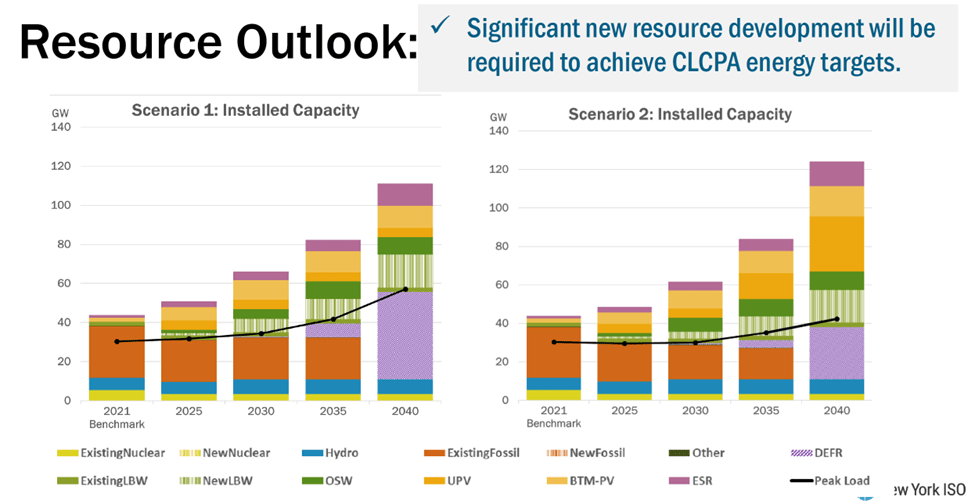
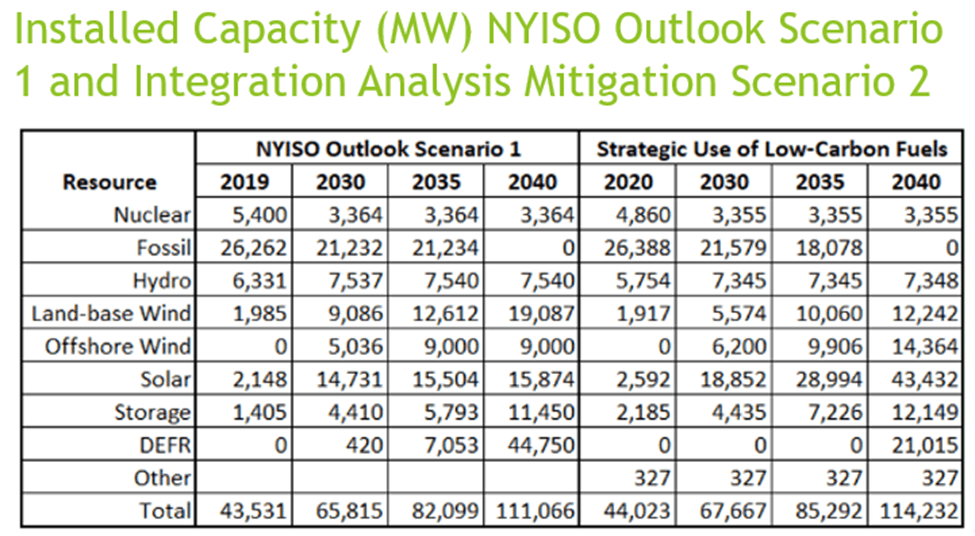
The presentation given by Zachary Smith gave an overview of the DEFR issue. In his first slide (shown below) he gave an overview of the generating resource outlook to make the point that a large amount of new generating resources needs to be developed. I believe that the estimates are from the 2021-2040 System & Resource Outlook. For context I have included a table that lists the capacity for the different resources for one of the Resource Outlook scenarios and one of the scenarios from the Integration Analysis. Of particular note, both projections estimate that DEFR capacity (MW) will be similar to the amount of current fossil capacity.
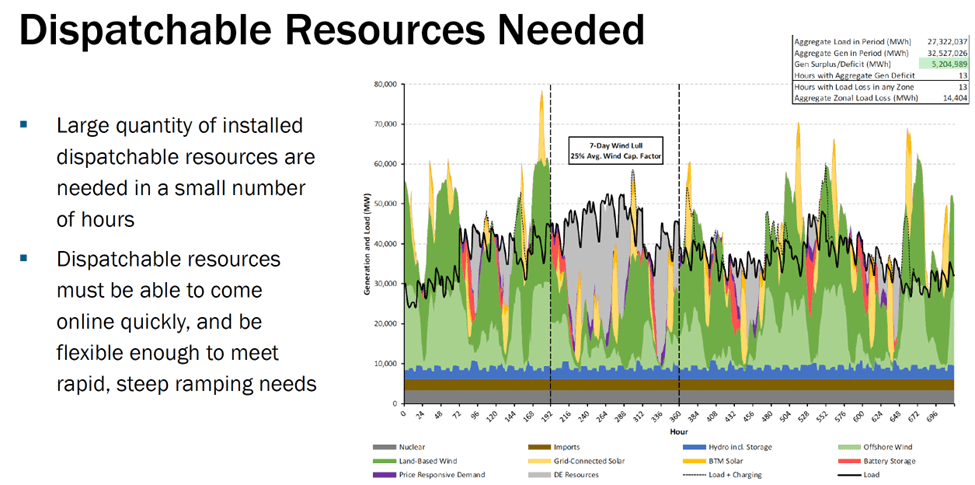
The ultimate problem for reliability in an electric system that depends on wind and solar is illustrated in the following slide from Smith’s presentation. It highlights a 7-day wind lull when the average wind capacity is 25%. The sum of the grey area under the curve during that period is the amount of energy (MWh) that must be provided by DEFR sources based on an analysis of historical weather data. If there are insufficient resources during a wind lull, then load cannot be met. The consequences of that situation would be catastrophic.
In order to meet this need for dispatchable resources Smith explained that dispatchable emission-free resources (DEFRs) must be developed and deployed throughout New York:
- As resources shift from fossil generators to zero emission resources, essential grid services, such as operating reserves, ramping, regulation, voltage support, and black start, must be available to provide New Yorkers with a reliable and predictable electric system that consumers require.
- DEFRs will be required to provide both energy and capacity over long durations, as well as the reliability attributes of retiring synchronous generation. The attributes do not need to be encapsulated in a singular technology, but in aggregate the system needs a sufficient collection of these services to be reliable.
The NYISO must toe the political correctness line so Smith downplays the enormity of the challenge to bring DEFR on-line in the timeframe necessary to meet the arbitrary Climate Act schedule. Smith lists the attributes needed by DEFR in his presentation. In the following I offer my comments on his list of attributes.
Smith’s first attribute for DEFR is that it must have “dependable fuel sources that are carbon free and allow these resources to be brought online when required”. Clearly intermittent wind and solar do not meet this fundamental requirement.
The second DEFR attribute is that it must be “non-energy limited and capable of providing energy for multiple hours and days regardless of weather, storage, or fuel constraints”. This is a particular concern of mine. Wind and solar resources correlate in time and space. In other words, when the wind is light at one wind farm in New York it is very likely that all the wind turbines are experiencing light winds. The seven-day wind lull example in the dispatchable resources needed figure illustrates the problem. If there are insufficient resources during that wind lull, then load cannot be met. My concern is that I think we do not know what the worst case low renewable resource availability period is. Until there has been more analysis done then I believe that the New York electric grid is risking catastrophe.
The NYISO operators balance generation with load constantly. Smith describes several attributes necessary for this requirement. DEFR must be able to “to follow instructions to increase or decrease output on a minute-to-minute basis”. There has to be “flexibility to be dispatched through a wide operating range with a low minimum output”. Finally, DEFR must be “fast ramping to inject or reduce the energy based on changes to net load which may be driven by changes to load or intermittent generation output”.
In addition to the attributes needed when units are operating, there are startup attributes. DEFR must be “quick-start to come online within 15 minutes” and capable of “multiple starts so resources can be brought online or switched off multiple times through the day as required based on changes to the generation profile and load”. Smith explains that a range or DEFR generation will likely be required so not every DEFR has to be capable of every attribute for matching load but sufficient amounts for the system requirement will be needed.
In addition to the generating requirements that cannot be supplied by wind and solar there are ancillary support services for the transmission system. Smith describes three transmission support DEFR attributes:
- Inertial Response and frequency control to maintain power system stability and arrest frequency decline post-fault;
- Dynamic Reactive Control to support grid voltage; and
- High Short Circuit Current contribution to ensure appropriate fault detection and clearance.
Smith’s presentation lists the attributes of twelve sample technologies in the following slide. When I started working for Niagara Mohawk in 1981 utilities were responsible for providing the generation for load in their service territories. They were proud of the diversity of their generation fleet that included coal-, gas- and oil-fired fossil, hydro, pumped storage, and nuclear. The generation all had a dependable fuel source and only the pumped hydro was energy limited but that was not an issue because it was used so shave diurnal peak loads. Only nuclear was not dispatchable but that did not matter because it was used for unvarying base load. There were resources in each system to provide all the other reliability attributes. Demand response was used sparingly but was included.
Attributes of Sample DEFR Technologies

In the future grid the insistence that all fossil fired units have to be shut down means that seven technologies that meet some of the necessary attributes will be required. The added complexity of these technologies does not increase resiliency because wind, solar, battery and demand response are all energy limited. Ancillary support services will be a major consideration because wind, solar and battery do not provide those services. Just from this overview, it is clear that affordability and reliability will be challenges.
Conclusion
Smith’s presentation is an excellent overview of need, attributes, and some potential resources that meet the need for dispatchable emissions-free generation. Any suggestion that some combination of these resources are not needed is simply wrong. Unsaid is the relative difficulty trying to develop these resources to meet the Climate Act net-zero transition schedule.

 Pragmatic Environmentalist of New York