I have been so busy lately with net-zero transition implementation issues that I have not had time to put together an article about every relevant post I have read. This is a summary of posts that I think would be of interest to my readers.
I have been following the. Climate Leadership & Community Protection Act (Climate Act) since it was first proposed and most of the articles described below are related to the net-zero transition. I have devoted a lot of time to the Climate Act because I believe the ambitions for a zero-emissions economy embodied in the Climate Act outstrip available renewable technology such that the net-zero transition will do more harm than good. The opinions expressed in this article do not reflect the position of any of my previous employers or any other company I have been associated with, these comments are mine alone.
The Empire Center’s Ken Giradin has written an exhaustive guide to New York’s drive to lower emissions. I recommend it highly. The Executive Summary states:
New York in 2019 adopted a sweeping climate law designed to reduce greenhouse gas emissions through bans, regulations and taxes. The law, the Climate Leadership and Community Protection Act (CLCPA), sets ambitious goals: 70 percent of electricity from renewables and a 40-percent economywide reduction in emissions by 2030, with an electric grid that uses only “zero emission” technology by 2040 and an economy that has effectively zero emissions by 2050.
The state’s approach to these goals is, however, deeply flawed. The Climate Act leaves the bulk of the decisions about how emissions will be reduced to state agencies under direct control of the governor, vesting them with policymaking powers that are supposed to be reserved for New York’s senators and assemblymembers.
The process that has played out in the five years since the law’s passage has been marred by a lack of transparency, with state officials failing to issue legally required cost estimates and crucial studies designed to guide state energy policy. There is growing evidence that the state will be unable to achieve its goals without significantly affecting the cost of living and doing business in New York and harming the reliability of its electric grid.
Giradin offers recommendations including “demanding updated state energy studies, as required by state law and the development of proper cost estimates.” Other steps include:
- Giving the Legislature the final say on any regulation or set of regulations with gross compliance costs of $100 million or more;
- Ceating an “off-ramp” in case of recession or other financial emergency;
- Setting renewable energy credit (REC) purchase requirements through legislation rather than administrative rulemaking;
- Pausing awards for offshore wind developers amid exploding costs and making more technologies eligible for zero-emission subsidies; and
- Eliminating obstacles to reducing emissions with steps such as making more types of zero-emission power plants such as nuclear, biogas and hydroelectric eligible for state subsidies and seeking an exemption from the federal Jones Act.
Maryland Offshore Wind
PenguinEmpireReports Substack published a great article “Whose grid is it anyways?”:
So whose grid is it? Is the grid supposed to provide flexible and dependable electricity to the customers when and where they need power? Or is the grid sub-servant to wind and solar? Is it the customer’s job to be ‘flexible’ to accommodate inflexible renewables? Who is the grid supposed to serve:
A. The customer?
or
B. Whatever power source is politically favored at the moment?
Fundamental Climate Model Concern
One of the reasons that I distrust climate models is because they do not model clouds well. It turns out that there is another issue with moisture. Pierre Gosselin explains that “A new study published in PNAS has demonstrated, once again, that climate models fail to simulate what happens in the real world with regard to fundamental climate change variables like water vapor. This is a devastating finding, as water vapor is the most significant greenhouse gas due to its alleged “feedback” capacity, accelerating warming well beyond what CO2 is said to be capable of alone.
The Institute for Energy Research reports that Massachusetts utilities are asking for rate increase:
Eversource and National Grid, the major utilities in Massachusetts, are requesting rate hikes to enhance the power grid and accommodate the growing demand from electric vehicles and heat pumps. They are requesting approximately $2.4 billion over the next five years for grid improvements to convert the grid for renewable energy production and make it more resilient and capable of handling the surge in electrification. That is because Biden’s and the state’s climate agenda will result in Massachusetts homes consuming nearly three times as much electricity by 2050 than they do today. To deliver all that power, Eversource and National Grid will have to invest billions in grid infrastructure upgrades with ratepayers picking up much of the cost. The two utilities have asked the state Department of Public Utilities to begin the process of recouping their investments in converting the electric grid by raising rates over a five-year period.
The Death of a Wind Farm: Why the United States is No Country for Old Wind
A Substack article by Isaac Orr and Mitch Rolling explains:
Taxpayer subsidies and utility profit motives are converging to incentivize the premature destruction and replacement of wind installations throughout America, and this trend will almost certainly become more common as an increasing number of wind turbines are added to the nation’s electric grid. Utility companies and wind turbine operators will seek to renew their access to the PTC to reduce the need for curtailment and to increase their government-approved profits on capital expenditures as long as these subsidies are available.
For your information New York’s October 2023 land-based renewable energy procurement included 612 MW of wind turbine re-powering.
Fundamental Greenhouse Gas Effect Concern
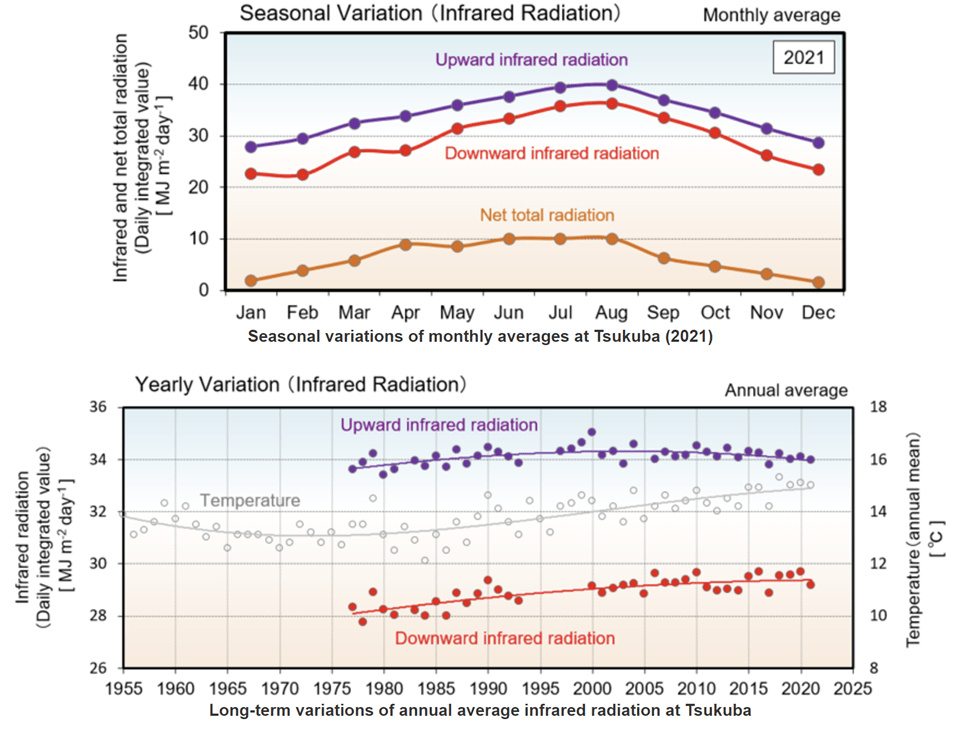
The Science and Environmental Policy Project Weekly Climate and Energy News Roundup #588 explains that physicist Howard Hayden demonstrates that AR6 is inconsistent with itself and with the Stefan-Boltzmann law which specifies the amount of radiation emitted per unit of time from a specific area of a blackbody. A webpage describing observations of infrared radiation compares radiation measurements with temperature measurements. The following results are described:
Both upward and downward infrared radiation can be measured by pyrgeometers mounted 1.5 to 2 meters (4.5 to 6 feet) above the ground. These measurements vary seasonally and by year. The example shown by the Japan Meteorological Agency at Tsukuba, Japan, the home of Tsukuba Science City and the headquarters of the Japan Aerospace Exploration Agency shows this variation and a modest increase in downward infrared radiation but not an appreciable increase in upward infrared radiation indicating a warming.