
I started posting on this blog on January 11, 2017 so it took a few months over nine years to produce 1,000 posts. This is a similar retrospective to my 500th post published on January 28, 2023.
The goal of my blog is to describe environmental issues from a pragmatic viewpoint. Pragmatic environmentalism is all about balancing the risks and benefits of both sides of environmental issues. It is not possible to grow and maintain our society without environmental impacts. Public perception is too often driven by scary one-sided sound bites that describe all impacts as existential threats. Unfortunately, those stories must be rebutted by getting into details. I have tried to show the complicated “other” side of environmental issues that gets overlooked during policy discussions.
My background as a scientist and my earlier responsibilities to provide technical comments on new or revised regulations means that I have the experience to explain the nuances of environmental policy. However, I tend to get bogged down in technical details that are, too be kind, wonky. To address that I publish a fortnightly summary of posts where I try to simply describe recent posts. If you want to get that summary, use the contact form.
There is another option. In May 2024 I started a Substack blog. I generally only use that site to publish the summary of posts on this blog. I have been asked why I don’t switch to Substack. After publishing a thousand posts I have the routine down for WordPress and it does not whine when my posts run long. I also get storage for media files, spreadsheets and reports which I use regularly. I have used that feature to provide a link to reports that have not shown up on the web elsewhere.
Topics
Although my posts cover a wide range of topics that interest me there are two primary topics covered. At the time of my 300th post, the Climate Leadership and Community Protection Act implementation process accounted for 109 articles. When I hit 500 articles 169 of the 200 latest published articles addressed the Climate Act for a total of 278 out of the 500 articles. Now there have been 651 articles about the Climate Act. This obsession is caused because I truly believe that the Climate Act “solution” will be far worse than the impacts of the problem they are trying to address and that does not consider the enormous costs. My other main topic is the Regional Greenhouse Gas Initiative (RGGI). This greenhouse gas control program is frequently described as a success but I have not been able to resist pointing out the flaws in that belief.
In the past year I have started using Perplexity AI to research topics and provide an outline for documents. It is very useful for me as a search engine if I cannot recall when I wrote about a specific topic. It is an amazing resource, but I have found that I cannot rely on its references, so I have to verify all the references and frequently replace what was recommended with something more appropriate.
Consider this example Perplexity query: What are the main topics covered in the blog? It provided the following response with my corrections and some changes.
The blog has focused on a consistent set of energy‑ and climate‑policy themes, with an increasing emphasis on New York’s Climate Act after 2019.
Core long‑running themes (Note that this query searched the website and listed topics that have been present since the beginning but does not try to rank the themes by the number of posts on each theme.) I have modified the references from the query response to point to specific pages.
- Pragmatic environmentalist principles – Foundational posts laying out principles such as balancing risks and benefits, finite resources (“we can do almost anything but not everything”), and the “iron law of climate.”
- Air quality issues – Pieces drawing on air pollution and meteorology experience, including regulatory analysis and discussion of real‑world air quality outcomes.
- Regional Greenhouse Gas Initiative (RGGI) – I have been involved in the RGGI program process since it was first proposed prior to 2008. Dealing with the RGGI regulatory and political landscapes is challenging enough that affected entities seldom see value in speaking out about fundamental issues associated with the program.
- New York State Energy Plan – I spent a lot of time evaluating the 2025 State Energy Plan
- New York energy policy – Ongoing coverage of NYISO, resource mix, reliability, and how state policy interacts with the grid and markets.
- New York environmental policy – Broader state environmental initiatives beyond energy (regulatory, legislative, and planning actions) viewed through a pragmatic lens.
Climate Act and decarbonization focus
- Climate Leadership and Community Protection Act (Climate Act) – Since the law’s passage in 2019, this has been the dominant topic: targets, implementation plans, schedule changes, and feasibility concerns.
- Climate Act implementation pages – Dedicated pages summarize “many articles on various aspects of the Climate Act,” including high‑level guides and deeper technical material considered too detailed for general audiences. (If you are interested in a specific topic I recommend using an AI search engine to find what you want because my documentation leaves a lot to be desired.)
- Cap‑and‑invest and carbon pricing – Multiple articles on New York’s cap‑and‑invest proposal and comparisons to other emissions trading programs, especially RGGI.
Technology and infrastructure topics
- Electric sector and “zero‑emissions” resources – Repeated analysis of the 70 percent renewables by 2030 and 2040 zero‑emissions electricity targets, including reliability, resource adequacy, and what counts as “zero‑emissions.”
- Wind, solar, and energy storage impacts – Posts under “Zero‑emissions Environmental Impacts” look at land use, wildlife, materials, and other environmental consequences of large‑scale wind, solar, and batteries.
- Electric vehicles – A dedicated section notes “many issues associated with widespread implementation of electric vehicles,” including infrastructure, grid impacts, and cost.
Cost, policy design, and tradeoffs
- Green energy costs – The blog links to and discusses estimates of green‑energy costs in other jurisdictions and how those lessons apply to New York.
- Affordability and iron‑law themes – Posts frequently emphasize that willingness to pay for climate objectives has limits and that aggressive targets without feasibility studies pose affordability and equity risks.
- Policy “doing more harm than good” – Principles posts (e.g., Ridley’s paradox) and later climate‑policy analyses highlight cases where policies may impose real economic or environmental costs with limited climate benefits.
How the content is organized
- The Menu and dedicated Climate Act summary pages serve as hubs that group posts by topic (Climate Act, electric vehicles, green‑energy costs, RGGI, air quality, New York energy and environmental policy, and the principles series).
- Substack summary updates (since about 2024) provide fortnightly or periodic digests of recent posts, reiterating that the blog has been “writing about the pragmatic balance of the risks and benefits of environmental initiatives in New York since 2017 with a recent emphasis on the Climate Act.”
Website organization is definitely a weak point. You know it is bad when the blog author resorts to searching with Perplexity AI because it is easier than trying to track something down on the blog.
Impact
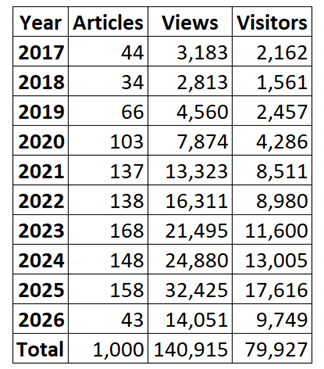
One question I have asked myself is whether my obsession with this blog has been a success and to me success is having people read the blog. According to the WordPress statistics, the views of the blog have been steadily increasing and there have been over 79,927 visitors. In context, popular blogs get this many views and visitors in a week and the most popular can match my totals on a good day.
Table 1: Overall Statistics
So where are the people coming from to find the blog. Very early on Judith Curry included this blog on her blogroll and a large percentage of the visitors visited since then. Tom Shepstone started reposting my articles at his Natural Gas Now blog starting 12/28/18 and continues to do so on Energy Security and Freedom. My thanks to both for bringing visitors.
I have also done blog posts for Judith’s site and Watts Up With That and there usually is a flurry of visitors after those posts. The comments on my work at those sites dwarf the responses on the blog itself and I am sure the total views were larger too.
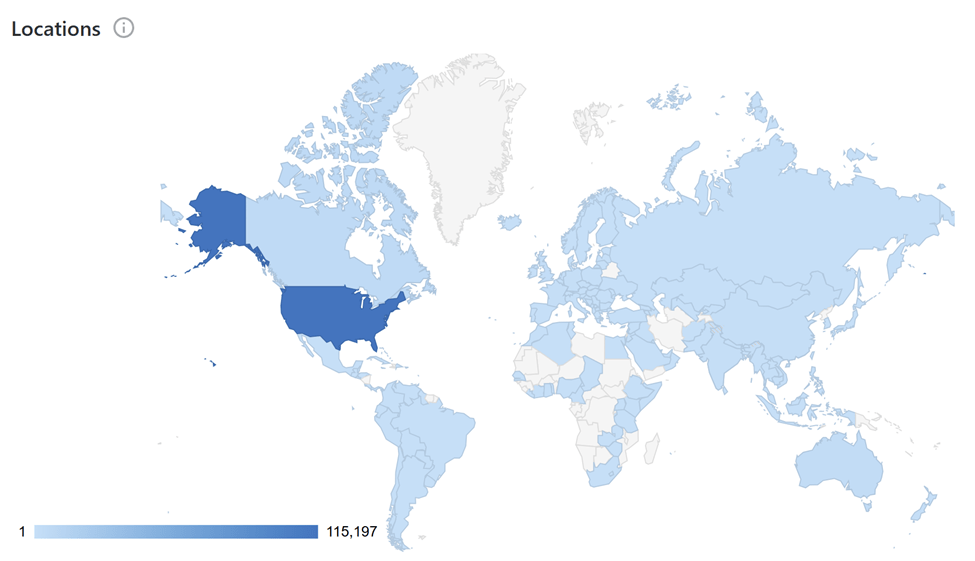
Finally, it is a source of amusement to me that people from all over the world have visited the site. Someone has visited the site from every country that is highlighted in the following map since the blog started.
Conclusion
In conclusion this has been a rewarding experience for me. I devoutly believe that it is important to keep busy during retirement and this blog keeps me busy. Just when I get discouraged and think about quitting, some insane proposal or article comes up that provides more than enough incentive to keep writing. My thanks to everyone who has read my work.


