Balancing the risks and benefits of environmental initiatives
The Difference Between Weather and Climate is Important
I recently published an article about the difference between weather and climate that was in response to a friend who consistently links weather events to climate change on his Facebook account. The reason for this post is his response to my latest explanation that ended with him saying “I’m comfortable with being wrong. It’s not a death match.” This post explains why it matters.
I will explain the problem with the successful propaganda campaign to convince the general population that unusual weather events justify New York’s Climate Leadership & Community Protection Act (Climate Act). I have followed the Climate Act since it was first proposed, submitted comments on the Climate Act implementation plan, and have written over 400 articles about New York’s net-zero transition. The opinions expressed in this post do not reflect the position of any of my previous employers or any other organization I have been associated with, these comments are mine alone.
Overview
The Climate Act established a New York “Net Zero” target (85% reduction in GHG emissions and 15% offset of emissions) by 2050. It includes an interim 2030 reduction target of a 40% reduction by 2030 and a requirement that all electricity generated be “zero-emissions” by 2040. The Climate Action Council (CAC) is responsible for preparing the Scoping Plan that outlines how to “achieve the State’s bold clean energy and climate agenda.” In brief, that plan is to electrify everything possible using zero-emissions electricity. The Integration Analysis prepared by the New York State Energy Research and Development Authority (NYSERDA) and its consultants quantifies the impact of the electrification strategies. That material was used to develop the Draft Scoping Plan outline of strategies. After a year-long review, the Scoping Plan was finalized at the end of 2022. In 2023 the Scoping Plan recommendations were supposed to be implemented through regulation, PSC orders, and legislation. Not surprisingly, the aspirational schedule of the Climate Act has proven to be more difficult to implement than planned and many aspects of the transition are falling behind.
Examples of the Causal Link
In order to keep the public’s support for the Climate Act net-zero transition the Hochul Administration links recent extreme weather events to climate change. The impetus of this article were two recent Facebook posts by my friend. The first said that “So it wasn’t so long ago that there was a thing called “snow” and included a memory of a hike during the winter of 2014-2015 when there were “MASSIVE snow dumps in the Catskills”. Yesterday the second post noted that he had heard spring peepers. This small chorus frog is “one sure sign of spring” and my friend noted that hearing them on March 8 was “by far the EARLIEST EVER”.
Climate Change and California Atmospheric Rivers
In my articles responding to the presumption that these weather events are tied to climate change I have explained that according to the National Oceanic and Atmospheric Administration’s National Ocean Service “Weather reflects short-term conditions of the atmosphere while climate is the average daily weather for an extended period of time at a certain location.” That article goes on to explain “Climate is what you expect, weather is what you get.” Rather than trying to expand on my arguments I think this recent article by Chris Martz provides good insight.
In his article Martz addresses those who will claim that the recent rounds of atmospheric rivers that have brought rainfall for days and recent heavy snowfalls to California are linked to climate change. He describes the news cycle that had been harping for years on the “megadrought” that would put California in a permanent drought because of climate change. The last two years of above average precipitation have destroyed that story. Martz writes:
Faced with the reality that these “forever drought” predictions from nearly a decade ago were woefully wrong, academics and their media mouthpieces have had one of two options, either:
Admit that the “permanent drought” prediction was wrong, or,
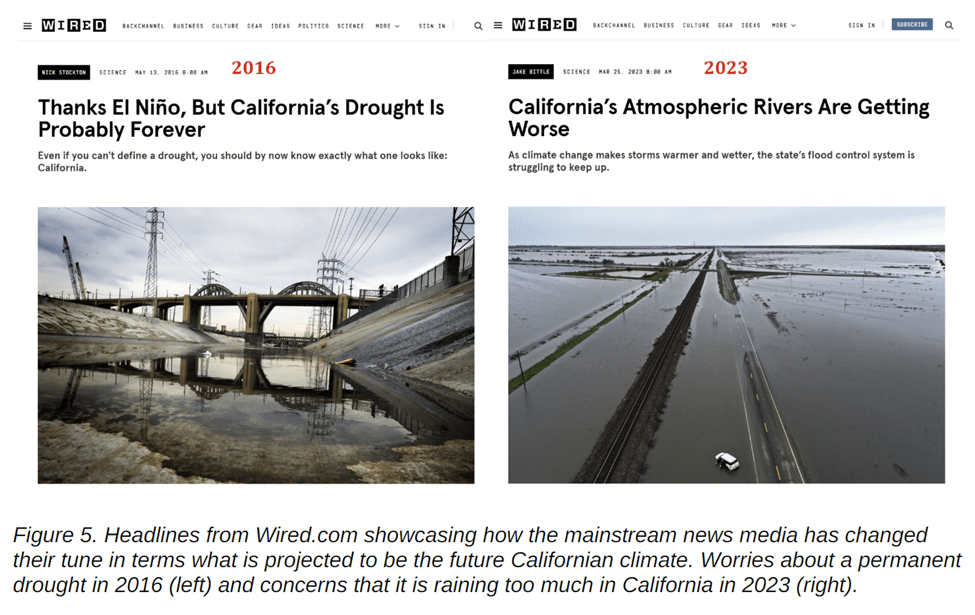
Change their tune quietly to say that human-induced climate change is making California wetter by “fueling” the atmospheric rivers that provide the bulk of the state’s annual rainfall budget, and hope the rest of us don’t notice.
And, of course, the second option is the one academics and government scientists decided to go with (Figure 5).
Martz goes on to describe atmospheric rivers and their potential for serious impacts. Then he addresses the question whether “human-induced climate change plays a role, and to what extent if that is indeed the case.” He notes:
I should prepend this discussion with the disclaimer that climate change itself does not cause any single weather event to occur. Climate is nothing but a statistical measure of various atmospheric state variables over a period of at least 30-years, preferably longer. The statistics may be organized into averages or “climate normals,” distributions and extremes. Each provides some sort of insight as to the weather one might expect at any given point in space or time. As the old saying goes, “climate is what you expect, weather is what you get.” Climate changes, both naturally and through man-made forcings, over a period of several decades. The equations of motion which physically explain how extreme weather phenomena occur do not change with the climatic base state.
I think he does a good job explaining what meteorologists should consider when trying to attribute weather events to climate change.
So, the question becomes, how does a changing climatic base state alter specific characteristics of atmospheric river events? In this case, there are two facets that atmospheric scientists care about:
Has there been a detectable increase in extratropical cyclone activity [and the accompaniment intense winds] that atmospheric rivers are associated with in the observational record? How is this expected to change in the future?
How has extreme rainfall associated with atmospheric rivers changed as the climate has warmed? How is this expected to change in the future?
In a nutshell, depending on which of the two key issues above are examined, we reach contrasting conclusions, showcasing the sheer complexity of the coupled ocean-atmosphere system. To elaborate, if we make the assumption that the planet continues to warm, extratropical cyclone activity and their associated extreme winds should wane, but extreme rainfall, on the contrary, should be enhanced.
Like every other aspect of climate change policy this is much more complicated than it appears at first glance. He does a great job breaking down all the factors at play. For example, the warmer climate means more moisture “super-charging” extreme weather. He says in response: “Simply put, just because more water vapor can occupy the air at higher temperatures does not mean that it will.” I recommend reading his article in its entirety to understand how difficult it is to make a definitive link between climate change and weather events.
Why it Matters
After I sent the link to the article to my friend he responded:
I might quibble with “The equations of motion which physically explain how extreme weather phenomena occur do not change with the climatic base state.” No, the equations don’t change, but the inputs do, right? So, more heat = more [whatever], etc. I appreciate the skepticism, but, clearly, there is something going on out there beyond the bounds of “normal”. But then again, you can be skeptical and say that my human timeframe is far too short to make such judgments – perhaps. But even beyond my mere mortal years, it seems that we’re seeing the furthest outliers of “weather” data that you might expect for a given season.
The frustration to me is that he gets it when he says, “my human timeframe is far too short to make such judgments”. Anecdotal evidence linking weather events and climate change is going to always be wrong because weather is what you get and climate is what you expect and our time frame is too short for climate comparisons.
However, that is not the problem. The issue is his concluding remarks:
I’m comfortable with being wrong. It’s not a death match.
My concern is that ultimately the conflation of every unusual weather event to climate change is linked to the preposterous idea that if New York converts its energy system to meet the Climate Act net-zero goals there will be an effect on the unusual weather events observed. I am convinced that the present trajectory of the Climate Act mandates aspirational goals that are dangerous. In February 2021, the Texas electric grid failed to provide sufficient energy when it was needed. The storm was the worst energy infrastructure failure in Texas history and resulted in at least 246 people dying and total damages were at least $195 billion. The Hochul Administration has not demonstrated that the Climate Act goals are feasible and will not endanger the reliability of the New York electric system. The same thing that happened to Texas could happen in New York.
Discussion
There is another related weather and climate related issue. I fear that the emphasis on ever more dangerous weather in the future due to climate change is diverting resources away from addressing observed weather problems. There is a limit to the resources available to address weather-related issues despite the value in doing so. Over building infrastructure in one place to account for potential issues related to climate change likely means that improving infrastructure elsewhere for observed weather events will not be funded.
I am often surprised how California state and local entities craft policies they believe would put us on the path to addressing the complex dynamics of what we label climate change. Whether these efforts—a bullet train to and from small cities, banning the sale of gasoline cars by 2035, limiting the use of gas appliances, and similar aggressive policies—make real-world sense or whether they are a virtue-signaling crystal ball without a feasible way of measuring those efforts remains to be seen.
This is the nub of the Climate Act problem. Can we come up with net-zero transition policies that will not do more harm than good. Nalven’s article describes how Curry lays out the wicked problem of whether climate action is necessary and how it should be addressed given the uncertainties. Nalven sums up:
Curry’s approach stands in stark contrast to the overreach and catastrophizing by climate justice warriors. Those warriors and their acolytes are unlikely to be persuaded by Curry’s pragmatic, but seemingly slower, approach to a changing climate.
There is no magic wand, no scientific alchemy, that can easily upend cognitive catastrophizing about weather events.
“The disconnect between historical data for the past 100 years and climate model-based projections of worsening extreme weather events presents a real conundrum regarding the basis on which to assess risk and make policies when theory and historical data are in such disagreement.”
Conclusion
Chris Martz sums up my concern about the mis-allocation of resources based on the fear of climate change:
Whether or not climate change is having any meaningful impact on the extreme weather events we care about is irrelevant in the need to raise awareness to the fact that we continue to develop in disaster-prone areas and the necessity to improve societal resilience through better zoning codes and community planning. Mother Nature always has and always will throw curveballs in our direction, regardless of what the climate is doing in the long-term, and being better equipped to mitigate disaster losses or prevent them in the first place must be a focal point of engineers, emergency managers and policymakers in the years and decades to come.
Sitting on our hands and blaming climate change for everything is really a waste of time that would be better spent finding solutions to real-world problems such that our children and grandchildren have a safer world to live in.
Against this backdrop, the cartoon-like presumption that any unusual weather is tied to climate change and thus needs to be addressed whatever the cost needs to be confronted. The difference between weather and climate does matter. N
I am a meteorologist (BS and MS degrees), was certified as a consulting meteorologist and have worked in the air quality industry for over 40 years. I author two blogs. Environmental staff in any industry have to be pragmatic balancing risks and benefits and (https://pragmaticenvironmentalistofnewyork.blog/) reflects that outlook. The second blog addresses the New York State Reforming the Energy Vision initiative (https://reformingtheenergyvisioninconvenienttruths.wordpress.com). Any of my comments on the web or posts on my blogs are my opinion only. In no way do they reflect the position of any of my past employers or any company I was associated with.
View all posts by rogercaiazza


 Pragmatic Environmentalist of New York