The Climate Leadership & Community Protection Act (Climate Act) requires that the Public Service Commission (PSC) issue a review for notice and comment that considers “(a) progress in meeting the overall targets for deployment of renewable energy systems and zero emission sources, including factors that will or are likely to frustrate progress toward the targets; (b) distribution of systems by size and load zone; and (c) annual funding commitments and expenditures.” The recently released Clean Energy Standard Biennial Review Report contains a lot of information that will be addressed in future posts. This post provides my first impression of the document. Spoiler – there is no chance that the 2030 mandate for the 70% renewable electric energy will be met.
I have followed the Climate act since it was first proposed, submitted comments on the Climate Act implementation plan, and have written over 400 articles about New York’s net-zero transition. The opinions expressed in this article do not reflect the position of any of my previous employers or any other company I have been associated with, these comments are mine alone.
Overview
The Climate Act established a New York “Net Zero” target (85% reduction in GHG emissions and 15% offset of emissions) by 2050. It includes an interim 2030 reduction target of a 40% reduction by 2030, a requirement for 70% renewable energy for electric production by 2030, and a requirement that all electricity generated be “zero-emissions” by 2040. The Climate Action Council (CAC) was responsible for preparing the Scoping Plan that outlined how to “achieve the State’s bold clean energy and climate agenda.” The Integration Analysis prepared by the New York State Energy Research and Development Authority (NYSERDA) and its consultants quantifies the impact of the electrification strategies. That material was used to develop the Draft Scoping Plan outline of strategies. After a year-long review, the Scoping Plan was finalized at the end of 2022.
Biennial Report
The Introduction to the report states:
The Climate Leadership and Community Protection Act (CLCPA) of 2019 requires that the Public Service Commission (PSC) issue a review for notice and comment that considers “(a) progress in meeting the overall targets for deployment of renewable energy systems and zero emission sources, including factors that will or are likely to frustrate progress toward the targets; (b) distribution of systems by size and load zone; and (c) annual funding commitments and expenditures.” This Report serves to inform the Commission’s review. It summarizes the progress made toward the renewable energy and zero emission goals set by the CLCPA since the establishment of New York State’s Clean Energy Standard (CES), assesses what remains to be done to achieve those goals, presents policy options and proposals, and invites comments from stakeholders and the public on these or any other matters raised in this Report. The Report focuses in particular on New York’s goal to obtain 70% of New York’s electricity from renewable sources by 2030 (the 70% goal) and the related goal of 9 gigawatts (GW) of offshore wind by 2035.
The footnote for the first sentence states: PSL §66-p(3). PSL §66-p(4) provides the Commission with authority to “temporarily suspend or modify” the obligations created by the Program if, after conducting a hearing, it finds that the Program “impedes the provision of safe and adequate electric service,” “is likely to impair existing obligations and agreements,” and/or is related to “a significant increase in arrears or service disconnections.” The Introduction goes on:
Section 1 identifies the key regulatory actions taken to date to support renewable energy deployment in New York, including the establishment of the CES. Section 2 summarizes progress to date in achieving the CLCPA and CES goals in terms of current contributions of operational renewable energy systems and zero-emission sources to the State’s energy portfolio. Section 3 offers a detailed assessment of major factors that have affected and will likely continue to affect progress towards the goals. Section 4 reports on the pipeline of contracted renewables from previous Tier 1 and offshore wind solicitations. Section 5 accesses the amount of renewables that would need to be procured, under the CES or a modified version of the program, to achieve the 70% goal and recommends adjustments to NYSERDA’s procurement authorization that may be necessary to do so. Section 6 considers other programmatic options for accelerating development and construction of renewable energy resources. Policy options and proposals under consideration in this Report are limited to the CES itself.
I could do a post on each section and may end up doing that. It is encouraging that the PSC acknowledges the safety valve mechanism in Public Service Law §66 that I have mentioned on many occasions. Optimistically could this signal recognition that if the aspirational scheduled mandates of the Climate Act are not feasible that the schedule must be modified?
Progress to Date
Section 5 summarizes the “Path to the 70% goal”. The description of the Table 8 “Summary of progress” states:
Under the base case load forecast assumption of 164,910 GWh by 2030 as described above, the 70% goal equates to 115,437 GWh. Table 8 below summarizes the contributions towards the goal from currently operational and contracted renewables, as set out above in Section 2 and Section 4 of this Report. In addition, it projects 10 GW of distributed generation by 2030 secured outside the CES framework.
I will follow up with a post addressing the assumptions used to calculate the numbers in Table 8. Sections 2 and 4 described how operational and contracted/awarded renewable estimates were projected and that discussion is also worthy of its own post. At this time it is notable that one of the key points in the report is the admission that contracted projects don’t always get built.
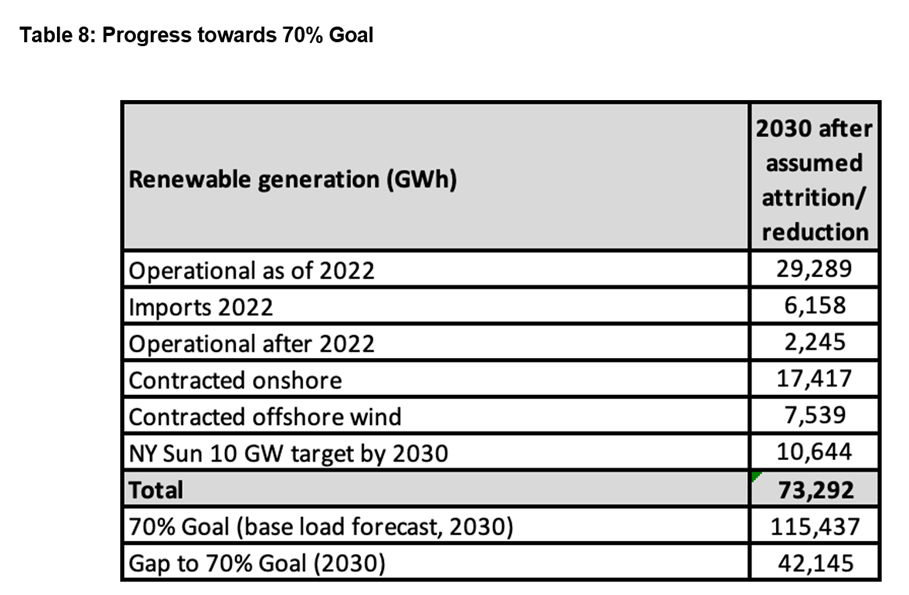
The report describes Table 8:
With these conservative assumptions, the expected amount of renewable generation from operational and awarded/contracted sources in 2030 totals 73,292 GWh. Under the base case forecast for the 2030 statewide electric load, there is a renewable energy supply deficit of 42,145 GWh that would have to be addressed through future procurements in order to reach the 70% goal amount of 115,437 GWh.
Consider these numbers in context. There is an admitted gap of 42,145 GWh which is greater than the total operational renewable generation in 2022, 2022 imports and operational after 2022 (37.692 GWh). Trying to cover that gap is an ambitious challenge.
2030 Projected Renewables
The Biennial report proposes to double down on building renewables to cover the gap and meet the target.
To fill the expected gap, three Tier 1 annual solicitations – those for 2024, 2025, and 2026 – are currently scheduled and will seek projects capable of deploying by 2030. However, the amounts procured in these solicitations would need to be adjusted to secure the needed quantity of 42,145 GWh. The analysis suggests NYSERDA would have to procure approximately 14,048 GWh per solicitation, assuming no project attrition, or, assuming a 30% attrition rate, an amount of 20,068 GWh per solicitation. This volume is significantly higher than the annual procurement quantity of 4,500 GWh per Tier 1 solicitation (before attrition) estimated in the 2020 CES White Paper and 2020 CES Order.
The best efforts of the State to date for renewable solicitations are far lower than what is needed. The report admits that “the maximum annual new project development rate would likely be in the range of 6,000-7,000 GWh per year at least in the near term” and that is contingent on meeting a number of conditions. Table 9 below describes what the report argues is feasible.

Even under the revised assumptions the PSC projects that the 70% renewable energy goal will not be achieved until 2033 when the historic renewable resource deployments are considered.
Conclusion
The State has never done a feasibility analysis to prove that their plan to rely on wind and solar will work. The Climate Act deadlines were set arbitrarily by politicians so achieving that is another level of wishful thinking.
Get out the popcorn. Reality is catching up to the Climate Act net-zero transition. This report is the first indication that things are not going as planned. How will the Hochul Administration handle the obvious need to relax the deadlines?
Stay tuned for future articles on this important report.

 Pragmatic Environmentalist of New York
Roger, This might be the solution to filling the gap. 😉
LikeLike