

Frequent readers of this blog know that many of my posts are long because I get document all my statements. This is because of my background in industry where it is necessary to prove my arguments to have credibility. This is an update of articles that I have read that I want to mention but do not require a detailed post. Previous commentaries are available here.
I have been following the Climate Leadership & Community Protection Act (Climate Act) since it was first proposed and most of the articles described below are related to the net-zero transition. I have devoted a lot of time to the Climate Act because I believe the ambitions for a zero-emissions economy embodied in the Climate Act outstrip available renewable technology such that the net-zero transition will do more harm than good. The opinions expressed in this article do not reflect the position of any of my previous employers or any other company I have been associated with, these comments are mine alone.
Supreme Court Ends the Chevron Defense
Francis Menton explains: “when the legality of a regulatory action of a federal agency is challenged in court, should (or must) the court “defer” to the interpretation that the agency itself has given to the governing statute, or to the challenged regulation?” the Chevron defense deferred to the agency. He states:
Chevron deference” is the ultimate unfettering of the government to enable it to expand as much as it wants, and with nothing to stop it. Of course every agency interpretation of a statute or regulation will be in a way to give the agency itself more power! For Exhibit A, look to the EPA under Obama, which has interpreted the term “waters of the United States” to cover every puddle and wet spot (in order to claim jurisdiction over a good half of all private land) and has determined that a colorless, odorless gas (CO2) is a “danger to human health and welfare” (in order to claim jurisdiction over the entire energy sector of the economy).”
Roger Pielke, Jr. explains why he would have joined the dissent on the decisions and Robert Bryce argues that the decision “finally brings some balance into the regulatory world”. I think the defense has led to one-sided decisions that are not in the best interests of society, so I applaud the decision.
New York Climate Super Fund
The New York legislature has passed the Climate Change Superfund Act but it has not been signed by Governor Hochul. The Institute for Energy Research explains:
The legislation would impose a retroactive tax on fossil energy companies that have emitted greenhouse gases and operated within the state over the last seventy years. If passed, the new law will impose $75 billion in repayment fees for “historical polluters,” who lawmakers assert are primarily responsible for climate change “damages” within the state. New York will “assign liability to and require compensation from companies commensurate with their emissions” over the last “70 years or more.” The bill would establish a standard of strict liability, stating that “companies are required to pay into the fund because the use of their products caused the pollution. No finding of wrongdoing is required.”
It is unclear why New York legislators believe $75 billion in repayment fees would not increase costs to consumers but numeracy is not a strong suit of the legislature. I suspect that there will be legal challenges as well. It is kind of mind boggling that the bill demands payment for something without requiring a finding of wrongdoing. Given that Hochul as indicated that she intends to run for Governor in 2026 I would not be surprised if she signs the bill.
Proposal to Raise the New York Distributed Solar Target
PV magazine describes a New York Solar Energy Industries Association (NYSEIA) report to Governor Kathy Hochul, requesting a raised target for the state’s distributed solar targets. The current target is 10 GW by 2030 and NYSEIA proposes raising the target to 20 GW by 2035. A quick look at the report suggests that I should address some of the claims made but, in this commentary, I want to address one issue.
Given the problems raised in the New York Independent System Operator Power Trends 2024 report, I believe that New York’s energy planning should focus on the wind and solar resource gap that was addressed at the first session of the Department of Public Service Proceeding 15-E-0302 technical conference held on December 11 and 12, 2023 entitled Zero Emissions by 2040. I described the problem and the new category of generating resources called Dispatchable Emissions-Free Resources (DEFR) necessary to keep the lights on during periods of extended low wind and solar resource availability.
The problem with solar is that it is not expected to provide any energy when the future winter load peaks after the sun has gone down. Distributed solar has a related problem. Roof top arrays are commonly used for distributed solar and in New York City many arrays are flat as shown below.
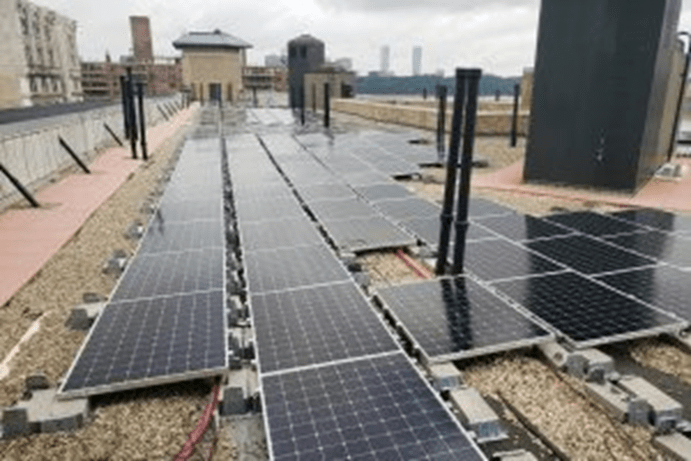
Source: https://www.brightpower.com/new-york-city-solar-co-op/
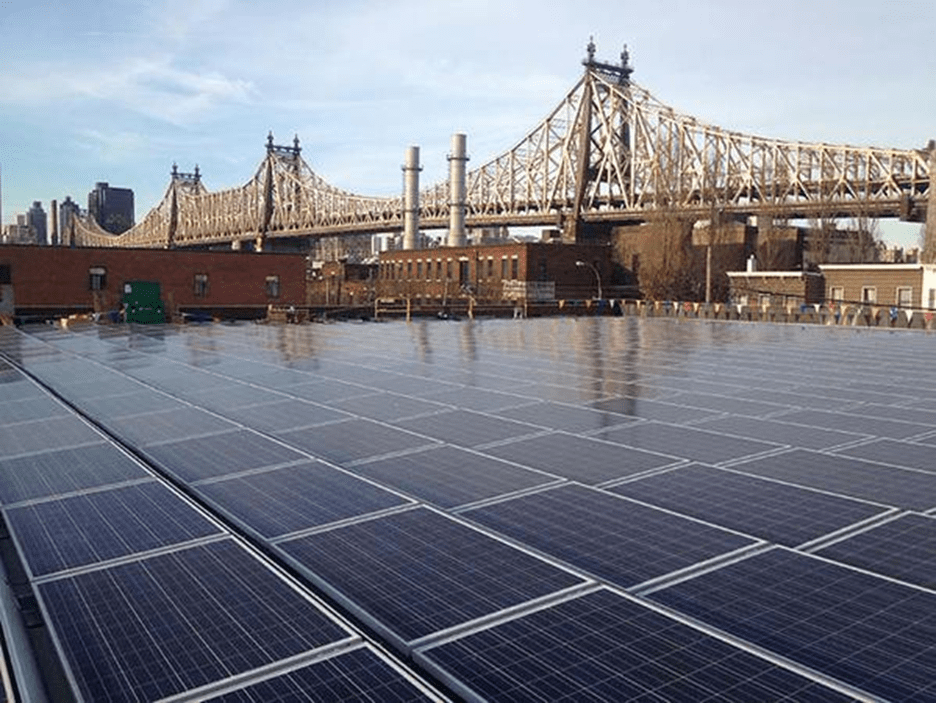
Just imagine how these panels will look after a significant snowstorm. There is no place to put the snow even if it could be cleared. It is not unusual for the coldest weather and the highest loads to occur after an impactful snowstorm. In that instance, rooftop solar will not only be unavailable during the peak hour but could be impacted for days after the snowstorm. Spending more money on distributed solar that will not help address future peak winter loads is a waste.
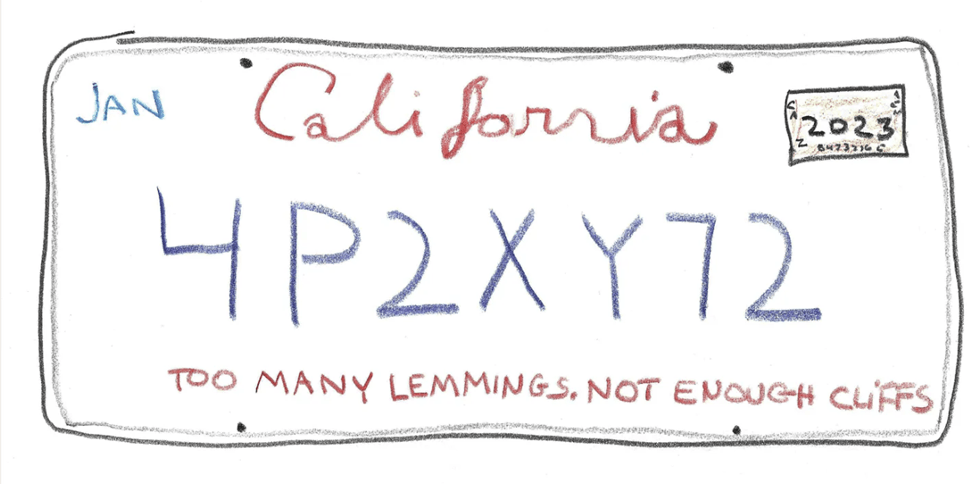
California in one License Plate
The Free Press TGIF edition published this cartoon by David Mamet:
India is Going Gangbusters on Coal
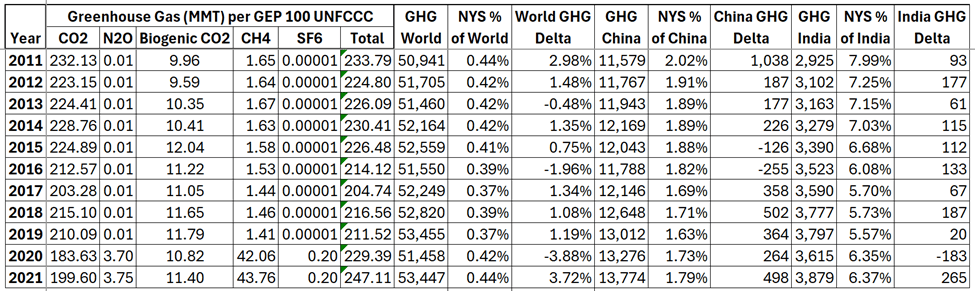
Jo Nova notes that India burns more coal than the US and Europe combined and just ordered $33b in “new coal plants”. I compared NYS GHG emissions with India and China using data from Our World in Data. In 2021, NYS GHG emissions (GWP-100) were 247 million metric tonnes (MMT). GHG emissions from China were 13,774 MMT and from India were 3,879 MMT. The increase in emission from 2020 to 2021 were 498 MMT in China and 265 MMT in India. New York emissions will be supplanted by emissions from China or India in less than one year.
Somebody explain to me why New York is doing this again.
Here are a few other items of interest.
Videos
- Tony Heller provides an example of the integrity- and veracity-free world of the press and climate academics.
- Nearly half of EV owners want to return gas cars.
- 10 Questions Climate Doomers Can’t or Won’t Answer- The Climate Realism Show
Articles
- New York City sea-level rise alarmism is misplaced.
- Reason for 2023 Record Warming Javier Vinós makes the case that the primary reason for the spike in temperatures was natural. In particular a very rare underwater volcano that injected water vapor into the stratosphere.
- Chuck Schumer’s ‘Dear Friend’ Invested in Solar as Schumer Secretly Negotiated Climate Bill. You will never be able to convince me that it is not all about the money. “More and more, it appears the ‘green’ in much of the green agenda has a lot less to do with the environment than it does with transferring taxpayer funds to preferred special interest bank accounts,” said Michael Chamberlain, the director of government watchdog group Protect the Public’s Trust.
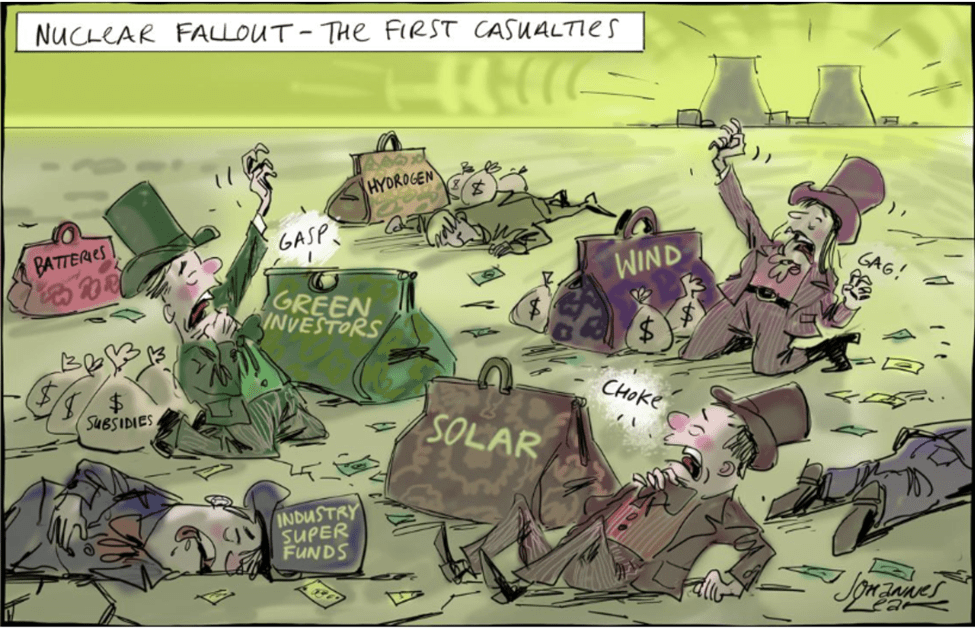
- Adults take charge: “Chaotic and only occasional wind and solar generation is what you get when infants run the show. Now in a ‘wait til your father gets home’ moment, governments of an adult bent are taking a firm grip on energy policy. Ditching the suicidal renewable energy targets and plumping for nuclear power, principally because it works.” I love the illustration for the article.

 Pragmatic Environmentalist of New York
If the DEFR capacity is required to replace the renewable generation when it is unavailable then the renewable generation is redundant capacity which adds to the cost and complexity of the electric system.
LikeLiked by 1 person