I have argued that Climate Leadership & Community Protection Act (Climate Act) affordability would become a political issue. I also argued that when Governor Hochul assigns Climate Act responsibilities to the New York Power Authority (NYPA)and then says “Too many New Yorkers are already falling behind on their energy bills and I will do everything in my power to reign in these astronomical costs” when NYPA proposed raising rates to cover those costs it is hypocritical. This post looks at utility rate impacts. Those costs are already increasing dramatically.
I am convinced that implementation of the New York Climate Act net-zero mandates will do more harm than good if the future electric system relies only on wind, solar, and energy storage because of reliability and affordability risks. I have followed the Climate Act since it was first proposed, submitted comments on the Climate Act implementation plan, and have written over 500 articles about New York’s net-zero transition. The opinions expressed in this article do not reflect the position of any of my previous employers or any other organization I have been associated with, these comments are mine alone.
Overview
The Climate Act established a New York “Net Zero” target (85% reduction in GHG emissions and 15% offset of emissions) by 2050. It includes two 2030 targets: an interim emissions reduction target of a 40% GHG reduction by 2030 and a mandate that 70% of the electricity must come from renewable energy by 2030. The Climate Action Council (CAC) was responsible for preparing the Scoping Plan that outlined how to “achieve the State’s bold clean energy and climate agenda.” After a year-long review, the Scoping Plan was finalized at the end of 2022. Since then, the State has been trying to implement the Scoping Plan recommendations through regulations, proceedings, and legislation.
Personal Experience
This post was prompted by an email from a friend who sent along screen shots of his most recent and last year’s electric supply bills from New York State Electric & Gas (NYSE&G).
NYSE&G current bill screen shot:

NYSE&G electric bill from a year ago:

I looked up my electric bills. Here are screenshots of current Niagara Mohawk Power Corporation, dba– National Grid electric rates

Here is a screenshot of the same information from a year ago:
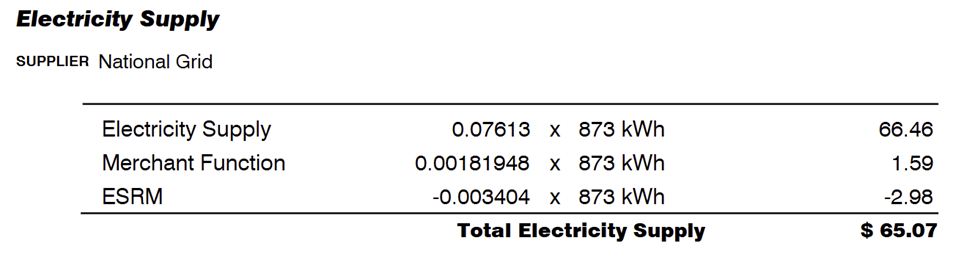
I compared the cost increases in Table 1. NYSE&G electric supply rates have increased sharply. National Grid went up but not nearly as much.
Table 1: New York Electric Supply Rate Increases Examples

New York State Electric Utility Rate Cases
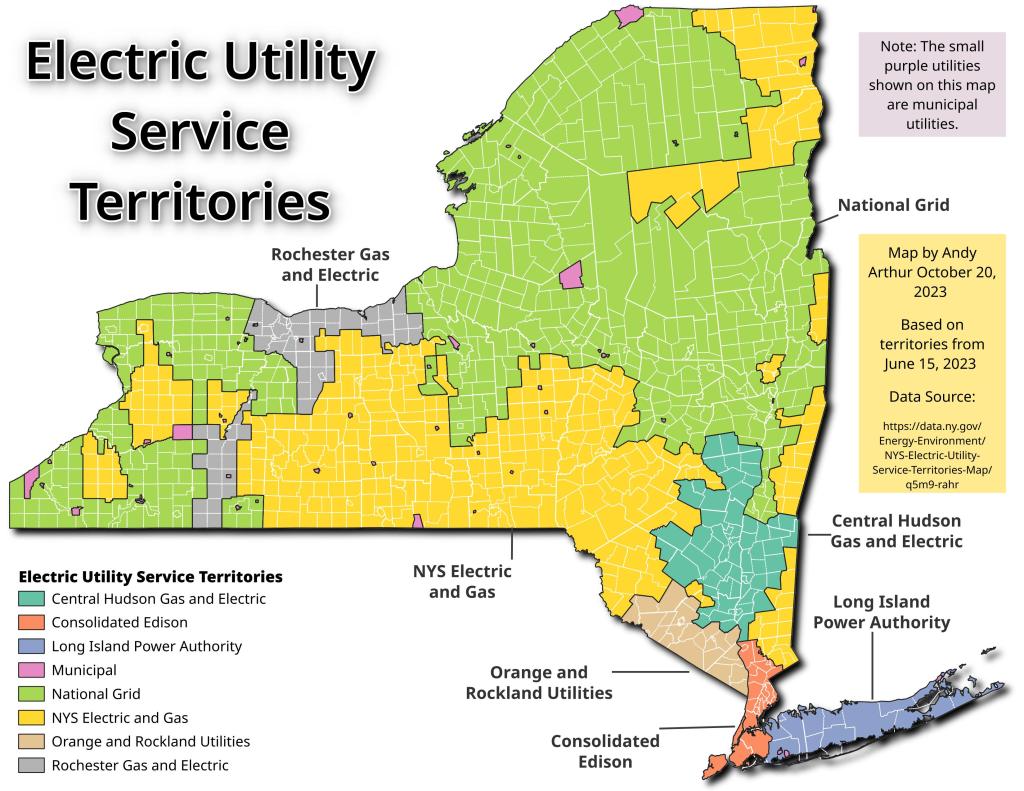
The differences between the two utility rates in Table 1 is striking. Particularly because the service territories overlap so much (Figure 1).
Figure 1: NYS Electric Utility Service Territories

I suspected that the differences at this time are due to the status of New York State electric utility rate cases. NYSE&G has recently settled their rate case whereas National Grid is in a pending case. National Grid rates will go up as soon as a new rate case is settled and the only question is how much. I checked the Public Service Commission (PSC) Pending and Recent Electric Rate Cases web pages and found the following information.
Niagara Mohawk Power Corporation dba National Grid:
NMPC is requesting an increase in annual electric revenues of approximately $525 million (20 percent increase in delivery revenues or 11 percent in total revenues) for the rate year ending March 31, 2026. NMPC estimates that the requested increase in delivery revenues will result in a monthly bill increase of $18.92 (23.4 percent increase in delivery bill or 15.3 percent increase in total bill) for a typical residential customer using 625 kilowatt-hours (kWh).
For the record here is information on other rate cases listed at the PSC website.
Central Hudson:
Central Hudson Gas and Electric Corporation is requesting an increase in annual electric delivery revenues of approximately $47.2 million (8.8 percent increase in base delivery revenues, or 4.6 percent increase in total system revenues), compared to the revenues approved by the Commission for the Company’s current Rate Year. The requested increase in electric delivery revenues results in a monthly bill increase of $9.19 (8.6 percent increase on the delivery bill, or 5.3 percent increase on the total bill) for an average residential customer using 630 kilowatt-hour per month.
Consolidated Edison:
Con Edison is requesting an increase in annual electric delivery revenues of approximately $1,612 million (an 18.0 percent increase in base delivery revenues, or an 11.4 percent increase in total revenues). The requested increase in delivery revenues results in an average residential monthly delivery bill increase of $26.60 (a 19.1 percent increase on the delivery bill, or a 13.4 percent increase on the total bill) for a 600 kilowatt-hour/month customer.
The primary drivers of the requested electric increase are local property taxes (which account for an overall electric bill increase of 3.1 percent), new infrastructure investment (2.6 percent) and operating expenses (2.6 percent). Con Edison purports that its filing will help accommodate demand growth, especially with clean energy options and substation investments, while maintaining reliability with investments in feeder replacements. The Company is also enhancing its system resiliency for more frequent and severe storms, as well as warmer temperatures.
In addition, the Company’s filing purportedly includes a focus on improving customer outreach and accessibility, enhancing customer support and the customer experience, and promoting energy efficient programs. The Company plans to expand outreach efforts to enroll eligible customers in the Energy Affordability Program.
I also did a Perplexity AI search asking the question: What is the status of New York State electric utility rate cases. The results noted that “as of February 17, 2025, there are no pending or recent electric rate cases for New York State Electric & Gas (NYSEG). However, there are some notable developments in the New York electric utility landscape”. The response stated:
Con Edison’s proposed rate hike: Governor Hochul has directed the state agency to reject Con Edison’s proposed rate increase, which would have raised electricity rates by 11.4% in 2026.
Orange & Rockland Utilities: There is a pending case (Case 24-E-0060) for Orange and Rockland Utilities, Inc. The company is requesting a 7.3% increase in electric delivery revenues for the rate year ending December 31, 2025.
National Grid: The company filed a request in May 2024 for new electric and gas rates in upstate New York, proposing to reset prices beginning in Spring 2025.
Previous rate increases: Con Edison has already implemented rate increases of 9% in 2023, 4% in 2024, and 1.4% in January 2025.
Discussion
The Perplexity AI response also noted that “It’s worth noting that Governor Hochul has also directed the Department of Public Service to conduct a statewide audit of utility company salaries and compensation, which may impact future rate cases.” The referenced article notes that Governor Hochul “pushed back against proposed rate hikes from Con Edison, directing the state’s Department of Public Service to reject the company’s request for approval.” I believe that there should be a line on bills that documents the Climate Act costs. That transparency could be politically damaging so that will never happen.
I am also concerned about the Public Service Commission. Given that all the Commissioners are partisan political appointees when she directs them to reject the rate case, that is what will happen. Furthermore, most of the board has ties to green energy. This will certainly lead to biased outcomes that I think will not be in the best interests of New York.
I asked Perplexity AI another question – Are the commissioners of the New York Public Service Commission partisan appointees of the governor. It responded that was true. The response was based primarily upon New York Public Service Law Section 4 and stated that:
The governor appoints the commissioners with the advice and consent of the New York State Senate.
However, there are restrictions on partisan composition:
- The commission consists of up to seven members.
- No more than three commissioners may be members of the same political party if there are five commissioners.
- If the number of commissioners is increased to seven, no more than four may be from the same political party.
These rules ensure some level of bipartisan representation on the commission, despite the commissioners being appointed by the governor. The commissioners serve six-year terms on a full-time basis.
However, the current composition is anything but bipartisan. Technically there are only three Democrats and one Republican but four members have direct experience with green energy non-governmental organizations. The Public Service Commission website for the Commissioners lists the backgrounds of the seven members.
- Rory M. Christian, Chair of the Commission – Chairs of New York agencies are chosen for political allegiance to the party of the Governor so I count him as a Democrat. He also was the Director of New York Clean Energy at Environmental Defense Fund.
- James S. Alesi – Held an office as a Republican.
- David J. Valesky – Held an office as a Democrat.
- John B. Maggiore – Worked in Democrat administrations.
- Uchenna S. Bright – Has not held political office but worked with environmental non-governmental organizations include the Natural Resources Defense Council (NRDC).
- Denise M. Sheehan has not held political office but has “30 years of experience in government and non-profit sectors” and currently serves as Senior Advisor to the New York Battery and Energy Storage Technology Consortium (NY-BEST).
- Radina R. Valova has not held political office. Served as Vice President of the Regulatory Program at the Interstate Renewable Energy Council (IREC), a national non-profit organization that builds the foundation for clean energy and energy efficiency. Prior to joining IREC, Ms. Valova served as Senior Staff Attorney and Regulatory Affairs Manager for the Pace Energy and Climate Center in White Plains.
I make that one Republican, three Democrats, and three that could conceivably be called non-partisan but certainly could also be called environmentalists. As a result, I think the makeup of these Commissioners will acquiesce to anything the Governor wants. At the top of that list is the Climate Act green energy narrative that transitioning away from fossil fuels to “free” solar and wind will lower prices. If that does not happen it must be because of the greedy utility companies.
There is only one problem with that approach – reality. In the real world, providing reliable wind and solar energy is expensive. The utility companies will be on the hook to provide the distribution and transmission system upgrades necessary to get the diffuse solar and wind power from where it is generated to where it is needed. The utility companies have also been told to develop infrastructure for electric vehicle charging. If Hochul’s grandstanding disapproval of rate cases continues, then how are those necessary components of the net-zero transition going to get built?
Conclusion
Hochul was quoted as saying “Too many New Yorkers are already falling behind on their energy bills and I will do everything in my power to reign in these astronomical costs.” I can’t believe that the Hochul Administration does not understand that the transition will cost enormous amounts of money and is a major reason for those “astronomical” costs. In my opinion, the political solution is to stop the transition and blame someone else. I expect that the Trump Administration’s slow down of offshore wind, cancellation of electric vehicle mandates, and the cut back on components of the Inflation Reduction Act will provide the political cover for Hochul to say we tried but evil Trump makes it impossible. Stay tuned to the political theater as this unfolds.

 Pragmatic Environmentalist of New York