

I recently wrote an article about the claim that renewable energy can reduce costs in the presentation by Jeff Freedman from the Atmospheric Sciences Research Center, University at Albany at the Energy Planning Board on March 3, 2025. I concluded that the claim is based on hope not evidence. Dr. Freedman’s presentation also included slides that support the Hochul Administration narrative that Greenhouse Gases (GHG) are the cause of the observed increases in global temperature and that the impacts of that warming are evident today. This article explains why I disagree with those claims in Freedman’s presentation.
I am convinced that implementation of the New York Climate Leadership & Community Protection Act (Climate Act) net-zero mandates will do more harm than good if the future electric system relies only on wind, solar, and energy storage because of reliability and affordability risks. I have followed the Climate Act since it was first proposed, submitted comments on the Climate Act implementation plan, and have written over 500 articles about New York’s net-zero transition. The opinions expressed in this article do not reflect the position of any of my previous employers or any other organization I have been associated with, these comments are mine alone.
Energy Plan Overview
According to the New York State Energy Plan website (Accessed 3/16/25):
The State Energy Plan is a comprehensive roadmap to build a clean, resilient, and affordable energy system for all New Yorkers. The Plan provides broad program and policy development direction to guide energy-related decision-making in the public and private sectors within New York State.
The current Plan was initially published in 2015, and updated in 2020, when it was amended to align with the objectives of the 2019 Climate Leadership and Community Protection Act (Climate Act). Since the last update, the Climate Action Council produced its Scoping Plan, examining many of the energy issues that contribute to climate change and offering recommendations that are currently being implemented by the State.
On September 9, 2024, the Hochul Administration initiated the State Energy Plan process to update the Plan consistent with the Climate Act. The goal of the planning process is to “map the state’s energy future by showing how the state can ensure adequate supplies of power, reduce demand through new technologies and energy efficiency, preserve the environment, reduce dependence on imported gas and oil, stimulate economic growth, and preserve the individual welfare of New York citizens and energy users.” The major question that must be addressed is whether the Hochul Administration will use the energy planning process as an opportunity to consider the advice of stakeholders in its stakeholder process or just an obligation with no attempt to meaningfully engage with any comments inconsistent with the narrative.
If the March 3 meeting is any indication, then the Energy Plan will be another political show extolling the virtues of the Climate Act and ignoring anything inconsistent with the political narrative. In other words, it looks just like the Scoping Plan process. Many of the appointees to the Climate Action Council chosen to approve the Scoping Plan were chosen because of their position within the Hochul Administration or political connections and not their technical expertise. One feature of the Scoping Plan process was the New York State Energy Research & Development Authority (NYSERDA) strict adherence to the political narrative rather than full disclosure of inconsistent issues. This article addresses several arguments made in the NYSERDA presentation by Freedman that misled the Energy Planning Board members.
Narrative Support
Climate Leadership & Community Protection Act Section 1. Legislative findings and declaration, subsection 3 defines the narrative:
Action undertaken by New York to reduce greenhouse emissions will have an impact on global greenhouse gas emissions and the rate of climate change. In addition, such action will encourage other jurisdictions to implement complementary greenhouse gas reduction strategies and provide an example of how such strategies can be implemented. It will also advance the development of green technologies and sustainable practices within the private sector, which can have far-reaching impacts such as a reduction in the cost of renewable energy components, and the creation of jobs and tax revenues in New York.
The presentation slides for the March 3 meeting included Freedman’s Key Findings slide that support this narrative. The first finding says that “Climate change is already constraining some sources of energy supply and stressing transmission and distribution infrastructure through extreme heat, changes in precipitation, and increasing storm intensity”. The implication is that reducing GHG emissions in New York will affect the rate of climate change which they claim has already become evident. The second finding that “Patterns of energy demand are shifting due to climate change and are expected to continue evolving over the coming decades” explicitly states that impacts are observable.
These findings were presented to the Energy Planning Boad as unequivocal statements of fact. In reality, there is significant uncertainty that should be considered in the draft Energy Plan.
Comparison of CO2 and Global Temperature
The common basis of the threat of climate change caused by human emissions of GHG is the graph comparing the concentration of CO2 and global temperatures that was included in Freedman’s presentation. There is no question that increasing the concentration of GHG in the atmosphere will reduce the out-going long wave radiation which will warm the atmosphere, and the graph shows a correlation. However, the conclusion that reducing New York’s GHG will affect global temperatures and the alleged weather impacts given the small contribution to the global concentration is unwarranted.
Esteemed climate scientist Richard Lindzen describes the energy budget in context:
The energy budget of this system involves the absorption and re-emission of about 200 watts per square meter. Doubling CO2 involves a 2% perturbation to this budget. So do minor changes in clouds and other features, and such changes are common. In this complex multifactor system, what is the likelihood of the climate (which, itself, consists in many variables and not just globally averaged temperature anomaly) is controlled by this 2% perturbation in a single variable?
Lindzen points out that believing this is “pretty close to believing in magic”. Nonetheless, Freedman presents the graph of CO2 concentration and global temperature without any mention of the shortcomings and complexities of the climate system.
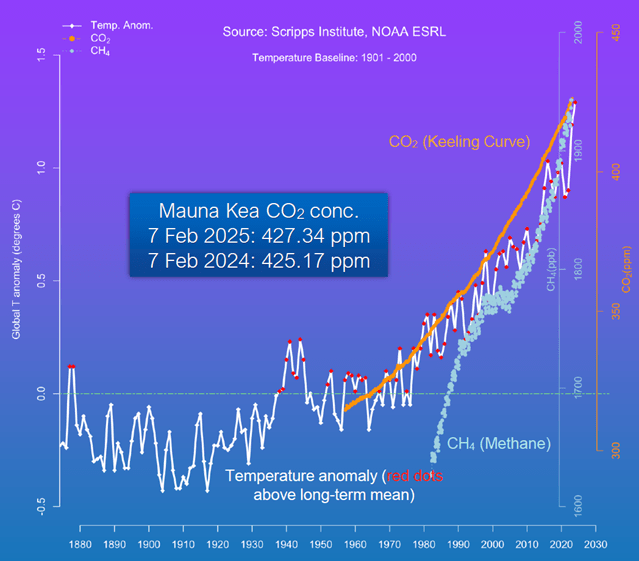
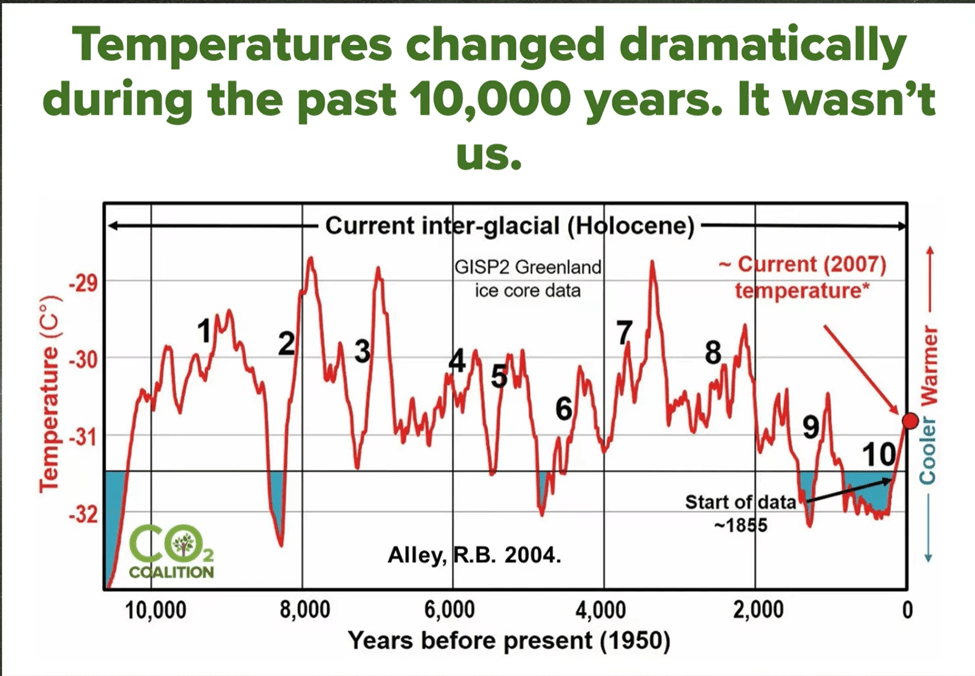
My point is that this is not as obvious a relationship as claimed. Sabine Hossenfelder produces You Tube videos on science and technology. Her climate change-related videos generally adhere to the narrative, but she has shown signs of waking up to reality. Peter Ridd commented on her awakening noting that she does not quite get there. I call your attention to Ridd’s commentary where he talks about uncertainties about how the earth’s weather system works. Especially relevant to Freedman’s graphic is Ridd’s explanation of temperature and CO2 concentrations going further back in time than Freedman’s graph. Ridd points out in the following graph that temperatures were higher many times in the last 10,000 years at the same time that CO2 concentrations were lower. That directly contradicts the notion that global temperature is primarily driven by anthropogenic CO2 concentrations.
Climate vs. Weather
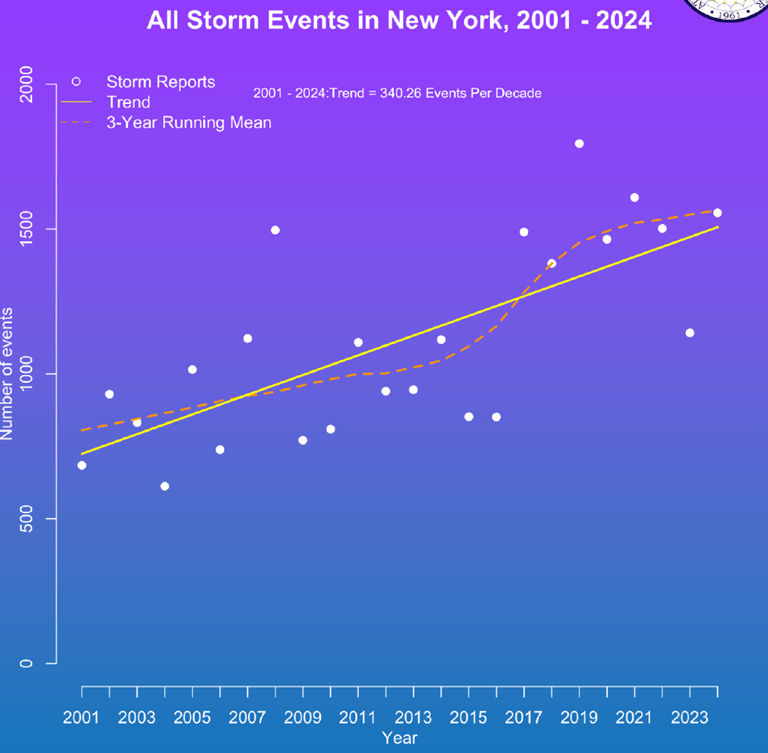
Freedman perpetuates the Climate Act myth that climate change is increasing extreme heat, changes in precipitation, and increasing storm intensity with a graph that shows increasing storm events in New York from 2001 to 2024. In general, climate is what you expect, and weather is what you get. To determine what you expect from climate, meteorologists use a 30-year climatological average. Therefore, to have a climate trend you need to look at the difference between two 30-year averages at a minimum. Freedman’s graph is a weather average trend unsuitable for making any climate trends claims.
After I drafted this article Anthony Watts summed up my problems with claims that climate change is an existential threat in a post entitled “Is Climate Change Real? Short Answer: Yes — But It’s Complicated.” I published an article that quoted the article with my annotated comments relating the points he made to the Climate Act. I highly recommend reading that aartilce.
Basis for Narrative Claims
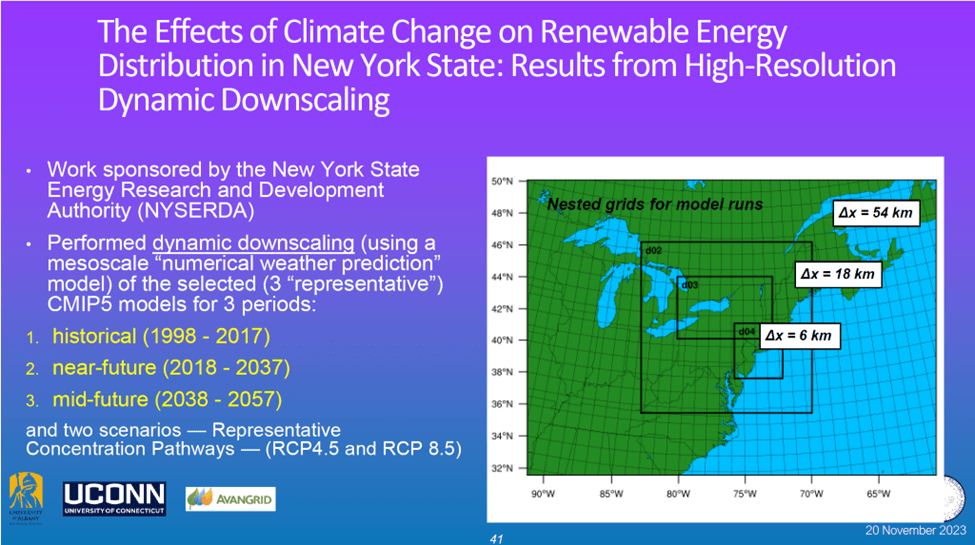
Expert presentations designed to promote the Climate Act narrative to an audience such as the Energy Planning Board often cite the results of modeling. In this instance there is a slide that describes the “effects of climate change on renewable energy distribution in New York State” based on “results from high-resolution dynamic downscaling”. Sounds very scientific and above reproach.
The grid size for CMIP5 (Coupled Model Intercomparison Project Phase 5) climate models typically ranges between 125 km to 300 km. This is too coarse for predicting the impacts of climate change on New York so higher-resolution regional models have been used in projects sponsored by NYSERDA to project impacts. This process is called dynamical downscaling. Unmentioned are the errors and inherited biases in the process from the Global Climate Models (GCM) for the following:
- Temperature trends: Persistent warm/cold biases in coastal and inland regions, exacerbated by future GCM projections exceeding historical maxima.
- Precipitation patterns: Systematic underestimation of seasonal rainfall in regions like the Caribbean and Southern Africa.
- Extreme events: Misrepresentation of high-frequency, low-intensity rainfall (“drizzle problem”) due to GCM limitations.
I think that those issues underestimate the problems because the fact is the GCM projections do not include the physics of clouds. The problem is that coarse grid size cannot incorporate precipitation or extreme events. This is not to say that the models don’t predict storms, just keep in mind that they are little more than guesses strongly influenced by the biases of the modelers.
There are structural RCM limitations that introduce their own errors despite higher grid size resolution:
- Simplified physics: Inadequate representation of convective processes and local interactions (e.g., lake effects).
- Scale mismatches: Difficulty resolving sub-grid features even at 10–50 km resolutions.
- Computational constraints: Limited ability to run multiple GCM-RCM combinations, reducing uncertainty sampling.
Those limitations are relevant to the purported New York results. For five months of the year much of Upstate weather is strongly influenced by the Great Lakes. Convective processes and local interactions like lake effect are erroneous in the RCM because the scale of the lake effects is smaller than the resolution of the models. I have been working with weather models and Upstate mesoscale weather regimes for decades and I am positive that the model projections are poor at best. Combined with the fact that the projections use a totally unrealistic estimate of future emissions (the RCP 8.5 scenario), I do not believe the results presented have any value.
Discussion
NYSERDA scripted the presentation to the Energy Board so that it was completely consistent with the narrative that climate change impacts are occurring today. I recently showed that the uncertainty of the historical temperature measurements is similar to the alleged temperature increase due to GHG emissions. This post explains that the claimed trend in storm events is not a climatic trend because the time range is too short, and that the model projections of weather have limited value. As a result, the Energy Planning Board came away from the meeting erroneously believing that the effects of climate change are occurring now and that reducing New York GHG emissions will reduce those impacts.
This is not in the best interests of New York. The New York energy plan is supposed to be a roadmap for a “clean, resilient, and affordable energy system for all New Yorkers.” There are conflicting priorities and challenges for those three goals. The State Energy Planning Board should be given all the information so that they can “focus on strategies to meet future energy needs and advance economy-wide decarbonization, while balancing reliability, affordability, environmental and public health impacts and economic growth.” The presentation did not give any of the qualifying information about uncertainties, so it gave the Board a false basis for evaluating the Climate Act approach and schedule.
The basic strategy for decarbonizing the economy is electrification of all sectors. Authors of the Climate Act believed that no new technology was needed for the transition of the electric sector to “zero emissions” using wind, solar, and hydro. All the organizations responsible for electric system reliability agree that a new dispatchable, emissions-free resource is necessary for extended periods of low wind and solar resource availability so that presumption is wrong. That means that the schedule must be adjusted to account for the necessity to develop, test, and deploy this new technology.
A primary driver for the Climate Act schedule was the perceived necessity to do something immediately because the effects of climate change are evident now. As shown here, that argument is not supported when temperature trend uncertainty is considered, long-term trends of weather events are evaluated, and the weaknesses of global climate models are acknowledged. Those results do not necessarily mean that it is inappropriate to do something, but the results do mean that the claims we must act immediately are unwarranted. We have time to do this right. I think that is a primary concept that should be incorporated into the Energy Plan.
Conclusion
I am disappointed that NYSERDA has become so politicized. The NYSERDA presentation by Dr. Freedman gave the Energy Planning Board misleading information about the threat of climate change and the need to act immediately. It is becoming increasingly evident that there are so many unanticipated issues associated with the Climate Act implementation that a pause to re-evaluate the schedule and goals is in order. If NYSERDA documentation had not been politicized the Scoping Plan could have included caveats and achievement milestones to provide an off-ramp to a Plan B that is clearly necessary. As it stands now, admitting delays and unavailable technologies will be a political embarrassment. However, it is necessary to ensure that reliability, affordability, environmental and public health impacts, and economic growth goals can be achieved.

 Pragmatic Environmentalist of New York