

Last December the Empire Center did a poll that asked questions about the Climate Leadership & Community Protection Act (Climate Act). I missed it at the time, but the results are striking. This post describes the results and takes a deeper look at the willingness to pay question.
I am convinced that implementation of the Climate Act net-zero mandates will do more harm than good because the proposed green energy programs are crimes against physics. The energy density of wind and solar energy is too low and the resource intermittency too variable to ever support a reliable electric system relying on those resources. If this reality is not acknowledged soon and these policies paused, then the enormous costs of this futile gesture to control the climate will bankrupt the state.
I have followed the Climate Act since it was first proposed, submitted comments on the Climate Act implementation plan, and have written over 500 articles about New York’s net-zero transition. The opinions expressed in this article do not reflect the position of any of my previous employers or any other organization I have been associated with, these comments are mine alone.
Overview
The Climate Act established a New York “Net Zero” target (85% reduction in GHG emissions and 15% offset of emissions) by 2050. It includes an interim reduction target of a 40% GHG reduction by 2030. The Climate Action Council (CAC) was responsible for preparing the Scoping Plan that outlined how to “achieve the State’s bold clean energy and climate agenda.” After a year-long review, the Scoping Plan was finalized at the end of 2022. Since then, the State has been trying to implement the Scoping Plan recommendations through regulations, proceedings, and legislation.
Poll Overview
The Empire Center, based in Albany, is an independent, not-for-profit, non-partisan think tank dedicated to promoting policies that can make New York a better place to live, work and raise a family. In the interests of full disclosure, I am an adjunct fellow of the Empire Center.
They sponsored a survey late last year. The Empire Center announcement of the survey says it canvassed 1,021 New York registered voters (margin of error: 3 percent) and was conducted by Morning Consult in mid-December 2024. The toplines and crosstabs can be viewed here. For survey neophytes like me the topline lists the questions and the overall results. Crosstabs breakdown the responses by the characteristics of the people polled. There were 38 questions in the survey and 16 questions about the demographics of the respondents. The crosstabs provides the breakdown of questions by the demographic categories.
Questions about the Climate Act were in the minority. Most of the questions were related to the value of taxes paid – “New Yorkers by a margin of more than two-to-one said they aren’t getting their money’s worth from taxes they pay in the state”. Other questions addressed the education system
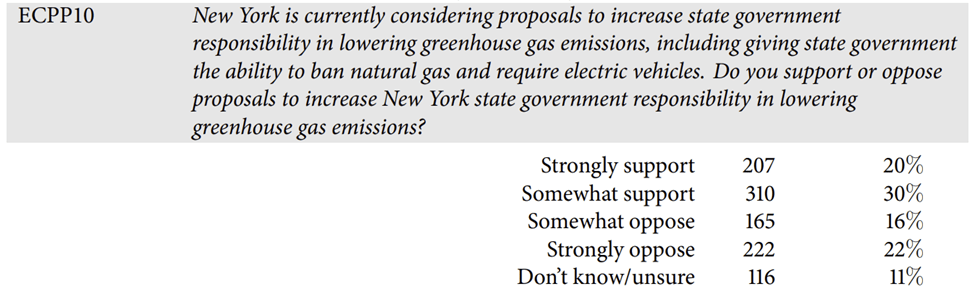
There were six questions about the Climate Act. I will address the first two questions in this article but will only list the others below.




Climate Act Awareness
Knowing what I understand about this law it is frustrating that there is so little pushback associated with it. The only reason I could think of is that the majority of New Yorkers are unaware of it. The question “How familiar are you, if at all, with the provisions of the Climate Leadership and Community Protection Act (also known as CLCPA or the Climate Act) that was signed into law in New York in 2019?” confirms my suspicion.
The survey found that 45% of the people polled had never heard of it and another 24% had heard of it, but didn’t know what it is. In my opinion, if they only have a general sense what it is (another 19%) then they are probably unaware of how much it will cost. That means 88% of the people polled do not know what is coming in enough detail to understand its impacts on affordability, personal choice, reliability, and environmental impacts.
I believe that the biggest trigger for demands to pause this will be the costs so let’s talk about those results.
Willingness to Pay
I have never seen any poll regarding a willingness to pay that did not find most people are unwilling to pay very much. This is proof of Roger Pielke’s Iron Law of Climate “While people are often willing to pay some price for achieving climate objectives, that willingness has its limits.”
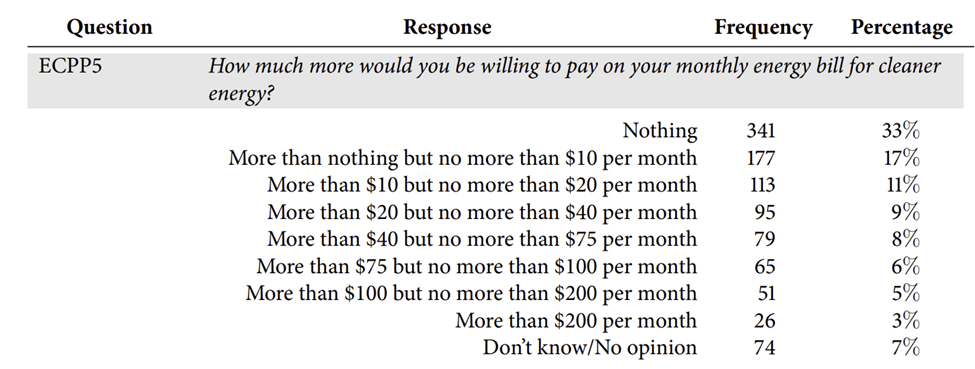
This poll is no different. One third of the respondents are not willing to anything on their monthly energy bill for cleaner energy. Another 28% are only willing to pay up to $20 a month for cleaner energy while another 20% would pay up to $40 a month. Nineteen percent are willing to pay up to $200 a month but only 3% are willing to pay more than $200 per month. Another 7% did not know or had no opinion.
I recently submitted comments about affordability in Proceeding 22-M-0149 “Assessing Implementation of and Compliance with the Requirements and Targets of the Climate Leadership and Community Protection Act”. On March 26, 2025, Jessica Waldorf, Chief of Staff and Director of Policy Implementation for the Department of Public Service (DPS) posted a letter responding to a letter from Michael B. Mager Counsel to Multiple Intervenors that had been submitted earlier in March to Chair of the Public Service Commission Rory Christian regarding the affordability standard. The Mager letter from the Multiple Intervenors pointed out that the DPS and New York State Energy Research & Development Authority (NYSEDA) were supposed to provide an annual report describing Climate Act implementation costs. No report was produced in 2024 and the letter asked when the next report would be provided. Waldorf’s response made no commitment. Given the politicization of all New York agencies and the willingness to pay results I don’t think that it is surprising that the Hochul Administration is stonewalling those estimates because I am sure that they will probably exceed $200 a month.
National Grid Long-Term Gas Plan
In a recent post I described the comments I submitted on Case 24-G-0248 Review of the Long-Term Gas System Plan for National Grid. That plan describes how the three National Grid operating companies intend to transition away from natural gas out to 2050.
I was frankly surprised with the costs for just this component of Climate At transition plan. The scenarios include a reference case, CEV or “clean energy vision”, and AE or “accelerated electrification”. The difference between the reference case and the CEV scenario represents the minimum cost of the Climate Act. The following tables are from the Long-Term Gas System Plan document.
The 2030 average monthly increase for National Grid customers in the former Niagara Mohawk service territory ranges from a 50% increase to a 96% increase. The Climate Act cost by 2030 is $57 additional per month.
Table 12-11: Niagara Mohawk Bill Impacts by Scenario
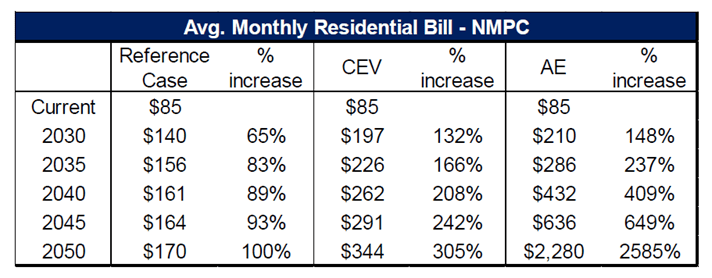
The 2030 average monthly increase for National Grid customers in the former Brooklyn Union Gas service territory ranges from a 65% increase to a 148% increase. The Climate Act cost by 2030 is $43 additional per month.
Table 12-12: Brooklyn Union Gas Company Bill Impacts by Scenario

The 2030 average monthly increase for National Grid customers in the former Key Span service territory on Long Island ranges from a 41% increase to a 90% increase. The Climate Act cost by 2030 is $44 additional per month.
Table 12-13: KeySpan Gas (LILCO) Bill Impacts by Scenario

Willingness to Pay for National Grid Long-Term Gas Plan
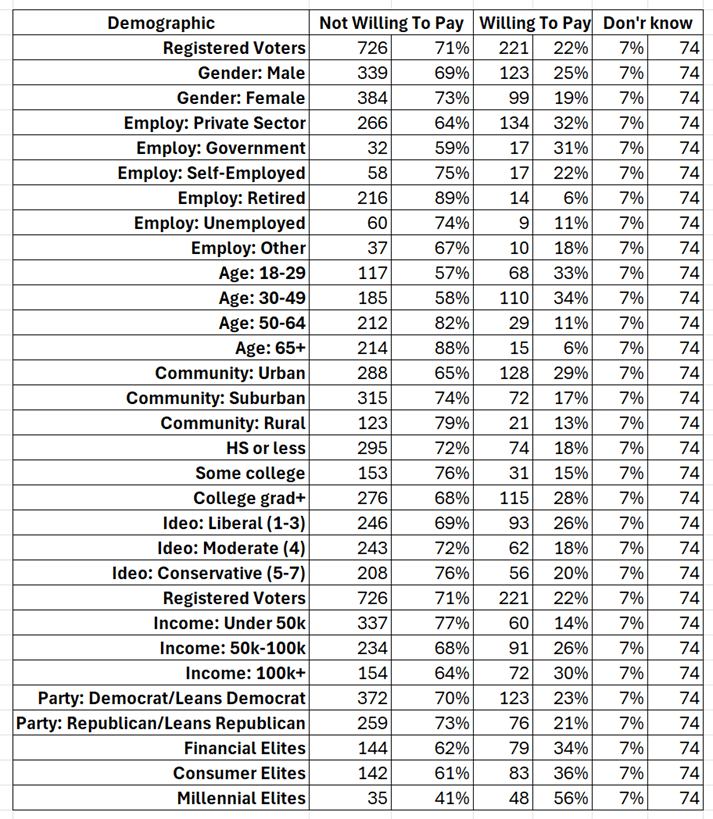
In the National Grid Long-Term Gas Plan, the expected increase in price to implement the “clean energy vision” exceeds $40 per month for all three service companies. Table 1 lists the willingness to pay $40 per month for selected demographics of the survey participants. Note that 71% of respondents when polled said that they were unwilling to pay more than $40 per month. I am not going to discuss the demographic breakdowns but present them for your edification.
Table 1: Empire Center Willingness to Pay for Increased Energy Costs Relative to National Grid Expected Gas System Transition Costs of at least $40 per Month Additional by 2030
Discussion
The electric and gas utilities must invest in programs that will implement the Climate Act mandates and those costs are starting to show up in their rate case proceedings. The National Grid long-term plan to transition the gas system out of existence which is necessary to comply with the Climate Act is but one example. The expected cost increase by 2030 to fulfill the clean energy vision is more than $40 per month. Only 22% of the people polled were willing to pay that much.
That is only one cost component for New Yorkers. Electric bills will need to increase by at least the same amount to pay for the infrastructure necessary to electrifying everything. The New York Cap-and-Invest program is nothing more than a tax on carbon that will necessarily increase the cost of gasoline and heating fuels. To electrify homes and transportation individual investments will be necessary. I believe that when people finally figure out that there is law in place that will markedly increase their energy costs that there will be a reckoning. I also believe that the Hochul Administration is fully aware of the ramifications of Climate Act costs on the next election. Consequently, they are slow walking the mandates to provide cost information.
In the meantime, the politicians will be more than willing to let the utilities take the heat for the inevitable major cost increases. No doubt they will simultaneously forbid the utilities to explicitly break out the Climate Act costs in their bills and demand that they lower their rate case proposals.
Conclusion
Any way you look at the willingness to pay question response, the Empire Center survey confirms Roger Pielke Jr’s Iron Law of Climate. People polled are not willing to pay much for the net-zero aspirations of the Climate Act if 50% are unwilling to pay more than $10 per month for cleaner energy. It is troubling that 88% of the New Yorkers polled had no more than a general sense of the Climate Act and many had never heard of it. This is setting up a reckoning for all the politicians that foisted the Climate Act on New Yorkers. It is inevitable that the politicians will reconsider and give up on it or be voted out for utter stupidity. The only question is whether political reality will occur before the electric and gas system is destroyed and costs bankrupts the state.

 Pragmatic Environmentalist of New York
Are New Yorkers really aware what they would have to pay and what they would have to endure under the Climate Act?
“Enquiring minds want to know.”
LikeLiked by 1 person
If they were aware they would be screaming about it
LikeLike
The industrial sector in NY is going to find it painful to pay their electric bills this summer. The 30% increase they experienced in Feb of this year vs last reminds me of the time PG&E eliminated our old time of use rate schedule in CA. https://www.eia.gov/electricity/monthly/epm_table_grapher.php?t=epmt_5_6_a
Mark
LikeLike