

In March 2025 Senator Mattera invited Richard Ellenbogen to Albany to address the NY State Senate Energy & Telecommunications Committee regarding NY State’s energy situation relative to the Climate Leadership & Community Protection Act (Climate Act). I was impressed that the meeting showed that the Committee agreed with Ellenbogen that there are implementation issues and course corrections are necessary. I previously described the emissions analysis I did for the Committee. This post describes the air quality aspects of New York power plant emissions.
Overview
The Climate Act established a New York “Net Zero” target (85% reduction in GHG emissions and 15% offset of emissions) by 2050. It includes an interim reduction target of a 40% GHG reduction by 2030. The Climate Action Council (CAC) was responsible for preparing the Scoping Plan that outlined how to “achieve the State’s bold clean energy and climate agenda.” After a year-long review, the Scoping Plan was finalized at the end of 2022. Since then, the State has been trying to implement the Scoping Plan recommendations through regulations, proceedings, and legislation.
Senate Energy and Telecommunications Committee Meeting
On March 18, 2025 Senator Mattera invited Richard Ellenbogen to Albany to address the NY State Senate Energy & Telecommunications Committee regarding NY State’s energy situation. Senator Parker, the committee chair, gave Ellenbogen time to describe his thoughts on the Climate Act transition, describe his proposal to use of existing technology that will not get to zero but will maintain system reliability, and answer questions. There is a video of the hearing available and a previous post includes links to specific discussions within the video.
Ellenbogen’s presentation argued that there is a better way that “adheres to reality”. He believes that repowering existing power plants with combined cycle gas turbines gives significant carbon reductions. Replacing the old units reduces emissions, decreases reliability risks because the old units are so old that they are more likely to fail, and because the combined cycle plants are more efficient, they would burn less fuel to produce the same amount of electricity.
During the discussions at the meeting, Chairman Parker said a couple of times that he wanted to get specific numbers for potential emission reductions. I described the detailed description of the emissions analysis I provided to the Committee in another post. The last thing I want to address is air quality associated with New York electric generating units.
Context
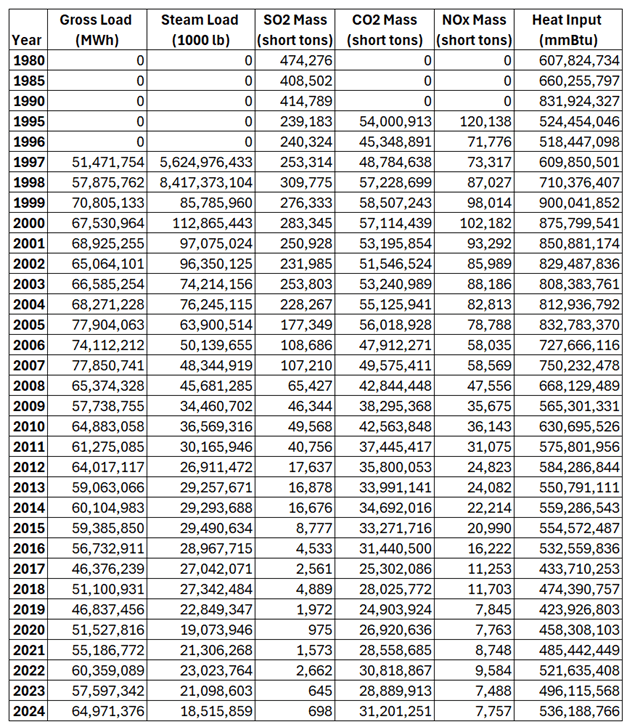
The detailed analysis that I submitted to the Committee included this section on context. I joined Niagara Mohawk Power Corporation (NMPC) in 1981 and one of my responsibilities until I retired in 2010 was accounting and reporting air pollution emissions. I think it is important to understand that there have been massive reductions in electric generating unit emissions in New York since the time I joined the utility industry. The earliest records I have date back to 1984. At the time NMPC owned and operated oil-fired facilities in Albany and Oswego and coal-fired plants in Dunkirk and Tonawanda. In 1984 those facilities emitted 136,684 tons of sulfur dioxide (SO2), 37,221 tons of nitrogen oxides (NOx), and 12,530,220 tons of carbon dioxide. In 1995, according to the Environmental Protection Agency all the fossil fueled power plants in New York emitted 239,183 tons of sulfur dioxide, 120,138 tons of nitrogen oxides, and 54,000,913 tons of carbon dioxide. In 2024 all the fossil fueled power plants in New York emitted 698 tons of sulfur dioxide, 7,757 tons of nitrogen oxides, and 31,201,251 tons of carbon dioxide. The following table (NY Emissions Analysis.xls “NYS” tab) lists the annual values from 1980 until 2024.
New York Electric Generating Unit Annual Emissions from EPA Clean Air Markets Division
Air Quality Trends
There have been recent reports that noted that the American Lung Association (ALA) reported that dangerous air pollution is affecting more Americans than last year. Behind the headlines is the fact that the data they used included “exceptional (e.g., wildfires) and natural events (e.g., stratospheric intrusions)” that are the reason air quality worsened. Not mentioning the fact that the deteriorating air quality has very little to do with humans would not help their agenda and fund raising so that information isn’t included in the news stories. In this context, however, it leads the general public to believe that this indicates a trend towards worse air quality.
The National Ambient Air Quality Standards (NAAQS) establish air quality levels that are protective of public health and welfare with an adequate margin for safety, including protecting the health of ‘sensitive’ populations such as asthmatics, children, and the elderly”. From a regulatory standpoint, there is nothing that local jurisdictions can do to reduce exceptional and natural events. Consequently, the high air quality associated with those events is not counted against the attainment designation relative to the NAAQS. The air quality was worse last year in many places but in the absence of exceptional and natural events the air quality is getting better. I also believe that while there are extreme weather events that cause things like wildfires, that climate change is not exacerbating extreme weather to any observable degree.
Without those events the observed emission reductions have been accompanied by improvements in air quality. SO2 levels have decreased dramatically, with a 98% reduction in annual average levels from 2009 to 2017. I found that nitrogen dioxide one-hour ambient levels decreased 63%. There also have been decreases in particulate matter.
For the most part New York air quality reflects national and regional trends. According to the EPA nonattainment/maintenance status summary, there are multiple counties In New York that do not attain the current NAAQS for ozone and New York County does not meet the coarse particulate matter standard. Note that all of New York State meets the inhalable particulate (PM2.5) NAAQS. All the other pollutants are in attainment. Finally, note that over the years the NAAQS limits have become more stringent.
Despite the fact that there have been significant improvements and New York is mostly in attainment with the NAAQS there is another approach to air quality health impacts that regulators and activists have used to claim more reductions are necessary. They claim that levels of pollution lower than the NAAQS have health impacts based on simplistic epidemiological extrapolations that assume there are no health impact thresholds.
For example, even though New York City is in attainment for inhalable particulates, this pollutant is used as a rationale for shutting down peaking power plants because of claims that reducing inhalable air quality impacts is beneficial. The New York City Department of Health and Mental Hygiene’s (DOHMH) 2011 Air Pollution and the Health of New Yorkers report is often referenced in this regard. The DOHMOH report concludes: “Each year, PM2.5 pollution in [New York City] causes more than 3,000 deaths, 2,000 hospital admissions for lung and heart conditions, and approximately 6,000 emergency department visits for asthma in children and adults.” These conclusions are for average air inhalable particulate pollution levels in New York City over the period 2005-2007 of 13.9 µg/m3.
I submitted comments on the Draft Scoping Plan where I showed that the New York City 2018-2020 average PM2.5 concentration was 7.4 µg/m3 which is substantially lower than the DOHMOH goal of 10.9 µg/m3. If the epidemiological linear no-threshold model is correct, then because inhalable particulate levels have come down In New York City there should be significant observed health benefits since the 2011. However, DOHMH has not verified their projections against observations. Until such time that the projected health impacts using this approach are validated with observed data, I will be skeptical of this metric. The fact that asthma and other health impacts have not improved at the same rate as the air quality improvements suggests that other factors are driving those outcomes. In my opinion, there should be a commitment to determining the more likely causes rather than wasting money on reducing already low power plant emissions.
Current Air Quality Conditions
During the Energy & Telecommunications Committee hearing on March 18, 2025 Chairman Parker questioned air quality levels around power plants. He said that there are “people sitting in the shadow of both industrial plants and nuclear power plants who are developing health outcomes that are negative because of these plants”. I need to address this misconception as it applies to fossil-fired power plants. First, I want to point out that there is no credible health outcome threat of air quality related to nuclear power plants.
I think that Chairman Parker has been misled by a “righteous risk”. In a post on this risk I noted that these risks arise from a “value-based policy approach that filters out facts and data within an ethical perspective.” The importance of these risks are “influenced by what is perceived as ethical rather than what is rational or scientific.” The Climate Act includes specific mandates to address righteous risks.
The Climate Act includes a commitment to address equity for “communities within New York that have been historically overburdened by environmental pollution”. One of the most repeated claims is related to air quality levels around power plants and reductions in co-pollutants is a prime benefit of the Climate Act.. The PEAK coalition has stated that “Fossil peaker plants in New York City are perhaps the most egregious energy-related example of what environmental injustice means today.” I believe this argument influenced Senator Parker. However, the presumption of egregious harm is based on selective choice of metrics, poor understanding of air quality health impacts, and ignorance of air quality trends. I have documented my concerns based on my extensive experience with air pollution control theory, implementation, and evaluation over my 45+ year career.
One of the legislative attempts to facilitate the Climate Act is the Build Public Renewables Act that gives the New York Power Authority (NYPA) renewable development responsibilities. This law is supposed to speed up the energy transition but it also includes a requirement for NYPA to shut down its existing fossil-fired power plants including a number of peaking power plants in New York City. I think this is as poor a policy choice as the decision to shutdown of the Indian Point nuclear power plant.
I have been an air quality meteorologist for 45+ years. A foundational presumption in my career is that if the ambient air quality effect of any polluting source is lower than the NAAQS then public safety and welfare is protected. There are two additional levels of air quality security. When the NYPA peaking power plants were permitted NYPA had to demonstrate that the increase in pollution due to the facilities was less than the Prevention of Significant Deterioration increment put in place to assure that new sources of pollution do not meaningfully worsen the air quality. In addition, the facilities had to install Lowest Achievable Emission Rate air pollution control equipment which is as good as it gets. My point is that the facilities that New York politicians are forcing to close may not have zero impacts, but they are close enough to no impacts, that they cannot possibly adversely affect health outcomes.
Discussion
After much thought I think I have an analogy that puts this in perspective. Think of power plant controls like cleaning the kitchen floor. Power plants have different levels of control equipment just like we all have different options to clean the floor. Keeping the kitchen floor clean is necessary for food safety given the likelihood of spills. In my opinion, sweeping the floor daily and mopping it regularly is “good enough”. Many don’t think that mopping the floor is good enough now because there are more sophisticated options like the Swiffer PowerMop or even steam mops. For some once-a-week mopping is not good enough and they may want to do that daily. The point is that there is a tradeoff between time and money for cleaning the floor “good enough”. In my opinion, the NYPA peaking power plants in New York City with Lowest Achievable Emission Rate controls are equivalent to using a steam mop several times a day. Demands to shut down the NYPA power plants is equivalent to deciding not use the kitchen because it is not clean enough even when using a steam mop several times a day.
Conclusion
A state-of-the-art combined cycle natural gas-fired turbine provides great grid support and is so efficient that it has significantly lower CO2 emissions than existing fossil-fired units in New York. To correctly consider the value of this technology for New York’s electric system it is necessary to use appropriate comparison metrics, have a comprehensive understanding of air quality health impacts, and consider air quality trends.Three things described in my emissions status article should also be considered. I found that a future electric system that uses nuclear power as the backbone and natural gas-fired combined cycle combustion turbines for backup support resolves the reliability risks and overall costs of a wind, solar, and energy storage system. At the same time it could reduce emissions from about 30 million tons per year today to less than 2 million tons per year in the future. I also noted New York GHG emissions are less than one half of one percent of global emissions and global emissions have been increasing on average by more than one half of one percent per year since 1990. Even Senator Parker acknowledges that this means “at the end of the day New York is not going to solve the climate crisis”. Finally, I pointed out that New York’s impact on global warming is unmeasurable. These three points lead to the inescapable pragmatic conclusion that nuclear power as the backbone combined with combined cycle combustion turbines is good enough for environmental risks even if there are some GHG emissions and co-pollutant emissions are not zero.

 Pragmatic Environmentalist of New York