

Thanks to Tim Knauss I found information on New York utility accounts in arrears and service disconnections on New York Open Data. These data enabled me to develop a spreadsheet that lists the residential collection data submitted by New York’s ten largest distribution utility companies and enabled me to prepare the data summary shown here.
This information is particularly relevant to the Climate Leadership & Community Protection Act (Climate Act) because there is a safety valve provision that enables the Public Service Commission to “temporarily suspend or modify the obligations” of the Climate Act if, among other things, implementation causes a “significant increase in arrears or service disconnections” related to the program. Before looking at the results please think about what you think is a reasonable percentage of customers in arrears, that is to say those who have not paid their bills for 60 days or more.
I am convinced that implementation of the New York Climate Act net-zero mandates will do more harm than good if the future electric system relies only on wind, solar, and energy storage because of reliability and affordability risks. I have followed the Climate Act since it was first proposed, submitted comments on the Climate Act implementation plan, and have written over 500 articles about New York’s net-zero transition. The opinions expressed in this article do not reflect the position of any of my previous employers or any other organization I have been associated with, these comments are mine alone.
Overview
The Climate Act established a New York “Net Zero” target (85% reduction in GHG emissions and 15% offset of emissions) by 2050. It includes an interim reduction target of a 40% GHG reduction by 2030. The Climate Action Council (CAC) was responsible for preparing the Scoping Plan that outlined how to “achieve the State’s bold clean energy and climate agenda.” After a year-long review, the Scoping Plan was finalized at the end of 2022. Since then, the State has been trying to implement the Scoping Plan recommendations through regulations, proceedings, and legislation. However, in the rush to meet Climate Act mandates fundamental consumer protections are being ignored.
Safety Valve
New York Public Service Law § 66-p (4) “Establishment of a renewable energy program” includes feasibility safety valve conditions for affordability and reliability that have not been addressed in the Hochul Administration implementation of the Climate Act. Section 66-p (4) states: “The commission may temporarily suspend or modify the obligations under such program provided that the commission, after conducting a hearing as provided in section twenty of this chapter, makes a finding that the program impedes the provision of safe and adequate electric service; the program is likely to impair existing obligations and agreements; and/or that there is a significant increase in arrears or service disconnections that the commission determines is related to the program”.
For the most part this provision of the Public Safey Law has been ignored. In my opinion it is incumbent upon the Hochul Administration to define specific criteria for each provision and establish a tracking system established to determine if suspension or modification of CLCPA obligations is appropriate. Until I found the Quarterly snapshot of residential collection data submitted I was unaware that the arrears and service disconnection data were available.
Residential Collection Data
New York State agencies love web-based dashboards because I think that they can be used to control the message. Consider the Climate Act Data Dashboard. There are options to look at the data for categories showing progress to date, but the data downloads are no more than the numbers shown in the splashy home pages. Not surprisingly there is nothing related to the safety valve conditions in Section 66-p (4).
There is an alternative source of data. New York Open Data was established to “promote transparency, improve government performance, and enhance citizen engagement”. It is a massive database that provides useful information if you can penetrate the clumsy interface to find what you want. Even then the data are just files of numbers with marginal documentation and typically require processing to get anything useful.
In a recent article on the National Grid rate case Tim Knauss mentioned that “More than 210,000 Upstate households are at least 60 days late paying National Grid, owing more than $323 million combined.” When I contacted him about the source of that information he graciously explained that the utilities file a monthly report in the PSC Case 91-M-0744 docket that details their arrears and service terminations. Unfortunately, for an overview of the status those submittals are not that useful.
I decided to check New York Open Data for these data. Nothing was obvious but when I figured out how to do a search and used some of the descriptive terms in the 91-M-0744 documents if found the Quarterly snapshot of residential collection data file. According to their general description:
This dataset provides a quarterly snapshot of residential bill collection activity for New York State’s ten largest electric and gas distribution utility companies regulated by the Public Service Commission. Included in this dataset are each utility’s total number of residential customers, residential customers with arrears (overdue bills) greater than 60 days, residential final service termination notices issued, residential accounts terminated (service shut off for nonpayment), active residential deferred payment agreements and the number of uncollectible residential accounts. Also included are the corresponding utility sales figures for each metric above, showing the dollar figure represented.
The following Data Dictionary table lists the specific parameters available by utility for each quarter starting with the first quarter of 2010. Processing this kind of data set is something I have been doing for years so I was quickly able to get a data summary together. I doubt that many members of the public have that skill set so it is transparently available in name only.
New York Residential Customer Summary
Table 1 lists the annual fourth quarter sum of all ten utilities data for the total number of residential customers, residential customers with arrears (overdue bills) greater than 60 days, residential final service termination notices issued, residential accounts terminated (service shut off for nonpayment), and active residential deferred payment agreements. Of note is that the percentage of residential customers with overdue bills has been between 13.6% and 14.2% the last three years.
Table 1: Annual Summary of Number of Customers and Bill Paying Status

New York Residential Customer Sales Summary
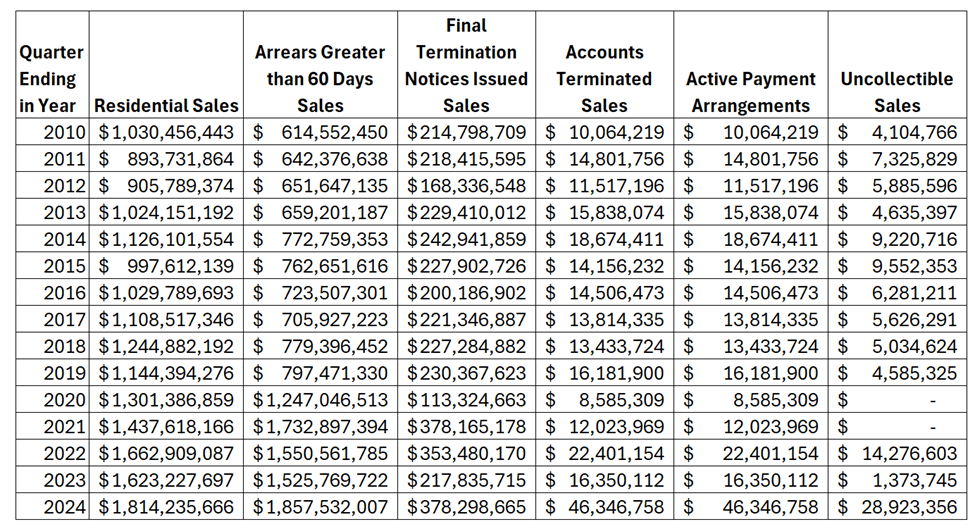
Table 2 lists the annual fourth quarter sum of all ten utilities data for the total sales by residential customers, residential customers with arrears (overdue bills) greater than 60 days, residential final service termination notices issued, residential accounts terminated (service shut off for nonpayment), and active residential deferred payment agreements. The highlight of this table is that the total amount of money that has accumulated since the utilities started this program is $1.86 billion which is more than the utilities collect annually.
Table 2: Annual Summary of Number of Customers and Bill Paying Status
Observations Discussion
Now that you have seen the results, how did your idea of a reasonable percentage of customers in arrears compare to the observed 13.7% at the end of 2024. I think anything over 10% is problematic. In my opinion the observed data indicate a utility system that is currently too expensive.
The number of people in arrears has been increasing since 2010. The number of termination notices issued varies quite a bit, undoubtedly in response to programs to prevent shutoffs. Fortunately, the actual number of shutoffs is relatively small because that should be a last resort. Unfortunately, the cost of these benefits must fall to an increasingly smaller fraction of the rest of the customers.
The sales figures are extraordinary. New York residential customers are paying $1.81 billion a year for utility service. The total amount of money that has accumulated by accounts in arrears since the utilities started reporting these data is $1.86 billion. I don’t think that the accumulated value accurately reflects the magnitude of the problem. Last year the sales associated with accounts that were sent final termination notices was $378 million or 20.9% of the total revenues. Surely that reflects the fact that many residential customers are having trouble paying their bills.
Significance
My primary incentive to analyze these data was to compare them to the Public Safety Law section 66-p (4) criteria for a “significant increase in arrears or service disconnections that the commission determines is related to the program”. There is no breakout of Climate Act costs that contribute to those attributes. We can only estimate whether the NY Open “Quarterly snapshot of residential collection” total data shows a significant increase.
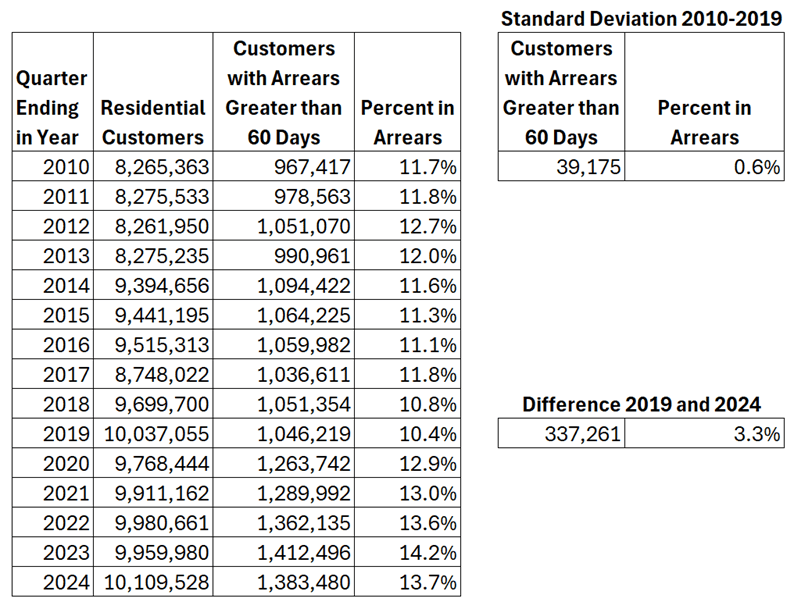
In this case defining significance will entail many value judgements. For example, what is a “significant” increase in arrears? Before the Climate Act was passed in 2019 there were 1,046,219 customers with arrears greater than 60 days, and at the end of 2024 there were 1,383,480 customers in arrears which is a 32.4% increase. The percentage increase for the percentage of customers in arrears was 31.3%. In my opinion that is a significant increase.
There is a limited amount of data to use for a statistical evaluation of significance. Nonetheless, we can use the data we have. In simplistic terms, if a change exceeds two times the standard deviation of the observed data, we can hypothesize that it is significantly different.
Table 3 is a subset of Table 1 that lists the annual fourth quarter sum of all ten utilities data for the total number of residential customers, residential customers with arrears (overdue bills) greater than 60 days, and the percentage of residential customers with overdue bills relative to the total number of customers. Between 2019 the last year before the CLCPA was implemented and 2024, there were 1.046,219 customers with arrears greater than 60 days, and at the end of 2024 there were 1,383,480 customers in arrears which is an increase of 337,261 or 32.4% increase. The percentage increase for the percentage of customers in arrears was 31.3%.
The standard deviation of the number of customers in arrears from 2010 to 2019 is 39,175 and the percent in arrears standard deviation is 0.6%. The observed increases are greater than two times the observed standard deviations. Keep in mind that a standard deviation based on ten observations is anything but robust so this indicative but not conclusive that there is a “significant” increase in arrears.
Table 3: Annual Customers in Arrears
There are other aspects of the calculation of significance for Public Service Law Section 66-p(4). Other value judgements for significance include the following. What costs are related to the Climate Act? Should the costs include programs implemented before the Climate Act but that are necessary to achieve the Climate Act goals. Should the evaluation consider the effect of programs designed to lower costs, programs that give residents an active payment plan and prevent service disconnections that all affect the totals? Should “significance” be defined relative to the value of the emission reductions for the programs in absolute terms or relative to global emissions?
All these have been valid questions since the Climate Act was passed in 2019. The Climate Action Council should have addressed this but dropped the ball. Given that there are so many issues coming up with the schedule and ambition of the Climate Act that it is obvious that we need to pause implementation and figure out how best to proceed. Defining the safety valve criteria and developing a tracking system for a transparent status report should be part of the implementation reassessment.
Conclusion
This analysis found a useful source of residential customer data. The New York Open Data was established to “promote transparency, improve government performance, and enhance citizen engagement”. Unfortunately, accessing the data file is not straightforward unless you have experience with this kind of data.
The observed differences between the number of residential customers in arrears before the Climate Act was enacted and the end of 2024 are greater than two times the standard deviations. It can be argued that this means the increase is “significant”. Therefore, it would be appropriate for the Public Service Commission to conduct a hearing to determine if it would be appropriate to temporarily suspend or modify the obligations of the Climate Act per Public Safety Law Section 66-p(4).
I think this should be resolved quickly. Given that there are so many issues coming up with the schedule and ambition of the Climate Act it is obvious that we need to pause implementation and figure out how best to proceed. Clearly defining the safety valve criteria and developing a tracking system for a transparent status report should be part of the implementation reassessment.

 Pragmatic Environmentalist of New York