

I recently used New York utility accounts in arrears and service disconnections information in New York Open Data to develop a spreadsheet that lists the residential collection data submitted by New York’s ten largest distribution utility companies. Since then, I have been evaluating the ongoing Niagara Mohawk Power Corporation (NMPC) dba National Grid rate case. In this article I evaluated the NMPC New York Open Data and found that there are grounds to reduce costs in the rate case because the increase in overdue accounts has increased significantly since the Climate Leadership & Community Protection Act (Climate Act) was introduced.
I am convinced that implementation of the New York Climate Act net-zero mandates will do more harm than good if the future electric system relies only on wind, solar, and energy storage because of reliability and affordability risks. I have followed the Climate Act since it was first proposed, submitted comments on the Climate Act implementation plan, and have written over 500 articles about New York’s net-zero transition. The opinions expressed in this article do not reflect the position of any of my previous employers or any other organization I have been associated with, these comments are mine alone.
Overview
The Climate Act established a New York “Net Zero” target (85% reduction in GHG emissions and 15% offset of emissions) by 2050. It includes a requirement to make the electric grid zero-emissions by 2040. The Climate Action Council (CAC) was responsible for preparing the Scoping Plan that outlined how to “achieve the State’s bold clean energy and climate agenda.” After a year-long review, the Scoping Plan was finalized at the end of 2022. Since then, the State has been trying to implement the Scoping Plan recommendations through regulations, proceedings, and legislation. However, the Hochul Administration has never acknowledged that there are safety valve provisions in the Act.
Safety Valve
New York Public Service Law § 66-p (4). “Establishment of a renewable energy program” includes safety valve conditions for affordability and reliability that are being ignored. Section 66-p (4) states: “The commission may temporarily suspend or modify the obligations under such program provided that the commission, after conducting a hearing as provided in section twenty of this chapter, makes a finding that the program impedes the provision of safe and adequate electric service; the program is likely to impair existing obligations and agreements; and/or that there is a significant increase in arrears or service disconnections that the commission determines is related to the program”. The problem is that the Hochul Administration’s Climate Action Council failed to establish specific criteria for these safety valves, set up a system to track the status, or consider the need for a hearing.
Niagara Mohawk Power Corporation dba National Grid Rate Case
The current NMPC rate case will raise typical household rates 20% more for electricity and 27% more for natural gas two years after the new rates start phasing in. There are many Climate Act related initiatives buried in the request. My previous article showed that Climate Act costs made up as much as 38% of the total residential utility customer costs in 2022.
The rate request filing states that the NMPC is focused on three priorities: delivery of “safe, reliable energy service to its more than two million customers”; enabling customers to “affordably meet their energy needs while improving the NMPC’s customer service”; and supporting the goals of the Climate Act. I think those priorities are inconsistent because of all my concerns related to the Climate Act impacts on reliability and affordability. I maintain that there is a safety valve in New York Public Service Law § 66-p (4) that if considered could be used to pause additional Climate Act costs. This post evaluates the number of customers in arrears to determine if there has been a significant increase.
Residential Collection Data
Utilities file a monthly report in the PSC Case 91-M-0744 docket that documents their arrears and service terminations. There is a data set in New York Open Data that provides data that can be used to determine the number of residential customers in arrears. The “Quarterly snapshot of residential collection dataset” contains this information.
This dataset provides a quarterly snapshot of residential bill collection activity for New York State’s ten largest electric and gas distribution utility companies regulated by the Public Service Commission. Included in this dataset are each utility’s total number of residential customers, residential customers with arrears (overdue bills) greater than 60 days, residential final service termination notices issued, residential accounts terminated (service shut off for nonpayment), active residential deferred payment agreements and the number of uncollectible residential accounts. Also included are the corresponding utility sales figures for each metric above, showing the dollar figure represented.
NMPC Residential Customer Summary
Table 1 lists the annual fourth quarter data for the sum of the Quarterly Snapshot NMPC category for the total number of residential customers, residential customers with arrears (overdue bills) greater than 60 days, and the percentage of residential customers with overdue bills relative to the total number of customers. Between 2019 the last year before the Climate Act was implemented and the most recent year there were 202,538 customers with arrears greater than 60 days, and at the end of 2024 there were 234,694 customers in arrears which is an increase of 32,156 or 16% increase. The final termination notices and number of service disconnections (not shown) are not good estimates of the effect of the Climate Act because other mandates have affected the data, e.g., service disconnections were suspended during COVID.
Table 1: Niagara Mohawk Power Corporation dba National Grid Summary Snapshot Fourth Quarter of Residential Collection Data

The Public Safety Law section 66-p (4) criteria for consideration of suspension or modification is a “significant increase in arrears or service disconnections that the commission determines is related to the program”. The standard deviation of the number of customers in arrears from 2010 to 2019 is 12,350. Because the observed difference, 32,156, is greater than two times the standard deviation the increase is statistically “significant”.
Climate Act Costs
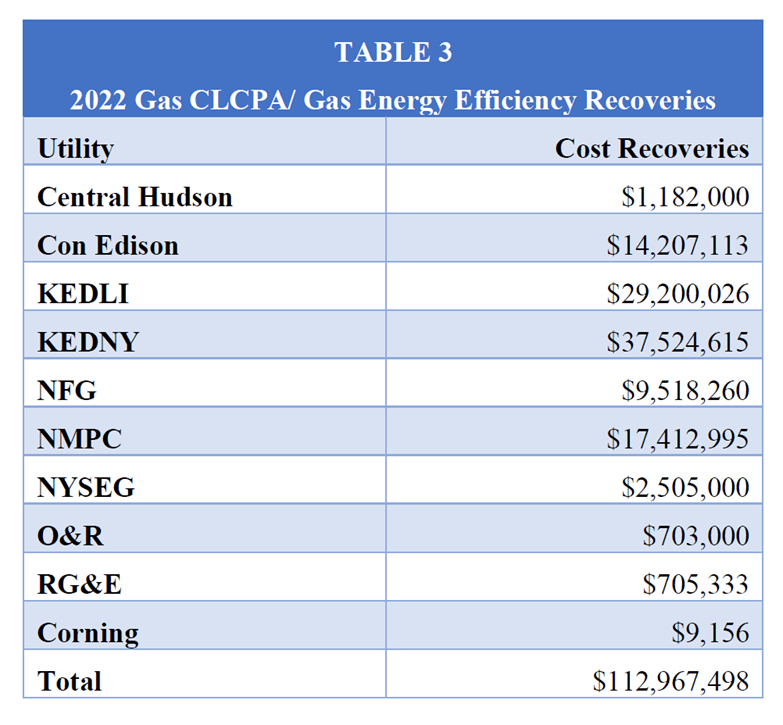
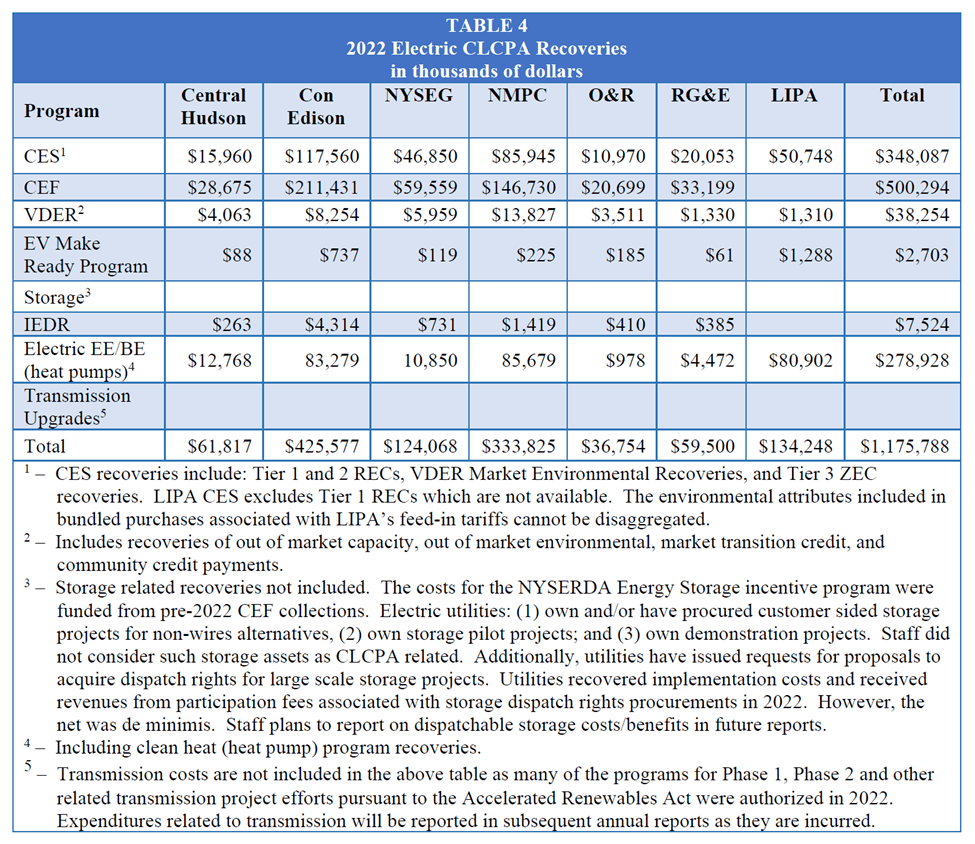
The number of people in arrears has been increasing since 2010 and the change since the start of the Climate Act is “significant”. However, it is not clear how much of the change can be ascribed to the Climate Act. On May 12, 2022, the Commission issued an “Order on Implementation of the Climate Leadership and Community Protection Act” for Case 22-M-0149 that directs DPS Staff to present information on Climate Act costs annually. On July 20, 2023, DPS Staff published the first report (Information Report) in compliance with the Commission’s Order. The costs recovered in 2022 by the utilities associated with Climate Act costs were described in the following Information Report tables:
2022 Climate Act Costs as a Function of Sales
There is insufficient information to ascribe the NMPC Climate Act costs associated with the significant increase in arrears observed. However, it is instructive to calculate the percentage of Information Report NMPC Climate Act costs relative to the annual NMPC residential customer sales. Table 2 lists the sum of the annual “Quarterly snapshot of residential collection dataset” residential sales NMPC.
Table 2: NMPC Annual Utility Residential Customer Sales
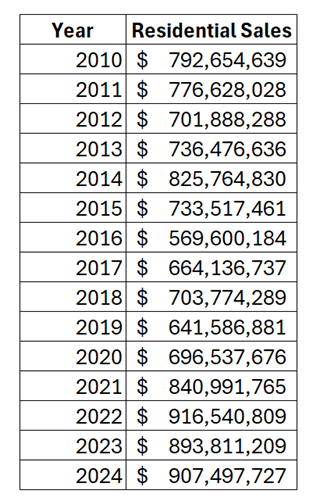
The Climate Act cost recoveries for NMPC are listed in Information Report Tables 3 and 4 included above. The sum of the 2022 Climate Act costs is $352,237,995. The Climate Act costs are 38% of the 2022 residential customer sales. This indicates that a significant share of increased costs that drove the number of customers in arrears to increase was related to the Climate Act implementation.
Discussion
There are so many issues coming up with the schedule and ambition of the Climate Act that it is obvious that we need to pause implementation and figure out how best to proceed. In addition is now clear that there will be significant cost increases.
My focus has been on the electrical system but don’t forget that there have been and there will be more costs associated with other reducing emissions in other sectors. After the PSC released its first annual informational report on the implementation of the Climate Act, I noted that 2022 the costs already associated with the Climate Act increased the NMPC residential customer monthly electric bills 9.8% or $9.38 per month. I recently described an Empire Center poll that asked questions about the Climate Act. The poll found that only 50% of the respondents willing to pay more than $10 a month for Climate Costs. I do not think there is any question that half of the poll respondents were paying more for Climate Act implementation than they are willing to pay in 2022.
The DPS should formally determine the amount of residential customer sales that are related to the Climate Act and affect the number of customers in arrears as part of future annual informational reports mandated by the “Order on Implementation of the Climate Leadership and Community Protection Act” for Case 22-M-0149.
This initial assessment of the Public Safety Law section 66-p (4) criteria for consideration of suspension or modification of the Climate Act related to overdue customers or customers in arrears meets the criterion for a significant change. The standard deviation of the number of customers in arrears for ten years before the Climate Act was implemented is 12,350. Because the observed difference between the 2019 and the most recent year, 32,156, is greater than two times the standard deviation the increase is statistically “significant”. Admittedly this is not a robust statistic because of the limited data available. The onus to develop a better metric and transparently track it is on the PSC.
Conclusion
An initial assessment of the change in the number of customers in arrears since the start of the Climate Act indicates that there has been a statistically significant change. This should trigger the PSC to conduct a hearing required by New York Public Service Law Section 66-p(4). There has been no acknowledgement of the requirement, much less any recognition that such a hearing is warranted.
Inevitably reality is going to catch up with the political aspirations of the Climate Act. It is very frustrating that there is a mechanism in place to protect New Yorkers, but it has been ignored so far. The time has come for that to change.
The double-digit rate increases in the NMPC rate case could be pared down substantially if funding for the CLCPA goals was paused until there is a hearing to see if the CLCPA needs to be temporarily suspended or modified per Public Service Law Section 66-p(4). When other reasons to pause are considered, there are reasons to believe that continued Climate Act funding for renewable energy development projects may be better spent on alternative resources.

 Pragmatic Environmentalist of New York