

I am very frustrated with the New York Climate Leadership & Community Protection Act (Climate Act) net zero transition because the reality is that there are so many issues coming up with the schedule and ambition of the Climate Act that it is obvious that we need to pause implementation and figure out how best to proceed. This article describes reasons to pause implementation.
I am convinced that implementation of the Climate Act net-zero mandates will do more harm than good because the energy density of wind and solar energy is too low and the resource intermittency too variable to ever support a reliable electric system relying on those resources. I have followed the Climate Act since it was first proposed, submitted comments on the Climate Act implementation plan, and have written over 500 articles about New York’s net-zero transition. The opinions expressed in this article do not reflect the position of any of my previous employers or any other organization I have been associated with, these comments are mine alone.
Overview
The Climate Act established a New York “Net Zero” target (85% reduction in GHG emissions and 15% offset of emissions) by 2050. It includes an interim reduction target of a 40% GHG reduction by 2030. The Climate Action Council (CAC) was responsible for preparing the Scoping Plan that outlined how to “achieve the State’s bold clean energy and climate agenda.” After a year-long review, the Scoping Plan was finalized at the end of 2022. Since then, the State has been trying to implement the Scoping Plan recommendations through regulations, proceedings, and legislation.
Energy Austerity Dangers
David Turver writing at Eigen Values explains that as more energy dense sources of power were used in England that less time and effort to survive was needed. That freed up time and resources were made available for innovation and development of art and culture. Furthermore, he states “Arguably, the availability of cheap, abundant energy enabled the Slavery Abolition Act to be passed in 1833 and the British Empire had sufficient surplus of energy, men and money to afford a Royal Navy to enforce the ban in the North Atlantic.” The use of cheap, abundant energy has transformed society in many positive ways.
There are problems brewing:
Unfortunately, the expansion of energy and wealth can lead to complacency and we collectively forget what it was that allowed us to create the most prosperous society the world has ever known. Bad ideas like Malthusianism can flourish and luxury beliefs that undermine the very principles on which society was built can begin to take over.
………………..
In the name of saving the planet, we are being forced to give up on concentrated, reliable energy and energy supply is dwindling as shown by the orange line in Figure 3 below.
Energy prices have risen as supply has fallen through a combination of taxes on hydrocarbons, subsidising expensive renewables and incurring the extra costs of intermittency and remote connections. As a result, energy consumption is falling and the economy is stagnating as shown by the blue line in Figure 3 (data sourced from OWID).

Turver goes on to argue that the wealth gap will increase as the energy use per person decreases. People will have to spend more of their time just getting by so that societal disorders will increase. He concludes that “If we continue down this Net Zero path, we will soon find that political change from energy austerity gets very ugly, very quickly.” England is further down this unsustainable path, but New York will surely follow unless we acknowledge the folly of chasing intermittent and diffuse energy.
Zero-Emissions Transportation
Chapter 11 in the Scoping Plan outlines the zero-emissions strategy for the transportation sector:
Transitioning the transportation sector to zero-emission technologies is central to achieving GHG emission reduction requirements. In most cases, this means replacing existing vehicles that run on gasoline or diesel fuel with either battery electric, hydrogen fuel cell, or future zero-emission propulsion technologies.
Recent experience in Korea is not encouraging for the hydrogen fuel cell option.
In my comments on the Draft Scoping Plan I noted the admission in the document that the “transition to ZEVs for this subsector will entail a mix of battery electric and hydrogen fuel cell vehicles” depends on technologies that are “just beginning to emerge into the market”. The text goes on to say: “Achieving the aggressive transition in this market will require a mix of regulations, incentives (which will require identifying new sources of funding), and removal of market barriers and depends on industry greatly accelerating the expansion of production capacity for these vehicles”. I commented that the Final Scoping Plan must include a feasibility analysis to prove that these strategies are viable. This suggestion was ignored.
So how is deployment of hydrogen fuel cells working out in Korea? Hyundai Motor Company has sold over 1,000 hydrogen fuel cell buses in Korea. On May 15, 2025, MPR Korea Certification described Hyundai’s Elec City FCEV bus:
- Equipped with a 180 kW fuel cell system, an 875-liter hydrogen tank, and a 78.4 kWh high-output battery.
- Offers a driving range of up to 550 kilometers per charge.
- Each bus can reduce CO₂ emissions by approximately 72 tons annually
According to the MPR website: “Hydrogen drive related components and equipment usually require KGS certification in order to be approved for import and sale in Korea.” “KC Certification (also known as KC Safety Certification or KC Mark Korea Certification) is a product certification that proves the compliance of products with Korean safety regulations.”
Someone has a sense of humor because on May 21, 2025, Hydrogen Insight reported that:
Hyundai is recalling all units of its hydrogen-powered Elec City buses in South Korea after a faulty part was found to create a risk of hydrogen leakage, according to the country’s Ministry of Land, Infrastructure and Transport (Molit).
Nick Carter notes that:
In September, the South Korean government decreed that 25 per cent of its metropolitan bus fleet would be powered by hydrogen by the decade’s end.
Three months later, a hydrogen-fueled bus exploded, sending debris into the face of a refueling station attendant in the city of Chungju and injuring two innocent passers-by.
Carter reports on the net-zero transition in Australia. He pointed out that like New York, the net-zero transition is supposed to rely on green hydrogen to decarbonize hard to electrify sectors. He explains:
Green hydrogen is vital to the government’s plan for net-zero emissions by 2050. In October, Chris Bowen set a target of producing a million tonnes of green hydrogen by the end of the decade, earmarking $8 billion in subsidies to achieve that goal.
That won’t happen, no matter how much borrowed money the government might throw at it. In Europe, EU member countries are scaling back their expectations and preparing to renege on their obligation under the European Union’s Renewable Energy Directive, which set a target of 42% green hydrogen usage in industry by 2030.
In a Facebook post, Norwegian cabinet minister Ola Borten Moe admitted that the technology was “light years away from being justifiable or sensible”.
New York is further behind in adoption. There are pilot programs in Rochester and New York City for hydrogen fuel cell buses. They are also used in forklifts in the warehouse sector but there is no evidence that any private vehicles are using fuel cells.
Another Example of a Net-Zero Plan Disaster in the Making
The Energy Bad Boys recently described a partnership with the Arizona Free Enterprise Club to analyze the Integrated Resource Plan (IRP) of Arizona Public Service (APS). Their findings were published in a March report detailing how APS’s self-imposed Environmental and Social Governance (ESG) goals of reaching 100 percent Net Zero by 2050 are going to cost its ratepayers billions of dollars in unnecessary costs and undermine grid reliability.
The IRP Preferred Plan proposes to replace coal and meet load growth with wind, solar, batteries, and demand management. The Preferred Plan does see some savings in fuel expenses, but these savings are far dwarfed by the additional cost of building and maintaining new wind, solar, and battery storage facilities.
The authors conclude that “even in states without mandates for unreliable energy sources, monopoly utilities are rushing in to close down their reliable power plants to replace them with billions of dollars in new capital expenditures in the form of solar panels, battery facilities, and wind turbines.” The inescapable conclusion is that even those resources aren’t very productive utilities are sacrificing reliability because it actually helps the utility’s bottom line.
One Big Beautiful Bill NY Implications
The environ MENTAL blog had an article that described changes in the recent “One Big Beautiful Bill Act” (1BBB) passed by the U.S. House of Representatives last week. If the Senate passes a version of the bill without substantive changes to Title IV “Energy and Commerce” where 1BBB hammers or eliminates the key federal tax incentives that have underpinned wind and solar energy for too long, primarily by targeting “clean energy” tax credits, accelerating their expiration and imposing strict new eligibility requirements it will remove critical incentives to the renewable energy industry.
The hyperbolic response to the loss of the endless subsidy stream by renewable energy developers chronicled in the article belie the argument that a transition to wind and solar will be cheaper. The Energy Bad Boys article mentioned the passage of this legislation and included a figure that showed the subsidy extensions.
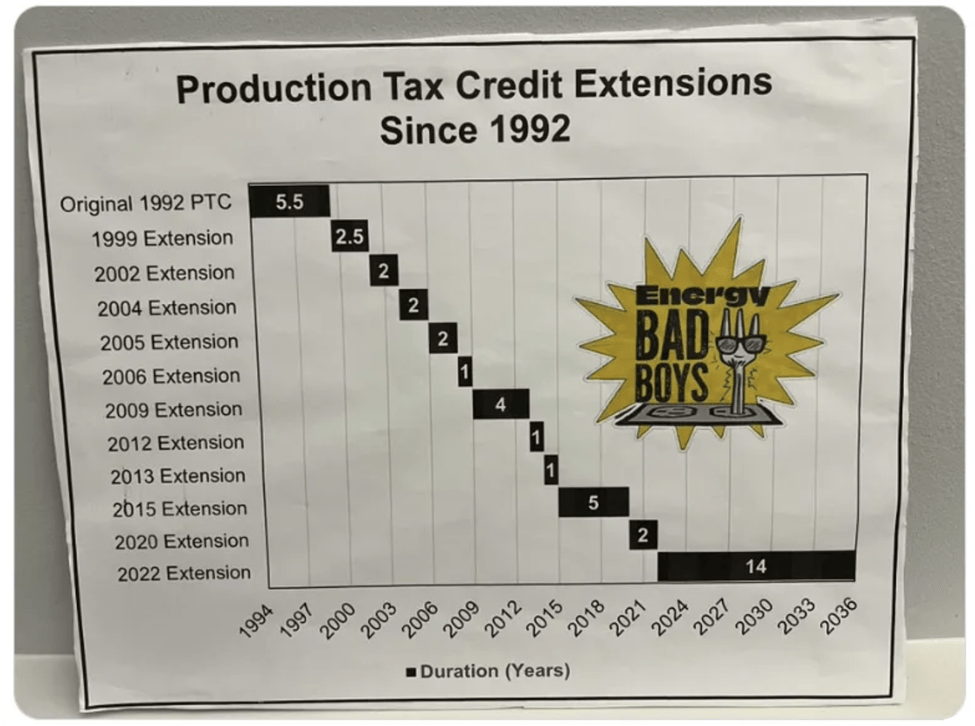
The chart below summarizes the change to the subsidies.

If this passes it will have an immediate and substantial impact to New York’s renewable energy development plans. I believe that many of the proposed wind and solar projects proposed for New York will not be viable without the subsidies. If New York cannot develop those resources, then it is clear that a pause in Climate Act implementation is necessary.
Conclusion
New York cannot “solve” climate change on its own because our greenhouse gas contributions to the atmosphere are dwarfed by emissions elsewhere. The best we can help for is a successful model for other jurisdictions, but the continuing ride of unresolved questions and unacknowledged issues suggests that the current approach is not on the right path. Pausing the insanity before it does more damage is the only rational path.

 Pragmatic Environmentalist of New York