

This is part of my continuing coverage of the New York State Energy Plan. On July 23, 2025, the Draft Energy Plan was released for comment. This post describes the scanty cost information in the draft.
I am convinced that implementation of the New York Climate Leadership & Community Protection Act (Climate Act or CLCPA) net-zero mandates will do more harm than good if the future electric system relies only on wind, solar, and energy storage because of reliability and affordability risks. I have followed the Climate Act since it was first proposed, submitted comments on the Climate Act implementation plan, and have written over 550 articles about New York’s net-zero transition.
I acknowledge the use of Perplexity AI to generate summaries and references included in this document. The opinions expressed in this article do not reflect the position of any of my previous employers or any other organization I have been associated with, these comments are mine alone.
Net-Zero Aspirations
The Climate Leadership & Community Protection Act (Climate Act) established a New York “Net Zero” target (85% reduction in GHG emissions and 15% offset of emissions) by 2050 and has two electric sector targets: 70% of the electricity must come from renewable energy by 2030 and all electricity must be generated by “zero-emissions” resources by 2040. The Scoping Plan that outlined how to “achieve the State’s bold clean energy and climate agenda” was based on an Integration Analysis prepared by the New York State Energy Research and Development Authority (NYSERDA).
Energy Plan Overview
According to the New York State Energy Plan website (Accessed 3/16/25):
The State Energy Plan is a comprehensive roadmap to build a clean, resilient, and affordable energy system for all New Yorkers. The Plan provides broad program and policy development direction to guide energy-related decision-making in the public and private sectors within New York State.
The driving factor for change is the Energy Plan’s net-zero ambitions of New York’s ruling political party. This is the first update of the Energy Plan since the Climate Act was passed in 2019. I have provided more background information and a list of previous articles on my Energy Plan page.
In this iteration of New York climate policy, the Pathways Analysis is equivalent to the Integration Analysis. Responsibility for implementing the Energy Plan as well as all the Climate Act programs lies with NYSERDA. Over my multi-decade career, I have seen an ever-increasing level of political influence on NYSERDA’s research priorities and, more recently, the research results. This post describes the cost information in Pathways Analysis scenarios and explains why it is inadequate.
Costs
My last post described how the misleading definition of the “No Action” scenario was being used to hide the true costs of the Draft Energy Plan. NYSERDA President and CEO Doreen Harris provided one of the few direct references to costs at the last Energy Planning Board meeting when she said.
You may recall during our last meeting in which we discussed the pathways modeling for this plan. And to remind you, the analysis showed that New York’s citizens and businesses will need to invest over one hundred billion dollars each year in the energy system, no matter which future path we take.
Even this reference was misleading because the expected cost is $120 billion. I consider a 20% difference significant, making this an example of hiding the costs.
Cost References
I reviewed the meeting slides and transcripts for the two Energy Planning Board meetings where the Pathways Analysis was discussed to find explicit references to expected costs. I searched for “$”, “dollar”, and “billion”. Searching the June 25, 2025 Board Meeting Slides I found two $ references to Hochul’s $1 billion decarbonization commitment, there were no relevant dollar references, and references to billion were for the decarbonization commitment. The meeting recording includes a transcript. When I searched “$” I found a reference to Hochul’s $1 billion decarbonization commitment. This came up when I searched “billion” along with a second reference to the decarbonization commitment. Searching for “dollar” provided no additional relevant references. Also note that there was no reference in the minutes to billions of dollars. My searches in the May 27 meeting materials also did not find references to the costs. The only relevant reference to billions in the last two meeting materials was the quote by Harris.
I find it telling that Harris said “you may recall” when she referenced the $100 billion investment figure but there are no actual references for that number in recent meeting materials. Cynic that I am I believe this is another indication of the cover up.
Legacy Programs
In my previous post I explained that the “No Action” pathway scenario reflects “outcomes in the absence of the Climate Act and energy policies enacted from 2019 onwards”. The Perplexity description goes on: “It includes federal energy incentives and legacy New York State policies (i.e., those in place as of early 2025), but it explicitly excludes any state and local climate, decarbonization, or efficiency policies put in place since 2019.” As a result, NYSERDA can claim that costs will be high no matter which future energy path we take. In no small part the costs in the “no action: case are the result of all the legacy programs that are only included to reduce greenhouse gas emissions.
Nine legacy programs are mentioned in the Draft Energy Plan:
- Core Infrastructure Investments
- Baseline System-Wide Spending
- Continued Investment in All Fuel Systems
- Natural Gas System Infrastructure
- Electricity System Expansion
- Transmission and Distribution Infrastructure
- Grid Reliability and Resilience Investments
- Load Growth Accommodation
- Energy Efficiency and Weatherization
It is impossible to determine how much of the costs in these legacy programs is due to pre-Climate Act GHG emission reduction programs and how much is necessary infrastructure maintenance and capital spending of the energy system in the absence of those initiatives. The “continued investment in all fuel systems” legacy program clearly does not include programs to reduce GHG emissions. The electricity system expansion refers to wind, solar, and storage programs that are necessary to achieve the Climate Act goals that clearly only exists to reduce GHG emissions. The other legacy programs include initiatives that fit both categories so differentiating costs for New York’s climate ambitions is impossible.
Cost Analysis of Pathways Analysis Scenarios
I say that it is impossible to categorize costs to achieve the Climate Act mandates in the Draft Energy Plan not only because there is insufficient explanatory information but also because cost details are not provided to enable the public to determine the costs. I submitted a Perplexity AI query asking for the costs in the Pathways Analysis “no action” scenario and other scenarios in the Draft New York State Energy Plan’s Pathways Analysis.
The response provided the following information:
The No Action scenario serves as the baselinefor cost comparisons and represents approximately $120 billion in annual system-wide spending (in 2024 dollars) through 2040. The Energy Plan states that the baseline spending covers:
- Maintaining and modernizing existing energy infrastructure
- Replacing aging equipment at the end of its useful life
- Purchasing fuels to meet energy needs
- Supporting replacement natural gas generators
- Continuing with end-use equipment replacement following normal cycles
- Scenario Cost Comparisons
The Pathways Analysis evaluates five different scenarios with specific cost implications relative to the No Action baseline:
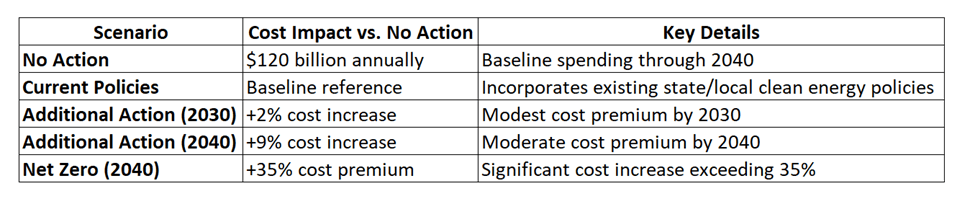
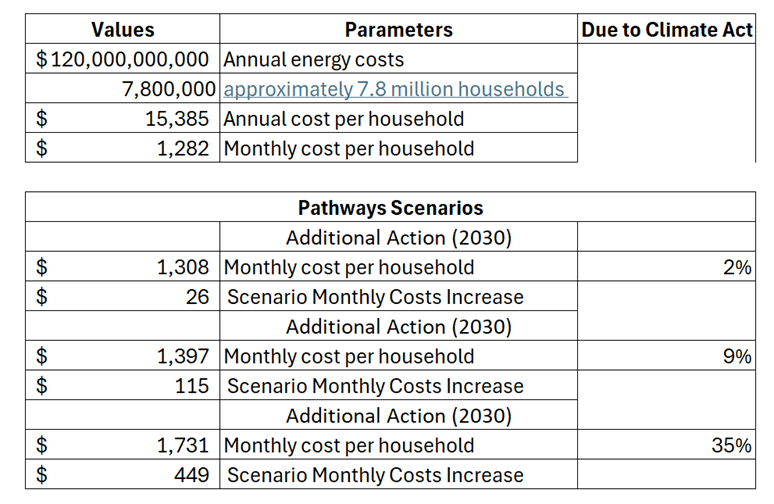
The NYSERDA Pathways Analysis projects that energy system investments will total $120 billion per year out to 2040. There are approximately 7.8 million households in New York State. The following table shows that dividing the $120 billion total by the number of households projects results in a $1,282 monthly energy cost per household. Keep in mind that these are total energy costs including not only utilities but also personal transportation. There are three Pathways scenarios with projected cost increases. The “Additional Action” scenario projects a 2% increase in 2030 equivalent to $26 a month extra. In 2040, the “Additional Action” scenario projects a 9% increase equivalent to $115 a month extra. To achieve the net-zero transition aspirations the modeling projects a 35% cost premium equivalent to $449 a month extra.
Discussion
As I noted in my previous post, I believe the reason to obscure the costs is because the energy costs necessary to achieve the Climate Act net-zero transition are so large that they are politically untenable. The cost slogan for the Energy Plan will claim that costs will be high no matter which future energy path we take and the incremental increase for net-zero nirvana is a small addition. I am sure that most New Yorkers will agree with me that the claimed $1,282 per month energy costs is higher than my personal costs. Frankly, that claim alone should be addressed because it could be the reason so many people are having trouble paying their utility bills.
With respect to Climate Act implementation, there are buried GHG emission reduction program costs in the $1,282 per month estimate. It is impossible to estimate how much it is because NYSERDA has not provided transparent and comprehensive cost documentation. In my opinion, there is very little public appetite for the additional $449 per month increase in costs necessary to achieve the Climate Act net zero targets. Governor Hochul’s recent admission that the Climate Act might not be affordable and the heretofore unacknowledged fact that there is an affordability safety valve give me some hope that changes are forthcoming.
Conclusion
The Climate Act has always been political theater. Passage of the law placated the loud and emotional constituency that believes that climate change caused by GHG emissions is an existential threat and enabled the politicians supporting the law to brag that they were leading the nation. Now that we have experience with the impacts of the rollout of wind and solar sprawl across the countryside and the cost impacts are becoming too large to ignore, the only way to stop the nonsense is for politicians to demand that the Public Service Commission address the safety valve provision in Public Service Law 66-P. That will not happen unless we hold politicians accountable.

 Pragmatic Environmentalist of New York