

I am very frustrated with the New York Climate Leadership & Community Protection Act (Climate Act) net zero transition because the reality is that there are so many issues coming up with the schedule and ambition of the Climate Act that it is obvious that we need to pause implementation and figure out how best to proceed. This article describes an interview with Steven Koonin and uncertainties associated with wind and solar forecasting that complicate renewable energy deployment.
I am convinced that implementation of the Climate Act net-zero mandates will do more harm than good because the energy density of wind and solar energy is too low and the resource intermittency too variable to ever support a reliable electric system relying on those resources. I have followed the Climate Act since it was first proposed, submitted comments on the Climate Act implementation plan, and have written over 550 articles about New York’s net-zero transition. The opinions expressed in this article do not reflect the position of any of my previous employers or any other organization I have been associated with, these comments are mine alone.
Steven Koonin on the Unsettled Science of Climate
I have been meaning to do a post on the recent Department of Energy (DOE0 report A Critical Review of Impacts of Greenhouse Gas Emissions on the U.S. Climate. That topic deserves more than a mention so it will have to wait In the meantime here is a link to an interview of one of the authors – Steven Koonin. John Robson from the Climate Discussion Nexus conducted the interview.
The theme of the interview was that contrary to the constant barrage from alarmists, the mainstream media, and New York’s energy policy analysts, there are major uncertainties associated with climate change science. Koonin and the other authors of the DOE report are not arguing that there is no climate change. He remarked that he was disappointed that some opponents call climate change a hoax or conspiracy but he also noted that supporters should not call climate change an existential threat or a potential catastrophe.
In no particular order, my notes include the following points made by Koonin and Robson:
- Need to understand subtleties
- Need humility when discussing climate variation because the observations are uncertain
- Regional models are unfit for purpose
- Societal impact descriptions are influenced by value judgements
- When evaluating climate change these are things to watch out for
- Historical context
- Scale
- Data, especially long-term
- Need to consider divergent opinions
A key point relative to climate change solutions is consideration of what we know, what we don’t know and why it matters. Contrary to popular opinion we don’t know nearly as much as proponents claim. Furthermore, personal values color the priorities of responses. Finally, both Koonin and Robson noted that many of the purported solutions do not consider feasibility.
Renewable Implementation Uncertainty
Electric grid operators must constantly balance generation and load on a near instantaneous basis. The variability of wind and solar complicates that challenge. To account for weather conditions that affect wind and solar resource availability, weather forecasters prepare projections. Forecasts ranging from very short term (minutes) to a week are needed. The Independent System Operator for New England (ISO-NE) recently released assessments of wind and solar forecast errors. The results offer another indication that implementation is not going to be easy.
The issues associated with solar and wind forecasts are different. Figure 1 shows the solar power forecast bias. Bias is the average tendency of a forecast parameter to overpredict or underpredict. Ideally, it would be equal to zero. Positive bias means less solar power was available compared to forecast. Negative bias means more solar power was available compared to forecast. The calculations are based on the solar forecast at 9:00 AM for periods out to a week for individual and the combined plants or fleet. The results show that the fleet peak loads forecasts consistently over-predict how much solar power will be available by approximately 20%. That is not a very good outcome. It implies that more storage will be needed to cover for solar variability.
Figure 1: ISO-NE Solar Medium and Long-Term Forecast Bias
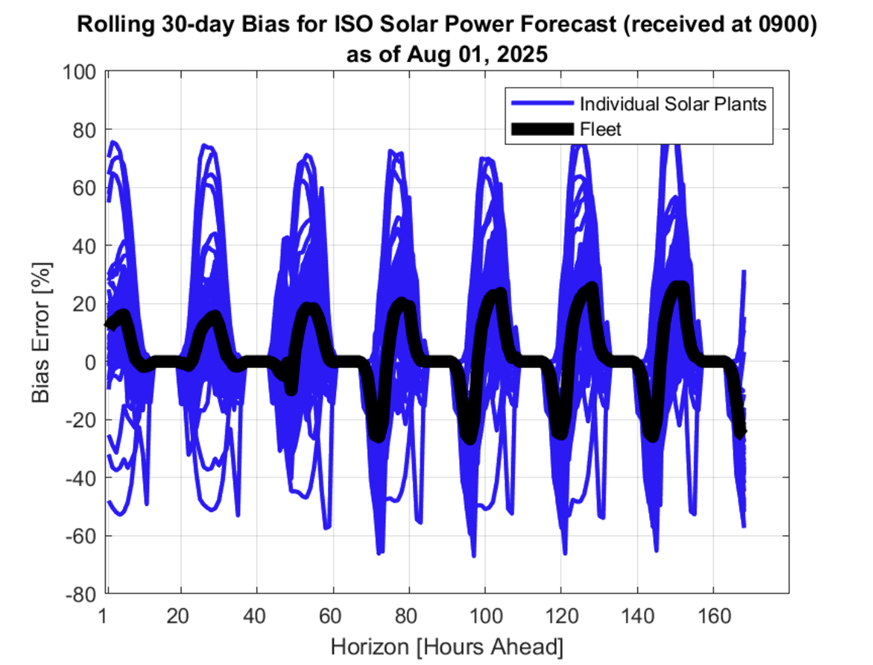
Figure 2 shows the wind power forecast bias. The calculations are based on the wind forecast at 9:00 AM for periods out to a week for individual plants and the fleet. In my opinion, there are some unexpected things going on in these data that would need more time than I have to address. It appears that the fleet forecast bias is very good out to 48 hours but after that there is an apparent diurnal effect and the difference between observed and forecast markedly increase. I think that the diurnal effect should show up in the first 48 hours albeit in a reduced form. Frankly the lack of that indicator makes me think there is a problem in the analysis.
Figure 2: ISO-NE Wind Medium and Long-Term Forecast Bias
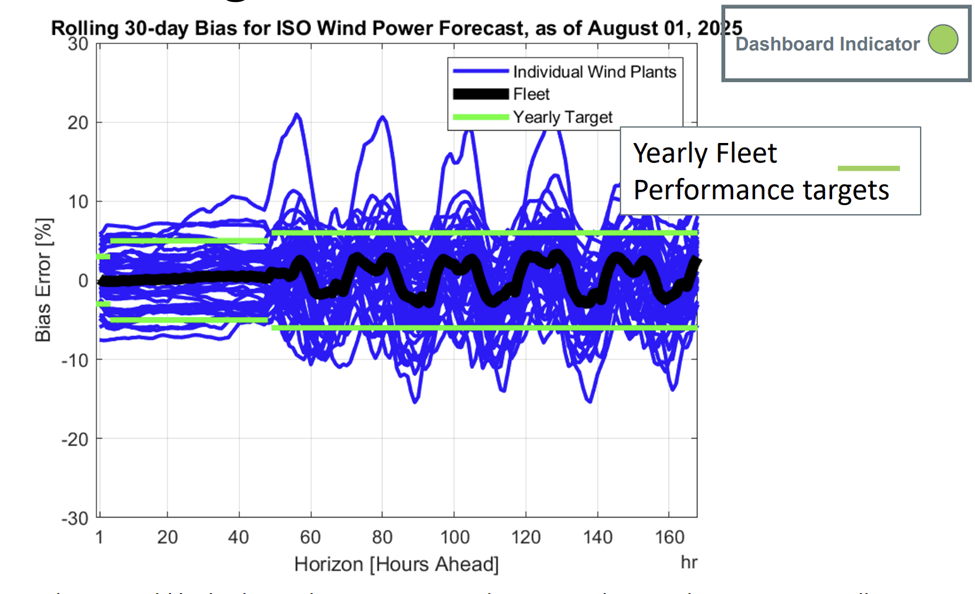
There are differences between the solar and wind results. The data indicate that the fleet wind estimates are better than the solar forecasts because the bias is lower. The individual forecasts vary more than the fleet forecasts for solar than for wind. These results are evidence that the factors affecting wind are driven more by larger scale factors than those for solar.
The challenge to balance generation and load on a near instantaneous basis in a system that depends on wind and solar is not going to be solved by weather forecasts. There are systemic weather forecast bias errors on the order of 20% for solar forecasts. Also note that these are average statistics. I have no doubt that there are days that the forecasts are bad enough to negatively impact the ability of the grid operators to balance generation and load.

 Pragmatic Environmentalist of New York