
My last post described a filing that I made with Richard Ellenbogen, Constatine Kontogiannis, and Francis Menton to New York Public Service Commission Case 22-M-0149 – Proceeding on Motion of the Commission Assessing implementation of and Compliance with the Requirements and Targets of the Climate Leadership and Community Protection Act. We argued that this Proceeding is the appropriate venue to address the safety valve provisions in Public Service Law (PSL) Section 66-P. This post explains that a requirement for the Public Service Commission to hold a hearing to consider whether it is appropriate to temporarily suspend or modify PSL 66-P obligations has been triggered.
I am convinced that implementation of the New York Climate Leadership & Community Protection Act (Climate Act or CLCPA) net-zero mandates will do more harm than good if the future electric system relies only on wind, solar, and energy storage because of reliability and affordability risks. I have followed the Climate Act since it was first proposed, submitted comments on the Climate Act implementation plan, and have written over 550 articles about New York’s net-zero transition. The opinions expressed in this article do not reflect the position of any of my previous employers or any other organization I have been associated with, these comments are mine alone.
Background
The Climate Leadership & Community Protection Act (Climate Act) established a New York “Net Zero” target (85% reduction in GHG emissions and 15% offset of emissions) by 2050 and has two electric sector targets: 70% of the electricity must come from renewable energy by 2030 and all electricity must be generated by “zero-emissions” resources by 2040. The Climate Action Council (CAC) was responsible for preparing the Scoping Plan that outlined how to “achieve the State’s bold clean energy and climate agenda.” The Scoping Plan that outlined how to “achieve the State’s bold clean energy and climate agenda” was based on an Integration Analysis prepared by the New York State Energy Research and Development Authority (NYSERDA).
The summary post describing the filing includes a summary of the safety valve requirement and the rationale for submitting the filing. In brief, Ellenbogen, Kontogiannis, Menton, and I believe that the Public Service Commission (PSC or Commission) has not adequately addressed their broad mandate to ensure access to safe, reliable utility service at just and reasonable rates relative to all the Climate Act mandates incorporated in recent rate cases. PSL 66-P requires the Commission to establish a program to ensure the State meets the 2030 mandate that a minimum of 70% of the statewide electric generation in 2030 is generated by renewable energy systems and the 2040 requirement that the statewide electrical demand system will be zero emissions also includes safety valve provisions. The Commission is empowered by this statute to temporarily suspend or modify these obligations if, after conducting an appropriate hearing, it finds that PSL 66-P impedes the provision of safe and adequate electric service. However, in response to those arguments Department of Public Service (DPS) staff have stated that the rate cases are not the appropriate venue to determine whether a hearing is necessary.
Our filing to a generic proceeding responds to that argument. It explains that the statewide utility customers in arrears provision has been exceeded so it would be appropriate to conduct a hearing. This post will describe Exhibit 1 – Trend in Company Customers in Arrears that documents increasing trends in statewide utility customer payment delinquencies, providing baseline data for the customers in arrears safety valve trigger. The filing includes the Exhibit 2 – Customers in Arrears spreadsheet that contains the detailed analytical data on utility arrears across New York’s major distribution companies.
Utility Customers In Arrears
Exhibit 1 of the filing documents my analysis of residential customer in arrears data to estimate whether there has been a significant increase in arrears consistent with New York Public Service Law 66-p (4) for the ten largest electric and gas distribution utility companies regulated by the Public Service Commission. The spreadsheet used for the calculations is available. The first tab in the spreadsheet describes the other tabs in the spreadsheet.
Residential Collection Data
Utilities file a monthly report in the PSC Case 91-M-0744 docket that details their arrears and service terminations. There is a data set in New York Open Data that provides this information that was used to determine the number of residential customers in arrears. The “Quarterly snapshot of residential collection dataset” contains the following information:
This dataset provides a quarterly snapshot of residential bill collection activity for New York State’s ten largest electric and gas distribution utility companies regulated by the Public Service Commission. Included in this dataset are each utility’s total number of residential customers, residential customers with arrears (overdue bills) greater than 60 days, residential final service termination notices issued, residential accounts terminated (service shut off for nonpayment), active residential deferred payment agreements and the number of uncollectible residential accounts. Also included are the corresponding utility sales figures for each metric above, showing the dollar figure represented.
The “Documentation” tab in the spreadsheet lists the Data Dictionary in the New York Open Data source record. For this analysis, the data were exported in May 2025 to the “Input” tab in the spreadsheet. The original data is available by quarter, but the data labels are listed as month and year, so the input data is converted to quarterly labels in the “Quarterly” tab. The “Statewide” tab sums data for all the utilities by quarter.
Company Residential Customer Summary – Quarterly Data
Table 1 lists the sum of the quarterly data for the Summary Snapshot for all ten utilities for the statewide number of residential customers, residential customers with arrears (overdue bills) greater than 60 days, and the percentage of residential customers with overdue bills relative to the total number of customers. The final termination notices and number of service disconnections (not shown) are not good estimates of the effect of the Climate Act because other mandates have affected the data, e.g., service disconnections were suspended during COVID.
Table 1: Ten Largest Electric and Gas Distribution Utilities Summary Snapshot Quarterly Residential Collection Data
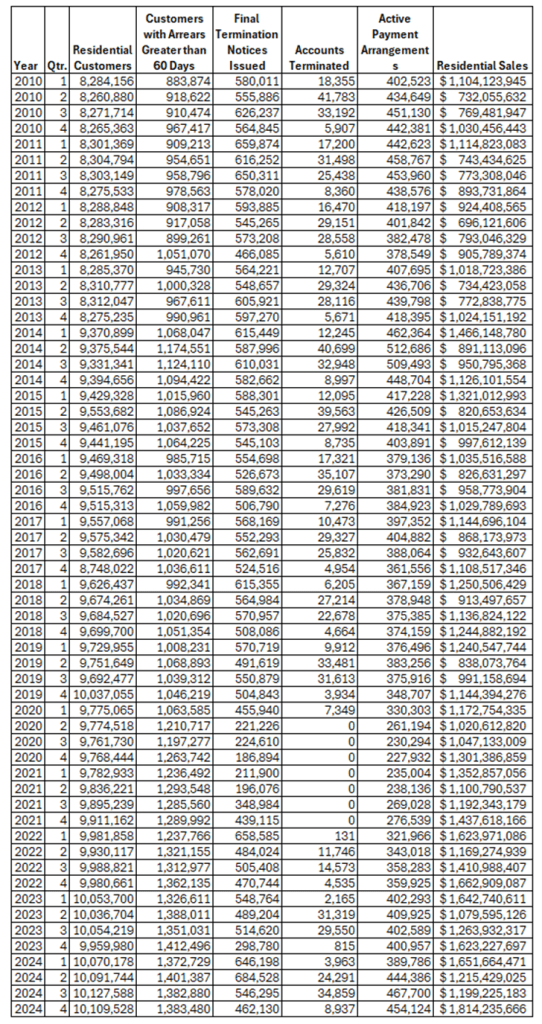
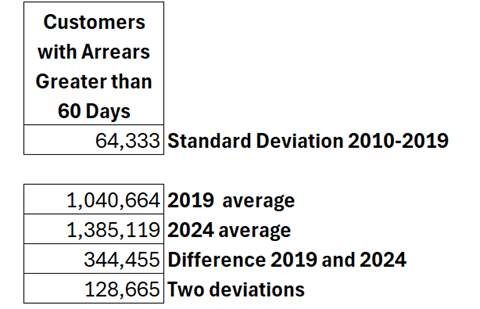
Table 2 summarizes these data relative to the PSL 66-P(4) trigger. The annual average number of statewide customers in arrears greater than 60 days was 1,040,664 in 2019, the last year before the CLCPA was implemented. The average in 2024 was 1,385,119 customers in arrears which is an increase of 344,455 or a 33% increase. The Public Safety Law section 66-p (4) criteria for consideration of suspension or modification is a “significant increase in arrears or service disconnections that the commission determines is related to the program”. The standard deviation of the number of customers in arrears from 2010 to 2019 is 64,333. Because the observed difference, 344,455 is greater than two times the standard deviation, the increase in statewide customers in arrears is statistically “significant”.
Table 2: Combined Ten Largest Electric and Gas Distribution Utilities Summary Snapshot Quarterly Residential Collection Data Summary of Customers in Arrears Greater than 60 Days
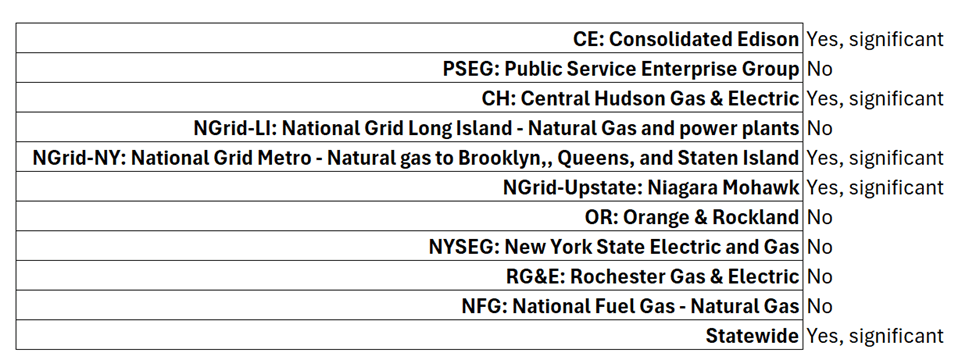
There are ten tables in the spreadsheet in a similar format but only include data from each of the ten largest utility companies that are included in the New York Open Data quarterly snapshot of residential collection data. Table 3 summarizes the results listed in the PSL 66-p(4) tab in the spreadsheet. In addition to the statewide significance finding, four of the ten utilities had a statistically significant increase in customers in arrears since the start of the CLCPA: Consolidated Edison, Central Hudson Gas & Electric, National Grid Metro – Natural gas to Brooklyn, Queens, and Staten Island, and National Grid Upstate: the former Niagara Mohawk service territory.
Table 3: Summary of Analyses of Customers in Arrears More Than 60 Days Difference Before the Climate Act and Since Implementation Showing Whether the Difference in the Number of Customers Changed Significantly Before 2019 and After 2020
Discussion
Our filing included a description of the DPS staff response to this argument that was based on a post here. There were two arguments. DPS stated that the proper place to address this was in a generic proceeding and our filing addresses that argument. It is anybody’s guess if and when the PSC will respond to our filing.
The other argument was that our analysis was incomplete. The Public Safety Law section 66-p (4) criteria for consideration of suspension or modification is a “significant increase in arrears or service disconnections that the commission determines is related to the program”. DPS argued that we did not prove that the significant increase was due to the Climate Act. That response overlooks the fact that the information necessary to determine whether the costs are due to the program is not available because DPS has not fulfilled its obligations. The information in the DPS informational report required as part of Case 22-M-0149 is needed to determine if the increase is related to the CLCPA program. The DPS has not provided that report since July 2023 so only information through 2022 is available. That is too short a period to be used for this evaluation.
Conclusion
Utility affordability is a major issue as reflected by the PSC decision for the National Grid request. According to the press release: “The Commission’s action will significantly reduce the company’s request for total electric delivery revenues by over $340 million (67% decrease from request) and total gas delivery revenues by nearly $100 million (63% decrease from request) in the first year.” This post explains that the requirement for the Public Service Commission to hold a hearing to consider whether it is appropriate to temporarily suspend or modify PSL 66-P obligations has been triggered. The significant reduction in the National Grid rate case implicitly acknowledges that Climate Act costs are contributing to unacceptable cost increases. However, the decision was driven by the political imperative to reduce energy costs and not the rational decision to pause the Climate Act. At some point the politicians supporting the Climate Act must be called out to defend the costs of the net-zero transition. This filing demonstrates that the rationale to hold a hearing to determine if the schedule should be temporarily suspended exists.

 Pragmatic Environmentalist of New York
One thought on “Climate Act Safety Valve Filing – Customers in Arrears Trigger”