

Update 9/19/25 Meeting Materials
Hearing Transcript [PDF]
Hearing Presentation [PDF]
Hearing Recording (opens in new window) My oresentation begins at 19:00
This post documents the oral comment I submitted at the Draft State Energy Plan Public Hearing on August 19, 2025. The New York State Energy Research & Development Authority (NYSERDA) only allocated two minutes per person, so this article documents the statements that I made.
I am convinced that implementation of the New York Climate Leadership & Community Protection Act (Climate Act or CLCPA) net-zero mandates will do more harm than good if the future electric system relies only on wind, solar, and energy storage because of reliability and affordability risks. I have followed the Climate Act since it was first proposed, submitted comments on the Climate Act implementation plan, and have written over 550 articles about New York’s net-zero transition. The opinions expressed in this article do not reflect the position of any of my previous employers or any other organization I have been associated with, these comments are mine alone.
Net-Zero Aspirations
The Climate Act established a New York “Net Zero” target (85% reduction in GHG emissions and 15% offset of emissions) by 2050 and has two electric sector targets: 70% of the electricity must come from renewable energy by 2030 and all electricity must be generated by “zero-emissions” resources by 2040.
According to the New York State Energy Plan website: “The State Energy Plan is a comprehensive roadmap to build a clean, resilient, and affordable energy system for all New Yorkers.” The New York State Energy Planning Board is a “multi-agency entity established under Article 6 of the Energy Law, playing a core role in the State Energy Plan process”. Among its responsibilities is adopting the State Energy Plan: The Board has the authority to adopt the comprehensive statewide energy plan, and the stakeholder process should be an important component of that responsibility.
The driving factor for the updated Energy Plan is net-zero ambitions of the Climate Act. This is the first update of the Energy Plan since the Climate Act was passed in 2019. I have provided more background information and a list of previous articles on my Energy Plan page. Because of the importance of this process on the future energy system of New York I am following it closely and will be submitting oral and written comments.
Comments
This section documents the comments I made on August 19. I used bullets to differentiate my comments from the explanations.
- My name is Roger Caiazza. Documentation for my comments will be posted on my Pragmatic Environmentalist of NY blog
I am convinced that implementation of the New York Climate Leadership & Community Protection Act (Climate Act or CLCPA) net-zero mandates will do more harm than good if the future electric system relies only on wind, solar, and energy storage because of reliability and affordability risks. I started the blog in 2017, it documents my posts on the Climate Act since it was first proposed, submitted comments on the Climate Act Scoping Plan and various implementation plans, and have written over 550 articles about New York’s net-zero transition. The opinions expressed in my comments do not reflect the position of any of my previous employers or any other organization I have been associated with, these comments are mine alone.
- This process appears to be similar to the Scoping Plan stakeholder process which is not a good sign
NYSERDA claimed that there was “robust public input” during the draft Scoping Plan process that “included 11 public hearings across the State and more than 35,000 written comments” that supposedly were read, summarized, and presented to the Climate Action Council. The problem is that Agency staff screened the comments for the Climate Action Council and there is no publicly available documentation of their work. They only presented generalities at meetings and did not summarize specific comments. I am convinced that any comments that questioned the narrative espoused by Climate Act proponents were ignored and there is no evidence that I am wrong. I think that NYSERDA is following the same script where the numbers were tortured to provide the desired results then tied up into a pretty package. Now they will go through the motions of accepting public input and will not respond to comments submitted.
- Two minutes for comments indicates NYSERDA is going through the motions of dealing of stakeholder input
My background as an industry air pollution meteorologist required that I back up any analyses submitted to regulatory agencies and reference my findings in paper presentations. Obviously, that is not possible when only two minutes is allotted for comments. It also means that NYSERDA does not care if detailed information is provided and that leads me to believe that the answer is in the back of the book. This whole process is a charade whose only intent is to be able to check the box that there was a stakeholder process.
- The stakeholder process for the Draft Energy Plan will fail if NYSERDA and other state agencies treat it as an obligation and not an opportunity to improve the final plan
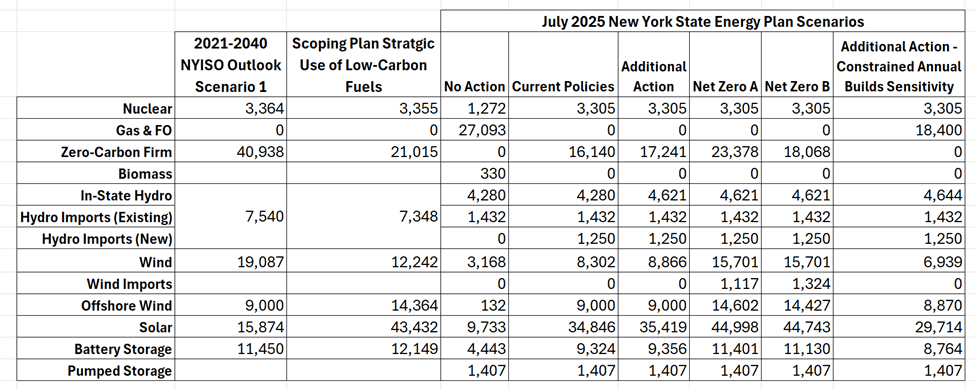
I understand that the New York Independent System Operator and the New York State Reliability Council have provided expert input to the Draft Energy Plan Pathways Analysis. However, that interaction is not documented and there are substantial differences between NYISO projections of future electric system capacity and the Pathways Analysis. The differences in Table 1 are important for the Energy Planning Board to understand. The stakeholder process should reconcile the differences in an open and transparent public forum. In my opinion, NYSERDA should host a technical meeting to address this technical issue and others. Such a meeting could include a dialogue between staff and stakeholders where questions could be asked.
Table 1: Comparison of 2040 Fuel Mix Capacity (MW) Projections by NYISO and NYSERDA
- This process will have no credibility if NYSERDA does not summarize each comment received and explains how they were resolved to Energy Planning Board
A credible stakeholder process treats responds to comments. For example, the Santa Clara County Rapid Transit Development Project includes a master plan for transportation for Silicon Valley. An interview with the founding manager notes: “Part of the plan is a four-year public stakeholder review process. In the reviews, if the public came up with good ideas, the ideas went into the plan. If an idea wasn’t good, we had the responsibility of explaining why” from California’s High-Speed Rail Visionary Bill Buchanan, Trains, Volume 85, No. 1, January 2025, pages 30-37. Their process also included public outreach meetings that included the opportunity to ask questions.
The Scoping Plan stakeholder process did not document their response to comments. There is nothing that indicates that the Draft Energy Plan process will be any different. Availability of the draft was announced after a series of Planning Board meetings earlier this year. There hasn’t been any opportunity for stakeholders to ask questions about the assumptions and methodologies used. If the State was serious about considering public input for an energy plan that affects every New Yorker, then they would hold a series of meetings to cover specific technical topics. A stakeholder process that does not allow for interaction between stakeholders and NYSERDA staff is nearly useless.
- The Pathways analysis includes some of the flaws of the integration analysis. For example, none of the existing solar and wind generators are retired
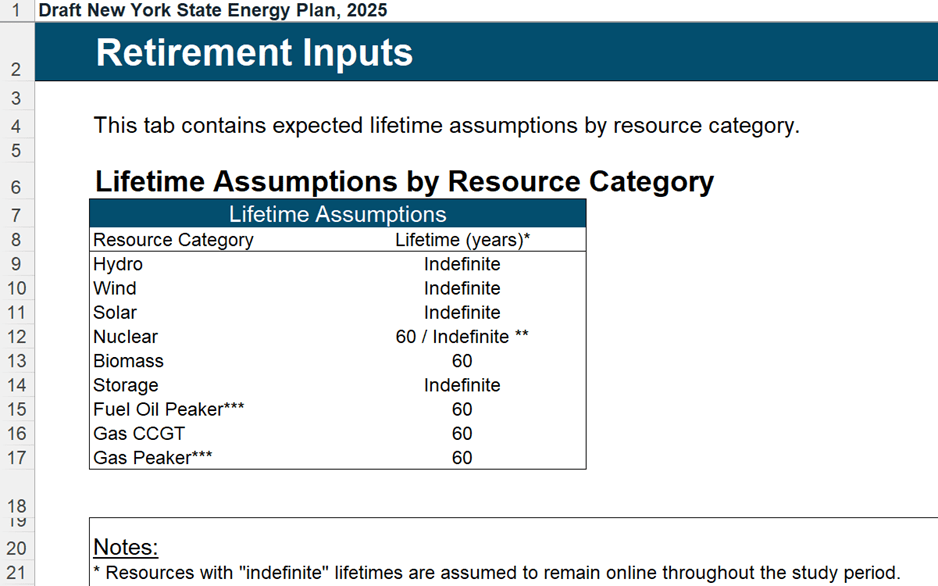
This is one example of an obvious issue in the Pathways Analysis. The “Retirement Input” tab in the Pathways Analysis Technical Supplement: Key Drivers and Outputs spreadsheet is shown in Figure 1. It states that the expected lifetimes for wind, solar, and storage are indefinite. Most of the existing wind and solar and all of the existing storage will have to be replaced by 2040. This is an absurd assumption.
Figure 1: Retirement Inputs Table
The fact that this error was pointed out years ago means that NYSERDA does not care about public input. On June 16, 2022 I submitted a Comment on Retirement Input Assumptions used in the Draft Scoping Plan.
In what appears to be an egregious attempt to reduce the published costs of wind, solar, and battery storage, the Integration Analysis assumes that the expected lifetimes of those technologies are indefinite. As a result, units are assumed to remain online throughout the study period and no costs for replacements between now and 2050 are included. However. that is a poor assumption because it is totally unreasonable to expect that, for example, the existing land-based resources will still be in operation in 2050.
I estimated the potential impact of this assumption. Using an indefinite retirement date for these resources underestimates the total builds needed for 2050. For land-based wind between 3,814 MW and 4,600 MW are not included and for offshore wind between 6,200 and 6,600 MW are not included. The amount of solar not included ranges between 22,639 MW and 19,983 MW. Finally, battery storage between 10,713 MW and 12,207 MW of additional resources will need to be developed to meet the 2050 projected value.
The Draft Energy Plan only covers the next 15 years to 2040, so these projections are not completely compatible. Nonetheless, this is still a uncontestably incorrect assumption. This error will cause an underestimate of the costs to comply with the Climate Act 2040 mandates. It is a matter of credibility if it is not acknowledged.
- The biggest problem is that the Pathways “No Action” scenario is not a baseline that excludes all programs necessary to achieve the Climate Act targets. It includes legacy programs in place prior to the Climate Act. This hides the true costs of the net-zero transition. A no GHG emission reduction program scenario is needed
This is another issue that I raised in the Scoping Plan stakeholder process in verbal and written comments. As was the case with the Integration Analysis and Scoping Plan, NYSERDA is interpreting the “No action” scenario as one that includes all legacy programs in place prior to the passage of the Climate Act. The appropriate baseline scenario is one that excludes all programs that were promulgated to reduce GHG emissions because that is the only way to determine the costs to achieve the “Net Zero” target (85% reduction in GHG emissions and 15% offset of emissions) by 2050 and the two electric sector targets: 70% of the electricity must come from renewable energy by 2030 and all electricity must be generated by “zero-emissions” resources by 2040. I provided more details in this post.
- Without assurances that this process will respond to input there is no sense in developing detailed comments. If you are serious then hold a technical conference where the public can ask questions.
I developed an extensive set of comments on the Draft Scoping Plan that took an enormous amount of time. Many others invested similar time and effort. The lack of documentation that proved that someone had read the comments along with the lack of a summary document that summarized each comment and explained how NYSERDA reconciled the comment in the Final Scoping Plan for the Climate Action Council indicates to me that the whole process is rigged. If the Energy Planning Board members responsible for “approving” the Draft Energy Plan are not given all the stakeholder information regarding the plan then it is reasonable to believe that informed approvals were never expected. The plan was always to get a rubber stamp approval and check the box that there was a stakeholder process.
- Given the tremendous uncertainty related to Federal programs the comment period for the Draft Energy Plan should be extended. If that is not done, then it is likely that the Energy Plan will be obsolete as soon as it is completed.
There is no question that there will be changes in Federal policies that will have enormous impact on the Draft Energy Plan. Even before the change in Washington, state agencies highlighted other factors that have delayed the planned schedules including supply chain challenges, inflation, canceled projects, outdated data/miscalculations, permitting issues, and the need to balance reliability, costs, and equity. The Draft Energy Plan must acknowledges that there are significant outside factors
- Finally, the Energy Plan will only be credible if it establishes specific affordability, reliability, and environmental impact acceptability criteria, mandates that a tracking mechanism is established for each, and formulates a mandatory course of action when the criteria are exceeded.
The overview fact sheet for the Draft Energy Plan claims that it “advances abundant, reliable, affordable, and clean energy for all New Yorkers.” That is just a slogan unless those terms are defined. I have long argued that Public Service Law (PSL) Section 66-P, “Establishment of a renewable energy program”, includes bounds on implementation that have not been considered to date. I have shown that one of the provisions of that regulation and other circumstances warrant the PSC commencing a hearing process to “consider modification and extension” of New York Renewable Energy Program timelines. Clearly this has an impact on the Draft Energy Plan and must be considered. In my opinion, the Climate Action Council should have defined acceptable reliability, affordability, and environmental impact metrics. Their failure to do so means that the responsibility falls upon the Energy Planning Board.
Discussion
I fear that the Hochul Administration is going to direct NYSERDA to follow the stakeholder template used in the Scoping Plan. In so doing the Administration can continue to avoid responsibility for the impacts of the Climate Act. The Draft Energy Plan is too important to rely on emotion and political pandering to specific constituencies to not do this process right.
Conclusion
One of the things I do in my retirement is to play stakeholder process games. The State agencies pretend that they will consider public input, and I pretend that they will actually listen to me. The thing is that I have reality on my side. The low energy density of wind and solar and their intermittent availability are insurmountable hurdles to a affordable and reliable electric energy system. The Draft Energy Plan must recognize that challenge.

 Pragmatic Environmentalist of New York
“According to the New York State Energy Plan website: “The State Energy Plan is a comprehensive roadmap to build a clean, resilient, and affordable energy system for all New Yorkers.” “
There are goals, but there are no detailed plans.
“A failure to plan is a plan to fail.”, Benjamin Franklin
‘A goal without a plan is just a wish.”, Antoine de St. Exupery
A “comprehensive roadmap” is useless if the roads (such as DEFR) don’t exist.
I suspect a utility failure to meet the goals would lead to a state takeover.
LikeLiked by 1 person