

I am very frustrated with the New York Climate Leadership & Community Protection Act (Climate Act) net zero transition because the reality is that there are so many issues coming up with the schedule and ambition of the Climate Act that it is obvious that we need to pause implementation and figure out how best to proceed. This post summarizes an article that describes the misleading nomenclature used by activists to describe clean and dirty energy, notes that Tisha Schuller says: “Get ready for an extinction burst of myth-making”, and references two Climate Discussion Nexus Newsletter items that address the root cause for the Climate Act transition.
I am convinced that implementation of the Climate Act net-zero mandates will do more harm than good because the energy density of wind and solar energy is too low and the resource intermittency too variable to ever support a reliable electric system relying on those resources. I have followed the Climate Act since it was first proposed, submitted comments on the Climate Act implementation plan, and have written over 550 articles about New York’s net-zero transition. The opinions expressed in this article do not reflect the position of any of my previous employers or any other organization I have been associated with, these comments are mine alone.
Clean and Dirty Energy
Tom Shepstone hosted a guest post from the Institute for Energy Research that raises the important distinction between “clean” and “dirty” energy sources. The article notes that:
Discussions about energy policy tend to draw a stark divide between “clean” (or “green”) and “dirty” energy sources, with the former largely referring to wind, solar, and hydro, and the latter targeting natural gas, oil, and coal. This distinction is generally accepted by the public and politicians, who abhor the economic and technological problems that force the continued use of “dirty” sources, assuming that “clean” ones will become cost-effective enough to take over eventually.
The article goes on to compare different energy sources and points out often overlooked aspects of “clean” and renewable wind, solar, and hydro compared to fossil fuels. The weak energy density of renewable energy sources requires much more land area to produce equivalent amounts of power. Wind turbines and solar panels last half as long and the volume of materials is greater than a fossil plant. “Wind turbines, solar panels, and their batteries require significant mineral resources — including copper, cobalt, nickel, lithium, and rare earths — the extraction and processing of which produce carbon emissions, erosion, and wastewater, while threatening species habitats.”
I agree with this statement:
When it comes to energy production, no source can be considered completely “clean” because all human activity necessarily involves environmental effects. Therefore, calling a source “clean” indicates more about whether politicians favor it than the extent of its environmental impact.
The article goes on to describe a framework for considering environmental protection:
The Environmental Kuznets Curve (EKC) depicts the phenomenon of environmental outcomes improving as a result of growing income. According to the model, environmental degradation increases as poorer economies begin to industrialize because they lack the resources to mitigate the environmental damage of industrialization. This occurs up to a certain point, after which the level of environmental degradation begins to decrease as the economy grows because it can use its wealth to spend on improving the environment.
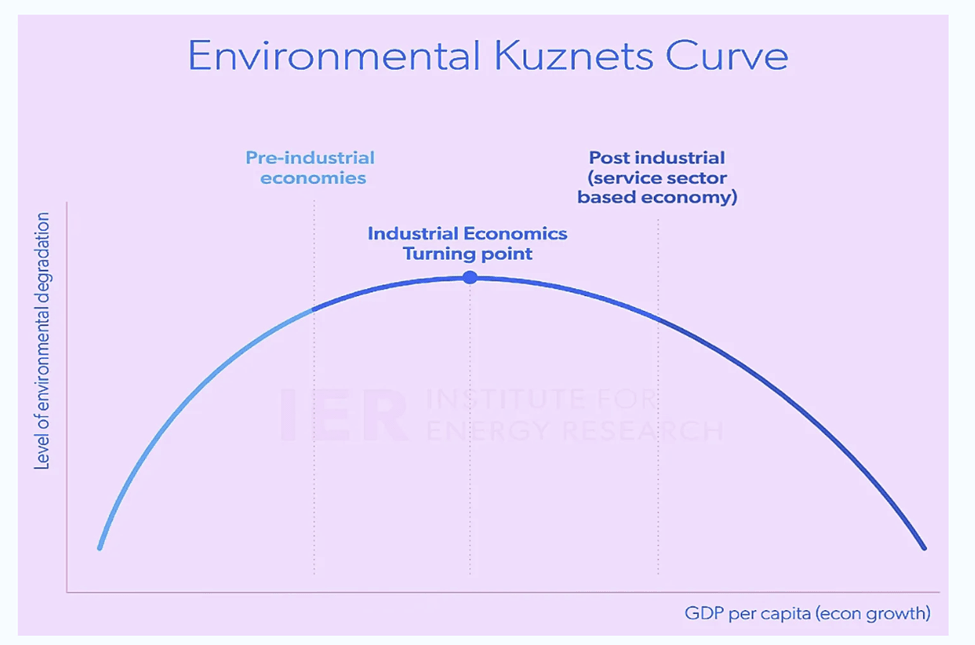
Source: Institute for Energy Research
The article explains:
As the EKC highlights, wealth, not emissions-reducing regulation, leads to improved human welfare and environmental quality. For an advanced economy such as the U.S., this means that the best course of action involves pursuing energy policies that focus on allowing production, mining, and utilities to connect dispatchable and reliable generating sources to the grid. These actions lower electricity costs, making it easier for communities, businesses, and individuals to fund their activities and invest in environmental protection.
New York’s economy is far to the right on this curve. The fact that there are value judgements related to the level of acceptable environmental degradation is leading New York down a path with inevitable unacceptable costs, reliability risks, and the adverse environmental impacts described in this article.
Extinction Burst
Tisha Schuller uses a different term to describe where we are in the clean energy debate. We are already seeing climate activists and their sycophants in the mainstream media claim that the One Big Beautiful Bill (OBBB) is to blame for anticipated energy price spikes even though it hasn’t been implemented yet. She says: “Get ready for an extinction burst of myth-making”.
Her article explains that two things are true:
- Energy prices are likely to rise in the short term.
- Those price hikes were largely baked in before the Big Beautiful Bill even arrived.
She notes that the Myth of an Easy Energy Transition is “throwing a timely tantrum”. There will be an overreaction that has its own consequences for future energy and climate politics. She states:
In a nutshell:
- Oversimplified climate policy had us on a path to big challenges—not just for energy prices but for energy reliability as well. (The Myth promised that the transition would be easy and cheap; it would have been neither.)
- Lately, more citizens and decision-makers (including many identified with the climate left) have begun to understand that decarbonization and infrastructure buildout are and will be difficult and expensive. (The Moment for practical energy conversations has finally arrived.)
- This understanding contributed to a political shift last fall, and all things climate and renewables became controversial.
- The BBB arrived.
- And now there is a sweeping new narrative claiming that but for the BBB energy prices would be … where, exactly? The Myth has not provided a suitable response.
In my dreams I had hoped that the New York Energy Plan would open the door to practical energy conversations but that is not happening. Schuller goes on to define the extinction burst:
An extinction burst is the whirlwind of a behavior an organism will demonstrate after the reinforcement for that behavior stops. For example: A lab rat that’s been receiving pellets by pressing on a lever will press furiously at the lever when the pellets suddenly stop coming. And then it will go bite and kick the lever and go berserk. If you’ve ever seen a toddler throw a fit when their screen time ends, you’ve witnessed an extinction burst. Well, The Myth of an Easy Energy Transition is throwing its own tantrum.
Media outlets and policy wonks are spinning a tale: The Big Beautiful Bill will jack up prices. That’s not wrong. But here’s what they’re not saying: Energy prices were already climbing—thanks to poorly coordinated climate mandates, a lagging grid, and reliability issues.
We can expect this kind of misdirection repeatedly in the months ahead, as The Myth becomes more exposed and tattered.
The challenge for a pragmatic New York energy policy is to target the energy reality message to those who want to get out of this mess. She recommends arguing for a “durable strategy that includes clear commitment to growing energy resources, pragmatic decarbonization, energy reliability, and cost control”.
Weather and Climate
The August 20 Climate Discussion Nexus Newsletter had two items that address the root cause for the Climate Act transition.
In the past NYSERDA CEO Doreen Harris has described climate change as “the existential threat” when talking about the need for the Climate Act transition. I suppose it is progress that the Draft State Energy Plan does not explicitly refer to climate change as an existential threat. However, the rabid climate activists who spoke at recent New York Power Authority and Draft Energy Plan hearings continued to call climate change an extreme threat.
John Robson’s Newsletter featured an article that described the response to the major new climate report from the U.S. Department of Energy. The report by five esteemed scientists dared to say that the “science” that claims there is a catastrophic threat from climate change is much less certain than advocates for the transition away from fossil fuels acknowledge. They have been so blunt to say that the “science” is unfit for policy purposes. In a pragmatic world that means that the urgency to transition away from fossil fuels is unwarranted and certainly does not support the idea that New York must transition before the technology necessary for the Climate Act renewable energy plan is available.
The frustrating inability to distinguish between weather and climate continues in the Draft State Energy Plan. Chapter 6: Climate Change Adaptation Resilience states “New Yorkers have experienced the impacts of climate change in numerous ways in recent years, including extreme storms, heat waves, seasonal drought, and smoke from wildfires in the Western U.S. and Canada.” It goes on to list five weather events that “prove” climate change is “already driving measurable impacts worldwide”.
In his Tidbits section, John Robson describes a mass media description of extreme weather and climate. The highlighted passage is important.
How wrong can you get? Well, the Canadian Broadcasting Corporation is up to the challenge. It bellows “A new study suggests extreme weather caused by climate change is disrupting more and more large events, like festivals and sports.” But you see the problems, right? First, the data clearly show that extreme weather is not getting worse and the IPCC does not claim otherwise. Second, climate change isn’t something that causes weather to change, it’s a statistical description of long-term changes in the weather. Other than that, fine journalism from the Canadian state propaganda outfit that has, the Canadian Taxpayers Federation recently noted, “more than: 250 directors 450 managers 780 producers 130 advisors 81 analysts 120 hosts 80 project leads 30 lead architects 25 supervisors” and “200 Mystery People” all “Paid more than $100,000 per year!” But none, apparently, doing proper fact-checking.
The simple explanation of the difference is that climate is what you expect and weather is what you get. A separate article on the DOE report also addresses the difference between weather and climate.
Another beneficial aspect of the DOE report is that it informs the public about the facts regarding climate science. Namely, it finds fault with those who invoke process-based reasoning and simple thermodynamic arguments to assert that warming is worsening extreme weather events. Because climate is the statistical property of weather over decades, single event attribution to climate change is not possible by definition.
I suppose it is too much to ask that the New York Energy Plan consider the actual science. There is too much invested by too many people who will never admit that climate change is not an existential threat. A problem yes, but one that should not be an over-riding priority siphoning funding and resources from other environmental issues.

 Pragmatic Environmentalist of New York