Balancing the risks and benefits of environmental initiatives
Bait and Switch Draft Energy Plan Costs
As part of my continuing coverage of the draft New York State Energy Plan. I recently explained how the analyses for the Draft Energy Plan are hiding the true costs to meet the Climate Act targets. Energy Bad Boys Mitch Rolling and Isaac Orr recently published an article that describes a similar evaluation that has the same flaw that does a better job explaining the problem.
I am convinced that implementation of the New York Climate Leadership & Community Protection Act (Climate Act or CLCPA) net-zero mandates will do more harm than good if the future electric system relies only on wind, solar, and energy storage because of reliability and affordability risks. I have followed the Climate Act since it was first proposed, submitted comments on the Climate Act implementation plan, and have written over 550 articles about New York’s net-zero transition.
The opinions expressed in this article do not reflect the position of any of my previous employers or any other organization I have been associated with, these comments are mine alone.
Net-Zero Aspirations
The Climate Leadership & Community Protection Act (Climate Act) established a New York “Net Zero” target (85% reduction in GHG emissions and 15% offset of emissions) by 2050 and has two electric sector targets: 70% of the electricity must come from renewable energy by 2030 and all electricity must be generated by “zero-emissions” resources by 2040. The Scoping Plan that outlined how to “achieve the State’s bold clean energy and climate agenda” was based on an Integration Analysis prepared by the New York State Energy Research and Development Authority (NYSERDA). The Climate Act is not the only legislation or regulation that was promulgated to achieve reductions in greenhouse gas emissions to address climate change. That fact has a major bearing on the NYSERDA Draft Energy Plan analyses.
According to the New York State Energy Plan website: “The State Energy Plan is a comprehensive roadmap to build a clean, resilient, and affordable energy system for all New Yorkers.” The driving factor for the Energy Plan is the net-zero ambitions of New York’s ruling political party. This is the first update of the Energy Plan since the Climate Act was passed in 2019. I have provided more background information and a list of previous articles on my Energy Plan page.
You may recall during our last meeting in which we discussed the pathways modeling for this plan. And to remind you, the analysis showed that New York’s citizens and businesses will need to invest over one hundred billion dollars each year in the energy system, no matter which future path we take.
I have one immediate response. There is no future net-zero transition path that would not cost much more than $100 billion. NYSERDA, ever beholden to the Hochul Administration’s political plans, has prepared a “comprehensive” roadmap using a misleading limited assessment As was the case with the Integration Analysis and Scoping Plan, NYSERDA is interpreting the “No action” scenario as one that includes all legacy programs in place prior to the passage of the Climate Act. This reduces the implementation costs. The appropriate baseline scenario is one that excludes all programs that were promulgated to reduce GHG emissions.
After publishing my article, I found an analysis of a similar situation by Energy Bad Boys Mitch Rolling and Isaac Orr describing the Environmental Protection Agency (EPA) analysis of its regulations on greenhouse gas (GHG) emissions from existing coal and new natural gas plants. They describe the same problem with that evaluation as the NYSERDA Energy Plan evaluation. I think the article does a better job than I did explaining the problem, so this post features their excellent work and its implications to NYS..
B,S. Baseline Modeling
In the Introduction to their article the Rolling and Orr describe the challenge of modeling future energy possibilities. It is entirely applicable to New York.
Whenever you see a regulatory agency like the Environmental Protection Agency (EPA) or a utility company crow about how much an energy proposal or regulation will save or cost Americans, the first thing you should do is ask: “Oh yeah? Compared to what?”
It’s important to ask this question because these entities never report the true cost of a proposal compared to today’s costs, but instead, they compare the costs to some imaginary future baseline scenario that is often even more expensive.
This deceptive bait-and-switch tactic allows utilities and regulatory agencies to hide the true costs of their onerous regulations or integrated resource plans in a B.S. baseline. It also allows these entities to dishonestly claim their preferred policies will save energy consumers money—when in reality, they won’t.
In New York this tactic was used in the Scoping Plan analysis and is being used again in the Draft Energy Plan analysis. In my description of the Scoping Plan I referred to this as a shell game. The Rolling and Orr call it “bait and switch” and describe it thusly:
Imagine you were at Best Buy browsing around, and you saw an advertisement for two TVs—the one on the left has a price tag of $800, and the other on the right has a price tag of $500. The sign reads: “Save $300 by choosing the one on the right!”
Sure, you can save $300 by buying the TV on the right, compared to buying the one on the left, but ultimately, you understand that you’re still spending an extra $500. You could save even more ($500) by not buying a new TV in the first place. These are the kinds of bait-and-switch shenanigans used by regulatory agencies and utilities to sell their energy proposals to the public.
To help understand how this relates to energy modeling, it helps to look at another example involving a government budget.
Let’s say the federal government currently spends $200 billion per year on government programs, but some lawmakers want to increase spending to $1 trillion to pay for more government programs. Ultimately, Congress agrees to spend a total of $700 billion per year instead of $1 trillion.
Most people would probably look at this budget and agree that it increases spending by $500 billion per year, but spending advocates would argue that this bill saves $300 billion per year. This is only true if you read the fine print that says, “compared to the baseline cost estimate that assumed a total of spending $1 trillion.”
In New York, NYSERDA is claiming that the costs of the net-zero transition are a small increment of the one hundred billion annual investments in the energy system, “no matter which future path we take.” Much to the chagrin of NYSERDA, they have not been able to torture the numbers to the point where they can claim that the net-zero transition will save money so they are left with arguing that it is a small increment. For New Yorkers the key point is that NYSERDA has not provided a detailed breakdown of costs per emission strategy future path. As a result, we do not know how the expected costs are allocated so that we cannot check their claim.
Rolling and Orr evaluated the costs of the GHG emission reduction regulations implemented by the Biden Administration
Ordinarily, it would seem reasonable to assume that the benefits of reversing a regulation could be determined by reversing the estimated cost of complying with said regulation.
When the Biden EPA finalized its regulations, they claimed the rules would only cost Americans $19 billion in additional costs, and that these compliance costs would be far outweighed by the benefits of fewer emissions of criteria pollutants and greenhouse gases.
But there was a major problem with their claim: Almost all of the actual compliance costs of the rules were buried in a B.S. Baseline.
The B.S. Biden Baseline is a scenario created by the Biden EPA in 2023 that assumed almost all of the changes to the power generation fleet in the next two decades would be due to the subsidies in the Inflation Reduction Act (IRA), and state wind and solar mandates, not the Biden administration’s greenhouse gas regulations.
Based on our evaluation (let’s be real, Mitch did this part) of the EPA’s slew of Excel spreadsheets, the Biden Admin’s B.S. Baseline accounted for 95 percent of the changes in generation capacity from the MISO grid in 2025 through 2055, compared to the final rules, which you can see in the table below.
Because the Biden administration hid almost all of the new generation capacity in its B.S. Baseline, nearly all of the costs associated with building and operating this generating capacity were hidden, as well.
NYSERDA has not provided sufficient information in their documentation to develop a similar table. Rolling and Orr went on to explain how the true EPA plan costs were buried.
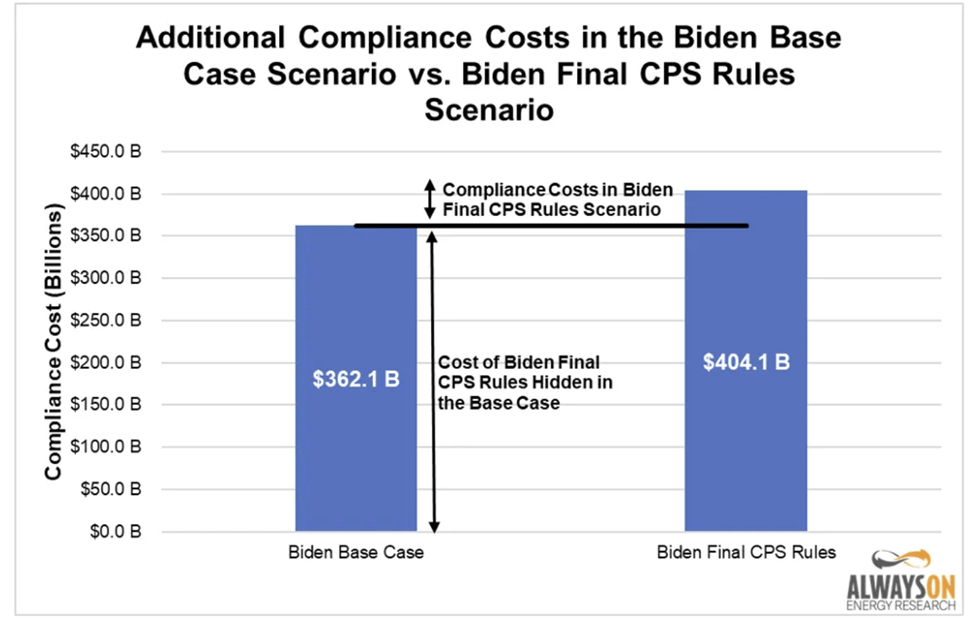
The Biden administration claimed that its final power plant wrule ould only increase costs by $19 billion over a 24-year period, spanning from 2024 through 2047, using a 2 percent discount rate. However, this modest compliance cost is entirely due to the fact that most of the expenses for the modeled MISO grid in the Biden Final CPS Rules IPM output files are incurred in the Biden Base Case.
The graph below shows the costs of building and operating the MISO grids outlined in the Biden administration’s B.S. Baseline and final regulations. Our modeling indicates that the modeled MISO grid in the Biden Baseline would cost $362.1 billion, using the subsidy phaseout timeline established in the One Big Beautiful Bill Act, and the final Biden regulations would cost $404.1 billion.
As a result, the true cost of building and operating the MISO grid under the Biden rules envisioned in Biden’s regulatory impact analysis would be $404.1 billion, but the administration would only consider $42.9 billion as compliance costs.
Ideally at this point I would prepare a similar chart describing New York’s energy cost breakdown and illustrating my point that NYSERDA is using a similar bait and switch tactic. In theory, I could emulate Mitch Rolling and prepare my own estimate of costs but that would require an enormous amount of time that I do not have for this post. The NYSERDA Pathways Analysis projects that energy system investments will total $120 billion per year out to 2040. In my opinion, that is an extraordinary claim that should be justified with transparency that identifies the choices and assumptions made to arrive at that number, including the numbers needed to make a similar chart.
Rollings and Ord concluded:
Long story short, the B.S. Baseline used by the Biden administration hid 90 percent of the costs of its regulations. Because the Biden Base Case is responsible for the vast majority of the changes observed in the modeled MISO grid in the Biden Final CPS Rules, it is responsible for driving the vast majority of the cost of the changing resource portfolio.
Therefore, it is incredibly misleading to suggest that the Final CPS Rules would be cost effective, since the 90 percent of the costs are hidden in its baseline modeling. This is called a Bait & Switch—and it’s completely B.S.
It is impossible to provide a similar breakdown of costs associated with the NYSERDA Draft Energy Plan’s claim that energy system investments will total $120 billion per year out to 2040 whatever future energy path because there insufficient documentation. I believe that full disclosure would lead to the same conclusion.
Discussion
The Energy Plan Pathways Analysis defines the “No Action” pathway scenario as “reflecting outcomes in the absence of the Climate Act and energy policies enacted from 2019 onwards”. It includes federal energy incentives and legacy New York State policies (i.e., those in place as of 2019), but it explicitly excludes any state and local climate, decarbonization, or efficiency policies put in place since 2019. NYSERDA insinuates that this represents the world without New York State driven climate action. However, as shown in my earlier post, there are many projects in the “No Action” pathway scenario that when included underestimate the cost of achieving net-zero.
For illustrative purposes, the “No Action” scenario includes the Federal electric vehicle mandate emission reduction program. Switching to electric vehicles is necessary to achieve the Climate Act emission reduction targets but the costs for this program are buried in the $120 billion annual investment because the federal mandate was in place before the law was passed. The current uncertainty of Federal electric vehicle mandates will affect the implementation ramp rate.
Conclusion
New York’s B.S. Baseline of the bait and switch tactics described in the Rollings and Orr post improperly includes “no action” projects that only exist because of the Climate Act. I believe that the majority of New Yorkers agree with me that we want to know the total cost, irrespective of which regulation requirement, of the Energy Plan projects that will be necessary to meet the net-zero and electric system mandates of the Climate Act. In my opinion, there is no question that those costs would be enormous and no question that that fact is being hidden by NYSERDA in its own B.S. Baseline.
I am a meteorologist (BS and MS degrees), was certified as a consulting meteorologist and have worked in the air quality industry for over 40 years. I author two blogs. Environmental staff in any industry have to be pragmatic balancing risks and benefits and (https://pragmaticenvironmentalistofnewyork.blog/) reflects that outlook. The second blog addresses the New York State Reforming the Energy Vision initiative (https://reformingtheenergyvisioninconvenienttruths.wordpress.com). Any of my comments on the web or posts on my blogs are my opinion only. In no way do they reflect the position of any of my past employers or any company I was associated with.
View all posts by rogercaiazza





 Pragmatic Environmentalist of New York