Balancing the risks and benefits of environmental initiatives
The challenges of achieving a 100% renewable electricity system in the United States
I am very frustrated with the New York Climate Leadership & Community Protection Act (Climate Act) net zero transition because the reality is that there are so many issues coming up with the schedule and ambition of the Climate Act that it is obvious that we need to pause implementation and figure out how best to proceed. In my opinion, the Hochul Administration failed to acknowledge that the observed problems were inevitable during the development of the Scoping Plan. This post describes an article that came out in June 2021 prior to the preparation of the Draft Scoping Plan that should have guided the development of the plan.
I am convinced that implementation of the New York Climate Leadership & Community Protection Act (Climate Act or CLCPA) net-zero mandates will do more harm than good if the future electric system relies only on wind, solar, and energy storage because of reliability and affordability risks. I have followed the Climate Act since it was first proposed, submitted comments on the Climate Act implementation plan, and have written over 550 articles about New York’s net-zero transition.
The opinions expressed in this article do not reflect the position of any of my previous employers or any other organization I have been associated with, these comments are mine alone.
Net-Zero Aspirations
The Climate Leadership & Community Protection Act (Climate Act) established a New York “Net Zero” target (85% reduction in GHG emissions and 15% offset of emissions) by 2050 and has two electric sector targets: 70% of the electricity must come from renewable energy by 2030 and all electricity must be generated by “zero-emissions” resources by 2040. The Scoping Plan that outlined how to “achieve the State’s bold clean energy and climate agenda” was based on an Integration Analysis prepared by the New York State Energy Research and Development Authority (NYSERDA). The Climate Act is not the only legislation or regulation that was promulgated to achieve reductions in greenhouse gas emissions to address climate change.
Challenges for a 100% Renewable Electricity System
The article, The challenges of achieving a 100% renewable electricity system in the United States, (Challenge Article) was authored by staff from the National Renewable Energy Laboratory, Office of Energy Efficiency and Renewable Energy, United States Department of Energy and the University of Colorado Boulder, Renewable and Sustainable Energy Institute. That means that it represented the mainstream “consensus” of Federal government renewable energy thinking at the time the New York State Energy Research & Development Authority (NYSERDA) was preparing the Scoping Plan.
The following information is the formal citation for the document.
The challenges of achieving a 100% renewable electricity system in the United States,
Paul Denholm, Douglas J. Arent, Samuel F. Baldwin, Daniel E. Bilello, Gregory L. Brinkman, Jaquelin M. Cochran, Wesley J. Cole, Bethany Frew, Vahan Gevorgian, Jenny Heeter, Bri-Mathias S. Hodge, Benjamin Kroposki, Trieu Mai, Mark J. O’Malley, Bryan Palmintier, Daniel Steinberg, Yingchen Zhang, Joule, Volume 5, Issue 6, 2021, Pages 1331-1352, ISSN 2542-4351, https://doi.org/10.1016/j.joule.2021.03.028.
Abstract:
Understanding the technical and economic challenges of achieving 100% renewable energy (RE) electric power systems is critical, given the increasing number of United States regional and state commitments toward this goal. Although no detailed study of a major utility of large interconnection under 100% RE system has been published, considerable literature explores the potential to greatly increase RE penetration. This literature, combined with real-world experience with increased RE deployment, points to two main challenges associated with achieving 100% RE across all timescales: (1) economically maintaining a balance of supply and demand and (2) designing technically reliable grids using largely inverter-based resources. The first challenge results in a highly nonlinear increase in costs as the system approaches 100% RE, in large part because of seasonal mismatches. The second challenge might require new inverter designs, depending on the mix of RE technologies. Analysis and experience to date point to no fundamental technical reasons why a 100% RE electric power system cannot be achieved, but the economic challenges indicate the need for advancements in several technologies and careful consideration of the suite of options that could be used to achieve equivalent carbon-reduction goals.
Previous work also points to the need for analytic tool development, and techno-economic feasibility analysis must also consider the host of regulatory, market, and policy issues that might limit the ability to deploy mixes of resources that are suggested by least-cost modeling exercises.
Climate Act Technology
One fundamental flaw in the Climate Act was the mistaken belief by the authors of the law, including Dr. Robert Howarth, that no new technology would be required. I have described this erroneous presumption and its impacts many times but will reference just one example.
The Challenge Article provides “a perspective on the most technically and economically challenging
aspects of achieving a 100% RE electric power system while maintaining a reliable, cost-effective balance of electricity supply and demand.” As noted in the Abstract two challenges were emphasized: the need to balance supply and demand and the engineering challenge of incorporating inverter-based resources. Both issues were discounted by the Climate Action Council.
The report concludes that:
Understanding the technical and economic challenges of achieving 100% RE electric power systems is critical, given the assumed role of these systems in achieving many regional and state commitments to reduce GHG emissions on aggressive timelines. Furthermore, these are complex, multidisciplinary challenges that cannot be solved by any individual entity but rather will require collaboration across technical research communities, academia, laboratories, and industry.
In the United States, several regions have met more than half of their load with renewables for multi-hour periods, and studies have indicated pathways to achieve cost-competitive penetrations of RE that are much greater than current levels.
Significant unanswered questions remain regarding moving toward or achieving 100% RE at a national scale for all hours of the year. There is no simple answer to how far we can increase RE penetration before costs rise dramatically or reliability becomes compromised. Studies have found no specific technical threshold at which the grid ‘‘breaks,’’ and we cannot extrapolate from previous cost analyses because of nonlinearities and unknown unknowns. Additional research is needed to evaluate the suite of technologies needed to ensure the supply of RE matches demand patterns across all time periods. Substantial engineering and design are needed to transition the grid from one that is dependent on synchronous machines to one that is based on inverters. This science, analysis, and engineering must consider the interaction of multiple low-carbon technologies to identify least-regrets pathways to decarbonizing both the electricity and energy systems in the United States and internationally.
In my opinion, these findings should have been incorporated into the Scoping Plan. The impacts of the failure to do so are evident now and will be felt for years to come if there is no pause in implementation to consider how best to proceed. While the Climate Act mandates a net-zero transition, the Public Service Commission (PSC) also has a broad mandate to “ensure access to safe, reliable utility service at just and reasonable rates.” It is not at all clear that the Climate Act “zero-emissions” electric system can meet the PSC mandate because of the issues raised in the Challenge Article.
It is Even Worse
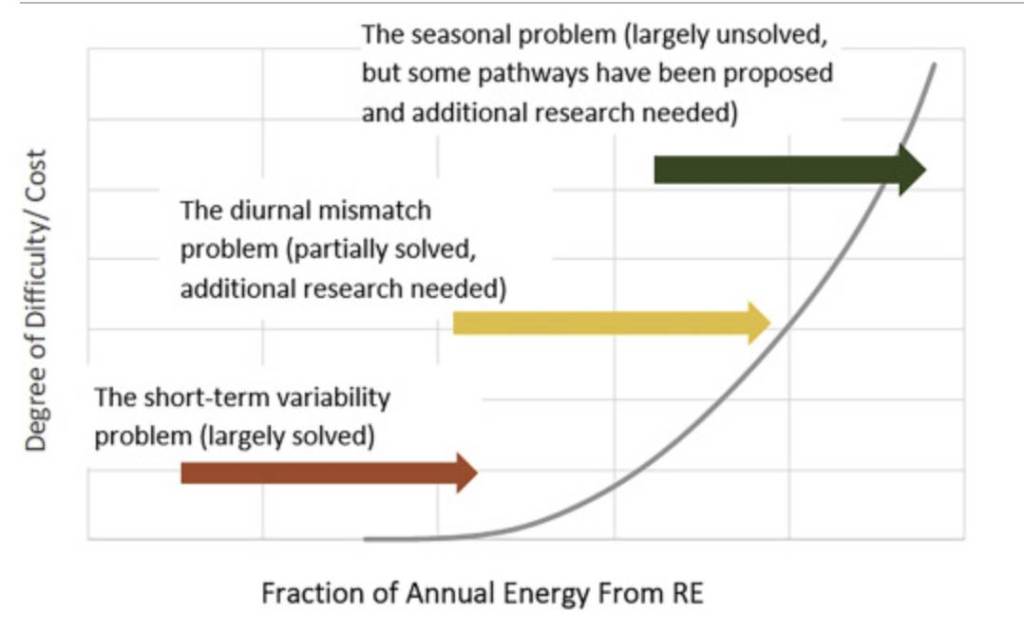
The Challenge Article emphasized engineering issues, but I think that they neglected one issue that has received much attention in New York. The Challenge Article included a section on “Exploring the balance challenge” that includes an important graph:
Figure 1 provides a framework to discuss the balance challenge, which conceptually illustrates how the expected costs and challenges might change with increasing penetration of RE. The figure loosely defines regions of annual RE penetration. As discussed in what we know about the balance challenge we know about the balance challenge from real-world re deployment, at current RE penetration levels (18% nationally in 2019), RE is cost competitive with traditional generation sources in many regions of the United States. This is caused by the utility industry cost effectively integrating these resources by addressing the hourly and sub-hourly variability of VRE and load.
Figure 1. A simple framework for discussing the degree of difficulty and cost of increased RE deployment
Beyond these levels, we reach the second zone, where studies discussed in what we think we know about the balance challenge from grid studies have explored how the diurnal mismatch problem might be cost effectively addressed with some combination of current and near-future technologies to reach annual contributions in the range of 80% RE. Beyond this point, in the third zone, the seasonal balance may require technologies that have yet to be deployed on a large scale, with highly uncertain costs and requirements.
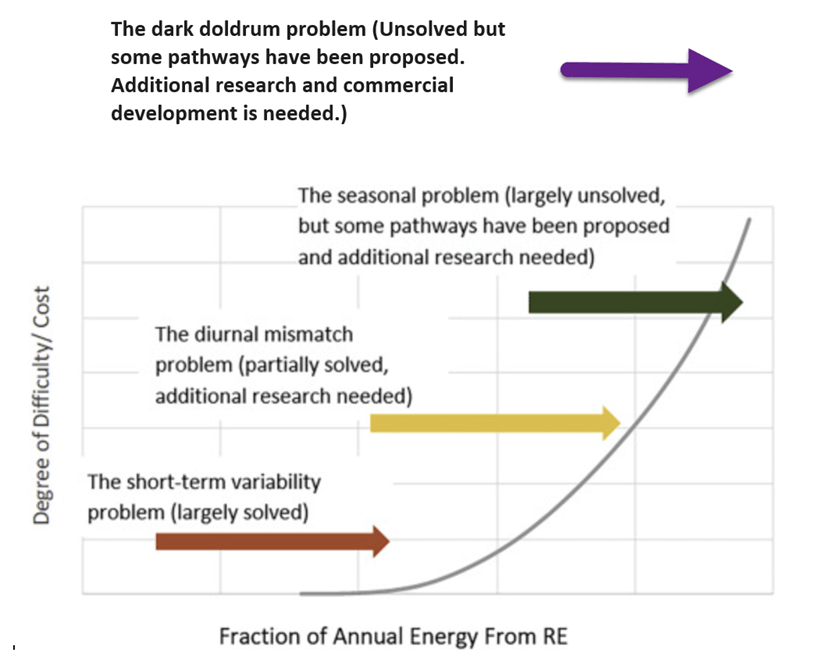
I think a fourth zone is appropriate. The Challenge Article emphasis on the engineering challenges neglects the weather challenge. Any electric system reliant on weather-dependent resources like wind and solar must address the dark doldrums, the extended periods of low wind and solar resource availability. The Scoping Plan, Integration Analysis, New York Independent System Operator (NYISO), and independent analysis by Prof. C. Lindsay Anderson, Chair of Department of Biological and Environmental Engineering Cornell all have noted that a new category of generating resources called Dispatchable Emissions-Free Resources (DEFR) is necessary to keep the lights on during these periods. This topic has received much attention at this blog because of my background as a meteorologist and is covered at my DEFR page.
I have incorporated the DEFR challenge as a fourth zone into the Figure 1 simple framework in Figure 2. I think that this problem will be more expensive and more challenging than the seasonal problem so it must be added to the figure. New York is addressing DEFR in Case 15-E-0302 – Proceeding on Motion of the Commission to Implement a Large-Scale Renewable Program and Clean Energy Standard, but progress has been slow given that there is agreement that the resource is needed but there is no state recommendation how to proceed.
Figure 2 Modified simple framework for discussing the degree of difficulty and cost of increased RE deployment
I believe the only likely viable DEFR backup technology is nuclear generation despite its costs because it is the only candidate resource that is technologically ready, can be expanded as needed, and does not suffer from limitations of the Second Law of Thermodynamics. If the only viable DEFR solution is nuclear, then the wind, solar, and energy storage approach cannot be implemented without nuclear power. Nuclear power works best as a baseload resource so using it solely as DEFR backup is inappropriate. Developing baseload nuclear eliminates the need for a huge DEFR backup resource and means that the “build as much as we can as fast as we can” wind and solar buildout currently in progress is unnecessary. When all the costs associated with the proposed Scoping Plan wind, solar, and energy storage approach are compared to an electric system based on nuclear I believe that nuclear will be cheaper especially if life expectancies are considered.
There is another argument in favor of abandoning weather-dependent resources in favor of nuclear. To ensure that there are sufficient backup resources the magnitude and duration of a dark doldrum must be determined. That is a significant challenge because of the tradeoff between the enormous costs of this necessary but infrequently used resource and the risks if insufficient electric energy is available when the de-carbonized energy system is completely electrified. This economic and safety tradeoff is not an issue in a de-carbonized system that relies on nuclear energy.
Conclusion
I want to emphasize two points. This comprehensive analysis should have been incorporated into the Scoping Plan discussions because it makes an irrefutable case that there are unsolved issues that require further research. Given that uncertainty, the Scoping Plan should have incorporated safety valves if the issues are unsolved at certain points in the transition. The second point is that the article did not address the dark doldrum DEFR problem so it underestimates the challenges of a 100% renewable system.
This is further evidence that a pause is necessary in Climate Act implementation.
I am a meteorologist (BS and MS degrees), was certified as a consulting meteorologist and have worked in the air quality industry for over 40 years. I author two blogs. Environmental staff in any industry have to be pragmatic balancing risks and benefits and (https://pragmaticenvironmentalistofnewyork.blog/) reflects that outlook. The second blog addresses the New York State Reforming the Energy Vision initiative (https://reformingtheenergyvisioninconvenienttruths.wordpress.com). Any of my comments on the web or posts on my blogs are my opinion only. In no way do they reflect the position of any of my past employers or any company I was associated with.
View all posts by rogercaiazza
One thought on “The challenges of achieving a 100% renewable electricity system in the United States”
The “Challenge Article” appears to “gloss over” the issue of storage in a 100% RE grid. Short-duration storage is commercially available but extremely expensive. Intermediate-duration storage (longer than 4 hours) is not commercially available. Long-duration storage (seasonal) is also not commercially available. Arguably, intermediate-duration and long-duration storage are currently undefined, as is the magnitude of each which would be required by a reliable 100% RE grid.
The 100% RE grid suffers from limited known knowns, numerous known unknowns and an unknown number of unknown unknowns. NY has chosen to assume that the required technology will magically appear in time to meet its aggressive transition schedule.



 Pragmatic Environmentalist of New York
The “Challenge Article” appears to “gloss over” the issue of storage in a 100% RE grid. Short-duration storage is commercially available but extremely expensive. Intermediate-duration storage (longer than 4 hours) is not commercially available. Long-duration storage (seasonal) is also not commercially available. Arguably, intermediate-duration and long-duration storage are currently undefined, as is the magnitude of each which would be required by a reliable 100% RE grid.
The 100% RE grid suffers from limited known knowns, numerous known unknowns and an unknown number of unknown unknowns. NY has chosen to assume that the required technology will magically appear in time to meet its aggressive transition schedule.
Hope springs eternal, but hope is not a strategy.
LikeLike